

Best Neighborhoods for Concert Nights in NYC
Where to stay, eat, and base your night — organized by venue, vibe, and the kind of concert evening you actually want.
The best neighborhood for a concert night in NYC is not always the one closest to the venue on a map. Sometimes the right plan is dinner near the arena. Sometimes staying near the hotel and taking transit is smarter. Sometimes the venue is the destination, and the neighborhood only needs to help with arrival and exit. NYC’s concert venues are spread across Manhattan, Brooklyn, Queens, Long Island, and New Jersey — and each one has a different neighborhood logic that shapes what the whole evening looks and feels like.
A great MSG concert night is not planned like a Brooklyn Bowl night. A Radio City date night is not the same as a MetLife stadium show. A Beacon Theatre evening has a different energy and neighborhood pull than a Kings Theatre destination concert. This guide helps you match the venue, the neighborhood, the transit, and the dinner to the kind of night you actually want to have.
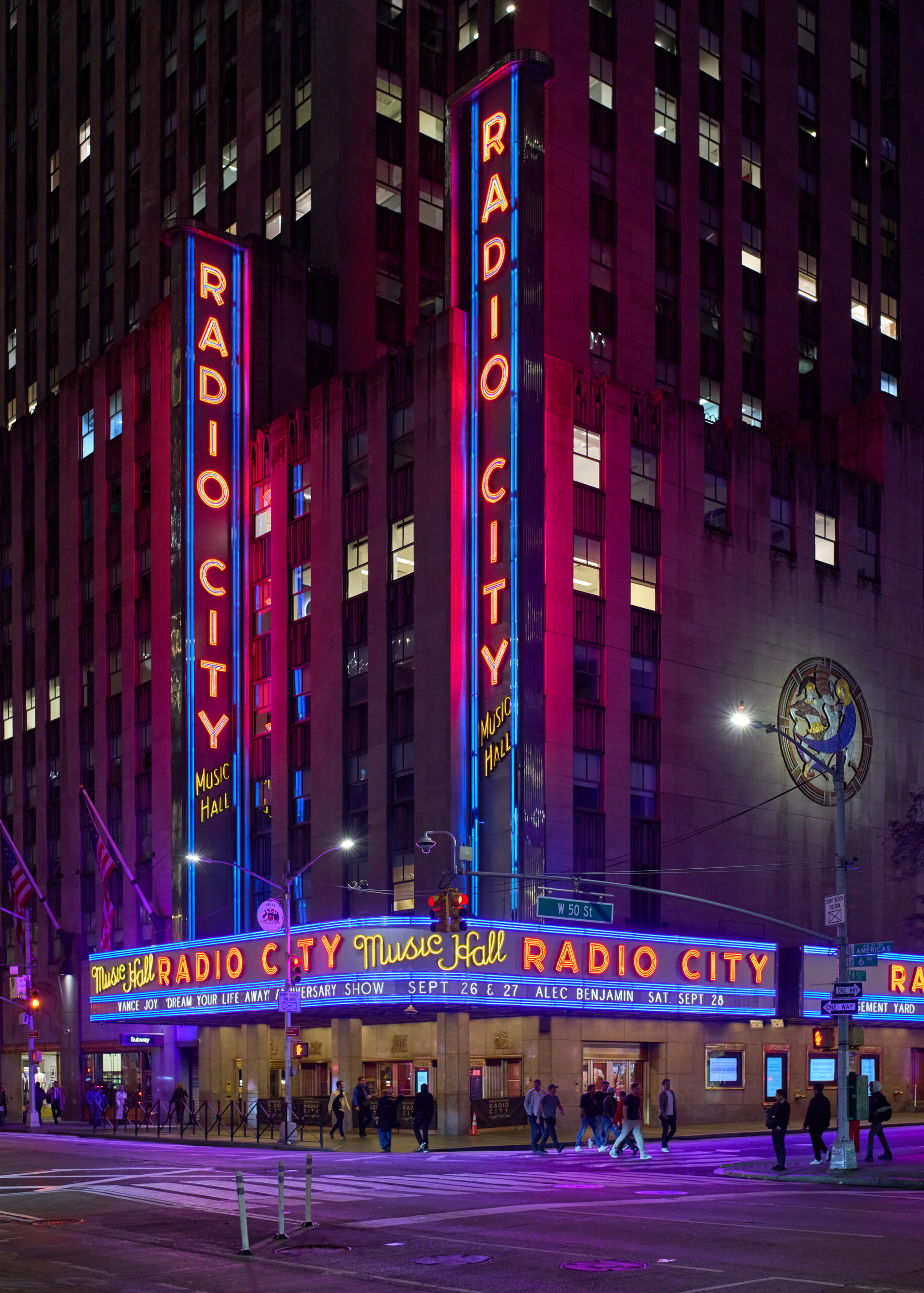
The best NYC concert neighborhood is not always just the closest area on a map — it is the place where the venue, dinner plan, hotel base, transit route, and post-show exit all work together. Photo: Frank Schulenburg, via Wikimedia Commons, CC BY-SA 4.0.
Quick Answer — Best Neighborhoods by Type of Concert Night
Midtown West / Koreatown / Penn Station. The most connected concert venue in the city — hotels, trains, restaurants, and the arena all meet at Penn Station.
Rockefeller Center / Bryant Park / Theater District edge. Polished, easy, and strong for date nights, families, and hotel-based visitors who want a refined Midtown experience.
Upper West Side / Columbus Circle. Calmer and more grown-up — best for elegant concert nights, classical, jazz, singer-songwriter, and visitors who want to skip Times Square.
Downtown Brooklyn / Fort Greene. A true Brooklyn neighborhood night — the venue sits inside a real dining and transit district, not a generic arena zone.
Williamsburg / North Brooklyn. Best when the whole evening is the point — drinks, dinner, music, and the neighborhood all feeding each other rather than just the venue.
Forest Hills / Queens. One of the most distinctive concert-night neighborhoods in NYC — a real residential neighborhood, not an arena district. Best for summer concerts with planning.
Logistics-first, not neighborhood-first. Great concerts, but the night is built around transit, parking, timing, and exit strategy — not walkable dining districts.
Midtown West, Bryant Park, or Times Square edge. Covers MSG, Radio City, Carnegie Hall, and easy transit to Barclays, Beacon, and Brooklyn venues from one base.
How to Choose the Right Concert Neighborhood
Before choosing a neighborhood, the questions that shape the decision are worth working through. The wrong answers to these lead to a night that feels like logistics rather than a concert.
Do not choose a neighborhood only because it is closest to the venue on a map. Choose it because it fits the transit plan, the dinner, the hotel, and how you want the night to end. “Near the venue” is one factor. It rarely should be the only one — and sometimes it should not even be the first one.
The questions worth answering before deciding: Are you staying overnight or coming just for the show? Is the venue in Manhattan, Brooklyn, Queens, New Jersey, or Long Island? What transit are you using — subway, LIRR, NJ Transit, Metro-North, rideshare, or driving? Is this a date night, group night, family night, or serious music fan night? Do you want dinner before, drinks after, or both? Does the venue sit in a real dining neighborhood? Will the show end late? Does the area work after the concert, or mainly before it?
The answers shape the neighborhood. That neighborhood shapes the evening.
Madison Square Garden sits directly on top of Penn Station — the most transit-connected sports and concert venue in the country. For visitors staying anywhere near Midtown West, Times Square, or Bryant Park, an MSG concert night is the most logistically forgiving major-concert plan in New York. You eat in Koreatown or Midtown West, walk to the arena, and take the train home. No rideshare. No parking. No last-mile scramble.
Koreatown on West 32nd Street remains one of the strongest nearby dining zones in New York — genuinely late kitchens, group-friendly formats, and a short walk from the arena. Midtown West adds hotel bars, izakaya, and sit-down options across every price range. The downside is the event-night density: Penn Station platforms and 7th/8th Avenue sidewalks before and after major shows can be very crowded. Have a restaurant reservation before the show rather than deciding after you exit.
Radio City Music Hall at 50th and Sixth Avenue sits in a polished, well-connected stretch of Midtown that works naturally for a refined concert night. The Rockefeller Center area to the north, Bryant Park and Midtown South to the south, and the Theater District edge to the west all extend the dining and hotel radius in different directions depending on your hotel and your appetite for the evening.
This is one of the easier Manhattan concert neighborhoods for visitors — the area is not as chaotic as Times Square, has strong restaurant and hotel density, and connects easily to most major Midtown transit lines. For Radio City date nights, family shows, holiday events, and the classic polished Manhattan concert experience, this zone delivers without requiring a complicated plan. Gabriel Kreuther at Bryant Park is the benchmark upscale option for a Radio City special-occasion dinner if the show ends early enough to allow it.
The Upper West Side and Columbus Circle work best for concertgoers who want a more grown-up, calmer concert night — one where dinner matters as much as the show and the neighborhood feels like a destination rather than a transit corridor. Beacon Theatre, Lincoln Center, and Carnegie Hall all anchor this zone, which is consistently underestimated by visitors defaulting to Midtown hotels.
For classical, jazz, singer-songwriter, comedy, and seated theater concerts, the Upper West Side has the right energy — neighborhood restaurants on Columbus and Amsterdam Avenues, hotel options near Central Park West, and the ability to end the night with a quiet post-show drink rather than a Midtown taxi scramble. Visitors who want to avoid Times Square energy without sacrificing Manhattan quality consistently find this area works better than expected for concert-trip hotel planning.
Downtown Brooklyn and Fort Greene are the strongest concert-night neighborhoods outside Manhattan — and the reason is that Barclays Center sits inside a real Brooklyn neighborhood rather than an isolated arena district. Atlantic Terminal makes transit easier than many first-timers expect: subway, LIRR, and multiple bus lines converge right at the venue. The dining radius extends into Fort Greene, Boerum Hill, and the blocks surrounding Fulton Street, giving you a range of pre-concert dinner options that a stadium-zone neighborhood cannot match.
Brooklyn Paramount adds another major music venue to the area, deepening the case for basing a concert trip in Downtown Brooklyn rather than Midtown. For visitors who want a Brooklyn concert night with easy transit, good dining, and hotels that put you in a real neighborhood rather than a Midtown hotel corridor, this zone is worth seriously considering over Midtown default planning.
Williamsburg is one of the strongest concert-night neighborhoods in NYC precisely because it is not just about the venue — the whole neighborhood is part of the evening. Brooklyn Bowl has its own bowling, food, and drink program built into the concert experience; Brooklyn Steel is a more focused music venue with surrounding Williamsburg dining and bar options. Both sit in a neighborhood that has genuine late-night energy, strong dining on Bedford Avenue and surrounding blocks, and the ability to sustain a full night before and after the show.
For indie, rock, electronic, alternative, and nightlife-forward concerts, Williamsburg consistently delivers a night that feels more like a neighborhood experience than an arena visit. The strongest advice for this zone: plan your return to Manhattan before the show rather than after. Late-night transit from Williamsburg back to Manhattan is available but rideshare surge after major shows can be significant. Knowing which subway option or rideshare window works for you before the show ends makes the end of the night much smoother.
Terminal 5 sits far enough west on West 56th Street that the neighborhood strategy matters in a way it does not for a centrally located venue like Radio City or MSG. Hell’s Kitchen and far West Midtown give you the most useful pre-show dinner radius — strong restaurants within walking distance of the venue, and hotel options near Columbus Circle, Hudson Yards, and Hell’s Kitchen proper that keep the transit footprint simple.
The most common mistake at Terminal 5 is underestimating how far west it feels from Midtown’s main transit spine. The subway is not immediately adjacent in the way Penn Station is for MSG. Visitors who stay in the mid-30s or eastern Midtown and plan to walk over will cover more ground than they expected. Building the night around the venue’s west-side position — rather than treating it like a centrally located Midtown venue — makes the logistics much more manageable.
Kings Theatre is a destination venue in Flatbush, Brooklyn — not a generic arena, and not a downtown Brooklyn extension of the Barclays zone. The theater itself is architecturally extraordinary, a restored movie palace from 1929 that is worth seeing as a room as much as for what is happening on stage. A Kings Theatre night has a different feel from any other concert night in the metro area: more neighborhood-specific, more intentional, and more distinctive for it.
Flatbush is a real Brooklyn neighborhood rather than an entertainment district, which means the dining and logistics require specific planning rather than assuming density on every corner. Visitors who plan intentionally — a specific pre-show restaurant, a transit plan, and a post-show route — consistently have a more interesting concert night than a Midtown show would deliver. Those who do not plan accordingly find the logistics harder than expected.
Forest Hills Stadium is one of the most distinctive outdoor concert venues in New York — an intimate stadium tucked into a residential Queens neighborhood that feels nothing like a Midtown arena night. The neighborhood itself has dining on Austin Street, transit via the E, F, and M trains and the LIRR Forest Hills station, and the kind of pre-show neighborhood walk that an arena district cannot replicate. It is one of the few NYC concert venues where the neighborhood around it is genuinely part of the experience rather than incidental to it.
Forest Hills is best planned around intentional pre-show dining — Austin Street has a range of options close to the stadium — and a clear transit or parking plan. Because it is an outdoor venue, weather matters in a way it does not for indoor venues, and the post-show crowd dispersal onto the E/F/M trains can be heavy after major shows. Having a specific restaurant and a clear exit plan makes the difference between a frustrating evening and one of the best summer concert experiences NYC offers.
Stadium concert nights require a different kind of neighborhood thinking. MetLife in East Rutherford, UBS Arena in Elmont, and Yankee Stadium in the Bronx all deliver major concert experiences — but none of them sits inside the kind of walkable dining-and-hotel neighborhood that MSG or Barclays Center provides. The neighborhood decision for these venues is really a logistics decision: how are you getting there, where are you eating (before and at which point on your transit route), and what is the exit strategy.
MetLife is the most logistics-intensive of the three — driving and parking, NJ Transit with the Meadowlands connection, or hotel-based planning near East Rutherford or Secaucus. UBS Arena benefits from the LIRR’s direct Elmont-UBS Arena station but the surrounding area is still developing as a dining neighborhood. Yankee Stadium concerts connect more naturally to the Bronx transit network, but the restaurant density around the stadium is not the same as in Midtown. For all three, the strongest post-show plan is often eating near the hotel after returning rather than trying to eat near the venue.
Best Concert Neighborhoods by Visitor Type
Midtown West / MSG for the easiest major-venue plan, Radio City / Bryant Park for a classic Midtown experience, or Barclays / Downtown Brooklyn for a Brooklyn night with easy transit. All three handle first-timers well.
Radio City / Bryant Park for a polished Midtown evening. Beacon / Upper West Side for elegant and calm. Barclays / Fort Greene for a Brooklyn dinner-plus-show. Forest Hills for a distinctive summer outdoor night. MSG / Koreatown for when the food is as important as the show.
Radio City and Beacon are the strongest family concert venues — strong transit, calmer neighborhoods, and more manageable post-show exits. Forest Hills works for outdoor summer shows with planning. UBS Arena with advance logistics for Islanders-market family concerts.
Williamsburg for Brooklyn Bowl and Brooklyn Steel. Beacon Theatre for serious artist residencies. Carnegie Hall and Lincoln Center for classical and jazz. Forest Hills for outdoor authenticity. Kings Theatre for the experience of a fully restored concert palace.
Koreatown for MSG, Bryant Park / Midtown South for Radio City, Downtown Brooklyn for Barclays, Williamsburg for Brooklyn venues, Forest Hills for the stadium, Upper West Side for Beacon and Lincoln Center. These are the areas with the strongest pre-concert dining density relative to the venue.
Midtown West and Bryant Park cover MSG, Radio City, Carnegie Hall, and easy subway access to Barclays and Beacon. Downtown Brooklyn is increasingly strong for Barclays and Brooklyn Paramount trips. Upper West Side for Beacon, Lincoln Center, and Carnegie. See the hotels near NYC concert venues guide for specifics.
MSG / Penn Station is the most connected concert transit hub in the city. Barclays / Atlantic Terminal is excellent. Radio City has strong Midtown subway access. Forest Hills has E/F/M and LIRR. MetLife, UBS Arena, and Kings Theatre all require more deliberate transit planning.
UBS Arena and MetLife are the most driver-friendly major venues in the metro area. Forest Hills and Kings Theatre can work with a specific parking plan. Avoid driving to MSG, Radio City, or Barclays unless you have a specific pre-booked garage — Midtown and Downtown Brooklyn parking is expensive, limited, and post-show exit is difficult.
Sample Concert Night Plans
Dinner in Koreatown or Midtown West → walk to MSG → post-show drink or direct train from Penn Station. Reserve dinner before the show. The most frictionless major concert date plan in the city.
Early dinner near Bryant Park or Rockefeller Center → Radio City → hotel bar or post-show dessert. Best for an earlier start time — do not try a tasting menu before a Radio City show with a hard curtain.
Dinner in Fort Greene or Downtown Brooklyn → Barclays Center → drinks nearby or subway home. A real Brooklyn concert night rather than a transit-in, transit-out arena visit.
Dinner and drinks in Williamsburg → Brooklyn Bowl or Brooklyn Steel → late drink nearby → planned subway or rideshare home. Plan the return to Manhattan before the show ends, not after.
Early dinner in Forest Hills → stadium concert → subway or LIRR exit with a backup plan. An outdoor venue with genuine neighborhood character — plan for weather and verify post-show transit timing.
Dinner on the Upper West Side → Beacon Theatre → quiet post-show drink or walk back to hotel. The right kind of evening for calmer, grown-up concerts where the neighborhood is as much the point as the show.
Eat early, tailgate, or pre-plan food → concert → pre-planned parking or transit exit → food near hotel after returning. The post-show food plan should happen after you get back, not at the stadium gates.
Common Concert Night Neighborhood Mistakes
Choosing a hotel only because it is closest to the venue. Proximity matters, but the neighborhood around it matters more. A hotel two stops away in a better neighborhood is often a better concert base than one a block from an arena with nothing useful around it.
Assuming all NYC concert venues are in Manhattan. Barclays, Brooklyn Bowl, Brooklyn Steel, Kings Theatre, and Forest Hills are all compelling concert nights — and they require Brooklyn or Queens neighborhood thinking, not Manhattan defaults.
Treating MetLife or UBS Arena like MSG. They are completely different planning situations. MSG is on top of Penn Station inside a dense restaurant and hotel zone. MetLife is a stadium in New Jersey. UBS Arena is a newer arena in Elmont. Both require advance logistics, not assumptions borrowed from Midtown planning.
Eating too far from the venue with a hard show start. Concert start times are often more flexible than Broadway curtains — but not always. An opener that goes long or a headliner that starts early can catch you mid-dinner. Know your headliner timing before you book.
Waiting until after the concert to find food. Post-show kitchen hours at most NYC venues are tighter than they look. The post-show restaurants guide covers what actually works late by neighborhood. Have a plan before the show ends.
Defaulting to Times Square when Bryant Park or Midtown West would serve the night better. Times Square is convenient by reputation, but Bryant Park, Midtown West, and Hell’s Kitchen all offer better dining, less tourist chaos, and comparable transit for most concert venues.
Ignoring post-show rideshare surge. After major MSG, Barclays, and MetLife shows, rideshare prices spike and wait times extend. The venues with the best transit access — MSG at Penn Station, Barclays at Atlantic Terminal — reward using it rather than waiting for a car.
Driving to Midtown or Downtown Brooklyn without a parking plan. Avoid driving to MSG or Barclays unless you have a specific pre-booked garage. The stadium venues — MetLife, UBS Arena — are where driving is actually practical.
Frequently Asked Questions
Midtown West and Koreatown are the strongest overall for MSG concerts — the most transit-connected major concert venue in the country, with strong pre-show dining and hotel options. Downtown Brooklyn is the best for Barclays Center. The right answer depends on which venue you are attending. The best concert venues guide helps narrow the choice from the venue side.
Midtown West and Bryant Park are the most versatile hotel zones — they cover MSG, Radio City, and Carnegie Hall, with easy subway access to Barclays and Beacon. For Barclays and Brooklyn Paramount trips, Downtown Brooklyn hotels are an increasingly strong option. For Beacon Theatre and Lincoln Center, the Upper West Side works well. See the hotels near NYC concert venues guide for specifics by venue.
Midtown West and Koreatown. MSG sits directly on Penn Station, which makes it the most connected major concert venue for visitors using the subway, NJ Transit, LIRR, Amtrak, or Metro-North. Koreatown on West 32nd Street is the strongest late-night dining zone within walking distance.
Yes — it is one of the best concert-night neighborhoods in the metro area precisely because Barclays sits inside a real Brooklyn dining and transit zone. Fort Greene, Boerum Hill, and Downtown Brooklyn all provide pre-show dining options within walking distance, and Atlantic Terminal makes subway and LIRR planning easier than many visitors expect.
Yes — especially for Brooklyn Bowl, Brooklyn Steel, and indie or nightlife-forward shows. Williamsburg is one of the few concert neighborhoods where the area itself is as much the point as the venue. The key is planning the return to Manhattan before the show ends rather than trying to figure out transit after a late show.
The Rockefeller Center area, Bryant Park, and the Theater District edge are the natural zones for Radio City. The venue at 50th and Sixth is between these two zones, so both work depending on your hotel location. Bryant Park / Midtown South tends to be calmer and less chaotic than the Times Square edge for a Radio City dinner plan.
Very much so — for the right kind of concert. Beacon Theatre, Lincoln Center, and Carnegie Hall all anchor the Upper West Side concert scene, and the neighborhood delivers a calmer, more grown-up evening than Midtown. The strongest case for the Upper West Side is a concert where the dinner, the walk, and the neighborhood feel are as important as the show itself.
Near the venue usually makes more sense before a concert — it removes transit from the equation and lets you walk straight to the show. Near the hotel makes more sense after the show, especially when you are at a stadium or outer-borough venue where post-show restaurant options are limited. The exception: if your hotel is in a neighborhood with better dining than the venue area, eat there and transit in.
MSG / Midtown West is the easiest for most tourists — the venue, hotels, transit, and restaurants all converge in one area, and Penn Station handles almost every transit option in the metro area. Radio City / Rockefeller Center is the second-easiest, with slightly lower crowd intensity than the MSG Penn Station zone.
Radio City / Bryant Park for a polished Midtown evening. Beacon Theatre / Upper West Side for an elegant and calm concert night. Barclays / Fort Greene for a more neighborhood-feeling Brooklyn date. Forest Hills Stadium for a distinctive outdoor summer show. MSG / Koreatown for a date where the dinner and the show both matter. The best concerts for date night guide covers the full range.
Pick the Neighborhood, Not Just the Venue
A great NYC concert night is not just about the ticket or the sound system. It is the neighborhood, the dinner plan, the hotel base, the subway route, the post-show option, and the exit strategy all working together. The venues that sit inside real neighborhoods — MSG, Barclays, Beacon, Williamsburg, Forest Hills — reward planning. The ones that are stadium-first — MetLife, UBS Arena — reward logistics. Both can be great nights. The difference is knowing which kind of evening you are building before you start.
The full NYC concerts guide, the concert venue hub, and the concert resources all support choosing the show. This guide helps with everything that surrounds it.
The Best Concert Night Starts With the Right Neighborhood
A great NYC concert night is not just the venue. It is the dinner, hotel base, subway line, post-show drink, parking decision, rideshare corner, and neighborhood energy all working together before the lights go down.
NYC Concert Venue Guides
Use the venue hub to compare room layout, seating, arrival logistics, neighborhood fit, and what kind of night each space creates.
Open Venue Hub Hotel StrategyHotels Near NYC Concert Venues
Pick the hotel zone that supports the concert night — Midtown for flexibility, Brooklyn for Barclays, UWS for Beacon, LIC/Queens when useful.
Plan the StayCore Concert Planning Hubs
Concerts · Venues · Night OutNYC Concerts Hub
Concert planning, venues, seating, hotels, restaurants, transportation, date nights, ticket timing, and resources.
NYC Concert Venue Guides
MSG, Radio City, Barclays, Beacon, Brooklyn Bowl, Brooklyn Steel, Forest Hills, MetLife, UBS, and more.
Concert Resources
Ticket timing, date-night concerts, last-minute strategy, venue choices, and practical planning help.
NYC Neighborhood Guides
Compare the neighborhoods that shape Broadway, concert, sports, hotel, restaurant, and full night-out trips.
NYC Night Out Hub
Restaurants, hotels, transportation, neighborhoods, Broadway, concerts, sports, and full-evening planning.
NYC Transportation Guides
Subway, rail, rideshare, parking, walking, venue arrivals, and post-show return strategy.
Best Neighborhoods by Concert Zone
MSG · Radio City · Beacon · BarclaysMidtown West
The strongest MSG zone: Penn Station, hotels, walkable arena access, Koreatown nearby, and easy rail exits.
Koreatown
The MSG dinner weapon: group-friendly, late-night, close to Penn Station, and built for food-before-show planning.
Bryant Park / Midtown South
Polished, central, calmer than Times Square, and excellent for Radio City, Midtown hotels, and refined concert nights.
Upper West Side
Best for Beacon, Lincoln Center, Carnegie, classical, jazz, singer-songwriter, and calmer date-night concert planning.
Downtown Brooklyn
The strongest Brooklyn arena base: Barclays, Brooklyn Paramount, Atlantic Terminal, Fort Greene, and real neighborhood dining.
Forest Hills
Outdoor summer shows with real neighborhood character, Austin Street dinner, subway/LIRR access, and weather-aware planning.
Venue Clusters to Keep Visitors Moving
Venue · Seating · SupportMadison Square Garden
Concert guide for the city’s easiest major concert zone: Penn Station, Midtown West, Koreatown, hotels, and transit.
Radio City Music Hall
Polished Midtown concerts, date nights, family shows, Rockefeller Center, Bryant Park, and hotel-based visitors.
Beacon Theatre
Upper West Side concerts with calmer restaurants, neighborhood hotels, seated shows, and grown-up post-show plans.
Barclays Center
Brooklyn arena concerts with Atlantic Terminal transit, Downtown Brooklyn hotels, Fort Greene dinner, and easy subway links.
Brooklyn Paramount
Downtown Brooklyn’s theater-scale concert room, pairing naturally with Barclays-area hotels and restaurants.
Forest Hills Stadium
Distinctive Queens summer concerts with neighborhood dinner, open-air weather planning, subway/LIRR, and post-show crowd flow.
Brooklyn, Queens & Stadium-Scale Nights
Williamsburg · Flatbush · MetLife · UBSWilliamsburg
The full neighborhood-night concert base for Brooklyn Bowl, Brooklyn Steel, dinner, drinks, nightlife, and late return planning.
Brooklyn Bowl
Bowling, food, drinks, live music, and one of the most complete built-in concert-night experiences in Brooklyn.
Brooklyn Steel
Williamsburg / East Williamsburg concert planning where the show, transit, dinner, and late-night return all need a plan.
Kings Theatre
A destination Brooklyn concert palace where food, transit, and post-show routes should be planned before the night starts.
MetLife Stadium
Major stadium tours where neighborhood planning really means parking, NJ Transit, tailgating, timing, and the exit wave.
UBS Arena
LIRR-first Elmont concert planning, useful for major tours where the venue is great but the neighborhood logic is logistics-first.
Hotels, Restaurants & Transportation
Support ClusterHotels Near NYC Concert Venues
Choose the base that works for multiple venues instead of overvaluing one block of proximity.
Where to Stay for Concert Nights
Midtown, Brooklyn, Queens, UWS, and venue-specific hotel logic for visitors building trips around live music.
Where to Eat Before a Concert
Match dinner to the venue zone: Koreatown for MSG, Bryant Park for Radio City, Fort Greene for Barclays, and more.
Best Post-Show Restaurants
Late-night restaurant logic by neighborhood, because post-show kitchens are never something to guess at.
How to Get to NYC Concert Venues
Subway, rail, rideshare, walking, driving, parking, and arrival plans across the major concert venue map.
Parking Near NYC Concert Venues
Where driving works, where it does not, and when a pre-booked garage matters more than proximity.
Use This Guide While Reading
On-Page JumpsQuick Guide
Fast neighborhood picks by venue type, including MSG, Radio City, Barclays, Williamsburg, Forest Hills, and stadiums.
Midtown West & Koreatown
The easiest major concert-night zone in NYC, especially for rail travelers, hotels, and pre-show dinner.
Barclays / Brooklyn Paramount
Downtown Brooklyn, Fort Greene, Atlantic Terminal, and Brooklyn concert-night dining logic.
By Visitor Type
First-timers, date nights, families, serious music fans, food-first visitors, hotel planners, transit users, and drivers.
Logistics-First Shows
MetLife, UBS Arena, Yankee Stadium concerts, major tours, parking, rail, rideshare, and exit planning.
Concert Neighborhood FAQ
Quick answers for where to stay, where to eat, date nights, first-timers, and venue-area tradeoffs.
Ticket Timing & Date-Night Planning
ResourcesBest Concerts for Date Night in NYC
Use this when neighborhood mood matters as much as the show: Radio City, Beacon, Barclays, Forest Hills, and more.
When to Buy Concert Tickets
Ticket timing strategy that pairs naturally with choosing the right venue, neighborhood, hotel, and dinner plan.
Last-Minute Concert Tickets
Useful when the ticket is late, but the neighborhood, dinner, transit, and post-show plan still need to work.