

Barclays Center Seating Chart — Concert Seating Guide & Venue Overview
Section-by-section advice on where to sit for concerts, what the floor is really like, which areas to avoid, and how to plan the full night.
Barclays Center opened in Brooklyn in 2012 and was designed from the ground up to handle both basketball and large-scale concerts — which shows in how the seating works. Unlike older arenas that were built for sports and retrofitted for shows, Barclays was conceived with the concert configuration in mind, and the bowl geometry reflects that. The result is a room where most seats work reasonably well, where the 200-level upper bowl is steeper and closer than it looks, and where the main variables that actually affect your experience are floor position, proximity to the stage, and which configuration your specific show uses.
This guide covers all of that with honest section-by-section analysis — not a sales pitch for any particular zone, but a genuine breakdown of what each area of Barclays Center is like for a concert and who each part of the arena suits best.
Whether you’re looking at a Barclays seating chart for the first time or comparing it against a Barclays concert seating chart from a specific tour, the underlying bowl geometry described below stays the same — only the stage position and floor configuration change from show to show.
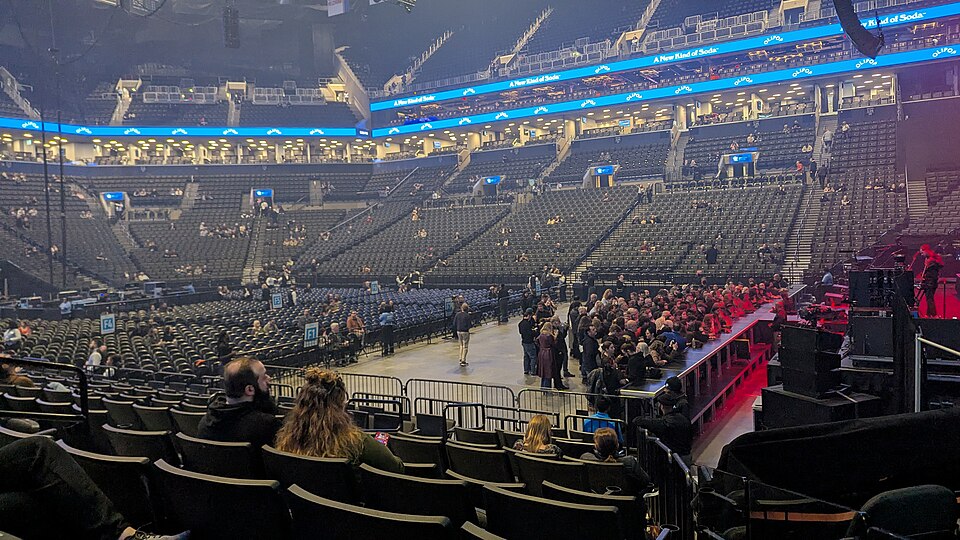
Inside Barclays Center in Brooklyn, showing the arena bowl and seating environment that shapes how floor, lower-level, and upper-level concert sections feel in practice.
The Venue at a Glance
Barclays was built to do both things well, and it largely succeeds. The bowl is tighter than most arenas of this capacity, the 200-level pitch is steep enough to keep sightlines strong even from the back rows, and the suite level between the lower and upper bowl means the 200s don’t feel as disconnected from the floor as they do at older venues. Acoustics are solid throughout the lower bowl and floor. The 200-level corner sections are better than they look on a flat seating chart — the curve of the bowl actually brings them closer to center than you’d expect.
You’ll find this layout referenced under a few different names — Barclays arena seating chart, Barclays stadium seating chart, barclay stadium seating, barclay arena seating, Barclays center arena map, or a plain Barclays seat map — since search engines don’t always distinguish between “arena” and “stadium” language for a venue that hosts both sports and concerts. Barclays center seating charts, seating capacity barclays center, barclays seating capacity, and barclay center seating capacity all point back to the same ~19,000-seat figure noted above. All of these terms point to the same three-zone bowl described on this page.
Barclays Center Seating Guide — Section by Section
The three main areas for concerts at Barclays are the floor, the lower bowl (sections 1–31), and the upper 200-level (sections 201–231) — this is the barclays center seating view and barclays center layout in short form. Here is an honest breakdown of each zone and what it actually delivers. Ask ten fans what are good seats at Barclays Center or the best seats for concert at Barclays Center and most will point to the same two zones — floor center and lower bowl center — though best seats Barclays Center concert questions get more specific once GA floor configurations enter the picture. However you phrase the search — barclays seating view, barclays center seating chart view, or barclays center seating concert — the answer below covers the same three zones.
Dead center of the floor for end-stage shows. Section 2 is closest (rows 1–15), section 5 is mid-floor. The best combination of proximity and center alignment. For any show where being close and centered matters, this is the target.
Directly facing the stage from elevated fixed seating. Strong sightlines, no flat-floor visibility issues, full production view. Sections 9–11 are stage-left center, 23–25 are stage-right center. Front rows of either zone are the sweet spot — excellent sightlines at a fraction of floor pricing.
Closest to the stage on the floor. Section 1 and 3 are stage-adjacent but slightly off-center; section 2 is center. Rows 1–5 of any floor section give you aisle separation from the section in front, which helps visibility on a standing-room floor. The energy here is high.
The best upper-bowl sections face the stage directly. The 200-level pitch at Barclays is steeper than it looks on the chart, which is a feature — even rows 10–15 have clear sightlines. Front rows of center 200s give you the full production picture in a way floor seats often can’t. Good value for visually ambitious shows.
These look angled on the chart and many buyers skip them — which is a mistake. The curved bowl design at Barclays means the corner 200s face much closer to center stage than the chart suggests. Good value sections that routinely outperform their price. Look at the specific rows before dismissing these.
The back of the floor for a standard end-stage show. Section 8 is often replaced by the soundboard mixing position, which eliminates it entirely. Sections 7 and 9 put you at the furthest floor point from the stage — elevated lower bowl seats at this distance are a better choice for nearly the same price.
The gap between the lower bowl (sections 1–31) and the 200-level is much smaller at Barclays than at older arenas, because the suite level fills the space between them and forces the 200s to start at a higher pitch. The practical result: front rows of the 200-level center sections feel closer than comparable seats at MSG or United Center. If you’re working with a budget, front-center 200s at Barclays consistently outperform their price. The floor and lower bowl center sections are better, but the gap is smaller than you’d expect.
Checking the View From Your Seat
The section descriptions above tell you where each zone sits relative to the stage, but the fastest way to settle any doubt is to search “Barclays Center view from my seat” for the exact section and row on your ticket before you buy. This matters most for the corner zones — 200-level sections 203–209 and 225–231, and lower bowl sections 3–6 and 26–29 — where the seating chart alone makes the angle look worse than it plays in person. A quick view-from-my-seat check on any major ticketing platform will confirm whether a specific row clears the row in front of it, which the chart itself can’t show you.
Some searches phrase this differently — “Barclays view from my seat,” or narrowed to a specific event as “view from my seat Barclays Center concert” — and autocomplete throws up noisier variants too, like “Barclays Center a view from my seat,” “view Barclays Center seats,” or the typo’d “view from Barclay center seats.” All of them pull the same tool. If you’re checking a floor ticket specifically, search “Barclays Center concert view from my seat” rather than the general venue term, since the floor doesn’t exist in the basketball configuration.
If you’re working from a Barclays center stadium map, a plain Barclays stadium map, a Barclays concert map, or a printed Barclays center seating arrangement handed out at will-call, the section numbers match what’s described above — the venue doesn’t renumber sections depending on the document you’re holding.
The Floor — What It’s Actually Like
The Barclays floor for end-stage concerts — barclays center floor seats, in the barclays center floor seating chart sense — is divided into nine sections (1–9) running from the stage toward the back of the arena. Sections 1–3 are closest to the stage, sections 4–6 cover the middle of the floor, and sections 7–9 run to the back. Section 8, directly behind the soundboard position, is frequently removed entirely from concert configurations — leaving sections 7 and 9 flanking an empty space.
Floor seating at Barclays is flat, which matters. There is no elevation between rows, which means your ability to see the stage depends directly on how tall the people in front of you are and how far back you’re sitting. This is a genuine consideration: sections 1–3 are close enough that height of crowd isn’t much of a factor, but by sections 4–6 you’re far enough back that shorter fans or anyone sitting will struggle to see over standing sections in front. Front-row positions in any floor section are better than back rows for this reason — the aisle between sections gives you a slight line-of-sight break. Barclays center floor seats view and barclays center floor seats concert both vary significantly by which specific floor section you’re in, and floor seats barclays center price runs a real premium the closer you get to sections 1–3.
Buying barclays center floor tickets
Floor tickets are sold as a distinct category from lower bowl and 200-level seats, and pricing reflects that. Whether the show runs reserved floor or general admission changes what you’re actually buying — see the GA breakdown just below before treating any floor ticket as a guaranteed seat.
GA floor vs. reserved floor
Many major concerts at Barclays run a general admission floor configuration rather than reserved seating. When the floor goes GA, the numbered section designations become meaningless — GA1, GA2, and similar row designations on your ticket are irrelevant, as all GA ticket holders access the same floor space. For GA shows, early arrival is the only meaningful variable for getting close to the stage. Doors typically open 90 minutes before showtime; arriving at doors-open is the standard move for anyone who wants a strong floor position.
Pit configurations
Higher-production shows sometimes run a pit section — a smaller GA area immediately in front of the stage, separated from the main floor by a barrier. Pit tickets are a separate purchase and typically require specific ticket designations. Check the individual show’s seating chart before buying any floor ticket to confirm whether a pit exists and whether your floor section is inside or outside it.
Floor seats at Barclays are not like reserved seated sections — there is no guaranteed sightline regardless of what the ticket says. Standing crowds, people on shoulders, and the flat grade all affect what you see. If you want a guaranteed clear view of the stage for the full show, lower bowl center sections 9–11 or 23–25 in the front rows will serve you better than mid-floor or rear floor positions at twice the price.
The flat floor matters most for small children, who can lose the stage entirely behind a standing crowd. For family shows, such as the Disney Worlds Collide Tour at Barclays Center on November 7, raised lower-bowl seats usually give younger kids a clearer view of the whole stage than mid-floor or rear-floor tickets. Check the event-specific map first, since stage position decides which side sections face the stage.
At arena dance shows, the floor is where people go to move, not to watch. For a night like John Summit’s CTRL ESCAPE Arena Tour at Barclays Center on November 28, check whether that date’s floor is GA standing or reserved before buying. If you’d rather see the full light-and-screen production with room to dance at your seat, lower-bowl center sections facing the stage are usually the better call.
For Rod Wave’s Don’t Look Down Tour at Barclays Center on October 27 and 28, the stage uses raised and moving pieces, fire and big lighting moments. A little height helps you see all of it, which makes front lower-bowl seats a strong alternative to the middle of the floor. Check the event map before buying floor, since it shows whether that night’s floor is seated or standing.
For Young Miko’s Late Checkout Tour finale at Barclays Center on November 5, there’s only one New York date, so there’s no second night to fall back on. If you want to be in the middle of the singalong, go floor; if you want a guaranteed view of the whole stage, front lower-bowl center is the safer buy.
For Jessie Reyez’s A Little Vengeance Tour at Barclays Center on November 19, the draw is the voice and the band, with big video screens behind her on recent tours. Front lower-bowl center gives you her, the band and the screens in one view. The event map shows whether that night’s floor is seated or standing, so check it before buying floor.
For The Neighbourhood’s Wourld Tour at Barclays Center on November 21 and 22, the two nights are separate events, so compare the same section on each date before you buy. The show leans on fog, lasers and lighting, which read best from lower-bowl seats facing the stage. The event map shows whether each night’s floor is seated or standing.
For Brent Faiyaz at Barclays Center on December 3, listings for the date show both a standing pit up front and reserved floor seats behind it, so read the ticket wording before you buy. It’s his only New York date on this run, and the show leans on mood and lighting, so front lower-bowl center gets you the whole stage without the pit crush.
For Gracie Abrams at Barclays Center on March 16, 17, 19 and 20, 2027, each night is its own event, so compare the same section across all four dates before you buy. Her sets swing between big singalongs and quiet stripped-down moments, and front lower-bowl center keeps her face, the band and the screens in one view. The event map shows whether the floor is seated or standing.
For Niall Horan’s Dinner Party Live tour at Barclays Center on April 4, 2027, it’s his only New York date, with Cameron Whitcomb opening. Check whether the floor is GA standing or numbered rows before you buy. If you’re shorter or bringing kids, a seated lower-bowl section facing the stage avoids watching from behind a standing crowd.
Lower Bowl and 200-Level — The Real Comparison
Lower bowl (sections 1–31)
The lower bowl wraps the full arena at floor level. For concerts, sections behind the stage (roughly sections 28–31 and 1–4 on the stage side) can have limited or partial views depending on production design — always check the specific show chart before buying these. The prime lower bowl territory for an end-stage concert is the center arc from sections 7 through 11 and 23 through 25, where you get an elevated, direct sightline to the stage with no obstruction concerns.
Lower bowl rows run from 1 to approximately 19W. Row 1 in any lower bowl section will feel premium; by row 15 you are noticeably further back but still significantly closer than even the front rows of the 200-level. If lower bowl center sections are available in rows 1–8, these represent the strongest non-floor seats in the arena for most concerts.
200-level (sections 201–231)
The 200-level upper bowl is where Barclays surprises most first-time visitors. Because the suite level sits between the lower bowl and the 200s, the upper bowl starts at a higher point in the room and pitches steeply downward — which means even rows 10–15 in the 200s maintain decent sightlines rather than the nosebleed experience you get at many older arenas.
The best 200-level sections for an end-stage concert are the center-facing sections: roughly 210–215 on one side and 219–224 on the other. Corner sections 203–209 and 225–231 are frequently undervalued. The seating chart makes them look awkwardly angled, but Barclays’ circular bowl means the actual angle to the stage is far less severe than it appears. Sections 3–6 and 26–29 in the lower bowl show the same pattern — they look like side seats but often have better-than-expected angles.
What to avoid in the 200s: sections directly behind the stage (roughly 201–203 and 229–231 depending on the stage orientation), which will give you a back-of-stage view. Always verify which end of the arena the stage is at for your specific show before buying upper bowl tickets.
Concert Configurations — Why This Matters Before You Buy
Barclays Center does not use a single fixed concert layout. The stage placement, floor configuration, and which sections are live or blocked vary significantly from show to show — which is why a Barclays center seating chart concert search often returns different results depending on the artist, and a Barclays concert seating map for one tour can look nothing like the next. The most common configurations are:
Stage at one end, floor sections 1–9 reserved seated (often minus section 8 for soundboard). Lower bowl and 200s fully active. The standard configuration for major tours with full production.
Stage at one end, all floor tickets are general admission standing. Often includes a separate pit section close to the stage. Section numbers on floor tickets are irrelevant — all GA holders access the same floor area.
Stage extends into the floor via a runway or catwalk. Some center floor sections are removed to accommodate it. Changes the value of floor sections significantly — center sections further back can suddenly have excellent sightlines. Verify the chart before buying floor.
Stage in the center of the arena, seating on all sides. All bowl sections become roughly equal. Floor seating surrounds the stage. Happens occasionally for very large touring productions. Check the specific chart — it changes every buying decision.
The configuration descriptions above are generalizations. Before buying any ticket — especially floor or lower bowl — look up the specific seating chart for your show on the ticketing platform. Barclays publishes event-specific charts, and what section 4 means for one show can be completely different for another. This is especially true for floor sections: reserved vs. GA, with or without pit, with or without catwalk. Spend two minutes on this before you spend money on tickets. If your Barclay concert seating question is really about floor configuration, the answer is always the same: check the individual event page rather than a generic Barclays seats chart, since floor sections 1–9 only exist for certain configurations. The same goes for a Barclays center concert layout or Barclays center concert map search — both should point you to the event-specific chart rather than a generic venue diagram.
What to Avoid at Barclays Center
Rear floor sections (7 and 9) for reserved shows
The back of the floor for an end-stage show puts you as far from the stage as many lower bowl seats — without the elevation that gives lower bowl seats their sightline advantage. Section 8 is often removed for the soundboard. Sections 7 and 9 at the back of the floor are frequently the worst value in the arena for reserved floor shows: you’re paying floor prices for a worse sightline than a $20-less lower bowl seat would give you.
Behind-stage sections without checking first
Lower bowl sections immediately behind the stage (varies by show but roughly sections 28–31 on the stage side) will give you a rear production view. Sometimes this is interesting — you see the back of the stage, the performers from behind, the production crew. Sometimes it’s genuinely limited. These tickets are sold at reduced prices and often marked as partial view. Read what is on your ticket before buying; do not assume all lower bowl sections face the stage.
Side floor sections for standing shows without arriving early
On a GA floor, arriving late means you end up pushed to the sides or toward the back. The side positions on a standing floor are the weak spots — not terrible, but the crowd energy concentrates at the center and front. If you have GA floor tickets and want a strong position, arriving at doors-open is the practical requirement, not a nice-to-have.
High rear rows of the 200-level directly behind the stage
200-level sections 201–203 and 228–231 (the ends of the upper bowl furthest from center stage) combined with high row numbers are the furthest and most angled seats in the arena. They are inexpensive for a reason. For a show where seeing the full production matters, these are a meaningful step down from even mid-level 200s in the center arc.
Plan the Full Night Around Barclays Center
Barclays Center’s location at 620 Atlantic Avenue in Brooklyn puts it at one of the borough’s best-connected transit points and within walking range of four distinct neighborhoods — Downtown Brooklyn immediately adjacent, Boerum Hill a short walk south, Prospect Heights to the east, and Fort Greene to the northwest. The night before and after the show has more options here than at most NYC arenas.
Getting there
The Atlantic Avenue–Barclays Center station directly below the arena serves the 2, 3, 4, 5, B, D, N, Q, and R trains — 9 subway lines. The G train is a short walk away on Atlantic Avenue. LIRR Atlantic Terminal is directly across the street — the fastest option for visitors coming from Long Island. Transit is the strong recommendation for event nights; street parking is essentially nonexistent and garage options fill quickly. The full guide to getting to Barclays Center covers every option.
Where to eat before the show
Boerum Hill (a 10-minute walk south down Smith Street) is the strongest pre-show dinner neighborhood in the cluster — a concentrated restaurant strip with genuine neighborhood character. Prospect Heights (east along Flatbush) has solid casual options. Downtown Brooklyn has quick-service options including DeKalb Market Hall inside City Point for fast variety. See the restaurants near Barclays Center guide for specific recommendations across all four neighborhoods.
Which neighborhood to base yourself in
Downtown Brooklyn for transit and hotel convenience. Boerum Hill for a better pre-show dinner. Prospect Heights for a casual, local feel. Fort Greene for the most complete Brooklyn evening. The neighborhood guide for Barclays Center nights covers all four in detail with honest comparisons.
Hotels and overnight stays
Downtown Brooklyn has the strongest hotel cluster near the arena. See the hotels near Barclays Center guide for the best-positioned options at different price points.
Barclays Center Seating Chart — Frequently Asked Questions
What is the view from my seat at Barclays Center?
It depends heavily on section and row, but the general pattern holds across the arena: floor sections 1–5 and lower bowl sections 7–11 and 23–25 face the stage directly with no obstruction. The 200-level corner sections look angled on the seating chart but read closer to center in person than the chart suggests. For a specific ticket, a view-from-my-seat lookup on your ticketing platform is the fastest way to confirm before buying.
What are the best seats at Barclays Center for concert?
Floor sections 2 and 5 for proximity and center alignment, and lower bowl sections 9–11 and 23–25 for the best combination of sightline and value. If budget is the deciding factor, front-row center sections in the 200-level (210–215, 219–224) consistently outperform their price. That holds whether the phrasing is Barclays center best seats, Barclays center best seats for concert, best seats in Barclays Center for concert, or best seats for Barclays Center concert — all four questions point to the same two zones.
What are the best concert seats at Barclays Center?
Same answer as above: floor sections 2 and 5, plus lower bowl sections 9–11 and 23–25, consistently rank as the strongest combination of sightline and value for concerts specifically — as opposed to the basketball configuration, which uses different section logic entirely.
Is Barclays Center concert seating different from basketball seating?
Yes. Concert configurations typically add floor seating (sections 1–9) that doesn’t exist for Nets games, and the stage position changes which lower bowl and 200-level sections face the action directly. Always check the show-specific seating chart rather than assuming a section works the same way it does for basketball. This is also why a Barclays concert seating view search and a Barclays concert view search can return different results than a general Barclays center concert view of the arena — the first two are about a specific seat’s sightline, the last is often just photos of the room.
Where can I find a Barclays Center seat map before I buy?
The ticketing platform for your specific show will display an event-specific seat map, since floor configuration (reserved, GA, with or without a pit) changes which sections exist. The general seating breakdown on this page holds true across configurations, but always confirm against the live chart for your date. This holds whether you’re searching for a Barclays center arena seating chart or a Barclays center stadium seating chart — same document, different phrasing.
Barclays Center in Brief
Barclays Center is one of the better-designed arenas of its generation for concerts — a bowl that works at multiple price points, an upper level that outperforms its price tier, and a floor that rewards planning (check your configuration, arrive early for GA). The seat choice that surprises most visitors: front-center 200-level sections consistently outperform mid-floor and rear-floor sections at similar prices. The lower bowl center (sections 9–11, 23–25) is the gold standard for a seated concert experience here.
For everything around the show — transit, restaurants, hotels, neighborhood planning — the cluster of guides linked throughout this page covers the full picture.