

NYC Concert Venues:
Music Venues, Concert Halls & Live Music Guide
Compare NYC concert venues by size, neighborhood and experience — from arenas and concert halls to Brooklyn music venues, small rooms and outdoor stages.
New York’s concert landscape runs from stadium-scale tours and major arenas to historic concert halls, Brooklyn theaters, standing-room clubs and intimate music rooms. Madison Square Garden and Barclays Center anchor the arena tier; Radio City Music Hall, the Beacon Theatre and Carnegie Hall cover very different kinds of seated performance; Brooklyn Steel, Terminal 5, Webster Hall and smaller rooms fill out the club circuit. The point of this guide is not just to list names — it is to help you understand how NYC concert venues differ before you choose where to spend a night.
If you’re comparing NYC concert venues, music venues in NYC, live music venues, or concert halls in NYC, scale is the best place to start. Capacity affects sightlines, acoustics, crowd energy, ticket value and how much the neighborhood matters before and after the show. This hub covers the major rooms, then routes you into individual venue guides for concert tickets, box office details, seating overviews, transit and venue-specific planning.
The venue you’re in shapes everything about a concert night — not just where you sit but how the sound reaches you, how the crowd energy builds, how easy it is to get there, and what’s available before and after the show. This guide covers New York’s major concert venues the way they actually matter to someone buying tickets: what each one is like to experience, which sections deliver the most value, and how to plan the evening around it.
NYC Concert Venues by Size & Type
The most useful frame for understanding New York’s concert landscape isn’t genre or prestige — it’s scale. Every other difference flows from how many people a venue holds, because capacity shapes acoustics, sightlines, crowd energy, and the kind of production a show can mount.
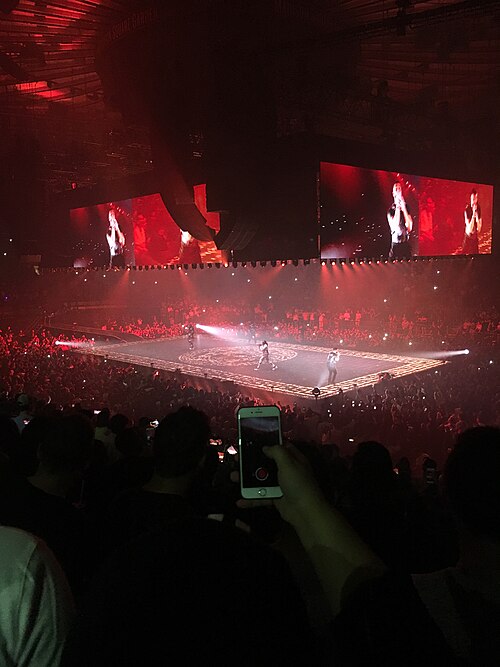
A live concert at Madison Square Garden, capturing the scale and crowd energy that define New York City’s major concert venue scene.
MetLife Stadium, Yankee Stadium. For tours too large for any arena. Productions designed for distance — massive screens, elaborate staging, pyrotechnics. Transit planning is essential.
Madison Square Garden, Barclays Center, UBS Arena, and Prudential Center in Newark. The core of major touring: full-scale production, reserved bowls, premium floor inventory and arena-level ticket demand.
Radio City Music Hall, Hammerstein Ballroom. Large enough for significant touring acts, intimate enough to feel close to the stage. Often the best acoustic experience at scale.
Beacon Theatre, Carnegie Hall. Where the venue becomes part of the experience. Restored historic buildings with character that newer rooms can’t replicate.
Terminal 5, Brooklyn Paramount, Brooklyn Steel, Irving Plaza. Where established artists downsize and emerging artists level up — often with more crowd energy than the arenas.
Bowery Ballroom, Music Hall of Williamsburg, Brooklyn Bowl and similar rooms. These are the small music venues NYC fans mean when they want proximity, standing-room energy and a much more immediate connection to the stage.
Before picking a seat, understand the production. A show designed for stadium scale rewards distance in a way that a stripped-back acoustic performance doesn’t. At MSG, lower bowl center is almost always the best value. At a mid-size theater like the Beacon or Radio City, front mezzanine center frequently outperforms orchestra for both sight lines and sound. The individual venue guides on Stage & Street break this down specifically for each house.
Not every NYC concert happens indoors. Outdoor concert venues NYC has to offer are more limited than the indoor list, but Forest Hills Stadium in Queens is the standout — a genuinely outdoor concert experience in a historic setting, distinct from the enclosed arenas and theaters that make up most of this guide. If you’re specifically after outdoor music venues NYC rather than indoor concert venues, Forest Hills’ full guide below covers what that experience is actually like.
Concert Halls in NYC
Concert halls in NYC are a different category from arenas and clubs. Carnegie Hall is built around acoustics and seated listening; Radio City Music Hall combines large-theater scale with landmark architecture; the Beacon Theatre sits between a classic theater and a modern touring room; and Lincoln Center is a multi-venue performing-arts campus rather than a single concert hall.
Featured NYC Concert Venues
These are the venues that define New York’s concert landscape — each one worth understanding before you book tickets or plan a night around a show there.
The world’s most famous arena earned that title through concerts as much as sports. Billy Joel holds the record for the most lifetime performances at MSG, with over 100 sold-out shows. Every major artist on earth has played here, and something about the building — its age, its density, its position in the middle of Manhattan — creates a specific energy that newer arenas haven’t replicated.
For concerts, lower bowl sections 101–119 facing the stage provide the best combination of sightlines and sound for most configurations. The floor is electric when standing room is open; seated floor can feel distant depending on stage depth. The upper bowl is steep but maintains reasonable connection — MSG’s vertical rise keeps upper sections closer to the action than a shallower building would. Transit is one of MSG’s biggest advantages: the A/C/E and 1/2/3 stop at 34th Street–Penn Station, while NJ Transit, LIRR and Amtrak serve Penn Station directly below the arena.
Opened in 1932, Radio City is one of the most beautiful performance spaces in the world — the Art Deco interior alone is worth the visit. At just under 6,000 seats, it sits in a unique position: large enough for significant touring acts, intimate enough to feel genuinely connected to the stage. The acoustics throughout the house are excellent — the building was designed for performance in ways that newer venues spend hundreds of millions trying to replicate.
The main floor orchestra is excellent throughout. The first mezzanine center is arguably the best section in the house — elevated enough for clear sight lines, close enough to feel in the room. The Rockefeller Center location puts you in one of Midtown’s more polished and walkable corridors for pre-show dining.
Ask anyone who has seen a show here and they’ll give you the same answer: it might be the best concert venue in the city. The 1929 restored interior is ornate without being fussy, and the scale — under 3,000 seats — creates an intimacy that the arenas can’t replicate. Sound is excellent throughout the house. Acts like the Allman Brothers Band have made it a long-term home — it’s the kind of venue that feels both grand and personal.
The orchestra delivers a warm, connected experience. The mezzanine provides a slightly elevated perspective that works beautifully for most performances. The Upper West Side neighborhood rewards arriving early: Amsterdam and Columbus Avenues have some of the better pre-show dining in the city, and the 1/2/3 to 72nd Street drops you two blocks away.
Since 1891, Carnegie Hall has been synonymous with musical excellence. The Stern Auditorium is in a category of its own — a room designed so that sound reaches every seat with a clarity and warmth that the best modern halls spend hundreds of millions trying to achieve. For classical, jazz, and acoustic performances, nothing in the city matches it. Even the upper tiers deliver an extraordinary acoustic experience by any reasonable standard.
Brooklyn’s major arena has established itself as a genuine alternative to MSG for major touring acts — and for some shows, the better choice. The bowl is proportioned in ways that make it feel slightly more connected than MSG at similar capacity, and the lower bowl provides strong sight lines across a wide range of sections. Nine subway services plus the LIRR serve the Atlantic Avenue–Barclays Center / Atlantic Terminal complex, making Barclays one of the most transit-connected large venues in the city.
The Atlantic Avenue and Flatbush Avenue neighborhoods around Barclays have improved significantly since the arena opened and now offer real pre- and post-show options that reward staying in Brooklyn rather than rushing back to Manhattan.
Newark’s arena is the easiest out-of-city arena trip New Yorkers can make: one NJ Transit or PATH ride to Newark Penn Station, then a two-block walk. It opened in 2007 with a run of ten Bon Jovi shows and plays a full slate of major tours, including dates that skip the city venues entirely. The 2026 holiday stretch alone brings two Jonas Brothers nights and a Trans-Siberian Orchestra double bill.
For most end-stage concerts, lower-level seats facing the stage are the safest pick, and upper-level center seats are the value play. The floor changes from tour to tour: it can be a standing pit, reserved seats, or both. Two rules to know before you go: no backpacks of any size, and the arena is fully cashless.
MetLife hosts the tours that outgrow any arena. At 82,500 seats, productions designed for this scale deploy screens, runway stages, and effects that compensate for the distance the size creates. The stadium experience — open air, maximum scale, a crowd larger than many cities — is genuinely different from any indoor venue. For major events, NJ Transit operates Meadowlands rail service; most riders connect at Secaucus Junction, with the Secaucus-to-stadium segment taking about 10 minutes.
Find Current Concerts by Venue
All Show GuidesVenue pages answer what the room is like; the NYC Concert Shows hub owns the changing calendar. Use it for upcoming concerts, tonight, this weekend and current 2026 show guides, then jump back here when you need to compare the venues themselves.
This venue hub is for choosing and comparing rooms. The shows hub is for who is playing and when. Individual venue pages handle concert tickets, box office and venue logistics; dedicated seating guides handle seating charts, best seats and seat views.
Brooklyn Concert Venues & Music Venues
Brooklyn concert venues and Brooklyn music venues now cover nearly every scale of live music, from Barclays Center to restored theaters and standing-room clubs. The important distinction is neighborhood and room type: Downtown Brooklyn is built around Barclays Center and Brooklyn Paramount, Flatbush has Kings Theatre, Williamsburg has Brooklyn Steel, Music Hall of Williamsburg and Brooklyn Bowl.
Small Concert Venues in NYC
Searches for small concert venues NYC and small music venues NYC are smaller than the main venue terms, but the intent is distinct. These rooms trade production scale for proximity: shorter sightlines, mostly general-admission floors, lower capacities and stronger neighborhood identity.
Classic downtown choices for standing-room shows, touring indie acts and smaller headline dates.
Smaller rooms where the neighborhood and the show blend together into the same night out.
Outdoor Concert Venues in NYC
Outdoor concert venues NYC is a smaller but useful search cluster. Forest Hills Stadium is the clearest dedicated outdoor concert venue in the directory, while The Rooftop at Pier 17 runs an outdoor seasonal concert series with the Lower Manhattan skyline as part of the experience. Stadium shows at Yankee Stadium, Citi Field and MetLife are also open-air, but they operate at a much larger touring scale.
NYC Concert Venues by Experience Type
MSG for the full arena experience — nothing prepares you for the feeling of 20,000 people in that building when the lights go down. Radio City for something more refined — the Art Deco interior adds a layer of New York that MSG doesn’t have.
Ask working musicians which NYC venue they love most and the Beacon comes up constantly. Under 3,000 seats, extraordinary acoustics, restored 1929 interior. If the artist you want plays here, prioritize it over the arenas.
The mid-size venues turn a concert into a proper evening. The neighborhood context — Upper West Side for the Beacon, Rockefeller Center for Radio City — makes dinner and the show work together as a night rather than two separate events.
For the specific artists and tours that only play stadiums, MetLife is the default New York answer. Yankee Stadium has summer concerts with a Bronx energy that’s different from anything in New Jersey. Both reward arriving early.
Barclays for major touring acts — it now rivals MSG for the biggest shows and the neighborhood around it beats Penn Station for a full evening. Brooklyn Paramount in Downtown Brooklyn or Kings Theatre in Flatbush for a mid-scale show in a restored historic room. Between these two and the club circuit, Brooklyn concert venues now cover nearly every scale — Brooklyn music venues aren’t just a backup to Manhattan anymore.
Carnegie Hall’s acoustics are the standard against which every other concert hall measures itself. Lincoln Center is the broader campus — the Philharmonic, the Metropolitan Opera, Jazz at Lincoln Center — that anchors the city’s classical and orchestral world.
Concert Seating: What This Venue Hub Covers
Seating matters, but this directory should not compete with the dedicated venue seating guides for exact-match terms such as seating chart, best seats, seat views, rows and sections. Use the guidance below as a quick comparison by venue type, then move into the individual seating guide when you are choosing a specific ticket.
Floor standing at an arena show is the most immersive experience for the right kind of performance — EDM, hip-hop, high-energy rock. But for productions built around visual storytelling — elaborate screens, choreography, staging that extends across the full stage — being slightly elevated in the lower bowl often provides a better overall view. Floor sections toward the back of a deep floor setup can feel surprisingly distant while the PA hits you from the wrong angle.
At both MSG and Barclays, lower bowl sections directly facing the stage deliver the best combination of sight lines, sound quality, and crowd energy. These sections price at a premium but reliably outperform floor and upper bowl at comparable secondary market prices. If you’re buying on the secondary market, compare lower bowl center to floor — the value is often clearly in the bowl.
At Radio City, the Beacon, and similar venues, the first mezzanine center frequently delivers the best overall experience — elevated for clear sight lines, well-positioned for PA coverage, and with a full-stage perspective that orchestra level sometimes can’t match.
At MetLife and Yankee Stadium, the very front field-level sections can put you too close to see the full production — screens are above you, the stage extends away, and the PA is designed to project forward away from your position. For shows with elaborate staging, lower bowl 20–40 rows up from the field often delivers the best view of the full spectacle.
Every major NYC concert venue has updated its bag policy in recent years. MSG allows bags that fit under the seat but no oversized bags, with no bag check available. Barclays has a clear bag policy for some events. MetLife’s policy varies by event. Check the specific venue’s website before you arrive — a small or clear bag saves significant time at security.
Madison Square Garden seating guide →
Barclays Center seating guide →
Concert Neighborhoods: Before & After
Where the venue sits determines what’s available before the show and what’s worth doing after. New York’s major concert venues are spread across the city, and each one has a different neighborhood story.
Hell’s Kitchen along 9th and 10th Avenues is the strongest pre-concert dining corridor for Midtown venues — good restaurants, manageable prices, easy walking distance to the Garden and Radio City. Post-show, walk west rather than fighting the Penn Station crush.
One of the genuinely pleasant concert neighborhoods in the city. Amsterdam and Columbus Avenues in the low-to-mid 70s reward visitors who arrive early enough for a proper dinner. The neighborhood has a slower pace than Midtown — more residential, better for lingering before and after a show.
Atlantic Avenue east of Barclays has developed into a solid pre-concert dining corridor — more variety than most arena districts. After a Barclays show, staying in Brooklyn beats rushing back to Manhattan. Boerum Hill and Cobble Hill are a short walk with better late-night options than what’s around Penn Station at midnight.
Eat before you take the train. The options at Meadowlands are limited to venue concessions and the surrounding area offers little beyond the stadium. The right approach for MetLife concerts is a proper dinner in Midtown before boarding NJ Transit — the 10-minute ride makes this entirely practical.
The Ironbound, Newark’s Portuguese and Spanish restaurant district just east of Newark Penn Station, is the classic pre-show dinner. Downtown spots near the arena work for a quicker bite. Look up your train back to the city before the show, not after it. Restaurants near Prudential Center →
Full NYC Night Out planning guide →
Frequently Asked Questions
NYC’s concert venues range from stadiums and major arenas to large theaters, classic concert halls, mid-size standing-room rooms, intimate clubs and outdoor seasonal venues. The right type depends on the artist, production scale, whether you want assigned seating or GA, and how much the neighborhood matters to the night.
Lower bowl sections 101–119 facing the stage deliver the best combination of sight lines and sound for most concert configurations. For standing floor shows, floor center puts you in the crowd energy but can feel distant if the stage configuration is deep. The upper bowl is steep but maintains reasonable sight lines — MSG’s vertical rise helps in the upper sections. Avoid corner sections in both lower and upper bowl.
MSG sits directly above Penn Station at 34th Street and 7th Avenue. The A, C, E, 1, 2, and 3 trains all stop here. From Times Square, the 1/2/3 trains take one stop. From Brooklyn or Queens, the A/C/E connects directly. NJ Transit and LIRR also arrive at Penn Station, giving MSG unusually strong regional transit access.
Both are excellent in different ways. MSG carries more prestige and history — playing MSG means something specific in the music world. Barclays has a slightly more compact-feeling bowl for a similar capacity and especially strong transit access from Brooklyn and other parts of the city. For a concert night, Barclays has a better neighborhood around it for before and after the show.
For major events, NJ Transit operates Meadowlands rail service, with most riders connecting at Secaucus Junction before the roughly 10-minute segment to the Sports Complex station. Buy your train ticket in advance to skip the post-show queue. If driving, the stadium lots fill early — plan to arrive 90 minutes before the show.
Barclays Center is the major arena, hosting the biggest touring acts. Brooklyn Paramount in Downtown Brooklyn and Kings Theatre in Flatbush are separate restored theaters for mid-scale shows. Music Hall of Williamsburg and Brooklyn Steel cover the indie and mid-size touring market in Williamsburg. All are accessible by subway from Manhattan.
All NYC Concert Venue Guides
Browse the complete Stage & Street venue directory — arenas, stadiums, concert halls, theaters, clubs and outdoor rooms. Individual venue pages cover concert tickets, box office and logistics; dedicated seating guides handle detailed seating-chart and seat-selection intent where available.
Know the Venue Before You Book the Ticket
In New York, the venue is part of the experience in ways that aren’t true in most cities. Seeing a show at the Beacon Theatre is a different evening from seeing the same artist at MSG — not better or worse, different in kind. Understanding that difference before you book means you’re choosing the right experience for the right night, not just the most available seat at the most convenient price.
Use the venue guides above to understand the specific building you’re walking into, then move to the seating guide when you’re choosing a section and the shows hub when you want the current calendar. That keeps venue discovery, show discovery and seat selection separate — and makes each page more useful.
NYC Concert Venues
Jump to a Section
Know Your Venue?
Browse current NYC concert tickets across every major room.