

Hammerstein Ballroom Tickets & Upcoming Events: Manhattan Center NYC Concert Guide
One of New York’s most distinctive large-room concert venues — ornate, energetic, and built with balconies that sit unusually close to the stage. Here is how to choose the right level, when to arrive, and how to plan the night.
The Hammerstein Ballroom is on the ground floor of the Manhattan Center at 311 West 34th Street — one block from Penn Station, in a building that has been hosting performances since 1906. The current Manhattan Center room specifications list Hammerstein Ballroom at up to 3,500 for standing-room GA concerts, with lower capacities for seated and reception-style configurations. At that size it sits in the most interesting gap in New York’s concert landscape: too large to feel like a club, too intimate to feel like an arena, and architecturally distinctive enough that the room itself is part of the experience every time the lights go down.
The defining physical feature: two main balconies that are, in the venue’s own words, “unusually close to the ground and gently sloped.” Most ballroom venues with balconies put you at some distance from the stage and the floor energy. Hammerstein’s balconies are lower and closer than visitors expect. The first balcony does not feel remote. It feels elevated — which is a meaningfully different experience, and the reason the first balcony is so often the smartest ticket in the building.
One thing to know before everything else: the official Manhattan Center FAQ is clear — seat and row numbers on tickets are used for capacity tracking, not assigned positions. Both floor and balcony tickets are first-come-first-served unless a specific event is configured with reserved seating. Whether you are in the best position in the room depends on when you arrive. This changes the planning significantly, and it is the most important practical fact this guide can give you before you buy.
Hammerstein Ballroom tickets and concert listings are sold through Ticketmaster. For a specific date, use the official Manhattan Center upcoming-shows page or the Hammerstein Ballroom Ticketmaster venue page to confirm availability, event configuration, door time, age restrictions, and current pricing.
Hammerstein Ballroom Tickets, Upcoming Events & Concert Schedule
Hammerstein Ballroom tickets are sold through Ticketmaster, and the official Manhattan Center upcoming-shows page is the best place to confirm the current Hammerstein Ballroom upcoming events calendar. The venue hosts concerts, live events, debates, sporting-style events, and special programming, so always check the specific event listing rather than assuming every night uses the same floor and balcony configuration.
Upcoming Hammerstein Ballroom Events — Current 2026 Listings
Looking for Hammerstein Ballroom tonight? Check the current Ticketmaster venue page immediately before traveling. Event schedules, door times, ticket inventory, and room configurations can change after an editorial guide is updated.
Official Hammerstein Ballroom Tickets — Ticketmaster
The Manhattan Center public-events FAQ directs buyers to Ticketmaster. Start there for primary inventory. If you compare resale inventory for a sold-out show, verify the exact event date, ticket type, floor or balcony access, transfer method, and final checkout total before purchasing.
Hammerstein Ballroom Box Office & Will Call
The Manhattan Center box office is open on the night of the show for day-of tickets only and sells tickets only for that specific event. Will call is on the far west side of the main lobby and opens at door time. Ticketmaster currently notes that box-office availability can vary by event, so do not make a daytime trip expecting a permanent daily box-office schedule.
Hammerstein Ballroom at Manhattan Center — NYC Location
Hammerstein Ballroom is inside Manhattan Center at 311 West 34th Street, New York, NY 10001, between Eighth and Ninth Avenues in Midtown Manhattan. Searches for Hammerstein Ballroom NYC, Hammerstein Ballroom Manhattan, Manhattan Center Hammerstein Ballroom, and Hammerstein Ballroom at Manhattan Center all refer to this first-floor venue.
Do not confuse Hammerstein Ballroom with the Grand Ballroom in the same building. Hammerstein is on the first floor; the Grand Ballroom is on the seventh floor and is a separate event space with its own capacity and event schedule.
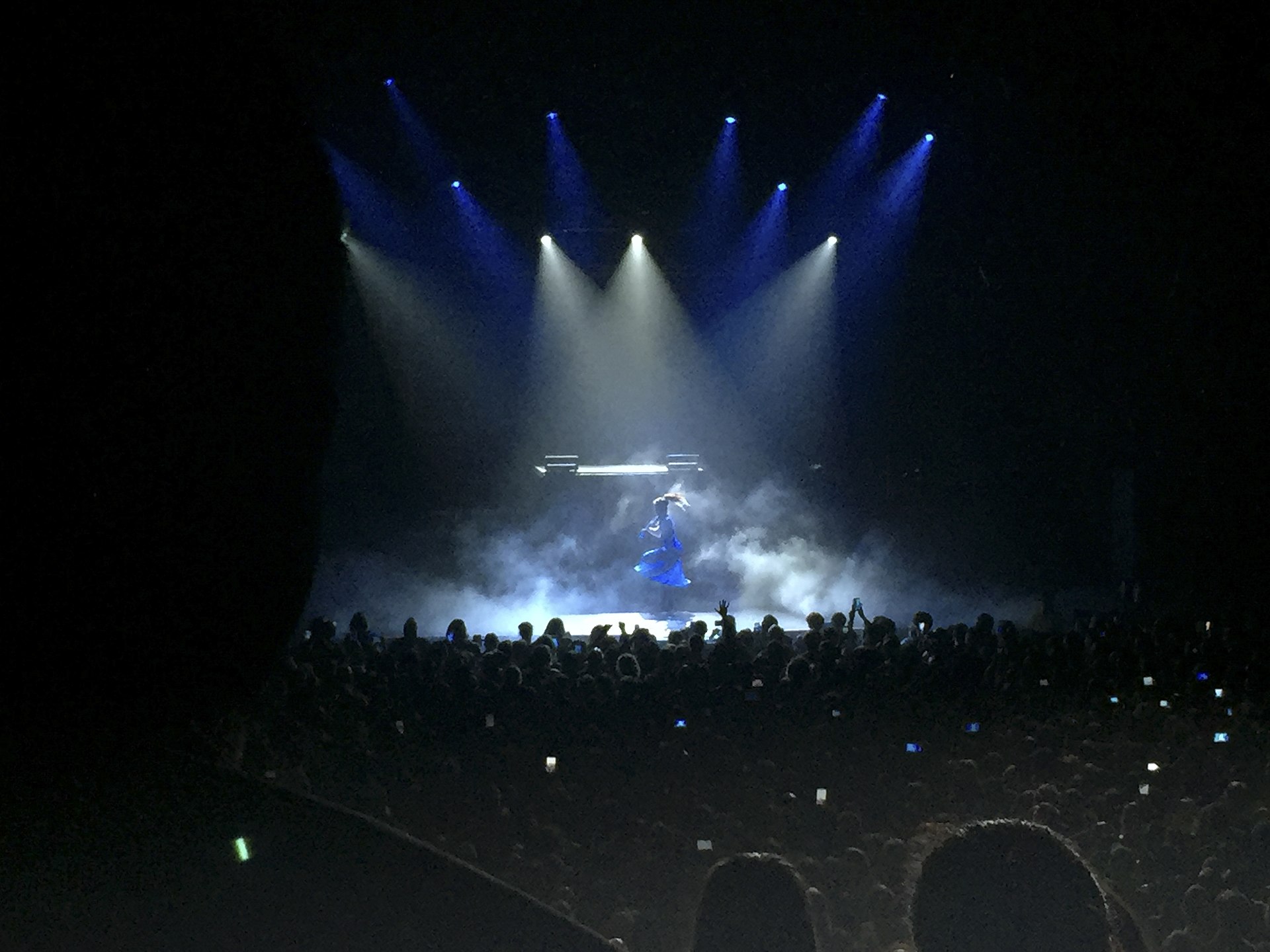
A live concert inside Hammerstein Ballroom, capturing the scale, energy, and dramatic indoor atmosphere that make it one of New York City’s standout mid-large concert venues.
What the Hammerstein Ballroom Is Actually Like for Concerts
Walking into the Hammerstein is the first thing that distinguishes it from most large-room standing venues. The ornate plasterwork, the gilded details, the proportions of a room designed in 1906 as a proper opera house — these elements create a physical environment that does not feel like a converted warehouse or a purpose-built concrete box. The room has warmth and visual weight that most mid-size concert venues lack, and that character concentrates the energy of a crowd rather than diffusing it.
The floor is flat and slants gently down toward the stage — a deliberate design choice that gives the back rows of the floor a slightly better sightline than a completely flat concrete floor would. The stage is at one end. The two main balconies wrap around the room on both tiers. Above those, six shallow box-style balconies run along the sides — these are normally reserved for artist guests and VIP uses rather than general ticket holders, though configurations vary by show.
Sound in the Hammerstein is noticeably better than in most larger standing venues. The room was designed for acoustic performance, and while it has been adapted for amplified concerts, the acoustic properties of the space — the proportions, the materials, the ceiling height — produce a clarity that flat-walled club rooms of comparable capacity cannot match. This is particularly noticeable in the first balcony, where the sound is full and dimensional in a way that pure floor GA at maximum crowd density sometimes is not.
The Manhattan Center building contains two distinct event spaces: the Hammerstein Ballroom on the ground floor and the Grand Ballroom on the 7th floor. They are not the same room, do not have the same capacity, and do not have the same character. If your ticket says Grand Ballroom, you are going to a different room. Always verify which venue your specific event is in before planning your visit.
When the Hammerstein Is the Right Venue — and When It Isn’t
Hammerstein is the right choice when
The show is a high-energy, crowd-focused concert where the room’s energy is part of the value. Hammerstein fills with sound and people in a way that feels intense and theatrical simultaneously — the kind of room where the crowd’s collective presence is amplified by the physical space rather than dissipated by it. Rock shows, high-energy pop, hip-hop, and EDM acts that play Hammerstein on the way up or on the way back from arena scale consistently produce memorable nights here because the room is designed to hold that kind of collective intensity. Checking concerts at Hammerstein Ballroom before you commit to a specific date is worth it — the booking calendar runs across genres, and what’s playing changes the crowd character significantly night to night.
You want more atmosphere than a plain large club but less sprawl than an arena. This is the Hammerstein’s specific position in the city’s concert ecosystem. It is larger than a Brooklyn Steel or a Terminal 5, with more architectural character than either, and smaller and more connected than MSG or Barclays. For shows that would be too small for an arena and too large for a club, Hammerstein frequently lands in the right zone — big enough to feel significant, intimate enough to feel personal.
You are coming from Penn Station or the surrounding transit network. The transit situation at Hammerstein is exceptional for a mid-size venue: one block from Penn Station, with 1/2/3 and A/C/E subway access, PATH from New Jersey, and Metro-North via Grand Central to Times Square to the 1/2/3. For visitors arriving from Long Island, New Jersey, Westchester, or anywhere connected to Penn Station, Hammerstein is one of the most accessible mid-size concert venues in the city.
Hammerstein may not be the right choice when
Assigned comfortable seating is your priority. Hammerstein is primarily a standing and first-come-first-served balcony venue. If you want an assigned seat in a specific position, a show at Radio City, Carnegie Hall, or even the Beacon will serve that preference much better. Some Hammerstein events do configure reserved seating — verify on your specific ticket — but the default format here is GA on the floor and first-come-GA seating in the balconies.
The show would be better in a smaller or more intimate room. Hammerstein is a genuine mid-large venue, with current Manhattan Center specifications listing up to 3,500 guests for a standing-room concert configuration. For artists who belong in a 500-person club or a 1,000-seat theater, the scale works against the performance and the atmosphere can feel cavernous rather than connected. The right room for the right show matters — Hammerstein’s size and character are not universal advantages.
You strongly dislike GA floor environments. If long standing periods, unpredictable crowd density, and sightline uncertainty in GA floor situations are deal-breakers, the first balcony at Hammerstein is often a better alternative — but the overall venue culture skews toward standing crowds and physical energy. For a more controlled seated experience at comparable capacity, Radio City is the cleaner choice.
Floor vs Balcony — The Complete Hammerstein Viewing Guide
This main venue page keeps the original floor-vs-balcony planning context, but detailed seat-selection intent belongs on the Hammerstein Ballroom seating guide — including seating chart, view-from-my-seat strategy, first-balcony sections 102–104, obstructed rows J/K, side-section angles, and deeper row-by-row buying guidance.
The most important decision at Hammerstein is not which section to buy — it is which level. The floor and the balconies are genuinely different experiences, and the right choice depends on the show type, the expected crowd size, and what kind of concert night you want. Getting this decision right is what separates a great Hammerstein night from an avoidable one.
The Hammerstein balconies are unusually close to the stage. This is not a general statement about most venues — it is a specific physical fact about this room. The two main balconies sit lower and closer to the ground than typical theater or ballroom balconies. From first balcony center rows A through E, you are looking at the stage at a gentle downward angle from a position that is genuinely close to the performance — not distant and disconnected. For high-demand GA floor shows where the floor fills to a dense standing-room crowd, the first balcony can produce a materially better experience than the floor unless you are willing to arrive very early and commit to a front position.
GA floor — when it works and when it doesn’t
GA floor at Hammerstein is the full standing-crowd concert experience. The floor slants gently down toward the stage, which helps sightlines for rear positions more than a flat floor would. For shows where the floor is not packed to maximum density — smaller or mid-demand events where the floor holds 800–1,200 people — GA floor can produce excellent proximity and crowd energy. You can work your way toward the center-front and maintain a workable view.
For high-demand shows where the standing floor becomes densely packed, GA floor becomes significantly more challenging. Arriving early becomes essential — the difference between arriving at doors and arriving 30 minutes after doors can be the difference between a clear center position and being trapped in a dense crowd pocket 60 feet back with a compromised sightline to the stage. If you are not willing to commit to arriving at doors and maintaining position for the duration, GA floor at a packed Hammerstein show is often less satisfying than first balcony at the same event.
First balcony — the smartest ticket for most shows
The first balcony is where experienced Hammerstein concertgoers most often land, and the reasoning is consistent: you get a seated position (even in GA balcony configurations, there are actual seats) with a clean elevated view of the full stage, you are not fighting a standing crowd for sightlines, and the closeness of the balcony to the stage means the visual distance is smaller than the venue’s footprint would suggest.
The strongest positions in the first balcony are center sections rows A through E — the front half of the center three sections. From here you have the full stage picture in front of you, the room’s ornate ceiling and architecture above, and a sound environment that is full and clear. Arrive early even for GA balcony shows — this is first-come-first-served and the best seats fill quickly.
Rows J and K in the first balcony have obstructed views — confirmed from the official Manhattan Center floor plan. These are the rear rows of the first balcony and sit under the overhang of the second balcony, creating a sightline restriction. If you are buying reserved first balcony tickets, avoid rows J and K specifically. For GA first balcony, arrive early enough to secure rows A through H before the rear rows fill.
First balcony side sections — the angle caveat
The first balcony has five sections. The center three (102, 103, 104) are the target. The two side sections — 101 (far left) and 105 (far right) — have angle disadvantages. If you end up in section 101, the better seats are toward the higher seat numbers (which sit closer to the center). In section 105, the better seats are the lower seat numbers (which sit closer to center). Buying a side-section ticket and assuming all seats are equivalent is a common error — the outside seats in sections 101 and 105 have meaningfully worse angles to the stage than the inside aisle seats.
Second balcony
The second balcony sits above the first and offers a higher vantage point over the room. The same general guidance applies — center sections, front rows, and avoid the outermost side positions. The second balcony trades some proximity for a more complete overhead view of the full room and stage, which for shows with elaborate lighting and staging can actually be a more satisfying visual experience. The acoustic character at the second balcony level can vary — some positions are affected by the first balcony’s overhang beneath them. Front rows of second balcony center have generally strong sound.
Elevated view, unusually close to the stage for a balcony, full room picture, actual seats (even in GA balcony configuration), clean sound. The position most experienced Hammerstein regulars return to. Arrive early for GA balcony shows.
Maximum proximity and crowd immersion. Works best for mid-demand shows where the floor is not at maximum density. For high-demand packed shows: arrive at doors or accept being further back. Front center floor is excellent when you can get it — it just requires real commitment.
Higher vantage point with a complete view of the full room and stage. Good for shows with elaborate production design where seeing everything simultaneously matters. More elevation, slightly more distance, but often better acoustic clarity than the packed floor at sold-out shows.
Angle disadvantage relative to center sections but workable from the inside aisle seats. In section 101: higher seat numbers are better. In section 105: lower seat numbers are better. Both sections have outside seats that are noticeably worse — verify position before buying at non-discounted prices.
Confirmed obstructed views from the official Manhattan Center floor plan. These rear rows sit under the second balcony overhang. The obstruction is real — verify row assignment for reserved balcony tickets and arrive early enough to avoid them for GA balcony shows.
Arriving late for a sold-out GA floor show and ending up 50+ feet back in a dense standing crowd with sightlines blocked by the crowd is the most common Hammerstein disappointment. Not a section issue — a timing issue. Arriving late to GA floor at a high-demand show is the single most reliable way to have a worse night than your ticket price should produce.
Viewing Strategy by Concert Type
High-energy rock and pop shows — large GA crowds
For high-demand shows where the floor will be at maximum density — the shows where the Hammerstein floor is at high standing-room density — first balcony center rows A through E is consistently the stronger position for anyone not committed to arriving at doors. The packed floor at these shows can be physically exhausting and visually frustrating from anywhere beyond the first 30 feet. If you are willing to arrive at doors and fight for a front-center floor position, floor is excellent. If you are not, first balcony beats mid-to-rear GA floor in every meaningful way.
EDM and dance-forward shows
For shows where being in the crowd and moving with the collective energy is the primary experience — EDM, high-energy dance acts, shows where the crowd’s physical participation is inseparable from the performance — GA floor is the right call. The Hammerstein floor at a sold-out dance show has an energy compression that the balconies cannot replicate. For this category of show specifically, arrive early, commit to floor, and plan accordingly. First balcony at an EDM show can feel disconnected from the energy below in a way it does not at a rock or pop show.
Vocalist-forward or acoustic-leaning shows
For shows where lyric clarity and visual connection to the performer matter more than crowd energy — an acoustic act, a singer-songwriter, a performance where hearing the performance clearly is as important as the atmosphere — first balcony center is an excellent choice. The acoustic properties of the Hammerstein room carry well to the balcony, and the seated position allows sustained focus over a full set. GA floor at these shows can produce better proximity but does not always produce better sound, particularly further back in a standing crowd.
Partially seated or special event configurations
Some Hammerstein events are configured with reserved seating throughout — assigned sections, rows, and seat numbers. When this is the configuration, the guidance becomes similar to any theater purchase: center, rows A through E of the balcony, avoid J and K, prefer center sections over 101 and 105. For these events, arriving early matters less but the seat-selection intelligence above becomes the primary decision factor.
Shows where the room itself is part of the appeal
For performances where the Hammerstein’s architectural character — the ornate plasterwork, the aged grandeur of a 1906 room — is part of why you are attending, the first balcony center rows A through B are the seats that give you the most complete view of the room simultaneously with the performance. From here you see the stage, the full floor below, and the ceiling’s decorative expanse. It is the position that makes the most of what the building actually is, not just what is happening on the stage.
What First-Timers Need to Know Before a Concert at Hammerstein
The seating numbers on your ticket do not mean assigned seats
This is the first thing that confuses people — the official Manhattan Center FAQ explains it plainly: “The seat and row numbers are simply a way for us to track capacity. It does not mean you have assigned seating.” Floor tickets with section numbers are GA standing. Balcony tickets with row numbers are almost always first-come-first-served GA seating unless your specific event is confirmed reserved. The number on your ticket tells you the level, not the position. Your actual position is determined by when you arrive.
Doors open one hour before showtime — know what that means for you
The official Manhattan Center FAQ confirms doors open one hour before the scheduled show time. For GA floor shows at high-demand events, arriving at or just after doors gives you the full hour to establish position before the opener starts. For GA balcony shows, arriving in the first 30 minutes after doors opens is typically enough to secure a good center row A through E position. Arriving 15 minutes before the headliner for either GA configuration consistently produces the worst positions available at that price tier.
Penn Station is one block away — use it
Hammerstein Ballroom is one block from Penn Station, with 1/2/3 and A/C/E subway access from virtually any point in Manhattan or Brooklyn, PATH train access from New Jersey (33rd Street and 6th Avenue), and Metro-North connections via Grand Central and the 1/2/3. The transit situation is exceptional for a venue of this size. For visitors driving from New Jersey, the Lincoln Tunnel is approximately 10 minutes away with Meyer’s Parking Garage directly next door to the venue on 34th Street. See the transit guide for full route details.
Footwear and physical preparation
GA floor at Hammerstein means standing for the full opener and headliner set — typically 2.5 to 3 hours from doors to close. Comfortable shoes are not a minor detail at this venue; they determine whether the third hour of the night is an experience or an endurance test. For GA balcony shows, the physical demand is lower — you are seated — but the standing transitions when people in front of you stand for good moments means having comfortable shoes matters here too. See the what to wear guide for venue-specific advice.
No ATM inside — one across the street
The official Manhattan Center FAQ confirms there is no ATM inside the venue. One is located across the street. Credit and debit cards are accepted at the venue bars. Plan your cash situation before entering, not after you are inside and realize the only option is leaving.
The Full Night — 34th Street, Dinner, and Getting There
Be realistic about the immediate area
The blocks immediately surrounding the Hammerstein Ballroom — 34th Street between 7th and 9th Avenues, the Penn Station transit hub — are densely functional and not particularly inviting for a pre-show dinner. The area serves commuters, MSG crowds, and transit transfers well. It does not serve a thoughtful pre-concert dinner as well as neighborhoods a few blocks or a train stop away. Walking into the nearest restaurant on 34th Street because you are running late produces a worse dinner experience than spending five minutes planning beforehand.
Where to actually eat before a Hammerstein show
Hell’s Kitchen — the 9th Avenue corridor between 34th and 55th Streets — is a 5–10 minute walk west of Hammerstein and has the strongest pre-show restaurant density in this part of Midtown. The same neighborhood that serves MSG serves Hammerstein, and the same logic applies: plan dinner in Hell’s Kitchen rather than defaulting to the Penn Station block. Book a restaurant when you buy the tickets. For a more casual approach, Koreatown on 32nd Street (between Broadway and 6th Avenue) is a 5-minute walk east and consistently has availability on show nights. See the restaurants near NYC concert venues guide for specific options.
Is this a full night-out venue or a show-first venue?
Hammerstein is primarily a show-first venue. The transit convenience (Penn Station directly adjacent) makes it extremely easy to arrive, see the show, and leave — it does not naturally invite the kind of extended evening that the Beacon’s Upper West Side setting or Barclays’s Fort Greene neighborhood does. For first-time visitors who want to build a complete night around the concert, plan the dinner deliberately in advance rather than expecting the surrounding streets to provide it. For veterans of the transit-and-show format, Hammerstein’s Penn Station adjacency is a genuine asset rather than a limitation.
Hotels near Hammerstein
For out-of-town visitors, the Penn Station hotel cluster — The New Yorker across 8th Avenue, the Fairfield Inn across from Moynihan Train Hall — puts you literally around the corner from Hammerstein. The post-show walk from the venue to the hotel is five minutes. This is one of the most naturally situated overnight options relative to a mid-size NYC concert venue. See the hotels near NYC concert venues guide for full Penn Station area options.
Hammerstein Ballroom vs Other NYC Concert Venues
Hammerstein for crowd energy and GA atmosphere; Radio City for polished seated elegance. Radio City at 5,960 fully seated is a theater experience; Hammerstein can reach up to 3,500 in standing-room concert configuration and is primarily a GA / crowd-energy venue for many public shows. The show types that play each reflect this: Radio City hosts seated concerts, film events, and productions where acoustic clarity and assigned comfort matter. Hammerstein hosts high-energy standing concerts where crowd participation and floor energy are part of the value. Neither is better — they serve categorically different kinds of nights.
Hammerstein for architectural character and Penn Station access; Terminal 5 for an equally large GA room in a different part of the city. Terminal 5 in Hell’s Kitchen holds approximately 3,000 people across three floors of standing room. It is a pure modern standing venue without historic character. Hammerstein is architecturally distinctive and has the balcony-viewing advantage. Terminal 5’s multi-floor format provides its own kind of viewing variety — each level has different sightlines and energy. Transit to Hammerstein (Penn Station) is significantly more convenient from most of Manhattan than Terminal 5’s 56th Street and 11th Avenue location. For most visitors choosing between the two based on convenience alone, Hammerstein wins.
Hammerstein for Midtown/Penn Station access; Brooklyn Paramount for a larger seated-and-standing hybrid in Brooklyn. The Brooklyn Paramount (~3,000 capacity) is a restored historic theater with a different seating structure — some configurations are more seated than Hammerstein’s GA-dominant format. For visitors based in Manhattan who want Penn Station access, Hammerstein is the more convenient option. For Brooklyn-based concertgoers or those who prefer the Brooklyn Paramount’s specific character and configuration, the borough makes its own case.
Hammerstein for scale; Irving Plaza for intimacy. Irving Plaza at approximately 1,000 capacity is a smaller club. It is more intimate, more physically connected, and has a different energy ceiling. Hammerstein’s 2,000–2,500 capacity produces a bigger, louder room. For artists outgrowing Irving Plaza but not yet ready for Hammerstein’s scale, the comparison comes up often — the Hammerstein show will feel more like an event, the Irving Plaza show will feel more personal. When both options exist for the same artist, the choice is usually about which kind of connection you want with the performance.
Completely different scales — not a comparison that comes up for the same show. MSG at 20,000 is a major arena; Hammerstein is a large ballroom that can reach up to 3,500 in standing-room concert configuration. Artists who play MSG are not also playing Hammerstein on the same tour as equivalent options. They represent different stages in a touring career and different kinds of night. The transit overlap is the most useful comparison point: both are directly accessible from Penn Station, one block apart.
Common Hammerstein Concert Mistakes
Arriving late for GA floor and accepting a rear position
The most consistent Hammerstein disappointment is arriving 30–45 minutes after doors for a high-demand GA floor show and finding yourself 50+ feet from the stage in a dense standing crowd. The sightline from that position — blocked by moving heads, compressed shoulder-to-shoulder — is genuinely poor for the price paid. GA floor rewards arrival at doors, not arrival before showtime. For popular shows where the floor fills to a dense standing-room crowd, the distance between a good floor experience and a poor one is heavily determined by timing.
Not realizing the balcony is GA first-come-first-served
The official Manhattan Center FAQ is explicit: seat and row numbers are capacity-tracking tools, not assigned positions. Balcony tickets at most Hammerstein events are first-come-first-served, meaning your row A or row B position depends on arriving early enough to claim it. Buyers who assume their ticket number guarantees a specific seat arrive mid-show to find their “assigned” row A position has been taken by someone who showed up an hour earlier. Verify whether your specific event is reserved or GA balcony before assuming position security.
Buying first balcony rows J or K
Rows J and K in the first balcony have obstructed views — confirmed from the official Manhattan Center floor plan. These are the final rows of the first balcony and sit under the second balcony overhang. For reserved seating events, avoid them specifically. For GA balcony events, arriving early enough to secure rows A through H is the practical safeguard.
Buying side balcony sections without checking the angle
Sections 101 (far left) and 105 (far right) of the first balcony have angle disadvantages to the stage. The outside seats in these sections — the ones furthest from center — have the worst angles in the balcony. If you are in section 101, the better seats are toward higher seat numbers (inside aisle, closer to center). In section 105, the better seats are lower seat numbers. Paying center-section prices for an outside seat in 101 or 105 produces a significantly weaker experience than the price suggests.
Conflating the Hammerstein Ballroom with the Grand Ballroom
The Manhattan Center building contains two distinct venues on different floors. The Hammerstein Ballroom is on the ground floor. The Grand Ballroom is on the 7th floor. They have different capacities, different characters, and different event types. If your ticket says Grand Ballroom, you are attending a different room in the same building. Verify which venue your event is in before planning your visit — the two are not interchangeable.
Not planning dinner in advance
The immediate 34th Street and Penn Station block is not a restaurant destination. Walking out of Hammerstein and improvising dinner on the surrounding blocks produces the most tourist-facing, event-night-pricing results in Midtown. Plan a restaurant in Hell’s Kitchen or Koreatown when you buy your tickets — both neighborhoods are 5–10 minutes from the venue and have the right range of options for a pre-show dinner at any price point.
Frequently Asked Questions
The Manhattan Center directs public-event ticket buyers to Ticketmaster. Use the official Manhattan Center upcoming-shows page or the Manhattan Center Hammerstein Ballroom Ticketmaster venue page for primary inventory, event configuration, door time, age restrictions, and current pricing.
As of September 22, 2026, current Ticketmaster listings include DANCEHALL at 9AM, ALVARO DIAZ — OMAKASE TOUR, Sienna Spiro: My House Tour, It’s Up for Debate: Andrew Yang vs. Scott Jennings, Haymakers for Hope — Hope NYC XIV, Sleeping With Sirens, Beartooth, Lenny Pearce, and two December Yll Limani dates. Check Ticketmaster before traveling because the calendar can change.
The current Manhattan Center room specifications list Hammerstein Ballroom at up to 3,500 for a standing-room GA concert configuration. Other setups have lower limits, including theater-style seating up to 2,000, so the working capacity depends on the event configuration.
Yes. The Manhattan Center says its box office is open on the night of the show for day-of tickets only and sells tickets only for that specific event. Will call is on the far west side of the main lobby and opens at door time.
Yes — for the specific category of concert it is built for. Hammerstein is excellent for high-energy large-room standing shows where crowd intensity, room atmosphere, and the experience of being in a crowd of 2,000 focused people matters. The architectural character of the space, the acoustic quality, and the unusually close balconies make it one of the better mid-large concert rooms in New York for the right kind of show. It is not ideal for everyone — GA floor requires physical commitment and early arrival, and the venue is not suited for shows where assigned seated comfort or acoustic precision are the primary priorities.
First balcony center sections 102–104, rows A through E — consistently the strongest position in the building for most concert types. Elevated but close (the balconies sit unusually low and near the stage), seated even in GA balcony configurations, with clean sightlines and good sound. For GA floor: front-half center, accessible only by arriving at doors or shortly after. First balcony rows J and K are confirmed obstructed — avoid for reserved seats, arrive early enough to skip them for GA balcony. Side balcony sections 101 and 105 have angle issues — choose inside-aisle seats if you are in those sections.
For most high-demand shows, first balcony center is better than mid-to-rear GA floor — yes. The reason is specific to Hammerstein: the balconies sit unusually close to the stage and to the ground, so the elevated position does not produce the remoteness typical of theater balconies. From first balcony center rows A through E, you have a clear view of the full stage and the full room, actual seats, and a sound environment that is often cleaner than the packed floor at maximum density. The exception: for shows where being in the crowd and moving with the floor energy is the primary value — EDM, dance, high-energy shows where collective physical participation matters — GA floor is the right choice for someone willing to arrive early and commit to it.
Yes, for most concerts. The default configuration is GA standing floor and GA seated balcony (first-come-first-served for both). Some events configure reserved seating in the balconies with assigned sections, rows, and seats — but the Manhattan Center FAQ is clear that seat and row numbers on tickets are capacity-tracking tools, not position guarantees, unless the event specifically offers reserved seating. Always verify whether your specific event is GA or reserved before assuming your ticket number secures a specific position.
For GA floor at high-demand shows: at doors (one hour before showtime). The floor can become extremely dense at sold-out events, and arriving after the opener starts consistently produces rear positions in a standing crowd. For GA balcony: 30–45 minutes after doors opens is typically enough to secure first balcony center rows A through H before the rear rows fill. For reserved seating events, arrival timing matters less for position but still matters for entry queue management and getting settled before the show. For all events, allow extra time for any queue at entry.
Subway: 1/2/3 or A/C/E to 34th St–Penn Station — one block north to 34th Street and 8th Avenue, then one block west. The venue is at 311 West 34th Street. From New Jersey: PATH train to 33rd Street and 6th Avenue (one block east and one block south). From Grand Central: Metro-North or subway shuttle to Times Square, then 1/2/3 southbound to 34th St. Parking: Meyer’s Parking Garage is directly next door at 323-331 W 34th Street.
For most Manhattan-based visitors: Hammerstein wins on transit convenience by a meaningful margin — Penn Station directly accessible versus Terminal 5’s 56th Street and 11th Avenue location, which requires either the C train to 50th Street or a longer walk from Midtown. Hammerstein also has more architectural character and the balcony-viewing advantage. Terminal 5’s three-floor standing format creates its own kind of viewing variety that Hammerstein’s two-balcony structure does not directly replicate. For the same show at both venues, most visitors from Manhattan will find Hammerstein the more practically convenient choice; the experience itself is comparable in energy and scale.
Yes — particularly for first-timers who want a large, energetic room that still feels personal rather than arena-sized. The room has genuine character, the Penn Station transit access is among the easiest of any venue this size, and the first balcony option gives visitors who are not comfortable with packed GA floor situations a seated alternative that does not significantly compromise the experience. The main thing to know in advance: understand the GA first-come-first-served structure, plan to arrive early, and choose floor or balcony deliberately based on the show type and your own comfort level.
Hammerstein Ballroom, Done Right
The Hammerstein Ballroom is one of New York’s best answers to a specific question: where do I see a large, high-energy concert in a room that still feels architectural and alive, without going to an arena? The up-to-3,500 standing-room concert capacity, the ornate character of the 1906 space, the unusually close balconies, and the Penn Station adjacency combine to produce a concert venue that is genuinely harder to replicate than it appears on paper.
The planning checklist: first balcony center sections 102–104, rows A through E for the most reliable experience. Avoid first balcony rows J and K (obstructed). For GA floor at high-demand shows: arrive at doors or accept rear position. Verify whether your event is GA or reserved before assuming position security — the ticket number does not guarantee a seat. Plan dinner in Hell’s Kitchen or Koreatown before arriving, not on the Penn Station block. Take the 1/2/3 or A/C/E to 34th Street.
Get those right and Hammerstein delivers one of the best large-room concert experiences available in New York City.
From floor vs balcony to dinner, transit, hotels, and nearby concert alternatives.
Hammerstein is easy to reach, but the night gets better when you make the right call on level, arrival time, dinner neighborhood, and whether this is the right room for the show.
Hammerstein Ballroom Seating Guide
Use this before buying: GA floor timing, first balcony center rows A–E, rows J/K obstruction, side balcony angle warnings, and when balcony beats floor.
Open the seating guide →NYC Concert Venue Guides
Compare Hammerstein with Radio City, Beacon, MSG, Barclays, and other NYC rooms by layout, neighborhood, transportation, and night-out feel.
Browse all venue guides →NYC Concert Seating Guide
Understand GA floor, balconies, side views, soundboards, upper levels, and when cheaper seats are actually the smarter move.
Restaurants Near NYC Concert Venues
Skip the weak Penn Station default and plan Hell’s Kitchen, Koreatown, or another nearby route that actually fits the night.
Hotels Near NYC Concert Venues
Hammerstein is one of the easiest mid-size venues for hotel planning because Penn Station and Moynihan are right there.
How to Get to NYC Concert Venues
Subway, PATH, LIRR, NJ Transit, Metro-North connections, and the easiest ways to reach Manhattan venues without guessing.
Parking Near NYC Concert Venues
Hammerstein has a garage next door, but event-night Midtown driving still rewards planning before you leave home.
Hell’s Kitchen Night Out Guide
The strongest nearby restaurant corridor for Hammerstein, MSG, and West Midtown shows — usually better than eating on 34th Street.
Koreatown Night Out Guide
A smart pre-show option east of Penn Station when you want energy, late hours, group flexibility, and a quick walk to Hammerstein.
Midtown West Night Out Guide
Use this for the broader Penn Station, MSG, Hudson Yards, and West Side planning layer around Hammerstein.
Madison Square Garden Concert Guide
Compare the Hammerstein mid-size room with the full arena version of the Penn Station concert night.
Radio City Music Hall Concert Guide
Use Radio City as the clean contrast: assigned seats, polished theater feel, and a much different kind of Midtown concert night.
Beacon Theatre Concert Guide
Another ornate NYC concert room, but with a more seated Upper West Side theater-night rhythm instead of Hammerstein’s GA energy.
Barclays Center Concert Guide
Use this when comparing Hammerstein’s smaller Midtown intensity with a bigger Brooklyn arena show and Fort Greene night out.
Best NYC Concerts for First-Timers
Figure out which rooms are easiest, which nights are most forgiving, and where Hammerstein fits for a first NYC concert.
What to Wear to a Concert in NYC
Especially useful for Hammerstein GA floor nights where shoes, layers, and standing comfort matter more than people expect.
How to Find Last-Minute Concert Tickets
Use this before overpaying late — especially when you still need to decide whether floor, balcony, or a pass is the smarter buy.
When to Buy Concert Tickets
For GA-heavy venues like Hammerstein, timing is not just about price — it can affect which level and arrival plan make sense.