

The Best Neighborhoods to Stay in New York for Broadway, Concerts & Nights Out
The neighborhood you choose shapes everything — where you eat, how stressed the commute is, and whether the evening feels effortless or exhausting.
Where you stay in New York doesn’t just determine your commute — it determines the texture of the entire trip. The hotel that puts you five minutes from your Broadway theater means the evening starts with a walk and ends with one, no cab required, no surge pricing, no racing against the clock. The neighborhood that puts you two subway stops from Barclays Center means arriving relaxed and leaving without fighting for a ride home. The area with the better restaurants means dinner is part of the occasion rather than just something you got through before curtain.
This guide covers the best neighborhoods to stay in New York for entertainment-focused trips — Broadway nights, concert evenings, sports outings, and the weekend visits that combine several of these. It explains what each area is actually like, what kind of night it supports best, and what tradeoffs it asks you to make. The neighborhood decisions that produce great evenings are almost always made before you arrive, not after.
Choose the Event First — Then Choose the Neighborhood
This guide should help you choose the part of New York that makes the night easier. Once you know whether the trip is built around Broadway, Madison Square Garden, Barclays Center, Yankee Stadium, Citi Field, Radio City or another venue, the next step belongs in the matching Stage & Street event page. Neighborhoods handles where to base yourself; Broadway, Concerts and Sports handle current shows, schedules, seats and ticket decisions.
Choose the neighborhood here, then move to the show/ticket pages for the actual Broadway decision.
Current Broadway Shows & Tickets →Last-Minute Broadway Tickets →
When to Buy Broadway Tickets →
Midtown West solves the location question. Use the matching event page for the ticket decision.
MSG Concerts & Concert Tickets →Knicks Tickets & Schedule →
Rangers Tickets & Schedule →
Downtown Brooklyn handles the stay. The venue/team pages handle the event itself.
Barclays Center Concerts & Tickets →Brooklyn Nets Tickets & Schedule →
Use neighborhood strategy for the base, then continue to the team page for current games and ticket intent.
Yankees Tickets & Schedule →Mets Tickets & Schedule →
How to Choose the Right NYC Neighborhood
The most common neighborhood mistake visitors make is choosing a hotel based on price per night without thinking about what the neighborhood costs them in friction — transit time, dinner quality, post-show logistics, and whether the area supports the kind of evening they’re planning. A slightly cheaper hotel in the wrong location for your specific trip can produce a worse experience than paying more for the right one. Searches for the best neighborhoods to stay in nyc or the best neighborhoods to stay in manhattan usually return the same handful of generic answers — Midtown, Times Square — without accounting for what you’re actually there to do, which is exactly the gap this guide is built to close.
The variables that actually matter are these. First: which venue or venues are you going to? A Knicks game at Madison Square Garden and a concert at Barclays Center require completely different neighborhood logic — MSG sits above Penn Station in Midtown, Barclays is in Brooklyn at the Atlantic Avenue subway hub. Choosing the same base neighborhood for both events without thinking through the implications means one of the evenings will involve more transit friction than necessary.
Second: is this a single-night trip or a multi-day stay? For one night, proximity to the specific venue matters most — get as close as the budget allows. For three or four nights combining Broadway, restaurants, and general sightseeing, a central Midtown location that’s serviceable for everything often beats a closer hotel that’s only ideal for one thing.
Third: what does the evening look like before and after the show? A neighborhood’s restaurant scene matters as much as its proximity to the venue. Hell’s Kitchen is a ten-minute walk from most Broadway theaters and dramatically better for dining than the Theater District core — which means it’s often the right base even though it isn’t technically “closer.” Downtown Brooklyn puts you adjacent to Barclays Center and inside one of the city’s best neighborhood dining scenes simultaneously.
The Neighborhoods That Matter
The Theater District is where Broadway lives — 41 theaters clustered in a ten-block radius around Times Square. Staying here puts you within walking distance of every Broadway show, which solves the transport problem entirely and makes the evening feel genuinely effortless. It’s the right neighborhood for any trip where Broadway is the primary or only reason for coming to New York.
The tradeoffs are real. The Theater District core is one of the most tourist-dense parts of the city, the restaurant options at street level skew toward chains and tourist pricing, and the energy of Times Square is stimulating in small doses and exhausting in large ones. The best Theater District hotels sit slightly away from the Times Square core — on 44th, 48th, or 50th Streets — where you get the proximity without the noise directly below the window.
Hell’s Kitchen is the neighborhood immediately west of the Theater District, and it is, by almost any measure, the better place to eat near Broadway. The 9th Avenue corridor from the mid-40s through the mid-50s has a higher concentration of worthwhile restaurants per block than anywhere else in the Broadway zone — Marseille, Danji, The Marshal, Nizza, Ippudo, Dutch Fred’s — at prices that reflect a real neighborhood rather than a tourist premium.
The walk from most Broadway theaters to a Hell’s Kitchen restaurant is six to ten minutes. The walk back to the theater after dinner is six to ten minutes. For visitors who want the dinner to be as good as the show, that’s a fair trade. Hell’s Kitchen hotel prices also tend to run below Theater District rates for equivalent quality, which makes it a legitimately better value base for multi-night stays. It’s a slightly calmer neighborhood than the Theater District core — more residential, less tourist-facing — which suits repeat visitors and anyone for whom the Broadway atmosphere doesn’t need to be constant.
The blocks around Penn Station and 34th Street serve a specific purpose: they put you directly below Madison Square Garden while keeping you within reach of Broadway and most Midtown venues. This is the natural base for anyone whose trip is built around MSG — Knicks games, Rangers games, major concerts — rather than Broadway. Penn Station’s direct connections to NJ Transit and the Long Island Rail Road also make it the cleanest transit hub for suburban visitors commuting in rather than staying overnight.
Koreatown on 32nd Street is one of the city’s best concentrated dining strips, open late, and well-priced — which makes the Penn Station area more useful for dinner than its generic reputation suggests. Hudson Yards, a short walk west, adds a more curated restaurant and retail environment that suits upscale pre-event evenings. The neighborhood itself is functional rather than atmospheric — this is where to base yourself when logistics matter more than neighborhood character.
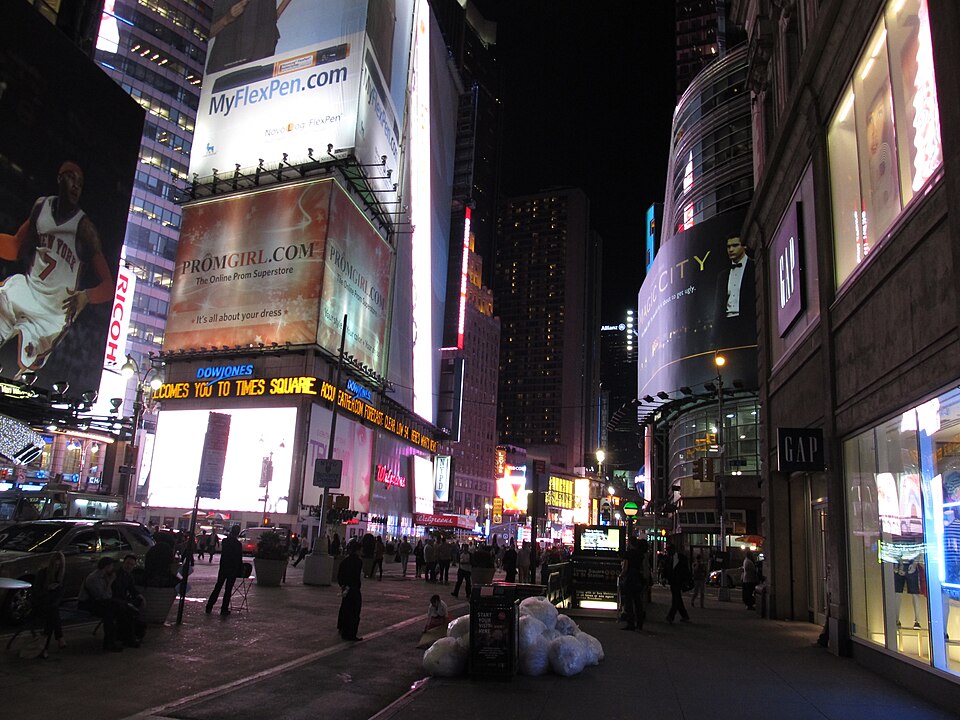
Times Square is simultaneously the most convenient and most misunderstood place to stay near Broadway. The convenience is genuine — you are at the center of the subway system, within walking distance of every Broadway theater, and surrounded by amenities at every hour. The misunderstanding is treating it as automatically the best Broadway base when the Theater District’s side streets and Hell’s Kitchen often produce better evenings at the same or lower cost.
The case for Times Square specifically: first-time visitors for whom the iconic visual experience of Times Square is itself part of the trip, families who want maximum walkability and no navigation complexity, and anyone doing a single overnight where proximity to everything is the only variable that matters. The case against: the restaurant quality immediately around Times Square is poor relative to what’s available six blocks west, the noise and energy are non-stop, and the hotel prices at this precise location don’t always reflect better value than comparable hotels one or two blocks away.
The blocks around Bryant Park — roughly 40th to 42nd Streets between 5th and 6th Avenues — offer an alternative to the Theater District’s Times Square energy that many visitors underestimate. The area is quieter, the hotel stock around Bryant Park tends toward boutique rather than convention-scale, and the proximity to Grand Central, the 42nd Street subway hub, and the southern edge of the Theater District is excellent. Radio City Music Hall is a ten-minute walk north on 6th Avenue.
For visitors whose Broadway theater is in the 40s or whose concert venue is Radio City, Bryant Park / Midtown South is one of the cleanest bases on the map — central enough to eliminate most transit problems, calm enough to feel like staying somewhere rather than just camping in a tourist zone. The restaurant options in the immediate area are solid without being exceptional; the proximity to Midtown East’s better dining adds options within walking range.
The blocks along Central Park South and around Columbus Circle are the city’s classic park-view hotel address — the Mandarin Oriental, the Ritz-Carlton, Park Hyatt and the JW Marriott Essex House all sit within a few minutes of each other. The 59th Street–Columbus Circle station puts the A, B, C, D and 1 trains at the corner, Carnegie Hall is a short walk down 57th Street, Jazz at Lincoln Center is inside the Columbus Circle complex, and Lincoln Center itself is a walk up Broadway.
For Broadway, the northern theaters in the 50s are a comfortable walk, and the rest of the Theater District is a short ride. This is the right base when the trip mixes a show with Lincoln Center, Carnegie Hall, jazz or time in the park — and when a quieter, more polished address matters more than being in the middle of the Times Square energy.
Downtown Brooklyn and its adjacent neighborhoods — Boerum Hill, Cobble Hill, Prospect Heights — represent the strongest neighborhood argument for any trip built around Barclays Center. The arena sits at the Atlantic Avenue–Barclays Center subway station, which is also the neighborhood’s central transit hub. Staying here means walking to your event rather than transiting from Manhattan, and returning home after the game or concert on foot rather than competing for surge-priced rides.
The neighborhood dining scene is one of Brooklyn’s strongest — Atlantic Avenue stretches into excellent Middle Eastern and Mediterranean restaurants, the Boerum Hill and Cobble Hill blocks have some of the best neighborhood restaurants in the outer boroughs, and the pre-event energy around Barclays on game nights has a genuinely different character from Midtown arena nights. Hotel prices run meaningfully below comparable Manhattan properties. For visitors whose trip is Brooklyn-focused or whose primary event is at Barclays, this is often the best overall value proposition on the map.
Long Island City, directly across the East River from Midtown Manhattan, is one subway stop from 42nd Street–Grand Central on the 7 train. Hotel prices here run substantially below comparable Midtown properties, which makes it one of the better value-to-location ratios on the map for visitors whose primary concern is minimizing accommodation cost without dramatically extending their commute. The 7 train also connects directly to Citi Field in Flushing, making LIC a genuinely practical base for Mets-focused trips.
The tradeoff is real: Long Island City is a transit neighborhood rather than an experience neighborhood. The dining scene and street life don’t match Hell’s Kitchen or Downtown Brooklyn. If the plan is to arrive, sleep, and transit to events, it works well. If the neighborhood itself is part of what you want from the trip, it isn’t the right choice.
Best Neighborhoods by Night Type
Theater District for maximum proximity and zero navigation. Hell’s Kitchen for better dining, calmer streets, and meaningful value savings — worth the ten-minute walk for multi-night stays.
Penn Station is directly below MSG. Staying in the surrounding blocks eliminates transit entirely for arena events and keeps Koreatown and Hudson Yards within walking range for dinner.
The only neighborhood on this list where walking to the arena is the default. Better dining than the immediate MSG area, meaningfully lower hotel prices, and a Brooklyn character that suits the venue.
Radio City is on 6th Avenue at 51st Street. Bryant Park is a ten-minute walk south and considerably calmer. Theater District hotels work equally well with a quick subway or short cab.
Proximity and simplicity over optimization. Save the neighborhood-specific strategies for when you know the city better and want to do more with less tourist scaffolding.
Both have the restaurant quality and neighborhood atmosphere that make a date night feel like a real New York evening rather than a Times Square tourist circuit. Plan which venue you’re near first, then choose.
Families benefit most from proximity — every extra transit leg with children adds stress. For Broadway, walk from the Theater District. For other venues, stay as close as budget allows.
Hell’s Kitchen for Broadway trips with meaningful savings over Theater District rates. Downtown Brooklyn for Barclays events. Long Island City for pure budget transit-in accommodation.
Neighborhood Strategy for Broadway Nights
Broadway has a specific neighborhood logic that differs from other entertainment types in one important way: the curtain is at a fixed time and late arrivals are held at the back. This creates a real premium on proximity and navigational simplicity that other venue types don’t require to the same degree.
The Theater District is the correct base for any trip where Broadway is the sole or primary purpose and where convenience matters more than everything else. For first-time visitors, families, and one-night Broadway trips, it’s close to a non-negotiable recommendation — the walk from hotel to theater and back eliminates every transport variable the evening could introduce.
Hell’s Kitchen becomes the right answer when two conditions apply: the visitor is comfortable with a ten-minute walk and cares about where they eat. The neighborhood’s 9th Avenue dining corridor is the best pre-show restaurant zone near Broadway, offering meaningfully better food at meaningfully lower prices than the Theater District core. For couples on a date night, for visitors doing multiple shows over several days, and for anyone who treats the dinner as equally important to the show, Hell’s Kitchen consistently produces better overall evenings than staying closer to the theaters.
Bryant Park and Midtown South work well for Broadway theaters in the southern cluster — the Nederlander, the St. James, the Hayes, the Shubert — where the walk from 42nd Street is comparable to walking from the Theater District’s northern hotels. For Radio City shows or Lincoln Center performances, the logic shifts further north toward the 50s — and for Lincoln Center or Carnegie Hall specifically, Central Park South and Columbus Circle is the cleaner base.
Use this page to choose Theater District vs Hell’s Kitchen vs Midtown. For the event itself, continue to current Broadway shows and ticket guides, last-minute Broadway tickets, or Broadway rush tickets.
Neighborhood Strategy for Concert Nights
Concert neighborhood logic is more venue-specific than Broadway neighborhood logic because New York’s major concert venues are distributed across Manhattan and Brooklyn rather than clustered in one district. The right neighborhood for an MSG show is not the right neighborhood for a Barclays Center show, and treating them interchangeably produces unnecessary friction.
Madison Square Garden and the Penn Station area
MSG sits directly above Penn Station at 34th and 7th, which makes the immediate surrounding blocks — Midtown West, the Penn Station area, the edge of Hell’s Kitchen — the most efficient base for MSG concert nights. Staying within walking distance of the arena eliminates the post-concert transport problem entirely, which is significant: MSG empties thousands of people simultaneously onto the same streets, and rideshare surge pricing after a major show is both real and substantial. The Midtown West blocks immediately north of Penn Station, and the Koreatown strip on 32nd Street, provide solid dinner options before the show.
Once the Midtown West / Penn Station neighborhood decision is made, use the Madison Square Garden concert guide for upcoming concerts and ticket intent, or when to buy concert tickets if timing is the remaining decision.
Radio City Music Hall and Midtown concert venues
Radio City is on 6th Avenue at 51st Street, at the east end of Rockefeller Center. The Theater District, Bryant Park, and the 50th Street hotel corridor all provide reasonable walking-distance or one-short-ride access. Radio City shows tend to attract a more composed pre-show dinner energy than MSG — the Rockefeller Center area and the Midtown East blocks have well-suited restaurant options for the occasion. For the Beacon Theatre on the Upper West Side, the neighborhood logic shifts entirely — staying on the UWS or in the high 60s on the West Side simplifies what is otherwise a non-trivial transit trip from Midtown.
Use the neighborhood strategy here, then continue to the Radio City Music Hall concert guide for the event and concert-ticket side of the night.
Barclays Center
Barclays Center requires the clearest neighborhood commitment of any major venue in New York: if the event is at Barclays, the right base is Brooklyn. The Atlantic Avenue–Barclays Center subway station is the venue’s front door, and the surrounding Downtown Brooklyn, Boerum Hill, and Prospect Heights neighborhoods have the restaurants, the atmosphere, and the hotel value to make staying in the neighborhood the obvious choice. Attempting to base yourself in Manhattan and transit to Barclays for an event — particularly a late one — adds complexity that staying locally avoids entirely.
Downtown Brooklyn solves the stay. For the event itself, continue to the Barclays Center concert guide or last-minute concert ticket guide.
Neighborhood Strategy for Sports Nights
Sports venue location varies more dramatically across New York’s geography than any other entertainment category. The Knicks and Rangers play in Midtown Manhattan. The Nets play in Brooklyn. The Yankees are in the Bronx. The Mets are in Queens. Each venue implies a different neighborhood strategy, and none of them share the same logic.
Knicks and Rangers at MSG
The same Midtown West / Penn Station neighborhood logic that applies to MSG concerts applies to Knicks and Rangers games. The arena is above Penn Station; staying nearby means walking in and walking home. For suburban visitors using NJ Transit or the LIRR — which is genuinely the most efficient way to reach MSG from New Jersey and Long Island — Penn Station arrival puts you at the arena door. Koreatown is five minutes from the arena on foot and one of the city’s best pre-game dining options by any measure: good food, late hours, reasonable prices, and a lively atmosphere that suits the pre-game energy.
Nets at Barclays Center
Nets games at Barclays follow the same neighborhood logic as Barclays concerts — the arena is in Brooklyn, the neighborhood is the right base. Downtown Brooklyn and the surrounding areas have developed a genuine game-day culture around Barclays, with bars and restaurants on the Flatbush Avenue and Atlantic Avenue blocks that understand pre-game timing in the same way Theater District restaurants understand Broadway curtain times. The subway from Midtown takes roughly twenty minutes to the arena entrance, which makes a Manhattan base workable but a Brooklyn base more comfortable.
Yankees at Yankee Stadium
Yankee Stadium in the Bronx is a transit trip from almost anywhere in the city. The 4, B, and D trains all run directly to 161st Street–Yankee Stadium, which is the most consistent way to get there from Midtown or Brooklyn. For visitors whose trip is specifically built around a Yankees game, the question isn’t really which neighborhood to stay in — the subway handles the commute well from anywhere on the west side of Manhattan. The Midtown West or Theater District hotels that are useful for other events remain the practical base, with the subway ride to the stadium treated as part of the game-day experience rather than a logistics problem to be solved.
Mets at Citi Field
Citi Field in Flushing, Queens, is served directly by the 7 train to Mets–Willets Point station. From Midtown, the 7 train runs from Times Square and Grand Central. Long Island City, one stop from Grand Central on the 7, is the most logical budget base for a Mets-focused trip — the combination of lower hotel prices and direct 7 train access to Citi Field creates a genuinely practical arrangement. For visitors combining a Mets game with broader Manhattan activity, Midtown remains the sensible base with the 7 train as the game-day transit plan.
Neighborhoods should answer where to stay. For the game itself, use the matching commercial team page: Knicks, Rangers, Nets, Yankees, or Mets.
The right neighborhood for a Broadway night, a Knicks game, and a Barclays Center concert are three different answers. Most “where to stay in NYC” guides treat Midtown as the single correct answer for any entertainment-focused trip. For Broadway and MSG that’s reasonable. For Barclays, it’s wrong — and staying in Manhattan for a Brooklyn event adds transit friction both ways, on a night when the last thing you want is post-event transportation stress.
When to Stay in the Core — and When to Step Back
The central Midtown location — Theater District, Times Square, Bryant Park — earns its premium under specific conditions. First-time visitors to New York who don’t know the transit system and want the evening to require no navigation decisions beyond walking. Families with young children, where every additional transit leg adds significant logistical overhead. Single-night trips where the specific venue is Broadway or MSG and every minute of the evening matters. Winter trips where the idea of walking twenty minutes in January to get to a restaurant is genuinely unappealing rather than a reasonable trade.
The case for stepping back from the core applies when two things are true: you’re comfortable with the subway or a short walk, and you care about what you eat and where you stay. Hell’s Kitchen, for Broadway trips, is the clearest example — better food, calmer atmosphere, meaningful savings, and a walk that most visitors find straightforward rather than inconvenient. Chelsea / Flatiron works the same way for mixed trips — NoMad and West Chelsea restaurants, calmer hotels, and a short subway ride up to the theaters. Downtown Brooklyn, for Barclays events, is another — the neighborhood is better for dinner than anything adjacent to the arena’s Manhattan alternatives, and the transit advantage of being local is significant.
The general principle: if you’re a first-time visitor or this is a single-purpose one-night trip, optimize for proximity. If you’re returning, staying for multiple nights, or treating the neighborhood as part of the experience, the areas just outside the highest-demand core almost always offer a better overall stay.
What People Get Wrong About NYC Neighborhoods for Nights Out
Times Square is the highest-traffic, highest-price, and frequently lowest-value neighborhood for entertainment-focused trips. Its advantages — proximity to Broadway and the subway hub — are real, but they’re shared by Theater District hotels on quieter side streets and by Hell’s Kitchen hotels one crosstown walk away. The instinct to default to Times Square is understandable; acting on it without checking adjacent options is usually a mistake.
The Theater District is the right base for Broadway because Broadway is in the Theater District. It is not the right base for Barclays Center, Yankee Stadium, or Citi Field, where the transit commute from Midtown adds meaningful friction to the evening. Venue-specific neighborhood planning produces better evenings than one-size-fits-all Midtown booking.
The hotel is where you sleep. The neighborhood is where you eat, drink, and spend time before and after the event. A neighborhood with a strong restaurant scene at the price point that suits your evening produces a fundamentally better trip than one that just reduces the hotel-to-venue walk by three minutes. Hell’s Kitchen vs. Theater District core for Broadway is one version of this. Downtown Brooklyn vs. Manhattan for Barclays is another.
Brooklyn feels conceptually distant to visitors who’ve never been. The Atlantic Avenue–Barclays Center subway station is twenty minutes from Times Square by train. Downtown Brooklyn hotels are almost always meaningfully cheaper than comparable Manhattan properties. And for a Barclays event, staying locally means walking to your seat and walking home — no transit, no surge, no crowd-exiting stress. The perceived distance is not the actual distance.
Where you’re going after the show shapes which neighborhood makes sense before it. A post-Broadway drink in Hell’s Kitchen argues for a Hell’s Kitchen hotel. A post-Nets game late dinner in Prospect Heights argues for a Downtown Brooklyn base. The neighborhood that makes the whole evening flow — before, during, and after the event — is rarely identified by looking only at proximity to the venue entrance.
Neighborhood Guides
Each of these guides covers a specific neighborhood in depth — dining, hotels, transit, and what kind of night it genuinely supports.
Broadway’s home neighborhood — dining, hotels, streets, and how to navigate it well for a show night.
Theater District →The best dining neighborhood near Broadway — why it’s often the smarter base than the Theater District itself.
Hell’s Kitchen →Grand Central’s hotel corridor — Park Avenue hotels, SUMMIT One Vanderbilt, best transit access in Manhattan, and a 10–15 minute walk to Broadway.
Midtown East →Museum Mile, Madison Avenue dining, luxury hotels — the right base for trips combining The Met, Guggenheim, or Frick with Broadway or concert nights.
Upper East Side →Cast-iron streets, design hotels, date-night restaurants — the downtown stay that works best when the neighborhood itself is part of the trip.
SoHo →Luxury hotels, serious restaurants, Hudson River Park, families, cobblestone streets — downtown NYC’s most polished base.
Tribeca →Barclays Center’s neighborhood — the case for staying in Brooklyn rather than transiting from Manhattan.
Downtown Brooklyn →The Penn Station and MSG corridor — where to base yourself for arena nights and commuter rail convenience.
Midtown West →NoMad dining, the High Line, galleries and calmer hotels — a smarter base for mixed trips, one short subway ride from Broadway.
Chelsea / Flatiron →Park-view luxury hotels, Carnegie Hall, Jazz at Lincoln Center and an easy walk to Lincoln Center — Midtown access without the Midtown noise.
Central Park South →Move from neighborhood planning into the current Broadway show and ticket decision.
Browse Broadway Shows →Upcoming MSG concerts, concert-ticket intent, venue planning and the next step after choosing Midtown West.
MSG Concert Guide →Current Barclays concert planning after deciding to stay in Downtown Brooklyn.
Barclays Concert Guide →Knicks tickets, games and schedule after choosing the MSG / Midtown West base.
Knicks Tickets & Schedule →Frequently Asked Questions
The Theater District gives you the most effortless version of a Broadway trip — everything is walking distance, and there’s no transit planning at all. Hell’s Kitchen, just west of it, trades a ten-minute walk for meaningfully better restaurants and lower hotel rates, which makes it the better overall pick for return visitors or anyone doing multiple shows. See the Theater District guide and the Hell’s Kitchen guide for the full comparison.
Downtown Brooklyn, right at the Atlantic Avenue–Barclays Center subway stop. It’s the one venue on this list where staying in the neighborhood — rather than basing yourself in Manhattan and transiting in — is clearly the better call: better restaurants, lower hotel prices, and a walk home instead of a subway ride or a surge-priced car. The Downtown Brooklyn guide covers it in full.
Start With the Venue, Then Choose the Neighborhood
The best NYC neighborhood for your trip is determined first by where your event is, second by how many nights you’re staying, and third by whether the neighborhood has the restaurants and atmosphere that suit the kind of evening you want. Working backwards from those three answers produces a clearer recommendation than browsing hotel sites by star rating.
For Broadway: Theater District for simplicity, Hell’s Kitchen for a better overall evening, Midtown East for the best transit access with a short walk to the theaters. For MSG: Midtown West and the Penn Station corridor. For Barclays: Downtown Brooklyn. For Radio City: Bryant Park or the Theater District. For a calmer, restaurant-first base for mixed trips: Chelsea / Flatiron. For a luxury or downtown stay: SoHo or Tribeca — both work best when the neighborhood is part of the trip, not just a hotel address. For Lincoln Center, Carnegie Hall or a park-view luxury stay: Central Park South and Columbus Circle. For uptown museum trips combined with Broadway or concerts: the Upper East Side. Use the neighborhood guides above for the specific details — dining, hotels, and the practical night-out logistics in full.
The Right Neighborhood Changes the Whole Night
A good NYC night out is not just the show, the game, or the reservation. It is the hotel block, the walk after the curtain, the restaurant before the event, the subway line home, and the neighborhood you actually want to be in when the night slows down.
Theater District
The right call for first-time Broadway visitors, families, short stays, and anyone who wants the simplest walk back after the show.
Open Theater District Guide Best Dining BaseHell’s Kitchen
Broadway walkability with better restaurants, calmer streets, and a real night-out neighborhood feel west of the theater crush.
Open Hell’s Kitchen GuideCore Neighborhood Guides
Broadway · Midtown · DowntownTheater District
Maximum show-night simplicity, theater walkability, family-friendly logistics, and the highest-convenience Broadway base.
Hell’s Kitchen
Pre-theater restaurants, 9th Avenue energy, Restaurant Row, calmer hotels, and Broadway without Times Square overload.
Midtown West
Broadway, MSG, hotels, restaurants, Penn Station logic, and a strong base for mixed show/concert/sports weekends.
Times Square
When the energy is the point, when convenience beats calm, and when staying right in the center actually makes sense.
Bryant Park / Midtown South
A polished central compromise for Broadway, Grand Central, Midtown hotels, library-area calm, and flexible subway access.
Downtown Brooklyn
The smart base for Barclays Center nights, Brooklyn concerts, value-focused stays, and strong subway access to Manhattan.
More Night-Out Neighborhoods
Village · Union Square · LICGreenwich Village
Downtown restaurants, comedy, jazz, date-night walks, intimate venues, and a more local-feeling NYC night out.
Union Square
A strong downtown launch point for Webster Hall, Irving Plaza, East Village dining, subway access, and flexible returns.
Long Island City
Hotel value, skyline views, subway access, and the important question: are you actually using transit enough to justify the stay?
Yankee Stadium Area
River Avenue, stadium bars, subway vs driving, post-game flow, and how to use the Bronx around a Yankees night.
Forest Hills
Forest Hills Stadium, Austin Street restaurants, LIRR/subway access, and open-air concert night planning.
Upper West Side
Beacon Theatre, Lincoln Center, calmer hotels, neighborhood restaurants, and one of NYC’s best walkable culture bases.
Upper East Side
The Met, Guggenheim, Frick, Madison Avenue dining, luxury hotels, and a quieter Midtown alternative for museum-anchored trips.
Midtown East
Grand Central transit hub, Park Avenue hotels, Chrysler Building, SUMMIT One Vanderbilt, and the best-connected Midtown base.
SoHo
Cast-iron streets, design hotels, date-night restaurants, shopping, galleries, and a downtown base worth building a trip around.
Tribeca
Luxury hotels, serious restaurants, Hudson River Park, families, cobblestone streets, and downtown NYC at its most polished.
Plan by Night-Out Type
Shows · Concerts · SportsBroadway in NYC
Shows, theaters, first-time visitor planning, hotel zones, restaurants, transit, and post-show returns.
NYC Concerts
Venue guides, seating guides, concert-night restaurants, hotels, transportation, and date-night planning.
Sports in NYC
Yankees, Mets, Knicks, Nets, Rangers, Islanders, Giants, Jets, stadiums, arenas, seating, and game-night logistics.
NYC Restaurant Guides
Pre-theater dinner, concert dining, sports-night meals, date-night restaurants, and neighborhood-specific food planning.
NYC Hotel Guides
Where to stay for Broadway, concerts, sports, families, romantic weekends, transit access, and venue-specific nights.
NYC Transportation Guides
Subway, rideshare, parking, walking, trains, venue arrivals, and the smartest way home after the night ends.
Use This Hub While Reading
On-Page JumpsHow to Choose
The real questions: how long you are staying, what event you are planning, and how you want the night to feel.
The Neighborhoods
Theater District, Hell’s Kitchen, Bryant Park, Chelsea, Downtown Brooklyn, Penn Station, and more.
Best Areas by Night Type
Broadway nights, MSG concerts, Barclays events, Yankees games, first-time visits, and date nights.
Central vs. Nearby
When Times Square is worth the premium and when stepping back into a calmer neighborhood makes more sense.
Common Mistakes
Wrong hotel zones, dinner in the wrong direction, overpaying for proximity, and ignoring the post-show plan.
Explore the Guides
Jump to the individual neighborhood guides and build the full night around the area that actually fits.