

The Theater District NYC — A Guide for Broadway Visitors
What the area is actually like, where Broadway theaters are, and how to use it well for a night of Broadway musicals, plays, dining, or a full weekend stay.
The Theater District NYC is the reason most people come to this part of New York. Nearly all Broadway theaters are concentrated in this Midtown Manhattan corridor, roughly from 40th to 54th Streets between 6th and 8th Avenues, with Times Square at its center. For a visitor whose trip is organized around a Broadway musical or play, this Theater District Manhattan corridor is the neighborhood that will define the evening. It’s loud, it’s convenient, it’s unmistakably New York, and it rewards visitors who understand how it works and frustrates those who don’t.
This guide to the New York Theater District is built for that decision: whether the area is the right base for your specific trip, where Broadway is in relation to Times Square, what the experience of being there actually looks like, and how to get the most out of the Theater District Times Square corridor regardless of which neighborhood you ultimately choose to stay in.
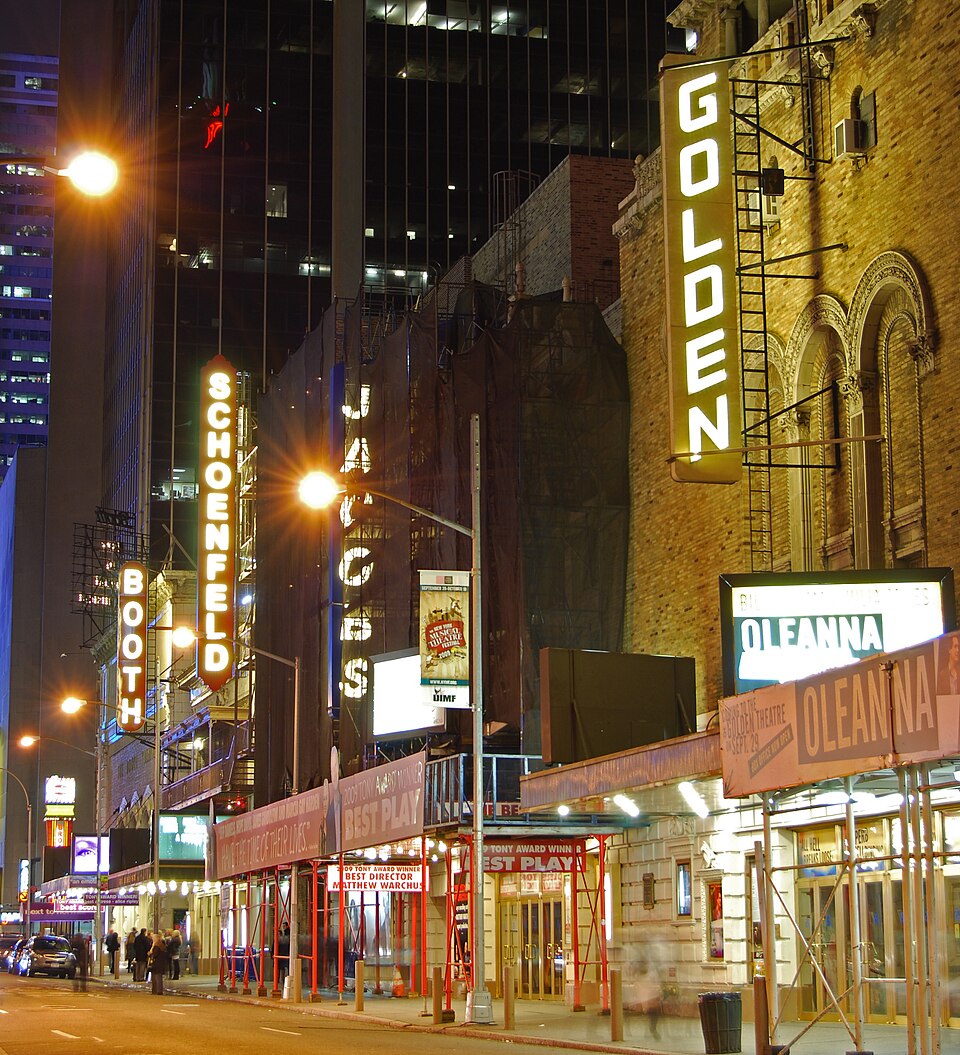
Where Broadway Is in NYC: Musicals, Plays & Theaters
If you’re asking where Broadway is in New York, there are two answers. Broadway the street runs for miles through Manhattan, but Broadway theater is concentrated here in the Theater District. Nearly all Broadway houses sit in the Midtown area around Times Square, mostly on the side streets between 6th and 8th Avenues rather than directly on Broadway itself. That is why searches for the Broadway theater district, the Manhattan Theater District, and Broadway theaters near Times Square are all pointing to essentially the same part of the city.
This is also the core area for Broadway musicals in New York and Broadway plays in NYC. The specific production changes from theater to theater and season to season, so this neighborhood guide does not try to duplicate the live show listings. For what’s playing now, including current musicals and plays, use our current Broadway shows guide. For the buildings themselves — addresses, histories, seating-guide links, and venue planning — use the Broadway theaters guide.
Use this Theater District page to decide where to stay, eat, walk, and position yourself for the night. Use the Broadway show pages to choose what to see, and the theater pages to understand the specific venue. If you’re buying close to curtain time, our last-minute Broadway tickets guide owns that ticket-buying decision.
Broadway theaters near Times Square
Times Square is the visual center of the district, but many Broadway theaters are one or two blocks off the square on West 44th, 45th, 46th, 47th, 48th, 49th, 50th, 51st, and 52nd Streets. That matters when you’re planning dinner, a hotel, or the walk to curtain: a place described as “near Times Square” may still be several crowded blocks from your actual theater. Always plan around the theater address, not Times Square as a single point.
What the Theater District Is Actually Like
The Theater District is not a neighborhood in the residential sense. It doesn’t have a corner bodega where locals pick up coffee on the way to work, or a park where people walk their dogs on Sunday mornings. It’s a commercial and entertainment zone that runs at full volume from mid-morning until well past midnight, shaped almost entirely by the rhythms of Broadway shows, tourist foot traffic, Midtown office workers, and the constant churn of Times Square.
Before a show — particularly in the 6:00 to 8:00 PM window — the blocks around the main theater cluster on 44th, 45th, and 46th Streets are crowded but organized. People are moving with purpose. Restaurants have turned over one seating and are cycling through another. The marquees are lit. The energy is genuinely exciting in the way that New York at its most concentrated tends to be exciting. It feels like something is happening, because something is.
After the show — roughly 10:30 to 11:00 PM — the same streets empty fast. Multiple Broadway shows releasing their audiences within the same short window creates a brief surge of foot traffic that disperses quickly. Within twenty minutes, 44th Street is noticeably calmer. The immediate neighborhood doesn’t have much of a late-night bar scene; the energy moves west toward Hell’s Kitchen or south toward the Meatpacking District if people want to continue their evening somewhere with actual character.
Times Square itself — the specific intersection of Broadway and 7th Avenue around 42nd to 47th Streets — is something distinct from the broader Theater District and worth understanding separately. It operates as a 24-hour tourist destination with its own logic: the LED boards, the costumed performers, the chain restaurants, the souvenir shops. The Theater District surrounds Times Square but is not the same thing. You can stay in the Theater District and be two blocks from Times Square without being directly in its blast radius, which matters considerably for how the trip feels.
What the area does well
Transit access is genuinely exceptional. The connected Times Square–42nd Street / 42nd Street–Port Authority complex serves the 1, 2, 3, 7, A, C, E, N, Q, R, W, and 42nd Street Shuttle services, which makes this one of the city’s most useful transit hubs. For visitors combining Broadway with other Midtown attractions — Rockefeller Center, the Museum of Modern Art, Central Park — the Theater District is as well-positioned as anywhere in Manhattan. The hotel density is high and the range is wide, from budget pods to full-service luxury properties, and the competition keeps rates at every tier in check relative to similarly positioned neighborhoods elsewhere in the city.
What it doesn’t do well
The dining immediately adjacent to Times Square is the area’s most consistent weakness. The high tourist volume and commercial rents create conditions where mediocre restaurants priced for visitors survive alongside genuinely good ones, and the difference isn’t always obvious from the outside. The streets closest to 7th Avenue and 42nd Street — the tourist core — skew most heavily toward chains and overpriced mid-range spots. The better restaurants in the Theater District are generally one or two blocks removed from that core, or on Restaurant Row along 46th Street west of 8th Avenue, where the pre-theater crowd creates a more sustainable dining ecosystem.
Who the Theater District Works Best For
The Theater District is not the right base for every Broadway visitor. Understanding who benefits most from staying or centering an evening here makes the decision considerably easier.
For a first Broadway trip, the simplicity of being able to walk to and from the theater without a subway decision or a surge-priced rideshare is genuinely valuable. The Theater District’s core convenience eliminates the logistics that most often go wrong on a first visit.
Short trips with Broadway as the primary purpose benefit most from proximity. The theater is the whole point; everything else is secondary. Staying in the Theater District maximizes the show-focused part of the visit.
Managing children after a Broadway show at 11:00 PM is considerably easier when the hotel is a five-minute walk away. The subway is always an option, but not having to use it with tired kids is worth the location premium.
Visitors who know how the area works and are comfortable with the subway often find Hell’s Kitchen a better base — better dining, calmer streets, slightly lower hotel rates, still walking distance to every theater.
The Times Square energy becomes wearing over multiple nights. For a longer stay, a slightly more residential neighborhood with better restaurants tends to produce a better overall trip even accounting for the extra few minutes’ walk to the theater.
If the Broadway show is the centerpiece and you want everything smooth and walkable, the Theater District works. If the dinner and the after-show drink matter as much as the show itself, Hell’s Kitchen offers a better dining environment at a comparable distance.
Theater District vs. Nearby Neighborhoods
The most useful thing this page can do is help you choose between the Theater District and the alternatives. Here’s the honest comparison.
Times Square is not a neighborhood — it’s an intersection and the blocks immediately surrounding it. The Theater District contains Times Square but extends well beyond it, north to 54th Street and west to 8th Avenue. Staying in the Theater District and staying “in Times Square” are often the same thing in practice, but the specific block matters. A hotel on West 44th Street between 8th and 9th Avenues is technically in the Theater District and is a fundamentally calmer experience than a hotel directly on 7th Avenue and 45th Street, which is in the heart of Times Square. When people say they don’t want to “stay in Times Square,” what they usually mean is they don’t want to be directly on the tourist-dense blocks around the LED boards. Two blocks west, the feel changes considerably.
Hell’s Kitchen sits immediately west of the Theater District, beginning roughly at 8th Avenue and running to about 11th Avenue, between 42nd and 57th Streets. For a Broadway-focused trip, the practical difference between the two neighborhoods is smaller than most people expect. Every Broadway theater is within a ten to fifteen-minute walk from 9th Avenue. The subway connections are equivalent. The meaningful differences are in dining and atmosphere: Hell’s Kitchen has considerably better pre-theater restaurants, particularly along 9th Avenue and on Restaurant Row at West 46th Street, and quieter side streets once you move west of 8th Avenue. Hotel rates in Hell’s Kitchen are generally somewhat lower for comparable properties. The tradeoff is that the walk from the furthest reaches of Hell’s Kitchen to some theaters can push fifteen minutes — not a burden for most visitors, but worth knowing.
For first-timers and families, the Theater District’s extra convenience is worth the tradeoff. For repeat visitors or anyone who cares significantly about where they eat, Hell’s Kitchen is the stronger choice.
The stretch of Midtown between roughly 38th and 42nd Streets, around Bryant Park, offers central Manhattan access with a notably lower tourist density than the Times Square core. It’s one subway stop or a twelve to fifteen-minute walk from most Broadway theaters — manageable for a single evening, but less convenient for trips where you’re going to shows multiple nights in a row. The hotel options here can be good value. The dining scene is more eclectic and less theater-focused. For visitors whose trip combines Broadway with other Midtown priorities — meetings, shopping, Grand Central-adjacent activities — this area can make sense. For pure Broadway focus, it’s a compromise.
Ask yourself: if the show ends at 10:45 PM and you want to be somewhere comfortable within the next twenty minutes, where do you want that somewhere to be? If the answer is your hotel room, stay in the Theater District. If the answer is a bar or restaurant with some character to it, Hell’s Kitchen is a better base. That post-show twenty minutes is where neighborhood choice shows up most clearly.
Eating in and Around the Theater District
The Theater District’s dining situation is more nuanced than its reputation suggests, in both directions. It’s not all tourist traps — there are genuinely excellent restaurants in the neighborhood. But it does require more intentionality than a neighborhood like Hell’s Kitchen, where a walk along 9th Avenue in either direction will turn up several good options without much planning.
Where the good dining actually is
Restaurant Row on West 46th Street between 8th and 9th Avenues is the Theater District’s most reliable pre-show dining strip. The block has been feeding Broadway crowds for decades, and the restaurants there — Italian, Mediterranean, American, French — are practiced at the pre-theater rhythm. Joe Allen, Becco, and Lattanzi have been institutions on this block for a reason. The service understands curtain times and the pacing works. It’s not the most exciting dining in the city, but it’s consistent, the walk to most theaters is under ten minutes, and the environment is genuinely pleasant rather than chaotic.
Further into Hell’s Kitchen — 9th and 10th Avenues in the 44th to 56th Street range — the dining quality improves and the tourist density drops. Marseille on 9th Avenue at 44th Street, Nizza nearby, and The Marshal further west are all worth the extra few minutes’ walk. For a date night or a celebration meal before a show, these restaurants offer a meaningfully better experience than most of what you’ll find closer to 7th Avenue.
Pre-show vs. post-show logic
Pre-show dinner works best when the restaurant and the theater are close enough that the walk between them doesn’t add timing pressure. For an 8:00 curtain, sitting down by 6:00 or 6:15 at a restaurant within a ten-minute walk of the theater is the right structure. Anything further requires either eating quickly or leaving the restaurant anxious about the clock, which defeats the purpose.
Post-show is a different calculation. The Theater District blocks around the main theater cluster empty fast after curtain — there isn’t a strong late-night dining scene immediately adjacent to the theaters. If you want a proper drink or meal after the show, having a destination in mind — a bar in Hell’s Kitchen, a restaurant that stays open late — beats wandering out of the theater hoping something good is still open nearby. Our pre-theater dining guide covers the best options with timing advice for both situations.
A late comedy set instead of a late dinner
If the theaters clear out and you’re not ready for the night to end, a comedy show is the easiest way to keep it going without leaving the neighborhood. Comedy Village at 352 West 44th Street sits on a Theater District block west of 8th Avenue, a few minutes’ walk from most houses, and runs shows every night. Broadway Comedy Club at 318 West 53rd Street is a 10 to 15 minute walk north. Book a set that starts at least 30 to 45 minutes after your show is scheduled to end, and expect a drink minimum on top of the ticket. Our guide to comedy shows in NYC covers both clubs, the downtown rooms worth the subway ride, and how to time comedy after Broadway.
Live jazz after the curtain
For music instead of stand-up, Birdland at 315 West 44th Street, between 8th and 9th Avenues, is the Theater District’s own jazz club and a short walk from most Broadway houses. It runs more than one set a night, and the later set is the one that works after a show. Expect a cover charge and a per-person minimum, book ahead on weekends, and go straight over when the curtain comes down: reserved seats can be released shortly after a set starts. Our jazz clubs NYC guide covers Birdland, the Greenwich Village rooms and Smoke on the Upper West Side, with covers and set times for each.
Staying in the Theater District
The Theater District has the highest hotel density of any area in this guide, with options at every price point from basic pod hotels to full-service properties with concierge, room service, and Broadway-adjacent everything. The concentration of competition keeps rates at each tier more in check than you might expect for such a central location, though premium nights — Tony season, holiday weekends, major limited runs — push prices up across the board. For the block-by-block breakdown — which specific hotels sit closest to which theaters — see our hotels near the Theater District guide.
When the location premium is worth paying
The clearest cases for paying Theater District hotel rates are short visits (one or two nights), first Broadway trips, and family outings where post-show logistics matter. In all three situations, the ability to walk to and from the theater without a transportation decision adds genuine value that justifies the premium. For a two-night trip where both nights involve Broadway shows, being within a five-minute walk of the theaters is worth real money in reduced friction.
When to reconsider
For stays of three or more nights, particularly if dining quality matters to you, the calculus shifts. The additional cost of a Theater District hotel over a comparable Hell’s Kitchen property, multiplied across several nights, can easily fund several excellent dinners — and the ten-minute walk difference to the theater is trivial once you know the area. Repeat visitors who book Theater District rates out of habit rather than necessity are often paying a premium they no longer need.
One practical note: the specific block within the Theater District matters for hotel feel in a way that the broader neighborhood label doesn’t capture. A hotel on West 48th Street between 8th and 9th Avenues will be noticeably calmer than one directly on 7th Avenue, even though both are “in the Theater District.” If noise is a concern — and Times Square hotels can be loud, particularly on weekend nights — look at the specific street address and which direction the rooms face before booking.
Getting Around the Theater District
The Theater District’s transit situation is one of its strongest assets. The connected Times Square–42nd Street / 42nd Street–Port Authority complex serves the 1, 2, 3, 7, A, C, E, N, Q, R, W, and 42nd Street Shuttle services. From the Theater District, Grand Central and Penn Station are both easy to reach, and most Manhattan neighborhoods are accessible directly or with a simple transfer. For visitors combining Broadway with broader city exploration, the location is exceptionally practical.
Within the Theater District itself, walking is almost always the right answer. The Broadway theater cluster is concentrated through the West 40s and low 50s around Times Square, with most houses only a few blocks from one another. Taxis and rideshares are available but are often slower than walking in the pre-show window when Midtown traffic is heavy. The one exception is bad weather, when a cab from a hotel on one end of the district to a theater on the other can be worth the wait and the cost.
Post-show, the Times Square subway station gets crowded in the 10:45 to 11:15 PM window as Broadway audiences and late-night tourists converge. If you’re taking the subway home after a show, walking one or two blocks to the 50th Street station or the 42nd Street–Port Authority station can mean a shorter wait and less crowding. Our full transport guide covers this in detail.
What People Get Wrong About the Theater District
Times Square is part of the Theater District, not the whole of it. The blocks between 8th Avenue and 9th Avenue in the mid-40s feel genuinely different from the LED-board chaos of 7th Avenue and 42nd Street. Visitors who write off the entire area as “too Times Square” are often turning down hotel locations that are a perfectly reasonable base for a Broadway trip.
Some are, particularly the chains on 42nd Street and the blocks closest to Times Square. But Restaurant Row on 46th Street, the stretch along 9th Avenue in Hell’s Kitchen, and a handful of genuinely good spots scattered through the district mean that bad dining is a choice rather than an inevitability. Joe Allen, Becco, Lattanzi, Marseille, Nizza, and The Marshal are established options that understand Broadway timing. The key is doing five minutes of research rather than defaulting to whatever is visible from the theater door.
The most common evening mistake in the Theater District is sitting down to dinner at 7:00 for an 8:00 show. Ninety minutes sounds like plenty of time; in practice, with menus, courses, the check, and a walk to the theater, it’s tight at best and stressful at worst. For an 8:00 curtain, a 6:00 or 6:15 reservation is the right call. For a 7:00 curtain, adjust to 5:00 or 5:15. The restaurants around Broadway understand this rhythm — the challenge is getting visitors to trust it.
The Theater District’s immediate post-show landscape — the blocks around the main theater cluster at 10:45 PM — is not a destination. The area clears quickly, and what’s left is late-night chains and bars that cater to the remaining tourist crowd rather than theater-goers looking to decompress over a good drink. Having a specific place to go after the curtain, even if it’s just a bar on 9th Avenue twenty minutes from the theater, converts a slightly anticlimactic ending into an evening that actually concludes well. A late comedy set a few blocks away works too. So does a late jazz set at Birdland on West 44th Street.
It’s often the right choice, but not always. For repeat visitors, longer stays, or anyone who cares significantly about the quality of their pre-show dinner, Hell’s Kitchen offers nearly identical Broadway access with meaningfully better dining and a calmer hotel environment. The Theater District earns its premium for specific trips and specific visitors — it shouldn’t be the default for everyone who buys a Broadway ticket.
Frequently Asked Questions
The Theater District is the section of Midtown Manhattan where nearly all Broadway theaters are located, roughly from 40th to 54th Streets between 6th and 8th Avenues, with Times Square at its center. It’s a commercial and entertainment zone rather than a residential neighborhood, built around Broadway shows, hotels, and pre- and post-theater dining.
Not exactly. Times Square is the specific intersection of Broadway and 7th Avenue and the blocks immediately around it. The Theater District is the broader area that contains Times Square but extends further north and west. You can stay well within the Theater District — on West 48th Street, for example — without being directly in the Times Square tourist core.
The Theater District is a busy, heavily trafficked part of Midtown, including late into the evening around Broadway curtain times. As anywhere in New York, use normal city awareness, watch your belongings in dense crowds, and plan your route after the show rather than assuming every block will feel equally active late at night.
The Theater District sits in Midtown Manhattan, roughly from 40th to 54th Streets between 6th and 8th Avenues. Times Square is at its center, and the connected Times Square–42nd Street / 42nd Street–Port Authority subway complex provides access to numerous subway services.
Both work well. The Theater District wins on walkability and simplicity — you can reach most theaters in five to ten minutes on foot. Hell’s Kitchen, immediately to the west, generally has better and less touristy dining and slightly lower hotel rates, at the cost of a somewhat longer walk to some theaters. First-timers and short stays tend to do better in the Theater District; repeat visitors and longer stays often prefer Hell’s Kitchen.
Broadway the street runs through much of Manhattan, but Broadway theater is concentrated in the Theater District around Times Square. Most Broadway theaters are on the side streets in the West 40s and low 50s rather than directly on Broadway itself.
Yes. Times Square sits at the center of the Theater District, and most Broadway theaters are within a short walk of it. The exact theater address matters, though: a theater on West 52nd Street and one on West 41st Street are both part of the Broadway district but can be several busy blocks apart.
Most Broadway musicals and plays are staged in the Theater District in Midtown Manhattan. Because productions and theaters change over time, use our current Broadway shows guide to see what’s playing now, then use the Theater District guide to plan the hotel, dinner, and transportation around the performance.
Yes. Birdland, at 315 West 44th Street between 8th and 9th Avenues, is a short walk from most Broadway theaters and runs a late set that fits after a show. Book that set, expect a cover charge and a per-person minimum, and head over as soon as your curtain comes down. For the Village clubs, Smoke on the Upper West Side and the rest of the city, see our jazz clubs NYC guide.
How to Use the Theater District Well
The theatre district of New York is exactly what it claims to be: the center of Broadway in New York, where musicals, plays, theaters, hotels, restaurants, and Times Square all overlap, with all the convenience, energy, and crowding that implies. Used well — with a dinner reservation timed properly, a hotel on a block that doesn’t put you directly in the Times Square blast zone, and a post-show plan that takes you somewhere with actual character — it delivers a genuinely excellent Broadway night. Used passively — whatever restaurant is closest, wherever the crowd goes after the show — it can feel expensive and slightly hollow despite the remarkable theater at its center.
The difference between those two experiences is almost entirely planning. A show worth seeing, a dinner reservation made with the curtain time in mind, and a clear sense of where the evening goes after the curtain comes down. The Theater District provides the infrastructure for all of it. What you bring to it determines what you get back.
The Theater District Works When Broadway Is the Center of the Night
The Theater District is the easiest Broadway base in New York — but it is not automatically the best full night out. Use it for short stays, first trips, family logistics, and walk-back simplicity. Then use Restaurant Row, Hell’s Kitchen, transit, and hotel strategy to make the night feel better than a tourist default.
Restaurants Near Broadway
Use this when the show is fixed, the curtain time matters, and you need dinner that does not turn into a rushed Midtown mistake.
Plan Dinner Walk-Back SimplicityHotels Near Broadway
For first-timers, families, and short trips, a Theater District hotel can be worth the premium because the exit is easy.
Plan the StayCore Broadway Night Planning
Dinner · Hotels · Transit · TicketsBroadway in NYC
Main Broadway hub for shows, theaters, first-timers, planning guides, dining, hotels, and ticket strategy.
Best Broadway Shows for First-Time Visitors
Perfect next step for the visitors most likely to benefit from a Theater District base.
Last-Minute Broadway Tickets
Use this when the neighborhood plan is set but the show choice or ticket timing is still flexible.
Restaurants Near Broadway
Restaurant Row, Hell’s Kitchen, pre-show timing, post-show options, and how to avoid Times Square dining traps.
Hotels Near Broadway
Theater District, Times Square, Hell’s Kitchen, Midtown West, and where staying close is worth the premium.
How to Get to a Broadway Show
Subway, walking, rideshare, parking, late-night exits, and the real movement around Times Square.
Use This Guide While Reading
On-Page JumpsWhat It’s Like
Noise, crowds, Times Square overlap, Broadway energy, and the difference between convenience and atmosphere.
Who It Works For
First-timers, families, short trips, repeat visitors, longer stays, and date-night tradeoffs.
vs Nearby Areas
Theater District vs Times Square, Hell’s Kitchen, Midtown West, and Bryant Park / Midtown South.
Dining Strategy
Restaurant Row, 9th Avenue, curtain timing, and why the closest visible restaurant is often not the answer.
Staying Here
When the hotel premium is worth it, when it is not, and how the exact block changes the trip.
Common Mistakes
Late dinner reservations, no post-show plan, confusing Times Square with the whole district, and default dining.
Compare the Nearby Neighborhoods
Theater District · Hell’s Kitchen · Times SquareTheater District Guide
Best when Broadway convenience, short walks, first-time simplicity, and family logistics matter most.
Hell’s Kitchen Guide
Better restaurants, calmer side streets, stronger post-show drinks, and still walkable to every Broadway house.
Times Square Guide
Maximum spectacle, bright lights, chain hotels, tourist infrastructure, and the full Times Square experience.
Bryant Park / Midtown South
Better for longer mixed itineraries where Broadway is important but not the entire trip.
Midtown West Guide
Better for MSG concerts, Knicks, Rangers, Penn Station, Koreatown, and event logistics south of the theaters.
Koreatown Guide
Useful when a Broadway weekend also includes MSG, Penn Station, late food, Korean BBQ, or karaoke.
Restaurants, Hotels & Night-Out Support
Food · Stay · Transit · ParkingPre-Show Dining Guide
Reservation timing, curtain-time math, Restaurant Row, and how to avoid eating anxiously before an 8pm show.
Best Pre-Theater Restaurants
Broader restaurant picks for Broadway, Off-Broadway, date nights, families, and special nights.
Best Post-Show Restaurants
Use this when the night should continue after the curtain instead of ending in the Times Square crowd flow.
Hotels Near the Theater District
Which specific hotels sit closest to which theaters, by cluster — not just a general Broadway hotel strategy.
Where to Stay for Broadway Weekends
Compare Theater District, Hell’s Kitchen, Times Square, Midtown West, and calmer Manhattan bases.
Parking Near Broadway
Garage strategy, driving tradeoffs, Midtown traffic, and when transit beats bringing a car into the core.
NYC Transportation Guides
Subway, walking, rideshare, parking, late-night exits, and event movement across NYC.
Comedy Shows NYC
Comedy Village on West 44th, Broadway Comedy Club and the downtown rooms, plus how to time a late set after curtain.
Best Late-Night Restaurants
Kitchens still open after Broadway lets out, for when the night keeps going past 11.
Jazz Clubs NYC
Birdland on West 44th for a late set after curtain, plus the Village Vanguard, Blue Note, Smalls and Smoke.
Restaurants Near Times Square
Where to eat in the tourist core without paying for the view, and which blocks to skip.
Hotels Near Times Square
Stays in the brightest blocks of the district, and how to pick a quieter room nearby.
Broader Stage & Street Planning
Broadway · Night Out · NeighborhoodsBroadway vs Off-Broadway
Helpful when deciding whether the Theater District is the right night or whether a downtown show fits better.
Off-Broadway in NYC
Use this when the show night does not need the full Theater District spectacle.
NYC Restaurant Guides
Pre-show dinners, post-show meals, date-night restaurants, special nights, and neighborhood dining strategy.
NYC Hotel Guides
Where to stay for Broadway, concerts, sports, families, date nights, and transit-friendly weekends.
NYC Neighborhood Guides
Compare Theater District with Hell’s Kitchen, Times Square, Midtown West, Bryant Park, Brooklyn, Queens, and more.
NYC Night Out Hub
Restaurants, hotels, transportation, neighborhoods, Broadway, concerts, sports, and complete evening planning.