

The Yankee Stadium Area — Event Night Guide
What the area around Yankee Stadium is actually like, who benefits from using it as a base, and how to plan an event night that works for the neighborhood rather than against it.
The area around Yankee Stadium works well — but only if you understand what it is. It is not a polished entertainment district. It is not a neighborhood with late-night dining depth and after-show cocktail bars. It is a working South Bronx residential community that happens to contain one of the most storied sports venues in American history, and that transforms dramatically for a few hours around each event. For the right kind of visit, the area is genuinely useful. For the wrong kind, it is better understood as a destination you pass through rather than linger in.
This guide is for people planning an event night at Yankee Stadium — a Yankees game, a concert, an NYCFC soccer match, the Pinstripe Bowl — who want to understand the area as part of their planning, not just the venue itself. Whether to stay here, whether to eat here, how transportation shapes the experience, and what kind of night actually works in this part of the Bronx.
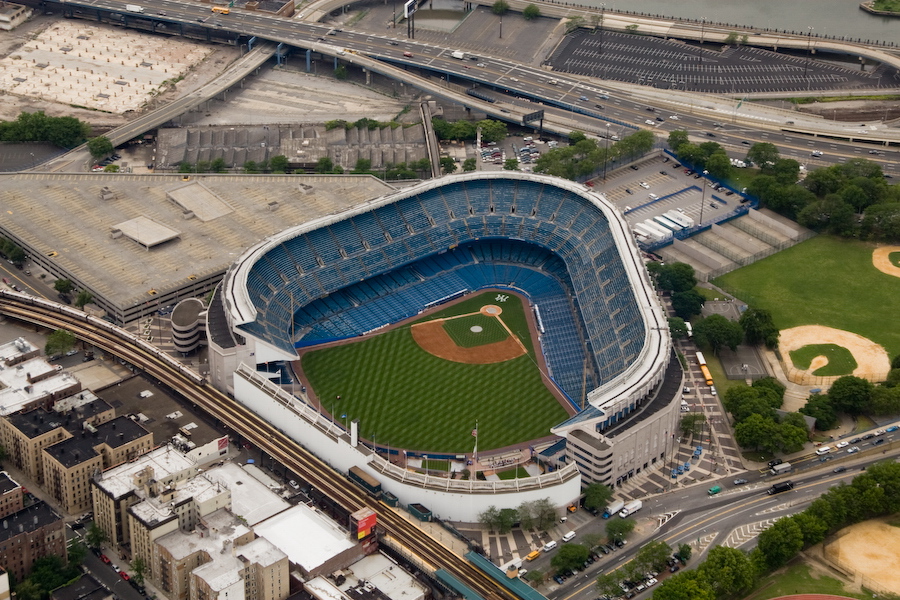
Aerial view of Yankee Stadium and the surrounding Bronx area.
Where the Yankee Stadium Area Fits in the City
Yankee Stadium sits at 1 East 161st Street in the Concourse section of the South Bronx — specifically at the intersection of 161st Street, River Avenue, and the Grand Concourse, which has been the neighborhood’s main thoroughfare since the 1900s. The Concourse is a predominantly residential neighborhood in the southwestern part of the borough, bordered by Highbridge to the west along the Harlem River and Melrose to the east.
The Grand Concourse itself has genuine architectural character — it is one of the largest collections of Art Deco residential buildings outside of South Beach, Miami, built to house the borough’s growing population in the 1920s and 1930s. The neighborhood is historically significant and legitimately interesting if you are inclined to look at it that way. But the Concourse’s character as an area, day to day, is residential and community-serving. The corridor that activates for stadium events — River Avenue, the blocks along 161st Street, the area within a few hundred feet of the stadium gates — is a small subset of the broader neighborhood.
For orientation: Yankee Stadium is about 25–30 minutes from Midtown Manhattan by the 4 train (no transfers required), and is served by the 4, B, and D trains at the 161st Street–Yankee Stadium subway station — the same station that served the original stadium for generations. Metro-North also stops at the Yankees–East 153rd Street station, a 3-minute walk south of the stadium, giving suburban commuters from Westchester, Connecticut, and upstate a direct route without the subway. By car, the Major Deegan Expressway (I-87) provides the primary highway access.
The implication of all that transit: the Yankee Stadium area is not isolated. It is well-connected to the rest of the city, and many visitors use it effectively as an in-and-out destination rather than a base. Understanding which approach fits your trip is what the rest of this guide is about.
What the Area Feels Like on Event Nights
The transformation that happens around Yankee Stadium on event nights is real and visible. A few hours before a Yankees home game or a major concert, River Avenue becomes a genuine stadium corridor: vendors working the sidewalk, bars and restaurants with full capacity and spillover crowds, pinstripes everywhere, a noise level that is entirely different from the neighborhood on a non-event day. The 4 train unloads a continuous wave of fans at the station steps from the gates. The energy is specific and earned — this is what a major urban sports venue looks like when it is functioning at capacity.
That energy, however, is concentrated. It exists on River Avenue, along the east side of 161st Street toward the stadium, and in the blocks immediately adjacent to the gates. One street further in either direction and you are back in the working neighborhood: residential buildings, corner stores, the regular life of the Concourse. This is worth naming directly because some visitors arrive expecting a multi-block entertainment district and find something more contained.
After events, the area clears quickly. The post-game rush hits the subway platforms hard for 15–20 minutes, then thins considerably. The River Avenue bars stay open and absorb the lingering crowd, but it is not a neighborhood with much midnight dining depth or late-night options beyond those specific establishments. Visitors who want to extend the evening beyond the gates — for a real dinner, a proper bar night, a nightcap somewhere with more atmosphere — are better served taking the train back to Manhattan or Harlem, or ridesharing to Arthur Avenue in the Belmont neighborhood, which has some of the best Italian restaurants in New York City about 30–35 minutes east by car.
For daytime events or afternoon games, the area has a slightly different character. The Grand Concourse is active at midday — community institutions, local foot traffic, the Bronx Museum of the Arts a short walk north — and the pregame build-up to an afternoon game has a more relaxed pace than the compressed energy of a 7pm first pitch. Families attending afternoon games find the area more navigable and less crowded than evening event nights.
Who Should Actually Use This Area as a Base
The key question for any visitor planning around Yankee Stadium: is this a trip where the game or event is the whole point, or is this a New York City trip that happens to include a game? That distinction shapes everything else — where to stay, whether eating nearby makes sense, and whether the area’s logistics simplify or complicate the evening.
If you are arriving for the game, staying overnight, and leaving the next day, a Bronx hotel near the stadium simplifies the whole night. No subway stress after the final out, no post-game transit calculation. The area hotels are meaningfully less expensive than comparable Manhattan properties. The pregame bar strip on River Avenue does exactly what a pregame bar strip is supposed to do. For a purpose-built game trip, the area works.
A baseball-specific weekend in the Bronx — two or three games, Monument Park, a stadium tour, maybe dinner at Arthur Avenue before an evening game — is genuinely well-served by staying in the area. You are not fighting the stadium logistics twice a day, the area’s character suits the purpose of the trip, and the value on hotel pricing is real when amortized over several nights. This is the strongest use case for a Bronx base.
Hotels near Yankee Stadium price well below equivalent Manhattan properties, and the transit connection is strong — the 4 train runs directly from 161st Street to Grand Central, Midtown, and downtown Manhattan without transfers. For a visitor comfortable using the subway and focused on minimizing accommodation costs, the Bronx area is a legitimate strategy for a full New York City visit, not just a stadium trip. The subway proximity at the Opera House Hotel (one block) makes this work even for visitors with tight schedules.
If New York City is the destination and the game is one element of a broader trip — museums, neighborhoods, restaurants, Central Park — a Manhattan or Harlem hotel serves far better. The stadium area does not have the restaurant variety, neighborhood character, or evening infrastructure that supports a full multi-day New York visit. Take the 4 train to the game from Midtown or Harlem, and spend the money saved on a better dinner in your actual neighborhood.
The stadium area’s bar scene is a pregame and immediate postgame scene, not a late-evening destination. If the plan is dinner, a game, and then a proper bar night somewhere with more depth, the area does not support it. The River Avenue bars work for a post-game beer while traffic clears; they are not the environment for a fuller evening. Plan the post-game portion of that kind of night in Harlem, Upper Manhattan, or wherever you are staying.
For a major stadium concert, the area functions the same way it does for baseball — pregame bar energy, post-show transit choices, no late-night dining depth. Whether the area makes sense as a base for a concert trip depends on the same factors: is this concert the whole trip, or is it part of a broader visit? For summer festival-style events that run very late, knowing that the post-show subway will be crowded and the nearby late-night options are limited is worth planning around.
Where Hotels Fit Into the Decision
The Bronx near Yankee Stadium has a handful of solid hotel options at prices that compete well with Manhattan — and in some cases, against Midtown and even Harlem. The value proposition is real, but it requires an honest read of what you are trading for it.
The Opera House Hotel is the most distinctive nearby property — a former Bronx performance venue housing a 78-room hotel with spacious rooms, complimentary breakfast, and a one-block walk to the subway. Its reviews consistently note room quality well above what the price suggests, and it functions as an effective base for both Yankees trips and general New York visits if you are comfortable on the subway. The Wingate by Wyndham Haven Park adds a full-service option: on-site Latin fusion restaurant (Rosa’s at Park), rooftop terrace, breakfast, and valet parking about 1.2 miles from the stadium. Hotel 365 Bronx solves the parking problem specifically — free on-site parking for drivers who want to avoid the stadium lot costs. The Comfort Inn & Suites near Stadium delivers standard chain reliability at competitive pricing.
What these hotels share: they are in a working South Bronx community, not a visitor corridor. The immediate neighborhood is urban and residential in a way that requires some comfort with that environment — reviewers across all properties note this consistently, and it is worth knowing in advance rather than discovering at check-in. The hotels themselves are clean, functional, and in several cases genuinely good. The surroundings are honest New York.
The decision rule is straightforward: if the event is your primary reason for being in New York, staying nearby eliminates a variable — the post-game subway rush, the late-night logistics, the second-taxi-of-the-night feeling — without adding much complexity. If New York itself is the destination, a Manhattan or Harlem base serves the broader trip better and still gets you to the game via the 4 train in 25 minutes. The hotels near Yankee Stadium guide covers the specific properties, what each one actually delivers, and when each makes sense.
Where Restaurants Fit Into the Decision
The area around Yankee Stadium has a clear and honest dining story: the immediate stadium corridor — River Avenue, East 161st Street — offers a pregame bar-and-food scene that does exactly what a pregame scene is supposed to do, and not much more. Yankee Tavern has been there since 1927. Court Deli has been there since 1936. Billy’s Sports Bar handles the overflow when everyone wants to be on the same block at the same time. These spots are legitimate; they are not culinary destinations.
For visitors whose primary goal is to eat, drink, and get into the game efficiently, the River Avenue strip delivers that. Arrive 75–90 minutes before first pitch, get a table at Yankee Tavern or a counter seat at Court Deli, have something honest and good, walk to the gate. The system works.
The more interesting dining option — which many repeat Yankee Stadium visitors discover — is Arthur Avenue in the Belmont neighborhood, about 30–35 minutes by rideshare east of the stadium. Arthur Avenue has some of the best Italian-American restaurants in New York City, in a neighborhood that feels genuinely different from the stadium area: family restaurants, a functioning Italian retail market, real character. For evening games where you have time, eating at Arthur Avenue before driving or ridesharing to the game changes the whole quality of the night. Zero Otto Nove and Emilia’s are the specific recommendations for that route.
Post-game dining options near the stadium are limited. The bars stay open and serve food, but the area is not a late-night restaurant district. If dinner after the game is the plan, heading elsewhere — Harlem, Upper Manhattan, or back to wherever you are staying — is more reliable than expecting the stadium area to accommodate a full post-game restaurant evening. The restaurants near Yankee Stadium guide covers the full picture, including the River Avenue options, the Arthur Avenue detour, and how to time everything around different event schedules.
How Transportation Shapes the Area
Transit access is the single greatest asset of the Yankee Stadium area. Very few major American sports venues are this directly served by public transit — a subway station literally at the stadium gates, served by three lines (4, B, D), with direct connections to every part of Manhattan and beyond. This transit strength changes the whole area calculus: it means visitors do not need to stay nearby to have easy stadium access, it means parking is genuinely optional for most visitors, and it means the post-game exit — while crowded for the first 15 minutes — eventually resolves cleanly.
The subway is the right default for most visitors
The 4 train from Grand Central to 161st Street takes about 25 minutes, runs frequently on game nights, and deposits you at the stadium gate. For visitors staying in Midtown, the Upper East Side, or Harlem, this is the move. The B and D trains serve visitors from the West Side and Upper Manhattan. No transfers required for either. The post-game crowding at 161st Street is real — plan to wait 15–20 minutes after the final out before heading to the platform, or build in a stop at a River Avenue bar while the first wave clears.
Metro-North changes the equation for suburban visitors
The Yankees–East 153rd Street Metro-North station, a 3-minute walk south of the stadium, runs direct Yankee Clipper service from Grand Central for all evening and weekend home games on the Hudson Line, with additional service from Harlem and New Haven Lines on game days. For visitors staying in Westchester, Connecticut, or using Grand Central as a transit hub, Metro-North delivers a direct, crowd-separated, stress-free ride to the game. This is often the best transit option available and remains underused by visitors who default to the subway without checking.
Driving and parking: when it makes sense
The Major Deegan Expressway (I-87) provides the primary highway access to the stadium area, with connections to the Cross Bronx Expressway and other major routes. Parking is managed by City Parking — roughly 9,000+ spaces across seven garages and lots at around $49 for self-park, bookable in advance. Driving makes sense primarily for visitors coming from New Jersey or the outer suburbs, families with young children who want maximum flexibility, or late-night concerts where the post-event subway feels less appealing. For visitors coming from Manhattan or the inner boroughs, the subway is almost always the faster and cheaper call. The parking near Yankee Stadium guide covers the specific lots, advance booking strategy, and post-game exit timing that makes parking actually work.
Arrival and departure timing shape the whole experience
In this neighborhood, when you arrive and when you leave matters more than at many venues. Arriving 90 minutes before first pitch gives you time for a pregame stop on River Avenue without fighting the peak-crowd rush. Leaving immediately after the final out means navigating a compressed post-game crowd at the subway. Waiting 20 minutes — at a bar, on a bench, in the stadium concourse — typically results in a dramatically more comfortable exit. The area rewards patience on departure in a way that changes whether the evening feels smooth or frantic.
The full picture on transit options, including subway routes from different parts of the city and the complete Metro-North guide, is in the how to get to Yankee Stadium guide.
How Your Seat Changes Your Relationship With the Area
One connection that is easy to miss: where you sit at Yankee Stadium affects how the surrounding area fits into your night, not just the experience inside the gates.
A Field Level premium seat — Legends Suite, Champions Suite — implies a full-service environment inside the stadium. The question of where to eat before the game almost answers itself: either at the club inside, or at a nicer pre-game restaurant that warrants a separate reservation. The River Avenue bar strip is not necessarily the right pre-game for a Legends Suite night. Arthur Avenue for dinner before a 7pm game, arriving at the stadium 45 minutes before first pitch, works better for that level of investment.
A Main Level infield seat — the best value baseball position in the stadium — works well with a casual River Avenue or Court Deli pregame. Arrive 75 minutes before, eat something honest and quick, walk to the gate relaxed. The seat and the pregame logistics match each other.
A bleacher ticket implies a different kind of night entirely: maximum energy, full pregame participation, the Bleacher Creatures, and a post-game experience of being in the noisiest possible part of the crowd. The River Avenue pregame energy matches this perfectly.
The Yankee Stadium seating guide covers seat decisions for all event types — baseball, concerts, NYCFC soccer, and more. Reading it alongside this area guide gives you the full picture of how the venue and the neighborhood work together for a given kind of night.
How to Think About a Full Yankee Stadium Night
There are a few distinct versions of a Yankee Stadium night, and each one uses the area differently. Knowing which one describes your situation makes the planning straightforward.
The most common approach for NYC-based visitors. Take the 4 train, stop at Yankee Tavern or Court Deli pregame, go to the game, wait out the post-game crush, take the train home. No hotel needed. Clean and efficient. The neighborhood exists to serve exactly this plan.
Drive or rideshare to Arthur Avenue for a real Italian dinner at Zero Otto Nove or Emilia’s, then rideshare to the stadium for a 7pm game. Elevates the food portion significantly without adding much complexity. Best for visitors who want a genuinely good meal as part of the night.
Hotel nearby, pregame bar stop, game, quick return to the hotel after the game clears. Removes all transit variables. Best for visitors for whom the game is the trip — especially visitors flying in from out of town.
Pre-booked City Parking garage, arrive 90 minutes before first pitch, walk to the gate, stay 20 minutes after the game for traffic to thin, exit south on the Major Deegan. Best for families, visitors with cars, and suburban attendees who find the subway less appealing for evening events.
The underused excellent option. Grand Central to the stadium in under 30 minutes on the Yankee Clipper, with a train that is far less crowded than the subway post-game and that provides direct service for both the inbound and outbound legs. Best for visitors from Westchester, Connecticut, or anyone staying near Grand Central who wants to skip the subway entirely.
Two or three games, nights at the Opera House Hotel or Wingate, dinner at Arthur Avenue on one night, Monument Park visit, maybe the Bronx Museum of the Arts. The fullest version of using the area as a base rather than just a destination. The trip where the Bronx is the point, not just the stadium.
The area around Yankee Stadium is a residential South Bronx neighborhood that activates dramatically on event nights and returns to its regular character when the crowd clears. Its strengths are transit access (among the best of any major American sports venue), event-night bar and dining energy on River Avenue, hotel value relative to Manhattan, and the ease of logistics for visitors whose primary reason for being in the Bronx is the event itself. Its limitations are equally clear: no late-night dining depth, no polished entertainment district beyond the immediate stadium corridor, and a neighborhood character that is honest New York rather than visitor-optimized.
For the right kind of visit, the area is a practical, legitimate base. For the wrong kind, it is better used as a destination you commute to rather than linger in. The 4 train does not care which approach you choose — it gets you there from wherever you are staying.
Frequently Asked Questions
The area is a predominantly residential South Bronx neighborhood — the Concourse section — centered on the Grand Concourse and 161st Street. It is a working-class urban community with some architectural character (Art Deco residential buildings along the Grand Concourse) and strong subway access. On event nights, the immediate stadium corridor on River Avenue activates with bars, restaurants, and crowd energy. Away from that corridor, it is a regular NYC neighborhood. It is not an entertainment district, not a polished visitor area, and not comparable to neighborhoods like Hell’s Kitchen or the West Village for evening atmosphere — but it has genuine character and serves stadium visitors well when you know what to expect.
It depends on what kind of trip you are planning. For visitors whose primary purpose is the stadium event — flying in for a game, doing a baseball weekend, wanting to minimize post-game transit complexity — yes, the Bronx hotels near the stadium offer real value at prices well below comparable Manhattan properties, with strong subway access for getting around the rest of the city. For visitors doing a broader New York trip where the game is one element among many, a Harlem or Manhattan base serves better and still gets you to the game via the 4 train in 25 minutes. The full hotel analysis is in the hotels near Yankee Stadium guide.
If the game or event is your primary reason for being in New York: consider the Bronx, especially for one-night trips and baseball weekends. If New York City is your destination and you are also going to a game: stay in Harlem or Manhattan, take the 4 train to 161st Street, and use the hotel money on a better dinner. Harlem is the specific middle-ground option — cheaper than Midtown, a few stops closer to the stadium than Midtown, a neighborhood with real restaurants and culture. The decision is about the shape of your trip more than pure stadium convenience.
Yes, for the pregame specifically. Yankee Tavern (open since 1927) and Court Deli (open since 1936) are both legitimate, and Billy’s Sports Bar handles groups who want to drink more than dine. The River Avenue strip does its job well for pregame logistics. For a genuinely good dinner, Arthur Avenue in the Belmont neighborhood — about 30–35 minutes east by rideshare — has some of the best Italian restaurants in New York City. Zero Otto Nove and Emilia’s are the specific recommendations. The full picture is in the restaurants near Yankee Stadium guide.
For a game-centered night out, yes — the pregame energy on River Avenue is the right kind of pregame energy, and the post-game bar options let you decompress while waiting for the crowds to thin. For a full-evening dinner-and-drinks-and-show kind of night with multiple destinations, the area does not have the infrastructure. After the game, the better plan is usually moving elsewhere — Harlem, Upper Manhattan, or wherever you are staying — for the second act. The area’s event-night strengths are concentrated in the hours before and immediately after the event, not in late-evening entertainment depth.
More than at almost any other major New York venue. The transit access is excellent, which means staying nearby is not required to have easy stadium access — but it also means that the post-game subway experience (crowded for the first 15–20 minutes after the final out) is a real planning factor. The Metro-North Yankee Clipper is the underused excellent option for visitors near Grand Central. Parking works well if pre-booked in advance through the official City Parking garages. The choice between subway, Metro-North, and driving shapes the whole evening’s logistics in ways that other venue areas do not require you to think through. The transportation guide is the right starting point for that decision.
Plan for What the Area Is, Not What You Assume It Might Be
The Yankee Stadium area is good at what it is. It is a well-connected, event-infrastructure neighborhood that supports a stadium crowd efficiently, has genuine pregame energy, and offers hotel value that beats Manhattan for visitors whose trip is event-first. It is not a neighborhood that extends the evening in interesting directions, provides a polished urban dining scene, or functions as a destination beyond the stadium itself.
Use it for what it is: a reliable event-night base for the right kind of visitor, and a smart in-and-out destination via excellent transit for everyone else. The 4 train, the Metro-North Yankee Clipper, and Arthur Avenue for a proper pre-game dinner are the three things that, once you know about them, make a Yankee Stadium night genuinely easy to plan well.
The Yankee Stadium Area Works Best When the Event Is the Point
The area around Yankee Stadium is not a polished nightlife district. It is a working South Bronx neighborhood that becomes a focused stadium corridor on event nights. Use the subway, Metro-North, River Avenue, nearby hotels, parking strategy, and Arthur Avenue wisely, and the night can feel smooth instead of chaotic.
How to Get to Yankee Stadium
The 4, B, D, Metro-North, rideshare, walking routes, Grand Central connection, and post-game crowd timing shape the whole night.
Open Transit Guide Event-First StayHotels Near Yankee Stadium
Use this when the game or stadium event is the trip and removing post-event transit stress is worth more than a Manhattan base.
Open Hotel GuideThe Full Yankee Stadium Cluster
Seats · Food · Hotels · Transit · ParkingYankee Stadium Area Guide
The neighborhood layer: Concourse, River Avenue, South Bronx reality, event-night energy, hotels, food, transit, and who should stay nearby.
Yankee Stadium Seating Guide
Baseball, concerts, NYCFC, sightlines, premium sections, bleachers, field level, upper deck, and event-specific seat strategy.
Restaurants Near Yankee Stadium
Yankee Tavern, Court Deli, Billy’s, River Avenue pregame options, and the Arthur Avenue dinner-first move.
Hotels Near Yankee Stadium
Opera House Hotel, Wingate, Hotel 365, Comfort Inn, Bronx value, parking, subway access, and event-first hotel logic.
How to Get to Yankee Stadium
The 4 train, B/D trains, Metro-North Yankee Clipper, Grand Central, Harlem, Midtown, driving, and post-game exits.
Parking Near Yankee Stadium
Official lots, pre-booking, Major Deegan access, post-game traffic, family trips, and when driving makes sense.
Use This Guide While Reading
On-Page JumpsWhere It Fits
Concourse, South Bronx, Grand Concourse, 161st Street, subway access, Metro-North, and how the area sits in NYC.
Event Nights
River Avenue activation, pregame crowds, stadium energy, post-game clearing, and what changes on game days.
Who Benefits
One-night trips, baseball weekends, budget-conscious visitors, families, concert attendees, and when Manhattan is smarter.
Restaurants
River Avenue for pregame convenience, Arthur Avenue for a real dinner, and why post-game dining is limited nearby.
Transportation
Subway, Metro-North, driving, parking, timing, Grand Central, and how the exit strategy shapes the whole night.
Full Night Plans
Convenience-first, dinner-first, overnight stay, drive-in game night, Metro-North night, and stadium-focused Bronx weekend.
Baseball, Sports & Stadium Planning
Yankees · Baseball · Sports Nights · VenuesBaseball in NYC
The baseball hub for Yankees, Mets, Yankee Stadium, Citi Field, Subway Series, seating, families, tourists, and game-day planning.
NYC Sports Hub
Teams, venues, seating guides, first-time planning, family guides, date-night logic, and sports-night neighborhoods.
Best Neighborhoods for Sports Nights
Compare Yankee Stadium with MSG, Barclays, Citi Field, MetLife, UBS Arena, Prudential Center, and other game-night bases.
Citi Field Area Guide
Queens baseball comparison: Citi Field, Flushing food, 7 train / LIRR, and a very different stadium-neighborhood plan.
MetLife Stadium Area
Giants, Jets, tailgating, parking-first logic, NJ Transit, hotels, and how an NFL stadium night differs from Yankee Stadium.
NYC Concert Venue Guides
Use this when Yankee Stadium is a concert venue instead of a baseball venue, and compare it with other major NYC rooms.
Food, Hotels & Transit Support
Pregame · Hotel Base · Subway · ParkingNYC Restaurant Guides
Restaurant planning across Broadway, concerts, sports, stadiums, date nights, families, and neighborhood-focused nights.
NYC Hotel Guides
Compare Bronx event-first hotels with Midtown, Harlem, Times Square, Brooklyn, Queens, and stadium-area bases.
Where to Stay for Shows & Events
Use this to decide whether a Bronx base, Harlem, Midtown, or another neighborhood actually fits the whole trip.
NYC Transportation Guides
Subway, Metro-North, rideshare, parking, stadium exits, event timing, and getting between neighborhoods.
NYC Subway Tips for Shows & Events
Helpful because the 4, B, and D trains are the default answer for most Yankee Stadium visitors.
NYC Night Out Hub
Restaurants, hotels, transportation, neighborhoods, Broadway, concerts, sports, and full-evening planning.
Compare Nearby & Competing Event Bases
Bronx · Manhattan · Queens · Stadium AreasMidtown West Guide
Better for Madison Square Garden, Penn Station, Knicks, Rangers, MSG concerts, and mixed Midtown event weekends.
Upper West Side Guide
Beacon, Lincoln Center, Central Park, AMNH, calmer hotels, and a Manhattan base with better full-trip infrastructure.
Times Square Guide
Better for first-time NYC visitors who want Broadway, tourist orientation, and central Manhattan infrastructure.
Bryant Park / Midtown South
Better for mixed trips that include Broadway, Midtown, Grand Central, restaurants, and one Yankee Stadium game.
Long Island City Guide
Useful for value-focused hotel planning, skyline views, Queens access, and subway-comfortable repeat visitors.
NYC Neighborhood Guides
Compare entertainment neighborhoods for Broadway, concerts, sports, hotels, restaurants, transportation, and full-night planning.