

How to Use the NYC Subway for Shows & Events
A practical NYC subway guide for show nights — how to ride, choose routes and stations, pay the fare with OMNY, handle service changes, find the right exit, and plan the ride back before the curtain drops.
Most NYC event visitors have the same instinct: open Google Maps, find the subway stop, and assume the rest works itself out. It usually does — until it does not. The subway gets you close. What actually determines whether the night is smooth or stressful is whether you planned the full chain: which station entrance, which exit, which direction, how long the walk is, and what happens after the show when five thousand other people are trying to do exactly what you are doing.
This guide is not a subway basics tutorial. It is an event-specific guide to the decisions that matter on show nights — which venues reward the subway, which ones require something else, how early to leave, how to handle the return, and what the most common visitor mistakes actually are.
If you are figuring out how to use the NYC subway for the first time, you will also find the essentials here: how to choose a route and direction, how local and express service affects the trip, how much the subway costs, how to pay with OMNY, how transfers work, and how to check weekend or late-night service before an event.
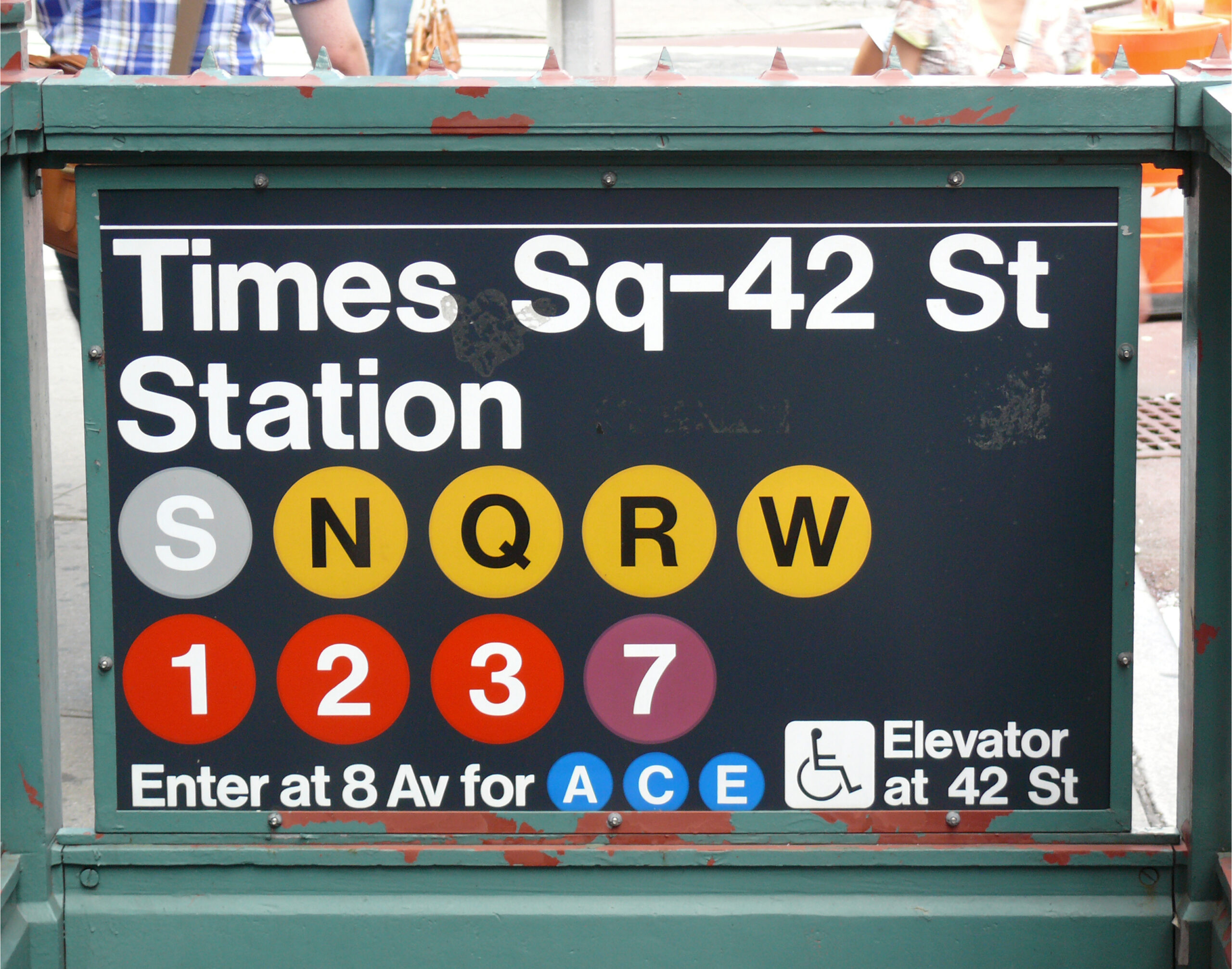
Times Square–42nd Street station signage — a fitting NYC subway anchor for planning Broadway shows, concerts, sports games, transfers, station exits, and post-event returns.
How to Use the NYC Subway for a Show, Concert, or Game
For an event night, using the NYC subway is less about memorizing the entire system and more about getting five decisions right before you leave: the route, the direction, the fare, the transfer plan, and the station exit. The official MTA subway map is useful for seeing how lines connect; live service status matters just as much because weekend work and late-night changes can alter the route you expected.
Plan Door to Seat, Not Station to Station
Visitors planning a show night usually look at the subway map and confirm that a train goes to the venue. That part is easy. What they rarely plan is the whole chain: hotel or restaurant exit → walking to the station → buying or tapping in → correct platform, correct direction → any transfer → the right station exit → which way on the sidewalk → security line → the seat. Every one of those links takes time on event nights, and Google Maps estimates are typically built for normal conditions, not for the moment when several thousand people are doing the same thing.
Add 15 to 20 minutes to whatever your maps app estimates before a major event. More for stadiums. More for families. More when weather is bad. A slightly farther subway station with a cleaner exit and a calmer walk can beat the technically closest station if that station exits onto a crowded corner with confusing signage.
The Exit Is Part of the Route
“Do not ask only, ‘What subway goes there?’ Ask, ‘What is the easiest full route from where I am eating or staying to my seat?’ That is the difference between arriving calm and arriving sweaty.”
NYC Subway Map, Routes and Lines: What Event Visitors Actually Need
The NYC subway map is the right tool for understanding which lines connect your hotel, restaurant, and venue, but a static map is only the first layer. For a timed event, pair the map with current service status so you know whether the train is running express or local, skipping a stop, terminating early, or being rerouted for maintenance.
New York subway routes are identified by letters and numbers, not by color alone. Several lines share the same color but make different stops. Before leaving, confirm the exact train letter or number, the direction of travel, the transfer station if there is one, and the final station exit. That is more useful for a show night than trying to memorize the full New York subway system.
When Is the Subway Better Than Taxi or Rideshare?
The answer changes by venue, by time of night, and by how large the event is. The general principle is this: when traffic near the venue is heavy and the route is direct, the subway almost always beats a car. When the route requires complicated transfers, the weather is bad, or you are traveling with very young kids late at night, a car may genuinely be the better call.
Subway Often Wins When
- Going to Broadway, MSG, Barclays, Yankee Stadium, Citi Field, Radio City, Beacon, or Carnegie
- Traffic near the venue will be heavy on event night
- It is raining or event traffic is pushing rideshare prices higher
- You are leaving with thousands of other people after the show — rideshare waits and prices can spike
- You want predictable cost and timing
- The route is direct or has one simple transfer
- You are comfortable with the route before leaving
Car May Be Better When
- Mobility or step-free access is needed and elevator status is uncertain
- Traveling with very young children late at night
- Weather is severe and the walk to/from station is long
- Route requires multiple complicated transfers
- Wearing formal clothes or carrying large items
- Group size makes car cost reasonable per person
- Venue is UBS Arena or MetLife Stadium — not standard subway venues
- Your hotel is awkwardly located relative to useful lines
One important post-event note: rideshare pricing and pickup waits after major concerts and games at MSG, Barclays, and stadiums can jump when a large crowd exits at once. Letting the first wave pass, walking one or two blocks from the main exit crowd where appropriate, or taking the subway home can be more practical than requesting a car the moment the event ends.
NYC Subway Tips by Venue
Broadway is one of the best cases for the subway — the Theater District is served by more train lines than almost anywhere in the city, and the final walk from station to theater is typically short. The mistake most visitors make is defaulting to Times Square–42nd Street for every Broadway show. That station works for theaters on 42nd and 44th, but theaters on 45th–54th Street are often better served by 49th Street, 50th Street, or other nearby stops. Match your station to your theater’s address, not to Times Square by habit.
After a show, the Times Square station fills quickly. Waiting 10 minutes, walking a block to a different entrance, or strolling toward 8th or 9th Avenue before descending can make the return meaningfully calmer.
MSG is arguably the best-served major arena in the country by transit. Penn Station sits directly beneath the arena, and every train that runs into Penn Station — Amtrak, LIRR, NJ Transit, and multiple subway lines — deposits you essentially at the arena entrance. For visitors coming from anywhere in Manhattan, the 1/2/3 trains are the most direct options from most hotel areas. The A/C/E provides additional access from the west side and Downtown.
The transit advantage is also the crowd challenge: the Penn Station corridor handles enormous event-night volumes, and the streets directly around 34th Street and 7th Avenue get congested quickly after shows. If your hotel is within a 15–20 minute walk of MSG, walking may genuinely be faster than waiting for a packed post-event train.
Barclays Center sits at one of the largest transit intersections in Brooklyn, with the Atlantic Avenue–Barclays Center station serving nine subway lines and LIRR Atlantic Terminal directly across the street. From most parts of Manhattan, the 2/3 express from Penn Station is among the fastest options at roughly 15 minutes. The B and D provide direct service from Midtown and the Upper West Side.
The key to making this work as a transit night is committing to Brooklyn before you leave. Visitors who eat in Midtown, take the subway to Barclays, go to the show, and then try to navigate the return from Atlantic Avenue at 11pm have a harder time than those who treat the whole evening as a Brooklyn night and know exactly how they are getting back.
Radio City sits in the Rockefeller Center corridor with multiple accessible station options. The B/D/F/M at 47–50 Streets–Rockefeller Center puts you essentially at the front door. Visitors staying on 5th Avenue or the east side can use 5 Av/53 St. For anyone coming from Times Square, it is worth checking whether walking the eight blocks from Times Square takes less time than waiting for the right train connection — it often does.
After shows, Radio City’s Midtown location disperses well. The surrounding blocks have good density and multiple station options, which means the post-event crowd spreads rather than funneling into a single exit.
Yankee Stadium is genuinely subway-accessible at 161 St–Yankee Stadium. The 4 and D serve the station, while B service is a weekday option when operating. Travel time from Midtown varies by starting point, service pattern, and transfer. The key consideration is that stadium events generate very large crowds, and the station after a sold-out concert or baseball game can be slow to clear. For concerts especially, having the return route planned — including knowing which direction you are going and where you are transferring — before you leave for the stadium is the smart move.
Citi Field is reachable by the 7 train from Times Square and Midtown, with the Mets–Willets Point station sitting right at the stadium. The 7 is often the most efficient option for Manhattan hotel guests. From certain Long Island locations, the LIRR Port Washington branch to Willets Point offers a faster alternative worth checking based on your origin.
The 7 train after a stadium concert or baseball game carries a very large crowd, and the platform at Willets Point can be crowded. Building extra time for post-event rail and expecting a slower-than-normal return is the right mindset. If you are with families or older visitors, patience at the platform is more important than trying to rush the first train.
The Beacon is one of the cleanest subway-to-venue experiences in the city. The 1/2/3 at 72nd Street deposits you a short walk from the theater, and the 1 at 79th Street works for those coming from the south who want to walk down. The whole logic here is to make it an Upper West Side night: eat on the Upper West Side, take the subway or walk, and keep the evening in one neighborhood. Visitors who eat in Times Square and cab up are adding stress they do not need.
Both venues are straightforward by subway. Carnegie Hall is best reached from 57th Street and 7th Avenue. Lincoln Center has its own dedicated stop on the 1 train at 66th Street. Neither venue generates the post-event crowd surge of MSG or Barclays — walking a block or two in any direction after a performance here feels calm rather than chaotic. For hotel guests in Midtown, Columbus Circle, or the Upper West Side, walking can be as easy as the train for either venue.
These two venues require a fundamentally different planning approach. UBS Arena at Belmont Park on Long Island is reachable by LIRR (approximately 30 minutes from Penn Station), not by subway. MetLife Stadium in East Rutherford, New Jersey is served by NJ Transit game-day bus service from the Port Authority and by train to Secaucus Junction — it is not accessible by NYC subway at all.
For both venues, plan transit before dinner. Visitors who treat these like standard Midtown venues and plan a relaxed subway ride after a meal will run into significant timing problems. See the dedicated transit guides for both.
For smaller concert venues, the subway strategy is neighborhood-specific rather than arena-specific. Bowery Ballroom (Lower East Side), Irving Plaza (Union Square/14th Street), and Webster Hall (East Village) are all easy subway venues from multiple lines. Terminal 5 on the far west side of Midtown is accessible but the surrounding blocks are sparse — build in the walk from 10th Avenue. Brooklyn Steel and Brooklyn Paramount are in North Brooklyn and Downtown Brooklyn respectively — check the current best line for each based on your starting point, as routes from Manhattan differ.
For late-night club shows, always verify the return route before the show starts. Club events ending at midnight or 1am can have different service frequencies than shows ending at 10:30pm.
Venue-by-Venue Subway Strategy Snapshot
| Venue | Subway? | Best Strategy |
|---|---|---|
| Broadway / Theater District | Easy | Choose station by theater cross street — not always Times Square |
| Madison Square Garden | Easy | Penn Station access; post-event wait 15–20 min before returning |
| Barclays Center | Easy | Atlantic Av hub; treat the night as Brooklyn end-to-end |
| Radio City Music Hall | Easy | 47–50 Sts–Rockefeller Ctr or walk from Times Square |
| Beacon Theatre | Easy | 72nd St / Upper West Side — make it a neighborhood night |
| Carnegie Hall | Easy | 57 St/7 Av; walking from Midtown West also works well |
| Lincoln Center | Easy | 66 St–Lincoln Center (1 train); direct and calm |
| Yankee Stadium | Good | 4/D to 161 St; B when operating on weekdays; plan return direction before leaving |
| Citi Field | Good | 7 train to Mets–Willets Point; build in post-event time |
| Forest Hills Stadium | Good | E/F/M/R to Forest Hills–71 Av; plan ahead for late events |
| UBS Arena | LIRR Only | Penn Station → LIRR; not a subway venue — plan accordingly |
| MetLife Stadium | No Subway | NJ Transit only; eat before heading to the stadium |
How Early Should You Leave for a NYC Event?
The app estimate is a floor, not a plan. It assumes you walk at a normal pace, the train comes immediately, there is no transfer delay, and the station exit is uncrowded. For events, add a meaningful buffer. Not because the subway is unreliable, but because the crowd conditions on event nights are genuinely different from normal commute conditions.
Add 10–15 min buffer to app estimate. More with kids, will-call, bags, or if walking from a venue-adjacent restaurant.
If you only care about the headliner, listed start time ≠ headliner time. Still arrive before the crowd surge — plan based on doors-open, not listed start.
Security, entry, and crowd flow at venues over 15,000 capacity add real time. For MSG, Barclays, Yankee Stadium, and Citi Field, 45+ minutes before listed time is not excessive.
For families, add 15–20 minutes to whatever you plan for an adult group. Bathroom stops, stairs, kids’ pace through crowded stations, and keeping the group together all take longer than expected. Arriving with a buffer turns an event night into a relaxed experience; arriving on the edge makes it a sprint that none of the kids will remember fondly.
The underlying rule: for NYC events, “on time” means near the venue before the crowd surge — not stepping out of the subway at the listed start time.
Subway Exits Matter More Than You Think
Large NYC subway stations can have exits that emerge on different avenues, different sides of the street, and sometimes in completely different blocks. The wrong exit from Times Square can add five minutes and significant sidewalk confusion. Herald Square, Penn Station, Atlantic Avenue, Grand Central, and Columbus Circle all have multiple exits that lead to meaningfully different places on the street above.
Before you leave for any event, check: the nearest cross street of your venue, which avenue it sits on, whether the station exit you are using puts you on the right side of that street, and which direction you walk from the exit. This takes two minutes to look up at home with full signal. It is nearly impossible to do reliably underground or in a crowded station while also managing a group, watching the time, and finding the right platform.
The Train Gets You Close. The Exit Gets You There.
“For NYC events, the exit is part of the route — not a detail to figure out after you arrive. Know which exit to take before you go underground.”
Save your directions before you go underground — signal is unreliable in many stations and drops entirely in others. A screenshot of your walking directions from the station exit to the venue entrance takes thirty seconds and can be the difference between calm arrival and frantic sidewalk navigation.
Transfers: When to Take Them, When to Walk Instead
Take the Transfer When
- It saves significant walking distance
- It avoids bad weather exposure
- It is simple, clearly signed, and you know it
- The route is familiar and you are not on a tight clock
- The transfer station is a major hub with clear wayfinding
Skip It and Walk When
- Traveling with kids, older adults, or heavy bags
- The transfer is underground and confusing
- It saves only 3–5 minutes over walking
- You are running close on time
- Wearing uncomfortable shoes or formal clothes
- A direct train exists with a slightly longer ride
A direct train with a 10-minute longer ride almost always beats a complex transfer before a timed event. The risk of a transfer is not just the time it takes — it is the uncertainty of platform wait times, exit direction confusion, and the mental load of navigating a new-to-you connection while also managing group logistics. First-time visitors should default to direct routes whenever the option exists.
NYC Subway Tips for Families Going to Shows
Families can absolutely use the subway for NYC events — but the planning calculus is different. Everything takes longer: station navigation, platform waits, turnstile management with multiple people, stairs, and walking through crowded sidewalks. The math that works for two adults does not always work for a group of four including kids.
Keep routes direct. The more transfers, the more opportunities for stress. A slightly longer direct ride beats a confusing connection with children every time.
Matinees are meaningfully easier than evening events on the subway. Weekday afternoon and Saturday matinee subway cars are less crowded, platforms are calmer, and there is no late-night return to manage. If the choice is between a matinee and an evening show for a family, the matinee wins on logistics almost every time.
Elevator access: If someone in your group needs step-free access, do not assume elevator availability. MTA elevator status changes frequently due to maintenance and outages. Check the current MTA elevator/escalator status before committing to a subway route for any accessibility-dependent trip. Some venues and hotel areas may be better served by taxi or rideshare for families with strollers or mobility needs.
Post-event patience. Waiting 10–15 minutes after a Broadway show or arena event lets the first wave of the crowd clear the station. For families, this converts a crowded, stressful platform experience into a manageable one — and kids are usually ready for a bathroom break or a snack before the train ride anyway.
After the Show: Subway Return Strategy
The post-event subway is the part most visitors plan least and stress most. The good news: it is usually fine if you know what to expect and do not try to beat the crowd.
After major events at MSG, Barclays Center, Yankee Stadium, and Citi Field, station entrances can become dense, slow-moving, and loud when thousands of people leave at once. Knowing that this first post-event wave is coming makes it easier to choose a calmer return strategy.
Let the first wave pass. If you are not in a rush, use the venue restroom, get a drink, buy a souvenir, or simply stand back near the exit while the initial surge moves through. Even a short pause can make the station entrance and platform feel more manageable.
Walk to a calmer station. After Broadway, walking from Times Square to 49th Street or toward 8th Avenue before descending is often faster than using the main Times Square entrance. After MSG, walking south toward 28th Street can sometimes be calmer than fighting Penn Station directly. After Barclays, a secondary entrance to the Atlantic Avenue station can be less crowded than the main plaza-facing entrance.
Know your direction before the show ends. The last thing you want to figure out at 11:15pm in a crowded station is whether you need uptown or downtown. Know this before the lights come up. It is one less decision to make under pressure.
Have a meeting point. For groups, designate a specific physical spot — “the corner of X and Y street” or “the Duane Reade at ___” — before you go in. Post-event crowds and poor cell signal make text coordination unreliable.
NYC Subway Hours, Weekend Service Changes & Late-Night Trains
The NYC subway operates 24 hours a day, but that does not mean every line runs the same pattern at every hour. Weekend maintenance and overnight work can make trains run local instead of express, skip stations, terminate early, or use shuttle buses on affected segments. These changes are announced through MTA service-status tools but are easy to miss if you are not looking for them.
Saturday matinees and Sunday shows are the two moments when visitors are most likely to be surprised by service changes. The train that worked on Friday night may not run the same way on Saturday afternoon. Always check MTA service status before leaving for an event — it takes two minutes and can save thirty.
Late-night service is typically less frequent than peak or early-evening service, and the exact wait depends on the line and current work program. For shows that end late — especially club concerts and events ending after midnight — check the specific line you need before the show starts and again when you leave.
Save an alternate route before the show starts. If Plan A is not running normally, knowing Plan B before you are standing in a crowded station is much easier than figuring it out on the spot. The MTA Trip Planner at mta.info is the most current source for service status.
NYC Subway Fare, Cost & Payment: OMNY at the Turnstile
As of 2026, the base NYC subway fare is $3.00 per ride. For most visitors, the simplest way to pay is OMNY: tap a contactless credit or debit card, smartphone, wearable device, or OMNY Card at the reader. If you use the same payment method for your own rides, OMNY applies a rolling seven-day fare cap of $35; after 12 paid fares in that seven-day period, additional eligible subway and local-bus rides are free for the rest of that period.
For event groups, one OMNY payment method can pay for the primary rider plus up to three additional riders on the same trip. Each person still needs a separate tap at the turnstile, and only the first tap in that group trip counts toward that payment method’s fare cap. If you are trying to earn the cap for multiple people, separate payment methods are usually cleaner. Have cards or devices ready before approaching the turnstile so the group is not sorting out payment during the pre-show rush.
MetroCards are no longer sold as of December 31, 2025. Riders with remaining MetroCard value can continue using it until MetroCard acceptance ends later in 2026, but new visitors should plan around OMNY. If you prefer a physical fare card or want to pay with cash, an OMNY Card is the current reusable option.
NYC Subway Accessibility: Elevators, Step-Free Routes & Event Nights
Not every NYC subway station or route is step-free. Elevator availability changes based on maintenance, and some lines and station combinations have no elevator access at all. Visitors who need step-free access should not assume the subway is the right option without first verifying the specific route from MTA accessibility resources.
Even at accessible stations, large subway hubs can involve long underground walks between platform and exit. “Accessible” does not always mean “easy.” If mobility matters for your group — including strollers for young children — check the specific route on the MTA website before committing, and keep a rideshare option as backup.
Some venues are more practically accessible by taxi or rideshare than by subway regardless of official accessibility status, particularly for visitors with limited stamina for long walks through transit hubs. Plan based on your group’s actual needs, not on what is technically possible.
Is the NYC Subway Safe for Shows and Events?
The NYC subway is a routine way to get around the city for residents and visitors, including people heading to Broadway shows, concerts, and games. For event visitors, the useful approach is practical awareness: know your route before entering the station, keep your phone, wallet, and bag secure in crowded cars and on platforms, stand back from the platform edge, and keep your group together.
Late at night, stick to cars with other passengers rather than isolated empty cars. Wait in well-lit, populated areas on the platform. For shows that end after midnight in less-familiar neighborhoods, rideshare is a reasonable alternative to a subway route you are not confident navigating in the dark. There is no rule that says the subway is always the answer — use it when it works and choose something else when it does not.
Event-night subway crowds after major concerts and games can feel intense but are usually well-managed. Follow the general flow of the crowd after large events, which tends to self-organize. The most stressful moments are usually the first five minutes outside a venue exit — this is the same time the rideshare surge is worst and the station entrance is most crowded. Waiting it out for a few minutes helps on all fronts.
Common Subway Mistakes NYC Event Visitors Make
Assuming the closest station is the best station
The technically closest station can have the worst exit, the most crowded platform, or put you on the wrong side of the street. A station one block further with a clean exit and calm sidewalk is often the better choice.
Not checking weekend service changes
Saturday matinees and Sunday shows are the most common times visitors get surprised. The route that worked Friday night may not work Saturday afternoon. Check MTA service status before leaving.
Using Times Square as the default Broadway station
Times Square–42nd Street works for theaters on 42nd and 44th Street. Theaters on 46th through 54th are often better served by 49th St, 50th St, or 7th Av/53 St. Match station to theater address.
Treating UBS Arena or MetLife like a subway venue
UBS Arena requires the LIRR from Penn Station. MetLife Stadium requires NJ Transit. Neither is reachable by NYC subway. Planning dinner and transit timing as if these were standard Midtown venues creates serious problems.
Not knowing uptown/downtown direction before entering
The worst moment to figure out direction is at the turnstile or on a platform with a group behind you. Know which direction you are going before you enter the station.
Assuming rideshare is faster after a major event
Post-event rideshare prices and waits can rise sharply when a show or game lets out. The subway — even when crowded — may be faster and cheaper than sitting in post-event traffic, especially at transit-heavy venues.
Not saving directions before going underground
Cell signal is inconsistent underground. A screenshot of walking directions from the exit to the venue entrance costs nothing and solves the most common arrival problem visitors have.
Relying on elevator access without verifying status
Elevator availability changes frequently due to maintenance. If step-free access is needed, check MTA elevator/escalator status before committing to a subway route.
NYC Subway Checklist for a Show or Event
Frequently Asked Questions
Start with the exact address of where you are going. Choose the train letter or number, confirm the direction before entering, tap OMNY at the turnstile, and check whether your stop is served by the local or express train you are boarding. For an event, also save the correct station exit and the return route before you leave. You do not need to memorize the entire subway map — you need to know the specific trip.
The base subway fare is $3.00. With OMNY, using the same card or device for your own eligible rides gives you a rolling seven-day fare cap of $35; after 12 paid fares in that seven-day period, additional eligible subway and local-bus rides are free for the rest of the period.
Tap a contactless credit or debit card, smartphone, wearable device, or OMNY Card at the OMNY reader. One payment method can pay for the primary rider plus up to three additional riders on the same trip, but each person needs a separate tap and only the first tap counts toward that payment method’s fare cap.
Yes. The subway operates 24 hours a day, but overnight service can be less frequent and maintenance can change which stops or tracks are used. For a late concert or club show, check current service for your specific line before the event and again when you leave.
A subway map is useful for seeing how routes connect, but a static map should not be your only tool. For a timed event, confirm the exact train letter or number, direction, transfer, station exit, and current MTA service status. Weekend and late-night changes can alter the route shown on a general map.
For most NYC venues, yes. Broadway, Madison Square Garden, Barclays Center, Radio City Music Hall, Beacon Theatre, Carnegie Hall, Lincoln Center, Yankee Stadium, and Citi Field are all well-served by subway. The key is knowing the right station and exit for your specific venue — not just the nearest station. UBS Arena and MetLife Stadium are the main exceptions: neither is a standard subway destination.
In many cases, the subway is the simpler choice. Midtown traffic before Broadway shows can be significant, rideshare cars add unpredictable timing, and a Times Square drop-off does not guarantee a faster arrival than a train that stops near your theater. Post-show rideshare prices and pickup waits can also rise when multiple theaters let out. Choose the station by theater address rather than defaulting to Times Square.
Yes. Madison Square Garden sits directly above Penn Station and is served by the 1/2/3 and A/C/E subway lines, plus LIRR, NJ Transit, and Amtrak. The main challenge is the post-event crowd around Penn Station. If you are not in a rush, letting the first crowd wave pass or walking a few blocks before descending can make the return easier.
Yes. Atlantic Avenue–Barclays Center is one of Brooklyn’s largest transit hubs, with nine subway lines and LIRR service. The 2/3 express from Penn Station reaches Barclays in roughly 15 minutes. Treat the night as a Brooklyn event — eat in Brooklyn, take the subway there, and plan the return before the show ends rather than figuring it out on the Atlantic Avenue sidewalk.
Yes. The 4 and D serve 161 St–Yankee Stadium, and the B is also a weekday option when operating. Which route is best depends on your starting point and current service. Know your return direction before heading in and expect the station to be busy after large games or concerts.
Yes, via the 7 train to Mets–Willets Point. From Times Square the ride is roughly 25–35 minutes. Build in extra post-event time — the 7 platform after a sold-out event can be slow to clear. LIRR Port Washington branch also serves Willets Point and may be worth checking depending on your origin.
Yes. The B/D/F/M at 47–50 Streets–Rockefeller Center puts you right by the entrance. For visitors staying near Times Square, it is sometimes easier to walk the eight blocks on 6th Avenue than to wait for a specific train. After shows, Radio City’s location disperses well — no single station bottleneck like Penn Station or Atlantic Avenue.
For many event visitors, the subway is a normal and practical way to travel before and after shows. Use ordinary city-transit precautions: know your route, keep belongings secure, stay back from the platform edge, remain with your group, and check late-night service before leaving the venue. If a route or station situation does not feel workable for your group, taxi or rideshare is a reasonable alternative.
Add 15–20 minutes to whatever your maps app estimates. For Broadway, aim to arrive at the theater 30 minutes before curtain. For arenas and stadiums, 45 minutes before listed start time is not excessive. For families, add another 15–20 minutes beyond that. The extra time is not wasted — it becomes the buffer that keeps the night calm instead of stressful.
Assuming the closest station is the best station and not planning the exit in advance. These two mistakes together — wrong station choice plus no exit plan — account for the majority of stressful event arrivals. The fix is two minutes of looking up the venue’s cross street and the correct station exit before leaving your hotel or restaurant.
Look up the venue address before going underground and match it to an exit that gets you out on the right block and right side of the street. Google Maps and Apple Maps both show exit options at major stations when you look at walking directions. Save a screenshot before you lose signal underground. Large stations like Times Square, Penn Station, and Atlantic Avenue have exits that emerge in meaningfully different places.
Yes, frequently. Weekend maintenance is common and can affect express vs. local service, which stations a line serves, and in some cases require shuttle buses to replace train service. Always check MTA service status at mta.info before leaving for an event, especially Saturday and Sunday shows. Do not assume the route that worked on a prior visit will run the same way.
Yes, with planning. Use direct routes, avoid complex transfers, add extra time, and verify elevator access before committing to a route if step-free access is needed. Matinee shows on weekdays and Saturdays are easier than evening shows for families — less crowded platforms, calmer post-show crowds, and earlier return times. Know the post-show plan before you go in so nobody has to make decisions with tired kids on a crowded platform.
Some routes and stations are step-free accessible; many are not. Elevator availability changes due to maintenance, and even accessible stations can involve long walks. If step-free access matters for your group, verify the specific route from MTA accessibility resources before committing to it, and keep a rideshare option available as backup. Do not assume accessibility based on a general “accessible” station designation without checking the current status of specific elevators on your route.
More NYC Night Out Transportation
The Subway as Part of a Better Night Out
The NYC subway can make a show night easier, cheaper, and faster — but only when you plan the whole route. For Broadway, that means choosing the right Theater District stop by theater address, not by habit. For MSG, it means understanding the Penn Station crowd and planning the post-event wait. For Barclays, it means treating the night as Brooklyn and knowing Atlantic Avenue before you get there. For Yankee Stadium and Citi Field, it means expecting stadium-scale crowd flow at the station and building in time. For UBS Arena and MetLife, it means understanding when the subway is not the answer at all.
Check the route and current service. Know the train letter or number, direction, fare payment, transfer, and exit. Give yourself a real time buffer and plan the return before the curtain goes up. That is how using the NYC subway becomes the easy part of the night instead of the stressful part of it.
Turn the Subway Into a Better NYC Night
The subway is often the smartest move for shows, concerts, games, and Broadway nights — but only when the whole route is planned. Use these guides to connect venue-specific transit, station exits, dinner timing, family logistics, late-night returns, and the venues where subway is not the answer.
Subway to Broadway
The Theater District is one of the easiest subway areas in the city, but the right station depends on the actual theater cross street — not just Times Square.
Open Broadway Subway Guide Transportation HubNYC Transportation Guides
Use the main transportation hub for subway, rail, rideshare, parking, walking, and late-night return planning across every Stage & Street cluster.
Open Transportation HubBest Subway-Friendly Event Venues
Broadway · Arenas · StadiumsHow to Get to a Broadway Show
Choose the right station by theater address, not by habit. Perfect companion for first-timers and Theater District visitors.
How to Get to Madison Square Garden
Penn Station, 1/2/3, A/C/E, LIRR, NJ Transit, and the post-event decision around whether to wait or walk.
How to Get to Barclays Center
Atlantic Avenue–Barclays Center is a major transit hub, but the best night treats Brooklyn as the plan from the start.
How to Get to Radio City
Rockefeller Center subway logic, Midtown walks, rideshare strategy, and the calmest way into Radio City events.
How to Get to Yankee Stadium
4/B/D subway, Metro-North, Bronx game-day crowds, and why the postgame return needs its own plan.
How to Get to Citi Field
7 train, LIRR, Mets–Willets Point, Flushing Meadows crowd flow, and the slower post-event platform reality.
Concert Venue Transit Add-Ons
Clubs · Halls · Outdoor RoomsHow to Get to Terminal 5
The subway gets you close, but the last west-side walk and post-show rideshare plan are the real decisions.
How to Get to Forest Hills Stadium
Subway, LIRR, walking through Forest Hills, no-parking reality, and open-air show timing.
How to Get to Carnegie Hall
57th Street / 7th Avenue, Midtown walking logic, and calmer post-performance exits.
How to Get to Lincoln Center
66th Street–Lincoln Center, Upper West Side planning, and calmer cultural-night transit.
How to Get to NYC Concert Venues
Compare MSG, Barclays, Radio City, Terminal 5, Forest Hills, UBS, and other concert-night transit choices.
NYC Concert Venues Guide
Pair subway strategy with venue layout, seating, neighborhood feel, and show-night planning.
When the Subway Is Not the Answer
LIRR · NJ Transit · DrivingHow to Get to UBS Arena
UBS Arena is a rail and parking decision, not a subway decision. Start with LIRR, lots, and post-show exit planning.
How to Get to MetLife Stadium
No NYC subway. Use NJ Transit, bus, driving, rideshare, and full Meadowlands game-day planning.
Parking Near MetLife Stadium
The backup plan for users who realize the subway cannot solve Meadowlands logistics.
Build the Full Show or Event Night
Food · Hotels · FamiliesPre-Show Dining Guide
Dinner timing and subway timing belong together — especially before Broadway, arena concerts, and family shows.
NYC Restaurant Guides
Build the restaurant choice around the venue route so you are not crossing town right before curtain.
NYC Hotel Guides
Pick hotel zones based on venue access, late-night returns, family needs, and the subway lines you will actually use.
Best Family Concerts in NYC
Use for kid-friendly event choices where transit simplicity, matinee timing, and post-show exits matter more.
NYC Night Out Guide
Restaurants, hotels, transportation, neighborhoods, Broadway, concerts, and sports planning in one place.
NYC Sports Guide
Connect subway strategy to Yankees, Mets, Knicks, Nets, Rangers, Islanders, Devils, Giants, Jets, and venue planning.
Helpful On-Page Planning Jumps
Use While ReadingStation Exits Matter
The train gets you close. The exit gets you there. This is the most useful visitor lesson on the page.
After the Show Strategy
Wait, walk, or use a calmer entrance instead of fighting the first event-exit crowd surge.
Common Subway Mistakes
Closest station, weekend changes, UBS / MetLife confusion, and rideshare assumptions are the big traps.