

Parking Near MetLife Stadium
The parking strategy guide for the Meadowlands — how NFL and concert parking differ, when to drive versus take the train, what tailgating actually requires, and why the exit matters as much as where you park.
The parking decision at MetLife Stadium is not primarily about which lot to use. It is about whether driving is the right call at all — and if it is, which parking approach fits the specific event and the kind of night you want. Those two questions sound simple but they contain a lot of nuance that people typically skip past, resulting in either the right lot chosen for the wrong event, or a smooth arrival that turns into a 90-minute exit queue the moment the final whistle blows or the encore ends.
MetLife Stadium has approximately 27,500 parking spaces in the Meadowlands Sports Complex — one of the largest surface parking systems in the country for a sports venue. On paper, parking here should be the easy part. In practice, the complexity comes not from finding a space but from understanding why NFL game parking works very differently from concert parking, why tailgating changes what “best lot” means entirely, and why the lot that gets you in fastest is not necessarily the one that gets you out with the least frustration. This guide addresses all of that.
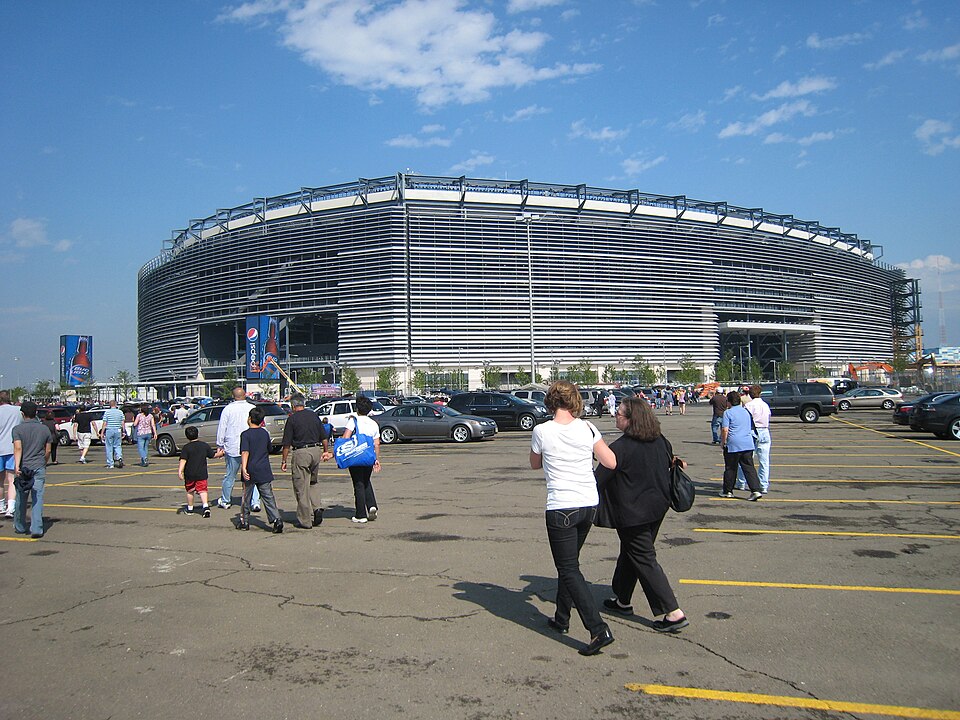
MetLife Stadium from the parking lot in East Rutherford, where parking strategy and exit planning can shape the entire event night.
Is Driving to MetLife Stadium Worth It?
MetLife Stadium has enough parking for a small city. For most major events, that parking is functional, well-managed, and accessible. But “enough parking exists” is not the same as “driving is the smartest choice for your night.” The two questions every driver should settle before pulling out of the driveway are: is the car actually necessary for how this evening is structured? And if yes, does my parking plan include what happens after the event?
Tailgating is the plan — you need a car to bring the gear, food, and group setup. You are coming from suburban New Jersey or another area where transit access to Secaucus is complicated. You are traveling with a large group where the per-person parking cost splits favorably against transit. You are staying overnight at a nearby hotel and plan to park once and leave the car. You need the flexibility of your own schedule regardless of transit timing.
You are coming from Manhattan, Hoboken, or anywhere on the NJ TRANSIT rail network. You are attending a sold-out event where post-event lot exits will be severe. You are a solo visitor or small group — parking per person costs more than transit. The event runs late and you want a reliable, non-surge return trip. You are attending a FIFA World Cup match (no on-site parking available). Exit timing is more important than arrival flexibility.
The hardest part of MetLife parking happens when everyone leaves at once
MetLife Stadium’s lot network handles 80,000+ spectators, but the highway network it empties onto is Route 3 and the New Jersey Turnpike — roads that funnel the entire exit rush through a small number of on-ramps simultaneously. Post-event lot exits of 45–90 minutes are not unusual for major sold-out events. Planning your parking with the exit in mind — not just the arrival — is the single most important upgrade to most people’s MetLife parking strategy. The sections below are built around this principle.
MetLife Stadium Parking — How the System Actually Works
MetLife’s parking operates under two different systems depending on event type, and confusing one for the other is the most common first-timer mistake. Understanding the distinction before you try to buy a permit or arrive at a gate will save real friction on event day.
NFL game parking: prepaid, tiered, and permit-controlled
For NFL games (Giants and Jets regular season and playoff games), parking is entirely prepaid and operates on a two-tier permit system. All permits are digital — a barcode or QR code on your phone that scans at the lot entrance. Vehicles without valid permits can be turned away at the gate.
The two permit tiers are Platinum and Gold. Platinum permits access Lots E, F, or G — the closest surface lots to the stadium gates, reserved for premium seat holders and season ticket licensees. Gold permits access Lots B, D, J, K, L, M, P, Deck A, and the American Dream area lots. These Gold lots are the ones most visitors will use. The lot numbers on permits are informational — they don’t guarantee a specific spot within the lot, just access to that tier. Important: if you hold two permits, you cannot use adjacent spaces for a larger tailgate setup. One permit equals one space, enforced.
Permits are purchased through the Ticketmaster NFL Ticket Exchange when buying game tickets — select “Show Parking Tickets” on the event page and add the appropriate tier to your order. Purchase well ahead of popular games; preferred lots sell out. Lots open 5 hours before kickoff for NFL events.
Concert and general event parking: more flexible, but still plan ahead
For concerts and non-NFL events, parking operates differently — and more flexibly. The official MetLife guidance is that general event parking is available on a first-come, first-served basis, with pre-paid permits also available via ParkWhiz. Some concerts may allow payment on arrival; others may require pre-booking for specific lots. Lots typically open 3–4 hours before concerts and major shows.
Because concert crowds and their arrival patterns differ from NFL game day, lot availability dynamics change. Arriving early — at least 90 minutes before showtime — is advised for comfortable parking. Check the specific event page on metlifestadium.com for event-specific parking instructions, as guidance can vary by production and promoter.
No lot-hopping once you are parked
One rule that catches people by surprise: circulation between lots is not permitted once you have entered the complex. If you park in a Gold lot and later wish you were in a Platinum lot, you cannot move. Choose your approach before you enter. This is also why the park-and-ride option at Secaucus is worth serious consideration — you eliminate the lot-choice question entirely.
Accessible parking
Accessible parking is available in Lots E, F, and G for vehicles displaying a valid state-issued ADA license plate or hangtag. The permit holder must be present in the vehicle. The standard accessible drop-off location for rideshare and car service is near Lot C at the Verizon Gate. For current accessibility guidance, check the official MetLife guest services page before your event.
Best Parking Strategy — By Kind of Night
For full tailgate setup — grill, coolers, folding chairs, the works — a Gold lot surface space is the correct choice. Arrive 3–4 hours before kickoff to claim a good space within your lot, set up, and have time to break down properly before entering the stadium. Pre-book the permit when you buy your tickets. Plan for a 45–90 minute exit after the game; tailgating is NOT allowed during or after the game itself.
If you’re going for the game but not the tailgate, the park-and-ride at Secaucus Junction is often the cleanest option. Park at Edison ParkFast (1,100 spaces, 24/7), take the Meadowlands Rail Line 10–13 minutes to the stadium, and reverse it after. Avoids the lot exit entirely — you take the train out and retrieve your car from Secaucus, which is significantly less congested than the stadium lots post-game.
Concert parking at MetLife is more flexible than NFL parking but not unlimited. Pre-booking via ParkWhiz before the event is recommended for popular shows. Check the specific event page on metlifestadium.com for current parking guidance — some concerts have event-specific lot arrangements or restrictions. Lots typically open 3–4 hours before showtime. If the concert runs late, plan for a post-show exit surge similar to NFL game day.
The most elegant parking strategy for hotel guests is parking at your hotel and using transit or a short rideshare for the stadium leg — avoiding the stadium lot entirely. Hotels in East Rutherford and Carlstadt (Hampton Inn, SpringHill Suites, Fairfield Inn) are a short drive to the parking lots or a brief rideshare to the venue. Park at the hotel, check in, and let the stadium’s transportation system handle the event day. See the [internal link to Hotels Near MetLife Stadium] for nearby options.
NJ drivers have the most straightforward access — Route 3 West from the Turnpike, following Sports Complex signs. For tailgaters, on-site parking with a pre-bought permit makes sense. For non-tailgaters, the Secaucus Junction park-and-ride on NJ Turnpike Exit 15X is a useful intercept point that cuts out the stadium traffic zone and improves exit timing significantly.
If you are driving from Manhattan specifically to avoid transit, consider what you are actually gaining. The Lincoln Tunnel approach adds toll costs, Route 3 builds congestion on event days, and the post-event exit puts you back into that same tunnel corridor. For most Manhattan visitors, the NJ TRANSIT approach (Penn Station → Secaucus → Meadowlands Rail Line) is faster in total time, cheaper, and produces a dramatically better exit experience. See how to get to MetLife Stadium for the full transit picture.
Closest Lot vs. Smartest Lot
The Platinum lots (E, F, G) are the closest to the stadium gates — a shorter walk in and a shorter walk out to your car. They are also the most expensive, reserved primarily for premium seat holders and PSL owners, and they empty last in the post-event queue because they absorb so many departures simultaneously. Being close to the gate does not necessarily mean being first out of the complex.
The Gold lots spread across a larger footprint — some farther from the stadium gates, some adjacent to the American Dream mall complex. The tradeoff on a Gold lot further from the stadium is a longer walk in, but often a less congested exit funnel out, because fewer vehicles are concentrated at a single exit point. For non-tailgaters who care about exit efficiency more than walking distance, a Gold lot that is less centrally located can produce a meaningfully better departure.
The smartest lot is the one that fits both your arrival and departure priorities. If the tailgate is the point, closeness matters for setup and atmosphere. If getting home quickly after the game is the point, a lot with a less-congested exit corridor and good proximity to your highway on-ramp matters more than saving two minutes walking to the gate. Make the decision before you buy the permit — not after you’re already parked and realizing it.
How Tailgating Changes the Parking Decision
For NFL game days, tailgating is not a side consideration — it is the primary reason many people choose to drive in the first place. The Meadowlands tailgate experience is one of the larger and more established in the NFL, and understanding the rules beforehand prevents the kind of arrival friction that wastes the first hour of the pre-game.
The one-car-one-space rule is strictly enforced. Stadium tailgate patrol actively manages it. If your group is large and needs more space, that requires more permits — you cannot use the adjacent unoccupied spot even temporarily. Vehicles longer than 18 feet or wider than 8 feet cannot park in standard lined spaces and must use designated large-vehicle zones.
For those who arrive by train or bus but still want pre-game atmosphere, MetLife Stadium operates official pre-game activity zones in the plaza areas adjacent to the stadium on event days — food, games, entertainment, and activities for all ages. You do not need to tailgate to access the pre-game energy.
Deck parking and tailgating
Deck A (the American Dream parking structure) and other enclosed parking decks are explicitly excluded from tailgating. No grills or heating devices are permitted in any deck. If you are planning to tailgate, you must park in a surface lot — a Gold tier surface lot is the standard choice for most tailgating fans who do not have Platinum access.
Park-and-Ride at Secaucus Junction
MetLife Stadium’s own official parking pages — for both NFL games and general events — specifically recommend an alternative to on-site parking that most drivers overlook: the Edison ParkFast lot at the Frank R. Lautenberg Station at Secaucus Junction.
The park-and-ride approach works as follows: drive to Secaucus Junction via the NJ Turnpike (Exit 15X), park in the Edison ParkFast lot, and take the Meadowlands Rail Line shuttle to MetLife Stadium — approximately 10–13 minutes. Reverse the process after the event. The lot holds 1,100 cars, is patrolled and open around the clock, and is directly integrated with the train station.
The strategic advantage is the exit. When the event ends and 20,000+ vehicles are attempting to exit the MetLife lots simultaneously, you are not in that queue. You are on a train heading to Secaucus. When you arrive at Secaucus and retrieve your car, the stadium traffic surge has typically moved on. You exit into a lighter traffic environment. This is why experienced MetLife visitors consistently cite this approach as one of the better parking decisions available for the venue.
Exit Strategy — Planning for What Happens After
The exit from MetLife Stadium parking is where most visitors’ plans collide with reality. The road network serving the Meadowlands is efficient by design but finite in capacity. When a sold-out event ends and tens of thousands of vehicles begin moving simultaneously, the surface lots funnel into a road network that connects primarily to Route 3 and the New Jersey Turnpike — and both can back up significantly in the first 30–60 minutes after an event.
Strategies that consistently work
The two approaches that reduce exit time most reliably at MetLife are opposite in execution. The first is leaving early — exiting your parking spot 10–15 minutes before the final whistle or the encore puts you ahead of the main traffic wave. You may miss the literal final moments of the event in exchange for reaching the highway before the main surge. For games with a clear outcome or concerts where you have already heard the best songs, this tradeoff is often worth it.
The second approach is staying late — remaining in the venue or visiting the adjacent American Dream mall for 45–60 minutes after the event concludes. By the time you return to your car, the worst of the initial traffic surge has moved through the lot exits and onto the highway. The American Dream complex — directly adjacent to the stadium — is specifically useful here: food, retail, and a reason to stay occupied while the lots clear.
Where you parked affects how you exit
The lot you chose on arrival shapes your exit options. Lots closest to the stadium gates (Platinum) concentrate the most vehicles in the smallest area with the most direct approach to the same exit routes. Lots farther from the stadium but closer to a highway on-ramp can empty more cleanly because fewer vehicles are competing for the same exit corridor. The park-and-ride option at Secaucus eliminates the stadium lot exit entirely, which is the cleanest resolution to this problem.
Concert exit timing vs. NFL exit timing
NFL games tend to end within a predictable time window, so the exit rush is concentrated and intense. Concert exits are sometimes more gradual — people leave at different points during the encore, during the show itself, and over a longer departure window after the final song. The exit is still busy, but the peak is sometimes less compressed than a football game. That said, for sold-out concerts with a defined end time, treat the exit with the same planning respect as an NFL game.
Building the Full MetLife Night Out
Parking is one decision inside a larger plan. Here’s the rest of the cluster.
Common Parking Mistakes at MetLife Stadium
Trying to drive without a pre-bought permit for NFL games
NFL parking at MetLife is prepaid and digital — no permit, no entry. The lots do not accept cash or walk-up credit card purchases for game day parking. Permits are sold through the Ticketmaster NFL Ticket Exchange when you buy game tickets. If you wait until the day of a popular game to think about parking, you may find preferred lots sold out. Add the parking permit at the same time you buy the ticket, not as an afterthought.
Assuming concert parking works the same as NFL parking
These are meaningfully different systems. Concert parking (general events) can operate on first-come, first-served or pre-paid ParkWhiz permits, with some flexibility for on-site payment depending on the event. NFL parking is entirely pre-paid permit-based. Check the specific event page on metlifestadium.com before any event rather than assuming one system applies to all.
Trying to use a second permit for additional tailgate space
MetLife’s tailgating rules explicitly prohibit using multiple permits to claim adjacent spaces. One permit = one space, period. Stadium tailgate patrol enforces this actively. If your group needs more space, that requires more permits legally — you cannot occupy empty neighboring spots even if they are temporarily unoccupied. Plan your setup to fit within one space or buy the right number of permits before you arrive.
Trying to grill in a parking deck
Grills and heating devices are not permitted in any enclosed parking deck at MetLife, including Deck A. If tailgating with a grill is part of your plan, you must be in a surface lot — a Gold tier surface lot is the right choice. Deck parking is fine for non-tailgating visitors who want the shortest walk, but it does not support the traditional game day setup.
Not thinking about the way out when choosing a lot
The natural instinct is to choose the lot closest to the stadium gates. This optimizes arrival. But a lot that concentrates the most departing traffic into the smallest number of exit routes is not necessarily the best choice when 60,000 people leave simultaneously. Consider your exit route when choosing a lot — where is the lot’s exit relative to your highway on-ramp? Can you exit toward Route 3 East cleanly, or are you merging into the worst of the departing traffic? A slightly further lot that exits onto a less congested road can be worth the extra walking time.
Ignoring the FIFA World Cup parking rules
For FIFA World Cup 2026 matches at MetLife Stadium, on-site parking is not available and tailgating is not permitted. The parking lots are repurposed for security perimeters, broadcast infrastructure, and fan zones. Fans must use transit, rideshare, or approved park-and-ride arrangements. This is a fundamentally different event-day setup from NFL and concert operations. Verify official FIFA and MetLife guidance well before your match date.
Frequently Asked Questions
It depends on your event and your priorities. For NFL games with tailgating: a Gold tier surface lot, pre-bought permit through the Ticketmaster NFL Ticket Exchange. For NFL games without tailgating: the Edison ParkFast park-and-ride at Secaucus Junction (1,100 spaces, NJ Turnpike Exit 15X) is specifically recommended by MetLife’s own guides and produces a significantly cleaner exit by taking you out of the stadium lot system entirely. For concerts: check the specific event page on metlifestadium.com — pre-book via ParkWhiz if available, or confirm on-site payment options for your event.
Driving and parking at MetLife is worth it when tailgating is the plan, when you’re coming from suburban New Jersey where the car is the natural mode, when you’re traveling with a large group that splits parking costs efficiently, or when you’re staying overnight nearby and can park once at a hotel. It becomes less worth it when you’re coming from Manhattan (the train is usually faster and cheaper), when getting home quickly after the event is the priority (post-event lot exits can take 45–90 minutes), or when you’re attending a FIFA World Cup match (no parking available).
For NFL games: yes, always — permits are required and the lots are entirely prepaid and cashless. Purchase through Ticketmaster NFL Ticket Exchange when buying game tickets. For concerts and general events: often pre-booking is available and recommended via ParkWhiz, but some events may allow payment on arrival. The specific event page on metlifestadium.com will have current guidance. For FIFA World Cup matches: on-site parking is not available at all. Check official FIFA/MetLife guidance for alternative arrangements.
Yes, significantly. NFL parking is entirely pre-paid with a digital permit system (Platinum and Gold tiers) purchased through Ticketmaster — no walk-up purchases accepted. Concert and general event parking operates more flexibly: first-come, first-served or pre-paid via ParkWhiz, with some events allowing on-site payment. The lots open earlier for NFL (5 hours before kickoff) versus concerts (typically 3–4 hours before). Always check the specific event page rather than assuming one system applies.
Tailgating is permitted in all surface parking lots. It is NOT permitted in enclosed parking decks (Deck A and others). No grills or heating devices are allowed in any deck. Key rules: one permit equals one space (strictly enforced, no claiming adjacent spaces), tents maximum 8’x8′, no deep fryers or open fires, maximum sound 65 decibels. Tailgating is only permitted before the event — not during or after. Check the current MetLife tailgating page for the full rule set before game day.
Pre-book via ParkWhiz when possible — available spaces fill up for popular shows. Check the specific event page on metlifestadium.com for event-specific parking guidance, as some concerts have custom arrangements. Arrive at least 90 minutes before showtime to avoid lot entry congestion. For exit, either leave slightly before the final song to beat the surge, or wait 45–60 minutes post-show at the American Dream mall before heading to your car. If you don’t need to tailgate, seriously consider the Secaucus Junction park-and-ride to bypass the lot exit entirely.
Staying at a nearby hotel (East Rutherford, Carlstadt, or Secaucus area) significantly simplifies driving to MetLife events — you park at the hotel, don’t move the car during the event, and avoid the post-event lot exit entirely by staying local. The Hampton Inn, SpringHill Suites, and Fairfield Inn near the stadium are commonly used for this strategy. See the [internal link to Hotels Near MetLife Stadium] for current options. If your trip allows it, parking once and walking or taking a short rideshare to the stadium is one of the smoothest MetLife event-day strategies available.
The MetLife Parking Plan That Actually Works
MetLife Stadium has the parking capacity to handle what it hosts. The complexity is not in finding a space — it’s in making choices before you arrive that set up a good experience on both ends. Book your NFL permit when you buy your tickets. Check the concert event page rather than assuming it works like game day. Know whether tailgating is part of your plan before you choose a lot. And think about the exit before you think about the entrance.
For many visitors, the most underused parking option at MetLife is the one that isn’t at MetLife at all: the Edison ParkFast park-and-ride at Secaucus Junction, officially recommended in the venue’s own guidance, that lets you drive most of the way and take the train for the final leg — and more importantly, take the train back out when the stadium lots are locked in a highway queue. It doesn’t work for tailgaters. For everyone else, it is often the cleanest solution the venue offers.
Treat Parking Like Part of the Event
MetLife Stadium is not a quick subway-and-seat venue. For Giants games, Jets games, concerts, and major events, the parking lot can be the pregame, the meal, the meeting point, and the hardest part of the exit. Use these guides to plan the pass, tailgate, hotel, restaurant, team choice, transit alternative, and post-event return before you drive into the Meadowlands.
How to Get to MetLife Stadium
Compare driving, NJ Transit, Secaucus transfer, rideshare, Manhattan tourist routes, and the postgame return before choosing the car.
Open Transit Guide Football DayMetLife Stadium Football Guide
Use the full football guide for game-day flow, first-timer mistakes, stadium experience, tailgate rhythm, and team-night planning.
Open Stadium GuideCore MetLife Parking & Transportation Planning
Parking · Transit · StadiumHow to Get to MetLife Stadium
NJ Transit, Secaucus transfer, rideshare, driving, Manhattan visitor strategy, and post-event return planning.
NYC Transportation Hub
Subway, commuter rail, parking, rideshare, walking, and late-night return planning for NYC-area events.
MetLife Stadium Football Guide
Full stadium planning for Giants, Jets, first-timers, seating, tailgating, weather, families, and game-day feel.
MetLife Stadium Seating Guide
Pair the parking plan with seat choice, upper vs lower level, club options, sightlines, weather, and exit flow.
MetLife Stadium Area Guide
Understand the Meadowlands, East Rutherford, Secaucus, hotels, restaurants, roads, and what is actually near the stadium.
NYC Sports Hub
Plan football, basketball, baseball, hockey, venue nights, first-time visits, tourist games, and family sports outings.
Giants, Jets & Football Decision Guides
Teams · Matchups · VisitorsNew York Giants Guide
Giants game-day planning, MetLife parking culture, tailgate timing, family notes, and first-time visitor strategy.
New York Jets Guide
Jets gameday flow, parking pass reminders, tailgate atmosphere, matchup nights, and how the fan experience differs.
Giants vs Jets
Choose the better MetLife football experience for tourists, families, locals, schedule, rivalry feel, and game-day vibe.
Best NYC Football Game for Tourists
How Manhattan visitors should think about Giants, Jets, MetLife logistics, transit, parking, timing, and full-day plans.
Best NYC Football Game for Families
Family-friendly football planning with parking control, afternoon kickoff logic, restroom timing, weather, and exit patience.
MetLife Seating Guide
Seat choice, weather exposure, club access, upper-level tradeoffs, lower bowl feel, and where to sit for football.
Hotels, Food & Meadowlands Support
Stay · Eat · AreaHotels Near MetLife Stadium
Meadowlands, East Rutherford, Secaucus, and nearby hotel bases that shorten the postgame return after parking.
Restaurants Near MetLife Stadium
Food planning for tailgaters, non-tailgaters, nearby hotels, Secaucus, East Rutherford, and flexible postgame meals.
MetLife Stadium Area Guide
The honest Meadowlands context: roads, hotels, food, transit, tailgating, and why this is not a walkable NYC neighborhood.
Choose the Right Parking Decision
Pass · Tailgate · ExitMetLife Parking Overview
Why parking is different here, how the Meadowlands setup works, and why the lot can be part of the event.
Parking Passes
Confirm your parking permit before driving, have it ready before the lot approach, and verify rules for your exact event.
Tailgating Guide
What is generally permitted, what is not, when to arrive, what to verify, and how to avoid rookie lot mistakes.
Parking by Event Type
Giants games, Jets games, concerts, soccer, major events, and why football rules do not automatically apply to every show.
Parking vs Train vs Rideshare
When parking wins, when NJ Transit is cleaner, and why rideshare can be rough after sold-out events.
Getting Out After the Event
Postgame lot congestion, waiting out the first wave, no tight reservations, and how to leave without turning the day sour.
Helpful On-Page Planning Jumps
Use While ReadingBest Plan by Visitor Type
Manhattan tourists, families, tailgate groups, date nights, concertgoers, suburban visitors, and NJ drivers.
The Parking Verdict
Parking works beautifully when planned — and becomes stressful when you improvise the pass, rules, arrival, or exit.
MetLife Parking FAQ
Quick answers on parking passes, tailgating, lot opening times, NJ Transit, rideshare, concerts, accessible parking, and tourists.