

How to Get to NYC Concert Venues — Transit, Trains & Logistics Guide
Getting to a concert in New York is not complicated — but the right approach depends entirely on which venue you’re going to, where you’re coming from, and what happens after the show ends. This is the guide that explains the difference.
New York’s major concert venues span six or seven distinct geographic situations — from an arena sitting directly on top of a national rail hub to a seasonal stadium in Queens to a neighborhood theater on the Upper West Side you can walk back from in fifteen minutes. The right transit plan is different for every one of them, and the mistake most visitors make is treating them all the same way. The subway advice for getting to MSG does not apply to Forest Hills Stadium. The rideshare strategy that works for the Beacon falls apart at Barclays after a sold-out show. And driving, which seems like the obvious answer from outside the city, is almost never the right call for any of them.
This guide is about the actual decisions: what to take, where to be aware of problems, and what the after-show exit looks like for each major venue. The goal is a plan that gets you there without stress and gets you back without turning the trip into its own logistical event.
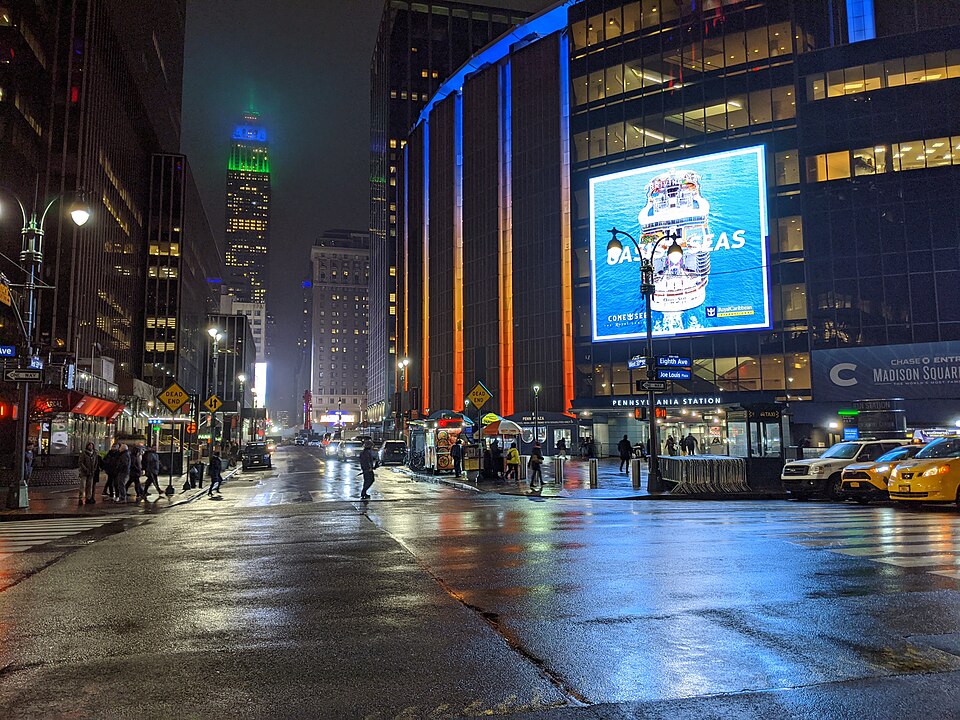
Madison Square Garden at night, a fitting image for a guide to getting to NYC concert venues by train, subway, rideshare, or car.
Quick Answer — Best Transit Approach by Venue
The 1/2/3 and A/C/E trains stop directly below the arena at 34th St–Penn Station. LIRR, NJ Transit, and Amtrak terminate below MSG. The most transit-connected concert venue in the country.
B/D/F/M at 47th–50th Sts–Rockefeller Center for Radio City. N/Q/R/W at 57th St for Carnegie Hall. Both are within easy walking distance of most Midtown hotels. No commuter rail needed.
1 train to 72nd Street (2 minutes from the Beacon). For UWS hotel-stayers, the walk is the whole answer. Best walkback of any major NYC venue.
2/3/4/5/B/D/N/Q/R trains at Atlantic Ave–Barclays Center, directly adjacent to the arena. From Manhattan: the 2 or 3 from Penn Station is direct. LIRR at Atlantic Terminal for Long Island arrivals.
Same subway stations serve the Brooklyn Paramount at Flatbush and DeKalb. A/C/G at Hoyt–Schermerhorn or the Atlantic Terminal complex both work. Downtown Brooklyn has strong transit density.
E or F train to Forest Hills–71 Ave station, a short walk to the stadium. From Midtown Manhattan, approximately 30 minutes. Plan your return train before you arrive; the station gets busy after shows.
NJ Transit Meadowlands Service from Penn Station to the Meadowlands Sports Complex station runs specifically for events. Approximately 35–40 minutes. Check the schedule for post-show trains before you go.
2/3/4/5 to Fulton Street, or J/Z to Fulton Street, or A/C/E/1/2/3 to Chambers Street. All put you within a 5–10 minute walk of Pier 17. Lower Manhattan subway access is strong.
How to Choose the Right Transit Plan for a Concert Night
Before getting into venue specifics, the framework that matters most is thinking about the full night — not just how you get there, but what your exit looks like when the show ends. The venues that are easy on arrival can be slow on exit. The venues that require a little more planning coming in often have a cleaner exit. And the single biggest mistake in concert transit planning is not the route in; it is having no plan for the route out.
Cheapest, most reliable, and often fastest for venues with direct subway access. The subway does not surge-price after shows, runs on a fixed schedule, and cannot get stuck in event-exit traffic. The right default for MSG, Barclays, Radio City, the Beacon, and all Midtown venues.
LIRR, NJ Transit, and Metro-North all connect to venues with strong rail access — Penn Station for MSG and Barclays, Grand Central for some Midtown shows. For visitors arriving from Long Island, New Jersey, or Connecticut, commuter rail eliminates driving entirely and often produces a faster trip than any car alternative.
Rideshare works well for getting to most venues — especially if you are dressed up, running late, or coming from somewhere subway-inconvenient. It is significantly less reliable after a sold-out show ends. Surge pricing kicks in immediately as 15,000+ people all request rides simultaneously. Post-show pickups near major arenas can involve 30–45 minute waits even at marked pickup zones.
Event parking near MSG runs $45–70+. Traffic on 7th and 8th Avenues during show nights is significant. Post-show parking garage exits can take 30–45 minutes. For MetLife Stadium and Forest Hills, driving is more viable — but both have dedicated transit solutions that are faster and cheaper. If you must drive, pre-book parking through an app before leaving home.
Before leaving for any NYC concert, identify two things: the subway station directly serving the venue (confirmed, not assumed), and how you are getting back after the show. The return trip is where most concert-night logistics break down — not the arrival. A plan for both directions, made before you leave, eliminates most of the friction.
Getting to Madison Square Garden
MSG is the easiest major concert venue in New York to reach by transit, and it is not particularly close. The arena sits directly above Penn Station, which is served by virtually every subway line in Manhattan, every LIRR branch from Long Island, NJ Transit from all of New Jersey, and Amtrak from anywhere on the Northeast Corridor. If you are arriving by train from outside the city, the concert venue is literally above the station where you arrive. There is nothing logistically simpler in New York live music.
From within the city, the 1/2/3 trains at 34th St–Penn Station put you directly below the arena. The A/C/E trains stop at the same station, accessible via the 8th Avenue entrance. The B/D/F/M/N/Q/R/W lines stop at 34th St–Herald Square, one block east — a short walk to the 7th Avenue entrance.
One practical tip worth knowing: the Moynihan Train Hall entrance to Penn Station, on 8th Avenue between 31st and 33rd Streets, is significantly less chaotic than the original Penn Station concourses. If you are arriving by LIRR or NJ Transit and do not enjoy the underground crush of old Penn Station, the Moynihan entry is worth using. Hotels on the immediate 33rd Street block have this entrance at their doorstep.
Driving to MSG is genuinely not recommended. Event parking in the immediate area runs $45–70+, the surrounding blocks are gridlocked on event nights, and rideshare pickup after the show is slow due to the sheer volume of concurrent requests from a 20,000-person crowd. The subway is faster door-to-door than any vehicle option for most of Manhattan and all of Brooklyn.
Getting to Radio City, Carnegie Hall, and Midtown Venues
Radio City at 50th and 6th, Carnegie Hall at 57th and 7th, Sony Hall in the Theater District — the Midtown concert cluster sits in the most subway-dense part of Manhattan. The B/D/F/M at 47th–50th Streets–Rockefeller Center is the closest stop to Radio City (two-minute walk). The N/Q/R/W at 57th Street is the direct stop for Carnegie Hall. For Theater District venues, the A/C/E at 50th Street or 1 train at 50th Street both work.
Most visitors staying in Midtown hotels can walk to Radio City or Carnegie Hall comfortably — the real advantage of a Midtown base for these shows. For visitors coming from Brooklyn or Lower Manhattan, the express B or D train handles the trip efficiently.
Rideshare and taxis are viable for Midtown show arrival, particularly since the neighborhoods around these venues are active enough that pickup and dropoff is manageable. Post-show rideshare is easier here than at the arenas — the crowd disperses into a larger area rather than concentrating at a single exit point — but surge pricing still activates immediately after major shows let out. The subway remains faster and cheaper for anyone within a reasonable walk of a relevant line.
Getting to the Beacon Theatre
The Beacon Theatre on the Upper West Side is one of the most pleasant venues in New York to navigate — before and after the show. The 1 train on Broadway stops at 72nd Street, a two-minute walk from the theater. The 2 and 3 express trains stop at 72nd Street on Broadway as well, making the Upper West Side accessible from most of Manhattan in under 20 minutes.
For anyone staying on the Upper West Side — particularly in the 70s and 80s along Broadway and Amsterdam Avenue — the Beacon is simply a walk. The post-show walkback through quiet residential Upper West Side streets, usually around 11 PM, is one of the more pleasant after-show experiences at any major NYC venue. No transit stress, no surge pricing, no garage exit queue.
From Midtown hotels, the 1 train from Times Square–42nd Street to 72nd Street takes approximately 8–10 minutes. From the East Side, a crosstown bus to the 1/2/3 trains works, or the B train from 72nd Street on the East Side runs through Central Park transversely and stops at 72nd Street on the West Side. Post-show, the 1 train back toward Times Square runs frequently and handles the Beacon crowd efficiently — this is not a venue that creates serious exit congestion.
Getting to Barclays Center and Brooklyn Paramount
Barclays Center is anchored by the Atlantic Avenue–Barclays Center subway station, which is one of the largest and most connected station complexes in the New York City subway system. The 2, 3, 4, 5, B, D, N, Q, and R trains all stop here — at all times, with the B and 5 running weekday daytimes and several others running 24/7. From virtually anywhere in Manhattan, there is a direct or one-transfer route to this station. The 2 or 3 train from Penn Station (34th St–Penn Station) to Atlantic Ave–Barclays Center is the most direct connection from Midtown, taking approximately 20–25 minutes.
For Long Island arrivals, the LIRR’s Atlantic Terminal station is directly across the street from Barclays Center. The LIRR runs to Atlantic Terminal from Jamaica Station approximately every 8 minutes at peak and every 20 minutes off-peak. This makes Barclays genuinely easy for Queens and Long Island visitors without a car.
The Brooklyn Paramount, at Flatbush and DeKalb Avenues, is served by the same Atlantic Terminal transit hub — the A/C at Hoyt–Schermerhorn Streets and the multiple Atlantic Avenue lines all put you within a 5–10 minute walk of both venues. Downtown Brooklyn’s transit density is one of the area’s strongest logistical assets.
Post-show at Barclays, the multiple train lines dispersing in different directions prevent the kind of single-station bottleneck that some venues create. The 2/3 back to Manhattan, the Q to Midtown and the Upper East Side, the B to Midtown and the Upper West Side — the crowd spreads across multiple lines rather than competing for the same train. This makes Barclays’s post-show exit notably cleaner than you might expect for an 18,000-seat arena.
Getting to Williamsburg and Other Brooklyn Club Venues
Williamsburg and the adjacent East Williamsburg club venues are served primarily by the L train on 14th Street from Manhattan, which runs to Bedford Avenue in the heart of Williamsburg. From Union Square (14th St–Union Sq), the L train reaches Bedford Avenue in approximately 10–12 minutes — one of the cleaner cross-borough connections in the city. The G train serves Williamsburg and Greenpoint from Brooklyn neighborhoods without requiring a trip through Manhattan.
Brooklyn Steel sits in East Williamsburg — slightly further from the Bedford Avenue stop than Williamsburg’s central venues, but accessible via the L to Morgan Avenue or via rideshare from the Bedford stop. Music Hall of Williamsburg is a 5-minute walk from Bedford Avenue on the L train.
The L train runs frequently on evenings and weekends, which means post-show transit from Williamsburg venues back to Manhattan is generally smooth. The crowd from a 1,500-person club show disperses faster than an arena, and the L train frequency at 1 AM handles the post-show volume better than most people expect. The one caveat: if the L train is running on weekend overnight service (check the MTA’s weekend schedule in advance), rideshare from Bedford Avenue may be a cleaner option than navigating limited-service trains.
Getting to Forest Hills Stadium, MetLife, and Outer Venues
Forest Hills Stadium
Forest Hills Stadium in Queens is a seasonal outdoor venue — and one that rewards planning more than most, specifically because the return trip requires checking the E/F train schedule before you go rather than improvising at 11 PM. The E and F trains on Queens Boulevard stop at Forest Hills–71 Avenue station, a short walk from the stadium. From Midtown Manhattan (42nd Street), the trip takes approximately 30 minutes. The express E train is generally faster than the F local.
After the show, the Forest Hills–71 Avenue station gets busy. Having your MetroCard ready and a clear sense of which train you are taking back reduces the friction significantly. The E and F trains run late into the night and handle the post-show crowd, but the station is a modest neighborhood stop rather than a major hub, so trains fill up quickly on popular summer concert nights. Getting on the platform within 20–30 minutes of the show ending is better than lingering until the crowd fully disperses.
MetLife Stadium is in New Jersey, and the transit plan is different from any in-city venue. NJ Transit operates dedicated Meadowlands event service from Penn Station — the train runs directly to the Meadowlands Sports Complex station adjacent to the stadium, taking approximately 35–40 minutes. Trains run both before and after events, with specific schedules published by NJ Transit for each show date.
The single most important piece of MetLife transit planning is to check the post-show NJ Transit train schedule before the concert and know when the last practical train departs. Trains after events run on a specific event schedule, not the regular NJ Transit timetable, and the service ends at a certain point. Guests who linger too long post-show have occasionally found the last train gone. Check the departure times, set a reminder, and plan your exit accordingly.
Driving to MetLife is viable for New Jersey-based attendees but requires pre-booked parking — stadium parking lots are substantial but fill on major shows. For visitors from Manhattan, the NJ Transit event train is faster than driving through the Lincoln Tunnel in post-show traffic and significantly cheaper than parking. The taxi and rideshare situation post-show at MetLife is challenging: the volume of concurrent requests, limited pickup zones, and New Jersey geography combine to make the post-show rideshare experience at MetLife one of the more stressful in the region. Have the train plan.
After the Show — The Exit Plan Most People Skip
The after-show transit situation is where most concert-night logistics plans break down. Arrival is easy — you have time, the subway is not crowded in your direction, and the options are clear. The exit is different: you are one of 15,000 to 80,000 people all moving at the same time, rideshare prices have surged, the specific subway line you need may be running delays due to volume, and you are tired. The exit plan made before the show is worth more than any improvised decision made at midnight outside an arena.
Post-show subway: the smarter moves
At MSG, the 1/2/3 trains on the 7th Avenue platform and the A/C/E on the 8th Avenue side both surge in volume immediately post-show. Platform crowding is real for 20–30 minutes. If you can stay for an encore, linger for a drink, or otherwise delay your departure by 20–30 minutes, you often find a significantly less crowded station. At Barclays, the multiple train lines dispersing in different directions make this less of a concern — the crowd does not pile onto a single platform in the same way.
Post-show rideshare: real expectations
Rideshare surge pricing after major NYC concert venues activates within minutes of a show ending. For a 20,000-person MSG show, prices regularly jump 2–3x during the 20–30 minutes immediately after the crowd starts moving. The pickup zones near major arenas are congested — both by the volume of cars and by the difficulty of finding your specific driver in a crowd of thousands. If you plan to rideshare home, either accept a 30–45 minute wait at the venue for prices to normalize, or walk several blocks away from the arena before requesting — both produce better experiences than competing for a pickup spot at the main exit.
When a nearby hotel solves the whole problem
For any show where the post-show logistics feel complicated — late night, large venue, uncertain subway timing — staying within walking distance of the venue is the cleanest possible solution. The New Yorker across from MSG. An Upper West Side hotel for the Beacon. A Downtown Brooklyn hotel for Barclays. Walking back is not about saving the subway fare; it is about eliminating every variable in the post-show plan. The hotels near NYC concert venues guide covers which venues have strong walkable hotel options.
Know your exit plan before you sit down for the show. Not after the last song. Before. The venue, the station or pickup zone, and the timing. A plan made in advance is five times better than improvisation at midnight in a crowd of thousands.
Best Transit Strategy by Traveler Type
For visitors arriving by LIRR, NJ Transit, Metro-North, or Amtrak: MSG is the simplest possible destination — your train arrives below the arena. For Barclays shows, take LIRR to Atlantic Terminal (direct, 20 min from Jamaica) or the 2/3 from Penn Station. For any other venue, arrive at Penn Station or Grand Central and take the appropriate subway — no car or rideshare needed from either terminal to any major concert venue.
MSG for the simplest possible experience: train from anywhere in the Northeast, walk out of Penn Station, arena is above you. Radio City or Carnegie Hall as a very close second — Midtown subway access is dense and intuitive. Avoid driving entirely. The subway is genuinely the right answer, and it is not complicated once you know which train to take.
Every major Manhattan venue is accessible by subway from any Midtown hotel in 30 minutes or less. Use the 1/2/3 or A/C/E for MSG, the B/D/F/M for Radio City, the 1 for the Beacon, the 2/3 for Barclays, the L for Williamsburg. No driving, no rideshare for getting there. Save rideshare as a backup for the way home if you specifically want the comfort of a car.
Rideshare to the venue on a date night is often worth the cost — no planning required, door-to-door, and you arrive without the underground commute. Plan the return differently: either walk back (if you are staying nearby), take the subway (accepts the minor logistics in exchange for the guaranteed schedule), or wait out the surge before requesting a post-show ride. See the concert date night guide for the full evening planning context.
Groups traveling together benefit from leaving in advance of the main crowd — if you can exit 10 minutes before the final encore, the platform wait drops significantly at most venues. The subway is still the right call for most groups; two cars of Uber for a 6-person group is expensive and slow post-show. Have everyone’s MetroCard loaded before leaving for the venue, not at the subway entrance after the show.
If you must drive: pre-book parking through SpotHero or a similar app before leaving home. Event parking near MSG and Barclays runs $45–70+; pre-booked rates are often 30–40% lower than lot prices on the night. Plan the driving route to the garage specifically, not to the arena — they are often different blocks. And plan a 30–45 minute wait to exit the garage after the show regardless.
Common Concert Transit Mistakes — and How to Avoid Them
Assuming rideshare is the easy option
Rideshare is easy to book. It is not necessarily easy to execute post-show near a major arena. Surge pricing, pickup zone congestion, driver no-shows in high-demand areas, and 30-minute wait times are all common after sold-out shows at MSG and Barclays. Plan for the subway as your primary exit; use rideshare as a backup if conditions permit.
Not checking the post-show train schedule for MetLife and Forest Hills
Both MetLife Stadium (NJ Transit event service) and Forest Hills Stadium (E/F local trains) require knowing the post-show train schedule before you arrive. At MetLife, the event train has specific departure times and service ends at a certain point. At Forest Hills, the trains run but fill quickly. Checking the schedule before the show, not after, is the difference between a smooth exit and a long wait or expensive rideshare from New Jersey.
Treating all Manhattan venues as equally easy to reach
Radio City and MSG are both in Manhattan but they are not the same transit situation. MSG is directly served by Penn Station — every subway line, every commuter rail. Radio City requires knowing the B/D/F/M at Rockefeller Center. Carnegie Hall is served by the N/Q/R at 57th Street. They are all easy, but they each have a specific right answer. Looking up the correct subway line before leaving saves the confusion of figuring it out at the turnstile.
Driving into Midtown for a concert
$50–70 parking, 30-minute garage exits, post-show traffic on 7th and 8th Avenues, and a rideshare-style surge affecting every intersection in Midtown after a major show. Driving to MSG or Radio City from within the New York metro area is rarely faster door-to-door than the subway and is consistently more expensive and more stressful. If you are coming from New Jersey or Long Island, the commuter train is faster and cheaper than driving.
Waiting at the subway entrance rather than the platform
At major venues post-show, there can be significant congestion at the street-level subway entrances as well as the turnstiles. Getting underground and to the platform — even if you wait there — is better than waiting above ground where the crowd is denser and less organized. Once you are on the platform, the next train will come.
Frequently Asked Questions
Madison Square Garden, without question. The arena sits directly above Penn Station, which is the terminus for LIRR, NJ Transit, and Amtrak — meaning visitors arriving by train from Long Island, New Jersey, Boston, Philadelphia, or Washington DC literally walk upstairs into the arena. The 1/2/3 and A/C/E subway lines also stop directly below. For transit access, MSG has no equivalent in New York live music.
For virtually every in-city venue, the subway is better — faster door-to-door, dramatically cheaper, and immune to the post-show traffic that makes driving out of the area slow and expensive. Parking near MSG or Barclays runs $45–70+ on event nights, and the garage exits after a sold-out show can take 30–45 minutes. For MetLife Stadium and Forest Hills, commuter rail or the E/F train are still the better options over driving for most visitors. If you must drive to any venue, pre-book parking before leaving home.
The Atlantic Avenue–Barclays Center subway station is directly adjacent to the arena and is served by the 2, 3, 4, 5, B, D, N, Q, and R trains. From Manhattan, the 2 or 3 from Penn Station (34th St–Penn Station) is the most direct route — approximately 22 minutes. From Long Island, the LIRR to Atlantic Terminal (across the street from Barclays) is faster than any car alternative and runs approximately every 8 minutes at peak hours.
Not always bad — but usually worse than people expect at the point when they need it most. Post-show rideshare surge pricing activates within minutes of a show ending at major arenas. Wait times at designated pickup zones near MSG and Barclays can be 30–45 minutes for sold-out shows. The strategies that improve the experience: wait 30 minutes post-show for prices and congestion to normalize, or walk several blocks away from the arena before requesting a pickup. The subway is almost always faster and cheaper for the return trip.
MSG first — the Penn Station connection is so simple that first-timers who arrive by train have the most foolproof possible venue experience. Radio City is a close second — it is in the heart of Midtown, walkable from most tourist hotels, and served by dense Midtown subway access. The Beacon Theatre is excellent for first-timers staying on or near the Upper West Side, with a straightforward 1 train connection from Midtown. All three are significantly simpler than venues requiring a specific Brooklyn routing or a New Jersey commuter train.
Take the E or F train to Forest Hills–71 Avenue station, which is a short walk to the stadium. From Midtown Manhattan (42nd Street), the trip takes approximately 30 minutes on the E train. Check the return train schedule before the show, not after — the E and F trains handle the post-show crowd, but the station gets busy and trains fill quickly on major concert nights.
No — Barclays Center in particular is extremely well-served by transit, with multiple subway lines (2/3/4/5/B/D/N/Q/R) at Atlantic Ave–Barclays Center and LIRR service at Atlantic Terminal directly across the street. Williamsburg venues are straightforward on the L train from 14th Street–Union Square, taking approximately 10–12 minutes to Bedford Avenue. The main difference from Midtown venues is that you are crossing the East River, which adds 10–20 minutes to most transit routes from Manhattan. That is not a meaningful obstacle — just an accurate expectation to set.
For most shows at most venues, commuting in works fine and staying near the venue is not necessary. The specific situations where staying nearby makes a meaningful difference: very late shows where post-show transit at midnight feels like a burden, sold-out MSG or Barclays events where post-show rideshare surge and subway crowding are real, and any venue where the walkback to a nearby hotel genuinely improves the evening (the Beacon on the UWS is the clearest example). See the hotels near NYC concert venues guide for the full hotel planning context.
The Transport Plan That Actually Works
Getting to an NYC concert is not complicated once you know the right approach for the right venue. The subway handles most of it — MSG with the 1/2/3 or A/C/E, Barclays with the 2/3 from Penn Station, Radio City with the B/D/F/M at Rockefeller Center, the Beacon with the 1 train to 72nd Street. Commuter rail eliminates the need for any car if you are arriving from Long Island, New Jersey, or Connecticut. And driving, which sounds like the obvious answer, is almost always the slowest and most expensive choice.
The plan for getting back matters as much as the plan for getting there. Know your exit before you sit down, and the after-show becomes part of the evening rather than its own logistical crisis.
For where to eat near each venue, see the restaurants near NYC concert venues guide. For where to stay, see the hotels near NYC concert venues guide. For the full concert landscape across the city, see the NYC concerts hub.
Keep Building the Concert Night
Transportation works best when it is tied to the venue area, the hotel base, the dinner plan, and how easy the exit will feel once the show ends.