

Subway to Broadway — The Smart Visitor’s Guide to Taking the Train
The subway is often the easiest way to reach a Broadway show — if you choose the right stop, leave enough time, and know when Times Square is the answer versus when another station makes the night easier.
Most transit guides tell you to take the subway to Times Square for a Broadway show. That is not wrong — but it is incomplete. The Theater District spans roughly 40th to 57th Streets between 6th and 9th Avenues, and the right subway stop depends entirely on which theater you are going to, where you are coming from, and what the rest of the night looks like. This page is built around that decision.
Use it to pick the right station before you leave, understand what Times Square station actually involves, know when another stop is faster and calmer, and plan the ride home before the curtain goes up. For the full picture of getting to Broadway — including parking, rideshare, train arrivals, and neighborhood strategy — see the complete Broadway transportation guide.
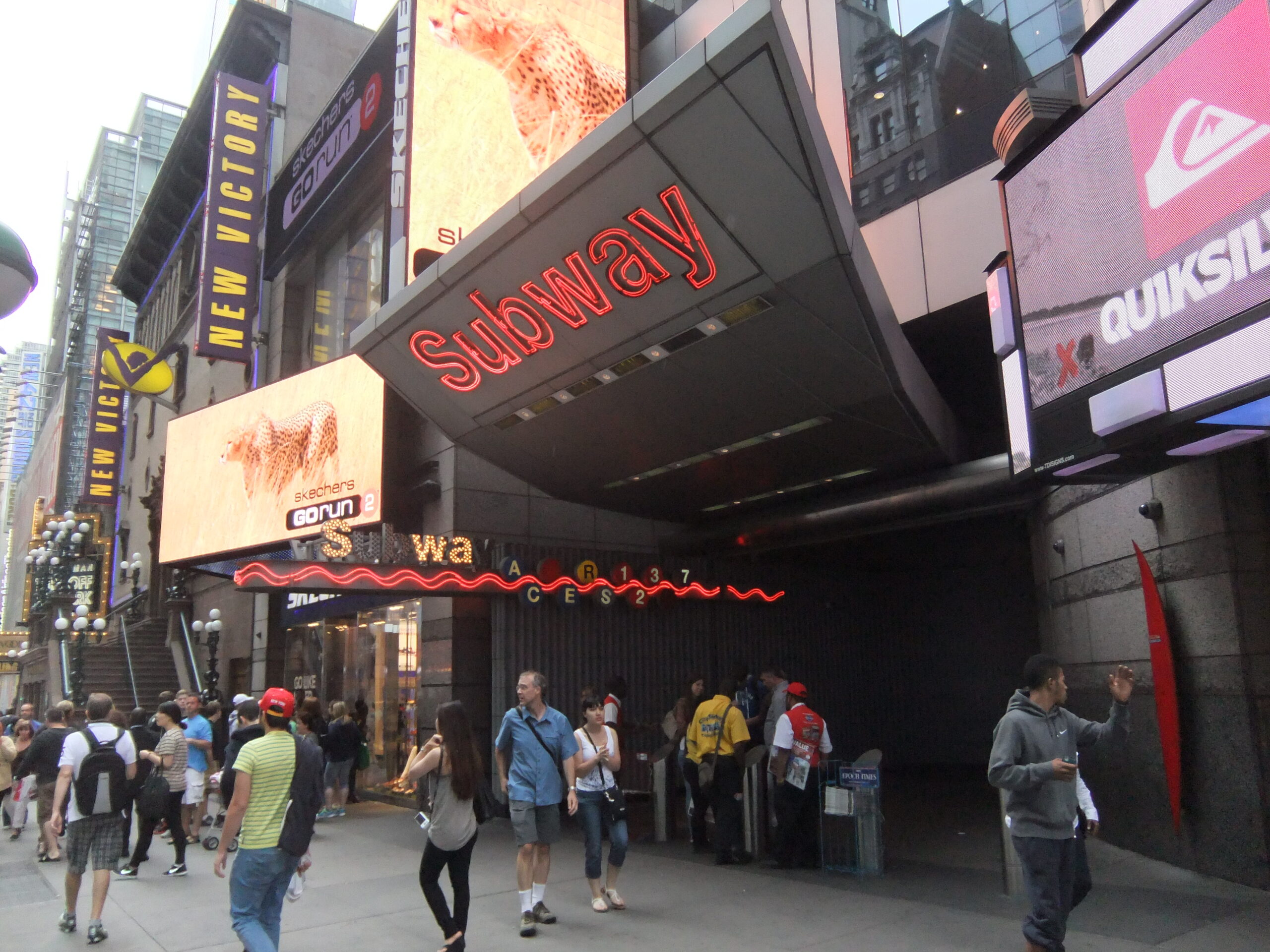
The Times Square–42nd Street subway entrance at 42nd Street and 7th Avenue — one of the main arrival points for visitors taking the subway to Broadway shows in the Theater District.
The Quick Answer: Which Subway Stop for Broadway?
For most Broadway shows, Times Square–42nd Street / Port Authority is the most practical hub. It is served by the 1, 2, 3, A, C, E, N, Q, R, W, 7, and S shuttle lines — more lines than any other Theater District station — and puts you within walking distance of theaters scattered across the mid-40s. If you are not sure which stop to use, Times Square works.
But Times Square is also the busiest, most confusing station in New York City. The exits are labyrinthine, the post-show crowds are intense, and for theaters above 47th Street, it may actually add unnecessary walking. Here is the faster breakdown:
Largest station hub, most lines. Bryant Park works well from the 6th Avenue side.
N, R, W trains. Often calmer than Times Square, closer to upper Theater District shows.
C and E trains. Good for west-side theaters and visitors staying in Midtown West.
B, D, F, M, N, Q, R, W trains. Walk north — good for matinees with a lunch plan.
“The best subway to Broadway is not one route. It is the route that gets you closest to your specific theater without turning the last ten minutes into a Times Square maze. Look up the theater’s cross street first. Then choose the stop.”
How Broadway Subway Planning Actually Works
“Broadway” as a theater district and “Broadway” as a street are two different things, and that confusion catches visitors every time. Most Broadway theaters do not sit on Broadway the avenue — they line the cross streets between 6th and 9th Avenues in the West 40s and 50s. The theater named after your show is probably not at the corner labeled “Broadway.”
The Theater District is walkable, but event-night sidewalks are slow. Foot traffic around Times Square peaks from about 6:30 to 8 PM on weeknights and noon to 3 PM on weekends. Google Maps will give you a technically accurate route that can still be more stressful in practice than an alternative station with a slightly longer but calmer walk.
The right approach: look up the exact theater address, find its cross street, match that to the nearest station, and plan the exit before you go underground. A few minutes of planning eliminates the most common Broadway subway problem — surfacing at Times Square and not knowing which direction to walk.
“Do not plan for the subway stop only. Plan for the subway stop, plus the exit, plus the sidewalk walk to the theater. That last piece is where Broadway visitors lose the most time.”
For detailed neighborhood context — what the Theater District looks and feels like block by block, where restaurants cluster, what the streets are like before and after curtain — the Theater District neighborhood guide covers all of that.
The Best Subway Stops for Broadway — Station by Station
Here is a practical breakdown of every Theater District-adjacent station, what lines serve it, and when it is and is not the right choice.
The most connected station in the city. Works for theaters around 42nd–46th Streets and for most visitors who are not sure which stop to use. Also connects directly to Port Authority bus terminal. Tradeoffs: crowded exits, confusing layout, heavy post-show crowds. Know the theater address before you exit — the wrong exit can send you several blocks in the wrong direction.
Served by the N, R, and W trains (R and W not during late nights). Located at 7th Avenue and 49th Street — one of the calmer Theater District stations. Well-suited for shows around 47th–50th Streets. Less chaotic than Times Square, closer for upper Theater District theaters. Fewer lines, so a transfer may be required depending where you are coming from.
Served by the C and E trains (A during late nights). On 8th Avenue at 50th Street — good for theaters in the upper Theater District west side, visitors staying in Hell’s Kitchen or Midtown West, and anyone connecting from the A/C/E corridor. Note: there is also a 50th Street station on the 1 line at Broadway — these are different stations. Confirm which serves your route.
Served by the B, D, F, and M trains. Located at 6th Avenue and 42nd Street — now connected to Times Square–42nd Street via a new in-station passageway (completed 2024). Good for visitors coming from the 6th Avenue lines, staying near Bryant Park or Midtown East, or looking for a calmer entry point than Times Square. Walking west on 42nd–45th Streets reaches most central theaters in 5–10 minutes.
Served by the B, D, F, M, N, Q, R, and W trains. About a 10–15 minute walk north to the Theater District core. Better for matinees with a lunch plan nearby (Koreatown is a block away), visitors staying near Herald Square or NoMad, or anyone who prefers to avoid Times Square station entirely. Less practical for evening shows with tight dinner timing or anyone with mobility or weather concerns.
The 1 train stops at 57th Street and 7th Avenue — useful for visitors staying near Central Park South or Carnegie Hall and heading to shows in the north Theater District. Not the default for most Broadway shows. Check the theater’s cross street first — if it’s below 50th, Times Square or 49th Street may be a better call even from a northern hotel.
Served by the A, B, C, D, and 1 trains. Best for visitors staying on the Upper West Side or heading to Lincoln Center area venues (including the Vivian Beaumont Theater). Generally too far north for standard Theater District shows — Lincoln Center is not Times Square Broadway. For Upper West Side hotel guests seeing a central Theater District show, the 1 train south to 50th Street or Times Square is the natural route.
Subway Stop by Theater Location — The Cluster Guide
Rather than a theater-by-theater list (which goes out of date as shows move), use the cluster approach. Find your theater’s cross street on the ticket or on the theater’s website, then match it to the right station.
| Theater Cross Street | Best Station(s) | Notes |
|---|---|---|
| Around 42nd–43rd Streets | Times Square–42nd St or Bryant Park | Bryant Park works well from the east/6th Avenue side |
| 44th–46th Streets | Times Square–42nd St | Central Theater District core — Times Square is the most convenient hub |
| 47th–50th Streets | 49th Street or Times Square | 49th Street is often calmer and may be closer depending exact address |
| West 50s (8th/9th Ave side) | 50th Street (8th Ave) | C/E trains; good for west-side theaters and Hell’s Kitchen visitors |
| North Theater District / upper 50s | 57th Street (1 train) or 50th St | Check exact address — Times Square may still be appropriate for some |
| Lincoln Center / Vivian Beaumont | Columbus Circle (1, A, B, C, D) | Lincoln Center is distinct from the Times Square Theater District |
Theater addresses are on your ticket and on the theater’s official website. Look up the cross street before you choose a station — the difference between 44th Street and 49th Street is the difference between two different subway stops being correct.
The Broadway theater guide lists every Broadway house with its exact address, neighborhood context, and planning notes — useful for checking location before you book.
From Penn Station to Broadway
Penn Station sits at 34th Street and 7th/8th Avenues — close enough to the Theater District that walking is often the most practical option for many shows. The walk north along 7th Avenue or 8th Avenue to theaters in the mid-40s takes roughly 15–20 minutes depending on pace and exact destination. For shows above 50th Street, subway or rideshare may be more practical.
If you are arriving by NJ Transit, LIRR, or Amtrak and the weather is good, try the walk first before deciding you need a subway transfer. The Theater District is more manageable on foot than most visitors expect — the chaos is concentrated around Times Square itself, not the whole walk north.
If you do want to subway from Penn Station, the 1, 2, and 3 trains run north on 7th Avenue and stop at Times Square–42nd Street, 50th Street, and beyond. The A, C, and E trains run north on 8th Avenue and stop at Times Square–42nd Street (for the A/C) or 50th Street depending the service. Check which stop matches your theater before you tap in.
Penn Station visitors planning a Broadway weekend often do well staying in the Midtown West or Hell’s Kitchen area — see the guide to Broadway weekend hotels for location-by-location strategy.
From Grand Central to Broadway
Grand Central is at 42nd Street and Park Avenue — east of the Theater District. For shows in the central Theater District, visitors have a few options: the 42nd Street–Bryant Park station (B, D, F, M trains) is immediately adjacent to Grand Central and provides a direct subway connection to 6th Avenue, from which theaters are a 5–10 minute walk west. The S shuttle runs between Grand Central and Times Square–42nd Street for a direct connection to the heart of the Theater District.
On a nice evening, the walk west across 42nd Street from Grand Central to the Theater District takes about 15 minutes and is one of the better Midtown walks — wide sidewalks, Bryant Park as a midpoint, and a clean sight line west toward Times Square. With kids or bad weather, the Bryant Park subway connection is the smarter call.
Metro-North arrivals at Grand Central have the same options. For frequent visitors and commuters, the Bryant Park-to-Theater District walk is often the fastest route — fewer platform changes, simpler exit, calmer arrival.
For pre-show dining options near the Grand Central side of Midtown, the restaurants near Broadway guide covers options across the Theater District and surrounding neighborhoods.
From Port Authority to Broadway
Port Authority Bus Terminal is already inside the Theater District — at 8th Avenue and 41st–42nd Streets, within walking distance of most Broadway theaters. For many bus arrivals, the subway is completely unnecessary. Walk out of the terminal, orient yourself on 42nd Street or 8th Avenue, and head north toward your theater.
The Port Authority / Times Square station complex is shared — they connect underground — but exiting through Port Authority to the street and walking north is often simpler than navigating the underground station. Build in a few extra minutes to get out of the terminal and get your bearings, especially at peak times.
For bus arrivals with luggage or mobility considerations, the subway from Port Authority (A, C, E lines at 42nd Street) connects to 50th Street if the theater is farther north. But for most shows, the walk is the answer.
Getting to Broadway From Other Parts of the City
From Long Island City (Queens)
Long Island City is a popular hotel base for Broadway visitors — it is close to Midtown and tends to offer better rates than Manhattan hotels. The subway connections into Midtown are generally direct depending which hotel and station you are near. Choose your Theater District station based on the theater’s cross street, not just “Times Square.” For Long Island City hotel planning, see the budget hotel guide.
From Brooklyn
Many Brooklyn lines connect directly to Times Square–42nd Street, 34th Street–Herald Square, or Bryant Park. B, D, F, M lines from the Brooklyn side reach Bryant Park (6th Avenue) directly. N, Q, R, W lines from Brooklyn reach Times Square and 49th Street. Choose the Theater District station based on the theater, not just the most obvious stop.
From the Upper West Side
The 1, 2, 3 trains south from the Upper West Side stop at Times Square–42nd Street, 50th Street, and 34th Street. The A, B, C, D trains from the Upper West Side stop at Columbus Circle (59th Street), 50th Street, and Times Square. From most Upper West Side locations, the 1 train to 50th Street or Times Square is the natural route for Theater District shows.
From the Upper East Side
The Upper East Side requires a crosstown transfer or walk to reach west-side Theater District subway lines. The Lexington Avenue lines (4, 5, 6) stop at Grand Central–42nd Street, from which the shuttle or a walk west reaches the Theater District. Build extra time for the crosstown portion — this is one route where rideshare may be worth considering for groups or bad weather.
From Lower Manhattan / Downtown
Most Lower Manhattan subway lines connect to Times Square, Bryant Park, or Herald Square with few transfers. A, C, E trains run directly from downtown to 42nd Street/Times Square. The F, M from Lower Manhattan reach Bryant Park (42nd Street–6th Avenue). Choose based on your line and theater address — downtown connections to the Theater District are generally straightforward.
How Early Should You Leave for Broadway by Subway?
Google Maps will tell you how long the subway ride takes. What it does not account for: the time to get from the train to street level, the time to walk from the exit to the theater entrance, the time to clear security or bag check (now standard at most Broadway houses), and the time to find your seats. Add those together before deciding when to leave.
Leave earlier than the app says. Aim to be near the theater 30 minutes before curtain.
Add bathroom time, slower walking, stroller navigation, crowd wrangling. Matinees are easier.
Times Square station gets congested 6–8 PM on weeknights. Theater District sidewalks are at peak density 6:30–7:45 PM.
Lunch timing is the biggest risk for matinees — the subway is usually fine, but a slow restaurant can turn a matinee into a sprint. Check MTA weekend alerts the morning of.
“The subway ride is usually the shortest part. The station exit, the sidewalk walk, the theater security line, the bathroom, and finding your seat — that is where the time goes. Plan for all of it, not just the train.”
For a full rundown of pre-show timing strategy, dinner planning, and how to build the evening — the pre-show dining guide covers all of that in detail.
Subway to Broadway With Kids or a Family
The subway works well for Broadway families — it is often faster than rideshare during peak hours, avoids parking, and delivers you directly to the Theater District. The key is planning the route before you go rather than figuring it out with kids in tow at the station.
Keep the route simple
A direct subway with no transfers beats a slightly shorter route with a confusing transfer. Especially with young kids, predictability matters more than efficiency. If you can get from your hotel to the theater on one train, do it even if it takes a couple extra minutes.
Choose the right station exit
Look up the theater address and the station exit before you leave. Coming out of Times Square on the wrong side can mean an extra three blocks of walking — which is nothing as an adult and a real problem with tired kids on show night.
Elevators and accessibility
If elevator access matters — for strollers, mobility aids, or anyone who cannot use stairs — verify the specific station’s current elevator status directly through the MTA before you go. Elevator availability changes and is not always reliable at older stations. The MTA’s website and the MYmta app show real-time elevator status.
Matinees are easier than evening shows for families
Daytime subway crowds are lighter, the approach to the Theater District is calmer, and there is no dinner/rush-hour timing crunch to manage. If a Broadway matinee is on the table, it is usually the better family option. See the Broadway matinee guide for full planning details.
For Broadway show recommendations for families — including what works for different age groups and experience levels — the first-time Broadway visitor guide covers the best starting points.
After the Show: Taking the Subway Back
Post-show subway logistics are straightforward — but the first five minutes after curtain require a little strategy. When thousands of theatergoers hit the Theater District sidewalks simultaneously around 10–10:30 PM, the immediate area around Times Square station gets crowded fast.
You do not need to rush
Waiting 10 minutes after curtain call — applauding, collecting your things, moving at a normal pace — usually means you hit the sidewalk just after the surge. The subway is still running. Broadway shows end within a fairly small window of each other, and the crowd clears faster than it feels like it will.
Consider an alternate station for the return
If your line allows it, walking a block or two to 49th Street, 50th Street, or Bryant Park instead of Times Square can mean a meaningfully calmer platform. You are still heading home — just via a slightly less congested entry point. Know your options before the show ends.
Know your direction before you enter
In the post-show crowd, the last thing you want is to pause inside the station figuring out uptown vs downtown. Know your direction, your line, and your destination stop before you tap in. The MYmta app works before you go underground — check it before you leave the theater.
Dessert is a valid strategy
Families, older visitors, or anyone who finds the immediate post-show crowd stressful: a dessert stop, a drink at a nearby bar, or simply a slow walk east or west before heading to the station turns the crowd problem into a non-event. The Theater District has plenty of options within a few blocks — see restaurants near Broadway for post-show ideas.
“The subway after Broadway is not hard, but it is crowded. The trick is not speed — it is knowing your station, your line, and your direction before everyone hits the sidewalk at once.”
MTA weekend service changes can affect which lines run and how frequently. Always check the MTA Weekender alerts on Fridays before a weekend Broadway trip. Late-night service patterns also differ from daytime — confirm your return route, especially if the show runs past 10:30 PM.
Subway vs Taxi or Rideshare — Which Is Better?
- It is raining and Midtown traffic is heavy
- You are near a direct subway line
- Coming from Brooklyn, Queens, Upper West Side, or downtown
- Leaving after the show — thousands of people are also requesting rideshares
- You want predictable cost and timing
- Traffic around Times Square is at its worst (most evenings)
- Parking is not part of the plan
- Mobility limitations or accessibility needs
- Weather is severe and the route is complicated
- Group of 4+ makes the cost reasonable
- Hotel is awkward by subway
- Special occasion, dressed up, prefer no walking
- Late-night comfort is a priority
- Older visitors or very tired kids
One important caveat on post-show rideshare: the immediate area around the Theater District immediately after curtain is one of the worst rideshare pickup situations in the city. Prices surge, drivers circle, and it can take 20+ minutes to get a car. The subway home is almost always faster from Times Square or Theater District stops at 10:30 PM than any rideshare option.
For full transportation comparison — subway, taxi, rideshare, parking, and getting from Penn Station, Grand Central, or Port Authority — the complete Broadway transportation guide covers all of it.
Subway Mistakes Broadway Visitors Make
- Assuming every Broadway theater is closest to Times Square — the theater address is the only thing that matters
- Not checking the exact theater address and cross street before choosing a station
- Leaving no time for station exits — the underground-to-street journey can take 5–10 minutes at busy stations
- Picking the route with the fewest minutes but the most confusing transfer
- Exiting Times Square on the wrong side and walking several blocks in the wrong direction
- Confusing Broadway the street with Broadway the theater district
- Attempting a complicated transfer route with kids right before curtain
- Not checking MTA weekend service changes before a Saturday matinee
- Relying on elevator access without verifying current status through MTA
- Not knowing uptown vs downtown direction before entering the station
- Walking into Times Square station post-show without knowing the line or direction
- Expecting rideshare to be faster than the subway right after curtain
- Not downloading a route or saving it before going underground — cell service is unreliable in stations
Simple Subway-to-Broadway Planning Checklist
Run through this before you leave for the show:
- Know the exact theater address and cross street
- Matched the cross street to the closest station
- Confirmed the subway line(s) that serve that station
- Know which exit to use at the station
- Checked if the route requires a transfer (and if it is worth it)
- Added 15–20 minutes of cushion to Google’s estimate
- Checked MTA service alerts if it is a weekend or holiday
- Verified elevator access if needed (MTA site or MYmta app)
- Know uptown vs downtown direction for the return
- Saved or screenshotted the route before going underground
- Know which station to use for the post-show return
- Have a plan for if the subway feels too crowded after curtain
Frequently Asked Questions
It depends on the theater. Times Square–42nd Street / Port Authority is the most connected hub and works for shows in the mid-40s. For theaters in the upper 40s and 50s, 49th Street (N/R/W) or 50th Street (C/E) may be closer and calmer. Always check the theater’s cross street first — that is what determines the right stop, not the word “Broadway.”
For many shows, yes — it has the most lines and the most central Theater District access. But it is also the busiest and most confusing station in the system. For theaters above 47th Street, 49th Street or 50th Street may actually be closer and significantly less chaotic.
The 1, 2, 3, A, C, E, N, Q, R, W, 7, and S shuttle all serve Times Square–42nd Street. The N, R, W serve 49th Street. The C and E serve 50th Street on 8th Avenue. The B, D, F, M serve 42nd Street–Bryant Park. The B, D, F, M, N, Q, R, W serve 34th Street–Herald Square.
Yes, for most shows. Penn Station is at 34th Street and 7th/8th Avenues — the walk north to the Theater District core takes roughly 15–20 minutes depending on pace and exact theater. On a nice evening, the walk is often easier than a subway transfer. In bad weather or for theaters above 50th Street, a subway or rideshare makes more sense.
The 42nd Street S shuttle runs between Grand Central and Times Square. The B, D, F, M trains from 42nd Street–Bryant Park (adjacent to Grand Central) run to 6th Avenue, from which you can walk west to most theaters. On a clear evening, walking west across 42nd Street from Grand Central is about 15 minutes and is one of the better Midtown walks.
Yes. The Theater District subway stations are among the most heavily trafficked in the system — they are busy, not isolated. Normal urban awareness applies: keep belongings secure, pay attention to your surroundings, and know your route. The vast majority of Broadway visitors take the subway without issue every night.
Absolutely — the subway is often the most practical option for families, especially for matinees. Choose a direct route without complicated transfers, verify elevator access if needed, and arrive earlier than you think you need to. Matinees are generally easier than evening shows for subway logistics.
Add 15–20 minutes to whatever the app tells you, then aim to arrive near the theater 30 minutes before curtain. This accounts for station exits, sidewalk crowds, theater security, and finding your seat. Families should add more time. Evening shows during rush hour warrant extra cushion.
Often yes — especially in the rain, during rush hour, and immediately after shows when rideshare prices surge and pickup times spike. The exception is when mobility is a concern, the group is large enough to split the cost, or the hotel is awkwardly located for subway access.
The same station you arrived at — but consider walking one stop north (to 49th Street or 50th Street) to avoid the immediate Times Square post-show crowd. Know your direction before you enter the station. Waiting 10 minutes after curtain usually means the first rush clears before you reach the platform.
Yes, frequently. The MTA publishes weekend service changes every Friday through the MTA Weekender newsletter and at mta.info. Always check weekend alerts before a Saturday matinee or Sunday show — planned maintenance can reroute or reduce service on lines you are counting on.
Some Theater District stations have elevator access, but availability changes and is not guaranteed at all stations. Verify current elevator status directly through MTA — their website and the MYmta app show real-time elevator status. Times Square–42nd Street and 42nd Street–Bryant Park both have some accessible infrastructure, but conditions change. Always confirm before you rely on it.
OMNY contactless payment lets you tap and pay at every subway station using a credit card, debit card, or phone — no MetroCard required. Single-ride fare is currently $2.90 (verify current fare at mta.info before traveling). MetroCards are also still accepted. OMNY is often the fastest option for visitors who do not want to manage a physical card.
The Right Subway. The Right Stop. Better Night.
The subway is often the smartest way to reach Broadway — but the best route depends on the theater, not the word “Broadway.” Times Square works for many shows, but 49th Street, 50th Street, Bryant Park, Herald Square, and Penn Station Station can all be better answers depending on where you are coming from and where the theater actually is.
Check the address. Pick the station. Add a little cushion. And the subway can turn a Broadway night from a logistics problem into the easiest part of the evening.
For the complete Broadway planning picture — hotels, restaurants, pre-show dining, what to wear, and what to see — start with the Broadway hub and the Theater District neighborhood guide.
Lock in dinner before you worry about the subway. A slow restaurant is a bigger curtain risk than the train.
Broadway Planning Guides
MTA weekend service changes can reroute or reduce service on key lines. Always check mta.info/weekender before a Saturday matinee or Sunday show.
Shows, Theaters & Resources
Make the Train the Easiest Part of Broadway Night
The subway to Broadway is simple when the stop matches the theater. Use these guides to connect the right station, Theater District cross streets, pre-show dining, hotels, matinee timing, parking backups, and the post-show return.
How to Get to a Broadway Show
Use the main Broadway transportation guide for subway, walking, Penn Station, Grand Central, Port Authority, rideshare, parking, and theater-night logistics.
Open Broadway Transit Guide Theater DistrictTheater District Guide
Subway planning gets easier when readers understand the neighborhood blocks, restaurant clusters, hotel zones, crowds, and post-show sidewalk flow.
Open Area GuideBroadway Transit Essentials
Subway · Parking · NeighborhoodHow to Get to a Broadway Show
The complete transportation guide for subway, train arrivals, walking, rideshare, and the safest route to curtain.
Parking Near Broadway
For readers who decide the subway is not the move: garages, arrival timing, drop-off strategy, and Midtown driving reality.
Theater District Guide
Where theaters sit, how Times Square fits in, and what the blocks feel like before and after curtain.
Broadway Theater Guide
Use the exact theater address and cross street before choosing Times Square, 49th Street, 50th Street, or Bryant Park.
Broadway Hub
Move from subway planning into show selection, theater guides, visitor resources, and full Broadway-night planning.
NYC Transportation Guides
Subway, walking, rideshare, parking, commuter rail, and late-night returns for NYC shows and events.
Build the Broadway Night Around the Route
Dinner · Hotels · MatineesPre-Show Dining Guide
Restaurant timing and subway timing should work together — especially before evening shows and weekend matinees.
Restaurants Near Broadway
Choose food by theater location so you are not crossing Times Square at the worst possible moment.
Hotels Near Broadway
Stay close enough that subway, walking, or a short rideshare all remain realistic after the show.
Where to Stay for Broadway Weekends
Penn Station, Midtown West, Hell’s Kitchen, and walkable hotel zones that make subway planning easier.
Broadway Matinee Guide
Matinees can be easier by subway, especially for families, but weekend service changes still matter.
Best Broadway Shows for First-Time Visitors
Help new visitors choose a show and then match the subway stop to the theater address.
Station-Specific On-Page Jumps
Use While ReadingBest Subway Stops for Broadway
Times Square, 49th Street, 50th Street, Bryant Park, Herald Square, 57th Street, and Columbus Circle.
Subway Stop by Theater Location
Match the theater’s actual cross street to the right station instead of using “Broadway” as the destination.
From Penn Station to Broadway
Sometimes walking north beats transferring — especially for theaters in the mid-40s and good weather.
From Grand Central to Broadway
Use the shuttle, Bryant Park connection, or the walk west across 42nd Street depending on timing and weather.
After the Show Subway Strategy
Wait 10 minutes, walk to a calmer station, or know your line and direction before entering the crowd.
Broadway Subway Mistakes
Wrong station, wrong exit, weekend changes, confusing transfers, and assuming rideshare wins after curtain.
Hotels & Family Support
Stay · Kids · BudgetFamily-Friendly NYC Hotels
Useful for Broadway visitors weighing stroller access, subway simplicity, walking distance, and matinee logistics.
Budget-Friendly NYC Hotels
Great companion for readers considering Long Island City, Midtown edge zones, and subway-friendly Broadway trips.
NYC Night Out Guide
Restaurants, hotels, transportation, neighborhoods, Broadway, concerts, and sports planning in one place.