

How to Get to Lincoln Center
Getting to Lincoln Center is not complicated — but arriving well requires more thought than just choosing the nearest subway stop. Here’s how to choose the right arrival strategy for the kind of evening you’re having.
The standard advice for getting to Lincoln Center — “take the 1 train to 66th Street” — is correct and deserves to stay that simple for most visitors. But the arrival decision has more texture than one subway line. Coming from the East Side means a different route than coming from Midtown West. Coming from Penn Station or Grand Central changes the calculation. For visitors arriving by car, for date nights where a taxi makes more sense, or for anyone trying to manage accessibility, the right strategy is not automatically the fastest one on paper.
Lincoln Center nights also have their own rhythm. Performances start precisely. Late seating is limited or entirely denied. The campus requires a few minutes to navigate once you arrive, especially on a first visit. This guide is organized around the decisions that actually shape whether you arrive calm and ready or rushing and stressed.
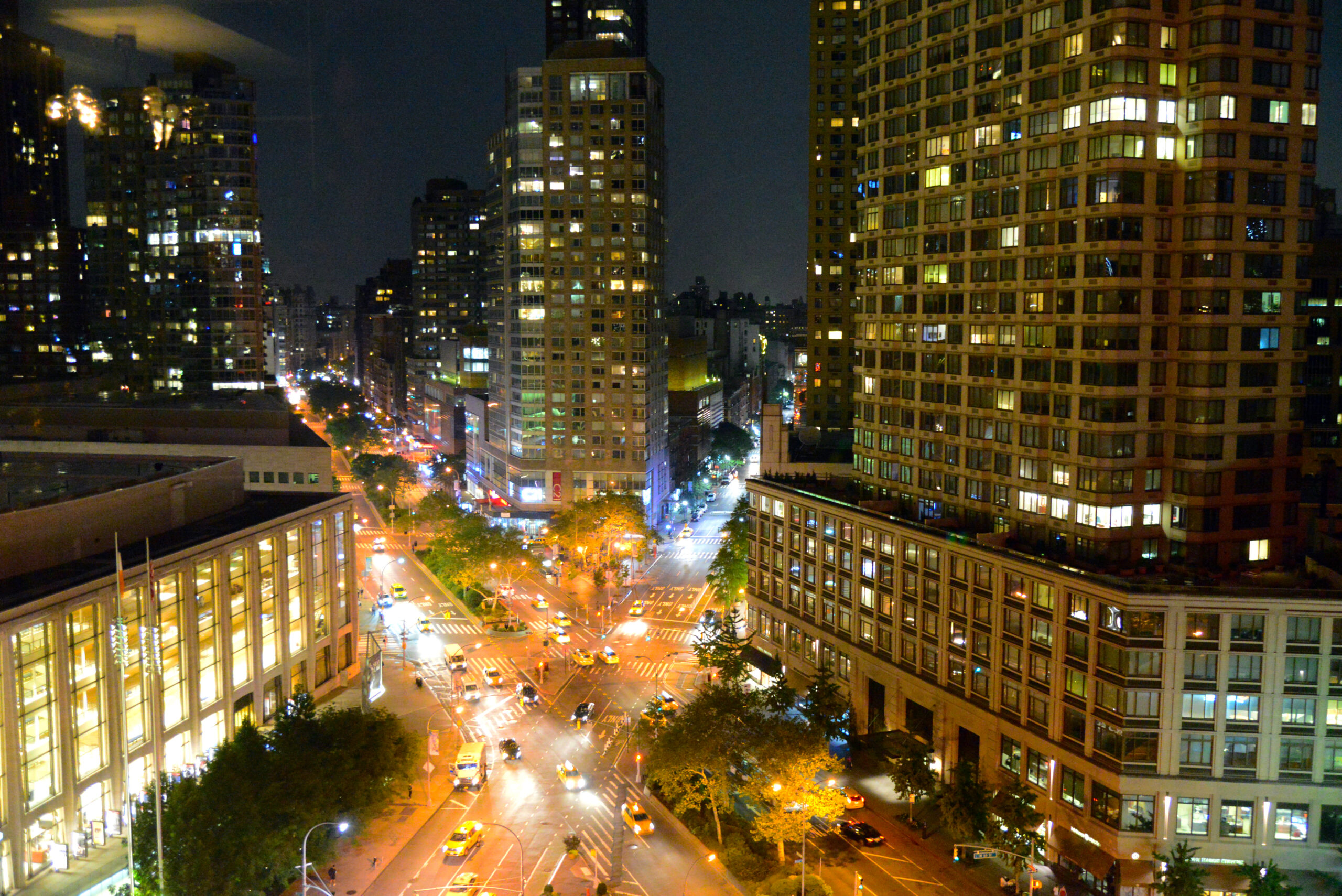
Broadway and Columbus Avenue by Lincoln Center — a useful visual for understanding the Upper West Side approach before a performance.
Why Getting to Lincoln Center Is Different from Other NYC Venues
Lincoln Center is not an arena where a headliner goes on 45 minutes after the announced start time and late arrivals quietly find their seats. Performances here start when they are scheduled to start. Late seating — if permitted at all — is typically held until an appropriate break. Being five minutes late to a Lincoln Center performance is meaningfully different from being five minutes late to a concert at a smaller club or a Broadway show where the ushers are flexible.
The campus itself also has a different character from venue neighborhoods with a single front door. Lincoln Center spans several blocks with multiple entrances, different venues pointing in different directions, and a plaza that rewards taking a moment to orient yourself rather than rushing in from the street. First-time visitors who arrive with 10 minutes to spare and have not located their specific venue entrance in advance are more likely to feel rushed than visitors at most other NYC venues. The solution is not complicated — arrive earlier and give yourself a few minutes to settle — but it requires actually factoring that into your arrival plan.
Lincoln Center Rewards Arriving Early Enough to Actually Enjoy the Campus
The fountain, the plaza, the architecture at night — these are part of the Lincoln Center experience and not just something to rush past. Arriving 20–25 minutes before curtain gives you time to find your entrance, check your ticket, and walk through the campus at a pace that starts the evening well rather than in the back of a rush. That kind of arrival is worth planning around, not treating as a nice-to-have.
Subway to Lincoln Center — The Default and the Backup
Two subway stations serve Lincoln Center, and understanding what each one offers changes how you plan depending on where you are coming from.
The 66 St–Lincoln Center station is the station specifically named in Lincoln Center Theater’s directions, the Metropolitan Opera’s getting-here guidance, and the Lincoln Square BID’s visitor information. It serves the 1 local train only. Exiting onto Broadway at 66th Street puts you at the northeastern edge of the campus — from the station exit to the nearest campus entrance is a short walk, with David Geffen Hall (New York Philharmonic) and the Alice Tully / Vivian Beaumont cluster accessible within minutes.
For visitors coming from any point along the 1 train’s west-side Manhattan route — Penn Station at 34th Street, Times Square at 42nd Street, the Upper West Side at 72nd and 79th — this station is the direct and straightforward answer. No transfers required if you are already on the 1 line. The ride from Penn Station is approximately 15–20 minutes depending on service.
Columbus Circle at 59th Street is the nearest major multi-line hub to Lincoln Center — approximately a 5–7 minute walk north and west to the campus. It serves the A, B, C, D, and 1 trains, which makes it the practical arrival station for visitors coming from the East Side (A/C/B/D express from Midtown), the far West Side, or anywhere on the broader subway network where transferring to the 1 line would add time and complexity.
The practical case for Columbus Circle over 66th Street: if you are already on the A, C, B, or D lines, or if you are coming from a point on the east side of Manhattan where the 1 train requires a transfer, Columbus Circle may be a simpler arrival even though it involves a longer walk. The walk itself is pleasant — Columbus Circle is one of Manhattan’s more legible intersections and the route along Broadway or Columbus Avenue is straightforward.
The core subway principle
The simple rule: if you are on the 1 train or can easily reach it without a cross-town transfer, use 66 St–Lincoln Center. If you are coming from the East Side or any point where the A/B/C/D makes more sense than switching to the 1, use Columbus Circle. The walk from Columbus Circle is longer but not burdensome if you have built in adequate pre-show time. The walk from 66th Street to a specific Lincoln Center venue will vary — David Geffen Hall is immediately accessible; the Met Opera and Koch Theater require a short additional walk through the campus. Always add 5–10 minutes for campus orientation on a first visit.
Driving to Lincoln Center
Driving to Lincoln Center is a real option, not a bad one — the campus has an underground parking garage and the surrounding blocks are navigable, particularly from the West Side routes. The consideration is not whether driving is possible but whether it fits the kind of evening you want to have, and whether the parking logistics are handled in advance.
The primary parking option is the Lincoln Center underground lot, which enters from West 65th Street between Amsterdam and Columbus Avenues (underneath the campus overpass). The Metropolitan Opera’s official directions list this as the primary on-site parking, open 24 hours. If you are planning to drive, arriving with enough buffer to find the garage entrance, park, and walk to your specific venue — minimum 45 minutes before curtain, ideally more — is the right plan rather than a tight arrival.
The driving approach is most natural for visitors coming from New Jersey (via Lincoln Tunnel or Holland Tunnel), from the West Side Highway (Henry Hudson Parkway), or from certain parts of Queens and the outer boroughs where the subway connection to the 1 train involves a long multi-leg ride. For Midtown-based visitors, taxis and the subway are generally simpler.
For full driving directions by approach route and detailed parking information — including the garage entrance, hours, rates, and alternatives — see the parking near Lincoln Center guide.
How to Get to Lincoln Center from Common Starting Points
| Starting Point | Best Route |
|---|---|
| Penn Station (34th St) | 1 train uptown to 66 St–Lincoln Center. Direct, no transfers, approximately 15–20 minutes. This is the simplest of all commuter-rail arrival routes — exit Penn Station, find the 1 train, ride north four stops. |
| Times Square (42nd St) | 1 train from Times Square–42nd Street to 66 St–Lincoln Center — four stops. Or A/C/B/D from Times Square to 59th St–Columbus Circle, then walk 5–7 minutes. Either works; the 1 train from 42nd Street is slightly more direct if you are already in the Times Square station. |
| Grand Central (42nd St, East Side) | S shuttle from Grand Central to Times Square, then 1 train north to 66th Street. Or — particularly for date nights and formal performances — a taxi or rideshare is often cleaner from Grand Central. The cross-town subway transfer at Times Square adds time and requires navigating a busy station; a direct taxi or Uber takes 10–15 minutes in moderate traffic. |
| Midtown East (50s/60s) | Taxi or rideshare directly to campus is often the simplest option from the East 50s–60s. The subway requires a west-bound transfer. If you prefer subway, A/C/B/D from Lexington Ave via cross-town bus to 59th St–Columbus Circle, then walk north to campus. |
| Upper East Side | Taxi or rideshare across Central Park — approximately 10–15 minutes in moderate traffic and often the cleanest option for East Side visitors. Alternatively, take the 4/5/6 to 59th St, transfer to N/Q/R/W to Times Square, then 1 train north — this routing is functional but adds transfer time. |
| Upper West Side (staying nearby) | Walk if within 15–20 minutes of the campus. The 1 train from 72nd or 79th Street is two stops. Citi Bike is an option for physically comfortable visitors who want a pleasant pre-show ride. |
| Brooklyn / Downtown Brooklyn | A or C train from Jay St–MetroTech or Hoyt–Schermerhorn to 59 St–Columbus Circle, then walk to Lincoln Center. Or take any train to Times Square and transfer to the 1. Budget approximately 30–40 minutes from central Brooklyn. |
| New Jersey (via NJ Transit) | NJ Transit to Penn Station (Newark, Secaucus, or Hoboken connections), then 1 train uptown to 66 St–Lincoln Center. Or via Lincoln Tunnel by car with the underground parking garage as destination. Budget buffer time for tunnel traffic on performance evenings. |
| Long Island (via LIRR) | LIRR to Penn Station, then 1 train uptown to 66th Street. The same direct route as any Penn Station arrival — one of the cleaner commuter rail paths to Lincoln Center. |
How Early to Arrive — and Why It Matters More Here
First-timers: arrive 25–30 minutes before curtain
Lincoln Center is a multi-venue campus and its entrances are not immediately obvious from the street on a first visit. Adding 10 minutes beyond your standard arrival buffer to locate the correct entrance — David Geffen Hall, the Met Opera House, the Koch Theater, Alice Tully Hall, and the Vivian Beaumont are all on the same campus but in different positions — prevents the specific stress of arriving on time for the campus but late for your venue entrance.
Regular visitors: 20 minutes is a workable minimum
Visitors who know the campus and know exactly where their venue entrance is can arrive closer to curtain comfortably. But 20 minutes still gives you time to check your coat, find your seat, and begin the evening without hurrying. The performance does not wait.
If dining nearby first, add buffer for the walk
Most of the restaurants near Lincoln Center are within a few minutes’ walk of the campus, but getting out of the restaurant, retrieving a coat, and walking to the right entrance takes longer than it looks. Plan your reservation to end at least 30 minutes before curtain, not 15.
Bad weather and winter nights: add 10–15 more minutes
Walking through rain or cold to a formal performance — especially if arriving by subway from a station a few blocks away — takes longer than the same walk on a clear September evening. Winter arrival logistics, including umbrella management, coat check lines, and slower streets, all add time. Budget accordingly.
The post-show exit is different from the arrival
After a large performance at Lincoln Center, the streets immediately around the campus fill with exiting audiences. Rideshare surge is real and immediate. The 1 train from 66th Street is a consistently good exit — it is right there and runs frequently. If you plan to walk or use rideshare after the show, building in 10–15 minutes of patience before requesting a car will convert a surge-priced wait into a normal fare in most situations.
Accessible and Least-Stress Arrival Planning
The 66 St–Lincoln Center station (1 train) and 59 St–Columbus Circle station (A/B/C/D/1 trains) both have elevator access, but elevator reliability at any specific station on any specific day requires checking. The MTA’s live elevator and escalator status page (mta.info) is the right tool for this — confirm elevator status before travel, not after arriving at the platform.
For visitors prioritizing the fewest possible stairs, the least physical exertion, or the most direct arrival without navigation uncertainty, curbside drop-off by taxi or rideshare is often the cleanest option. The Lincoln Center campus has drop-off access along Columbus Avenue and Amsterdam Avenue, and venue staff are typically present to direct arriving guests on performance nights.
Lincoln Center itself has accessibility information for each individual venue — the Met Opera, David Geffen Hall, Alice Tully Hall, and others each have specific accessibility resources for hearing, vision, mobility, and other considerations. Confirm directly with your specific venue in advance of the visit, particularly for formal evenings where accessibility logistics are worth resolving before the night rather than at the door.
What Trips People Up on the Way to Lincoln Center
Arriving too close to curtain
The most common Lincoln Center arrival mistake is treating it like an arena night and planning to arrive at or just before the scheduled start. Late seating is either prohibited or restricted to breaks at most Lincoln Center venues. Arriving 8 minutes before curtain at the Met Opera with a first-time visitor and no prior venue map puts you at real risk of missing the opening act entirely.
Not knowing which entrance to use
Lincoln Center has multiple buildings with separate entrances. “Lincoln Center” as an address does not specify whether you are going to David Geffen Hall (New York Philharmonic), the Metropolitan Opera House, the David H. Koch Theater (New York City Ballet), Alice Tully Hall, the Vivian Beaumont Theater, or another space. Know your specific venue’s entrance before you arrive, or allow enough time to ask.
Assuming rideshare is always easier than subway
From Penn Station or Times Square on the West Side, the 1 train to 66th Street is typically faster, cheaper, and more predictable than a pre-show rideshare — traffic on 9th and 10th Avenues heading uptown before an 8pm performance is a real variable. The subway wins on reliability here for most West Side departures.
Driving without handling parking in advance
Arriving at Lincoln Center by car without knowing which entrance leads to the parking garage, or without having checked that the garage is accessible and has space, can turn a 10-minute buffer into a 20-minute scramble. The underground lot on W 65th Street is the primary on-site option — confirm the entrance and plan to arrive earlier than you think you need to.
Not checking accessibility elevator status before leaving
If anyone in your group is relying on elevator access at 66th Street or Columbus Circle, check the live MTA status before leaving home — not when you arrive at the station. An out-of-service elevator discovered at platform level with 20 minutes to curtain is a solvable problem but a stressful one.
Plan the Full Lincoln Center Night
Frequently Asked Questions
The 66 St–Lincoln Center station on the 1 train is the primary recommendation from Lincoln Center Theater, the Metropolitan Opera, and the Lincoln Square BID. It exits onto Broadway at 66th Street, a short walk to the campus. For visitors coming from the East Side or on the A/B/C/D lines, 59 St–Columbus Circle is the major nearby hub — a 5–7 minute walk from the campus — that connects more lines without requiring a transfer to the 1.
66th Street if you are on the 1 train or can reach it without a cross-town transfer — it is closer and more direct for most West Side arrivals. Columbus Circle if you are on the A, B, C, or D train, or if you are coming from the East Side and a taxi is not your preference. The walk from Columbus Circle to the campus is longer (5–7 minutes) but entirely manageable if you have built in adequate arrival time. Both are good options; choose based on which requires fewer transfers from your starting point.
Yes. Columbus Circle to Lincoln Center is approximately a 5–7 minute walk north along Broadway or Columbus Avenue. It is a clear, walkable route through a pleasant part of the Upper West Side. On a nice evening, some visitors prefer this approach specifically because the walk through the neighborhood is a pleasant beginning to the evening. In bad weather or time pressure, a taxi or subway makes more sense.
1 train directly from Penn Station (34th St–Penn Station station) to 66 St–Lincoln Center — no transfers, approximately 15–20 minutes depending on service and wait time. This is one of the cleanest commuter rail to Lincoln Center paths in New York: exit the LIRR, NJ Transit, or Amtrak at Penn, find the 1 train, ride four stops north.
Sometimes yes, sometimes no — it depends on your starting point and the kind of night. For formal performances, East Side arrivals, or bad weather, a taxi or rideshare provides a more comfortable and sometimes quicker arrival than navigating a cross-town subway transfer. From Penn Station or the West Side of Manhattan, the 1 train is typically more reliable and avoids pre-show traffic. Post-show rideshare surge is real at Lincoln Center; the 1 train from 66th Street is usually the cleaner exit regardless of how you arrived.
Not a bad idea, but it requires a parking plan. The Lincoln Center underground garage on W 65th Street is the primary option — open 24 hours. Arrive earlier than you think you need to for garage access, and allow time to walk from the parking level to your specific venue. For most Manhattan-based visitors, the subway or a taxi is simpler; driving makes the most practical sense for visitors coming from New Jersey, Long Island, or outer-borough locations where the subway connection to the 1 train is genuinely inconvenient.
25–30 minutes before curtain for first-time visitors who are unfamiliar with campus layout. 20 minutes for returning visitors who know their entrance. Add 5–10 minutes for bad weather, winter coat check lines, and any complexity in your arrival route. Performances start on time and late seating is restricted at most Lincoln Center venues — the stress of arriving at curtain is avoidable by simply building in a reasonable buffer.
The Lincoln Center Arrival Plan in Brief
Getting to Lincoln Center is not complicated — but arriving well is a slightly different goal than arriving on time. For most visitors from the West Side of Manhattan and commuter rail arrivals at Penn Station, the 1 train to 66 St–Lincoln Center is the direct and obvious answer. For East Side arrivals, Grand Central visitors, and formal evenings where a taxi is worth the comfort, a car to the door is the cleaner choice. For visitors from New Jersey and Long Island, the car and the Lincoln Tunnel are serviceable routes if parking is planned in advance.
The most important variable in any Lincoln Center arrival plan is not the transportation mode — it is leaving enough time to arrive at the campus, walk to the right venue entrance, and settle in before the performance begins. Everything else is details.
Build the Lincoln Center night around the 1 train, Columbus Circle backup, campus orientation, curtain-time buffer, parking garage, pre-show dinner, walkable hotel, and calm post-show exit
Lincoln Center is not hard to reach, but it rewards a calmer plan than most venues. The best route depends on whether you are coming from Penn, Grand Central, the East Side, the Upper West Side, Brooklyn, New Jersey, or Long Island — and whether the night is subway-fast, taxi-polished, hotel-walkable, or driving with parking already handled.
How to Get to Lincoln Center
This page handles the arrival decision: 1 train to 66 St–Lincoln Center, Columbus Circle walk, Penn Station route, Grand Central route, East Side rideshare, driving, parking, accessibility, arrival timing, and the post-show exit.
You are hereGetting there is simple. Arriving early enough to enjoy the campus is the move.
Leave time for the plaza, the fountain, the correct entrance, coat check, and late-seating rules. This is not an arena arrival.
Lincoln Center Campus Guide
The main venue guide for the plaza, halls, entrances, campus layout, performance-night feel, and full Upper West Side planning.
Open campus guide → SeatsLincoln Center Seating Guide
Pair your route with hall-specific seating choices, campus navigation, venue entrances, balcony logic, and arrival timing.
Choose Lincoln Center seats → FoodRestaurants Near Lincoln Center
Pre-theater dinner, date-night meals, quick bites, post-show drinks, and restaurant timing that leaves room for curtain.
Plan Lincoln Center dinner → HotelsHotels Near Lincoln Center
Walkable Upper West Side and Columbus Circle hotel bases that turn the post-show exit into a simple stroll.
Plan nearby hotel → ParkingParking Near Lincoln Center
Underground garage strategy, W 65th Street entrance logic, driving routes, timing buffer, and why parking must be planned.
Plan parking → NeighborhoodUpper West Side Guide
The area layer for Lincoln Center: restaurants, hotels, subway access, Columbus Circle, Central Park, and calmer night-out planning.
Explore Upper West Side → SouthMidtown West Guide
Helpful for visitors approaching from Penn Station, Carnegie Hall, Columbus Circle, Midtown hotels, and west-side transit.
Explore Midtown West → Transport HubNYC Transportation Hub
The main routing hub for subway, rideshare, parking, commuter rail, Broadway, concerts, sports, and post-event exits.
Open transportation hub → Concert TransitHow to Get to NYC Concert Venues
Compare Lincoln Center with Carnegie Hall, Beacon, Radio City, MSG, Barclays, Brooklyn venues, Queens stadiums, and more.
Plan concert transit → Concert ParkingParking Near NYC Concert Venues
Use this to compare garages, street-parking myths, rideshare zones, stadium lots, and subway-first venue logic.
Compare concert parking → After ShowBest Way Home After a Show
Post-show subway timing, rideshare surge, hotel walk-backs, late food, and calmer exit strategy after curtain.
Plan the exit → Car vs TrainUber vs Subway for NYC Nights Out
Helpful for Lincoln Center nights where rideshare feels polished but the 1 train may beat traffic and surge pricing.
Compare the choice → Subway TipsNYC Subway Tips for Shows and Events
OMNY, service changes, late-night frequency, station exits, platform crowds, and smart subway habits for event nights.
Ride smarter → Date NightDate Night Restaurants NYC
Strong for opera, ballet, Philharmonic, and formal nights where the dinner plan should match the evening.
Plan date-night dinner → Before ShowWhere to Eat Before a Concert
Pre-concert dinner timing, route logic, and how to avoid letting a meal make you rush through the plaza.
Plan pre-show food → Late FoodBest Post-Show Restaurants
Use a drink or late bite to let rideshare surge fade and make the post-show exit feel less rushed.
Find post-show food → Concert StayWhere to Stay for Concert Nights
Compare Upper West Side, Midtown West, Theater District, Brooklyn, Queens, and venue-adjacent hotel bases.
Choose concert base → Hotel GuideHotels Near NYC Concert Venues
The broad hotel routing page for venue clusters, walk-backs, subway returns, rideshare exits, and full concert-trip planning.
Compare venue hotels → Nearby HallCarnegie Hall Seating Guide
A nearby classical and concert-planning companion for visitors comparing Midtown and Upper West Side performance nights.
Compare Carnegie Hall → ConcertsNYC Concerts Hub
The main concert hub for major shows, venue planning, seating, date nights, families, first-timers, and logistics.
Open concerts hub → VenuesNYC Concert Venue Guides
Compare Lincoln Center with Carnegie Hall, Beacon, Radio City, MSG, Barclays, Brooklyn rooms, and stadiums.
Compare venues → Full NightNYC Night Out Hub
The full planning hub for restaurants, hotels, transportation, neighborhoods, Broadway, concerts, sports, and complete nights out.
Plan the full night →