

Madison Square Garden Seating Chart: Best Seats, Views & Concert Sections
Use the MSG seating chart to compare concert sections, seat views, floor layouts, 100- and 200-level seats, Chase Bridge sections, seat numbers, and the areas to check carefully before you buy.
Madison Square Garden is the most famous arena in the world, and like most famous things, the reputation is both deserved and complicated. The current MSG — the fourth venue to carry that name, opened in 1968 at 34th Street and 7th Avenue — is a circular arena that was built for boxing and basketball and has hosted concerts for more than five decades. It is not a purpose-built concert venue, and that distinction matters when you are trying to figure out where to sit. The geometry, the sightlines, and the experience vary more dramatically from section to section here than at newer arenas designed with concerts in mind.
This guide breaks down the honest truth about every level at MSG — what the floor is actually like, how the 100s and 200s compare, when the 300s are worth considering, and what to skip. Not a sales pitch for any zone, just practical section-by-section analysis to help you make a better seat decision before you spend money.
This page is the concert-focused Madison Square Garden seating chart guide: seating plan and layout, MSG seat map logic, seat-view strategy, floor vs. bowl tradeoffs, and sections to approach carefully. For tickets, upcoming concerts, the event calendar, and box-office details, use the Madison Square Garden tickets and concert guide.
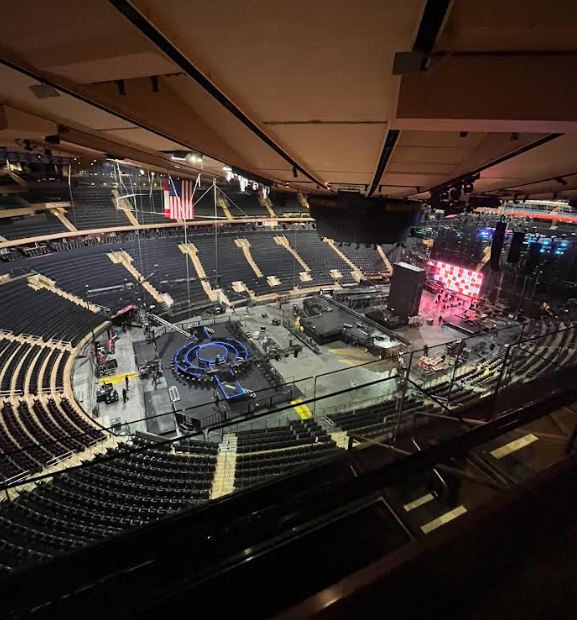
Inside Madison Square Garden, showing the arena bowl and seating environment that shapes how floor, lower-level, club, and upper-level concert seats feel in practice.
The Venue at a Glance
MSG was not designed for concerts. It is a circular, column-free arena whose geometry works extremely well for some seats and significantly less well for others. The 100-level lower bowl is genuinely strong for concerts. The 200s are a mixed bag — center sections are solid, side sections are weaker than they look on the chart. The 300s are high and steep but surprisingly usable from center positions for visually large productions. The floor rewards planning more than at newer arenas because the flat grade and tight floor layout amplify the difference between a good floor position and a mediocre one.
Madison Square Garden Seating Capacity, Seating Plan & Venue Map
Madison Square Garden publishes an arena capacity of 19,500 before production kills. For concerts, the usable number changes with the touring setup: an end-stage build removes seats behind and beside production, a large thrust or catwalk can reshape the floor, and in-the-round shows can reopen sections that would be closed for a conventional end-stage concert.
The phrases Madison Square Garden seating plan, MSG seating plan, Madison Square Garden seating layout, MSG seat layout, MSG arena seating chart and Madison Square Garden venue map all point to the same underlying question: how the arena is divided for the event you are attending. The permanent bowl gives you the basic geography, but the concert map is never truly complete until the stage and floor configuration for that exact show are loaded.
Buying for a specific show this fall or holiday season? Each guide below covers that concert’s floor layout and where to sit: Harry Styles MSG seating (through Oct 31), Dave Matthews Band at MSG (Nov 12–13), the best seats for Karan Aujla at MSG for the P-Pop Culture World Tour (Nov 18), the Stevie Wonder MSG seating chart and best seats for the full-album show on Nov 19, the sombr MSG seating chart (Nov 23–24), the best seats for Doja Cat at MSG for the Tour Ma Vie finale (Dec 1), the best seats for Jingle Ball at MSG for Z100’s 12-act holiday show (Dec 11), the best seats for Ryan Castro at MSG for his Los Chorros Con Richy holiday show (Dec 12), the Andrea Bocelli MSG seating chart and best seats for the two Romanza anniversary nights (Dec 16–17), the Phish MSG seating chart and floor tickets for the four-night New Year’s run (Dec 30–Jan 2), and, looking ahead, the best seats for Def Leppard at MSG for the three-band rock night with Goo Goo Dolls and The Struts (Jun 23, 2027). The event-specific map on the ticketing page is still the final word on how the floor is set for your night.
Madison Square Garden Concert Seating Chart — Section by Section
MSG’s circular design means the quality of your seat depends heavily on two variables: how far you are from the stage, and how directly you face it. The center sections at every level — those that face the stage head-on rather than from the side — are consistently better than their price suggests relative to side sections at the same level. Here is an honest breakdown of each zone.
For concert buyers, the useful version of an MSG seating chart is not a list of every synonym for the map — it is a breakdown of which zones work for different stage setups. The floor, lower bowl, 200 level, upper areas and Chase Bridge can all be good choices, but not for the same reasons. The section cards below focus on the tradeoffs that matter when you compare price, distance, viewing angle and production scale.
For a standard end-stage concert, lower-bowl seats that sit near the stage axis are usually the safest non-floor purchase: elevated above the flat floor, close enough for performer detail, and positioned to take in more of the full production. The exact best section numbers change with stage placement, so use the event-specific chart rather than assuming one fixed pair of sections.
The closest seats to the stage in the building. Energy is high and performer proximity is the best in the arena. The trade-off: flat floor with no elevation, so sightlines depend on crowd height and how far back you are within the floor section. Front-center positions in the first few rows are excellent. Mid-floor and rear floor are a different story.
Center-facing 200-level sections give you the full stage picture from a higher vantage point. The distance is noticeable compared to the 100s, but for visually ambitious shows with large production design — and for budget-conscious buyers — front rows of the center 200s hold up well. Side 200s are a different calculation entirely.
The 300-level at MSG is high and steep, but center sections in the front rows offer something the 200s don’t always provide: a clear, unobstructed top-down view of the full stage. For a production with elaborate floor design, light shows, or full-arena spectacle, front-center 300s are often the right call for buyers prioritizing the full picture over proximity.
Side 200-level sections can be much more angled than they appear on a flat diagram. For some end-stage builds, production towers, speaker hangs or the stage itself can also reduce what you see across the far side. These can still be good value, but they are sections where an exact seat-view check matters more than the section label alone.
Rear floor positions combine a long stage distance with no elevation advantage. They can work for buyers who want floor energy, but they are often a weaker sightline value than an elevated lower-bowl seat at a similar price. Check the location of the soundboard and any production platforms on the show-specific map before paying a floor premium.
At most modern arenas, every level has a broadly acceptable view because the bowl was designed around concerts. MSG was not. The gap between center and side seats is larger here than almost anywhere else in the city, and it runs through every level. At the 100s, center rows 1–10 are legitimately excellent; side sections at the same rows are noticeably weaker. The same is true at the 200s and 300s. When buying tickets to MSG, center-facing sections are worth paying a modest premium for. The alternative — a side section at the same level for a slightly lower price — often represents a worse deal in practice.
Checking Your Seat View Before You Buy
The Madison Square Garden seating chart shows you section boundaries, but it won’t tell you how a specific row actually feels once you’re in it — that’s what a seat view lookup is for. Before buying, it’s worth confirming the madison square garden seat view for your exact section and row on your ticketing platform, especially for side 100s, 200s, and 300s where the printed seating plan tends to understate the angle. The general seat layout holds true across most shows, but always cross-check against the event-specific chart, since MSG’s own seating plan changes slightly depending on stage placement.
MSG Seat Views: “View From My Seat” Before You Buy
Madison Square Garden seat view, MSG seat view, view from my seat Madison Square Garden and view from my seat MSG all describe the same high-value buying check: what the stage actually looks like from the section and row you are considering. This matters most for side angles, high upper-level rows, bridge seating and any concert with a large production rig.
A flat seat map can tell you where a section sits, but it cannot fully show the vertical angle, speaker hangs, lighting trusses, camera platforms or how much of a catwalk is visible from that exact row. Before paying a premium, compare the event-specific seating chart with a seat-view source for the same section whenever possible.
MSG Seating Chart With Seat Numbers, Rows & Interactive Views
MSG seating chart with seat numbers, Madison Square Garden seating chart with seat numbers, and MSG seating chart with numbers are especially useful searches because section alone is not enough to judge a concert seat. Row depth changes distance and overhang relationships, while the exact numbered seat can move you from the center of a section toward a sharper side angle.
Use the ticketing map for your exact event to confirm the row and numbered seat location rather than relying on a generic arena diagram. For concerts, this matters most in side sections, on the floor, and anywhere a production rig or catwalk changes the normal geometry.
Interactive and virtual MSG seating charts
MSG’s official venue guide includes an interactive virtual tour with 360-degree views of the building. That is useful for understanding height and orientation, while the event-specific ticketing chart is still the authoritative source for which concert sections are open and how the floor is configured. In other words: use the virtual view to understand the room, and the concert map to understand your show.
Madison Square Garden Floor Seats & MSG Floor Plan
The MSG floor is not one fixed numbered grid. For end-stage concerts it may be split into reserved sections, a single GA floor, a separate pit, or a layout shaped around a thrust or catwalk. Section labels and the position of the soundboard vary by tour, so a generic floor plan should be treated as an example rather than a promise of what your event will use.
The MSG floor is flat with no elevation between rows, which means sightlines depend entirely on where you are in the section and how tall the people around you are. This is a more significant issue at MSG than at purpose-built concert arenas because the floor is particularly large — the distance from front to back of the floor is substantial, and by the middle of the floor you are far enough back that standing crowds in front become a real visibility factor. If you have reserved floor seats and you’re in rows 10 or higher, manage expectations accordingly.
GA floor vs. reserved floor
Many major concerts at MSG use general-admission floor setups, while others use assigned floor seating. For GA, your location is determined by entry timing and any pit or wristband procedures set for that specific event. Door times and floor-entry rules vary by show, so check the official event page rather than assuming a universal 60- or 90-minute doors window.
Pit and extended stage configurations
Higher-production tours occasionally run a separate pit section immediately in front of the stage, a catwalk or thrust stage that extends into the floor, or an in-the-round configuration with the stage at the center of the arena. Each of these changes the value of different floor sections significantly. Always verify the specific show’s seating chart before buying any floor ticket — what floor section 4 means for one show can be completely different for another.
Searches for the Madison Square Garden floor plan spike heavily around major tour announcements, and for good reason: the msg floor plan for a concert bears little resemblance to the basketball or hockey floor plan, and it changes again between reserved and GA configurations. Don’t rely on a generic floor plan graphic — pull the event-specific one for your show before deciding on a floor section.
Reserved floor tickets at MSG do not guarantee a clear sightline regardless of row number. The flat grade, the standing crowds, and the sheer size of the MSG floor make mid- and rear-floor seats a riskier buy than they appear on the chart. If unobstructed views matter to you throughout the full show, front rows of the center 100-level sections will consistently outperform mid-floor and rear-floor positions — often at similar or lower prices on the secondary market.
MSG 100 Level, 200 Level & 300 Level Seats — The Real Comparison
100-level (lower bowl)
The 100-level is the strongest non-floor seating at MSG for concerts. It sits directly above the floor level, close enough to the stage that performer detail is clear, and elevated enough to avoid the flat-floor sightline problems. Center sections facing the stage directly — roughly the sections positioned between the two sides of the stage arc — are the prime zone. Front rows of center 100-level sections are the most consistently strong concert seats in the building outside of the very front of the floor.
Side 100-level sections are a different story. Because MSG is circular rather than a standard arena bowl shaped around an end-stage configuration, the side sections of the lower bowl are angled more sharply than at most venues. Sections on the extreme sides of the 100-level will have you looking across the stage at a significant angle. These are not terrible seats, but they are a notable step down from center positions at the same level.
200-level (mid-level)
The 200-level sits above the lower bowl and noticeably further from the stage. The center-facing 200-level sections are usable — a decent view of the full production, more distance than the 100s but with the full stage picture visible. For visually ambitious shows where seeing the entire stage at once matters more than proximity, center 200s can be the right call at a lower price than the 100s.
Side 200-level sections at MSG are where buyers most often feel they got a worse seat than expected. The angle from side 200s to an end-stage setup is more pronounced than the seating chart suggests — you will be looking across rather than at the stage, and some production elements at the opposite side of the stage will be partially obscured. Always verify the exact section angle for your specific seats before buying 200-level positions that are not clearly center-facing.
300-level (upper bowl)
MSG’s upper areas include conventional upper seating as well as the suspended Chase Bridge experience discussed below. The height is real, but elevation can work in your favor for a production built around lighting, video and a large stage picture. For concerts, the better upper-level buys are generally the positions with the cleanest face-on angle to the stage; extreme side or behind-production locations require more caution.
What to avoid in the upper levels depends on the event-specific production. Seats directly behind an end-stage build or at a severe side angle can be heavily compromised, and rigging can affect individual bridge or upper-bowl sightlines. Discounted or partial-view labels should be taken literally rather than treated as harmless boilerplate.
Chase Bridge Seats at MSG
The Chase Bridges are one of Madison Square Garden’s most distinctive seating options: suspended catwalk-style sections above the bowl that create a steep, bird’s-eye view of the floor. Common seating references identify the north bridge as sections 310–316 and the south bridge as 324–328; MSG’s own accessibility guidance also identifies section 313WC as a Chase Bridge location.
For concerts, the advantage is perspective. You can see the entire stage design, lighting pattern and floor geometry in a way that lower seats cannot. The trade-off is intimacy: performers are physically farther away, and touring speaker or lighting rigs can intrude on some concert sightlines. That makes Chase Bridge view MSG a configuration-specific decision rather than an automatic upgrade or downgrade.
They can be excellent for large, visually complex productions and for buyers who like a complete overhead view. They are less compelling for stripped-down shows where seeing the performer’s face and body language is the priority. Check a seat view for your exact bridge section on the event-specific setup before buying.
Madison Square Garden Concert Seating Chart & MSG Concert Map Configurations
MSG does not use a single fixed concert layout. Stage placement, floor configuration, and which sections are live vary by show. The most common configurations are:
Stage at one end of the arena, floor sections reserved with assigned seating. The standard configuration for major touring productions. Rear floor section often removed for soundboard. Center 100-level sections directly face the stage and are the strongest value seats in this setup.
Stage at one end, entire floor is general admission standing. Section numbers on floor tickets are irrelevant. Early arrival determines your position. Pit section may be present close to the stage — check the show-specific chart. GA floor with a front position is the most energetic experience in the building.
Stage extends into the floor via a runway or catwalk. This removes some floor sections and changes which remaining floor and 100-level sections have the best sightlines. Center floor sections further back can suddenly become excellent positions. Always verify the specific chart before buying floor tickets for productions known for elaborate stage design.
Stage in the center of the arena with seating on all sides. All bowl sections become roughly equal distance from the stage. MSG has hosted in-the-round productions and the circular design actually suits this configuration well. If your show is in-the-round, many of the sightline concerns about side sections become less relevant — verify the configuration first.
The configuration descriptions above are generalizations. Before buying any ticket — especially floor or lower bowl — look up the specific seating chart for your show on the ticketing platform. MSG publishes event-specific charts, and what a section looks like for one show can be completely different for another. This is especially true for floor sections (reserved vs. GA, with or without pit, with or without catwalk) and for any sections that might be behind or beside a thrust stage. Two minutes of checking saves real money and disappointment.
Buying for a specific show this fall or holiday season? Each guide below covers that concert’s floor layout and where to sit: Harry Styles MSG seating (through Oct 31), Dave Matthews Band at MSG (Nov 12–13), the best seats for Karan Aujla at MSG for the P-Pop Culture World Tour (Nov 18), the Stevie Wonder MSG seating chart and best seats for the full-album show on Nov 19, the sombr MSG seating chart (Nov 23–24), the best seats for Doja Cat at MSG for the Tour Ma Vie finale (Dec 1), the best seats for Jingle Ball at MSG for Z100’s 12-act holiday show (Dec 11), the best seats for Ryan Castro at MSG for his Los Chorros Con Richy holiday show (Dec 12), the Andrea Bocelli MSG seating chart and best seats for the two Romanza anniversary nights (Dec 16–17), the Phish MSG seating chart and floor tickets for the four-night New Year’s run (Dec 30–Jan 2), and, looking ahead, the best seats for Def Leppard at MSG for the three-band rock night with Goo Goo Dolls and The Struts (Jun 23, 2027). The event-specific map on the ticketing page is still the final word on how the floor is set for your night.
MSG Seats to Avoid — and When a Discount Is Worth It
Side sections at every level
This is the single most consistent mistake MSG buyers make. Because the arena is circular, side sections at the 100s, 200s, and 300s are angled significantly away from an end-stage setup. The seating chart flattens this in ways that don’t translate to real experience — what looks like a 45-degree angle on the chart is often closer to 60 or 70 degrees in the seat. At every level, center-facing sections are meaningfully better than side sections at the same row and price. This is more pronounced at MSG than at almost any other major arena in NYC.
Rear floor sections without arriving early (GA) or checking rows (reserved)
The rear of the MSG floor — both the sections near the soundboard and the sections flanking it — puts you at maximum floor distance with no elevation. For reserved shows, rows 15 and higher in rear floor sections are frequently the worst value in the arena: you are paying floor prices for a view that many 100-level seats at a lower price would beat. For GA shows, the same sections are what you end up in if you arrive late. Either way, avoid the back of the floor unless you have a specific reason to be there.
High row numbers in 300-level side sections
The upper bowl’s steepness is a feature for center sections and a problem for side sections. High row numbers in any side 300-level section combine the furthest distance from the stage with the sharpest angle to it. These seats are inexpensive for a reason. For any show where production detail matters, these are a genuine last resort — front-center 300-level sections are a much better use of the same budget.
Behind-stage sections without verifying first
Sections directly behind the stage for an end-stage show — which at MSG are usually marked as partial view or obstructed — give you a rear view of the production. Sometimes this is an interesting perspective; often it is a significantly limited one. These tickets are priced lower and the designation is on your ticket. Read what is marked before you buy; do not assume all sections in the lower bowl face the stage.
Plan the Full Night Around Madison Square Garden
MSG’s location at 34th Street and 7th Avenue in Midtown puts it directly above Penn Station — the best-connected transit hub in New York City — and within walking distance of several distinct neighborhoods for pre- and post-show dining. The arena is also surrounded by Midtown on all sides, which means the planning logistics are different from an outer-borough venue: more options, more crowds, and higher prices than you’d find near Barclays or a smaller venue.
Getting there
Penn Station is directly below MSG and serves the A, C, E, 1, 2, and 3 subway lines, plus NJ Transit, Amtrak, and LIRR — making MSG arguably the easiest major arena in the country to reach by transit. The 34th Street–Herald Square station (B, D, F, M, N, Q, R) is a short walk away. Transit is the strong recommendation for event nights; Midtown parking is expensive and traffic is reliably slow. The full guide to getting to Madison Square Garden covers every option including PATH for New Jersey visitors.
Where to eat before the show
Hell’s Kitchen (a 10-minute walk north and west of MSG) has the strongest concentration of pre-show dining options near the arena — a neighborhood full of restaurants accustomed to theater and concert crowds, at a wider range of prices than Midtown proper. Koreatown on 32nd Street is two blocks away and offers fast, reliable pre-show dinner with minimal wait if you pick the right spot. Midtown proper has every option but at a price premium and with heavier crowds on event nights. See the restaurants near MSG guide for specific recommendations by neighborhood and occasion.
Which neighborhood to base yourself in
Hell’s Kitchen for the best pre-show dinner at reasonable prices. Koreatown for fast, efficient, and good. Midtown proper for hotel convenience. Chelsea to the south for a quieter option after the show. The neighborhood guide for MSG nights covers the full picture with honest tradeoffs.
Hotels and overnight stays
Midtown Manhattan has the highest concentration of hotels in the city, with hundreds of options within walking distance of MSG at every price point. See the hotels near MSG guide for the best-positioned options. Penn Station below MSG also makes it straightforward to base yourself in New Jersey and commute in via NJ Transit for the evening.
Madison Square Garden Seating Chart — Frequently Asked Questions
What does the Madison Square Garden seating chart look like for a concert?
The concert seating chart uses MSG’s permanent bowl plus an event-specific floor and stage layout. The bowl provides the basic 100-, 200- and upper-level geography, while the floor, production kills, pit, catwalk and behind-stage availability can change by tour. Always use the seating chart for your exact event rather than a generic sports map.
How many seats are at Madison Square Garden?
MSG publishes an arena capacity of 19,500 people before production kills. Concert capacity varies because stage placement, floor configuration, production equipment and closed sections can reduce the number of usable seats.
What are the best seats at Madison Square Garden for a concert?
For a standard end-stage concert, lower-bowl seats with a clean, near-center angle to the stage are usually the safest non-floor choice. Front floor can be excellent for proximity, while elevated center-facing seats can be better for large visual productions. The exact best sections depend on the show’s stage configuration.
How do I check the view from my seat at Madison Square Garden?
Start with the event-specific MSG or Ticketmaster seating chart to confirm the stage and open sections, then compare a seat-view source for the same section and row. This is especially useful for side sections, bridge seating, high upper rows and productions with large speaker or lighting rigs.
Does the MSG seating chart show seat numbers and rows?
Event-specific ticketing maps can show the row and exact numbered seat you are selecting. A generic venue map is not enough for this because row depth and seat position inside the section can materially change the viewing angle.
Does Madison Square Garden have an interactive or virtual seating chart?
MSG’s official venue guide offers an interactive virtual tour with 360-degree views of the building. Use that to understand the arena’s height and orientation, then use the event-specific seating chart for the exact concert floor, stage and section availability.
What are the Chase Bridge sections at MSG?
Common seating references identify the Chase Bridge as sections 310–316 on the north bridge and 324–328 on the south bridge. The bridges are suspended above the bowl and provide a distinctive bird’s-eye view. Concert rigging can affect individual sightlines, so check the event-specific view before buying.
Are floor seats at Madison Square Garden worth it?
They can be, especially close to the stage or for a GA show where floor energy is the priority. Mid- and rear-floor positions have no elevation advantage, so an elevated lower-bowl seat can offer a cleaner overall view at a similar price. Floor layouts vary by tour, so check the exact map.
What MSG seats should I avoid for a concert?
Be most cautious with seats directly behind an end-stage production, severe side-angle sections, rear floor positions at a premium price, and any seat explicitly marked partial or obstructed view. The exact problem areas change with the touring setup, which is why the show-specific chart matters.
Is the MSG concert seating chart different from the Knicks or Rangers seating chart?
Yes. Basketball and hockey use the arena floor differently, while concerts add a stage and may add reserved or GA floor seating, pits, catwalks or production kills. A sports seating chart should not be used as the final reference for a concert purchase.
Madison Square Garden in Brief
MSG is one of the best concert experiences in New York when you’re in the right seat — and one of the most frustrating when you’re in the wrong one. The arena’s circular design makes the center-vs-side distinction more consequential here than at almost any other major venue in the city. The 100-level center sections are genuinely excellent. The floor rewards arriving early and buying front positions. The 300s are better than their reputation from center-facing sections. And the side sections at every level are the most consistently disappointing seats in the building relative to their price.
Know what you’re buying before you buy it — check the specific show chart, verify whether the floor is GA or reserved, and prioritize center-facing sections at whatever level fits your budget. For everything around the show, the planning guides linked throughout this page cover transit, dining, hotels, and neighborhoods.
For Madison Square Garden tickets, upcoming concerts, schedule and box-office information, use the main MSG venue guide.
Where to Sit at The Garden
Upcoming at The Garden
Before You Pick a Section
Other Seating Guides
Plan Around Your Seats
Center-facing beats close-but-sideways at every level. Pick the most centered section your budget allows, then chase the row.