

Carnegie Hall Concert Tickets & Concerts: Schedule, Box Office & Venue Guide
Three halls, one address, and acoustics that make almost every seat worthwhile. Here is how to choose the right performance, pick the right seats, and build an evening that does the room justice.
Carnegie Hall is at 881 Seventh Avenue, at the corner of 57th Street, in Midtown Manhattan — a building that has been hosting performances since 1891 and contains three distinct concert halls at different scales. The largest, the Isaac Stern Auditorium / Ronald O. Perelman Stage, seats 2,790 people across five curvilinear levels and is the space most people mean when they say “Carnegie Hall.” Below it, Zankel Hall seats 599 for more contemporary and cross-genre programming. On the 57th Street side, the Joan and Sanford I. Weill Recital Hall holds 268 people in what is among the most intimate formal concert settings in New York.
The reason Carnegie Hall occupies a distinct category from every other concert venue discussed in these guides is the acoustics. Stern Auditorium is routinely cited as one of the finest acoustic rooms in the world for live music — not just for classical performance but for any music that benefits from clarity, depth, and natural resonance. This has a specific practical implication: distance from the stage matters significantly less here than at most concert venues because the sound carries with equal quality to positions that would be remote in any other room. The balcony at Carnegie Hall is a genuinely worthwhile seat in a way that the balcony at a flat-ceiling arena is not.
This guide covers all three halls, how to choose seats intelligently across the Stern Auditorium’s five levels — including the counterintuitive acoustic truth about the Parquet that experienced concertgoers know — what kind of performances belong at each hall, how to think about the 57th Street neighborhood, and the two cost-access details that most guides skip: the $10 same-day tickets and the Weill Café, which is open to the public without a concert ticket.
Getting Carnegie Hall Tickets — Schedule, Box Office & Discounts
Carnegie Hall tickets are sold directly through carnegiehall.org, where the full carnegie hall schedule and carnegie hall calendar for the current season are listed by hall and date. Whether you’re searching carnegie hall tickets nyc or the reordered carnegie hall new york tickets, there’s no ambiguity to sort through — the address is fixed at 881 Seventh Avenue regardless of which hall the performance is in. Because Carnegie Hall runs three halls under one roof, checking concerts at Carnegie Hall for a specific night means confirming which of the three — Stern Auditorium, Zankel Hall, or Weill Recital Hall — the performance is actually in, since availability and pricing vary by hall.
For visitors checking what’s on at Carnegie Hall tonight or Carnegie Hall today, the online calendar updates daily with same-day availability. The Carnegie Hall box office — also called the Carnegie Hall ticket office — sits in the main lobby off 57th Street and handles will-call pickup, in-person purchases, and day-of questions, a useful option if a specific performance’s availability needs confirming directly.
Carnegie Hall discount tickets take a few real forms beyond the $10 same-day rush covered below. Carnegie hall student tickets and carnegie hall student discount pricing are available for many performances with valid ID — the box office handles these rather than online checkout, so if you’re hunting for student tickets Carnegie Hall offers for a particular concert, that’s where to ask. Rush tickets Carnegie Hall releases shortly before curtain are also periodically available; since carnegie hall rush tickets aren’t published in advance the way the same-day program is, calling or visiting the box office on the day is the reliable way to check.
Carnegie Hall Schedule & Upcoming Events — 2026–27 Season
Carnegie Hall schedule, Carnegie Hall calendar, Carnegie Hall concerts, Carnegie Hall events, and Carnegie Hall upcoming events all point to the same practical issue: the building runs three halls at once, and the event calendar mixes Carnegie Hall presentations with independently presented performances. Always confirm the hall name as well as the date before buying.
Carnegie Hall’s 2026–27 presentation season opens with Kirill Petrenko and the Berliner Philharmoniker in Stern Auditorium / Perelman Stage.
Additional Berliner Philharmoniker performances follow Opening Night in Stern Auditorium / Perelman Stage.
A 7:30 PM Stern Auditorium / Perelman Stage performance is part of the early 2026–27 calendar.
An 8:00 PM Stern Auditorium / Perelman Stage recital — one example of the high-demand piano programming that makes the full Carnegie Hall calendar worth checking by date and hall.
For Carnegie Hall tonight or Carnegie Hall today searches: use the official calendar as the final authority. The building can host simultaneous activity across Stern Auditorium, Zankel Hall, Weill Recital Hall, and education spaces, so a generic venue listing may not show the full picture.
Carnegie Hall Box Office & Ticket Office Hours
The Carnegie Hall Box Office is at 57th Street and Seventh Avenue. Current posted hours are Monday through Saturday from 11:00 AM to 6:00 PM and Sunday from 12:00 PM to 6:00 PM. CarnegieCharge at 212-247-7800 is currently staffed Monday through Friday from 11:00 AM to 8:00 PM and Saturday and Sunday from 12:00 PM to 8:00 PM. Use the box office for in-person purchases, ticket questions, discount eligibility and performance-specific availability.
Official Carnegie Hall Tickets vs. Resale Tickets
For primary inventory, begin with Carnegie Hall’s own event calendar and ticket pages. The hall presents many of its own concerts but also hosts independently presented events, so the ticket path can vary by performance. If primary inventory is limited or sold out, resale can add options, but compare the exact hall, date, seating level, delivery method and final checkout total before purchasing.
Student Tickets, Rush & Discount Options
The Planner data shows unusually strong purchase intent around Carnegie Hall student tickets, Carnegie Hall student discount, Carnegie Hall rush tickets and Carnegie Hall discount tickets. These programs can vary by presentation and availability, so check the official ticket page or box office for the specific performance. Student offers at Carnegie Hall commonly use valid student identification, and same-day or rush inventory is never something to assume before confirming it.
Where Is Carnegie Hall? New York City Address & Location
Carnegie Hall is at 881 Seventh Avenue, New York, NY 10019, at West 57th Street and Seventh Avenue in Midtown Manhattan. Searches for where is Carnegie Hall, Carnegie Hall NYC, Carnegie Hall New York, and Carnegie Hall Manhattan all refer to this same landmark building.
The closest subway is the N/Q/R/W at 57th Street–Seventh Avenue. The F at 57th Street–Sixth Avenue and A/B/C/D/1 at 59th Street–Columbus Circle are also practical. Because the building contains three performance halls, your ticket should be checked for the hall name before arrival even though the main Carnegie Hall address stays the same.
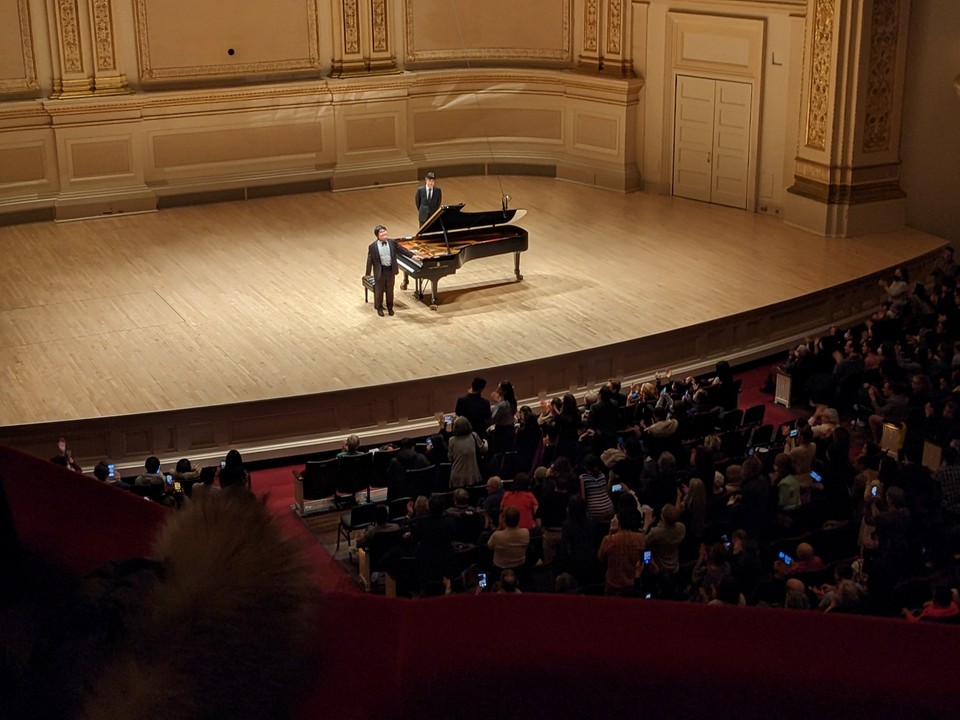
A live performance at Carnegie Hall, capturing the elegant atmosphere, stage presence, and listening-focused experience that make it one of New York City’s most distinguished concert venues.
What Carnegie Hall Is Actually Like for Concerts
Carnegie Hall is the venue you go to when you want the music to be the entirety of the experience. There is no production spectacle, no crowd energy displacing the performance, no arena-scale ambient noise. What there is: sound. The Stern Auditorium is a room built with extraordinary care for acoustic behavior — the five curvilinear levels, the materials, the proportions — and that care produces a listening environment that the most technically sophisticated modern concert halls struggle to replicate.
The audience culture at Carnegie Hall is more attentive and more focused than at most concert venues. This is not a formal requirement or a gate: there is no dress code, the programming is considerably more diverse than the “classical hall” reputation suggests, and first-timers who have never been to a formal concert feel comfortable here. But the room and its history attract audiences who are there specifically to listen, which changes the collective experience of being in it. A quiet moment in a piece of music is genuinely quiet. Applause is properly placed. The concentration in the room is palpable and adds to the performance.
The building also contains the Rose Museum on the second floor — free, open during performance evenings and on tour days — with archival photographs and materials from over a century of Carnegie Hall’s history. Arriving 20–30 minutes early to walk through it is one of the best free additions to a Carnegie Hall evening and one of the least-mentioned.
Carnegie Hall Concert Halls — Stern Auditorium, Zankel Hall & Weill Recital Hall
Carnegie Hall is not one room but three, and the distinction matters significantly for planning. Your ticket will specify which hall. Knowing what each offers before you arrive changes how you experience the evening.
The flagship. Five curvilinear levels, acoustics unchanged since 1891, the hall most people mean when they say Carnegie Hall. Home to major orchestral performances, full-scale recitals, prestige pop and jazz events, and film-in-concert programming. Enter from the main 57th Street lobby. Coat check on the Parquet level.
Below ground on the Seventh Avenue side, opened 2003. Flexible, modern room designed specifically for contemporary, jazz, world music, and cross-genre programming. 599 seats — intimate for the programming it houses. The restrooms are outside the Mezzanine level, which creates slightly faster intermission logistics. Coat check in the West Lobby.
The most intimate of the three. Chamber music, solo recitals, young artist debuts, panel discussions, master classes. 268 seats means genuine proximity to the performer at any position. Entrance near 154 West 57th Street. A room where the intimacy is as important as the acoustics. Often home to younger or emerging artists making their New York debuts.
Ticket listings for Carnegie Hall events specify the hall. Confirm whether your performance is in the Stern Auditorium, Zankel Hall, or Weill Recital Hall before making seat decisions — the seating logic differs significantly between them. Most of the seat guidance below applies to the Stern Auditorium specifically, which is where the majority of major performances occur.
When Carnegie Hall Is the Right Choice — and When It Isn’t
Carnegie Hall is the right venue when
The performance is built around sound rather than spectacle. Classical and orchestral programming is the obvious fit, but the hall serves jazz, chamber music, solo piano, vocal recitals, acoustic-leaning performances, film-in-concert events, and even comedy when the act is one for whom a listening room is the right context. The Stern Auditorium does something specific: it rewards music that has something to reveal in a quiet, attentive room. When that quality is present in the performance, Carnegie Hall amplifies it in a way that no other New York venue can match.
You want a genuinely different kind of concert experience. First-time visitors to New York who want something that is specifically, unmistakably New York — a night that they could not have had anywhere else — will find Carnegie Hall delivers it. The room, the history, the acoustic clarity, and the audience focus create a concert experience with a specific character that is not replicated by any other venue in the city.
A date night with real elegance is the goal. Carnegie Hall is one of New York’s most naturally date-night-appropriate venues — not because of formality (there is no dress code) but because the experience rewards attentiveness and generates a shared quality of attention that many other entertainment formats do not. The combination of a good dinner on 57th Street or in the surrounding neighborhood, the Carnegie Hall concert, and the post-show walk through Midtown is one of New York’s most complete evenings.
Carnegie Hall may not be the right choice when
You want arena energy, floor standing, or loud crowd participation. Carnegie Hall is a listening room. The audience culture is attentive and relatively quiet by concert-venue standards, which is a feature for some and a constraint for others. If the primary appeal of a night out is the feeling of being in a large, energetic crowd — the communal physical sensation of an arena or a standing-room club — Carnegie Hall is not the right room for it.
The artist’s show is specifically designed for arena or stadium scale. Some artists play Carnegie Hall on their touring schedules, but their productions — the staging, the volume, the visual elements — are designed for rooms five to ten times its size. A compressed arena production in a concert hall can feel slightly awkward for everyone. When an artist’s show is genuinely calibrated for Carnegie Hall’s scale and acoustic properties, the result is exceptional. When it is not, the venue works against the performance.
You want the loosest, most casual possible concert atmosphere. Carnegie Hall tends toward a more formal audience culture than most concert venues in New York. Not black-tie — but attentive, quiet, and focused. For visitors who want to drink, talk through the show, move around freely, or participate in a crowd-energy experience, the Beacon, Radio City, or a Brooklyn club will serve them better. See the first-timers concert guide for a broader framework for making this decision.
Best Seats at Carnegie Hall — The Complete Tier-by-Tier Guide
This main venue page keeps the seating material as a buying summary. For the full Carnegie Hall seating chart, seat views, Parquet vs. First Tier vs. Second Tier analysis, Dress Circle columns, Balcony legroom, rows and section-specific buying guidance, use the dedicated Carnegie Hall seating guide.
The Stern Auditorium’s five levels — Parquet, First Tier, Second Tier, Dress Circle, and Balcony — are each genuinely distinct in character and acoustic experience. The most important thing to know before buying: the standard assumption that “lower is better” does not hold at Carnegie Hall the way it does at most concert venues. This is not a caveat. It is the most useful piece of intelligence for anyone choosing seats here.
Experienced Carnegie Hall concertgoers — including subscribers who have spent decades attending orchestral series in multiple sections — consistently report that the First Tier and Second Tier box seats can deliver superior sound to many positions in the Parquet. The Parquet’s main floor has some zones, particularly toward the rear center, where the sound is not as clear and dimensional as from the elevated tiers above. This is not true of all Parquet positions, but it is documented by multiple experienced listeners and worth knowing before you pay a Parquet premium for rear center seats over a First Tier box at comparable or lower cost.
Carnegie Hall’s own guidance for the Parquet notes: “the stage a few feet above the seats, you may have to look upward” in the front rows. And for the Balcony: “The sound is rich and detailed.” The acoustics work in your favor at elevation in this room in a way that they do not in most venues.
Parquet — the main floor
The Parquet is the main floor level, with 1,021 seats in 29 rows (A through Z, then AA through CC). The center Parquet is the premium tier — closest to the stage, level with the performers. The sweet spot for most listeners is rows F through M of the center Parquet: close enough to see performer detail, far enough from the stage that the sound has dispersed and balanced, not yet reaching the rear zone where acoustic quality can drop relative to the upper tiers.
Front Parquet rows (A through E) put you very close to the stage, which is elevated above the floor — meaning the very front rows involve looking upward. For orchestral performances, extreme front rows can produce an angled perspective that makes it difficult to see the full ensemble simultaneously. For a solo pianist or a small chamber group, these same rows can be extraordinary. The performance type determines whether front Parquet is the right call.
In the center Parquet, seat number 101 is on the aisle on the right side (facing stage); seat 114 is on the left aisle. Right Parquet uses even-numbered seats starting at 2; Left Parquet uses odd-numbered seats starting at 1. Lower seat numbers are always toward the center aisle in the side Parquet sections.
First Tier / Blavatnik Family First Tier — the acoustic sweet spot
The First Tier consists of 65 open boxes, 8 seats per box, for 264 total seats. It sits above the Parquet at the first elevated level, looking down on the stage with a clear, direct sightline. Multiple experienced Carnegie Hall listeners and series subscribers specifically choose the First Tier center boxes over the center Parquet for orchestral and chamber performances. The elevation gives you a view of the full ensemble simultaneously and positions you within the room’s acoustic sweet zone — where the sound from the stage has filled the space before reaching you.
Center First Tier boxes are the benchmark high-value seat at Carnegie Hall. They are not always the most expensive seats in the house (front Parquet center often is), which means the price-to-experience ratio here is consistently favorable. For seats in the First Tier, aim for the first or second rows of a center box, and choose seats 1 through 6 for the best position within the box itself.
Second Tier — comparable to First, marginally more elevated
The Second Tier has 65 boxes with 6–8 seats each, totaling 238 seats. It sits above the First Tier with a similar box configuration and slightly more elevation. The acoustic character is comparable to the First Tier — many regular Carnegie Hall attendees hold Second Tier subscriptions and prefer them specifically for their sound. The slightly greater distance from the stage is compensated for by the acoustic environment of the room, where the sound continues to carry richly at this level.
Second Tier center boxes are among the strongest value seats in the building. The prices are typically lower than front Parquet center and often lower than First Tier center, while delivering a listening experience that experienced concertgoers rate highly.
Dress Circle — proceed with column awareness
The Dress Circle has 444 seats in 6 rows arranged in a semicircle surrounding the stage. The acoustic quality is strong, and the pricing is generally affordable. The critical caveat: the columns within the Dress Circle obstruct many sightlines, and most of the aisle seats have a column that may partially block the view. Carnegie Hall and third-party seating guides both confirm this. Within the Dress Circle, center sections are strongly preferred over side sections, and non-aisle seats are better than aisle seats in the column-affected positions.
One practical note: the elevator at Carnegie Hall goes up to the Second Tier only. Balcony patrons should plan on stairs because there is no elevator service to that level. Elevator access is available through the Dress Circle, although late-arrival procedures can still affect when patrons are seated. If punctuality is a concern, Dress Circle and Balcony seats require a more reliable arrival plan than the lower levels.
Balcony — the surprise
The Balcony has 837 seats — the largest single level in the Stern Auditorium — and is the highest and most affordable section. The warning is real: legroom in the Balcony is extremely tight. Multiple sources, including Carnegie Hall’s own guidance and venue reviews, confirm this. Anyone over about 5’7″ will feel the constraint, and the very front row of the Balcony is noted as particularly tight-legroom. Plan for it if you book here.
The surprise is the sound. Carnegie Hall’s own site is unambiguous: “There is nothing like experiencing an orchestra from the Stern Auditorium / Perelman Stage Balcony — the sound is rich and detailed.” The Balcony also offers the most complete architectural view of the hall — the ceiling details, the full sweep of the five levels — that make sitting in Stern Auditorium feel like sitting in history. The Balcony seating plot has been unchanged since 1891. For someone who wants the full Carnegie Hall experience at the most accessible price point, Balcony center rows are a genuinely worthwhile seat. Just bring awareness of the legroom situation and no expectations of stretching out.
Elevated view of the full ensemble, superior sound for orchestral and chamber music compared to many Parquet positions, often lower price than front Parquet. The benchmark seat for experienced Carnegie Hall concertgoers.
Marginally more elevated than First Tier, acoustically comparable, often the most favorable price-to-quality ratio in the building. Preferred by many regular season subscribers for orchestral series.
The main floor sweet spot. Closest level to the stage, sound balanced at this distance (avoids the too-close steep angle of front rows). Best for solo and small-ensemble performances where physical proximity enhances connection. Premium priced.
Sound is genuinely excellent — Carnegie Hall’s acoustics carry all the way to the top. Full architectural view of the room. Warning: legroom is extremely tight. Budget well for this. Center sections are strongly preferred over extreme sides.
Affordable and acoustically strong, but column obstructions affect many aisle seats. Carnegie Hall confirms most aisle Dress Circle seats have a column that may partially block the view. Prefer center, avoid aisle. Elevator stops at Second Tier — late arrivals must climb stairs to Dress Circle.
Parquet far left or far right, Dress Circle and Balcony extreme side sections — at any level, the outermost positions lose view of the opposite end of the stage. In all cases, center and center-adjacent are significantly better. Same-day discounted obstructed-view tickets (up to 50% off) are available if budget is the primary concern.
Carnegie Hall offers a limited number of same-day tickets at $10 for most performances — check carnegiehall.org on the day of the concert. Additionally, obstructed-view seats are typically available at up to 50% off the standard price. For budget-conscious concertgoers, these options access one of the world’s great acoustic rooms at a fraction of the premium pricing.
Carnegie Hall Concerts by Performance Type — Orchestra, Piano, Jazz & More
Full orchestra and symphonic performances
For a large orchestra filling the Stern Auditorium stage, the First and Second Tier center boxes are the strongest choice. The elevated angle gives you a view of the complete ensemble — you can see all the string sections, the woodwinds, the brass — and positions you in the room’s acoustic sweet zone where the orchestral sound has fully blended before reaching you. Center Parquet rows F through M are the premium proximity alternative, with the caveat that the very front of the Parquet loses some of the ensemble blend that the elevated tier positions capture naturally. Balcony center is an excellent budget option for orchestral performances specifically — the sound at the top of Carnegie Hall is genuinely rich for full orchestral music.
Solo piano or chamber music
For a single performer or a small ensemble, proximity shifts back toward the top priority. Front Parquet center rows A through E are strong here — the closeness to the performer becomes a connection asset, and the acoustic challenges of extreme front rows are less acute for a solo pianist or string quartet than for a full orchestra spread across the stage. First Tier center boxes remain excellent, but the argument for proximity over elevation is stronger for intimate performances than for large ensembles.
Jazz and special-event concerts
Carnegie Hall’s jazz programming in Stern Auditorium (and Zankel Hall’s full jazz program) calls for a different approach. Jazz benefits from proximity in a way that orchestral music sometimes does not — the conversational quality of jazz improvisation is more audible from closer positions. For jazz in Stern Auditorium, Parquet center rows D through K are the optimal listening zone. For jazz in Zankel Hall’s more intimate configuration, virtually all seats are strong — 599 seats in a flexible room means no position is significantly compromised.
Film-in-concert events
Carnegie Hall programs film-in-concert events (Final Fantasy, La La Land, and similar formats from the current calendar) where a full orchestra performs the score to a film projected above the stage. The seating logic for these events is similar to Radio City film-in-concert: an elevated angle where you can see both the screen and the orchestra simultaneously is preferable to extreme front positions. First and Second Tier center boxes or center Parquet rows G through N are the strongest choices for seeing both elements without awkward neck angles.
Weill Recital Hall performances
At 268 seats, Weill Recital Hall is intimate enough that the seating distinction between sections is minimal. Center positions in the front half of the hall are standard premium, but there is no genuinely bad seat in a 268-seat room with strong acoustics. Weill Recital Hall is also where many young artists make their New York debuts — the programming rewards discovery more than prestige-performance attendance, and the intimacy of the room makes any seat feel close.
What First-Timers Should Know Before a Concert at Carnegie Hall
There is no dress code — and the range of dress is wide
Carnegie Hall has no dress code. A typical Carnegie Hall audience will contain everything from formal eveningwear to smart casual to jeans — the programming’s diversity means the audience composition varies significantly by show. For a major orchestral opening night, the room tilts more formal. For a Zankel Hall jazz event on a Tuesday, it does not. Dress for a polished evening rather than a specific standard, and you will fit naturally into any Carnegie Hall audience. See the what to wear guide for practical venue-specific advice.
Arriving early is genuinely rewarding here
For a first visit to Carnegie Hall, arriving 30–45 minutes before the performance is worth the discipline. The Rose Museum on the second floor — free, open during performance evenings — has over 400 archival items and photographs from the hall’s history. The lobby architecture itself is worth a few minutes. And settling into your seat before the Stern Auditorium fills, watching the house lights on the full scope of the five curvilinear levels as the audience arrives, is one of the better orientation experiences available at any New York concert venue. The building rewards attention before the music starts.
Use the coat check — Carnegie Hall actually has one
Unlike MSG, Barclays, and most arena venues, Carnegie Hall has a coat check. For Stern Auditorium events it is on the Parquet level; for Zankel Hall it is in the West Lobby near the Blavatnik Family First Tier Box Office; for Weill Recital Hall, the coat check is in the Jacobs Room. It opens approximately one hour before the performance and closes around 30 minutes after the show ends. Using it removes the logistical friction of managing outerwear in a seated room, which matters more at Carnegie Hall — where people around you are trying to focus — than at most other venues.
There is no elevator service to the Balcony
Carnegie Hall elevators serve the Parquet, Blavatnik Family First Tier, Second Tier, and Dress Circle. There is no elevator service to the Balcony. Latecomers are still seated only at appropriate breaks, so upper-level patrons should leave extra time for arrival. Plan accordingly: arriving on time is a more urgent practical concern for Dress Circle and Balcony seats than for Parquet and Tier levels.
Latecomers are seated at breaks
Carnegie Hall, in common with most serious concert halls, seats latecomers at appropriate breaks in the music rather than continuously throughout. If you arrive after the performance has begun, you will wait in the lobby until an intermission or a natural pause. This is not punitive — it protects the experience for everyone in the room. It is a strong argument for factoring extra transit time into the evening plan.
The $10 same-day tickets are real
Carnegie Hall makes a limited number of same-day tickets available at $10 for most performances. Check carnegiehall.org on the day of the concert. For first-timers who want to experience the hall without a full-price commitment, this is a genuine access point to one of the best acoustic rooms in the world. Availability varies by show and is not guaranteed, but it is confirmed policy and worth checking.
The Full Evening — 57th Street, Dinner, and Getting There
The 57th Street corridor as a pre-show environment
Carnegie Hall sits at 7th Avenue and 57th Street, which places it at the upper edge of Midtown — close enough to Central Park South that the neighborhood has a slightly different character from the Penn Station or Times Square blocks. The 57th Street corridor has a concentration of restaurants at various price points, and the surrounding blocks of 55th through 60th Streets and 6th through 8th Avenues give enough range that a pre-show dinner within 10 minutes of the hall is straightforward. For a polished dinner-and-concert evening, the 57th Street area supports it in a way that the MSG block around Penn Station does not.
Pre-show dinner planning
The neighborhood around Carnegie Hall has options at multiple price points, but the best pre-show dining typically comes from booking slightly in advance rather than arriving without a reservation. On major performance nights — a sold-out orchestral event, a high-profile jazz concert — the restaurants within walking distance of the hall are busy. Booking the restaurant when you book the tickets is the consistent rule for any evening where the dinner is expected to be part of the experience. See the restaurants near NYC concert venues guide for area-specific options.
The Weill Café is open to the public without a concert ticket. Current daytime café service runs Monday through Friday from 8 AM to 3 PM with coffee, pastries, soups, salads, quiche and sandwiches. Carnegie Hall also offers reservation-only pre-concert dining before selected Stern Auditorium / Perelman Stage events, so check availability if you want the café to be part of the concert evening.
Transit — one of the cleaner Midtown venue situations
The N/Q/R/W lines stop at 57th St–7 Av, a 2–4 minute walk from the Carnegie Hall entrance on 57th Street. This is the closest station and the most direct. The F train stops at 57th St and Sixth Avenue, a 6–8 minute walk east to the hall. The A/B/C/D/1 at 59th St–Columbus Circle is a 3–5 minute walk south and offers connection from a wide range of Manhattan neighborhoods. Carnegie Hall’s official directions page confirms all of these routes. For post-show exit, the N/Q/R/W station at 57th–7 Av is the cleanest option — the post-Carnegie Hall crowd is significantly smaller and more manageable than the post-MSG or post-arena exit experience. See the transit guide for full details.
Hotels near Carnegie Hall
For visitors staying in New York around a Carnegie Hall performance, Midtown hotels between 54th and 62nd Streets are ideally positioned — walkable to the hall without subway involvement. Central Park South hotels specifically place you in a 5–10 minute walk of the venue with the park as an ambient backdrop for the evening. See the hotels near NYC concert venues guide for specific options near Carnegie Hall’s Midtown location.
Parking near Carnegie Hall
Carnegie Hall publishes a parking guide on its website with nearby garage recommendations. Midtown parking near 57th Street runs $35–55+ on performance evenings, and the density of Midtown traffic makes driving meaningfully less efficient than the subway for most visitors. Pre-booking through SpotHero is the best approach if driving is required. See the parking guide for Midtown strategy. The subway, for most visitors, is the clear first choice.
Carnegie Hall vs Other NYC Concert Venues
Carnegie Hall for acoustics and a listening-focused night; Radio City for a grander production event. Radio City (~5,960 seats) is more than twice Carnegie Hall’s capacity and designed for amplified productions with visual elements — film in concert, pop shows, the Christmas Spectacular. Carnegie Hall is designed for acoustic clarity and musical focus. For unamplified or lightly amplified music, Carnegie Hall is categorically superior. For visually designed productions that need a larger room, Radio City serves the format better. The programming rarely overlaps in a way that requires a direct choice.
Carnegie Hall for acoustic and cultural prestige; Beacon for intimacy and neighborhood embedding. The Beacon (~2,894 seats) is a warm, accessible room with a devoted audience culture and an Upper West Side setting that makes the full evening easy to construct. Carnegie Hall is more formal in audience culture, more acoustically sophisticated, and sits at a slightly more prestigious cultural position. For artists who play both, the Beacon will often feel more personal; Carnegie Hall will sound better for acoustic-dependent music. They serve different purposes and different kinds of evenings.
Related but distinct institutions at adjacent scales. Lincoln Center’s David Geffen Hall (the New York Philharmonic’s home, ~2,738 seats) is Carnegie Hall’s most direct peer in terms of scale and orchestral programming. The two venues have different acoustic characters — Geffen Hall underwent a major acoustic renovation completed in 2022. Lincoln Center is part of a larger performing arts complex on the Upper West Side; Carnegie Hall is a standalone midtown building. Visitors choosing between the two for orchestral or chamber music should consider both the programming and the experience of the respective neighborhoods. For jazz, Zankel Hall has no direct Lincoln Center equivalent.
Completely different categories. MSG is a 20,000-seat arena; Carnegie Hall is a 2,790-seat concert hall. No artist in 2025 plays both as interchangeable options. The two venues serve fundamentally different performance formats and different audience intentions. If you are deciding between MSG and Carnegie Hall for the same evening, you are probably deciding between two different artists, not two different ways to see the same performance.
Opposite ends of the intimacy spectrum. A Williamsburg club at 500 people puts you physically inside the performance; Carnegie Hall at 2,790 seats puts you in a concert hall. Both are “intimate” compared to an arena, but they produce entirely different experiences. Club venues are about energy, proximity, and scene. Carnegie Hall is about sound, focus, and the feeling of being in a room built for listening. Both have genuine value; neither substitutes for the other.
Common Carnegie Hall Concert Mistakes
Assuming lower levels always deliver better sound
The standard “orchestra floor = best” logic does not hold at Carnegie Hall. The First Tier and Second Tier center boxes are documented by regular Carnegie Hall attendees and by the hall’s own guidance as delivering superior sound to certain rear Parquet positions. The acoustic quality of the room at elevation is a genuine feature rather than a compromise. Buying rear center Parquet over First Tier center based on the assumption that “closer to the floor means closer to the music” produces a worse seat at a higher price.
Ignoring the Dress Circle column obstruction
The Dress Circle’s aisle seats have column obstructions confirmed by Carnegie Hall and multiple venue guides. These seats are priced below full-view Dress Circle positions but are not always clearly labeled as obstructed on third-party platforms. Within the Dress Circle, center sections and non-aisle seats are significantly better than the column-adjacent aisle positions. Verify the specific seat before purchasing Dress Circle tickets.
Booking the Balcony without planning for the legroom
The Balcony at Carnegie Hall has excellent acoustics and one of the tightest legroom situations of any major New York concert venue. Multiple sources, including Carnegie Hall’s own “best seat” guide and venue reviewers, confirm the constraint is real and significant for anyone over average height. The sound from the Balcony is genuinely worth experiencing — but arriving without knowing about the legroom and then spending two hours uncomfortable about it is a preventable problem. Front row of the Balcony is noted as particularly tight.
Missing the $10 same-day ticket option
Carnegie Hall offers limited same-day tickets at $10 for most performances. This is confirmed policy, available on carnegiehall.org, and represents one of the best cost-access situations at any major New York cultural institution. First-timers who want to experience the hall on a budget and are flexible about which performance they attend should check the same-day availability before assuming Carnegie Hall is inaccessible on a limited budget.
Arriving late without knowing the elevator limitation
If you have Dress Circle or Balcony seats and arrive after the performance has begun, you will need to climb stairs — there is no elevator service to the Balcony. Carnegie Hall seats latecomers at appropriate breaks, which means you may wait in the lobby for the first intermission or natural pause before being shown to your seat. This is standard concert-hall practice but worth knowing in advance so the evening’s timing plan accounts for it.
Treating Carnegie Hall as only for classical music
Carnegie Hall’s programming across its three halls is substantially more diverse than its reputation suggests. Zankel Hall specifically programs jazz, world music, and contemporary cross-genre artists on a consistent basis. Stern Auditorium hosts jazz concerts, film-in-concert events, pop and folk performances, and occasional comedy. The Weill Recital Hall features young artists across multiple genres making their New York debuts. Visitors who dismiss Carnegie Hall as “not for them” because they do not attend classical concerts may be dismissing a range of programming that would suit them well.
Carnegie Hall Tours & Tour Tickets — A Different Ticket Than a Concert
Carnegie hall tours are a separate product from concert tickets, sold and scheduled independently through carnegiehall.org. The one-hour guided tour walks visitors through the building’s 130-plus-year history, including a look at the Stern Auditorium / Perelman Stage itself — the only way to see it without attending a performance — plus the Composers’ Gallery and the Rose Museum. Tours run Monday through Saturday during most of the season, with tickets typically around $25 for adults and slightly less for students and seniors, plus a small online service fee.
Tour tickets are released weekly, and walk-in tickets are also available at the box office on tour days, subject to availability. Unlike a concert ticket, a tour doesn’t require checking a specific hall’s schedule — tours depart from the box office lobby regardless of what’s playing that evening. If you’re after a tour rather than a concert, book directly through Carnegie Hall’s own tours page rather than a general ticket marketplace.
Frequently Asked Questions
Start with Carnegie Hall’s official event calendar and ticket page for the specific performance. Because the building hosts both Carnegie Hall presentations and independently presented events, the exact primary ticket path can vary. Confirm the hall, date, seating level, delivery method and total price before purchasing.
Carnegie Hall’s 2026–27 presentation season opens October 8, 2026 with the Berliner Philharmoniker. Early-season highlights include additional Berliner Philharmoniker performances, The Philadelphia Orchestra, Yunchan Lim, and many other events across Stern Auditorium / Perelman Stage, Zankel Hall, and Weill Recital Hall. Use the official calendar for the complete current schedule.
Current posted box-office hours are Monday through Saturday from 11 AM to 6 PM and Sunday from 12 PM to 6 PM. CarnegieCharge at 212-247-7800 is currently staffed Monday through Friday from 11 AM to 8 PM and Saturday and Sunday from 12 PM to 8 PM.
Carnegie Hall is at 881 Seventh Avenue, New York, NY 10019, at West 57th Street and Seventh Avenue in Midtown Manhattan. The N/Q/R/W station at 57th Street–Seventh Avenue is the closest subway stop.
Yes — for the kinds of concerts it is built for, it is one of the best venues in the world. Classical, orchestral, chamber, jazz, solo recital, acoustic-leaning performances, film-in-concert, and vocal-forward events all benefit from the Stern Auditorium’s extraordinary acoustic properties. For concerts that are primarily about spectacle, crowd energy, or large-scale production, the room is less well-suited than larger arenas or production-oriented theaters. The quality of the acoustic experience at Carnegie Hall, across all five levels of the Stern Auditorium, is genuinely distinctive — it is the reason that Balcony seats here are worthwhile in a way that balcony seats at most other venues are not.
For most orchestral and chamber performances: First Tier center boxes, front rows, seats 1–6. Excellent acoustic position, full view of the ensemble, frequently better value than front Parquet center. Second Tier center boxes are a comparable alternative at often-lower prices. For proximity-focused performances (solo piano, small chamber ensemble): Parquet center rows F through M are the premium choice. The Balcony center, while having extremely limited legroom, delivers genuinely excellent sound and is a worthwhile budget option. Avoid extreme side positions at any level, Dress Circle aisle seats (column obstruction), and very rear Parquet center positions (acoustic quality can be lower than upper-tier alternatives).
Yes — more than at almost any other concert venue. The Stern Auditorium’s acoustics carry the sound richly through all five levels, and Carnegie Hall’s own guidance describes the Balcony sound as “rich and detailed.” First and Second Tier center box seats are frequently considered superior to rear Parquet center by experienced concertgoers, not inferior. The Balcony carries genuine acoustic quality at the tradeoff of very limited legroom. The upper tiers at Carnegie Hall are not budget compromises — they are different vantage points within a room where the acoustic quality remains high throughout.
Carnegie Hall’s history includes some of the most famous live recordings in American music. Judy Garland Carnegie Hall’s 1961 concert produced one of the best-selling live albums ever made. Billie Holiday at Carnegie Hall and the archival release billie holiday live at Carnegie Hall document her landmark 1956 appearance. Bob Dylan at Carnegie Hall dates back to his early-1960s shows, and Lenny Bruce at Carnegie Hall — often remembered as the Lenny Bruce Carnegie Hall midnight concert from 1961 — is considered one of the defining moments of his career. These are historical performances and recordings, not current listings, but they’re part of why the hall carries the reputation it does today.
No. Carnegie Hall’s programming across its three halls includes classical, orchestral, chamber, jazz, world music, folk, film-in-concert, pop, and occasional comedy. Zankel Hall specifically focuses on jazz, contemporary, and world music programming. The current season calendar (available at carnegiehall.org) typically includes a wide range of genres alongside the core classical programming. The hall’s reputation as a classical venue reflects its history and its acoustic design, not its current programming scope.
Yes — carnegie hall piano concerts are a significant part of the calendar across all three halls, from solo recitals in Weill Recital Hall to major piano soloists in Stern Auditorium. If you’re searching piano concert Carnegie Hall listings specifically, filter the calendar by hall, since piano recitals happen in more than one room. A carnegie hall jazz concert is also a regular fixture, particularly in Zankel Hall’s contemporary programming. Alongside these, carnegie hall classical concerts — full orchestra, chamber ensembles, vocal recitals — remain the core of the season. Check the current calendar for the specific genre and hall on any given date.
Carnegie Hall ticket prices vary significantly by performance and seating level. Premium front Parquet center can run well above $100; upper Balcony and Dress Circle seats are available for much less. Carnegie Hall offers a limited number of same-day tickets at $10 for most performances — check carnegiehall.org on the day. Obstructed-view seats are typically available at up to 50% off the standard price. Student and rush tickets may also be available for specific performances. The hall’s commitment to accessibility means that price is less of an absolute barrier to entry than at many comparable cultural institutions.
30–45 minutes before the performance for a first visit. This allows time for the Rose Museum on the second floor (free, worth 10–15 minutes), the coat check, and settling into the Stern Auditorium before the house fills. Carnegie Hall seats latecomers at appropriate breaks in the music — this is standard concert-hall practice, not a strict policy, but planning to be in your seat before the performance begins is strongly advisable. If you have Balcony seats, note that there is no elevator service to that level; leave extra time for the stairs and late-seating procedure.
The N/Q/R/W trains stop at 57th St–7 Av, a 2–4 minute walk to the Carnegie Hall entrance on 57th Street — the most direct subway option. The F train stops at 57th St and Sixth Avenue, 6–8 minutes away. The A/B/C/D/1 trains at 59th St–Columbus Circle are a 3–5 minute walk south. Carnegie Hall’s official directions page lists all subway options and bus routes (M5, M7, M10, M20, M31, M57, M104). Post-show, the 57th–7 Av station handles the Carnegie Hall crowd comfortably — a significantly easier exit than the post-arena crowds at MSG or Barclays. See the transit guide for full details.
Yes — with the right show. For a first-time visitor who wants a specifically New York experience that could not happen anywhere else, Carnegie Hall at the right performance is one of the most complete answers the city has. The acoustic quality is audibly extraordinary, the room has genuine visual and historical character, the transit access is straightforward, and the combination of the hall with a pre-show dinner in the 57th Street area constitutes an excellent complete evening. The caveat: choose a performance that actually fits the room — acoustic music, jazz, orchestral, chamber, or film-in-concert. A loud amplified pop show that belongs in an arena will be technically competent at Carnegie Hall and will not reveal what makes the room great. Match the show to the room and the evening is hard to disappoint. See the first-timers concert guide for the broader framework.
Carnegie Hall, Understood
Carnegie Hall is the venue New York has that most cities do not: a room where the acoustics are genuinely extraordinary, where the upper tiers are worthwhile rather than a compromise, and where a $10 same-day ticket can put you in one of the world’s great listening rooms for the price of a sandwich. The room rewards matching the performance to the space — music that benefits from clarity, depth, and focused attention is the music that Carnegie Hall serves best.
The seats to know: First Tier and Second Tier center boxes for orchestral and chamber music, where the acoustic position is frequently superior to rear Parquet at lower cost. Parquet center rows F through M for proximity-focused performances. Balcony center for the best budget option in one of the world’s great acoustic rooms — with full awareness of the legroom. Dress Circle center only, away from the aisle columns that obstruct the view.
Book dinner on the 57th Street corridor or in the surrounding blocks when you book the tickets. Take the N/Q/R/W to 57th–7 Av. Arrive early enough for the Rose Museum. Use the coat check. Be in your seat before the music starts.
That is Carnegie Hall done correctly.
Build the Carnegie Hall Evening Around Dinner,
the Seat, the Hotel, the Subway, the Parking Plan & the Post-Concert Drink
Carnegie Hall is one of the rare NYC venues where the meal can carry the same sense of occasion as the performance. Use these guides to connect pre-concert dinner, Midtown West hotels, arrival timing, parking, seating, and the broader night-out plan.