

Barclays Center Nets Tickets & Basketball Games: Brooklyn Venue Guide
Find Barclays Center Nets tickets and basketball games, then plan entrances, bags, transit, seating context, amenities and the full Brooklyn game-night experience.
Barclays Center changed what a New York basketball night could look like when it opened in Brooklyn in 2012 — not because it competed with Madison Square Garden on history or myth, but because it offered something different: a well-designed modern arena at one of the best transit hubs in the city, in a neighborhood that has its own reasons to visit. Understanding what the building adds to a Nets game, and how to plan the night properly around it, is what makes the difference between a good Brooklyn evening and a great one.
This is the basketball venue guide for Barclays Center — what the arena is for a Nets game, how to navigate it, how to think about seats, and how to connect the venue to the full night around it. For ticket-buying intent, this page covers Barclays Center Nets tickets, Brooklyn Nets tickets at Barclays Center, and how to find current basketball games at Barclays Center; broader team-ticket shopping stays on the Brooklyn Nets ticket guide, while section-level seat selection stays on the Barclays Center seating guide.
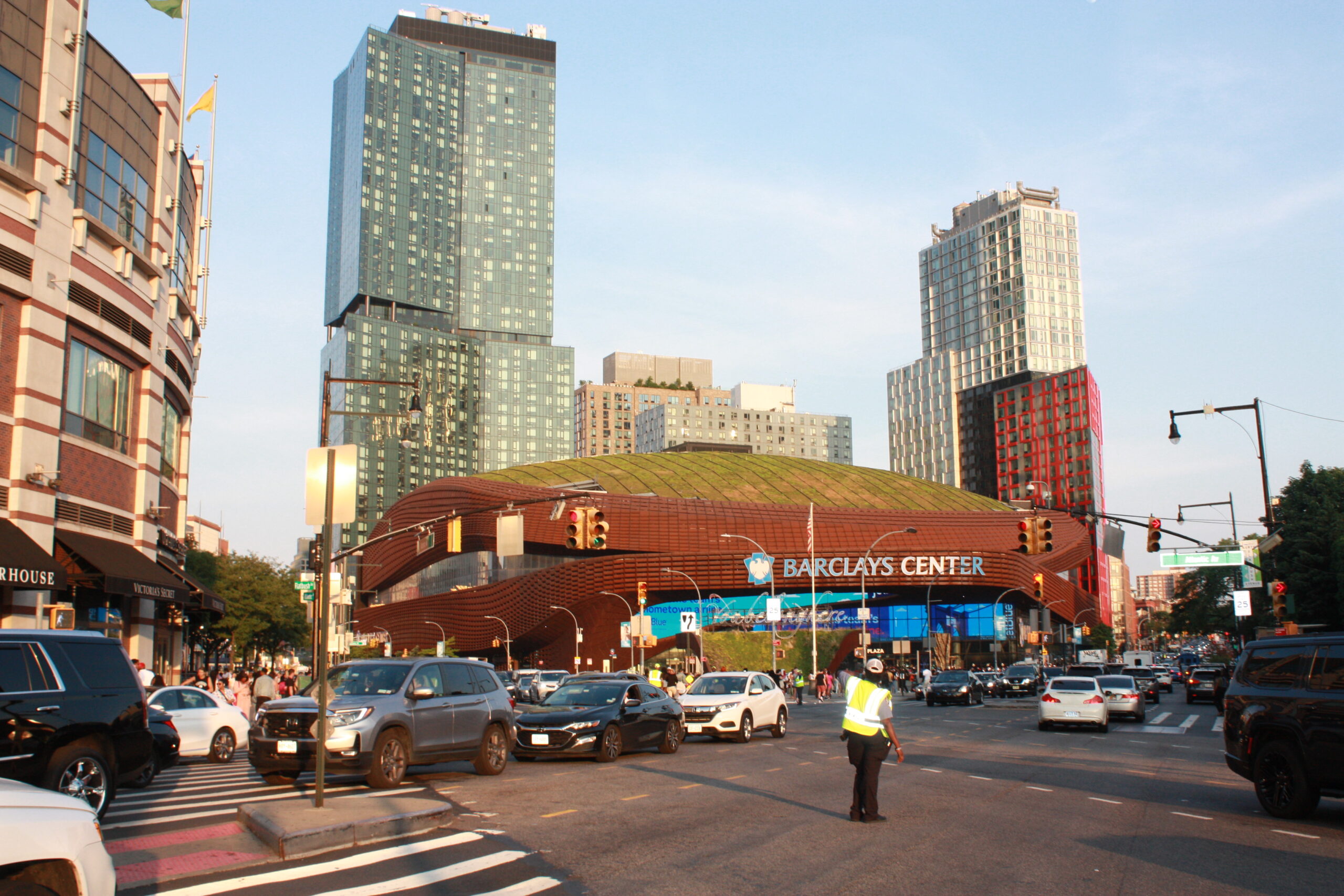
Barclays Center’s Atlantic Terminal location is the practical heart of a Nets game night, giving visitors strong subway and LIRR access plus an easy Brooklyn restaurant-and-arena flow.
What Barclays Center Is as a Basketball Venue
Barclays Center was designed as a basketball arena from the start — not converted from a hockey building, not a multi-purpose stadium with movable configurations that approximates an NBA environment. The bowl was planned with NBA sightlines and proportions in mind, and that design intention shows in how clean the views are from most sections. There are few genuinely bad angles in the building, which is not something every arena can say.
The building opened in 2012 as the Nets’ new home after the franchise relocated from New Jersey, and it has been Brooklyn’s NBA arena ever since. The relationship between the team and the venue is relatively young compared to MSG and the Knicks — there is no fifty-year accumulation of championship banners or retired numbers visible everywhere — but the arena has developed its own identity as a major Brooklyn institution. It is home to the Brooklyn Nets and New York Liberty and also hosts concerts, boxing, college basketball, family shows and other major events.
What Barclays does distinctly well for basketball: sightlines are strong throughout most of the bowl, concourses are wide enough to move through comfortably on a full-capacity game night, and the transit situation below the arena is arguably the most convenient of any major sports venue in New York. These are practical strengths that matter over the course of an evening in ways that are easy to underestimate until you have experienced a less well-organized arena by comparison.
The comparison with MSG comes up naturally for any visitor considering a New York basketball game. Barclays Center and MSG offer genuinely different experiences — different in tone, neighborhood, price point, and the kind of night they produce. That comparison is covered fully in the MSG vs. Barclays Center guide. This page focuses on what Barclays specifically offers and how to plan around it.
Basketball Games at Barclays Center
Barclays Center is home to the Brooklyn Nets and New York Liberty and also hosts other basketball events during the year. If you are searching for Barclays Center games, Barclays Center basketball games, or a Barclays Center game today, check the venue’s current event calendar first so you are working from the live event slate rather than an old schedule page.
For a Nets game, the commercial path is simple: use the Brooklyn Nets ticket route below for current inventory, then come back to this venue guide for entrances, bags, transit, amenities and game-night logistics. If the decision is about a specific section or view, move to the dedicated Barclays Center seating guide instead of treating the venue page like a seat map.
What a Nets Game at Barclays Center Actually Feels Like
The approach to Barclays Center is one of the most distinctive arrival experiences at any New York sports venue. You emerge from Atlantic Terminal — one of the city’s most connected subway and rail hubs — and the arena is directly in front of you. No long walk, no stadium-district transition, no figuring out which exit leads where. The building and the transit hub are effectively the same arrival point, and that immediacy shapes the whole evening from the start.
Inside, the bowl has a different character than MSG. Where MSG is steep and historically layered, Barclays Center is cleaner and more uniformly modern. The concourses are wide. The sightlines from most sections are strong without the dramatic elevation changes that define MSG’s experience. The crowd on a typical Nets night in the current era is more mixed in composition than a sold-out Knicks game — a combination of Brooklyn locals, families, visitors, and fans of the opposing team who made the trip. The overall atmosphere is more relaxed, which is a feature for some kinds of outings and a limitation for visitors specifically seeking high-intensity sports energy.
What first-time visitors most consistently note about Barclays: it is easier than they expected. The entry is straightforward. The concourses are navigable. The seats are comfortable. The exits flow well. The arena does not produce the kind of logistical friction that older or more chaotic venues can generate, and after a good Nets game in a well-planned Brooklyn evening, that smoothness registers as a real positive.
The transit situation at Barclays Center is the arena’s most underappreciated practical strength. The 2/3/4/5/B/D/N/Q/R subway lines serve Atlantic Ave–Barclays Center, alongside LIRR service at Atlantic Terminal. For visitors coming from Manhattan, the 2/3/4/5 from Midtown and the B/D from Broadway-Lafayette or the Upper West Side are direct. For visitors coming from Long Island, the LIRR eliminates the need for any Manhattan transfer.
Post-game departure is similarly clean. Unlike MSG’s Penn Station congestion after a sold-out game, Barclays Center’s multiple subway lines and LIRR options spread the departing crowd across several platforms simultaneously. Having a specific line and direction in mind before the game ends is still worthwhile — but the overall exit experience is less pressured than most comparable venues.
Barclays Center for Tourists and First-Time Visitors
For visitors to New York trying to decide between Barclays Center and Madison Square Garden, the Barclays case rests on three practical advantages that are easy to understate: transit convenience, ticket affordability, and Brooklyn as a destination in its own right.
The transit argument is real and specific. Atlantic Terminal connects more subway lines than almost any other station in the outer boroughs, and the LIRR access means visitors coming from Long Island, JFK Airport, or Jamaica can reach the arena without going through Manhattan at all. For visitors whose base is Brooklyn or whose trip includes time in the borough, Barclays Center is closer and easier to reach than any Manhattan venue.
The ticket argument depends on the specific matchup and live inventory. Nets home games can offer useful seat-price combinations, especially when your date and opponent are flexible, but the right comparison is the actual listing you are considering rather than a fixed Knicks-versus-Nets price assumption.
The Brooklyn argument is the one that most visitors underestimate before they go. Atlantic Terminal sits at the edge of Fort Greene, Prospect Heights, and Park Slope — among Brooklyn’s most interesting dining and nightlife neighborhoods. A pre-game dinner in Fort Greene followed by a Nets game followed by drinks in the neighborhood is a genuinely complete Brooklyn evening that does not require a single trip to Midtown. For visitors who want to experience Brooklyn rather than just transit through it, a Nets game at Barclays provides a natural anchor for that kind of trip.
For the team-level decision — whether the Nets or Knicks fit your trip better — see the Knicks vs. Nets for first-time visitors guide. For visitors specifically planning an NBA game as part of a New York trip, the best NYC basketball game for tourists guide covers the full comparison.
Arena Logistics — What to Know Before You Arrive
Barclays Center’s official site routes visitors to dedicated pages for Public Transportation & Driving, Entrances, Parking, A–Z Guide, and Seating Charts — a useful map of what visitors actually need to plan. Here is the practical version of each.
Location and entrances
The arena is at 620 Atlantic Avenue, Brooklyn, at the intersection of Flatbush Avenue and Atlantic Avenue in Downtown Brooklyn. Barclays Center has multiple entrances: the Main Atrium Entrance, Qatar Airways VIP Entrance, Crown Entrance, American Express Card Member Entrance, Lyft Atlantic Entrance, and Dean Entrance. The Flatbush Entrance is currently temporarily closed — check the official Barclays entrances page for current status before your game. Knowing your section’s recommended entrance before you arrive saves real time on a busy game night.
Box office and mobile tickets
Barclays Center’s box office is inside the Main Atrium. On Brooklyn Nets and New York Liberty game days, the current posted hours run from 12:00 PM through the start of the third quarter. Barclays also states that event tickets are digital: save the ticket to your phone wallet before arrival, and do not rely on a screenshot because screenshots are not valid for entry.
Bag policy — the most important thing to know
Barclays Center has a strict small-bag policy. According to the official A–Z Guide, bags larger than 10″ × 6″ × 2″ are not permitted — and there is no bag check at the venue. That means an oversized bag cannot be stored; it must go back to wherever you came from. That is a 10-inch by 6-inch by 2-inch limit, which is smaller than a standard clutch purse at the larger dimension and smaller than most small crossbody bags. Read that again: this is significantly more restrictive than MSG’s bag policy and more restrictive than many other NBA arenas. The official A–Z Guide notes special consideration for guests with medical needs and those caring for infants.
Guests who arrive without a bag — or with a bag within spec — can use Express Lanes for faster entry. This is a meaningful practical advantage on a full-capacity game night and worth planning around.
2/3/4/5/B/D/N/Q/R at Atlantic Ave–Barclays Center, plus LIRR at Atlantic Terminal. Check current MTA and LIRR service before leaving for the game.
This is stricter than most arenas. No oversized bags and no storage option. Verify current policy on the official Barclays A–Z Guide before leaving home. Guests without bags use Express Lanes for faster entry.
Multiple entrances including Main Atrium, Dean, Crown, and others. Flatbush Entrance currently temporarily closed — always verify current entrance status on the official Barclays entrances page. Correct entrance matters on a busy game night.
Parking near Atlantic Terminal on game nights fills fast. If you are driving rather than using transit, reserve a spot in advance. See the parking near Barclays Center guide for current options.
Bag rules, entrance assignments, and event-day logistics can change between events and seasons. The official Barclays Center site is the authoritative source. The policies above reflect current official guidance but should be confirmed before your specific game — particularly the bag size limit and the Flatbush Entrance temporary closure status.
Seating — How to Think About It Before You Buy
Barclays Center’s bowl was designed for clear sightlines across most sections — the arena does not have the dramatic elevation drop of MSG or the compromised corner views of some older venues. That means the range between good and mediocre seats is somewhat narrower than at older buildings, which is an advantage for first-time buyers who are not familiar with the specific sections.
What still matters: center court versus baseline, and lower bowl versus upper bowl. Lower bowl center court seats give you proximity to the game and floor-level crowd energy. Upper level center court seats offer a full-court view at a lower price. Baseline seats at any level cut off part of the court depending on where play develops. Live pricing and availability vary by matchup, date and section. If lower-bowl center seats are the goal, compare the exact game and listing rather than assuming a standard value level across the season.
The full section-by-section breakdown — what each area delivers, which sections to prioritize, and what to avoid — is in the Barclays Center seating guide. Read it before buying. For visitors comparing seats at both New York arenas, the Knicks vs. Nets seat comparison guide covers how the two bowl configurations differ as buying decisions.
The Barclays Center seating guide covers every section of the bowl — lower bowl vs. upper bowl, center court vs. baseline, where the value is, and what different kinds of visitors should buy. It is the right next page after this one. Note that the official Barclays seating chart may vary by event — always check the specific event layout before purchasing.
Amenities, Accessibility, and the Arena Tour
Concessions and food
Barclays Center has a full range of food and beverage options throughout the concourses, with the wide-concourse layout making movement between sections and food stations more comfortable than at venues where the concourse is a bottleneck. For visitors who want to eat at the arena rather than before it, the options are genuine rather than perfunctory. Peak waits are at halftime and just before tip-off — if you want to eat without a long line, arrive early or wait until after the game gets underway.
Accessibility
Barclays Center has accessibility services for guests with mobility, hearing, vision, and other needs. The official arena tours are specifically noted as ADA accessible, and strollers are permitted on tours. For game-night accessibility needs — seating, entry, services — contact Barclays Center directly through the official accessibility channel before your game. The right time to arrange accessibility support is before you arrive, not at the entrance.
Arena tours
Barclays Center’s official tours page describes behind-the-scenes access to backstage areas, clubs, and team facilities — a meaningful differentiator for basketball fans and first-time visitors who want to understand the building beyond one game night. Tours are ADA accessible and strollers are permitted. The official tour guidance recommends arriving 15–20 minutes early. Check current tour availability, scheduling, and pricing on the official Barclays site — tours run on non-game days and schedules vary by season.
For families with kids who are visiting New York and want more than a single game, the combination of a Nets game and a Barclays tour can make the arena a more substantial Brooklyn outing. See the best NYC basketball game for families guide for how the Nets and Barclays specifically fit family trip planning.
Planning a Full Nets Night Around Barclays Center
The Atlantic Terminal location is Barclays Center’s biggest night-out planning advantage. Fort Greene, Prospect Heights, and Park Slope are all within a short walk — three of Brooklyn’s best dining and nightlife neighborhoods, with independently-owned restaurants and bars that are completely different in character from the Midtown pre-game corridor around MSG. For visitors who want to engage with Brooklyn as part of the trip, a Nets game provides a natural anchor for that kind of evening.
Before the game
The blocks around Atlantic Terminal have dining and bar options at every price point and style, from quick and casual to full sit-down. Make a reservation for any restaurant you care about on a weekend — the neighborhood is popular independently of the arena, and game-night demand adds further competition for tables. The restaurants near Barclays Center guide covers current picks organized by type, distance, and occasion.
Hotels for overnight stays
For visitors building a Brooklyn overnight stay around a Nets game, the hotels near Barclays Center guide covers the closest options at multiple price points. Downtown Brooklyn and the surrounding neighborhoods have a range of hotel options from budget to full-service.
Transit and parking
Transit is the right default for most visitors — see the how to get to Barclays Center guide for the full subway and LIRR breakdown. If driving, advance parking booking is strongly recommended — see the parking near Barclays guide. For the full game-night planning framework — seat choice, timing, food, transit, the complete evening structure — see the how to plan a New York basketball night guide.
Who Barclays Center Is Best For
The transit hub situation makes Barclays Center the simplest sports logistics in the borough. If you are based in Brooklyn, a Nets game is the path-of-least-resistance NBA outing in New York.
Nine subway lines plus LIRR service at Atlantic Terminal. For visitors coming from Long Island, JFK, or outer Brooklyn, Barclays is more directly accessible than any Manhattan venue.
Wide concourses, clean sightlines, easy entry and exit. For visitors who found a previous high-demand arena night stressful, Barclays Center’s modern design and layout produce a noticeably easier experience.
The lower-pressure atmosphere of a Nets game during the current rebuild, combined with the family-friendly logistics of a modern arena, makes Barclays a strong choice for groups where ease matters more than intensity.
Visitors who have already seen a Knicks game at MSG, or who want to experience Brooklyn rather than Midtown, get a genuinely different evening at Barclays — same city, different borough, different feel.
For budget-conscious buyers, the useful advantage is flexibility: compare several Nets home dates and sections rather than assuming one fixed price relationship with MSG.
Common Mistakes at Barclays Center
Showing up with the wrong bag. The 10″ × 6″ × 2″ bag limit at Barclays is significantly more restrictive than most arena policies — and there is no bag check option. An oversized bag means turning around. This is the most preventable mistake at Barclays and requires only reading the official A–Z Guide before you leave home. Small clutch, phone, wallet, keys: that is what fits. Anything larger than a standard small crossbody is at risk of not fitting within spec.
Arriving at the wrong entrance. Barclays Center has multiple named entrances, and the right one for your section matters on a busy game night. The Flatbush Entrance is currently temporarily closed — arriving there and having to walk around costs time and frustration. Check the official Barclays entrances page for your section’s recommended access point before you leave.
Skipping the seating guide and buying the nearest available seat. Barclays Center’s bowl is generally well-designed, but center court versus baseline still makes a meaningful difference in the basketball-watching experience. Reading the seating guide before opening the ticket marketplace takes fifteen minutes and produces a better seat choice every time.
Assuming the Brooklyn location is complicated or inconvenient. Visitors who assume Barclays Center requires a difficult outer-borough transit situation are usually surprised by how easy it actually is. Atlantic Terminal is one of the most connected stations in New York. The 2/3 from anywhere on the 7th Avenue line and the B/D from Central Park West or Broadway-Lafayette are both direct. The logistics are simpler than many Midtown venues.
Not engaging with the Brooklyn neighborhood as part of the night. Arriving at Barclays, watching the game, and leaving immediately without engaging with the area around Atlantic Terminal misses the most interesting part of a Nets evening. Fort Greene and Prospect Heights are worth building into the plan — either before or after the game. The restaurants near Barclays guide is the right starting point.
Frequently Asked Questions
Use the Brooklyn Nets ticket route on this page for current Nets inventory at Barclays Center. For broader team-ticket questions such as season tickets, cheap tickets, playoffs or matchup shopping, use the dedicated Brooklyn Nets ticket guide.
Check the current Barclays Center event calendar for today’s live event slate. Barclays hosts Brooklyn Nets and New York Liberty games as well as other basketball events, so the venue calendar is the safest source for the specific date you are considering.
Barclays Center is home to the NBA’s Brooklyn Nets and the WNBA’s New York Liberty. The arena also hosts other basketball events during the year.
Yes — particularly for visitors staying in Brooklyn, families, budget-conscious visitors, and anyone who wants a well-run modern arena experience without the premium pricing of a high-demand MSG game. The arena is genuinely well-designed for basketball, the transit situation is excellent, and the Brooklyn neighborhood adds real value to the evening if you engage with it. For the full case, see the Brooklyn Nets guide.
Modern, comfortable, and easy to navigate. The arena has strong sightlines throughout most of the bowl, wide concourses, and a clean entry and exit flow. The atmosphere on a typical Nets night during the current rebuild is relaxed compared to a sold-out MSG playoff game — more mixed crowd, lower intensity, more casual. For some visitors that is exactly the right kind of basketball evening. The transit situation above Atlantic Terminal makes arrival and departure unusually smooth.
Transit is the right default. The 2/3/4/5/B/D/N/Q/R subway lines serve Atlantic Ave–Barclays Center. The LIRR runs from Atlantic Terminal, approximately 20 minutes from Jamaica Station. For Manhattan visitors, the 2/3 from Times Square or the B/D from Rockefeller Center are both direct. Full transit details are in the how to get to Barclays Center guide. If driving, see the parking guide — book in advance.
Four things: check the bag policy before you leave (10″ × 6″ × 2″ maximum, no bag check — significantly stricter than most arenas), confirm your entrance on the official Barclays entrances page, arrive 30–45 minutes before tip-off for regular-season games, and read the seating guide before buying tickets. Guests without bags can use Express Lanes for faster entry.
Only if it fits within the size limit. The official A–Z Guide says bags larger than 10″ × 6″ × 2″ are not permitted, and there is no bag check at the venue. This is a strict and important policy — an oversized bag has nowhere to go if it does not meet the limit. Special consideration is given for medical needs and guests caring for infants; contact the arena directly in advance if either applies. Always verify the current policy on the official Barclays site before your game.
Very — once you know about the bag policy. The transit situation at Atlantic Terminal is among the most convenient of any major sports venue in New York, and the arena’s layout is straightforward for first-time visitors. The Brooklyn location, which some tourists assume is complicated, is actually easy to reach from most Manhattan hotels in 20–25 minutes by subway. The main thing tourists need to know in advance is the bag size limit, which is strict and has no backup option at the venue.
Yes. The Barclays bowl is generally well-designed, but center court versus baseline still produces meaningfully different basketball-watching experiences. The Barclays Center seating guide covers every section with honest trade-offs. Read it before you open Ticketmaster. Note that the official Barclays seating chart may vary by event, so verify the layout for your specific game before purchase.
Barclays Center in Brief
Barclays Center is a genuinely good basketball arena — well-designed, well-located, and easier to navigate than most New York sports venues. The Atlantic Terminal transit hub makes arrival and departure unusually clean. The Brooklyn neighborhood around it adds real value to the evening if you engage with it. And during the Nets’ current rebuild, accessible tickets to a quality NBA experience make the value proposition particularly clear.
The bag policy is the one thing to internalize before anything else: bags larger than 10″ × 6″ × 2″ are not permitted, and Barclays Center does not offer a bag check service. The venue notes special consideration for medical needs and guests caring for infants, so verify current policy before your specific game.
The next steps are the seating guide and the night-out cluster. The Barclays Center seating guide is where the ticket decision gets made properly. After that, the restaurants guide, transit guide, and basketball night planning guide complete the picture.