

Forest Hills Stadium Seating Chart: Layout, Seat Views & Best Seats
A 100-year-old outdoor horseshoe in Queens that once hosted the US Open — and still one of the most distinctive concert experiences in the New York area. Here is how the room actually works and where to sit for the night you want.
Forest Hills Stadium is not like any other NYC-area concert venue. It is a horseshoe-shaped outdoor bowl built in 1923 on the grounds of the West Side Tennis Club in Queens — the same stadium that hosted the US Open tennis tournament for more than fifty years, and the same stage where the Beatles, Bob Dylan, and the Rolling Stones played in the 1960s. Restored in 2013 as a full-season concert venue, it now hosts over thirty shows a year. This guide functions as the Forest Hills Stadium seating chart, Forest Hills Stadium map, Forest Hills Stadium layout, and Forest Hills Stadium chart in one place — some fans search the shorter “Forest Hills seating chart” or “Forest Hills seating map” and land on the same venue and the same breakdown below. The Forest Hills Stadium seating capacity and Forest Hills Stadium capacity — roughly 13,000 — makes it intimate enough to feel connected and large enough to support major tours.
The seating structure at Forest Hills is more consequential than at most arenas. The three-tier system — floor, club, and bowl — creates meaningfully different experiences, and the single most important thing to understand before buying is that the standard Bowl seats are bench-style grandstand seating without backs. Club seats, physically located within the bowl in sections 401, 501, 601, and 701, are the exception and include actual seat backs. Floor can be either GA standing or reserved seated depending on the event. Getting this right before you book matters.
Forest Hills Stadium Seating Chart, Layout & Seat Map
The Forest Hills Stadium seating chart, Forest Hills Stadium layout, Forest Hills Stadium chart, and Forest Hills Stadium map all describe the same permanent horseshoe structure: a venue floor in front of the stage, Club sections embedded within the bowl, and standard Bowl grandstands surrounding the floor. What changes from concert to concert is the floor configuration — it may be GA standing or reserved seated — so the event-specific map is always the final authority before you buy.
The permanent seating decision is simpler than the stadium first appears. Floor is closest and most immersive. Club is the backed-seat upgrade in sections 401, 501, 601, and 701. Bowl is the broader grandstand inventory with bench seats and no permanent backs. The page below explains how those three products differ in comfort, sightline, elevation and value.
Forest Hills Stadium tells buyers to check AXS for the seating configuration of the specific event. The floor may be seated or standing, and some exact inventory changes by show. Use the permanent chart for orientation and the live event map for the final purchase decision.
Forest Hills Stadium View From My Seat & Seat Views
Forest Hills Stadium view from my seat, view from my seat Forest Hills Stadium, Forest Hills Stadium seat view, and Forest Hills Stadium view from seat searches are especially useful because the steep horseshoe changes the experience quickly as you move from Floor to lower Bowl to higher Bowl. A seat-view photo can tell you how elevated the section feels, how much of the full stage you can see, whether the center soundboard intrudes on a lower sightline, and how much of the stadium itself becomes part of the view.
For the most accurate comparison, match the same section and similar row depth, then confirm the specific event configuration. A bowl photo remains useful across shows because the permanent grandstand does not move; a floor view is much more configuration-sensitive because one concert can use GA standing while the next uses reserved chairs.
How to read a Forest Hills Stadium seat map before buying
Start with the ticket type: Floor, Club, or Bowl. Then locate whether you are centered or pushed toward a side of the horseshoe. Next compare row elevation. Finally, use the event-specific map to verify the floor setup and any production equipment. At Forest Hills, those first three decisions usually matter more than obsessing over a small difference in exact seat number.
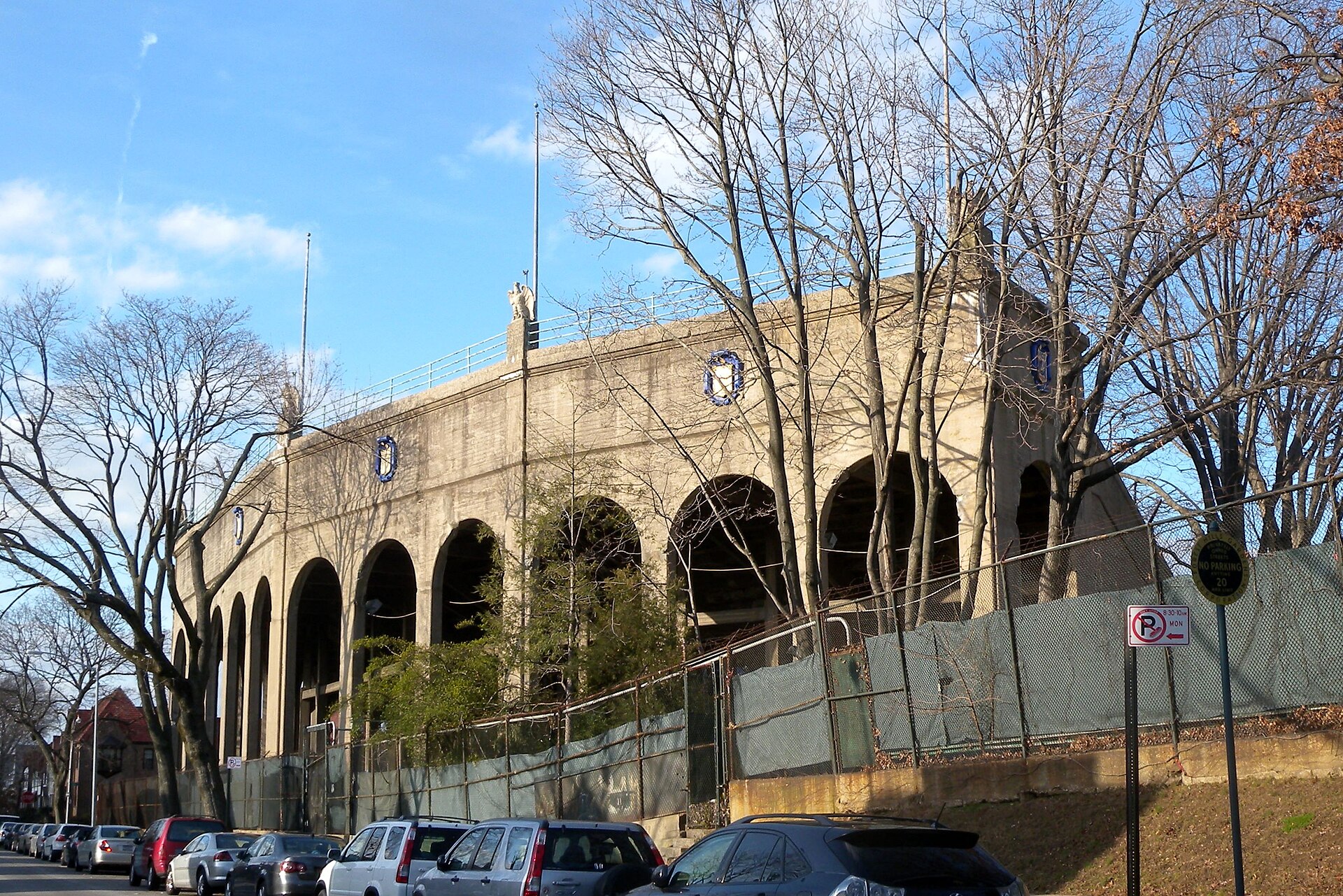
Street view of Forest Hills Stadium located in Queens, NY, home of many great concert events..
Best Seats at Forest Hills Stadium — Quick Answers
GA floor is where you feel the show most intensely. This is the closest you get to the stage, but it means standing in a crowd for the full set. Shorter visitors should think carefully about floor at GA standing shows — sightlines over the crowd are real concern. When floor is reserved seating, the experience is very different — check your event’s specific map before buying.
Club sections are the only bowl seats with actual seat backs. Section 401 in Row A offers center-stage views with no one in front of you and is consistently praised. Section 501 gets shade earlier in the evening and trades some stage proximity for comfort. The right call for visitors who want a better seated experience without the bench-seat reality of the standard bowl.
Standard Bowl tickets are the most affordable way into the stadium. The bench seats are genuinely less comfortable than Club, but the stadium’s steep sightlines mean even upper bowl sections have solid views. The portable seatback rental — available during ticket purchase and in limited quantities on site — meaningfully improves the experience and is worth adding if you are doing bowl.
The horseshoe’s steep rake means mid-bowl rows have a genuine elevation advantage over the floor. If the show has a GA standing floor, being at row F or higher in a lower bowl section puts you above the floor crowd rather than inside it. Reviews confirm that 5’1″ visitors have clear sightlines from mid-bowl even during high-energy standing moments.
First-timers who want to understand what makes Forest Hills special should sit somewhere they can see the full horseshoe — the beauty of the room is part of the experience. Club section 401 center gives you backed seats, center-stage orientation, and a view into the whole bowl. It is the option that best communicates what this venue actually is.
The bench seats in the standard Bowl are historic grandstand bleachers — wide, solid, and backless. Some visitors find them comfortable enough; others find two hours on them genuinely tiring. Portable seatbacks help, but they are an add-on, not a given. If seat backs matter significantly to you, Club is the answer. If you mostly stand during shows anyway, Bowl is fine.
What Forest Hills Stadium Is Actually Like
The simplest way to describe the experience of a Forest Hills Stadium concert is to say that it feels nothing like a major arena show — and that is almost entirely the point. The stadium was built in 1923 as a dedicated tennis venue, shaped in a deep horseshoe around a center court, with steep concrete grandstands rising on three sides and the stage occupying one open end. The scale is intimate relative to most major-tour venues: at roughly 13,000 capacity, it is closer to a theater than to Madison Square Garden, which means every seat is genuinely in contact with the show.
The outdoor setting is central to the identity. Forest Hills shows happen between late spring and early fall, in a residential Queens neighborhood called Forest Hills Gardens — a planned Tudor-style community whose rooftops and treetops are visible from the upper bowl. Arriving by subway or LIRR and walking through that neighborhood to the venue entrance on Burns Street is part of the experience in a way that walking into a Midtown arena never is. The transition from ordinary Queens block to a 100-year-old open-air horseshoe full of music is one of those New York moments that is hard to replicate.
The venue’s concert history matches the setting. The Beatles played Forest Hills in 1964, the Rolling Stones in 1966, Bob Dylan twice in the 1960s. Jimi Hendrix and Frank Sinatra both performed here. The current era has brought Strokes, LCD Soundsystem, Dave Matthews Band, Arctic Monkeys, Chappell Roan, and dozens of others across a season that runs May through October. The programming tends toward artists who suit the atmospheric character of the room — the venue’s identity is distinct enough that it draws a certain kind of show.
Most major concert venues in New York put you inside a box — the room shapes around you. Forest Hills is an outdoor bowl you watch from above, set inside a century-old horseshoe, in a Queens neighborhood that looks like no other part of the city. The show is the show, but the setting is also the show. If you have only ever seen concerts at arenas and amphitheaters, this feels like a different medium entirely.
Forest Hills Stadium Seating Layout — Floor, Club & Bowl
Forest Hills Stadium tickets divide into three named tiers: Floor, Club, and Bowl. The names describe genuinely different experiences, and one crucial detail — the bench-seat reality of the Bowl — is not always visible in the ticket-buying interface until you know to look for it. For a Forest Hills Stadium seat map, Forest Hills Stadium seat view, Forest Hills Stadium view from seat, Forest Hills Stadium view from my seat, or view from my seat Forest Hills Stadium check specific to your section, use the interactive tool on the official ticketing platform — the general Forest Hills Stadium seating breakdown below covers what each tier delivers, but exact row-level views vary by event and stage configuration.
Floor
Floor tickets cover the flat area directly in front of the stage inside the horseshoe. Whether the floor is GA standing or reserved seating depends entirely on the event — the official venue guidance is clear on this: the seating map for each event will indicate which configuration applies. When floor is seated, those seats always include backs.
For high-energy shows, GA standing floor is the closest, loudest, most electric option at the venue. It is the immersive end of the spectrum. For seated floor events, the floor configuration typically runs a grid of chairs facing the stage, giving you a front-area reserved-seat experience instead. These are different shows to be in the floor for, and knowing which you are buying before you commit matters.
Club
Club sections are physically located within the bowl grandstand — they are not a separate structure. What distinguishes them from standard Bowl tickets is exactly one thing: they have actual seats with backs. The official venue guidance states this directly: Club tickets in sections 401, 501, 601, and 701 include seats with backs. All other grandstand sections do not.
The positioning of the Club sections within the bowl means they offer a mid-level view of the full horseshoe — far enough back to see the whole stage picture, elevated enough to be above the floor crowd, and side-angled enough to take in the full visual sweep of the stadium. Section 401, which sits in the center of the bowl, gets particular praise from regular Forest Hills attendees for its central sightlines and front-row-of-the-club-section position. Section 501 is farther back and gets shade earlier in the evening — the tradeoff between proximity and comfort on summer afternoon shows.
Bowl
Bowl tickets cover the main grandstand sections of the horseshoe — the majority of the stadium. These are historic concrete bench seats without backs. The official venue description is exact on this: Bowl tickets are for the grandstands, which are bench seats without backs. Portable seatbacks are available for rental at the merchandise booth on the day of the show, or can be added during online ticket purchase.
The sightlines from the Bowl are genuinely strong throughout most of the horseshoe. The stadium’s steep rake means that even upper-bowl rows have a clear angle down to the stage. If you mostly stand during concerts — and at a high-energy Forest Hills show, many bowl-section visitors do stand for the majority of the headliner’s set — the bench-seat reality becomes less relevant. For visitors who sit for the full show, the seatback rental is not optional equipment; it is a meaningful quality-of-experience upgrade that makes the difference between a comfortable two hours and a tiring one.
Floor vs Club vs Bowl — The Real Comparison
Best Forest Hills Stadium Sections for Comfort, View & Value
Best backed-seat sections: Club 401, 501, 601 and 701
These four Club sections are the only permanent bowl sections with actual seat backs, making them the cleanest choice for visitors who want elevation without committing to the historic backless grandstand benches. Section 401 is the most central option in the existing guide; 501 is a useful comfort-oriented alternative for warm-weather shows where earlier shade can matter.
Best value: standard Bowl plus a portable seatback
The official venue says all standard Bowl tickets are grandstand bench seats without backs, and a limited number of portable seatbacks can be rented during online purchase or on site. If the ticket-price gap between Club and Bowl is large, the Bowl-plus-seatback combination can preserve the elevated Forest Hills experience at a lower total cost.
Best for full-stadium perspective: centered Bowl or Club
The horseshoe itself is part of the Forest Hills experience. Centered elevated positions let you see the stage, floor crowd, opposite grandstand, and open-air architecture together. That is the perspective Floor cannot provide, and it is why a centered bowl position can be a better first visit even when it is farther from the stage.
Best Seats by Concert Style
High-energy rock, pop, or indie — GA floor show
If the floor is GA standing and the act is the kind that generates real crowd energy, the floor is where the best version of that show lives. You are in the crowd, in the moment, close to the stage. The tradeoff is the standing-for-two-hours physical commitment and the sightline risk for shorter visitors. For the right kind of show, it is worth it. For visitors who want that energy but from a controlled seated position, Club section 401 Row A gives you a center-bowl perspective with the crowd energy visible below and around you — a different relationship with the show but a still-engaged one.
Atmospheric or quieter acts — seated bowl or Club
For shows where the atmosphere of the venue is as much the event as the music itself — a singer-songwriter night, a legacy-band reunion, something that works better at a slightly removed distance — the bowl sections are exactly right. The horseshoe’s architectural character, the Queens evening sky, the scale of the room: all of this reads more fully from the bowl than from the floor. Club sections 501 or 601 give you a slight elevation with seat backs and a view of the whole room.
Summer afternoon shows — shade considerations
Forest Hills Stadium sits in a bowl that catches afternoon sun directly on the lower sections. For hot-weather shows with afternoon start times, upper bowl sections and Club section 501 tend to get shade earlier in the evening than lower sections. The floor and lower bowl can be exposed to direct sun well into the show. Checking the stage orientation and your specific section’s sun exposure for the show time is worth a moment of planning — this is an outdoor venue where the physical conditions vary meaningfully.
First-timers to the venue
First-timers who care about the venue’s character as much as the concert should sit somewhere with a full view of the horseshoe — Club section 401 is the best single option because it is centered, elevated, backed, and oriented toward both the stage and the full bowl. You will understand exactly what Forest Hills is and why it has the reputation it has. If budget is the constraint, any mid-level bowl section with a seatback rental accomplishes a similar orientation at lower cost.
What to Know Before You Buy
Always check whether your floor is seated or standing before purchasing
The floor configuration at Forest Hills varies by event — not by default. The official venue guidance specifies that each event’s map will indicate whether the floor is seated or standing. GA standing and reserved seated floor are fundamentally different concert experiences. Do not assume one based on the other. Check the event-specific seating map before buying floor tickets.
The bench-seat situation matters more than it sounds
Standard Bowl bench seats are genuinely backless historic grandstand bleachers. Most people underestimate how this reads across a two-to-three-hour concert, especially if they are not standing for much of the show. The portable seatback rental is a real solution and is worth adding — either at online checkout or at the merchandise booth. If you are in any doubt about comfort over a long seated evening, buy the seatback or buy Club.
The soundboard blocks sightlines from dead-center lower floor rows
A central soundboard and equipment setup sits on the floor. Buyers targeting dead-center floor seats should be aware that the back of the soundboard tent may be in their sight line from the lowest rows. Reputable secondary markets typically label these as obstructed, but official ticketing pages vary in how clearly they communicate this. If you are in center floor, check the event-specific map; going 10 or more rows back in the bowl typically clears the obstruction entirely.
This is an outdoor venue — weather and summer heat are real variables
Forest Hills shows are outdoor, late spring through early fall, in a concrete bowl. Summer evening shows can be warm and exposed; afternoon start times can put lower sections in direct sunlight for part of the show. Sunscreen is practical advice, not just courtesy. For very warm days, upper bowl sections and Club 501 tend to catch shade earlier. Rain cancellation policies and inclement weather guidance are best checked on the official venue site before attending.
Arrive by transit — there is no parking here
The official venue guidance says it twice and explicitly: there is no parking at the venue or on the residential streets nearby. Forest Hills Gardens, the private planned neighborhood that surrounds the stadium, has no public parking infrastructure for events. Driving to this venue and trying to park is not a plan — it is a recipe for missing the opening act. See the transit section below for the actual approach.
Seating configurations vary by show — the map is the only authoritative source
Forest Hills runs multiple seating configurations across its season depending on the type of event and the artist’s preferences. The map layout for one show is not the map layout for the next. Before buying, open the event-specific seating chart rather than assuming a generic layout. Section numbers, floor configuration, and accessible section positioning can all change from event to event.
Getting to Forest Hills Stadium
The official venue guidance is direct: the best way to get to Forest Hills Stadium is via public transit, either the LIRR to Forest Hills or the MTA Subway to 71st–Forest Hills. There is no parking at the venue or on the nearby residential streets. The venue is unambiguous: “For your own convenience, please do not plan to drive and park.”
Subway — E, F, M, R to Forest Hills–71st Avenue
The Forest Hills–71st Avenue station is served by the E, F, M, and R trains. The E and F are express trains — the fastest connection from Midtown Manhattan. Exit at the Queens Boulevard SW corner (71 Av and Queens Blvd SW) and follow the signs toward Forest Hills Stadium; the walk through the neighborhood to the Burns Street entrance is about five to ten minutes. The stadium is three blocks from the station. The subway station at Forest Hills–71st Avenue was upgraded for accessibility in 2014 and has elevators to the platform.
LIRR — Forest Hills Station
The Long Island Rail Road stops at Forest Hills Station, which is located in Station Square — the brick-paved Tudor-style town center of Forest Hills Gardens, just outside the West Side Tennis Club grounds. For riders using the LIRR, the official venue guidance specifies a platform positioning detail: board one of the first four cars of the train in order to exit at Forest Hills Station. The station currently has ramp access but no elevator — accessibility notes on the official venue page reflect this. Station Square is a short walk to the Burns Street venue entrance.
No parking — what this means in practice
Forest Hills Gardens is a private residential community. The streets around the stadium are residential, not commercial — there is no event-parking infrastructure because there was never meant to be any. The venue does not operate parking, is not affiliated with any nearby commercial parking, and actively discourages driving. For any visitor with a practical transit option to Forest Hills, that is the plan.
Rideshare drop-off is possible, though the residential street grid around Forest Hills Stadium means congestion on show nights in the immediate area. A drop-off on Queens Boulevard or near the LIRR Station Square approach is typically cleaner than trying to reach the Burns Street entrance by car. Post-show rideshare pickup from a residential street can also be slow — the subway and LIRR are the more predictable exit options.
Building the Full Night Around Forest Hills Stadium
Forest Hills Stadium is in a Queens neighborhood with its own distinct identity — Forest Hills Gardens is one of the more unusual pockets of New York City, a planned early-20th-century Tudor-style community that feels almost completely unlike the rest of the borough. Station Square, the brick-paved central plaza where the LIRR station sits, has restaurants and cafes within a few minutes of the venue entrance, making it a natural pre-show staging area. Austin Street, the main commercial street running north through the neighborhood, has a denser cluster of dining and bar options that suit a pre-show dinner stop.
The combination of an outdoor concert, a distinctive neighborhood, and transit-forced arrival makes a Forest Hills night feel more like a real night out than a standard arena visit. You are not just showing up at a venue in a transit hub — you are going somewhere, walking through a real place, arriving at a historic outdoor bowl under the Queens sky. That journey is part of what the night is.
For full pre-show dining options, hotels near Forest Hills Stadium, and transit planning from anywhere in the metro area, the complete planning guides for the Forest Hills cluster are coming to this site. As those pages publish, they will be linked here directly. In the meantime, the NYC concert venues guide covers the broader context for Forest Hills within the city’s concert landscape.
Frequently Asked Questions
Use this guide for the permanent Forest Hills Stadium layout — Floor, Club and Bowl — and use the official AXS event map as the final authority for your specific concert. The floor can be GA standing or reserved seated depending on the event, so the live map matters before buying.
Match the same section and similar row depth first. For Bowl and Club, seat-view photos are good references for elevation, stage angle and whether the full horseshoe is visible. For Floor, confirm the event configuration because GA standing and reserved seated layouts can create very different sightlines.
Club sections 401, 501, 601 and 701 are located within the bowl but include actual seats with backs. Standard Bowl sections are grandstand bench seats without permanent backs. Portable seatbacks are available in limited quantities through the venue.
It depends on the type of concert and what you want from it. For immersion and energy: GA standing floor, if the show has that configuration. For a centered bowl view with backed seats: Club section 401. For comfort combined with shade on summer shows: Club section 501. For value with the stadium’s best sightlines at lower cost: mid-bowl Bowl sections with the portable seatback rental added. The bowl’s steep rake means most sections have solid sightlines — the main choice is between energy (floor), comfort (club), and value (bowl).
It depends entirely on the event. The official venue guidance is clear: each event’s seating map indicates whether the floor is standing (GA) or seated. When floor is seated, those seats include backs. Do not assume the floor configuration for one show matches another — check the event-specific map before buying floor tickets.
Club tickets are located in sections 401, 501, 601, and 701 of the bowl and include actual seats with backs — the only sections in the grandstand with seat backs. All other grandstand sections are bench seats without backs. Club provides a reserved, mid-bowl seated experience at an elevated position within the horseshoe. Section 401 is the most central; section 501 gets shade earlier in the evening.
The sightlines from Bowl seats are generally strong throughout the grandstand — the horseshoe’s steep rake means even upper sections have reasonable stage angles. The main honest caveat is the bench-seat reality: standard Bowl tickets are backless grandstand bleachers, not arena seats. For shorter shows or visitors who mostly stand, this is not a significant issue. For longer concerts where sitting is the plan, adding the portable seatback rental meaningfully improves the experience. The Bowl is genuinely good for the show; it just requires some physical preparation that Club does not.
Only in Club sections (401, 501, 601, 701). All other grandstand Bowl sections are bench seats without backs. Portable seatbacks can be added during online ticket purchase and are available in limited quantities on site on the day of the show. Reserved seated floor configurations also always include seats with backs when that configuration is in effect. GA standing floor has no seating at all.
Yes, with the right expectations. It is a genuinely distinctive outdoor experience that many first-timers find remarkable — the scale, the setting, the historic character of the room are all part of what makes it memorable. The things to know going in are the bench-seat reality of Bowl tickets, the seated vs standing floor variable, and the no-parking situation. Going by subway or LIRR and choosing a Club section for the seat-back comfort is the lowest-friction first experience for someone new to the venue.
No. The official venue guidance states this explicitly and repeatedly: there is no parking at the venue or on the residential streets nearby. Forest Hills Gardens, the private planned community surrounding the stadium, has no public event-parking infrastructure. The venue strongly recommends not planning to drive. The E, F, M, and R trains stop at Forest Hills–71st Avenue, about a five-to-ten-minute walk from the venue entrance, and the LIRR stops at Forest Hills Station, which is even closer.
Via public transit, yes — it is a straightforward subway or LIRR trip from anywhere in the city or Long Island. The E and F express trains from Midtown Manhattan reach Forest Hills–71st Avenue in about 20–25 minutes. LIRR from Penn Station is even faster. The walk from both stations to the venue entrance is 5–10 minutes through a pleasant residential neighborhood. The no-parking reality means transit is not just recommended — it is the actual plan. The venue is designed around it.
Forest Hills Works Best When You Know What Kind of Night You Want
Forest Hills Stadium is one of the genuinely distinctive concert experiences in the New York area — an outdoor horseshoe built for tennis a century ago, now a summer-season music venue with a history that stretches from the US Open to the Beatles to the present. It rewards visitors who understand what makes it different and choose their section accordingly.
The bench-seat reality of the Bowl is not a problem if you know about it going in. The GA floor is not for every visitor or every show type. Club sections are the comfort answer without being the luxury answer. The transit-only arrival is genuinely workable and has its own charm. The right Forest Hills night is one where you have thought through what you want before you book, rather than discovering the seatback situation after the lights go down.
For everything else around the evening — where to eat in the neighborhood, how to get there from different parts of the region, and the broader Forest Hills area — additional planning guides are coming to the site. The NYC concert venues guide covers the full picture of where Forest Hills fits within the city’s broader live music landscape.