

Richard Rodgers Theatre Seating Chart: Best Seats, Seat Views & Hamilton
Use this Richard Rodgers Theatre seating chart and view-from-my-seat guide to compare the Orchestra, Front Mezzanine, Rear Mezzanine, stadium rake, overhang, accessible seating and the best seats for Hamilton.
The Richard Rodgers Theatre has housed more Tony Award-winning productions than any other Broadway house — 11 Best Play or Best Musical winners since it opened in 1925. Hamilton has been its resident show since 2015, and the production has been settled into this room long enough that the staging and the theater have become inseparable. This is not just Hamilton playing a venue; it is Hamilton at home.
The seating story here is more interesting than most guides give it credit for. The Richard Rodgers has an unusual stadium-style rake that starts at row L — making its rear Orchestra substantially better than the rear sections of most comparable Broadway houses. But there is a counterweight: the Mezzanine overhang begins around row M and grows more restrictive as you move toward the back. At the same time, there is no elevator. Orchestra rows A through K are the only step-free seats in the building. This guide untangles all of it.
Richard Rodgers Theatre Seating Chart: Seat Views, Map & Layout
The Richard Rodgers Theatre seating chart is easiest to read as three buying zones: Orchestra on the main floor, Front Mezzanine above it, and Rear Mezzanine behind that. Within the Orchestra, the most important layout change happens at row L, where the stadium-style rake begins. That is why a simple Richard Rodgers Theatre seat map does not tell the whole story — two seats that look similar on a flat diagram can feel very different once rake, overhang and stairs are factored in.
Richard Rodgers Theatre View From My Seat — What Changes Most
For anyone searching Richard Rodgers Theatre view from my seat or comparing a Richard Rodgers Theatre seat view, focus first on section and row rather than an isolated seat number. Center Orchestra rows B–H give the strongest close-up view; Front Mezzanine center gives the cleanest full-stage composition; stadium Orchestra rows L–R gain head-over-head sightlines but increasingly sit under the Mezzanine overhang; Rear Mezzanine trades proximity for price and a centered overview.
Best Seats at the Richard Rodgers Theater — Fast Buying Read
The best seats at the Richard Rodgers Theater depend on what you value. Choose Center Orchestra B–H for performer detail and immersion, Front Mezzanine A–C for Hamilton’s complete turntable and choreography, Center Orchestra E–J for strong value, and stadium Orchestra L–P when the price is meaningfully lower and you are comfortable with stairs. Avoid far-side angles and deep rear Orchestra when upper-stage action matters.
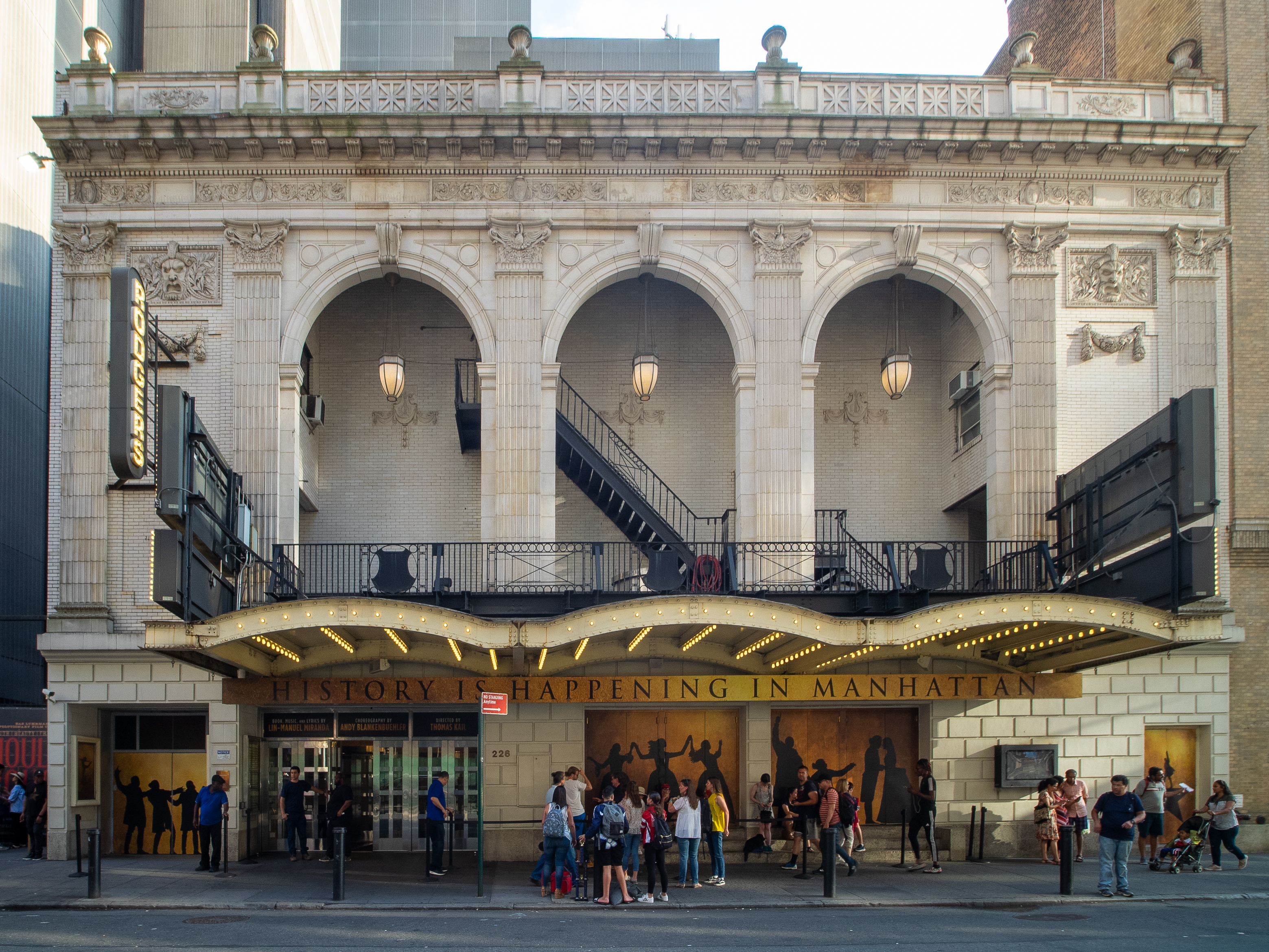
The Stadium Seating Advantage — The Richard Rodgers’ Best-Kept Secret
Most Broadway seating guides treat rear Orchestra as a compromise. At the Richard Rodgers, that assumption is wrong — and understanding why is the key to finding real value in this house.
Starting at row L, the Richard Rodgers Orchestra transitions to a dramatic stadium-style rake — each row rises significantly higher than the row before it, with handrails and steps between rows. The rear of the Orchestra sits so high above the lobby that the lobby itself runs beneath it. This means that patrons in rows L through R typically have excellent sightlines over the heads of everyone in front of them. At many Broadway theaters, rear Orchestra can feel obstructed or flat. At the Richard Rodgers, rows L–R are often the most sightline-efficient seats in the house relative to their price.
The catch — and it is a real one for Hamilton specifically — is the Mezzanine overhang. The same structure that creates the steep rake also creates an overhang from the Mezzanine level. That overhang begins to cut into the top of the stage around row M, and becomes significant from row S onward. Hamilton uses elevated platforms, upper walkways, and vertical staging across the full height of the proscenium. From the deep rear Orchestra, some of that upper-stage action can be cut off.
Mezzanine overhang begins around row M and becomes significant from row S. From hamiltontheater.com (official seating guide): “Views at the rear of the Orchestra level from Row M may be obstructed by the overhanging mezzanine level. After Row S, the overhang obscures your view of the upper part of the stage.” SeatPlan confirms: “Patrons may have to duck a little to see elevated walkways in Hamilton” from rows after S. For Hamilton — which uses upper walkways, multi-level platforms, and vertical staging as integral elements — this is a real trade-off, not a minor note.
The practical read: rows L through R in Center Orchestra are the sweet spot of the stadium zone — steeply raked for excellent sightlines, but still close enough to avoid the worst overhang impact. Rows S through X are where the overhang becomes the dominant factor and the value calculation shifts toward Front Mezzanine.
Orchestra Seats — The Premium Core and the Stadium Opportunity
Center Orchestra Rows B–H — The Best Seats in the House
Every major source — SeatPlan, hamiltontheater.com, Headout — converges on Center Orchestra rows B through H as the Richard Rodgers’ premium tier. The optimal specific targets within this zone are seats 105 through 109 (the center block), rows B through H. From here you get the full Hamilton experience: performer proximity, facial expression and lyric delivery at close range, the energy of the room at its most concentrated, and a clean centered view of the turntable and full-width staging.
Row CC (the very first row, before row A) is the most expensive in the house — extremely close to the stage, exciting for fans who want maximum immersion, but at this proximity the full stage picture can feel overwhelming rather than composed. Rows C through H give a better balance for most visitors.
Center Orchestra Rows E–J — Best Value in the Front Half
The value tier within the front Orchestra runs from approximately rows E through J. SeatPlan and Headout both confirm these as “much cheaper than premium Orchestra seats” with “quite decent” views. For many Hamilton visitors, rows E through J in Center Orchestra represent the smartest purchase in the house — strong enough proximity and staging clarity, priced meaningfully below the premium rows.
Center Orchestra Rows L–R — The Stadium Value Zone
This is where the Richard Rodgers’ unique seating character matters most. Rows L through R in Center Orchestra are elevated by the stadium rake — you are sitting significantly higher than front rows, with clear sightlines over everyone’s heads. The rake is steep enough that the lobby runs beneath this section of the house. As a result, rows in this zone often deliver sightline quality that rivals or exceeds what you would get in flat-rake mid-Orchestra sections at other Broadway houses. Combined with pricing that often falls below the front zones, this is one of the best value opportunities on Broadway for a major production.
The catch: the overhang begins around row M. For rows L through R, check your specific row against the current seat map. Rows L through R are generally the sweet spot — meaningful rake, overhang starting but not yet dominant. From row S on, the overhang increasingly cuts the upper stage.
Side Orchestra — Center Always Beats Side Here
The Richard Rodgers’ side Orchestra sections can feel angled for Hamilton’s centered turntable staging. The outer edges of the Left and Right Orchestra — especially in the front rows where the boxes curve inward — can miss portions of the stage and feel cramped against the side walls. Inside aisle positions within the side sections are more forgiving. Center Orchestra at a farther row is almost always the better Hamilton choice over close-but-angled side Orchestra.
Front Mezzanine — The “See the Whole Machine” Seat for Hamilton
If Center Orchestra is where you feel Hamilton, Front Mezzanine center is where you see Hamilton. These are meaningfully different experiences of the same show, and understanding which you want is the key decision for most buyers at the Richard Rodgers.
Hamilton is one of Broadway’s most choreographically and spatially complex productions. It uses a turntable that moves characters across the stage, a multi-level platform structure with upper walkways that appear throughout, ensemble formations that read as composed patterns, and a full-width staging picture where every corner of the stage is used with purpose. From front Orchestra rows B through H, you feel all of this close up. From Front Mezzanine center, you see all of it as architecture.
Front Mezzanine Center Rows A–C — The Recommended Full-Stage Position
Hamiltontheater.com specifically recommends “Rows A to C, seats 104-108 in the Front Mezzanine” as among the best views in the house. From these seats you have a clean elevated sightline across the full stage, the turntable reads as a composed theatrical mechanism, the ensemble choreography reveals its patterns, and the multi-level staging that can feel overwhelming from very close Orchestra resolves as intentional design.
TickPick’s guide notes: “Some frequent theatre attendees will tell you that they prefer the first row in the Mezzanine to seats down in the orchestra level. That may hold true for the Rodgers since the venue is intimate.” This is a Hamilton-specific endorsement of Front Mezzanine center.
A genuine Richard Rodgers advantage worth noting: TickPick confirms “Unlike many Broadway theatres, the Mezzanine’s sides are not obstructed” at the Richard Rodgers. This means even side Mezzanine seats maintain usable sightlines — though center is still preferable for Hamilton’s centered staging.
There is no elevator or escalator to the Mezzanine at the Richard Rodgers Theatre. This is confirmed by Broadway Direct, Theatre Access NYC, SeatPlan, and Playbill. All Mezzanine seating requires stairs. Orchestra rows A through K are the only step-free seats in the building. Do not book Mezzanine if step-free access is required.
Rear Mezzanine — A Real Budget Option, With Honest Caveats
The Rear Mezzanine has 252 seats across 8 rows (A through H). It is the most budget-friendly section — higher, farther from the stage, and accessed only by stairs. Hamilton is, however, a production that reads well at distance. The show was built for a room this size, and it has been performing here since 2015. The staging is clear and intentional from the back of the house in a way that more casually staged productions are not.
The caveats are real. Legroom in the Rear Mezzanine is noted as very tight — SeatPlan specifically calls this out. Tall visitors will find it genuinely uncomfortable. Shorter visitors will be fine. If legroom is a concern, the Rear Mezzanine is the most likely place in this house to cause physical discomfort over a nearly three-hour show with one intermission.
Center rows A through C of the Rear Mezzanine are the recommended positions if this section fits your budget and you accept the distance. Avoid far-side Rear Mezzanine — the angle at this height and distance compounds quickly and produces the most compromised views in the house.
Box Seats — Not the Right Choice for Hamilton
The Richard Rodgers has box seats at the elevated sides of the Mezzanine level. They feel special — private, elevated, and close-seeming. They are not recommended for Hamilton.
Hamilton uses a centered turntable, ensemble choreography that plays across the full stage width, and a multi-level platform structure built along the center axis of the stage. From a side-angle box position, you see one side of that structure as your primary view and lose much of the other. The show’s staging depends on seeing the full-width picture — box seats fundamentally compromise that.
SeatPlan specifically notes the Mezzanine section (which includes box access areas) “does not offer any designated wheelchair or transfer seats, and due to the steep stairs is not advised for patrons with limited mobility.” Boxes also require stairs. For a first-time Hamilton visitor, for anyone who cares about seeing the full staging as designed, or for anyone who has paid a premium price: choose Center Orchestra or Front Mezzanine center instead.
Best Seats for Hamilton at the Richard Rodgers Theatre
Hamilton is the musical that changed Broadway — book, music, and lyrics by Lin-Manuel Miranda, direction by Thomas Kail, choreography by Andy Blankenbuehler, and musical supervision by Alex Lacamoire. It tells the story of Alexander Hamilton through a genre-bending score that blends hip-hop, jazz, R&B, and Broadway. Won 11 Tony Awards, a Grammy, Olivier Awards, and the Pulitzer Prize for Drama. Has grossed hundreds of millions of dollars at the Richard Rodgers since its 2015 opening.
Runtime: 2 hours 45 minutes including intermission, per the current official Hamilton Broadway listing. Recommended for ages 10 and up. Infants are not allowed in the theater; children 5 and older are permitted but must have their own ticket. Box office hours are currently Monday–Saturday 10am–8pm; 1-show Sundays 11am–5pm; and 2-show Sundays 11am–7pm. Always verify the day’s schedule before making tight dinner or train plans.
Hamilton is a staging-forward show. The turntable is a central theatrical mechanism — it moves characters, reveals scenes, and creates spatial relationships that drive the storytelling. The upper platform structure allows characters to occupy different vertical levels that signal power, status, and emotional states. The ensemble choreography creates patterns that read as complete compositions. Where you sit determines which of these elements you experience most clearly.
Best Seats by Visitor Type
Center Orchestra for the full emotional experience. Front Mezzanine for the “see the whole machine” moment. Either delivers an outstanding first Hamilton. Budget permitting, Center Orchestra rows D–F is the single best starting point.
You’ve felt the show up close. Now see the architecture of it. Front Mezzanine center reveals the staging logic you may have experienced but not fully seen. Stadium zone is the great value discovery.
The immersive premium Hamilton experience. Close enough for the emotional connection, centered for the full picture. This is the date-night Hamilton seat.
Hamilton is recommended for ages 10+. Teens who know the cast recording will be excited by the performer closeness of Orchestra. Front Mezzanine works if the full picture matters more.
Stadium zone rows L–P are the secret: better sightlines than most Broadway rear Orchestra, often at budget pricing. Rear Mezzanine center is the other option — distant but Hamilton holds at distance when centered.
The seat from which the full architecture of Blankenbuehler’s choreography and Kail’s staging is most visible. The turntable reads as a mechanism, the ensemble as a composition. The most intellectually satisfying Hamilton seat.
The only step-free seats in the building. No elevator, no escalator. Orchestra rows A–K accessed via ramp. Wheelchair seating in the middle of the Orchestra. Call 212-221-1211 for accessible seating arrangements.
No one in front of you in CC or A. Aisle seats give more legroom throughout. Avoid Rear Mezzanine — legroom there is confirmed as very tight, and a tall person spending 2 hours 45 minutes in tight legroom is a bad night.
Accessibility at the Richard Rodgers — Know Before You Book
The Richard Rodgers is accessible in the Orchestra, not throughout the whole house. This distinction matters enormously for anyone with mobility concerns.
Theater representatives are available to meet visitors with disabilities in the main lobby to escort them to designated wheelchair-accessible areas. Contact the box office in advance at 212-221-1211 or through Broadway Direct to arrange accessible seating. Do not book Mezzanine seating for any visitor who cannot manage stairs.
Seats to Avoid — or Approach With Open Eyes
- Do not book box seats for Hamilton — the side angle compromises the turntable and multi-level staging that are central to how the production works.
- Do not book Center Orchestra rows S through X without checking the current seat map for overhang impact — upper-stage Hamilton staging can be significantly cut off from these positions.
- Do not book far outer side Orchestra when centered alternatives are available at comparable prices — Hamilton’s centered staging makes side angle a meaningful trade-off.
- Do not book Rear Mezzanine if legroom is a concern — it is confirmed as very tight; a tall visitor in the Rear Mezzanine for nearly three hours is a real discomfort issue.
- Do not book any Mezzanine seating if stairs are a mobility concern — no elevator, no escalator, no alternatives.
- Do not book aisle transfer seats L1, L2, M1, or M2 if stairs cannot be managed — these specific transfer seats require stairs to reach despite having folding armrests.
- Do not ignore the stadium zone as a value option — rows L through P Center Orchestra are often significantly undervalued relative to their actual sightline quality at the Richard Rodgers.
- Do not book Rear Mezzanine far-side positions — the combination of height, distance, and side angle creates the most compromised views in the house.
Seat Comparisons — Common Richard Rodgers Decisions
- Orchestra center vs. Front Mezz centerChoose Center Orchestra if proximity, performer detail, and being inside the Hamilton experience matters most. Choose Front Mezzanine center if you want the full-stage picture — turntable logic, choreographic patterns, multi-level staging as a complete composition. Both are excellent; which is right depends on whether you want to feel Hamilton or see Hamilton.
- Premium Orch B–H vs. Value Orch E–JPremium rows are the best Hamilton seats in the house. Value rows E–J are not a compromise — they are a smart buy that delivers the core experience at lower cost. The difference is closeness and pricing, not sightline quality.
- Value Orch E–J vs. Stadium zone L–PValue Orchestra gives you more proximity but the same or higher price as stadium zone. Stadium zone L–P gives you more rake-boosted sightlines at potentially lower pricing. The overhang from row M is the trade-off: check your specific row. For price-sensitive buyers who want sightline quality, stadium zone often wins.
- Stadium zone L–R vs. Front Mezz centerStadium zone if you want Orchestra proximity and pricing with the rake advantage. Front Mezzanine if the full-stage picture matters more and overhang is a concern for upper-stage Hamilton action. Often similarly priced — the choice is proximity vs. composition.
- Best for step-free accessOrchestra rows A–K only. No exceptions. Wheelchair seating in middle of Orchestra. Transfer seats without stairs at A1, A2, A101, C113, E1, E2, E23, E24, F101, F113.
The Richard Rodgers vs Other Broadway Houses
The Richard Rodgers is mid-sized by Broadway standards — 1,324 seats, fitting between a large house like the Lyric or Palace and an intimate house like the Music Box. Its stadium rake makes the rear Orchestra unusually strong compared with peers like the Imperial or Lunt-Fontanne. Unlike the recently renovated Palace or the New Amsterdam, it has no elevator — making it more restrictive for mobility-sensitive visitors than those modernized houses.
Planning Your Richard Rodgers Night
The Richard Rodgers sits at 226 West 46th Street — one block east of Restaurant Row (West 46th Street between 8th and 9th Avenues), which makes pre-show dining logistics as easy as any Broadway house. The 46th Street corridor has a strong range of pre-theater options at multiple price points within a five-minute walk. Book dinner 90 minutes before curtain for a comfortable experience; Hamilton’s runtime means dinner should be fully finished before you arrive.
The nearest subway is the 1 train to 50th Street or the N/R/Q to 49th Street — both a short walk south on 7th Avenue to 46th Street. The C and E trains at 50th Street also work, walking east. Times Square’s 42nd Street stations drop you a few blocks south and require a busier walk north through the crowd peak.
FAQ — Richard Rodgers Theatre Seating
Center Orchestra rows B through H, specifically seats 105–109 in each row, are the premium sweet spot — multiple sources agree. Front Mezzanine center rows A through C are the best alternative for a full-stage view. For value, Center Orchestra rows E through J and the stadium zone rows L through P offer strong Hamilton experiences below premium pricing.
Center Orchestra rows B–H for proximity and performer detail. Front Mezzanine center rows A–C for the complete staged picture — turntable, choreography, multi-level platforms. Stadium zone rows L–P for value with excellent sightlines. Avoid: box seats, far side Orchestra, Center Orchestra rows S–X (overhang issue), and Rear Mezzanine far sides.
Both are strong for different reasons. Center Orchestra delivers proximity, emotion, and the energy of being inside the show. Front Mezzanine center delivers the architectural picture — the turntable, the formations, the staging logic. Many repeat visitors prefer Front Mezzanine specifically because Hamilton’s staging is so complex; seeing it from elevation reveals how it was designed. First-time visitors usually start with Orchestra center.
Stadium-style Orchestra seating starts at row L. From row L back, each row rises more steeply than the one before it, with steps and handrails between rows. This gives rear Orchestra seats unusually strong head-over-head sightlines compared with many Broadway theaters. The trade-off is access and overhang: rows L and back require stairs, and the Mezzanine overhang begins around row M.
No. The Richard Rodgers Theatre has no elevator and no escalator. Orchestra rows A through K are the only step-free seats in the building. All Mezzanine seating and the stadium-style rear Orchestra rows require stairs. Do not book Mezzanine for anyone who needs step-free access.
Partially. The entrance and Orchestra rows A–K are accessible without steps. Wheelchair seating is on the Orchestra level only, in the middle of the section, with companion seats available. The wheelchair-accessible restroom is in the main lobby at street level. There is no elevator, so the Front Mezzanine, Rear Mezzanine, boxes, and rear stadium Orchestra rows are not step-free.
The step-free aisle-transfer seats are Orchestra A1, A2, A101, C113, E1, E2, E23, E24, F101, and F113. Seats L1, L2, M1, and M2 also have folding armrests, but they are in the stadium-style section and require stairs to reach. That distinction is critical: not every transfer seat is step-free.
It can be excellent — especially rows L through P center — because the stadium rake creates unusually clear sightlines over the heads in front. The warning is the Mezzanine overhang, which begins around row M and becomes significant from row S onward. Rows L–P are the value opportunity; rows S–X are the overhang caution zone.
Yes. Front Mezzanine center rows A through C are among the best seats in the house for seeing Hamilton’s full-stage design. The turntable, choreography, and upper walkways read very clearly from this elevated center position. The downside is access: no elevator, no escalator, stairs only.
Rear Mezzanine center seats are a real budget option because Hamilton’s staging reads well at distance, but the section is higher, farther back, and has tight legroom. Center rows A–C are the best targets. Avoid far-side Rear Mezzanine if possible, especially if similar-priced center seats are available.
Avoid box seats for Hamilton, far outer side Orchestra, Rear Mezzanine far sides, and Center Orchestra rows S–X if upper-stage Hamilton action matters to you. Also avoid any Mezzanine seat if stairs are a concern. For mobility-sensitive visitors, Orchestra rows A–K are the only step-free option.
Hamilton currently runs 2 hours 45 minutes including intermission, according to the official Hamilton Broadway listing. Plan your pre-show dinner and post-show transit with a nearly three-hour theater block in mind.
Yes. Hamilton remains one of the strongest first-time Broadway choices, and the Richard Rodgers is the definitive room for seeing it. Book Center Orchestra rows B–H for the premium experience, Front Mezzanine center rows A–C for the full-stage picture, or stadium Orchestra rows L–P for value.
Plan to arrive at least 20–30 minutes before curtain. Hamilton is a high-demand show, the 46th Street block gets congested before performances, and the theater itself is worth a few minutes to take in before the show.
The Room Where It Happens — Choose Your View
Center Orchestra to feel Hamilton. Front Mezzanine to see Hamilton. Stadium zone L–P to find Hamilton at value. The Richard Rodgers rewards a deliberate seat choice — use the current map before buying.
Pick the Hamilton View — Then Build the Whole Night
The Richard Rodgers has one of Broadway’s most useful seating quirks: a stadium-style rear Orchestra that can make value seats better than expected. But Hamilton also rewards a full-stage view, and access planning matters because there are no elevators or escalators.
Richard Rodgers Theatre Guide
Go deeper on Hamilton’s Broadway home, the 46th Street location, stadium-style rear Orchestra, access limitations, Restaurant Row, and full-night planning.
Open Theater Guide Current ShowHamilton Broadway Guide
Plan around turntable staging, ensemble movement, multi-level action, lyric detail, and the best Richard Rodgers sections for the show.
Open Show GuideMore Seating & Ticket Strategy
Seats · Timing · ValueBroadway Seating Guide
Compare Orchestra, Mezzanine, Balcony, boxes, side seats, premium zones, and view tradeoffs across Broadway houses.
When to Buy Broadway Tickets
Know when buying early matters, when waiting can work, and how timing changes for Hamilton, premium seats, and center sections.
Last-Minute Broadway Tickets
Compare same-day options without accidentally grabbing extreme sides, overhang-heavy rear seats, or stair-heavy sections.
Broadway Rush and Lottery Tickets
How discount systems work, what seat tradeoffs to expect, and why cheap seats can be great — or risky — depending on view.
First-Time Broadway Guide
For visitors choosing their first Broadway show: seats, arrival, timing, intermission, dress, crowds, and Theater District basics.
Best Broadway Shows for Date Night
Compare Broadway nights by energy, room feel, dinner pairing, crowd flow, and how the whole evening works beyond the ticket.
Plan the Richard Rodgers Theatre Night
Dinner · Hotels · TransitRestaurants Near Broadway
Use the broader Broadway dining guide when you want a pre-show meal that still leaves enough buffer for 46th Street arrival.
Restaurants Near Times Square
Useful for Hamilton nights when your group wants to stay close to Times Square, Broadway, and post-show transit.
Pre-Show Dining Guide
Plan reservation timing, walking buffer, arrival, intermission expectations, and post-show movement around a 46th Street show.
Hotels Near Broadway
Compare Theater District, Times Square, Midtown West, and Hell’s Kitchen hotel zones for a Hamilton-centered trip.
Hotels Near Times Square
Best for visitors who want short walks, easy subway access, and simple post-show return logistics after Hamilton.
How to Get to a Broadway Show
Subway, walking, rideshare, and arrival timing for Theater District shows, including the Richard Rodgers on West 46th Street.
Subway to Broadway
Pick the right subway approach for West 46th Street, Times Square, Restaurant Row, and post-show exits.
Parking Near Broadway
When driving makes sense, when it does not, and how to avoid turning a Hamilton night into a Midtown garage problem.
Best Way Home After a Show
Subway, taxi, rideshare, walking, and hotel return strategy after a crowded 46th Street performance.
Nearby Neighborhood & Theater Guides
46th Street · Restaurant Row · Nearby HousesTheater District
The practical guide to Broadway’s center: theaters, crowds, hotels, restaurants, walking routes, and first-time visitor logistics.
Hell’s Kitchen
A strong pre- and post-show dining base west of the Richard Rodgers, especially if you want less Times Square noise.
Times Square
Useful for hotels, transit, crowd planning, visitor logistics, and the classic Broadway arrival flow.
Music Box Theatre Guide
A nearby 45th Street theater useful for comparing smaller Broadway room feel, sightlines, and date-night planning.
Imperial Theatre Guide
A nearby classic musical house useful for comparing Broadway scale, orchestra/mezzanine strategy, and west-side arrival.
Lunt-Fontanne Theatre Guide
A 46th Street neighbor useful for comparing musical-house seating, access, Restaurant Row timing, and Broadway night flow.