

The Lunt-Fontanne Theatre — Broadway Guide
Seating, history, accessibility, location, and everything you need to know before your night at one of Broadway’s largest and most distinctive houses.
The Lunt-Fontanne Theatre is one of Broadway’s larger houses — approximately 1,500 seats across orchestra and mezzanine levels at 205 West 46th Street, near the heart of the Theater District. It started life in 1910 as the Globe Theatre, spent several decades as a movie house, and was completely gutted and rebuilt in 1958, when it was renamed for Alfred Lunt and Lynn Fontanne — the most celebrated acting couple in American theater history. The Nederlander Organization has operated it since 1973. Death Becomes Her played its final performance here on June 28, 2026, and the next booking is Blue Man Group: A New Holiday Surprise, the group’s first-ever Broadway engagement, from November 12, 2026 through January 3, 2027. Lin-Manuel Miranda and Eisa Davis’s new musical Warriors is announced to follow in spring 2027.
Some visitors search this venue as Lunt Fontanne Theatre New York, Lunt Fontanne Theatre New York NY, or Lunt Fontanne Theatre Broadway — all the same address. This page covers what the theater is like as a space, how to think through a seat choice across its large auditorium, the stair and accessibility realities that matter before you book, and how to plan the rest of a night around 46th Street. Whether you have tickets or are still deciding, this is the practical orientation you need.
What Kind of Broadway House This Is
The Lunt-Fontanne is one of Broadway’s larger working houses — bigger than most of its neighbors in the district and built to carry productions that can fill a large room without losing the audience. At approximately 1,500 seats, it sits comfortably above the midsize range occupied by theaters like the Hirschfeld or the Lena Horne, closer in scale to the Winter Garden or the Majestic. That size matters: the productions it attracts tend to have enough visual and theatrical scale to justify the space, and visitors should arrive expecting something that reads at distance as well as up close.
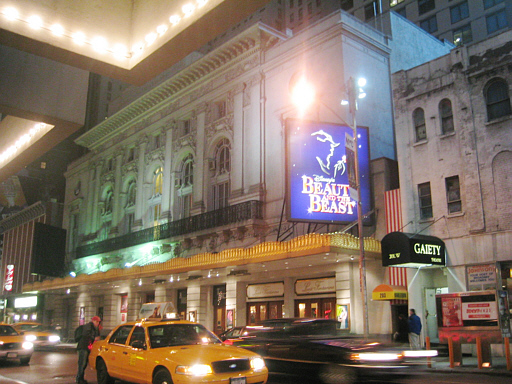
The building was designed by Carrère and Hastings — the same firm responsible for the New York Public Library on Fifth Avenue — in the Beaux-Arts style. The 46th Street facade is a designated New York City landmark. The interior, however, is not the original: the theater was completely rebuilt in 1958, and what visitors experience today is the 1958 renovation rather than the 1910 Globe. The original Italian Renaissance interior, with its retractable roof designed to cool summer audiences, is gone. What replaced it is a mid-century design that was considered contemporary and comfortable in its era and has been updated since.
The Lunt-Fontanne works best when the production fills it — visually ambitious musicals, shows with production design that rewards a large canvas, performances that project well to the back of a 1,500-seat house. It is not a chamber theater and does not pretend to be. The audience experience is correspondingly different from smaller Broadway houses: the scale is part of the event, and productions here tend to embrace that rather than fight it.
The proscenium stage is wide and the house deep enough to accommodate large-scale scenic design. Sightlines are generally considered strong for a theater of this size — the 1958 rebuild specifically addressed the auditorium configuration, and the result is a room where even upper-level seats maintain a reasonable connection to the stage. The front and center of both orchestra and mezzanine are where the house performs best, as in most Broadway theaters of this scale.
Seating Guide — How to Think About Best Seats
The Lunt-Fontanne has two main seating levels — orchestra and mezzanine — plus a small number of box seats on the sides. The mezzanine is subdivided into front and rear sections, which function quite differently from one another. Understanding that distinction before you book matters here more than at smaller houses, because the gap in experience between front mezzanine and rear mezzanine is significant at this scale.
One practical note specific to this theater: the stage is raised, which means the very front rows of the orchestra can look upward at the stage at a steep angle. Most experienced visitors recommend starting from row D or further back rather than going as close to the stage as possible.
The entire orchestra is step-free from the street entrance — the most accessible level in the house. Center orchestra rows D through J or K are consistently the strongest seats: direct sightlines, comfortable distance from the raised stage, and the full width of the stage visible without any angle compromise. Rows A through C are very close and require looking upward at an uncomfortable angle for many visitors. Further back, the mezzanine overhang begins cutting into the top of the stage view from around row W — center seats are less affected than side seats in this zone. Side orchestra seats with double-digit numbers at the far edges become progressively more angled and restricted.
The front mezzanine is directly above the orchestra and offers a clean elevated view of the full stage — the kind of perspective that suits visually complex productions particularly well. Rows A and B are the most premium seats in the section and among the most sought-after in the house. Rows C and D give a strong view at somewhat better value. Legroom can be tight throughout; inside aisle seats are the best option for extra space. Be aware that the front mezzanine requires stairs — it is not accessible by elevator. Once in the section, there may be additional steps between rows.
The rear mezzanine is the most affordable section and the furthest from the stage — 13 rows in a large house means the back rows are genuinely distant. The front few rows of the rear mezzanine are workable, particularly for musicals with strong visual design that reads at distance. Further back, detail is increasingly lost and the overhead perspective becomes more pronounced. If budget is the priority and the show has strong visual production, front rows of the rear mezzanine can be acceptable; the very back rows are a significant compromise. Stairs required throughout.
The Lunt-Fontanne has a small number of box seats on either side of the front mezzanine level. Box seats are elevated and angled — the trade-off is a close, distinctive perspective at the cost of a head-on sightline. Sightlines to one side of the stage will be restricted from box positions. Box seats suit visitors who want a unique experience and are comfortable with an oblique rather than direct view of the full stage. Stairs required; these are not accessible positions.
This is a large house, and in large houses the center rewards you disproportionately. Center orchestra rows D through J is where the theater performs at its best — raised stage at a comfortable angle, full width visible, strong detail. Front center mezzanine rows A through D is the strongest elevated alternative, with a complete overview of the stage picture that suits ensemble-driven or visually complex productions particularly well. In either level: center over sides, and further from the extreme front than instinct might suggest. Anyone with mobility considerations should book orchestra — it is the only fully step-free level, with no elevator alternative for upper seating.
Where the Lunt-Fontanne Sits — Location and Getting There
The Lunt-Fontanne is at 205 West 46th Street, on the north side of the block between Eighth Avenue and Broadway — close to the heart of the Theater District and within easy walking distance of Times Square. It shares the block with the Paramount Hotel and the Lena Horne Theatre to the west, and sits near the Hotel Edison to the north. The immediate area is well-served by transit from multiple directions.
Transit is genuinely convenient here. The 49th Street stop on the N, R, and W lines is one block north — walk south one block on 7th Avenue then west on 46th Street. The 50th Street station on the C, E, and 1 lines works from the west side, with a walk south on 8th Avenue or Broadway. The 42nd Street–Port Authority stop on the A, C, and E is also reachable with a walk north up 8th Avenue for visitors coming from downtown or the airport. For full transit options and timing across the Theater District, the guide to getting to a Broadway show is the right next read. Parking garages are available on 46th and 47th Streets between Broadway and 8th Avenue — book in advance for weekend and holiday performances. For driving details, use the parking near Broadway guide.
Accessibility — What to Know Before You Book
The Lunt-Fontanne’s accessibility situation follows the same pattern as several other Broadway houses in this section of the district: orchestra is fully step-free and where all accessible seating is concentrated; upper levels require stairs with no elevator alternative. In a house of this size, knowing this before you book is particularly important — the distance between orchestra and mezzanine is meaningful, and booking mezzanine with mobility limitations can make for a difficult evening.
The orchestra is completely step-free from the street entrance and lobby — accessible throughout, with no steps to navigate. This is the only fully step-free seating level in the house.
All mezzanine seating — both front and rear — requires stairs. There are no elevators or escalators at the Lunt-Fontanne. The front mezzanine is one level above the orchestra; once inside the section, there may be additional small steps between rows. The rear mezzanine is higher still.
Box seats are also accessible by stairs only and are not wheelchair-accessible positions.
Theater representatives are available in the lobby to escort patrons with disabilities to designated accessible areas — but they cannot make upper-level seats accessible. If stairs are a concern for anyone in your party, book orchestra.
Wheelchair seating
Wheelchair locations are available in the orchestra section, with companion seats available pending inventory. Aisle transfer seats with folding armrests are also available across multiple orchestra rows for guests with limited mobility. All step-free accessible seating is on the Orchestra level. Contact the Lunt Fontanne box office directly or book through Broadway Direct to confirm current accessible seating availability for your performance.
Assistive listening and other services
Headsets for sound augmentation are available free of charge, subject to availability. Guests are required to fill out a brief form with contact details to ensure the device is returned after the show. An induction loop is available for patrons with telecoil-equipped hearing aids. Guide dogs and service animals are permitted; inform the box office when booking. Contact the theater in advance to arrange any accessibility accommodations.
Accessible restrooms
A wheelchair-accessible unisex restroom is located on the orchestra level, step-free. Standard restrooms are located one floor below the orchestra (lower lounge level) and one floor up in the mezzanine. Build in time during intermission — lines at both standard restroom locations can be significant at a theater of this size.
Accessibility configurations and available services can change between productions. Always confirm current details directly with the Lunt Fontanne theatre box office or the Nederlander Organization before finalizing plans. Lunt Fontanne address: 205 West 46th Street. The Lunt Fontanne theatre address and box office can also be reached for accessibility arrangements. Phone: 212-575-9200.
Lunt Fontanne Theatre History — From the Globe to the Lunt-Fontanne
Some visitors search this venue as the Fontanne Theater NYC, La Fontanne Theater NYC, La Fontanne Theatre NYC, or La Fontanne Theater New York — common shortened or misspelled searches for Lunt-Fontanne, the same address. The full address is also written 205 W 46th St New York NY 10036, or Lunt Fontanne Theatre West 46th Street New York NY. The theater at 205 West 46th Street has existed in two distinct forms — the original Globe Theatre of 1910 and the rebuilt Lunt-Fontanne of 1958. What connects them is the address and the facade; everything inside is the product of the later renovation. Understanding that helps explain why the theater feels somewhat different from Broadway houses of similar age that have been continuously maintained rather than gutted and rebuilt.
Alfred Lunt and Lynn Fontanne were considered the foremost acting couple in American theater for most of the mid-twentieth century — a partnership that lasted professionally from the 1920s until their retirement in the 1960s and personally until Lunt’s death in 1977. They were known for a style of naturalistic ensemble acting that was distinctly modern for their era, and for a collaborative working process that treated their performances as inseparable from one another. They played opposite each other so often and so successfully that their names became a single entity in the vocabulary of American theater.
The renaming in 1958 was done in their honor while both were still alive and still performing — unusual for Broadway theater namings, which more often recognize figures posthumously. The fact that their final Broadway performance together, The Visit, was also the theater’s reopening production gives the naming a particular symmetry: the theater that bears their names together was both christened and closed by their joint work. Lunt survived Fontanne by eight years; she outlived him by another fifteen, dying in 1983 at ninety-five.
Build the Night Around the Lunt-Fontanne Theatre
The theater’s position on 46th Street between 8th Avenue and Broadway puts it in a strong spot for a full evening plan — close to Restaurant Row one block west on 46th Street, well-served by multiple subway lines, and surrounded by the full range of Theater District hotel and dining options. Planning an evening here is straightforward once you know the geography.
Getting there
The most direct subway approach is the 49th Street stop (N, R, W) on 7th Avenue — one block north of the theater, short walk west on 46th Street. The 50th Street station (C, E, 1) on 8th Avenue is also a clean option, with a walk south and east. Parking is available in garages on 46th and 47th Streets between Broadway and 8th Avenue, and on 8th Avenue between 46th and 47th Streets — book ahead for any weekend or holiday performance. For a full transit guide covering all routes into the Theater District, see how to get to a Broadway show. For driving and garage strategy, see parking near Broadway.
Dinner before the show
Restaurant Row — West 46th Street between 8th and 9th Avenues — is directly accessible: walk west from the theater along the same block. It is one of the most reliable pre-theater dining corridors in the district, with a range of options at different price points and restaurants accustomed to theater-crowd timing. For visitors who want to explore further, Hell’s Kitchen beginning a few blocks west has a broader and generally stronger independent restaurant scene. The restaurants near Broadway guide covers specific picks by type, and the pre-show dining guide covers timing strategy around shows with intermission.
Arriving at the theater
Current Broadway Direct box office hours are Monday through Saturday from 10am to 8pm, and Sunday from 12pm to 6pm on one-show days or 12pm to 8pm on two-show days. Check the day’s official listing before making a special trip, since holiday hours can differ. For evening performances, arrive at least 20–30 minutes before curtain if you need time for accessibility routing, restrooms, drinks, or Mezzanine stairs.
Hotels nearby
The Hotel Edison is directly north on 47th Street. The New York Marriott Marquis, one of the district’s largest hotel operations, is directly south. The Paramount Hotel shares the Lunt-Fontanne’s block to the west. The concentration of options directly adjacent to this theater is among the strongest in the district. The hotels near Broadway guide covers the best-positioned choices. For a full orientation to the surrounding neighborhood, the Theater District guide is the right starting point.
Current Show — Blue Man Group: A New Holiday Surprise
Blue Man Group: A New Holiday Surprise is the next production at the Lunt-Fontanne and Blue Man Group’s first-ever Broadway engagement. Performances begin November 12, 2026, opening night is November 17, and the limited run ends January 3, 2027. The Blue Men play holiday tunes on their own custom instruments, throw paint and pull the audience into the act, with no dialogue at all.
It runs about 90 minutes with no intermission and is recommended for ages 3 and up. Expect loud drumming and flashing, strobe-like lighting. The posted schedule has 7:00 pm curtains on Tuesday, Thursday and Friday, 2:00 and 7:00 pm on Saturday and 3:00 pm on Sunday, with Monday and Wednesday dark; holiday weeks can shift, so check your date. Official prices run from $48.25 to $274.
Where to sit for Blue Man Group here
The front orchestra puts you closest to the action and the mess; poncho seats haven’t been confirmed for this run. Center orchestra rows D through J give the best all-round view, and a centered front-mezzanine seat shows off the lighting and full stage picture, though it’s stairs only. With little kids, stay in the orchestra for the step-free access and easy bathroom trips, since there’s no intermission.
Before and after
Death Becomes Her, the musical comedy based on the 1992 film, played the Lunt-Fontanne from November 21, 2024 to June 28, 2026 and won the Tony for Best Costume Design of a Musical. After Blue Man Group, Lin-Manuel Miranda and Eisa Davis’s Warriors is announced for the theater, with previews in March 2027 and an April opening.
Frequently Asked Questions
The Lunt-Fontanne Theatre is at 205 West 46th Street in Manhattan, between Eighth Avenue and Broadway in the Theater District. The nearest subway is the 49th Street stop (N, R, W trains) on 7th Avenue, one block north with a short walk west along 46th Street.
Blue Man Group: A New Holiday Surprise plays the Lunt-Fontanne Theatre from November 12, 2026 through January 3, 2027, with opening night on November 17. It is Blue Man Group’s first Broadway engagement. Death Becomes Her played its final performance here on June 28, 2026, and Warriors is announced to follow in spring 2027.
Center orchestra rows D through J offer the strongest combination of sightlines and comfortable distance from the raised stage — starting from row D rather than the very front is generally advisable. Center front mezzanine rows A through D are an excellent elevated alternative with a full stage-width view. In any section, center seats are meaningfully better than far-side seats, which become progressively angled and restricted. If stairs or mobility are any concern, book orchestra — it is the only step-free level in the house. For deeper row-by-row advice, use the Lunt-Fontanne Theatre seating guide.
The orchestra level is fully step-free from the street entrance, and all wheelchair seating is located in the orchestra section. There are no elevators or escalators to the mezzanine or box levels, which require stairs. A wheelchair-accessible restroom is available on the orchestra level. Theater representatives can escort patrons with disabilities from the lobby to accessible seating areas. If stair access is any concern, book orchestra seats. Contact the box office at 212-575-9200 to confirm current accessible seating availability and arrange accommodations in advance.
The Lunt-Fontanne Theatre has approximately 1,500 seats across orchestra and mezzanine levels, plus a small number of box seats. Exact figures vary slightly depending on the source — Broadway Direct cites 1,505 seats. Use “approximately 1,500” as a reliable reference.
The theater was renamed in 1958 for Alfred Lunt and Lynn Fontanne — the husband-and-wife acting couple widely regarded as the foremost theatrical partnership in American theater during the mid-twentieth century. The naming happened while both were still alive and performing; their final Broadway appearance together, in The Visit, was also the theater’s reopening production. The theater was originally built in 1910 as the Globe Theatre — named after Shakespeare’s playhouse in London — before being converted to a movie house in the 1930s and completely rebuilt and renamed in 1958.
Yes — particularly if they book center orchestra or front center mezzanine seats and arrive knowing the stair situation at upper levels. The theater is large enough to feel like a proper Broadway event, the sightlines throughout the center of the house are strong, and big, visual productions like Blue Man Group’s holiday run are built for the scale of this room. First-timers who read the seating guidance above and book accordingly tend to have a solid experience here. The location is also easy to navigate — close to Restaurant Row, well-served by multiple subway lines, and surrounded by hotel options if they are staying overnight.
The Lunt-Fontanne Theatre in Brief
The Lunt-Fontanne Theatre is one of Broadway’s larger working houses — approximately 1,500 seats, a landmark Beaux-Arts facade on 46th Street, a completely rebuilt mid-century interior, and a name that refers to a theatrical partnership that shaped American stage acting for four decades. Its location puts it at the accessible center of the Theater District, with Restaurant Row on the same block and strong subway access from multiple lines.
The essentials before you arrive: center beats sides in every section; starting from row D rather than the front rows of the orchestra avoids the steep upward angle to the raised stage; and anyone with mobility considerations should book orchestra, because mezzanine and box seats require stairs with no elevator alternative. For a theater of this scale, those distinctions matter more than they would at a smaller house.
For the current show, see the Blue Man Group Broadway guide. For row-by-row seats, use the Lunt-Fontanne Theatre seating guide. For broader Broadway planning, the Broadway hub and the Theater District neighborhood guide are the right next stops.
The Theater Is Set — Now Choose the Right Seat
The Lunt-Fontanne is a large Broadway musical house with a raised stage, strong center-seat logic, and important stair realities. Start with the seating guide, then build the rest of the night around Blue Man Group’s holiday run, dinner, hotels, subway access, parking, and nearby Theater District planning.
Lunt-Fontanne Seating Chart & Best Seats
Compare Orchestra, Front Mezzanine, Rear Mezzanine, box seats, raised-stage sightlines, stair warnings, accessibility, and where to sit for Blue Man Group.
Open Seating Guide Current Show · Nov 12 – Jan 3Blue Man Group: A New Holiday Surprise
Blue Man Group’s first Broadway run: tickets, show length, ages 3+, poncho seats, where to sit and how to plan a holiday night around it.
Open Show GuideBroadway Seating & Ticket Strategy
Seats · Timing · ValueBroadway Seating Guide
Compare orchestra, mezzanine, balcony, boxes, side seats, premium zones, and obstructed-view listings across Broadway houses.
All Broadway Theater Guides
Browse every Broadway house guide and compare room scale, location, access notes, and seating strategy across the Theater District.
What’s Playing on Broadway
Compare current and upcoming Broadway productions, then connect each show to the right theater, seat choice, and full-night plan.
When to Buy Broadway Tickets
Know when buying early matters, when waiting can work, and how timing changes for limited runs, weekends, and strong seat inventory.
Last-Minute Broadway Tickets
TKTS, same-day listings, rush, lottery, and practical ways to compare late options without choosing awkward seats blindly.
Broadway Rush and Lottery Tickets
How discount systems work, what tradeoffs to expect, and why cheap seats can be great — or risky — depending on the view.
Plan the Lunt-Fontanne Theatre Night
Dinner · Hotels · TransitRestaurants Near Broadway
The Lunt-Fontanne sits on West 46th Street, close to Restaurant Row, Times Square, and Hell’s Kitchen dining.
Restaurants Near Times Square
Useful for visitors staying near Times Square or coming in from the central subway-heavy Theater District zone.
Pre-Show Dining Guide
Plan reservation timing, walking buffer, check arrival, and post-show movement so dinner and theater work together.
Hotels Near Broadway
Compare Theater District, Times Square, Midtown West, and Hell’s Kitchen hotel zones for a Broadway-centered trip.
How to Get to a Broadway Show
Subway, walking, rideshare, and arrival timing for Theater District shows, including the West 46th Street houses.
Parking Near Broadway
When driving makes sense, when it does not, and how to avoid turning a Broadway night into a Midtown garage problem.
Nearby Neighborhood & Theater Guides
46th Street · Theater District · Nearby HousesTheater District
The practical guide to Broadway’s center: theaters, crowds, hotels, restaurants, walking routes, and first-time visitor logistics.
Times Square
Best when convenience, subway access, and being right in the center matter most — especially for short Broadway trips.
Hell’s Kitchen
A strong nearby option when dinner matters — more restaurant depth, calmer blocks, and an easy walk west after the show.
Lena Horne Theatre Guide
A nearby 47th Street house useful for comparing midsize musical staging, Mezzanine decisions, and Theater District routes.
Palace Theatre Guide
A nearby Times Square landmark useful for comparing restored-house context, scale, access, and Midtown planning.
Richard Rodgers Theatre Guide
A nearby 46th Street Broadway house useful for comparing musical-house sightlines, location, and night-out planning.