

Music Box Theatre Tickets, Box Office & Broadway NYC Guide
How to buy Music Box Theatre tickets, use the Broadway box office, plan for Inter Alia, reach West 45th Street and understand accessibility before you book.
The Music Box Theatre opened in 1921 and has never tried to be anything other than what it is: a smaller, finely crafted Broadway house built for plays and intimate productions that benefit from a room where the performer is never far from the audience. For Music Box Theatre tickets, the official places to start are Telecharge and the theater box office at 239 West 45th Street. At around 1,009 seats — roughly half the capacity of the large houses a few blocks away — the venue occupies a specific and deliberate place in the Broadway landscape.
This guide covers official ticket sources, the Music Box Theatre box office, the upcoming Broadway engagement of Inter Alia, what the room feels like, accessibility and how to build a full evening around a theater at the center of the Theater District.
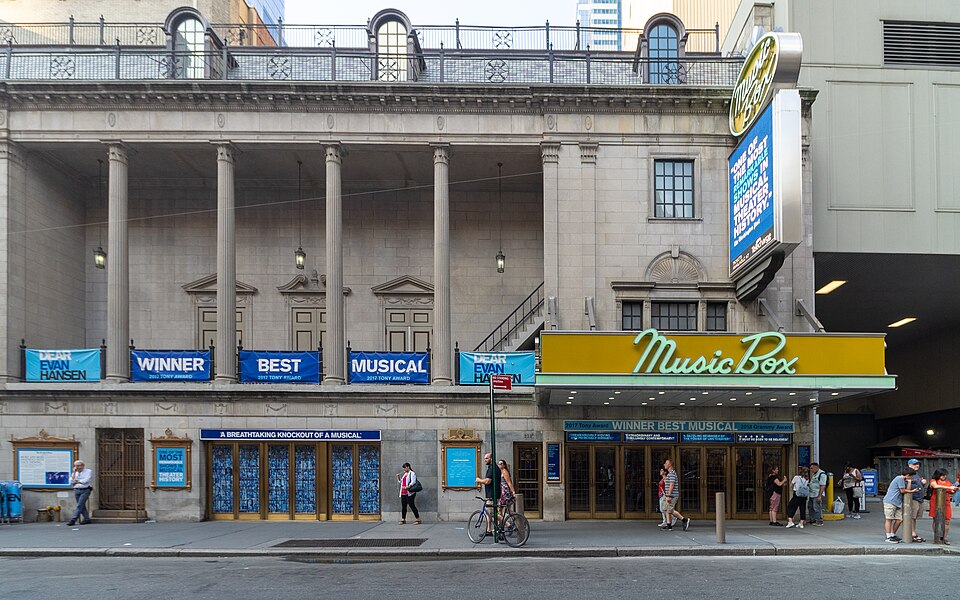
Music Box Theatre tickets are sold for the production and performance date you choose, not as a theater-wide season pass. The Shubert Organization directs online buyers to Telecharge, its official ticketing service, and face-value tickets are also sold at the theater box office. Inter Alia Broadway tickets are now on sale for the strictly limited engagement from November 10, 2026 through February 21, 2027.
Check Music Box Theatre Ticket AvailabilityOfficial Music Box Theatre tickets
Start with Telecharge or the Music Box Theatre box office for official, face-value inventory. Third-party marketplaces may have additional seats, but their prices can be above face value and can change with demand, so compare the full price before paying a premium.
Music Box Theatre box office
The box office is at the theater’s step-free street entrance at 239 West 45th Street, between Broadway and Eighth Avenue. Hours can change with the production and performance schedule, so confirm current hours before making a special trip. The ticket lobby includes an accessible pass-through counter.
Music Box Theatre group tickets
The Shubert Organization directs group buyers to Broadway Inbound. Group minimums, available performances and pricing are production-specific, so confirm the current terms for Inter Alia before collecting payment from your party.
Rush, lottery and last-minute options
A rush or lottery policy for Inter Alia has not been announced. Each production sets its own rules, and programs can change after performances begin. The Broadway rush and lottery guide, last-minute ticket guide and when to buy Broadway tickets guide explain the main alternatives.
What Kind of Broadway House This Is
The Music Box was built by Irving Berlin and producer Sam H. Harris in 1920 — not to house someone else’s work, but to house their own. Berlin wanted a theater designed around the specific aesthetic of the revues he was producing, and the result is a house that was built with artistic intention from the ground up. Architect C. Howard Crane designed the exterior in a Palladian-inspired, neo-Georgian style — limestone facade, symmetrical arrangement, more in the manner of a dignified townhouse than the typical theatrical marquee architecture of the era. Both the facade and the auditorium interior are New York City landmarks.
Inside, the auditorium is wider than it is deep, which is part of what makes the room feel the way it does. The orchestra level seats around 538 people; the mezzanine above adds roughly 455 more. With boxes on either side and standing space at the rear, the total is approximately 1,009 seats — well under half what you find at the Minskoff or the Marquis. That number is not a limitation. It is a design parameter. The productions that have worked best at the Music Box over a century — plays, intimate dramas, character-driven musicals — have worked because the room was the right size for what was on stage.
The Music Box is not a spectacle theater. It is a theater where the writing and the performance are the event, and the room is sized to make both feel immediate. Sitting in the orchestra here, you are physically close to what is happening on stage in a way that the large houses in the district cannot match. If you have seen Broadway primarily in bigger venues and found the distance from stage to seat a barrier to engagement, the Music Box offers a different and often more direct experience.
The theater has been operated by the Shubert Organization since it assumed full ownership in 2007, and it has maintained its reputation as one of the preferred Broadway addresses for prestige plays and limited-run dramas. The productions that have called it home — from Dear Evan Hansen and The Picture of Dorian Gray to Giant and the upcoming Inter Alia — reflect a consistent curatorial sensibility about what belongs in a room this size.
Seating Guide — How to Think About Where to Sit
Seating at the Music Box divides into two levels: orchestra on the ground floor and mezzanine above. The orchestra is fully accessible without steps; the mezzanine requires climbing two flights of stairs — 38 steps — and once you are there, each row is two steps down from the one behind it. These are not incidental details. At a theater this size, every section feels meaningfully different, and knowing what each offers before you book matters more than it might at a larger venue where mid-distance seats in the center are reliably safe.
The premium experience at this theater. The room’s width-to-depth ratio means you are genuinely close to the stage from a wide range of orchestra seats — not just the front rows. Center orchestra puts you inside the performance in a way that is specific to smaller houses. Strong throughout for plays where performer proximity and detail are the point.
Worth knowing: the last two rows of the orchestra are a step up from the rest of the orchestra level. Not a significant accessibility barrier for most visitors, but worth knowing in advance. Wheelchair seating is available in the orchestra at specific locations — not in these rear rows.
Reached by two flights of stairs (38 steps total). Once up, each row steps down approximately two steps. The mezzanine gives you an elevated angle on the full stage picture — good for productions where seeing the complete staging layout matters. Not step-free; plan accordingly if mobility is a consideration.
At a theater this size, seats at the ends of rows — particularly in the outer sections — offer more partial views than those facing the stage directly. This is a meaningful consideration at the Music Box, where the house is wide enough that extreme side positions can lose some of the stage picture. Center and center-adjacent seating throughout both levels is considerably stronger.
The Music Box has side boxes as part of its original architecture. These are architecturally interesting positions that trade stage width for a unique vantage point. Worth knowing what you are getting before you book a box seat — they offer a different experience, not necessarily a worse one, but the tradeoff is real.
For plays where the writing carries the weight — which is the norm at the Music Box — mid-mezzanine center tends to offer the best combination of sightlines, full stage view, and price. The intimate scale of the room means you are never as far from the stage as the same mezzanine position at a larger theater would feel.
At the Minskoff or the Marquis, the choice between orchestra and mezzanine is partly about scale — how much physical production you can take in versus how close you want to be to it. At the Music Box, the choice is more about angle. Both levels are close. The orchestra puts you at stage level with the performance; the mezzanine gives you a slight elevation that can reveal staging and blocking you might not see from ground level. For a character-driven drama where every expression and gesture carries weight, orchestra center is the premium choice. For a production with strong spatial or directorial design, mezzanine center has a legitimate argument. Neither is wrong — but the Music Box’s size means the gap between them is smaller than people expect.
Accessibility at the Music Box Theatre
The Shubert Organization is direct about the Music Box’s accessibility: the theater is not completely wheelchair accessible. Understanding what that means in practical terms matters before you plan your visit.
No steps from the sidewalk into the lobby
There are no steps between West 45th Street and the theater lobby or box office. The entrance is step-free from the sidewalk, and the ticket lobby includes an accessible pass-through counter. Box office assistance is available for patrons with disabilities. This is a meaningful practical advantage for a building of this era.
Orchestra is accessible without steps — mezzanine is not
Seating is accessible to all parts of the orchestra level without steps. Wheelchair seating is available in the orchestra only — specific locations include seats near rows K, L, and N (verify exact positions with the box office when booking). The mezzanine requires two flights of stairs — 38 steps total — with approximately two steps down per row once you are at mezzanine level. There are no elevators or escalators at this theater. Patrons who cannot use stairs must book orchestra-level seating.
Accessible restroom on the main floor only
A wheelchair-accessible ADA-compliant unisex restroom is located in the ticket lobby on the main floor. Additional restrooms require stairs: the lower lounge restrooms are 29 steps down; the mezzanine restrooms are 19 steps up. Visitors who require step-free restroom access should plan around the main-floor facility only.
Assistive listening, captioning, and audio description
Infrared assistive listening devices are available free at every performance — ID required as deposit. Hand-held audio description and captioning devices are available beginning four weeks after a show’s official opening night. Prior to that, live captioning via CART is available on request with two weeks’ advance notice. Downloadable audio description and captioning for personal mobile devices are also available free of charge. T-Coil loop technology is available for compatible hearing devices. Spanish-language subtitles are available via the GalaPro app for current productions where offered. Contact Shubert Audience Services at 212-944-3700 or audienceservices@shubertorg.com for advance arrangements.
Aisle transfer seats
Aisle seats with folding armrests and companion seats are available for patrons who can transfer from a wheelchair but need easier aisle access. Verify current availability and specific locations with the box office or Shubert Audience Services when booking.
The Music Box is not completely wheelchair accessible, and the stair requirements for the mezzanine and lower-level restrooms are significant. Always verify current accessibility provisions directly with the Shubert Organization box office or Shubert Audience Services (212-944-3700) before finalizing plans, particularly if mobility or step access is a primary consideration for your group.
A Century on West 45th Street
The Music Box is one of the few Broadway theaters built with a specific artistic vision rather than as a speculative commercial venture. Irving Berlin and Sam H. Harris did not want a generic Broadway house; they wanted a room designed around the particular kind of revue Berlin was writing. The result has outlasted both of them and the revues that inspired it, and has spent the past century housing some of the more distinguished dramatic productions the district has produced.
Location — Theater District and Getting There
The Music Box sits at 239 West 45th Street — George Abbott Way — between Broadway and Eighth Avenue, in the center of the Theater District. It is on the same block as the Imperial Theatre and a short walk from Shubert Alley, which puts it at the geographic heart of Broadway’s most concentrated cluster of houses. The location is convenient for virtually every transit option into midtown.
The subway is the practical choice for most visitors — the Theater District is as well-served by transit as any neighborhood in the city. If you are driving, the valet parking lot on the north side of 45th Street between Broadway and Eighth Avenue is the most convenient option for this specific theater, with a garage option east of Shubert Alley on the same block. For full transit details and timing guidance, see the guide to getting to a Broadway show. For parking options and pricing, the parking near Broadway guide covers the area in full.
Build the Night Around the Music Box
The Music Box’s position at the center of the Theater District means almost every pre-show dining and hotel option in the Broadway cluster is within easy walking distance. The surrounding blocks are among the most concentrated in the district for both. Inter Alia is expected to run approximately 1 hour 40 minutes with no intermission, which makes a post-show drink or late dinner more practical than it is after a long musical.
Dinner before the show
The Music Box is half a block from Shubert Alley and a short walk from Restaurant Row on West 46th Street — the most concentrated pre-theater dining strip near this part of the district. Hell’s Kitchen, two blocks west on 46th and 47th Streets, adds a stronger range of neighborhood restaurants for visitors who prefer something less tourist-adjacent. The restaurants near Broadway guide covers specific options by area and occasion. For timing strategy around the Music Box’s runtime, the pre-show dining guide covers how to schedule dinner without rushing the evening — particularly relevant if you are coming from out of town and arriving at the theater for the first time.
The audience this theater attracts
It is worth saying directly: the Music Box often draws a different kind of Broadway crowd than the Minskoff or the Marquis. A prestige drama such as Inter Alia — a limited engagement led by Rosamund Pike and centered on a judge confronting a collision between professional principles and family life — is likely to attract playgoers interested in performance, writing and adult subject matter rather than spectacle. That shapes the pre-show atmosphere and what the evening feels like as a social experience. If you are bringing a first-time Broadway visitor and want them to feel the intimacy and specificity of a smaller house, this is the kind of evening that can make that impression.
Hotels for out-of-town visitors
The Theater District and Times Square area have the widest selection of Broadway-adjacent hotels in the city at every price point, and the Music Box’s central location puts virtually all of them within a few blocks. The hotels near Broadway guide covers the best-positioned options. For a fuller orientation to the surrounding neighborhood, the Theater District neighborhood guide is the right starting point.
Music Box Theatre Shows: Inter Alia Arrives November 10
The Music Box is currently dark. Giant, Mark Rosenblatt’s Olivier Award-winning play starring John Lithgow as Roald Dahl, played a strictly limited 16-week engagement and closed June 28, 2026, following an acclaimed run that included a Tony win for Lithgow’s performance. There is no production booked in the interim — the theater’s next tenant is Inter Alia, beginning previews November 10, 2026.
Inter Alia marks Rosamund Pike’s Broadway debut, reprising her acclaimed performance as Jessica Parks — a London Crown Court judge navigating the gap between her professional principles and her own family — from sold-out runs at London’s National Theatre and West End. The play is written by Suzie Miller, the playwright behind Prima Facie, and directed by Justin Martin, reuniting the same creative team. Runtime is approximately 1 hour 40 minutes with no intermission; recommended for ages 14 and up given sensitive subject matter.
Inter Alia Broadway tickets are now on sale through Telecharge and the Music Box Theatre box office. A production-specific rush or lottery policy has not been announced. For the full picture on dates, cast and planning, see the Inter Alia Broadway guide.
Find Inter Alia Broadway Tickets See the Inter Alia Show GuideFrequently Asked Questions
Buy for a specific production and performance date. Telecharge is the Shubert Organization’s official online ticketing service for the Music Box Theatre, and face-value tickets are also sold at the theater box office. Marketplace listings can be useful when official inventory is limited, but compare the full price because resale tickets may cost more than face value.
Telecharge is the official online ticket seller for Shubert theaters, including the Music Box. The theater box office at 239 West 45th Street is also an official face-value source.
The box office is in the ticket lobby at 239 West 45th Street, between Broadway and Eighth Avenue. There are no steps from the sidewalk to the lobby, and an accessible pass-through counter is available. Hours can change with the performance schedule, so confirm current hours before making a special trip.
Yes, when a production offers group inventory. The Shubert Organization directs group buyers to Broadway Inbound. Minimum group size, dates and prices vary by production, so confirm the current terms for Inter Alia before organizing payment.
The Music Box Theatre is at 239 West 45th Street (George Abbott Way) in Manhattan, between Broadway and Eighth Avenue in the Theater District. It is a short walk north of Times Square and a short walk from Shubert Alley. The nearest subway is Times Square–42nd Street (1, 2, 3, 7, N, Q, R, W trains) — walk north to 45th Street and east toward Broadway.
Nothing right now. Giant, the Olivier Award-winning play starring John Lithgow, closed June 28, 2026, and the theater is dark until Inter Alia begins previews November 10, 2026, starring Rosamund Pike in her Broadway debut.
For most productions at the Music Box, center orchestra is the premium choice — the room’s intimate scale means you are genuinely close to the stage throughout most of the orchestra, not just the front rows. Front mezzanine center is a strong value alternative, giving you a slightly elevated angle on the full stage picture at a lower price point. Avoid extreme end-of-row seats in both sections, where the view of the opposite stage edge can be partial. The key practical note: the mezzanine requires climbing two flights of stairs (38 steps), and there are no elevators — orchestra seating is the only accessible option for visitors who cannot use stairs.
Partially. There are no steps from the sidewalk into the lobby or box office, and the full orchestra level is accessible without steps. Wheelchair seating is available in the orchestra only. The mezzanine requires 38 steps to reach and there are no elevators or escalators in the theater. The accessible restroom is on the main floor in the ticket lobby — mezzanine and lower lounge restrooms require stairs. Visitors who require step-free access should book orchestra-level seating and contact Shubert Audience Services at 212-944-3700 to confirm arrangements in advance.
The Music Box Theatre has approximately 1,009 seats across orchestra, mezzanine, and box positions. Different sources cite slightly different figures — the Shubert Organization lists 1,025 seats while The Broadway League cites 1,009 — reflecting how standing room and box positions are counted. It is one of the smaller Broadway houses currently in active use in the district.
The Music Box was built in 1920 by composer Irving Berlin and producer Sam H. Harris, who wanted a theater designed specifically to house Berlin’s annual Music Box Revues. Architect C. Howard Crane designed the building in a Palladian-inspired, neo-Georgian style. Both the facade and the auditorium interior are New York City landmarks. The Shubert Organization, which had been acquiring shares in the theater since the 1920s, assumed full ownership in 2007.
Yes, with one qualification worth knowing in advance: the Music Box tends to program plays and smaller-scale productions rather than large musicals, so it is the right venue if you want to experience Broadway’s more intimate, performance-focused side. Inter Alia is a serious drama recommended for ages 14 and up because of sensitive subject matter, not a big-budget spectacle. For visitors who want to understand the full range of what Broadway offers, seeing a show at the Music Box alongside something at a larger house gives a genuine picture of how different Broadway houses can feel. For help choosing, the best Broadway shows for first-time visitors guide covers the current season.
A rush or lottery policy has not been announced. Regular Inter Alia tickets are on sale through Telecharge and the Music Box Theatre box office, and any discounted program will be set by the production. Check the Inter Alia Broadway guide and the Broadway rush and lottery guide for updates.
The Music Box in Brief
The Music Box Theatre is one of Broadway’s most distinguished smaller houses — a 1921 theater built by Irving Berlin that has spent a century hosting the kind of productions that benefit from a room where every seat feels close to the stage. At approximately 1,009 seats, it offers a fundamentally different Broadway experience from the large-scale houses in the district. Giant closed June 28, 2026 after a strictly limited run, and the house is dark until Rosamund Pike arrives November 10 in Inter Alia.
For the current lineup, see the Inter Alia Broadway guide. For broader Broadway planning, the Broadway hub and the Theater District neighborhood guide are the right next steps.
The Music Box Is Set — Now Choose the Right View
The Music Box is one of Broadway’s classic intimate houses, currently between engagements after Giant’s run. Use the dedicated seating guide first, then build the full night around Inter Alia this fall, West 45th Street dining, hotels, transit, parking, and nearby Broadway houses.
Music Box Seating Chart & Best Seats
Compare Orchestra, Mezzanine, center-vs-side views, stair warnings, accessibility, and the best seats for plays and intimate Broadway productions.
Open Seating Guide Recently ClosedGiant Broadway Guide
John Lithgow’s Tony-winning run closed June 28, 2026. The show guide remains available for reference.
Open Show Guide Up Next · Nov 10Inter Alia Broadway Guide
Rosamund Pike’s Broadway debut in Suzie Miller’s legal drama, direct from a sold-out London run — book early for a strong seat.
Open Show GuideBroadway Seating & Ticket Strategy
Seats · Timing · ValueBroadway Seating Guide
Compare Orchestra, Mezzanine, Balcony, boxes, side seats, premium zones, and view tradeoffs across Broadway houses.
All Broadway Theater Guides
Browse every Broadway house guide and compare room scale, location, access notes, and seating strategy across the Theater District.
What’s Playing on Broadway
Compare current and upcoming Broadway productions, then connect each show to the right theater, seat choice, and full-night plan.
When to Buy Broadway Tickets
Know when buying early matters, when waiting can work, and how timing changes for plays, limited runs, stars, and premium center seats.
Last-Minute Broadway Tickets
Compare same-day options without accidentally grabbing awkward far-side seats or upper-level rows that do not fit your night.
Broadway Rush and Lottery Tickets
How discount systems work, what seat tradeoffs to expect, and why cheap seats can be great — or risky — depending on view.
Plan the Music Box Theatre Night
Dinner · Hotels · TransitRestaurants Near Broadway
The Music Box sits close to both Restaurant Row and the core Theater District, so dinner timing can be simple if you plan the walk.
Restaurants Near Times Square
Useful for visitors staying near Times Square, arriving by subway, or building a classic central Broadway night.
Pre-Show Dining Guide
Plan reservation timing, walking buffer, arrival, intermission expectations, and post-show movement.
Hotels Near Broadway
Compare Theater District, Times Square, Midtown West, and Hell’s Kitchen hotel zones for a Broadway-centered trip.
Hotels Near Times Square
Best for visitors who want the shortest walk, subway access, and easy post-show return logistics.
How to Get to a Broadway Show
Subway, walking, rideshare, and arrival timing for Theater District shows, including the West 45th Street cluster.
Subway to Broadway
Use Times Square, Port Authority, or nearby Midtown stops, then walk into the West 45th Street theater cluster.
Parking Near Broadway
When driving makes sense, when it does not, and how to avoid turning a Broadway night into a Midtown garage problem.
Best Way Home After a Show
Subway, taxi, rideshare, walking, and hotel return strategy after a crowded West 45th Street performance.
Nearby Neighborhood & Theater Guides
45th Street · Theater District · Nearby HousesTheater District
The practical guide to Broadway’s center: theaters, crowds, hotels, restaurants, walking routes, and first-time visitor logistics.
Times Square
Best when convenience, subway access, hotels, and a classic Broadway visitor base matter most.
Hell’s Kitchen
A stronger pre- and post-show dining base west of the theater cluster, especially for visitors who want less Times Square noise.
Imperial Theatre Guide
A nearby Broadway house useful for comparing West 45th Street arrival, seat views, and show-night planning.
Gerald Schoenfeld Theatre Guide
A nearby Theater District house that helps visitors compare room scale, location, access, and nearby dining strategy.
Bernard B. Jacobs Theatre Guide
A nearby house that keeps the West 45th Street theater cluster connected for seating, arrival, and night-out planning.