

Booth Theatre Tickets, Box Office & NYC Broadway Guide
Booth Theatre tickets, box-office guidance, upcoming Broadway shows, 222 West 45th Street location, accessibility, seating overview, and what to know before your NYC theater night.
The Booth Theatre is one of Broadway’s smaller, more intimate legitimate playhouses — 800 seats at 222 West 45th Street, New York, NY 10036, built in 1913 as a deliberate counterpoint to the larger Shubert Theatre next door. Visitors searching for Booth Theatre tickets right now are booking Downstate, Bruce Norris’s award-winning play, which begins previews October 17, 2026. The room was designed from the beginning for serious dramatic work rather than mass-scale spectacle, and that intent has shaped its identity ever since.
This guide covers the theater as a room: what it feels like, how to think about seats, what the accessibility realities are, where it sits in the district, and how to plan a full evening around it. Proof closed here on July 19, 2026. Bruce Norris’s Downstate, directed by Joe Mantello, is the Booth’s next Broadway engagement: previews begin October 17 and opening night is November 15.
Booth Theatre Tickets & Box Office
Booth Theatre tickets currently means tickets for the Broadway production of Downstate, which begins previews October 17 and opens November 15 for a strictly limited 12-week run. The Shubert Organization operates the theater, and the official venue page routes ticket buyers to Telecharge. For show-specific details (prices, the weekly schedule, runtime and the 17+ age rule), see our Downstate Broadway tickets guide.
Booth Theatre box office
The Booth Theatre box office is located at the theater at 222 West 45th Street. Box-office hours can change with the production schedule, so verify current hours before making a special trip.
Booth Theatre NYC ticket searches vs. TKTS ticket-booth searches
The standalone phrase “booth tickets” is ambiguous in search data because it overlaps heavily with TKTS and generic ticket-booth searches. This venue page is specifically about Booth Theatre tickets in New York, the Broadway house on West 45th Street — not the Times Square TKTS booth or TDF discount-ticket locations.
What Kind of Broadway House This Is
At 800 seats, the Booth is among the smaller houses currently operating on Broadway. That matters more than the number suggests. In a district where the larger musical theaters push past 1,800 seats, the Booth’s proportions create a fundamentally different experience: the stage feels closer, the performances feel more immediate, and the audience relationship with the actors is more direct. That is not an accident — it was the point from the day it opened.
Winthrop Ames, who partnered with Lee Shubert to build it, explicitly intended the Booth for the most challenging and prestigious productions possible. He was not interested in running a house that competed on volume; he was interested in the kind of work that a room of this scale could support. That philosophy has held, at least in reputation, through more than a century of ownership. The Booth’s production history tilts heavily toward plays and revivals over musicals, and toward work that requires close attention rather than spectacle.
The Booth works best for productions where the writing and the performances are the event — not the set, not the spectacle, not the scale. If you are seeing a play here, the room is working with the production rather than against it. The compact proportions mean there are very few seats where the performers feel remote.
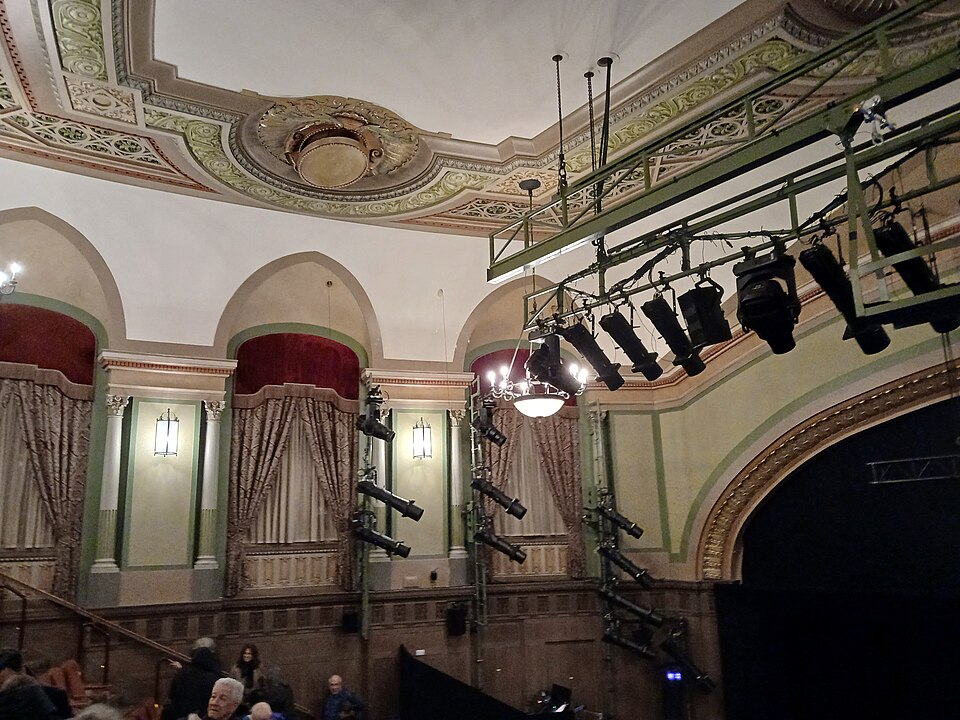
The architecture is restrained relative to some of the more ornate Broadway houses. Henry B. Herts designed both the Booth and the Shubert Theatre as a matched pair on the same block, with the Booth as the less extravagant of the two. The facade is brick and terracotta with sgraffito decorations; the auditorium has an elliptical proscenium arch, wooden wall paneling, and a coved ceiling. It is a handsome room, but the handsomeness is quiet rather than theatrical. The building itself does not compete with what is happening on the stage.
Booth Theatre Seating Overview
The Booth’s compact size changes the calculus on seats in a way that is worth understanding before you book. What feels like a significant distance in a 1,800-seat house is considerably less consequential here. For the full seating chart, view-from-my-seat considerations and section-by-section guidance, use the Booth Theatre seating guide. The venue-level seat breakdown is:
The main floor. For most straight plays at the Booth, center orchestra is the premium zone — close enough to read faces, hear full vocal dynamics, and feel the energy of the room. Front rows are very close; mid-orchestra center is usually the strongest position overall.
A fuller view of the stage picture from a slightly elevated angle. Because the room is compact, even the mezzanine is not far from the action. Front mezzanine center is a reliable choice — often better value than rear orchestra at comparable or lower prices. Note that each row requires approximately 2 steps up or down.
Side angles with an unusual perspective on the stage. The boxes offer novelty and proximity but come with viewing trade-offs — you are looking at the stage from the side rather than head-on. Worth considering only if the specific angle appeals to you or if center seats are unavailable.
Available for sold-out performances. Standing room at the Booth is at the rear of the orchestra. At this room size, standing room is more viable than at a larger house — you are still relatively close to the action.
In a smaller house like the Booth, front mezzanine center rows offer a complete view of the stage picture at a price point typically below center orchestra. For a play where staging and movement across the full stage matters, this often edges out rear orchestra seats.
Extreme side orchestra seats can have limited sightlines to the opposite side of the stage depending on the production’s staging. Center and center-adjacent seats — in either the orchestra or mezzanine — are consistently stronger.
At the Booth, the usual Broadway seat anxiety is compressed. A rear mezzanine seat here is not the same experience as a rear mezzanine seat in a 1,600-seat house. The room’s 800-seat scale means the distance between the best seat and a merely good one is considerably smaller than at a larger venue. Mid-range seats in both the orchestra and mezzanine are genuinely strong options here in a way they are not always elsewhere.
Booth Theatre NYC Location — 222 West 45th Street
The Booth sits at 222 West 45th Street, between Broadway and Eighth Avenue — one of the most central addresses in the Theater District. It shares the block with the Shubert Theatre directly to the south and the Bernard B. Jacobs and Gerald Schoenfeld Theatres to the west, making this stretch of 45th Street the single densest concentration of working Broadway houses anywhere in the district.
The theater’s position on 45th Street also puts it directly adjacent to Shubert Alley — the pedestrian passage connecting 44th and 45th Streets that has been part of Broadway’s physical identity for over a century. Arriving via Shubert Alley rather than the main 45th Street entrance is worth doing if you are coming from the south; it is one of the few parts of the Theater District that still feels distinctly theatrical in a way that the tourist-facing blocks do not.
For pre-show dinner, Hell’s Kitchen — starting a few blocks west along 9th Avenue — is the natural choice. It has the best concentration of legitimate pre-theater restaurants near this part of the district, with better quality and more reasonable prices than the immediate Times Square blocks. The full guide to getting to a Broadway show covers subway timing and parking for this part of 45th Street.
Accessibility at the Booth Theatre
Orchestra level — accessible without steps
Shubert lists all parts of the Orchestra seating area as accessible without steps, with wheelchair seating located in the Orchestra only. The theater also has an accessible restroom. Confirm the exact wheelchair and companion-seat configuration for your performance before booking.
Mezzanine requires stairs — no elevator access
The mezzanine is reached via two flights of stairs — approximately 31 steps total — and there are no elevators or escalators at this theater. Within the mezzanine itself, there are approximately two steps up or down between rows, with handrails at the end of stepped rows. Visitors who cannot manage stairs should book orchestra-level seats and verify current accessible seating with the box office directly.
Assistive listening and other services
The Booth provides infrared assistive-listening devices for every performance. Shubert Audience Services also provides captioning and audio-description options under its current accessibility program; availability and timing should be confirmed for the specific production.
Accessibility details, seating policies, and available services can change between productions. Verify current provisions directly with the Shubert box office or the official venue page before finalizing your plans, particularly if accessibility is a primary consideration.
Over a Century on West 45th Street
The Booth has been part of the Broadway landscape for more than a hundred years — long enough that its history tracks through nearly every era of American theater, from its founding in the early twentieth century through the present. It is one of the oldest continuously operating Broadway houses still in use.
The naming for Edwin Booth is a thread worth pulling. Booth was the most celebrated American stage actor of the 19th century — a classical tragedian who defined American theater at a time when the stage was the dominant entertainment culture. His brother John Wilkes Booth assassinated Abraham Lincoln, a fact that shadowed Edwin’s life and career. Naming the theater for him was an act of reclamation, honoring his art rather than his family’s infamy.
Now at the Booth — Downstate
The Booth’s current Broadway engagement is Downstate by Bruce Norris, directed by Joe Mantello. Previews begin October 17, 2026, with opening night set for November 15, for a strictly limited 12-week run. The company includes K. Todd Freeman and Francis Guinan, returning from earlier productions, alongside Thomas Sadoski and Liza Colón-Zayas.
Downstate centers on four men living together in a state-sanctioned group home after serving prison sentences for sex crimes against minors. When a survivor arrives to confront his abuser, the encounter drives the play into a volatile examination of punishment, accountability and what comes after a sentence has been served. The Booth’s intimate scale is consistent with the kind of actor-driven dramatic work the theater has housed throughout its history.
Two things to know before you book: Downstate runs about 2 hours 25 minutes with one intermission, and it is intended for ages 17 and up, so no one under 17 is admitted. Its weekly schedule is also unusual: no Wednesday performances, a Monday show, and two shows on both Saturday and Sunday. Use this page for the venue itself (address, box office, accessibility and logistics), the Booth Theatre seating guide for where to sit, and the Downstate show guide for tickets, cast, dates and what the play is about.
Plan the Night Around the Booth Theatre
The Booth’s position on central 45th Street makes it one of the most logistically straightforward Broadway houses to plan around. You are in the middle of the district, walking distance from most Midtown hotels, and close enough to Hell’s Kitchen to make a pre-show dinner work without any particular coordination.
Getting there
Times Square–42nd Street is the most central subway option, putting you a short walk east on 45th Street. The A, C, and E trains stop at 42nd Street and 8th Avenue, also an easy walk. From most Midtown hotels you are unlikely to need the subway at all. Arriving via Shubert Alley, which runs alongside the theater from 44th Street, is worth it if you are coming from the south — it is a better approach than the main 45th Street sidewalk when there is a full crowd flowing toward curtain. See the guide to getting to a Broadway show for full detail on subway timing and rideshare drop-offs. For parking, the parking near Broadway guide covers the closest garages to this part of 45th Street.
Dinner before the show
Hell’s Kitchen — a 5-to-10-minute walk west along 46th Street or 9th Avenue — is the most reliable pre-theater dining neighborhood for this part of the district. It has a dense cluster of restaurants that understand theater timing, at prices considerably better than the immediate Times Square blocks. Plan to be seated no later than 90 minutes before curtain. The restaurants near Broadway guide covers specific options by type and occasion, and the pre-show dining guide covers timing and logistics for different kinds of evenings.
Hotels nearby
The Theater District and Times Square area offer the widest range of Broadway-adjacent hotels in the city, from major chains on 7th Avenue to smaller options on the Hell’s Kitchen side. Being on this block puts you within walking distance of essentially all of them. The hotels near Broadway guide covers options across price ranges. For a fuller sense of the neighborhood, the Theater District guide is the right starting point.
Frequently Asked Questions
The Booth Theatre is at 222 West 45th Street in Manhattan, between Broadway and Eighth Avenue in the Theater District. It sits on one of the most central blocks in the district — adjacent to Shubert Alley and within walking distance of Times Square. The nearest subway is Times Square–42nd Street, served by the N/Q/R/W, 1/2/3, and 7 trains. The A/C/E stop at 42nd and 8th is also a short walk.
Bruce Norris’s Downstate, directed by Joe Mantello. Previews begin October 17, 2026, opening night is November 15, and it runs a strictly limited 12 weeks. It is intended for ages 17 and up.
For most productions at the Booth, center orchestra in the mid-rows is the strongest position — close enough for genuine immediacy, centered for full sightlines. Front mezzanine center is an excellent alternative that often offers a more complete view of the stage picture at a lower price point. Avoid extreme side orchestra seats, where sightlines to the opposite side of the stage can be limited. Because the Booth is a smaller house, even seats that would feel remote in a larger theater remain relatively close to the action here.
The Booth Theatre has 800 total seats: 514 in the orchestra, 252 in the mezzanine, 12 box seats, and 22 standing room positions. It is one of the smaller Broadway houses currently in operation — considerably more intimate than the larger musical venues in the district.
The orchestra level is accessible — there is one step into the theater, and wheelchair seating and an accessible restroom are available on the main level. The mezzanine requires two flights of stairs (approximately 31 steps) with no elevator or escalator access. Visitors who cannot manage stairs should book orchestra-level seats and confirm accessible seating arrangements with the Shubert box office before attending. Assistive listening devices are available with an ID deposit.
The theater is named for Edwin Booth, the celebrated 19th-century American stage actor widely considered the greatest classical tragedian of his era. Producer Winthrop Ames chose the name when the theater opened in 1913. Edwin Booth was the brother of John Wilkes Booth, who assassinated Abraham Lincoln — naming the theater for Edwin was a deliberate act of recognition for his artistic legacy rather than his family history.
Yes — the Booth is an especially good choice for first-time visitors who are seeing a play rather than a musical, or who prefer a more intimate theater experience over the scale of a large Broadway house. The room is compact enough that most seats feel genuinely close to the stage, the central 45th Street location is easy to navigate, and the theater’s history gives the visit a sense of context that newer or more generic venues do not offer.
The official Shubert Booth Theatre page links buyers to Telecharge for the theater’s current production, Downstate. Ticket marketplaces can help when you want to compare several dates; check the section and row against the Booth’s layout before buying.
The Booth Theatre box office is at 222 West 45th Street in Manhattan. Hours can vary with the production schedule, so confirm before making a special trip.
The Booth Theatre is in the Theater District at 222 West 45th Street, immediately west of Broadway and adjacent to Shubert Alley. It is a short walk from Times Square, but it is not the TKTS ticket booth.
The Booth in Brief
The Booth Theatre is one of Broadway’s oldest and most distinctive intimate playhouses — a compact 800-seat house on central 45th Street that was built for serious dramatic work and has largely lived up to that intent over more than a century. Its scale is its primary advantage: the room keeps you close to the performers in a way that many of the district’s larger houses simply cannot match, and productions here tend to be selected with that intimacy in mind.
After Proof closed July 19, the Booth’s next tenant is Bruce Norris’s Downstate, beginning previews October 17, 2026 and opening November 15. Whether you are planning around that production or a future visit, the theater’s central location, straightforward logistics, and genuine historical character make it one of the district’s most distinctive small Broadway houses. For broader Broadway planning, the Broadway hub and the Theater District neighborhood guide are the right starting points.
The Room Is Intimate — Plan the Night Around It
The Booth is one of Broadway’s smaller, more intimate playhouses, which makes the seat choice feel different from a giant musical house. Use these guides to connect the theater, the seating chart, Downstate, dinner, hotels, transit, and the full West 45th Street night.
Booth Theatre Seating Chart
Compare orchestra, mezzanine, boxes, standing room, accessibility, value picks, and the best seats for Downstate before you book.
Open Seating Guide Now Booking · Previews Oct 17Downstate Broadway Guide
Bruce Norris’s award-winning play, directed by Joe Mantello: tickets, dates, the 17+ age rule, runtime, cast, and how to plan the night around it.
Open Show GuideBroadway Seating & Ticket Planning
Seats · Timing · DealsBroadway Seating Guide
How orchestra, mezzanine, boxes, side seats, premium zones, and obstructed-view listings compare across Broadway houses.
When to Buy Broadway Tickets
Know when buying early matters, when waiting can work, and how timing changes for plays, weekends, holidays, and high-demand performances.
Last-Minute Broadway Tickets
TKTS, same-day listings, rush, lottery, and practical ways to compare late options without choosing awkward seats blindly.
Broadway Rush and Lottery Tickets
How discount ticket systems work, what tradeoffs to expect, and why cheap seats can be great — or awkward — depending on location.
First-Time Broadway Guide
For visitors choosing their first show or first theater: what to know about seats, arrival, timing, dress, and the Theater District.
Best Broadway Shows for Date Night
Compare shows by tone, dinner pairing, mood, pacing, and how the whole night feels beyond the ticket itself.
Plan the Booth Theatre Night
Dinner · Hotels · TransitRestaurants Near Broadway
The Booth sits near Shubert Alley and West 45th Street, with Restaurant Row, Times Square, and Hell’s Kitchen within easy reach.
Pre-Show Dining Guide
Plan reservation timing, walking buffer, arrival, and post-show movement so dinner and theater work together.
Best Pre-Theater Restaurants NYC
Use this when you want stronger restaurant choices around Broadway instead of only timing and logistics advice.
Best Post-Show Restaurants NYC
Where to go after the curtain when you want a drink, dessert, late dinner, or a calmer landing after the show.
How to Get to a Broadway Show
Subway, walking, rideshare, and arrival timing for Theater District shows, including the central West 45th Street houses.
Parking Near Broadway
When driving makes sense, when it does not, and how to avoid turning a Broadway night into a Midtown garage problem.
Nearby Neighborhood & Hotel Guides
45th Street · Shubert Alley · Broadway CoreTheater District
The practical guide to Broadway’s center: theaters, crowds, hotels, restaurants, walking routes, and first-time visitor logistics.
Times Square
Best when convenience, subway access, and being right in the center matter most — especially for short Broadway trips.
Hell’s Kitchen
A strong nearby option when dinner matters — more restaurant depth, calmer blocks, and an easy walk west after the show.
Midtown West
A broader west-side planning base for hotels, transit, restaurants, and nights that stretch beyond the immediate Theater District.
Hotels Near Broadway
Compare Theater District, Times Square, Midtown West, and Hell’s Kitchen hotel zones for a Broadway-centered trip.
Where to Stay for Broadway Weekends
Match hotel zone, walking distance, subway access, and post-show energy to the kind of Broadway weekend you want.
More Broadway Theater Planning
Nearby Houses · Hubs · CompareBroadway Theater Guides
Compare Broadway houses by room size, location, seating feel, history, accessibility, and what each theater is best for.
Shubert Theatre Guide
The neighboring Shubert Alley landmark — useful context for visitors comparing West 44th and West 45th Street Broadway houses.
Bernard B. Jacobs Theatre Guide
A nearby West 45th Street theater with its own seating, show, accessibility, and full-night planning context.