

Imperial Theatre NYC: Seating, Access & What to Know
A classic Broadway musical house on 45th Street — a practical guide to where to sit, how the mezzanine works, and how to plan the rest of your night.
About the Imperial Theatre
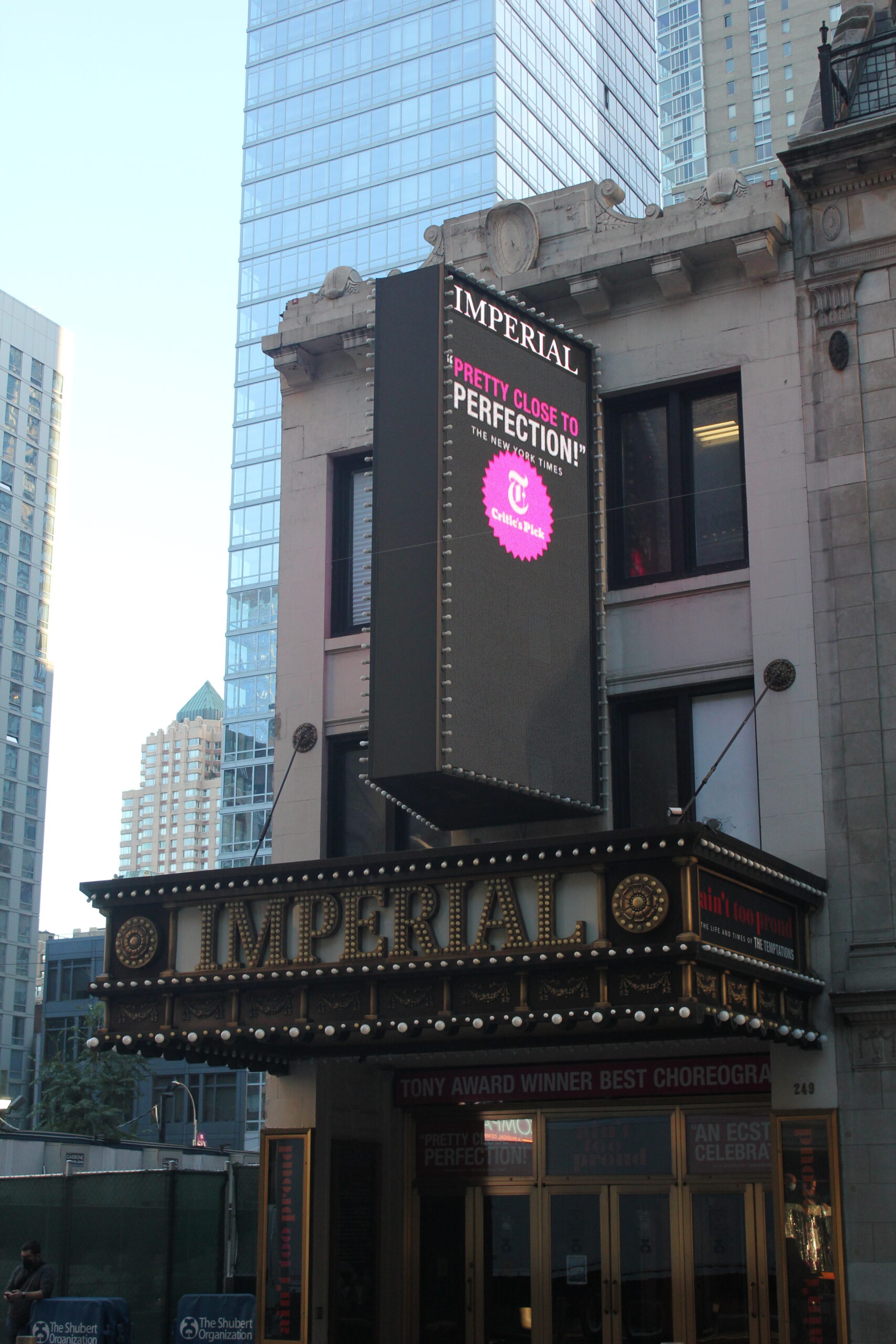
The Imperial Theatre NYC is at 249 West 45th Street, and this guide starts with what visitors look up first: Imperial Theatre tickets, the box office hours and phone number, the address, the bag policy and where to sit. The house is between shows until Billy Crystal: 860 begins previews on October 1, 2026.
The Imperial is one of Broadway’s most consistently programmed musical houses — a Shubert theater built in 1923 specifically for large-scale Broadway productions, and still delivering on that brief a century later. At 1,457 seats, it is a substantial room, but Herbert J. Krapp’s design is wider than it is deep, which is a meaningful detail: more seats are closer to the stage than the raw number suggests. It does not feel like a barn. It feels like a Broadway house built to put a lot of people in good contact with the show.
The Imperial’s most recent production was the Broadway revival of Chess, the ABBA-composed musical, which played its final performance on June 21, 2026. It is exactly the kind of score-driven, theatrically ambitious production the Imperial is built to hold. The next booking is a change of pace: Billy Crystal’s solo show 860 begins previews on October 1, 2026, a one-man play in a house built for big musicals. If you are planning a night here, this guide covers everything you need to decide where to sit and how to get the most out of the visit.
Is the Imperial right for you?
The Imperial suits most Broadway visitors looking for a classic musical-house experience — but the mezzanine stair situation is worth understanding before you book if access matters to your group.
Musical theater fans who want a big score and traditional Broadway presentation
First-time visitors who want a classic, wide Broadway-house feel rather than an intimate playhouse
Groups or families where the visual scale of the production is part of what matters
Visitors who want a central Theater District location with easy pre-show options
Visitors with mobility needs — the mezzanine involves two flights of stairs with no elevator or escalator; orchestra is the access-safe choice
Visitors who want an intimate, actor-focused experience — this is a musical house designed for scale, not closeness
A short history worth knowing
The Imperial opened on Christmas Day 1923 as a Shubert replacement for the Shuberts’ 20-year-old, out-of-date Lyric Theatre. Herbert J. Krapp — the most prolific Broadway theater architect of the era — designed it in an Adam-style decorative idiom that gives the auditorium a warmth unusual for a house of this size. The theater became one of Broadway’s most active musical stages almost immediately and has remained so for more than a hundred years. Productions that played here have ranged from early-twentieth-century revues through the golden age of Broadway musicals and into the present. It is Shubert venue number 50 and is still part of the Shubert Organization’s actively managed roster.
Imperial Theatre Tickets and Box Office
Imperial Theatre tickets are sold for each production booked into the house. The theater is between shows: confirm before you buy.
Imperial Theatre box office hours and phone
The Imperial Theatre box office phone number is 212-239-6200. Published listings give box office hours of Monday to Saturday 10 AM to 8 PM and Sunday noon to 6 PM, and the Times Square Alliance lists Monday to Saturday until 8:30 PM. Hours can vary by production and by week, so check the official listing before a special trip. Groups of 12 or more can use the group line, 800-714-8452.
Imperial Theatre tickets: what to check before you buy
Confirm the date and time, the level and section (Orchestra or Mezzanine) and the seller’s exchange and refund terms, and compare the all-in price at checkout, since fees and resale markups change the total. Because the Mezzanine is stairs-only, confirm access needs before you choose a level. Recommended ages for 860 differ by source, with New York Theatre Guide saying 12 and up and Broadway.com saying 5 and up, and the theater does not admit children under 4. Any rush, lottery or discount offer is set by the production, and the rush and lottery guide explains how those programs generally work. For row-by-row advice see the Imperial seating guide, for timing see the when to buy Broadway tickets guide, and for the wider calendar see the Broadway shows guide.
Recent Imperial Theatre shows
The most recent production was the Chess revival, which began Broadway performances on October 15, 2025, opened on November 16 and closed on June 21, 2026 after 34 previews and more than 240 regular performances. New York Theatre Guide lists earlier recent Imperial Theatre shows as Smash, Water for Elephants, Bad Cinderella and Ain’t Too Proud: The Life and Times of The Temptations.
Imperial Theatre Seating Guide
The Imperial has two seating levels: the Orchestra on the main floor and the Mezzanine above. There is no balcony. The room’s defining characteristic is its width — Krapp designed the auditorium to spread seats across a broad horizontal plane rather than stack them vertically, which means even seats toward the sides of the orchestra are not as far from the action as they would be in a narrower, deeper house. That said, section and angle still matter, and the mezzanine access situation is something every buyer should understand before booking.
The safest and most flexible choice
Center orchestra is the straightforward recommendation for most visitors — strong sightlines, step-free access from the sidewalk all the way to your seat, and wheelchair seating available. The wide auditorium means mid-orchestra seats carry less penalty for being off-center than they would in other houses. Front orchestra puts you close for a big musical; the middle rows give you the best balance of immersion and full-stage picture. Side orchestra seats are worth considering on a per-show basis — for a production that uses the full width of the stage, center is still worth prioritizing.
No steps from sidewalk · Wheelchair seating availableOften the best value in the house
Front mezzanine center is a genuinely strong seat at the Imperial — elevated enough to give you a clean full-stage picture, still close enough to stay connected to the performance. For a score-driven musical where staging and choreography are as important as individual actor detail, the mezzanine overview can actually be the better vantage point than front orchestra. The trade-off is the stairs: getting there requires two flights from the main lobby, and there is no elevator or escalator alternative. If your group can handle the climb comfortably, front mezzanine center is worth serious consideration.
2 flights / ~23 steps · No elevator or escalatorWorkable for the right show — plan accordingly
The rear mezzanine at the Imperial works better than rear sections at some other large Broadway houses, partly because there is no balcony above it pushing the sightline angle down. For a production with strong visual scale and a big orchestral sound, rear mezzanine center can still deliver. Side seats further back are where the angle and distance combination starts to matter more — worth checking against a seating chart before you book. The stair situation is the same as the front mezzanine: two flights up with no alternative for those who need one.
2 flights · ~2 steps per row within the mezzanine · Handrails at row endsThe Imperial’s wide auditorium is your friend — but it only helps if you are in a center section. Side seats at any level lose the benefit of the room’s design more quickly than center seats do. When choosing between a side seat in the front and a center seat further back, take the center.
Best seats by visitor type
Step-free access, strong sightlines, at the heart of the house.
Best full-stage picture for choreography and production design.
No stairs, accessible restroom on main level, most flexible seating.
The room’s width and lack of a balcony keep rear center viable for a big musical.
Accessibility at the Imperial Theatre
The Imperial is step-free from the sidewalk to the orchestra — which is a meaningful advantage for a theater of its era. The mezzanine, however, is a different situation. There are no elevators or escalators in the building, and reaching the mezzanine requires two full flights of stairs. If mobility is a factor for anyone in your group, orchestra seats are the clear right choice. Read the specifics below before booking anything above the main floor.
What you need to know
If you have specific access needs, the Shubert Organization’s accessibility team is the right point of contact before you book. They can confirm wheelchair locations, advise on companion seating, and help with any assistive technology needs for your specific performance date.
Getting to the Imperial Theatre
The Imperial is at 249 West 45th Street, between Broadway and Eighth Avenue — deep in the Theater District and within easy walking distance of the block’s best pre-show dining, the main Times Square transit hub, and most of the neighborhood’s hotels. It shares 45th Street with several other active Broadway houses, so the block tends to be busy in the hour before curtain.
By subway
The 1, 2, 3, N, Q, R, W, and 7 trains all stop at Times Square–42nd Street, about a four-minute walk north to 45th Street. The A, C, and E trains at 42nd Street–Port Authority are similarly close. Either cluster works well for the Imperial from almost any direction in the city.
By rideshare or taxi
Drop-off on 45th Street is straightforward before the show. Post-show is more complicated — the Theater District generates real gridlock between 10:30 pm and 11:15 pm when multiple shows let out at once. Consider walking a block or two east toward Sixth Avenue before requesting a rideshare to avoid the worst of the pickup congestion.
By car and parking
Several parking garages are within a few blocks of the Imperial. SpotHero covers the Theater District and is worth checking for pre-paid rates before you drive. Midtown parking is not cheap, but pre-booking beats circling. Arriving early is especially important if you have mezzanine seats and want time to get settled before curtain.
Plan for a real arrival buffer
If you have mezzanine seats, give yourself at least 20 to 25 minutes before curtain after you arrive at the theater — enough time to find the entrance, get through any line, climb the stairs, and locate your seats without rushing. Orchestra visitors have more flexibility, but earlier is still better on a busy night.
Imperial Theatre NYC Address, Location and Directions
The Imperial Theatre address is 249 West 45th Street, New York, NY 10036, between Broadway and Eighth Avenue in the Theater District. That stretch of 45th Street also carries the honorary name George Abbott Way. The Imperial Theater New York on Broadway is not the same as the Imperial Theatres in Augusta, Georgia, Saint John, New Brunswick, Sarnia, Ontario or Tokyo, so use the full address when you book.
Imperial Theatre, 249 W 45th St, New York, NY 10036
This is the address to use in maps, ticket confirmations and rideshare apps for the Imperial Theatre Broadway house.
Imperial Theatre location on Broadway: between Broadway and 8th Avenue
The Imperial Theatre location puts it a short walk from Times Square–42nd Street and 42nd Street–Port Authority. The guide to getting to a Broadway show covers transit and timing, and the Theater District guide covers the surrounding blocks.
Imperial Theatre Bag Policy and Visit-Day Rules
The Imperial Theatre bag policy is a space rule. Broadway Direct’s page for the theater says all items are subject to inspection and that anything you bring in must fit on your lap or completely under your seat without blocking an aisle. It advises against bringing packages, luggage and backpacks, and notes that some items must be checked.
Imperial theater bag policy: what to leave behind
Leave luggage, large backpacks and packages at your hotel. Broadway.com lists a coat check at this theater, while its general Broadway FAQ says theaters do not hold bags, so policies on checking items can vary and it is safest to travel light.
Food, drink and devices
No outside food or beverages are permitted unless medically necessary, and electric scooters, e-bikes and other battery-powered transportation devices are not allowed except when medically necessary. Cameras, recording devices and phones may not be used during the performance, except for accessibility services, and no weapons are permitted.
Children, late arrivals and dress
Children under 4 are not admitted, and latecomers are seated at the discretion of management. There is no dress code, so wear whatever is comfortable.
Build the Night Around the Imperial
West 45th Street is one of Broadway’s most concentrated blocks for pre-show dining and post-show options. Hell’s Kitchen is a short walk to the west, and the Theater District’s main restaurant corridor runs along both 45th and 46th Streets. The Imperial’s location makes it easy to build a full evening without much logistical planning beyond timing.
How to time dinner before a Broadway show — and what actually works in the Theater District.
Named picks for pre-theater and post-show dining, organized by type and occasion.
What’s on the streets around the Imperial — hotels, bars, restaurants, and how the neighborhood moves at night.
Where to stay if the Imperial is your anchor — Times Square, Hell’s Kitchen, and beyond.
Subway lines, rideshare strategy, and what to know about arriving in the Theater District.
Garages, rates, and timing advice if you’re driving to the Theater District.
Imperial Theatre FAQ
Where is the Imperial Theatre in NYC?
The Imperial Theatre is at 249 West 45th Street, New York, NY 10036, between Broadway and Eighth Avenue in the Theater District. The nearest subways are Times Square–42nd Street and 42nd Street–Port Authority.
Where can I buy Imperial Theatre tickets?
Imperial Theatre tickets are sold for each production booked into the house, through that production’s official ticket page, the theater box office at 249 West 45th Street, the ticket line at 212-239-6200 and authorized sellers. The next production listed is Billy Crystal: 860, which begins previews on October 1, 2026. Confirm dates before you buy.
What are the Imperial Theatre box office hours and phone number?
The Imperial Theatre box office phone number is 212-239-6200. Published listings give hours of Monday to Saturday 10 AM to 8 PM and Sunday noon to 6 PM, and hours can vary by production, so check the official listing before a special trip.
What is the Imperial Theatre bag policy?
All items are subject to inspection, and anything you bring in must fit on your lap or completely under your seat without blocking an aisle. Avoid packages, luggage and backpacks, and expect that some items must be checked. No outside food or beverages are permitted unless medically necessary.
What is playing at the Imperial Theatre next?
Billy Crystal’s solo show 860 begins previews at the Imperial Theatre on October 1, 2026, opens on October 21 and is scheduled to close on January 3, 2027, per Broadway.com. It runs 1 hour and 40 minutes with no intermission. Dates can change, so confirm before you buy.
What was the last show at the Imperial Theatre?
The Broadway revival of Chess played its final performance at the Imperial Theatre on June 21, 2026. It opened on November 16, 2025 and closed after 34 previews and more than 240 regular performances.
How many seats does the Imperial Theatre have?
Wikipedia and Broadway Direct list 1,457 seats across two levels, the Orchestra and the Mezzanine, with no balcony. Other sources list totals from about 1,417 to 1,425, so use the official ticketing map for your performance date.
Is the Imperial Theatre on Broadway the same as other Imperial Theatres?
No. The Imperial Theatre on Broadway is the Shubert Organization house at 249 West 45th Street in New York City. Other theaters with the same name, such as those in Augusta, Georgia, Saint John, New Brunswick, Sarnia, Ontario and Tokyo, are unrelated.
The bottom line on the Imperial
The Imperial is one of Broadway’s most dependable musical houses — a room that has been delivering large-scale productions for a century and still feels purpose-built for the job. Its wide auditorium keeps more seats in useful contact with the stage than the seat count alone would suggest, and the orchestra-to-mezzanine choice is genuinely interesting here because front mezzanine center is one of the better seats in the building for staging and score.
The stair situation is the one thing to plan around. If everyone in your group is comfortable with two flights, the mezzanine is absolutely worth considering. If stairs are a concern for anyone, book orchestra and do not second-guess it — the orchestra is strong, and the step-free access all the way from the sidewalk makes the evening easier from start to finish.
The Musical House Is Set — Now Choose the View
The Imperial is one of Broadway’s classic musical houses: wide, warm, and built for score-driven productions. This fall it hosts something different, Billy Crystal’s one-man show 860. Start with the seating chart to compare Orchestra and Mezzanine sightlines, then build the rest of the night around the show, dinner, hotels, transit, parking, and the Theater District.
Imperial Seating Chart & Best Seats
Compare Orchestra, Front Mezzanine, Rear Mezzanine, center-vs-side sightlines, stair warnings, accessibility, and where to sit for a solo show like 860 before buying.
Open Seating Guide Next Show · Previews Oct 1Billy Crystal: 860
Billy Crystal returns to Broadway with a new one-man show about family, friendship, luck and loss. Dates, official tickets, age guidance, best seats and night planning.
Open Show GuideBroadway Seating & Ticket Strategy
Seats · Timing · ValueBroadway Seating Guide
Compare orchestra, mezzanine, balcony, boxes, side seats, premium zones, and obstructed-view listings across Broadway houses.
When to Buy Broadway Tickets
Know when buying early matters, when waiting can work, and how timing changes for limited runs, weekends, holidays, and strong seat inventory.
Last-Minute Broadway Tickets
TKTS, same-day listings, rush, lottery, and practical ways to compare late options without choosing awkward seats blindly.
Broadway Rush and Lottery Tickets
How discount systems work, what tradeoffs to expect, and why cheap seats can be great — or risky — depending on the view.
First-Time Broadway Guide
For visitors choosing their first show or first theater: seats, arrival, timing, intermission, dress, and Theater District basics.
Broadway Shows for Families
Compare family-friendly Broadway choices by age, attention span, room logistics, show length, and full-night planning needs.
Plan the Imperial Theatre Night
Dinner · Hotels · TransitRestaurants Near Broadway
The Imperial sits in the heart of the Theater District, with Restaurant Row, Times Square, and Hell’s Kitchen all within easy reach.
Pre-Show Dining Guide
Plan reservation timing, walking buffer, check arrival, and post-show movement so dinner and theater work together.
Best Pre-Theater Restaurants NYC
Use this when you want stronger restaurant choices around Broadway rather than only timing and logistics advice.
Hotels Near Broadway
Compare Theater District, Times Square, Midtown West, and Hell’s Kitchen hotel zones for a Broadway-centered trip.
How to Get to a Broadway Show
Subway, walking, rideshare, and arrival timing for Theater District shows, including the West 45th Street houses.
Parking Near Broadway
When driving makes sense, when it does not, and how to avoid turning a Broadway night into a Midtown garage problem.
Nearby Neighborhood & Theater Guides
45th Street · Theater District · Nearby HousesTheater District
The practical guide to Broadway’s center: theaters, crowds, hotels, restaurants, walking routes, and first-time visitor logistics.
Times Square
Best when convenience, subway access, and being right in the center matter most — especially for short Broadway trips.
Hell’s Kitchen
A strong nearby option when dinner matters — more restaurant depth, calmer blocks, and an easy walk west after the show.
Broadhurst Theatre Guide
A nearby 44th Street house useful for comparing theater scale, sightlines, and classic Broadway room feel.
Gerald Schoenfeld Theatre Guide
A nearby 45th Street Broadway house with a different room shape, sightline profile, and show-night planning rhythm.
Bernard B. Jacobs Theatre Guide
Another nearby Broadway house worth comparing for location, room feel, seating choices, and 45th Street planning.