

Broadhurst Theatre NYC: Tickets, Box Office & Broadway Guide
Broadhurst Theatre tickets, box-office guidance, the 235 West 44th Street address, accessibility, seating overview, history, and what to know before a Broadway night at this Shubert house.
The Broadhurst Theatre NYC guide starts with the practical details: the Broadhurst Theatre is at 235 West 44th Street, New York, NY 10036, and Broadhurst Theatre tickets are sold production by production. The next booking is It’s a Wonderful Life: A Live Radio Play, a holiday engagement that begins previews November 4, 2026, opens November 18 and plays through January 3, 2027. This page covers how Broadhurst Theatre tickets and the box office work when a production is announced, where the theater is in Manhattan, the seating and access realities, and how to plan the night around it.
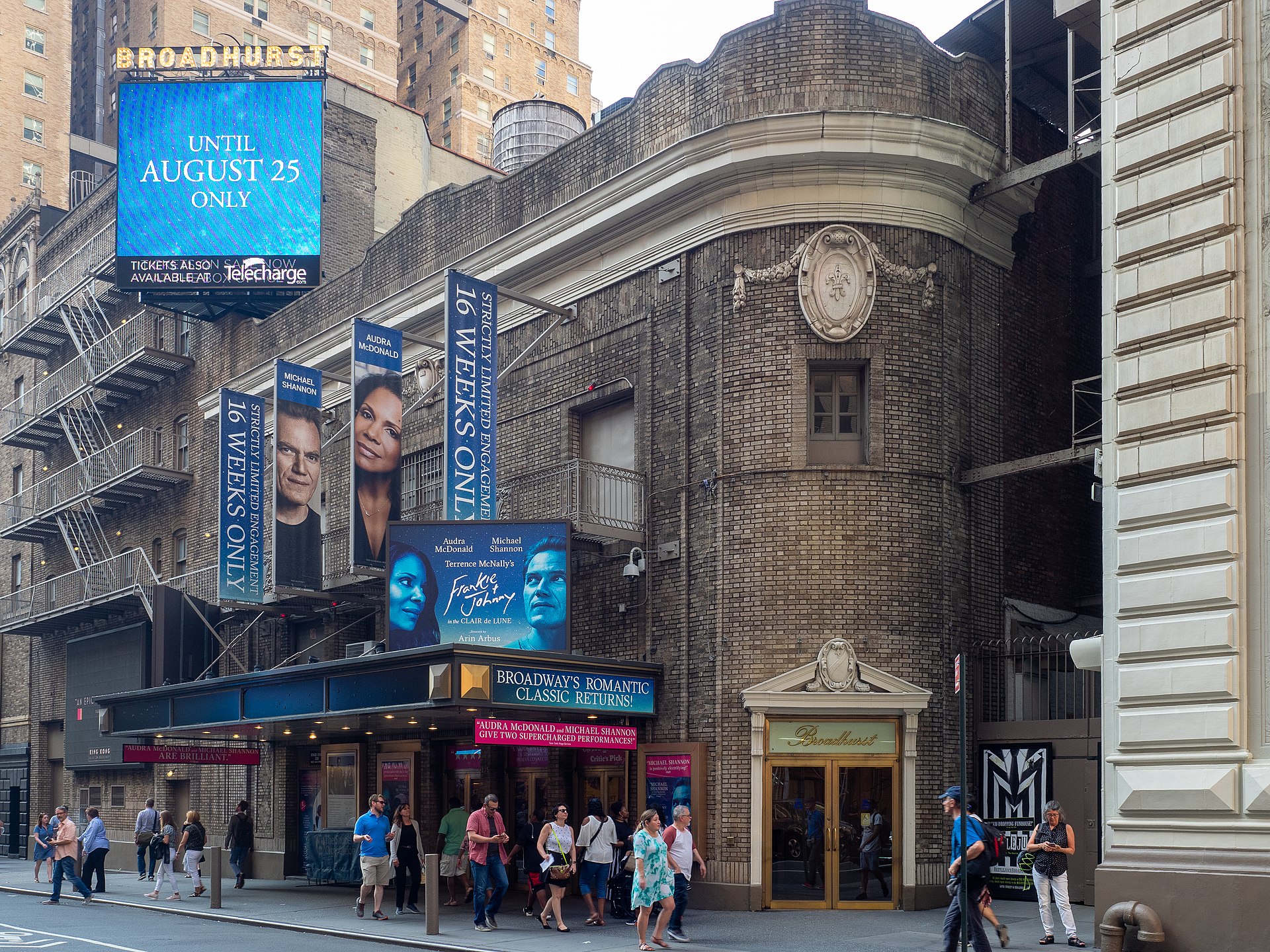
The Broadhurst Theatre is a classic Shubert Broadway house on West 44th Street — 1,218 seats, opened in 1917, and one of the most continuously programmed venues in the district. It sits in the middle of the Theater District’s densest block, between Broadway and Eighth Avenue, with the Shubert Theatre to one side and the Majestic to the other. It is large enough to carry a full Broadway production with ease, but not so large that the room loses its shape. Most visitors know where they are from the moment the house lights go down.
This guide is about the theater itself — what the room is like, how to think about seats, what the accessibility realities are, and how to plan a full night around this part of 44th Street. CATS: The Jellicle Ball closed here on August 8, 2026, and the house reopens for the holidays with It’s a Wonderful Life: A Live Radio Play, Joe Landry’s take on the Capra story staged as a live 1940s radio broadcast, with Andrew Rannells, Megan Hilty, Tituss Burgess, Harry Hamlin and Lisa Rinna. The room, seating and access guidance below applies whatever is booked here.
Broadhurst Theatre Tickets and Box Office
Broadhurst Theatre tickets are sold for whichever production is booked into the house. This season that is It’s a Wonderful Life: A Live Radio Play, which begins previews November 4, 2026, opens November 18 and closes January 3, 2027. Tickets are sold through the production’s official ticket page, the Broadhurst Theatre box office and the production’s authorized ticket seller. The show guide covers dates, cast, runtime and which performances to aim for.
Broadhurst Theatre box office hours and phone
The Broadhurst Theatre box office is at 235 West 44th Street. Ticketing by phone has historically used 212-239-6200, but box-office hours are tied to the production schedule. Window hours for the holiday run had not been posted when this page was updated, so don’t rely on hours from a previous production; confirm the current schedule before making a special trip.
Broadhurst Theatre rush tickets and discounts
Any Broadhurst Theatre rush, lottery or discount program is set by the individual production, not by the theater. None had been announced for It’s a Wonderful Life when this page was updated; check the show’s official ticket page closer to the November 4 first preview for a day-of rush, a digital lottery or other offers, and see the rush and lottery guide for how these programs generally work.
Before you buy Broadhurst Theatre tickets
Confirm the date and performance time, the level and section (Orchestra, Mezzanine or boxes), and the seller’s exchange and refund terms. Compare the all-in price at checkout, since fees and resale markups change the total. For seat choice, the Broadhurst seating guide covers rows and sections, and the when to buy Broadway tickets guide covers timing.
If you land here searching for Broadhurst Theatre NYC tickets, Broadhurst Theatre New York tickets, or the Broadhurst Theatre box office, the show you are buying for this season is It’s a Wonderful Life: A Live Radio Play (November 4, 2026 – January 3, 2027). Use that show’s official ticket page and the Broadhurst box office rather than an old production’s ticket link or hours, and check your performance date against the run before you pay.
Where the Broadhurst Is — and Why the Location Works
The Broadhurst sits at 235 West 44th Street, with its entrance directly on the north sidewalk between Broadway and Eighth Avenue. That address puts it in the heart of the Theater District’s most active corridor — the same block as the Shubert Theatre and within a short walk of virtually every major Broadway house. For visitors staying anywhere in Midtown, this is one of the most straightforward theater locations in the district to navigate.
West 44th Street operates slightly differently from 45th Street for pre-show logistics. The block is dense with theater traffic on performance nights but is also close enough to 9th Avenue and Hell’s Kitchen that a pre-show dinner does not require much advance planning beyond timing. The A/C/E stop at 42nd and 8th Avenue is the most direct subway option; Times Square on the N/Q/R/W and 1/2/3 is a slightly longer walk but still easy. See the guide to getting to a Broadway show for full subway and timing detail.
Broadhurst Theatre NYC Address: 235 West 44th Street, New York, NY
The Broadhurst Theatre address is 235 West 44th Street, New York, NY 10036, between Broadway and Eighth Avenue. Broadhurst Theater Manhattan listings, maps and rideshare apps all point to the same Shubert-owned Broadway house.
Also written as Broadhurst Theatre, 235 West 44th Street, New York, NY 10036.
Broadhurst Theatre, West 44th Street, New York, NY 10036
The entrance is on the north sidewalk of West 44th Street. For transit, the A/C/E at 42nd Street and Eighth Avenue is the most direct subway option, with Times Square–42nd Street a slightly longer walk. The guide to getting to a Broadway show covers subway, rideshare and timing, and parking near Broadway covers garages for drivers.
Broadhurst Theater New York: what is nearby
The Shubert Theatre is on the same block of West 44th Street and the Majestic Theatre is close by, so the Broadhurst sits in the middle of the Theater District’s densest stretch. Hell’s Kitchen dining is a short walk west; see restaurants near Broadway and the pre-show dining guide.
What Kind of Broadway House the Broadhurst Actually Is
At 1,218 seats, the Broadhurst occupies a middle position in the Broadway landscape — larger than the intimate playhouses like the Booth but not in the same category as the truly massive houses like the Gershwin or the Majestic. The distinction matters more than the number suggests. In a theater this size, the room still feels like a room rather than an arena. You are aware of the other audience members; the collective experience of watching something together registers in a way it does not always in the very largest houses.
The interior, designed by Herbert J. Krapp in 1917, uses Doric columns and Greek-style cornices and friezes — a restrained classical vocabulary that gives the room visual weight without overwhelming it. The exterior, built as a near-mirror of the Plymouth Theatre next door (now the Gerald Schoenfeld), uses brick with stone and terracotta trim. It is a handsome building, not a showy one, and the interior reflects the same proportional discipline. The stage is wide and deep enough to carry large-scale productions, which is why the Broadhurst has historically drawn both major musicals and serious plays.
The Broadhurst is not an intimate house, but it is not a barn either. The sightlines are generally strong, the room’s proportions keep the stage feeling present from most seats, and the production history here — spanning major musicals, serious plays, one-person shows, and dance revues — reflects a theater that has never been narrowly defined by one kind of programming.
Seating at the Broadhurst Theatre
The official Shubert seat breakdown is 733 orchestra, 429 mezzanine, 24 boxes, and 32 standing room. In practical terms, that means a large orchestra with significant depth front-to-back and a mezzanine substantial enough to have a real range of quality within it. Seat choice at the Broadhurst rewards some advance thought.
The main floor. Front and center orchestra rows are the premium zone — close to the stage, strong angles, the fullest sound. Mid-orchestra center holds up well. Rear orchestra, particularly toward the sides, can feel distant in a room this deep. Center is consistently stronger than side at any given row.
A full elevated level with real range. Front mezzanine center offers a complete stage picture and can be a smart value pick against mid-to-rear orchestra pricing. Further back in the mezzanine you gain height but lose detail — the production matters here. For a visually large ensemble production, the mezzanine reads well; for an intimate drama it becomes a harder trade.
Side angles with partial stage views. Boxes are a niche choice — proximity comes at the cost of head-on sight lines. Worth considering only if the specific angle appeals or center seats are unavailable at your price point.
Available for sold-out performances at the rear of the orchestra. In a room this size, standing room is a longer distance from the stage than in smaller houses — workable for a visually spectacular production, less so for character-driven drama.
At the Broadhurst’s scale, front mezzanine center rows typically offer the strongest combination of full stage visibility and reasonable pricing. For productions with elaborate staging across the full stage width, this position can edge out mid-orchestra center for sheer visual comprehensiveness.
With 733 orchestra seats, the rear side rows are a meaningful distance from the stage. Shubert notes no obstructed views, but angle and distance still affect the experience significantly. Prioritize center over side and front-to-mid over rear wherever budget allows.
The Broadhurst’s orchestra is deep — 733 seats is a lot of front-to-back distance. A front mezzanine center seat often gives you a better view of the full stage than a rear orchestra center seat at a similar or lower price. If you are choosing between those two options and the show has significant staging across the full stage width, the mezzanine wins. If you are choosing between front orchestra center and front mezzanine center, that comes down to whether you want closeness to the performers or a complete visual frame — both are legitimate preferences, and neither is wrong.
Accessibility and Mobility at the Broadhurst
Orchestra is accessible — no steps to wheelchair seating
There are no steps from the sidewalk into the Broadhurst, and the designated wheelchair seating locations in the orchestra are reached without steps. A wheelchair-accessible unisex restroom is located on the main level. Shubert’s specific wheelchair and companion seat locations in the orchestra include positions in rows J, K, O, P, and Q — contact the box office to confirm current availability before booking.
Mezzanine requires one flight of stairs
The mezzanine is reached via one flight of stairs. Within the mezzanine, there are approximately two steps down per row, with handrails available at the end of every stepped seat row. There are no elevators or escalators at this theater. Visitors who cannot manage stairs should book orchestra-level seats only.
Assistive listening, captioning, and audio description
The Broadhurst provides at least ten infrared assistive listening devices for every performance — a driver’s license or ID is required as a deposit, and advance reservation is available by contacting Shubert Audience Services. Closed captioning and audio description performances are also offered through Shubert Audience Services; contact them directly to confirm scheduled dates for whatever production is running.
Accessibility policies, seating availability, and service schedules can change between productions. If mobility or access is a primary consideration, contact the Shubert box office directly before finalizing your booking. Do not rely solely on general venue descriptions when specific arrangements matter.
A Short, Useful History of the Broadhurst
The Broadhurst opened on September 27, 1917, with George Bernard Shaw’s Misalliance — a fitting debut for a theater that would go on to host serious writing alongside popular entertainment across more than a century. It was built by the Shubert brothers in association with playwright and manager George Broadhurst, who gave the theater its name and served as co-manager in its early years.
The Broadhurst has been a New York City landmark for decades, and it has remained in continuous Shubert hands since it opened — one of the few Broadway houses whose ownership has never changed. That continuity is part of why the building still feels like itself rather than a renovated shell.
Next at the Broadhurst — It’s a Wonderful Life: A Live Radio Play
The Broadhurst’s holiday booking is Joe Landry’s It’s a Wonderful Life: A Live Radio Play, directed by Jerry Zaks, with Andrew Rannells, Megan Hilty, Tituss Burgess, Harry Hamlin and Lisa Rinna. It plays the familiar Bedford Falls story as a live 1940s radio broadcast, with the cast at studio microphones and sound effects made live on stage. It runs from previews on November 4, 2026 through January 3, 2027, with opening night on November 18.
That format changes the seat math a little. A radio play lives on voices, faces and small physical comedy rather than big stage pictures, so this room’s usual advice holds even more strongly: orchestra center from the front to the middle rows, or front mezzanine center, over deep side seats. The Broadhurst seating guide breaks down the sections, and the It’s a Wonderful Life show guide covers tickets, cast, runtime and whether it suits kids.
Most recent show: CATS: The Jellicle Ball
CATS: The Jellicle Ball was a reimagining of Andrew Lloyd Webber’s Cats — based on T.S. Eliot’s poems — reconceived as a ballroom-culture event rather than a conventional stage musical. It was directed by Zhailon Levingston and Bill Rauch, with choreography by Omari Wiles and Arturo Lyons, both New York City Ballroom legends. The production originated Off-Broadway at PAC NYC before transferring to the Broadhurst, where it played previews from March 18, 2026, opened April 7, 2026, and closed August 8, 2026 after 143 regular performances and 21 previews. It went on to win 3 of its 9 Tony nominations, including Best Direction of a Musical and Best Choreography.
For a fuller look at what the production was and who it was for, see the CATS: The Jellicle Ball show guide. For what’s currently running across Broadway, browse the Broadway shows hub, and for a record of other recently closed productions, see the Broadway shows archive.
Plan the Night Around the Broadhurst
West 44th Street is central enough that the usual Broadway planning logistics apply without complication, whatever is running here next. The main things that go wrong on a Broadway night are almost always the same: arriving too close to curtain, underestimating how long dinner takes, or assuming parking will be easier than it is. None of those problems are specific to the Broadhurst, but they are worth planning against.
Dinner timing
Plan to be seated for dinner no later than 90 minutes before curtain — 2 hours is more comfortable if you want to eat without rushing. Hell’s Kitchen, starting a 5-to-8-minute walk west along 46th Street or 9th Avenue, has the strongest cluster of pre-theater restaurants near this part of the district, with better pricing and more neighborhood character than the immediate Times Square blocks. The restaurants near Broadway guide covers options by type, and the pre-show dining guide covers timing and logistics in more detail.
Getting there
The A/C/E trains at 42nd and 8th Avenue are the most direct subway option for the Broadhurst. Times Square on the N/Q/R/W and 1/2/3 lines is slightly further east but still a walkable distance. Most Midtown hotels put you within easy walking range. Rideshare drop-offs on 44th Street work well on non-peak nights; on weekend evenings allow extra time for the Theater District traffic. The getting to a Broadway show guide has full detail, and the parking near Broadway guide covers garage options for drivers.
Arrive with time to settle
The Broadhurst’s lobby is sized for a 1,200-seat house — busy on performance nights, not cavernous. Arriving 20 to 25 minutes before curtain gives you time for will-call pickup, the security check, finding your seats, and ordering a drink if you want one. Latecomers are generally seated at management’s discretion, which can be strict for a high-demand production — worth knowing whatever’s booked here next.
Hotels and the neighborhood
Theater District hotels along 7th Avenue and the Hell’s Kitchen side of 8th put you within easy walking distance of the Broadhurst. The hotels near Broadway guide covers options across price points. For a fuller sense of how to orient yourself in this part of the district, the Theater District neighborhood guide is the right starting point.
Frequently Asked Questions
The Broadhurst Theatre is at 235 West 44th Street in Manhattan, between Broadway and Eighth Avenue in the Theater District. The entrance is directly on West 44th Street. The nearest subway is Times Square–42nd Street (N/Q/R/W, 1/2/3, 7 trains); the A/C/E stop at 42nd and 8th Avenue is also a short walk west.
The Broadhurst has 1,218 total seats: 733 orchestra, 429 mezzanine, 24 boxes, and 32 standing room positions. It is a mid-to-large Broadway house — larger than the intimate playhouses like the Booth, but a different scale from the biggest houses in the district like the Gershwin or the Majestic.
The Broadhurst is not completely wheelchair accessible. The orchestra level is step-free from the sidewalk, and designated wheelchair seating is available in the orchestra without steps. A wheelchair-accessible restroom is on the main level. The mezzanine requires one flight of stairs — there are no elevators or escalators. Visitors with mobility concerns should book orchestra-level seats and confirm arrangements with the Shubert box office before attending.
The Broadhurst’s next production is It’s a Wonderful Life: A Live Radio Play, a holiday engagement that begins previews November 4, 2026, opens November 18 and closes January 3, 2027. The house has been dark since CATS: The Jellicle Ball closed on August 8, 2026.
Front mezzanine center is often one of the better value choices at the Broadhurst specifically because the orchestra is so deep. A front mezzanine seat typically offers a more complete stage picture than a rear orchestra seat at a similar or lower price. Further back in the mezzanine the trade-off becomes less favorable — you gain an aerial view but lose detail and physical connection to the performance. For large-scale ensemble productions specifically, the mezzanine tends to read well throughout.
Prioritize center over side at any given row — with 733 orchestra seats, the far side positions involve a meaningful angle. Rear orchestra center is a more reliable choice than side orchestra mid-rows. If you are choosing between front mezzanine and rear orchestra at a similar price, consider what the production calls for: a visually spectacular show with full-stage staging often favors the mezzanine overview; an intimate drama often favors being in the orchestra and closer to the action.
Broadhurst Theatre tickets are sold for each production booked into the house, through that production’s official ticket page, the theater’s box office at 235 West 44th Street and authorized sellers. The current booking is It’s a Wonderful Life: A Live Radio Play (November 4, 2026 – January 3, 2027), so use that show’s official ticket page.
Broadhurst production ticketing has used 212-239-6200. Box-office operations change with each production, so confirm the current ticketing contact and window hours for It’s a Wonderful Life: A Live Radio Play before your visit.
Broadhurst Theatre box-office hours depend on the production schedule. Hours from previous productions should not be treated as current. Confirm the window schedule for It’s a Wonderful Life: A Live Radio Play before making a special trip.
Rush, lottery and discount programs are set by each production, not by the theater. None had been announced for It’s a Wonderful Life: A Live Radio Play when this page was updated; its official ticket page will list any rush or lottery.
The Broadhurst Theatre address is 235 West 44th Street, New York, NY 10036, between Broadway and Eighth Avenue in the Theater District.
The Broadhurst Theater New York is a short walk from Times Square–42nd Street (N/Q/R/W, 1/2/3, 7), and the A/C/E at 42nd Street and Eighth Avenue is the most direct subway option. The theater entrance is at 235 West 44th Street. Post-show rideshare pickup can be slow on 44th Street, so allow extra time.
The Broadhurst opened in 1917 with George Bernard Shaw’s Misalliance. Past productions include Beggar on Horseback (1924), Victoria Regina with Helen Hayes (1935), Bob Fosse’s Dancin’ (1979) and Fosse (1999), Kiss of the Spider Woman (1993), Amadeus, Hamlet with Jude Law, Equus with Daniel Radcliffe and Al Pacino in The Merchant of Venice. Most recently, CATS: The Jellicle Ball played from March 18 to August 8, 2026, and It’s a Wonderful Life: A Live Radio Play follows from November 4, 2026 to January 3, 2027.
The Broadhurst in Brief
The Broadhurst Theatre is one of Broadway’s most consistently active houses — a mid-large Shubert venue on West 44th Street that has hosted the full range of what Broadway can be across more than a century of continuous programming. Its scale keeps the room legible without being overwhelming, its central location makes the logistics of a full night out genuinely easy, and its production history gives any visit a sense of context that newer or more generic venues cannot match.
Understanding the room before you book leads to better decisions — about seats, about timing, about what to expect when the curtain goes up. The Broadway hub and the Broadway theaters guide are the right next steps for broader planning, and the Theater District neighborhood guide covers the full picture of what surrounds this part of 44th Street.
A Storied Stage — Plan the Night Around It
The Broadhurst sits in the heart of West 44th Street, close to Times Square, Hell’s Kitchen, Restaurant Row, and the Broadway transit grid. Use these guides to connect the theater, the seating chart, dinner, hotels, transit, and the full Theater District night, starting with this season’s holiday booking, It’s a Wonderful Life: A Live Radio Play.
Broadhurst Theatre Seating Chart
Compare orchestra, mezzanine, boxes, standing room, accessibility, and value picks before you book — useful no matter what’s playing.
Open Seating Guide Next Show · From Nov 4It’s a Wonderful Life: A Live Radio Play
Andrew Rannells, Megan Hilty and Tituss Burgess lead a live 1940s radio broadcast of the holiday classic, through January 3. Tickets, cast, runtime and kids guidance.
Open Show GuideBroadway Seating & Ticket Planning
Seats · Timing · DealsBroadway Seating Guide
How orchestra, mezzanine, boxes, side seats, premium zones, and obstructed-view listings compare across Broadway houses.
When to Buy Broadway Tickets
Know when buying early matters, when waiting can work, and how timing changes for hit shows, weekends, holidays, and limited inventory.
Last-Minute Broadway Tickets
TKTS, same-day listings, rush, lottery, and practical ways to compare late options without choosing awkward seats blindly.
Broadway Rush and Lottery Tickets
How discount ticket systems work, what tradeoffs to expect, and why cheap seats can be great — or risky — depending on location.
First-Time Broadway Guide
For visitors choosing their first show or first theater: seats, arrival, timing, dress, and the Theater District basics.
Best Broadway Shows for Date Night
Compare shows by tone, dinner pairing, mood, pacing, and how the whole night feels beyond the ticket itself.
Plan the Broadhurst Theatre Night
Dinner · Hotels · TransitRestaurants Near Broadway
The Broadhurst sits in the West 44th Street core, with Times Square, Restaurant Row, and Hell’s Kitchen within easy pre-show reach.
Pre-Show Dining Guide
Plan reservation timing, walking buffer, arrival, and post-show movement so dinner and theater work together.
Best Pre-Theater Restaurants NYC
Use this when you want stronger restaurant choices around Broadway instead of only timing and logistics advice.
Best Post-Show Restaurants NYC
Where to go after the curtain when you want a drink, dessert, late dinner, or a calmer landing after the show.
How to Get to a Broadway Show
Subway, walking, rideshare, and arrival timing for Theater District shows, including the central West 44th Street houses.
Parking Near Broadway
When driving makes sense, when it does not, and how to avoid turning a Broadway night into a Midtown garage problem.
Nearby Neighborhood & Hotel Guides
44th Street · Times Square · Broadway CoreTheater District
The practical guide to Broadway’s center: theaters, crowds, hotels, restaurants, walking routes, and first-time visitor logistics.
Times Square
Best when convenience, subway access, and being right in the center matter most — especially for short Broadway trips.
Hell’s Kitchen
A strong nearby option when dinner matters — more restaurant depth, calmer blocks, and an easy walk west after the show.
Midtown West
A broader west-side planning base for hotels, transit, restaurants, and nights that stretch beyond the immediate Theater District.
Hotels Near Broadway
Compare Theater District, Times Square, Midtown West, and Hell’s Kitchen hotel zones for a Broadway-centered trip.
Where to Stay for Broadway Weekends
Match hotel zone, walking distance, subway access, and post-show energy to the kind of Broadway weekend you want.
More Broadway Theater Planning
Nearby Houses · Hubs · CompareBroadway Theater Guides
Compare Broadway houses by room size, location, seating feel, history, accessibility, and what each theater is best for.
Majestic Theatre Guide
A nearby West 44th Street landmark with its own seating scale, show context, accessibility notes, and Theater District planning angle.
Shubert Theatre Guide
A neighboring Broadway landmark near Shubert Alley — useful for comparing West 44th Street theater nights and seating decisions.