

Hamilton Broadway Tickets: Theatre, Prices & Show Guide
More than a decade in and still the clearest answer to “which one musical should I see” — here’s what to know before you decide.
Hamilton is a musical about Alexander Hamilton — the immigrant, founder, and first Treasury Secretary whose life story Lin-Manuel Miranda adapted into a score that blends hip-hop, R&B, jazz, and traditional Broadway. It opened at the Richard Rodgers Theatre on August 6, 2015, won eleven Tony Awards including Best Musical, and has been running ever since. The production is now marking ten years on Broadway — not as a nostalgic institution coasting on past momentum, but as a show that still sells out regularly and still lands the way it was designed to.
This guide is for visitors deciding whether Hamilton belongs on their Broadway itinerary in 2026. The question worth asking is not whether you have heard of it — you have — but whether it is the right Broadway night for your specific trip, your group, and what you actually want from the experience. That is what this guide is here to answer.
If you are comparing Hamilton Broadway tickets, this guide also covers current official ticket prices, BroadwayDirect and the Richard Rodgers box office, the $10 Ham4Ham lottery, last-minute ticket availability, the best seats for Hamilton, current cast, and the differences between Broadway, touring, and West End ticket listings.
Why Hamilton Still Stands Out
The reasonable skepticism about a ten-year-old Broadway show is that it might be coasting — running on name recognition and tourist demand rather than on the quality of what happens in the room. That skepticism is worth taking seriously, and it is also, in Hamilton’s case, mostly wrong. The show does not rely on novelty. It relies on a score and a production that work independently of whether you came in already loving it.
What Lin-Manuel Miranda built is genuinely unusual in the Broadway canon: a show that is simultaneously hip-hop album, history lesson, political argument, and family saga, paced at the speed of a thriller and written with a level of lyrical density that rewards repeat listening. The staging by Thomas Kail and choreography by Andy Blankenbuehler were designed to match that energy — it is kinetic, precise, and built for the material rather than imposed on it. None of that has aged out of the production.
Hamilton covers the arc of Alexander Hamilton’s life from his arrival in New York as a young immigrant through the Revolution, the founding of the republic, his years as Treasury Secretary, his complicated rivalry with Aaron Burr, and his death in their duel in 1804. The cast is almost entirely performed by actors of color playing the founding fathers, a deliberate choice that reframes whose story American history is. The show moves fast — two and a half hours that feel shorter than they are.
The more-than-a-decade milestone is worth noting not as a marketing point but as a credibility signal. Broadway audiences are not sentimental — a show that continues to fill the Richard Rodgers Theatre nightly a decade in is doing so because people who see it keep recommending it. That is the most honest review available.
What the Experience Is Actually Like
Hamilton is a fast show. The score is dense, the storytelling is compressed, and the production does not pause to let things breathe in the way that more traditionally structured musicals do. Act one covers roughly thirty years of history in about an hour and fifteen minutes. If you are not used to musicals with this kind of velocity, the first twenty minutes require some adjustment. Most audiences lock in quickly once they do.
The emotional register shifts considerably between acts. Act one is high-energy, clever, and propulsive — it is the part of the show people tend to quote. Act two is heavier, more political, and more personal. The show earns its ending, which lands harder than most Broadway musicals allow themselves to. It is not a sad show in the way that a tragedy is sad — but it does not end on a note of simple triumph, and that is part of why it stays with people.
Yes — with a caveat. The cultural moment of 2015–2016, when Hamilton was genuinely impossible to get into and dominated every conversation, is over. Seeing it now is not that experience. What it is instead is a very good Broadway musical performing at a high level in a room where the audience is present and engaged. If you go in expecting the show rather than the phenomenon, it delivers.
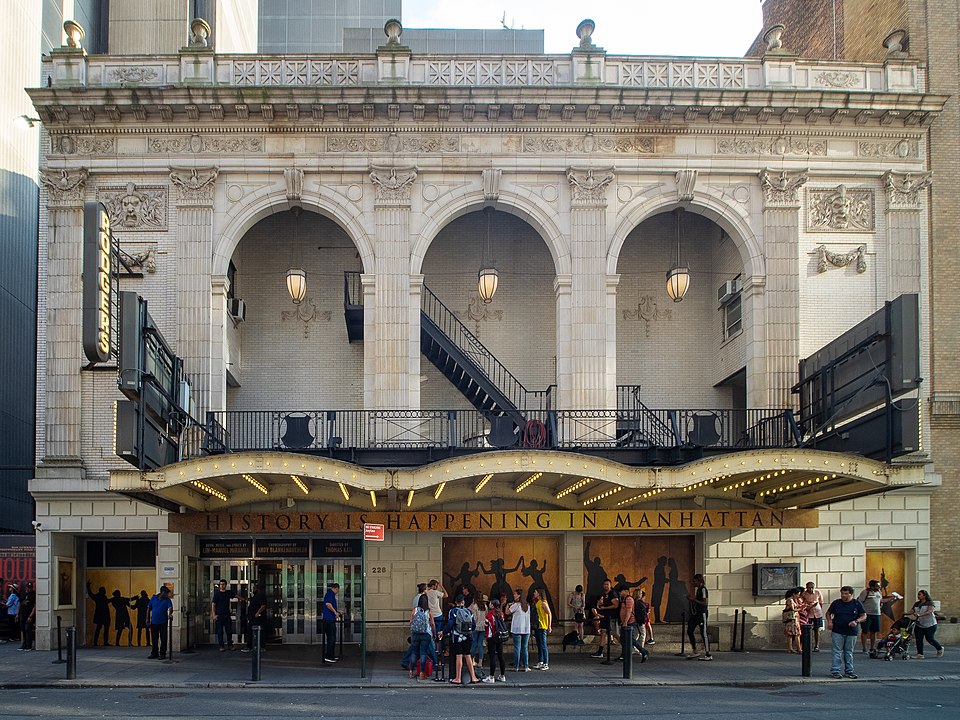
The Richard Rodgers Theatre is a mid-sized Broadway house with good sightlines throughout. The production uses the full stage with considerable movement — the turntable is central to how the choreography works — so proximity helps but most seats give you what you need. The energy in the room on a strong performance night is real, and audiences tend to be attentive rather than passive.
Who Hamilton Is Best For
Hamilton is one of the few Broadway musicals where the honest answer to “is it for me?” is yes for a wider range of visitors than usual — but that does not mean it is the right pick for everyone. The clearest recommendations go in specific directions.
If you are seeing one Broadway musical, Hamilton is the most reliable answer. It is accessible, energetic, emotionally complete, and gives you an immediate sense of what the form can do at a high level.
Recommended for ages 10 and up, and teenagers in particular tend to respond strongly to the score, the pace, and the storytelling. It is one of the more reliable family-plus-teenagers Broadway choices in the current season.
If you are in New York partly for its historical and cultural weight, Hamilton is the show that most directly addresses that interest — without sacrificing entertainment to do it.
If you only see one show and want it to be a cultural landmark — something with proven staying power and a complete emotional arc — Hamilton is still the most defensible single-show choice.
If you have already seen Hamilton, the current season has strong newer titles more worth a second Broadway slot than a repeat visit — If you have already seen it, the current season has strong newer options worth your second show slot, and this fall brings Miranda’s first musical, In the Heights, back for three weeks at City Center (October 28 to November 15).
Children under 5 are not permitted. The show contains some strong language, moves fast, and is not designed for very young audiences. For families with younger children, there are better-matched Broadway options in the current season.
If you are still weighing Hamilton against other options, our first-time visitor guide puts it in context alongside the current season’s other strong choices — it is the right page if you are deciding between two or three titles and want an honest comparison.
The Current Cast and Why the Run Still Matters
Hamilton more than a decade into its Broadway run is not the original cast production — those performers moved on years ago. What the current Broadway cast does is carry a score and a staging that were built to be performed by exceptional theater talent, regardless of who specifically is performing them. The show’s structure is strong enough that it does not depend on any one actor’s star power to hold together.
- Marcus JohnAlexander Hamilton
- Donald Webber, Jr.Aaron Burr
- Lauren MariasoosayEliza Hamilton
- Lencia KebedeAngelica Schuyler
- Christopher JacksonGeorge Washington (through Jan 3, 2027)
- Simon LongnightMarquis de Lafayette / Thomas Jefferson
- Wallace SmithHercules Mulligan / James Madison
- Amina FayePeggy Schuyler / Maria Reynolds
- David GuzmanJohn Laurens / Philip Hamilton
- Noah KiesermanKing George III
Verify current casting on the official site before booking — Broadway principal casts can and do change during long runs, and this list reflects the production as of September 2026.
The Broadway run, now more than a decade long, is genuinely unusual. Very few shows sustain this level of attendance and audience quality across a decade, and Hamilton has done it without the kind of institutional staleness that often sets in after the original cultural moment fades. The show is performing in 2026 because the material holds, not because the name does.
Know Before You Go
Hamilton contains some strong language. The show is recommended for ages 10 and up. Verify the current advisory language on the official site before booking, particularly if attending with younger children.
Nearly three hours with one intermission — plan dinner with that in mind
At 2 hours 45 minutes with a single intermission, Hamilton is one of the longer Broadway shows currently running. Pre-show dinner is the cleaner choice for most visitors — it means you are not rushing out hungry after a late curtain. West 46th Street puts you right in the Theater District, with Hell’s Kitchen a short walk west and a full range of pre-theater options in every direction. See the pre-show dining guide for timing advice and the restaurants near Broadway guide for specific picks near the Richard Rodgers.
The show is dense — first-timers benefit from a loose familiarity with the story
Hamilton moves fast and the lyrics carry a lot of narrative information. You do not need to have studied American history to follow it — the show is designed to be accessible — but visitors who go in with a rough sense of who Hamilton and Burr were tend to track the first act more easily. A ten-minute read beforehand is not required, but it helps.
The Richard Rodgers is a mid-sized Broadway house with strong sightlines
It has 1,319 seats across orchestra, mezzanine, and balcony. The production uses a turntable and full-stage choreography, so proximity to the stage matters more than in a more static production — the orchestra and front mezzanine put you closest to the movement. Balcony seats are a good value option if budget is a factor; the sound is strong throughout the house.
Hamilton Broadway Tickets: Prices, $10 Lottery & Where to Buy
This guide covers Hamilton at the Richard Rodgers Theatre in New York City. The North American tour and London production have separate venues, casts, schedules and ticket inventory, so confirm the venue says Richard Rodgers Theatre before buying Hamilton tickets for Broadway.
Hamilton Broadway tickets remain among the highest-demand tickets in New York. BroadwayDirect is the official online ticket seller for the Broadway production, and tickets are also sold at the Richard Rodgers Theatre box office.
How Much Are Hamilton Tickets on Broadway?
Official BroadwayDirect inventory is currently listed from $110.75 to $289.50, depending on seat location, performance date and availability. Premium inventory and peak dates can cost more, while weekday and matinee performances can offer better value. Prices are dynamic, so check the current calendar before treating any quoted price as fixed.
The official Ham4Ham digital lottery offers $10 tickets for every Broadway performance. Entry opens Friday at 10:00 AM and closes the following Thursday at noon for the next week’s performances. Winners are notified Thursday between noon and 4:00 PM and have two hours to purchase up to two tickets.
Where to Buy Hamilton Broadway Tickets
BroadwayDirect
BroadwayDirect is the official online ticket seller for Hamilton at the Richard Rodgers Theatre. Start there for current primary-market inventory, dates, sections and prices.
Richard Rodgers Theatre Box Office
Hamilton tickets are also sold directly at the Richard Rodgers Theatre box office at 226 West 46th Street. Current posted hours are Monday–Saturday 10:00 AM–8:00 PM, one-show Sundays 11:00 AM–5:00 PM, and two-show Sundays 11:00 AM–7:00 PM.
Last-Minute Hamilton Tickets
The official Hamilton site is currently advertising rolling last-minute ticket availability through November 26. If your date is close and you are flexible, check the box office, the Hamilton app and BroadwayDirect before paying a large resale premium.
Group Tickets
Special group rates are currently available for groups of 10 or more. If you are organizing a school, family or larger group, compare the group option before placing multiple individual orders.
Cheap & Discount Hamilton Tickets
The $10 Ham4Ham lottery is the lowest-cost official option, but winning is not guaranteed. For guaranteed seats, compare several dates and sections on BroadwayDirect, check rolling last-minute availability, and compare the full checkout price before using any secondary marketplace.
Best Seats for Hamilton at the Richard Rodgers Theatre
The best seats for Hamilton depend on whether you want to be close to the performers or see the full turntable choreography. The Richard Rodgers is compact enough that several sections can work well, and the full seating guide goes deeper on row-by-row value and sightlines.
Best if you want facial expressions, performance detail and the strongest sense of being inside the action.
A strong balance of proximity and perspective, especially for seeing the turntable, choreography and full-stage movement.
Often less expensive than premium Orchestra inventory while still keeping the full production in view.
Farther from the performers, but often the lower-cost way to secure a guaranteed seat for a specific performance.
For section-by-section recommendations, rows, value seats and sightlines, see the Richard Rodgers Theatre seating guide.
Plan the Night Around the Richard Rodgers Theatre
The Richard Rodgers Theatre sits on West 46th Street in the heart of the Theater District, surrounded by dining options in every direction and well-connected to every subway line that serves Midtown. It is one of the most centrally located Broadway houses, which makes the logistics of a full night out around it as straightforward as Broadway gets.
Getting there
Times Square is a three-minute walk and connects to the 1, 2, 3, N, Q, R, W, A, C, E, and S lines — essentially the entire system. If you are driving from outside the city, Theater District garages are available but fill quickly on performance nights. Book in advance if you are driving. Our guide to getting to a Broadway show covers subway routing, walk times from different neighborhoods, and the best garage options near this part of 46th Street.
Dinner before the show
With a nearly three-hour runtime, pre-show dinner is the right move for most visitors. The Theater District and Hell’s Kitchen together give you one of the densest concentrations of pre-theater dining in the city — from quick and casual to full sit-down, across every price point. Restaurants in this neighborhood are practiced at theater-crowd timing and 6:30pm reservations. See the restaurants near Broadway guide for specific picks and the pre-show dining guide for advice on timing and reservations.
After the show
A late drink or dessert after Hamilton is a natural way to close the evening — the show generates conversation, and the Theater District has plenty of options that stay open well past 11pm. If you are visiting from out of town and want to stay close, our hotels near Broadway guide covers the best-positioned options near the Richard Rodgers. For a full orientation to the neighborhood and how it connects to the rest of Midtown, the Theater District neighborhood guide is the right starting point.
Frequently Asked Questions
Hamilton tells the life story of Alexander Hamilton — orphan, immigrant, Revolutionary War soldier, aide to George Washington, author of the Federalist Papers, first Secretary of the Treasury, and, ultimately, the man who died in a duel with Aaron Burr in 1804. Lin-Manuel Miranda adapted Ron Chernow’s biography into a score that blends hip-hop, R&B, jazz, and traditional Broadway. The show covers roughly thirty years of American history across two acts, told almost entirely through song, with a cast of color playing the founding fathers.
Yes — with realistic expectations. The cultural phenomenon of 2015–2016 is not what you are buying a ticket to in 2026. What you are buying is a well-constructed, high-energy Broadway musical with a genuinely exceptional score, performed at a high level in a room that is still full of engaged audiences. For most visitors, that is more than enough. The show has been running for more than a decade because it works, not because of residual hype.
Yes — it is one of the strongest choices for a first Broadway musical. It is accessible without being simple, high-energy without being exhausting, and emotionally complete in a way that gives you a full sense of what Broadway can do. If you are comparing it to other current options, the first-time visitor guide puts it in context alongside the rest of the season.
The current principal cast includes Marcus John as Alexander Hamilton, Donald Webber Jr. as Aaron Burr, Lauren Mariasoosay as Eliza Hamilton, Lencia Kebede as Angelica Schuyler, Christopher Jackson as George Washington, Simon Longnight as Lafayette and Jefferson, Wallace Smith as Mulligan and Madison, Amina Faye as Peggy Schuyler and Maria Reynolds, David Guzman as Laurens and Philip Hamilton, and Noah Kieserman as King George III.
Hamilton runs approximately 2 hours and 45 minutes, including one intermission.
The show is recommended for ages 10 and up and contains some strong language. The official FAQ says children age 5 and above are permitted with their own ticket. Verify the current age policy before booking.
Hamilton is playing at the Richard Rodgers Theatre, 226 West 46th Street in Manhattan, in the Theater District.
Yes. The Ham4Ham digital lottery offers $10 tickets for every Broadway performance. Entry opens Friday at 10:00 AM and closes the following Thursday at noon for the next week’s performances. Winners are notified Thursday and have two hours to purchase up to two tickets.
No — they are separate productions with their own casts, venues, schedules and ticket inventory. This page covers the Broadway production at the Richard Rodgers Theatre in New York. Confirm the venue before buying if Broadway is specifically what you want.
BroadwayDirect currently lists official Hamilton tickets from $110.75 to $289.50, depending on performance date, seat location and availability. Prices can change as inventory changes. The $10 Ham4Ham lottery is the lowest-cost official option.
BroadwayDirect is the official online ticket seller for Hamilton at the Richard Rodgers Theatre. Tickets are also available directly from the Richard Rodgers box office.
The Bottom Line on Hamilton
More than a decade into its Broadway run, Hamilton is still the most complete answer to the question most visitors are actually asking: which one musical gives me the full Broadway experience — energy, storytelling, cultural weight, and something I will still be thinking about the next morning? No other show currently running combines those things as reliably.
It is not the right choice for every visitor. If you have already seen it, the current season has strong newer options worth your second show slot. If you are bringing very young children, there are better-matched productions. But for a first-time visitor, a one-show Broadway trip, or anyone who wants a proven institution performing at a high level — Hamilton in 2026 still makes the case for itself.
For help planning the rest of the evening, the pre-show dining guide and the Theater District neighborhood guide are the right places to start.