

Richard Rodgers Theatre: Tickets, Box Office & Hamilton Guide
How to buy Richard Rodgers Theatre tickets for Hamilton, use the West 46th Street box office, understand accessibility and plan the night around Broadway’s “house of hits.”
The Richard Rodgers Theatre at 226 West 46th Street, New York, NY 10036 holds a record no other Broadway house can claim: more Tony Award-winning Best Plays and Best Musicals than any theater in Broadway history — eleven, spanning seven decades. The Tony organization calls it “the house of hits,” and the phrase is earned. It has been home to Guys and Dolls, Damn Yankees, How to Succeed in Business Without Really Trying, Fences, In the Heights, and since 2015, Hamilton. The building itself is a New York City landmark, designed by Herbert J. Krapp in the neo-Renaissance style and opened in 1924.
This guide covers Richard Rodgers Theatre tickets and box-office details, what the venue is like as a room, how to think about seating across its three levels — including the stadium-style rear orchestra that most visitors don’t know about until they arrive — what accessibility actually means here, where it sits in the district and how to build a complete evening around a visit. The current production is Hamilton. For full show information, see the Hamilton Broadway show guide; for row-by-row buying advice, use the Richard Rodgers Theatre seating guide.
Buying Hamilton Tickets at the Richard Rodgers Theatre
Broadway Direct is the official online ticket seller for Hamilton at the Richard Rodgers Theatre. Primary tickets are also sold in person at the theater box office at 226 West 46th Street. Current official inventory is listed through June 13, 2027; that is an on-sale window, not an announced closing date.
Broadway’s Most Decorated House
The Richard Rodgers sits in the densest stretch of the Theater District — West 46th Street between Eighth Avenue and Broadway — surrounded by the Music Box, the Imperial, and several other houses that together make this block one of the highest concentrations of working Broadway theaters anywhere. It is a mid-sized house by Broadway standards, with an official capacity of 1,319 seats, and it has the feel of a serious working theater rather than a tourist destination: the lobby is elegant without being showy, the house is warm and well-proportioned, and the neo-Renaissance exterior — all white brick and terra cotta, with a loggia of arched windows above the marquee — has a civic weight that distinguishes it from the more commercial-feeling facades nearby.
What separates the Richard Rodgers from other houses of comparable size is its track record. No other Broadway theater has housed as many Tony-winning productions, and that history is not just trivia — it reflects a theater that has consistently attracted the kind of production that defines what Broadway is in any given era. From mid-century American musicals to the show that reshaped what Broadway could be in the 21st century, the Richard Rodgers has been where those productions landed.
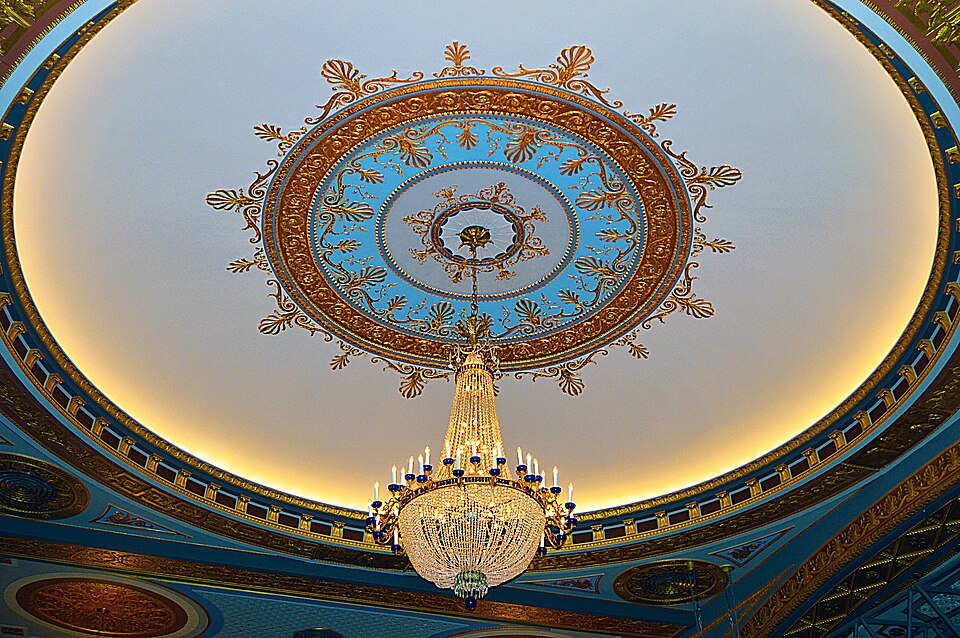
The Richard Rodgers works well for productions that use the full stage without requiring the sheer scale of the largest Broadway houses. Its neo-Renaissance interior is warm and well-maintained; the 2006 refurbishment preserved the historic character while modernizing the building, and the Richard Rodgers Gallery — a collection of memorabilia honoring the theater’s namesake composer — gives the building a curatorial quality that most Broadway venues don’t have. For any visitor who cares about the history of the art form as well as the production they are seeing, this is one of the more satisfying rooms to spend an evening in.
Seating Guide — The Stadium Seating Advantage
The Richard Rodgers has three seating levels: orchestra, front mezzanine, and rear mezzanine. The defining feature of this theater’s seating — and the thing most visitors don’t know until they sit down — is the stadium-style rake that begins at orchestra row L. From row L onward, the seats step upward steeply, so the rear half of the orchestra is elevated significantly above the front. The effect is that sightlines in the rear orchestra are often better than the price suggests: you are looking down onto the stage rather than craning behind taller heads, and you can see the full stage picture clearly. For the complete Richard Rodgers Theatre seating chart analysis, section tradeoffs and “view from my seat” guidance, use the dedicated Richard Rodgers Theatre seating guide.
The rear orchestra of the Richard Rodgers is set so high that the theater’s lobby sits underneath it. From row L to the back, the steep rake creates unobstructed sightlines for most seats — an unusual advantage in a Broadway house where front-of-orchestra tickets are typically assumed to be the only good value. The tradeoff: the mezzanine overhang begins around row M and becomes more prominent further back, which can limit sightlines to anything happening above the proscenium. Know this before you book rear orchestra for Hamilton, which uses vertical staging and elevated platforms as part of its production design.
Step-free access from the lobby. The front center orchestra is the closest and most immersive position in the house. Rows B–H are widely considered the strongest in the theater — direct sightlines, performer proximity, full stage width visible. The most expensive seats in the house; center rows CC and D are the premium zone. Worth it for Hamilton if the budget allows.
Where the stadium seating kicks in. From row L, the sharp elevation means you see over the heads of everyone in front of you without effort. Strong value relative to front orchestra pricing. The mezzanine overhang becomes a factor around rows M–S, limiting visibility above the proscenium. For a production where the stage-level action is what matters most, mid-rear orchestra is a reliable and underpriced section.
Elevated full-stage view. One flight of stairs from the orchestra — no elevator access. For productions with complex staging across the full stage width, the front mezzanine offers a perspective that orchestra seats don’t provide. For Hamilton, seeing the full revolving stage picture from a slight elevation is a different and sometimes richer experience. The front rows of the mezzanine are the strongest; legroom tightens toward the rear.
The most affordable section in the house. Further from the stage and higher up, with legroom that can be notably tight. For Hamilton, the show reads reasonably well at this distance because the production was designed to fill this room. Reviewers consistently flag the legroom — a real consideration for taller visitors or a longer show. No elevator access.
The far side orchestra seats lose sightlines to the opposite stage edge as the angle becomes more acute. Inside aisle seats on left and right are considerably stronger than the outer extremes. Row CC on the far sides can have the lip of the stage cut off action further back. Center and center-adjacent remain the strongest positions throughout the orchestra.
The boxes sit very close to the stage but at a sharp angle — intimate but with significant sightline compromise to the opposite side of the stage. For Hamilton’s multi-platform staging, this is a meaningful limitation. Not recommended unless you have a specific reason for the position.
The stadium seating changes the calculus here compared with most Broadway houses. At a standard theater, rear orchestra is a budget-compromise seat. At the Richard Rodgers, rear orchestra from row L onward gives you genuine sightline quality because the elevation prevents anyone blocking your view. The price premium for front orchestra is still worth it if you want performer proximity and the fully immersive experience — but if budget is a factor, mid-rear orchestra center is more competitive here than at most houses.
The mezzanine overhang is the main watchout: from around row M in the orchestra through the back of the section, you lose the top of the stage picture. For Hamilton, which uses elevated platforms and vertical staging as part of its design vocabulary, this is worth knowing. If seeing the complete vertical staging matters to you, front orchestra or front mezzanine are the right sections.
Accessibility at the Richard Rodgers Theatre
The Richard Rodgers has a clear and specific accessibility picture. The step-free zone is well-defined; the upper levels require stairs with no elevator alternative; and the accessible restroom is on the ground floor. Current official guidance identifies orchestra rows A through K as the only seats accessible without steps. The stadium seating section beginning at row L involves steps between rows even though it is still technically the orchestra level.
Step-free access — orchestra rows A through K only
Orchestra rows A through K are the only seats currently identified by the theater as accessible without steps. From row L onward — where the stadium rake begins — steps are required to reach individual rows. The entrance to the theater from the street has no stairs. The wheelchair-accessible restroom is on the ground floor in the main lobby.
Wheelchair and companion seating
Wheelchair seating is available in the orchestra section. Up to three companion seats may be purchased per wheelchair order when available. Current official listings identify no-step aisle-transfer positions at A1, A2, A101, C113, E1, E2, E23, E24, F101 and F113; L1, L2, M1 and M2 require stairs. Accessible seating can be purchased online pending availability; call (212) 221-1211 for direct assistance and verify the exact seat configuration before buying.
Mezzanine levels — stairs only, no elevator
There are no elevators or escalators at the Richard Rodgers Theatre. The front mezzanine and rear mezzanine are both reached by stairs from the orchestra and lobby. Neither mezzanine level offers designated wheelchair seating or transfer seats. Visitors who cannot use stairs should book within orchestra rows A–K and confirm the exact seat with the official seller or box office.
Accessible restroom
A wheelchair-accessible unisex restroom is located in the main lobby on the ground floor. Current venue information places the theater’s other restrooms on the ground floor as well. Ask an usher for the closest option and plan restroom use around intermission if mobility is a consideration.
Assistive listening and hearing support
Infrared headsets for sound augmentation are available free of charge after completing a short contact-information form; the theater states that the information is deleted when the device is returned. A copper induction loop (T-Coil compatible), I-Caption closed captioning, audio description and GalaPro are also available. Low-vision and hearing-access seating is listed at B1–B7 and B2–B8. Contact the box office in advance if these services are required.
Accessibility details and seating availability change over time. Verify current provisions directly with the Richard Rodgers Theatre at (212) 221-1211 or through the official Nederlander accessibility page before finalizing plans where accessibility is a primary consideration.
Where the Richard Rodgers Is — Location and Arrival
The Richard Rodgers sits on West 46th Street between Eighth Avenue and Broadway — a block that is as deep into the working Theater District as you can get. This is not Times Square tourist territory; it is the part of the district where the theaters crowd close together and the pre-show energy on the street is specifically Broadway rather than general Midtown. The location has practical advantages that are worth knowing before you plan your evening.
The most useful location fact for planning: Restaurant Row is literally one block west. The stretch of West 46th Street between Eighth and Ninth Avenues has one of the highest concentrations of pre-theater restaurants in the district — multiple cuisines, multiple price points, all accustomed to theater-crowd timing. You can walk from dinner to the Richard Rodgers in two minutes. This is a genuinely useful geographic alignment that the neighboring theater cluster doesn’t always have. For full subway routing and timing, the guide to getting to a Broadway show covers the details. Parking options near this part of the district are in the parking near Broadway guide; several garages are within one block of the theater.
A Century of Hits — The Theater’s History
The Richard Rodgers opened on December 24, 1924 as Chanin’s 46th Street Theatre — the first Broadway theater built by developer Irwin Chanin, who would go on to build five more. It was designed by Herbert J. Krapp, the most prolific Broadway architect of the era, in the neo-Renaissance style, and it was notable from the start for one specific innovation: it was the first Broadway theater to use “democratic seating,” in which all patrons — orchestra and balcony — used the same entrance. The exterior and auditorium interior are both designated New York City landmarks.
The naming for Richard Rodgers matters in context. Rodgers composed music for more than 40 Broadway productions across his career — with Lorenz Hart through the 1930s and 1940s, and then with Oscar Hammerstein II from 1943 through Hammerstein’s death in 1960. The Hammerstein partnership alone produced Oklahoma!, Carousel, South Pacific, The King and I, and The Sound of Music. Rodgers was not just a significant Broadway figure — he was arguably the dominant figure in American musical theater for three decades. Naming the theater’s record-holding house for him is a match between the right building and the right name.
Current Production — Hamilton
Hamilton has been the resident production at the Richard Rodgers since August 2015 — over a decade as of 2026. It was created by Lin-Manuel Miranda, directed by Thomas Kail, with choreography by Andy Blankenbuehler. The show tells the story of Alexander Hamilton and the founding generation through hip-hop, R&B, and a diverse cast, and won eleven Tony Awards from sixteen nominations in 2016 including Best Musical, Best Score, Best Direction, Best Choreography, and Best Actor.
The production was designed for this room. The revolving stage, the multi-level platform staging, and the choreography that fills the full width and depth of the Richard Rodgers are all calibrated to this specific theater — which is part of why it has stayed here rather than moving, as long-running shows often do. Visiting the Richard Rodgers for Hamilton is not just seeing a show; it is seeing a production in the room it was built for, performed in a theater that carries its own history into the experience.
Plan a Hamilton Performance
Official tickets are currently on sale through June 13, 2027. That date is the present sales window, not an announced closing date. The approximate runtime is 2 hours 45 minutes including intermission; the show is recommended for ages 10 and older, and children under 5 are not admitted.
Full Hamilton Show GuideFor full show information — runtime, content, age guidance, the $10 Ham4Ham digital lottery, ticket strategy, and whether Hamilton is right for your group or a first Broadway visit — see the Hamilton Broadway show guide. For broader first-time planning, the best Broadway shows for first-time visitors puts Hamilton in context alongside the rest of the current season. If you want both of Miranda’s Tony winners on one trip, his first, In the Heights, plays City Center on West 55th Street from October 28 to November 15, a 10-minute walk north of this theater.
Plan the Night Around the Richard Rodgers Theatre
The 46th Street location is one of the better-situated theater addresses in the district for a complete evening — directly between Restaurant Row and the Theater District’s core cluster, with strong subway access and a calmer sidewalk environment than the 42nd Street houses.
Dinner before the show — Restaurant Row is steps away
West 46th Street between Eighth and Ninth Avenues — one block west of the theater — is Restaurant Row, a stretch of pre-theater restaurants that has served Broadway audiences for decades. The variety is genuine: Italian, Japanese, American, steakhouse, and more, all running the theater-timing playbook fluently. You can finish dinner and walk to the Richard Rodgers in two minutes. It is rare to have this kind of dining proximity without navigating multiple blocks of Midtown. The restaurants near Broadway guide covers specific picks in this part of the district, and the pre-show dining guide covers the timing and logistics of dinner before a roughly 2-hour-45-minute show like Hamilton.
Getting there
The 1 train to 50th Street is the most direct connection — walk south on Broadway to 46th Street and turn west. The N, R, or W to 49th Street is a similar distance. From Times Square, the walk north on Broadway or Eighth Avenue takes about ten minutes. For full routing options from different parts of the city, the guide to getting to a Broadway show covers the specifics. Several parking garages are located within one block of the theater; the parking near Broadway guide covers options near this part of the district.
The Richard Rodgers Gallery — arrive early
The 2006 refurbishment installed the Richard Rodgers Gallery in the theater’s public spaces — a curated collection of photographs, playbills, and memorabilia from the composer’s career and the theater’s history. It is small but genuinely worth seeing, and the pre-show period when the lobby is open is the only time it is accessible. If you are the kind of theatergoer who appreciates the history of the room you are sitting in, arrive 25–30 minutes before curtain rather than the minimum 15.
Hotels for out-of-town visitors
The Theater District and Times Square area have the broadest concentration of Broadway-adjacent hotels in the city, with options at every price point within walking distance of the Richard Rodgers. The hotels near Broadway guide covers the best-positioned options for this part of the district. For a full orientation to the neighborhood — what the surrounding blocks feel like, what is nearby — the Theater District neighborhood guide is the right starting point.
Practical Information Before You Arrive
Theater policies can change between productions. Confirm current information with the Richard Rodgers Theatre box office at (212) 221-1211 before your visit.
Frequently Asked Questions
Broadway Direct is the official online seller for Hamilton at the Richard Rodgers Theatre. Primary tickets are also available at the box office at 226 West 46th Street. For official lottery information, current performance planning and audience guidance, see the Hamilton Broadway show guide.
Standard hours are Monday through Saturday from 10am to 8pm. On Sunday, the box office is open 11am–5pm on one-show days and 11am–7pm on two-show days. Holiday and performance schedules can change these hours, so confirm before making a dedicated trip.
The Richard Rodgers Theatre is at 226 West 46th Street in Manhattan, on the south side of 46th Street between Eighth Avenue and Broadway in the Theater District. The nearest subway is the 1 train to 50th Street — walk south on Broadway to 46th Street and turn west. The N, R, and W trains at 49th Street are also within a few blocks.
Hamilton is the current resident production at the Richard Rodgers Theatre and has been since 2015. Official tickets are currently on sale through June 13, 2027; this is a sales window, not an announced closing date. For full show details — cast, approximate 2-hour-45-minute runtime, age guidance and the $10 Ham4Ham digital lottery — see the Hamilton Broadway show guide.
For most visitors, center orchestra rows B–H are the strongest seats in the house — direct sightlines, performer proximity and the full stage picture. From row L onward, stadium-style seating gives the rear orchestra better-than-expected sightlines for the price. The main caveat is the mezzanine overhang, which becomes more significant farther back. Front mezzanine center is a reliable alternative for a complete elevated view. Avoid extreme side orchestra and box seats when an unobstructed full-stage view is the priority. Compare the sections in detail in the Richard Rodgers Theatre seating guide.
Starting at orchestra row L, the Richard Rodgers uses a stadium-style rake — the rows step upward steeply, so the rear half of the orchestra is significantly elevated above the front. The effect is that rear orchestra seats have unusually clear sightlines because each row looks over the heads of the row in front rather than through them. The rear of the orchestra is elevated high enough that the theater’s lobby actually sits underneath it. The tradeoff is the mezzanine overhang, which begins around row M and limits sightlines to anything above the proscenium from the rear section.
Partially, with clear limits. Orchestra rows A through K are the only seats currently identified as accessible without steps. Wheelchair seating and aisle-transfer seats are available in the orchestra, but exact access varies by position. From row L onward, steps are required. There are no elevators or escalators, so the mezzanine levels require stairs and do not offer wheelchair seating. The accessible restroom is in the main lobby. Assistive-listening devices, a T-Coil loop, captioning and audio-description options are available. Contact the box office at (212) 221-1211 and verify the exact seat before booking.
The Richard Rodgers Theatre has housed eleven Tony Award-winning Best Plays and Best Musicals — more than any other Broadway theater. In order: Guys and Dolls (1951), Damn Yankees (1956), Redhead (1959), How to Succeed in Business Without Really Trying (1962), 1776 (1969), Raisin (1974), Nine (1982), Fences (1987), Lost in Yonkers (1991), In the Heights (2008), and Hamilton (2016). The Tony organization calls it “the house of hits.”
The theater opened in 1924 as Chanin’s 46th Street Theatre and was known simply as the 46th Street Theatre for most of its history. In 1990, the Nederlander Organization renamed it in honor of Richard Rodgers, the composer whose partnership with lyricist Lorenz Hart and then Oscar Hammerstein II produced some of the most significant work in Broadway history — Oklahoma!, South Pacific, Carousel, The Sound of Music, and dozens of others over four decades. The renaming was led by producer Alexander H. Cohen.
Yes — it is one of the stronger theaters for a first visit, particularly if you are seeing Hamilton. The room is well-proportioned and warm, the sightlines are strong from most of the orchestra and front mezzanine, the stadium seating in the rear orchestra means even mid-priced tickets have a clear view, and the building’s history gives the experience a sense of occasion that matters on a first visit. For broader guidance on choosing the right show and theater for a first Broadway night, see the first-time visitor guide.
The Richard Rodgers in Brief
The Richard Rodgers Theatre is the most Tony-decorated Broadway house in history — eleven winning productions across seven decades, a landmark neo-Renaissance building at 226 West 46th Street, and the home of Hamilton since 2015. Its stadium seating makes the rear orchestra a better value proposition than at most comparable houses; its position one block from Restaurant Row makes pre-show dining unusually convenient; and the Richard Rodgers Gallery makes it worth arriving early.
The practical summary: for the best sightlines, center orchestra rows B–H or front mezzanine center. For value, consider mid-rear orchestra center from row L where the stadium rake begins. For step-free access, stay within orchestra rows A–K and confirm the exact position before buying. For tickets, start with Broadway Direct or the West 46th Street box office. For everything else — dinner, subway, hotels and building the rest of the night — the guides below are the right next steps.
The Richard Rodgers Is Set — Now Pick the Hamilton View
The Richard Rodgers is Hamilton’s Broadway home and one of the most important theater rooms on West 46th Street. Use the dedicated seating guide to handle Center Orchestra, stadium-style rear Orchestra, Mezzanine, overhang, and access questions, then build the rest of the night around Restaurant Row, Hell’s Kitchen, Times Square, hotels, transit, and parking.
Richard Rodgers Seating Chart & Best Seats
Compare Center Orchestra, Front Mezzanine, stadium-style rear Orchestra, Rear Mezzanine, overhang warnings, step-free rows, and best Hamilton views.
Open Seating Guide Current ShowHamilton Broadway Guide
Plan around turntable staging, ensemble movement, multi-level action, lyric detail, show timing, and the best Richard Rodgers sections.
Open Show GuideBroadway Seating & Ticket Strategy
Seats · Timing · ValueBroadway Seating Guide
Compare Orchestra, Mezzanine, Balcony, boxes, side seats, premium zones, and view tradeoffs across Broadway houses.
All Broadway Theater Guides
Browse every Broadway house guide and compare room scale, location, access notes, and seating strategy across the Theater District.
What’s Playing on Broadway
Compare current and upcoming Broadway productions, then connect each show to the right theater, seat choice, and night plan.
When to Buy Broadway Tickets
Know when buying early matters, when waiting can work, and how timing changes for Hamilton, premium seats, and center sections.
Last-Minute Broadway Tickets
Compare same-day options without accidentally grabbing extreme sides, overhang-heavy rear seats, or stair-heavy sections.
Broadway Rush and Lottery Tickets
How discount systems work, what seat tradeoffs to expect, and why cheap seats can be great — or risky — depending on view.
Plan the Richard Rodgers Theatre Night
Dinner · Hotels · TransitRestaurants Near Broadway
Use the broader Broadway dining guide when you want a pre-show meal that still leaves enough buffer for 46th Street arrival.
Restaurants Near Times Square
Useful for Hamilton nights when your group wants to stay close to Times Square, Broadway, and post-show transit.
Pre-Show Dining Guide
Plan reservation timing, walking buffer, arrival, intermission expectations, and post-show movement around a 46th Street show.
Hotels Near Broadway
Compare Theater District, Times Square, Midtown West, and Hell’s Kitchen hotel zones for a Hamilton-centered trip.
Hotels Near Times Square
Best for visitors who want short walks, easy subway access, and simple post-show return logistics after Hamilton.
How to Get to a Broadway Show
Subway, walking, rideshare, and arrival timing for Theater District shows, including the Richard Rodgers on West 46th Street.
Subway to Broadway
Pick the right subway approach for West 46th Street, Times Square, Restaurant Row, and post-show exits.
Parking Near Broadway
When driving makes sense, when it does not, and how to avoid turning a Hamilton night into a Midtown garage problem.
Best Way Home After a Show
Subway, taxi, rideshare, walking, and hotel return strategy after a crowded 46th Street performance.
Nearby Neighborhood & Theater Guides
46th Street · Restaurant Row · Nearby HousesTheater District
The practical guide to Broadway’s center: theaters, crowds, hotels, restaurants, walking routes, and first-time visitor logistics.
Hell’s Kitchen
A strong pre- and post-show dining base west of the Richard Rodgers, especially if you want less Times Square noise.
Times Square
Useful for hotels, transit, crowd planning, visitor logistics, and the classic Broadway arrival flow.
Music Box Theatre Guide
A nearby 45th Street theater useful for comparing smaller Broadway room feel, sightlines, and date-night planning.
Imperial Theatre Guide
A nearby classic musical house useful for comparing Broadway scale, orchestra/mezzanine strategy, and west-side arrival.
Lunt-Fontanne Theatre Guide
A 46th Street neighbor useful for comparing musical-house seating, access, Restaurant Row timing, and Broadway night flow.