

Madison Square Garden Concert Tickets: Concerts, Box Office & MSG Venue Guide
A concert-first guide to Madison Square Garden tickets, upcoming MSG concerts, the concert schedule, box office, seating overview, transit and full-night planning.
Madison Square Garden sits above Penn Station at 7th Avenue and 33rd Street in Midtown Manhattan — and the building’s location is inseparable from what makes it distinctive as a concert venue. The transit access is unmatched by any comparable arena in the country. The history embedded in the room is real and cumulative. And when the right artist is in front of a capacity crowd, the collective energy of 20,000 people in a compact Manhattan building is something that does not exist anywhere else in the region.
None of that means MSG is automatically the best venue for every concert. The arena format rewards large-scale production and high-volume crowd energy — it does not always reward intimacy, acoustic precision, or the kind of polished evening that flows naturally from dinner to show to walkback. And within MSG itself, seat choice changes the experience dramatically: a center lower bowl seat is categorically different from a rear corner upper deck, and the stage configuration for a given show changes which sections are best and which become compromised. Whether you’re comparing MSG concert tickets across sections or just trying to understand what you’re buying, seat choice is where most of the decision-making actually happens.
This guide covers Madison Square Garden tickets, upcoming MSG concerts and events, the concert schedule, box office basics, same-day ticket strategy, venue feel, and the practical logistics that shape a night at The Garden. For section-by-section seat maps, best-seat advice, Chase Bridge details, seat views and seats to avoid, use the dedicated Madison Square Garden seating guide.
Find Madison Square Garden Tickets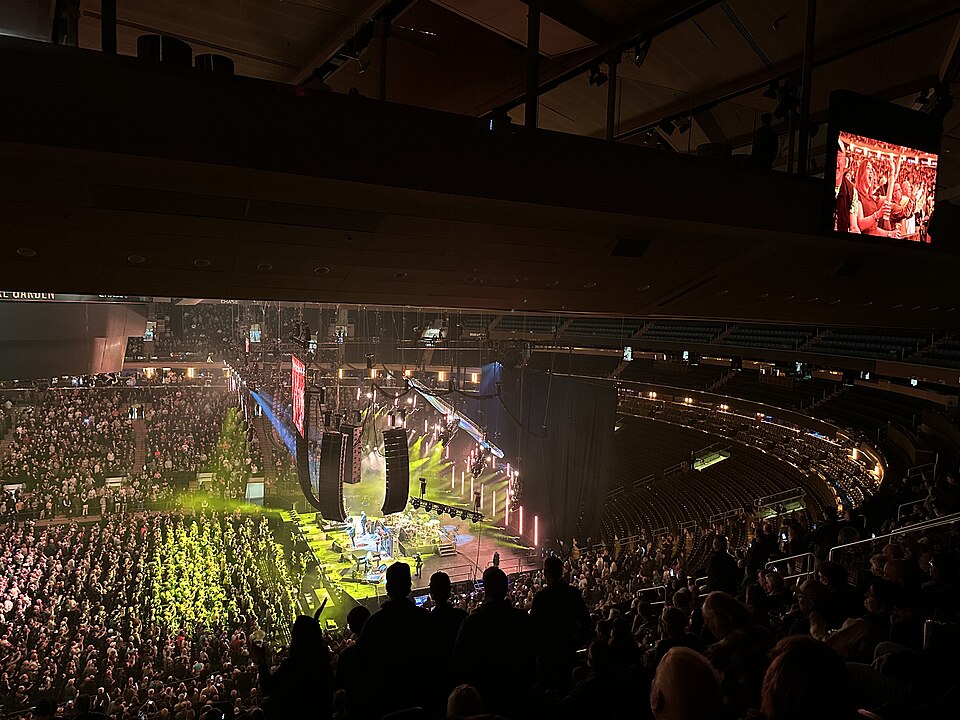
A live concert inside Madison Square Garden, capturing the scale, crowd energy, and full-arena feel that define one of New York City’s biggest music nights.
Madison Square Garden Concerts, Upcoming Shows & Concert Schedule
Madison Square Garden upcoming events change constantly because the arena hosts concerts, New York Knicks games, New York Rangers games, comedy, sports and family events throughout the year. For concertgoers, the most useful workflow is to start with the live MSG event calendar, confirm the exact artist/date, and then compare official ticket availability for that specific event rather than relying on a static list that can go stale.
The official Madison Square Garden calendar is the current source for upcoming events, concert dates, doors and event-specific policies. New shows, added dates and production changes can alter availability quickly, so use the live listing for the date you plan to attend.
Harry Styles — Together, Together: the 30-show MSG residency continues through October 31, closing with Harryween shows on October 30 and 31.
Dave Matthews Band: the 2026 Fall Tour closes with two nights at The Garden on Thursday, November 12 and Friday, November 13, both listed at 7:30 PM. DMB setlists change nightly, so the two dates are different shows rather than repeats.
Karan Aujla — P-Pop Culture World Tour: one night only at The Garden on Wednesday, November 18, listed at 8:00 PM with doors at 7:00 PM, with Ikky as special guest. It is the only New York date on the tour. The guide covers Karan Aujla MSG tickets and prices, the official VIP packages, the setlist so far and the best seats.
Stevie Wonder — Songs in the Key of Life 50th Anniversary Tour: one night only at The Garden on Thursday, November 19, listed at 8:00 PM with doors at 7:00 PM. The 1976 album is performed in its entirety, and MSG opens the U.S. leg of the tour. The guide covers Stevie Wonder MSG tickets, the setlist, runtime and best seats.
sombr — You Are the Reason Tour: two nights at The Garden on Monday, November 23 and Tuesday, November 24, both listed at 7:00 PM, with Dove Cameron and Hannah Jadagu also on the bill. The guide compares both nights, the recent tour setlist and how to buy sombr MSG tickets.
Doja Cat — Tour Ma Vie World Tour: the final night of the world tour at The Garden on Tuesday, December 1, listed at 7:30 PM with doors at 6:30 PM, with Latto as special guest. The guide covers Doja Cat MSG tickets, the tour setlist so far, VIP packages and best seats.
Z100’s Jingle Ball 2026: New York’s stop on the iHeartRadio Jingle Ball Tour, at The Garden on Friday, December 11 at 7:00 PM. The NYC lineup is sombr, Alex Warren, Charlie Puth, Hilary Duff, Teddy Swims, Sienna Spiro, TOMORROW X TOGETHER & YEONJUN, Stella Lefty and Freya Skye, with special guests Bella Kay and The Beaches. The guide covers Jingle Ball NYC tickets, prices, the best MSG seats for a 12-act show and how long the night runs.
Ryan Castro — Los Chorros Con Richy Tour: his first headline show at The Garden on Saturday, December 12, listed at 8:30 PM with doors at 7:30 PM, built around his December alter ego, Richy. The original on-sale sold out in about 24 hours, so the guide covers how to buy Ryan Castro MSG tickets after the sellout, resale safety, prices, the best seats and a Spanish-language buying section.
Andrea Bocelli — Romanza 30th Anniversary World Tour: two December nights at The Garden on Wednesday, December 16 and Thursday, December 17, both listed at 8:00 PM. The guide compares the two dates and covers Andrea Bocelli MSG tickets, the tour setlist so far, concert length, what to wear and the best seats for an orchestral arena show.
Phish — New Year’s Run 2026–27: four nights at The Garden from Wednesday, December 30 through Saturday, January 2, with New Year’s Eve on December 31 and the band’s 100th MSG show on January 2. Phish lists 7:30 PM shows with 6:30 PM doors for December 30 and 31, and the general on-sale is Friday, October 16 at noon ET. The guide covers Phish MSG tickets, how the four nights differ, the NYE gag, setlists and the best seats.
Def Leppard & Goo Goo Dolls, with The Struts: the only NYC date of the 2027 tour, at The Garden on Wednesday, June 23, 2027, listed at 7:00 PM with doors at 6:00 PM. General on-sale is Friday, October 16. The guide covers Def Leppard MSG tickets, prices and VIP, the setlist to expect, the best seats for a three-band night and the Newark alternative on March 13.
For every other major date, see upcoming NYC concerts or the past shows archive.
Madison Square Garden Concert Schedule & Calendar
The MSG concert schedule runs alongside sports and other arena events, which is why concert dates are best checked event by event. If you are searching for the Madison Square Garden schedule, MSG calendar, concert dates or upcoming concerts, use the venue calendar first, then the individual event page for showtime, doors, mobile-ticket instructions and any event-specific entry rules.
What MSG Is Actually Like for Concerts
Madison Square Garden is a round, vertically stacked arena — which means it is louder, more compact, and more intensely communal than a wider stadium. At capacity for a major concert, the sound and crowd energy reverberate in a way that creates a specific physical sensation: you feel the show as much as hear it. This is not a selling point for everyone. For those who want it, it is exactly what they are coming for.
The building opened in 1968 and underwent a major renovation completed in 2013–14 — which brought new seating, the Chase Bridge suspended walkways over the arena floor, a new scoreboard, and updated concourses. The renovation removed most of the genuinely obstructed seats that plagued the older configuration. What remains is a dense, functional arena that works best at the scales it was designed for: arena-touring production concerts with real staging, lighting, and energy that fills the room.
When the artist is right for the room — a pop or rock tour at full production, a show with a crowd that knows every word — MSG can be one of the best live-music experiences available in New York. When the artist is not suited to the scale — a show that works better in an intimate theater, a performance where acoustic clarity matters over atmosphere — the room can feel indifferent to the music playing in it.
When MSG Is the Right Choice — and When It Isn’t
MSG is the right venue when
The show is a major touring act with a production built for arena scale. MSG rewards large staging, significant light and video rigs, and artists whose live shows are designed to fill 20,000 people simultaneously. This is where the venue performs at its best: the compression of the round arena means the spectacle surrounds you rather than happening at a distance in front of you. A pop or rock tour at full production is the format MSG was built for.
The easy transit access matters. No other major concert venue in the New York area — including Barclays, MetLife, or any stadium — has the transit convenience of MSG sitting above Penn Station. For visitors arriving by train from Long Island, New Jersey, or anywhere along the Northeast Corridor, the arena is literally where you exit the train. For city residents, the 1/2/3 and A/C/E subway lines put you at the door.
You want a specifically Manhattan arena energy. MSG has a crowd character that comes from the density of the building, the history of the room, and the Manhattan location. A sold-out MSG show for an artist with a devoted audience creates a collective feeling that is real and specific — different from a comparable Barclays show or a stadium night at MetLife.
MSG may not be the right choice when
The performance is better suited to a smaller or more acoustically considered room. Some artists play MSG because they can sell it out — not because it is the best room for their music. A singer-songwriter, a jazz act, a performer for whom lyric clarity and intimate connection matter more than spectacle will often sound better at the Beacon or Radio City. The building does not do much to help artists who do not need arena-scale production.
You want an elegant, contained evening. MSG is a functional, effective arena. It is not an architecturally beautiful room. The corridors are dense on event nights, the immediate neighborhood around Penn Station is more transit infrastructure than dining destination, and the post-show exit from a capacity show requires patience. Visitors who want the full evening experience — beautiful room, easy dinner before, comfortable walkback — are often better served by the Beacon on the Upper West Side or Radio City in Midtown. See the first-timers concert guide for a fuller comparison.
The production does not match the room. An MSG show where the artist clearly belongs in a 3,000-seat theater is a show where 17,000 of the 20,000 people are farther from the stage than is ideal. The scale of the building only works in your favor when the artist and the production are designed to inhabit it.
MSG Seating Overview for Concert Ticket Buyers
MSG’s seating for concerts is organized around the floor and three bowl levels, plus the Chase Bridges suspended above the 100-level. Stage configuration changes the answer significantly — an end-stage show (most common) has very different best sections than an in-the-round or center-stage configuration. Always look at the show-specific seating chart on the ticket platform before buying.
MSG concert layouts change by artist and tour, so the event-specific seat map matters more than a generic arena diagram. Floor, lower-bowl, 200-level, Chase Bridge and upper-level seats can all work, but their value changes sharply with end-stage, thrust and in-the-round setups.
This main venue guide keeps the seating discussion focused on the ticket-buying decision. For the full Madison Square Garden seating chart, seat-number guidance, detailed section views, floor-vs.-bowl comparisons, Chase Bridge analysis and seats to avoid, use the dedicated MSG seating guide.
MSG uses multiple stage configurations depending on the artist and tour. For in-the-round shows, sections behind the stage for an end-stage configuration become excellent — and sections 1, 2, 3 (rear floor behind the soundboard) become closer to the action. For end-stage shows, those same rear sections are furthest from the stage. Check the event-specific seating chart, not the general venue chart, before purchasing.
Floor seats — when they are worth it and when they are not
The floor at MSG for concerts is divided into sections A, B, C (front floor closest to stage), D, E, F (middle floor), and sections 1, 2, 3 (rear floor near the soundboard) — this layout is what people mean by the msg floor plan or madison square garden floor plan. Floor B is generally the most sought-after — it is center floor, directly in front of the stage. Floor A is slightly stage-left and Floor C slightly stage-right from the audience perspective.
Madison square garden floor seats and msg floor seats — sometimes searched as msg floor seating — are worth it when you want physical proximity to the performance, you are comfortable standing for the full show (floor is typically GA or standing for major tours), and the artist’s show rewards being close rather than seeing the full production from a distance. They are less ideal when the stage is elevated enough that you are looking up at a steep angle from close range, when the production is primarily visual spectacle that reads better from a distance, or when you specifically want a seated experience.
The rear floor sections (1, 2, 3) near the soundboard are the most commonly misunderstood floor tickets. Technically “floor” — which implies proximity and premium — these sections are actually behind the soundboard and among the furthest floor positions from the stage. For many major tours, a center 100-level seat in rows 1–5 of section 109 or 115 will deliver a better experience than a floor section 3 ticket.
100-level (lower bowl)
The 100-level is generally the most consistent seating tier for concerts at MSG. You are close enough to the stage to see performer detail without needing a screen, the sound mix is better than the floor in most configurations, and you are seated — which matters for shows that run 2.5 hours.
Center-side sections 109 and 115 are consistently rated the best 100-level concert sections. They sit at the midpoint of the arena — not directly facing the stage (which would be sections 101–103 and 111–113 at the ends) and not in the deep corners (104, 110, 114, 120). Sections 105–108 and 116–119 are strong side sections with good angles to the stage for end-stage shows. Sections behind the stage in the 100-level (110–114) are viable only for in-the-round configurations.
200-level (mid-bowl)
The 200-level at MSG has a key issue that most buyers don’t know about until they are in the seat: the Chase Bridges — suspended above the back of the 100-level — obstruct the sightline for higher rows in mid-200-level sections. Approximately rows 15 and above in center 200-level sections can have the Chase Bridges crossing their view of the scoreboard and upper stage elements. This does not block the stage entirely, but it reduces the full visual experience. Front rows of the 200-level (rows 1–10) are typically clean.
Best center 200-level sections for concerts: 209–213 (stage-facing on one side) and 222–226 (stage-facing on the other). Front rows of these sections, before the Chase Bridge obstruction zone kicks in, offer a strong elevated angle of the full stage picture — better than floor for visually complex productions.
Chase Bridges (Sections 310–316, 324–328)
The Chase Bridges are MSG’s most distinctive seating feature — suspended walkway sections above the back of the 100-level, closer to center ice/floor than the back of the 200-level despite their elevation. Each section has 2–3 rows, wider padded seats, glass partitions between rows, and bar-stool-height seats (labeled BS) at the top. The view is genuinely birds-eye: you are looking directly down on the floor and stage from a position that feels more intimate than the altitude suggests.
This tier goes by several names depending on how you search for it — msg chase bridge seats, msg chase bridge seating chart, msg chase bridge bar stool seats, msg bridge seats, and chase bridge view msg all describe the same suspended section above the 100-level. If you’re asking what is the chase bridge at msg, what is chase bridges at msg, or what section is the chase bridge at msg, this is it: sections 310–316 and 324–328. And if the question is are chase bridge seats at msg good, the honest answer is yes for high-production shows where seeing the full stage from above enhances the experience, and less ideal for stripped-down shows where being close to the performer is what matters most.
For concerts, the Chase Bridges are a real option for people who want a distinctive vantage point and comfortable seating without paying lower-bowl prices. The scoreboard view is noted as partially obstructed by glass. Best for high-production shows where seeing the full stage from above enhances the experience — less ideal for stripped-down shows where being close to the performer is what matters.
300-level and 400-level (upper sections)
Best concert sections in the 300-level: 314 and 325 (center-facing). The 300-level upper bowl is far from the stage and best suited to shows where the overall spectacle reads at distance — a major pop tour with significant production, lighting, and video elements. The distance is real; use the zoom on your phone at the venue to judge whether you are comfortable with it.
The 400-level “Blue Seats” (Eighteen76 Balcony) are the farthest from the stage and priced accordingly. They offer clear views in the center sections after the renovation removed most obstructions. Sections 317–321 are behind the stage and should be avoided for end-stage shows. The “420” section is a novelty section with a low ceiling — past rows 2–3, the ceiling creates visual constraints. Best 300/400-level center sections: 314, 325.
For section-by-section detail on every level, see the full Madison Square Garden Seating Guide.
Consistently rated the strongest 100-level concert sections. Center angle, strong sightlines, seated, and closer than most floor rear sections. The benchmark for a great MSG concert seat.
Elevated angle of the full stage picture. Excellent for visually complex productions. Stay in front rows to avoid Chase Bridge obstruction in the upper rows.
Closest physical proximity to the stage. Floor B (center) is the most desirable. Best for GA shows where you want to be in the crowd. Less useful when the production reads better from elevation.
Suspended above the 100-level, birds-eye view, wider padded seats, glass partitions. Closer to center than upper 200s. Partial scoreboard obstruction. A genuine alternative to the upper bowl.
Far from the stage but clean sightlines after the renovation. Best for shows with large-scale production that reads at distance. Front rows of these sections offer the best upper-level view.
These sections are directly behind the stage for standard end-stage configurations. Only viable for in-the-round or center-stage shows where the artist performs toward all sections. Check configuration before buying.
How Stage Configuration Changes MSG Concert Seats
End-stage pop / rock arena tour (most common configuration)
The standard MSG setup: stage at one end, floor extending toward the center, bowl seating surrounding. Best value: front 100-level side-center (109, 115) or front 200-level center (rows 1–10 of 210–212, 223–225). Floor sections A, B, C for proximity. Avoid rear floor sections 1–3 and behind-stage 100/200-level sections. The center 200-level front rows often offer a better overall view of the production than the floor at comparable or lower prices.
In-the-round / center-stage configuration
When the artist performs in the center of the arena (stage in the middle of the floor), the seating equation changes completely. Behind-stage sections become center-facing sections. Floor is divided and surrounds the stage rather than extending from it. For in-the-round shows, all 100-level and 200-level sections within 90 degrees of center-stage are strong. The Chase Bridges become excellent — they offer a direct overhead view of the full in-the-round production. Rear floor sections 1–3 become among the closest floor positions to the stage.
Heavily produced spectacle shows
For tours where the production itself is part of the experience — elaborate lighting rigs, multiple stage areas, large-scale video content — a slightly elevated position typically delivers more of the show than floor-level proximity. Front 200-level center sections (rows 1–8) often produce a better overall view of spectacle productions than floor sections because you see the full canvas rather than being inside one part of it. This is the clearest case for choosing an elevated seat over floor.
Stripped-down or vocal-forward shows
For artists whose show is fundamentally about voice and performer connection rather than production — a more intimate tour playing MSG because they can fill it — proximity matters more than elevation. Front 100-level center sections and floor A, B, C are the right choice. The large room works against subtlety; being as close as possible narrows the gap between what MSG is and what the performance needs.
At MSG, “closest” is not automatically “best.” For most heavily produced tours, a front 200-level center seat delivers the full picture — stage, lighting, video, crowd — that a floor seat does not. Floor is for shows where physical proximity to the artist is the primary value. The 200-level front rows are for shows where seeing everything simultaneously is the primary value. Know which one you want before you buy.
Madison Square Garden Tickets & MSG Box Office
For most concerts, the official MSG event page routes buyers to Ticketmaster for online ticketing, while the Madison Square Garden box office at 4 Penn Plaza sells tickets in person for eligible events. Start with the official event listing for the date you want, then compare available sections and the final checkout total before buying. For sold-out events, verified resale may also appear through Ticketmaster, while third-party marketplaces use market pricing that can move above or below face value.
Madison Square Garden Concert Schedule & Tour Dates
The Madison Square Garden concert schedule changes throughout the year as tours add dates and the arena calendar fills around sports and other events. Use the official MSG calendar for the current schedule, then open the event-specific page to confirm date, doors, showtime and ticket availability. If you are comparing multiple MSG concerts, working from the live event calendar is more reliable than searching artist by artist or relying on an old static schedule.
Madison Square Garden Box Office: Tickets & Hours
Yes. The Madison Square Garden box office is at 4 Penn Plaza and sells tickets in person for many events. Current standard hours are Monday through Saturday, 10:00 AM to 6:00 PM. On event days the box office remains open until one hour after the event begins, and on Sundays it opens at noon and remains open until one hour after show time. Event-specific availability can vary, so the box office should be treated as an official purchase channel and same-day help point—not as a guaranteed source of hidden discount inventory.
Event days: open until one hour after the event begins. Sundays: noon until one hour after show time. Check the official MSG FAQ before a special trip because venue policies and event requirements can change.
Are tickets cheaper at the MSG box office?
Do not assume the MSG box office will be cheaper than the official online listing. Pricing and fee treatment can vary by event and transaction. The useful comparison is the final checkout total for the exact seat you want. Buying in person can be convenient if you are already at the arena, but the box office is not advertised as a separate bargain-ticket inventory.
Buy MSG Tickets NowDoes Ticketmaster release tickets last minute?
Additional ticket inventory can appear closer to an event as holds are adjusted or tickets are returned, but there is no guaranteed release schedule. If a concert is sold out, checking the official listing again a few days before the show and on the event date can be worthwhile. Treat any late inventory as event-specific rather than something you can count on.
StubHub, SeatGeek, and Vivid Seats all list MSG tickets and are legitimate, guarantee-backed platforms — but prices there reflect market demand, not face value, and can run well above or occasionally below what Ticketmaster’s own resale marketplace shows for the same section. Comparing Ticketmaster’s official resale against third-party listings before buying is worth the extra two minutes, especially on high-demand shows.
What First-Timers Should Know Before a Concert at MSG
Arriving via Penn Station changes everything
For visitors arriving by LIRR, NJ Transit, or Amtrak, getting to MSG is unusually simple because Penn Station sits directly below the arena. Subway riders can use the 1/2/3 or A/C/E at 34th St–Penn Station. Moynihan Train Hall across 8th Avenue is useful for Amtrak and LIRR passengers; NJ Transit riders use Penn Station. Check the entrance shown on your digital ticket before the event so you approach the building from the right side.
Arrive early — the building itself is part of the experience
Plan to arrive early enough for security, entrance routing and the walk to your section. For a major sold-out concert, roughly 45–60 minutes before showtime is a practical target, but event-specific guidance can differ. MSG currently tells guests to check the entrance shown on their ticket and to have mobile tickets ready before arrival.
Your ticket designates an entrance — use it
MSG has multiple entrances around the building, and your ticket typically specifies which entrance to use based on your section. Entering through the wrong side of the building wastes time navigating through concourses. Check your ticket in advance, identify the entrance, and arrive from the direction that gets you there directly.
The post-show exit requires a plan
Exiting MSG after a sold-out concert — 20,000 people, Penn Station below, Midtown traffic gridlocked around the building — requires patience and a plan. Options: stay in your section for 20–30 minutes after the last song, let the initial wave pass, then move to the exits and subway. Or, use the window during the encore to start moving toward your section exit. Rideshare is generally expensive and slow immediately post-show (surge pricing activates immediately, pickup zones are backed up). The subway is almost always faster. See the transit guide for full post-show subway strategy.
No bag check, no coat check
MSG does not offer bag check or coat check services. Bags must fit under your seat (maximum 22″ × 14″ × 9″). Oversized bags will be turned away — and with no onsite storage, that means leaving them at an off-site storage service or returning to your car. Plan your bag before you arrive. In winter, a packable insulated jacket that fits inside your bag is the right solution for the coat problem. See the what to wear guide for venue-specific bag and clothing logistics.
Travel light and check your event’s entry options
Current MSG guidance emphasizes traveling light, having your digital ticket ready and using the entrance suggested on your ticket. Some event pages also promote expedited CLEAR entry at designated Chase entrances. Entry options can vary by event, so check the current event page rather than relying on an older no-bag or app-express policy.
Madison Square Garden Concert Tonight: Last-Minute MSG Tickets
If you are checking what is at Madison Square Garden tonight, start with the official MSG calendar to confirm the event, then open that event’s ticket page for real-time availability. Same-day tickets can still appear for some concerts, but inventory, price and section choice are unpredictable. The event-specific listing is more useful than a general web search because it reflects the actual date, start time and current purchase options.
For last-minute MSG tickets, compare the official listing first and only then check reputable resale marketplaces if needed. Waiting until the day of the show can occasionally uncover newly available seats, but it can just as easily leave you with fewer sections and higher market prices. If seat choice matters, buying earlier is the safer strategy.
The Full Night — Neighborhood, Dinner, and Getting Back
Be realistic about the Penn Station area
The blocks immediately surrounding MSG and Penn Station — 34th Street, 7th and 8th Avenues between 30th and 36th — are dense, transit-busy, and not the most inviting pre-show dinner environment. The restaurants that exist on the immediate block benefit from captive event traffic more than culinary ambition. This is not a reason to skip dinner; it is a reason to plan dinner slightly away from the arena rather than defaulting to whatever is closest to the entrance.
Hell’s Kitchen — the right pre-show dinner zone
Hell’s Kitchen — the neighborhood extending west from 8th Avenue roughly between 34th and 55th Streets — has the strongest restaurant density of any area near MSG. Walk 5–10 minutes west and north from the arena and the dining options improve substantially: real neighborhood restaurants with real kitchens rather than event-night tourist traps. For a pre-show dinner that contributes to the evening rather than merely fueling it, Hell’s Kitchen is where to look. Koreatown on 32nd Street (between Broadway and 6th Avenue) is a closer alternative — lively, genuine, and accessible for groups without reservations on most nights. See the restaurants near NYC concert venues guide for specific areas and recommendations.
Hotels and overnight stays near MSG
For visitors making a trip to New York around an MSG concert, the Penn Station hotel cluster offers the most transit-convenient stays: The New Yorker by Lotte Hotels directly across 8th Avenue, the Renaissance New York Midtown two blocks north, the Fairfield Inn & Suites Midtown Manhattan/Penn Station across from Moynihan Train Hall. These hotels remove the post-show transit variable entirely — you walk from the arena to the hotel rather than competing for subway space or rideshare at 11 PM. See the hotels near NYC concert venues guide for full options.
Parking near MSG
MSG does not operate a dedicated event garage. Current MSG event pages link visitors to an official parking partner for nearby commercial garages and lots. Event-night rates vary substantially by location and demand, so reserving before the show is usually more predictable than driving in and searching block by block. If you are coming from Manhattan or arriving by commuter rail, transit is generally the simpler option. For the full strategy, see the parking near NYC concert venues guide.
MSG vs Other NYC Concert Venues
MSG for Manhattan access and arena energy; Barclays for a Brooklyn evening. Both are major arenas with strong transit. MSG wins on transit convenience (Penn Station below), historical weight, and Manhattan location. Barclays wins on neighborhood character — Fort Greene and Boerum Hill restaurants make a Barclays concert night a genuinely better dinner-and-show experience than the Penn Station block. Barclays capacity (~18,000) is slightly smaller, producing a marginally more contained crowd energy. Choose by which borough and which evening experience you want.
MSG for arena scale; Radio City for a polished Midtown theater experience. Radio City (~6,000 seats) is seated, architecturally beautiful, acoustically better, and a more contained evening. For an artist who belongs in a theater, Radio City is clearly the better experience. For an artist who needs arena scale to deliver what they do, there is no substitute for MSG. The choice usually makes itself based on the artist and production size.
MSG for scale; Beacon for everything else if scale doesn’t matter. The Beacon Theatre (~2,800 seats) on the Upper West Side is a different venue category from MSG — more intimate, more beautiful, neighborhood-embedded, and consistently one of the best mid-size concert experiences in New York. For artists who play both, the Beacon shows are almost always more interesting. MSG is the right choice when the artist is genuinely an arena-scale act; otherwise, the Beacon consistently produces a better evening.
MSG for contained arena intensity; MetLife for the artists who specifically play stadiums. MetLife Stadium in New Jersey has roughly 3–4x the capacity of MSG (~82,500). Stadium shows are a different physical and logistical experience than arena shows — more walking, longer transit (NJ Transit from Penn Station, ~35–40 minutes), and a less intimate crowd energy. When an artist plays both arenas and stadiums on the same tour, the arena show (MSG) typically delivers a better concentrated experience. Stadium shows are for artists whose production specifically requires that scale.
Completely different categories. MSG and a Brooklyn Steel or Music Hall of Williamsburg show are not competing options — they are different kinds of nights. Club shows for smaller artists deliver proximity, scene energy, and a physical closeness to the performance that an arena cannot approximate. MSG delivers scale, production, and crowd collectivity that a 1,500-person club cannot. Choose based on what the night is supposed to feel like.
Common MSG Concert Mistakes
Buying floor without understanding what floor means for that show
Floor at MSG is not universally “the best seats.” For end-stage shows with rear floor sections 1, 2, 3 near the soundboard, floor is among the furthest-from-stage seating in the building. For GA standing shows, floor is a physical endurance commitment for two-plus hours. For shows with elevated stages, front floor means looking steeply upward at close range. Know the configuration and know what floor actually means for that specific show before paying a floor premium.
Not checking the stage configuration before purchasing
MSG’s behind-stage sections (100-level: 110–114; 200-level: 214–221; 300-level: 317–321) are worthless for standard end-stage shows and excellent for in-the-round shows. Buying a behind-stage 100-level ticket for an end-stage concert because it says “100-level” is one of the most expensive mistakes a first-time MSG buyer makes. Check the show-specific chart, not the generic venue layout.
Ignoring the Chase Bridge obstruction in upper 200-level rows
The Chase Bridges crossing above the back of the 100-level obstruct the full sightline for approximately rows 15+ in the center 200-level sections. The stage itself remains visible, but the scoreboard and upper production elements are partially blocked. Front 200-level rows (1–10) are clean. If you are buying 200-level center seats and care about the full visual experience, verify which rows clear the bridge obstruction before finalizing.
Underestimating post-show exit time
Exiting MSG after a sold-out concert with 20,000 people, Penn Station below, and Midtown gridlocked is a 20–40 minute process if you leave with the main crowd. Riders who stay for 20 minutes after the last song typically find the exits and subway platform significantly cleaner. Factor this into hotel, transit, and late-night plans. Planning to be at a restaurant at 11:15 PM after an MSG show that ends at 11:00 is an optimistic plan.
Treating the Penn Station area as a natural dinner destination
The Penn Station block has restaurants. None of them are the reason to be there. A 10-minute walk west to Hell’s Kitchen delivers materially better dining options that contribute to the evening rather than merely occupying time before the show. Plan the dinner in the neighborhood, not on the block.
Arriving without a bag plan and getting turned away
MSG enforces the 22″ × 14″ × 9″ bag limit, and there is no onsite bag check. Arriving with an oversized bag means being turned away from entry with no option to store it at the venue. For a first-time visitor arriving from a hotel with carry-on luggage planning to “drop it somewhere” — there is nowhere onsite to drop it. Use an off-site luggage storage service before heading to the venue.
Assuming “lower level” automatically means “good seats”
Lower-level corner sections (104, 110, 114, 120) at the side extremes of the arena can have significantly angled views of an end-stage configuration. A center 200-level ticket in rows 1–5 of section 212 will often deliver a better overall experience than a corner 100-level seat in section 104 or 120. Level number is a rough proxy for price; it is not a reliable proxy for quality of experience.
Expecting the box office to have cheaper prices than Ticketmaster
The MSG box office is an official purchase channel, not a guaranteed discount channel. Pricing and fees can vary by event, so compare the final total for the exact seat you want instead of assuming the window will automatically undercut the online listing.
Frequently Asked Questions
Madison Square Garden hosts concerts, Knicks games, Rangers games, comedy, sports and family events throughout the year. Use the official MSG calendar for the current upcoming-event list, then open the specific event page to confirm date, doors, showtime and ticket availability.
Yes — for the right kind of concert. MSG is best for major touring acts with arena-scale production: large staging, significant lighting and video rigs, and artists whose live shows are built to fill 20,000 people. When the production matches the room, MSG delivers one of the best arena concert experiences available in New York. When the artist belongs in a smaller venue — a theater, a club — MSG’s scale works against the performance rather than with it. The venue is consistently excellent for its category; the question is whether the specific show belongs in that category.
Start with the official Madison Square Garden event page for your concert, which routes buyers to the official online ticketing flow, and use the MSG box office at 4 Penn Plaza for eligible in-person purchases. For sold-out events, verified resale may also appear through Ticketmaster; third-party resale platforms use market pricing, so compare carefully before buying.
Yes. The MSG box office at 4 Penn Plaza sells tickets in person for many events. Standard hours are Monday through Saturday, 10 AM to 6 PM; on event days it remains open until one hour after the event begins, and on Sundays it opens at noon and stays open until one hour after show time. Check the official MSG FAQ before making a special trip.
Current standard box-office hours are Monday through Saturday from 10 AM to 6 PM. On event days the box office remains open until one hour after the event begins. On Sundays it opens at noon and stays open until one hour after show time. Check the official MSG FAQ before a special trip because venue policies can change.
Additional official inventory can appear closer to an event as holds are adjusted or tickets are returned, but there is no guaranteed release schedule. For a sold-out concert, it can be worth checking the official listing again a few days before the show and on the event date.
For end-stage concerts (the most common configuration), the strongest value seats are center-side 100-level sections 109 and 115 — close enough for real performer detail, angled well to the stage, seated. Front rows (1–10) of center 200-level sections (209–213, 222–226) are excellent for visually complex productions where seeing the full stage picture matters. Floor sections A and B are the best floor seats when standing and proximity are what you want. Always verify the stage configuration for the specific show before purchasing — behind-stage sections change value dramatically between end-stage and in-the-round configurations.
Depends on the show and where on the floor. Front floor sections (A, B, C) are worth it when you want physical proximity to the artist and are comfortable standing for the full show. Floor section B (center) is the most desirable floor position. Rear floor sections (1, 2, 3 near the soundboard) are frequently overpriced for what they deliver — these are among the furthest floor positions from the stage, and center 100-level seats often provide a better experience at lower or comparable prices. For productions that are primarily visual spectacle, a slightly elevated center seat often delivers more of the show than floor-level does.
It depends on the show and which upper sections. The Chase Bridges (sections 310–316, 324–328) are suspended above the 100-level and closer to center than the standard upper bowl — these are a legitimate option for a unique perspective at moderate prices. Center 300-level sections (314, 325) are far from the stage but have clean sightlines after the renovation; for high-production shows where the spectacle reads at distance, they work. The 400-level (Eighteen76 Blue Seats) is farthest; sections directly behind the stage (317–321) should be avoided for end-stage shows entirely.
Different strengths, not a clear winner. MSG wins on transit convenience (Penn Station below the arena), Manhattan location and energy, and historical weight. Barclays wins on neighborhood experience — the Fort Greene and Boerum Hill restaurant scene makes a Barclays concert night a better dinner-and-show evening than anything immediately around MSG. Both are major arenas with comparable production capabilities. Choose by which borough and which kind of evening experience fits your plans better.
For a major concert, arriving roughly 45–60 minutes before showtime is a practical target for security, finding the entrance listed on your ticket and reaching your section. Event-specific guidance can vary, so check the current event page and have your mobile ticket ready before arrival.
By subway, use the 1/2/3 or A/C/E to 34th St–Penn Station, directly below the arena. LIRR, NJ Transit and Amtrak also serve Penn Station, making MSG unusually convenient for regional visitors. If you drive, reserve a nearby commercial garage through the parking partner linked from the current MSG event page rather than relying on walk-up availability. See the getting to NYC concert venues guide for the full arrival and post-show strategy.
For a first-timer who specifically wants the large-scale Manhattan arena experience, yes — and the transit logistics are particularly first-timer-friendly (Penn Station directly below removes most navigation complexity). For a first-timer who wants a more comfortable, contained, polished evening rather than arena intensity, a seated theater show at the Beacon Theatre or Radio City Music Hall is usually a stronger starting point. The first-timers concert guide covers the full decision framework for choosing the right first NYC concert experience.
Use the dedicated Madison Square Garden seating guide for the full concert seating chart, section-by-section advice, seat views, floor and bowl comparisons, Chase Bridge details and seats to avoid. For the exact configuration of a specific concert, also check that event’s official seat map because layouts change by tour.
The Chase Bridges are suspended walkway seating sections — 310–316 and 324–328 — positioned above the back of the 100-level, closer to center than their elevation suggests. They feature wider padded seats, glass partitions between rows, and bar-stool-height seats at the top. For concerts, they’re a genuine alternative to the upper bowl: a distinctive birds-eye vantage point at a price below lower-bowl seats, best suited to high-production shows where seeing the full stage from above adds to the experience.
Yes, often. Ticketmaster is the fastest way to check genuine same-day availability, since held inventory — production holds, previously reserved seats — is sometimes released the day of a show. Checking the official venue calendar or Ticketmaster’s MSG page directly gives a more accurate same-day picture than a general search. Last-minute availability tends to be more limited in section and price range than booking further ahead, so if flexibility matters more than spontaneity, checking a few days out usually gives better options.
The MSG Concert in Full
Madison Square Garden is the defining Manhattan arena concert experience — not because it is automatically the best venue for every show, but because when the right artist is in the right configuration with seats chosen intelligently, the combination of location, transit, scale, and crowd energy produces something that no other venue in New York replicates.
The trick is the planning that happens before you walk in. The stage configuration for your specific show changes the seating equation. The seat tier matters more than the level number. Compare the official online listing with the MSG box office rather than assuming one channel will automatically be cheaper. The post-show exit requires a strategy, not an improvisation. And the evening works better when dinner is planned in Hell’s Kitchen or at least west of 8th Avenue rather than on the immediate Penn Station block.
Get those things right and MSG delivers exactly what it is supposed to deliver: the biggest, loudest, most Manhattan version of a concert night in New York.
Get Your MSG TicketsMSG at a Glance
Jump to Section
Show Guides at The Garden
Before You Buy
Plan Around MSG
Save & Share
Plan the Whole MSG Concert Night
Seats, show guides, dinner, hotels and the Penn Station exit plan: everything that turns an MSG ticket into a smooth night in Midtown.
Madison Square Garden Seating Guide
Section by section: center 100s, front floor, value 200s, side-angle warnings and the seats to skip.
Open the seating guide →Upcoming NYC Concerts
Every Stage & Street show guide in one place, from Garden doubleheaders to Brooklyn arena nights.
See upcoming concerts →Show Guides at The Garden
Fall & Holiday 2026Phish New Year’s Run
Four nights, NYE on the 31st, and show 100 at the Garden on Jan. 2.
Read →