

Todd Haimes Theater Seating Chart: Best Seats, Views & Sections
Compare Orchestra and Mezzanine views, accessible locations, the overhang, value rows and the seats that need the most caution at Roundabout’s 740-seat house on 42nd Street.
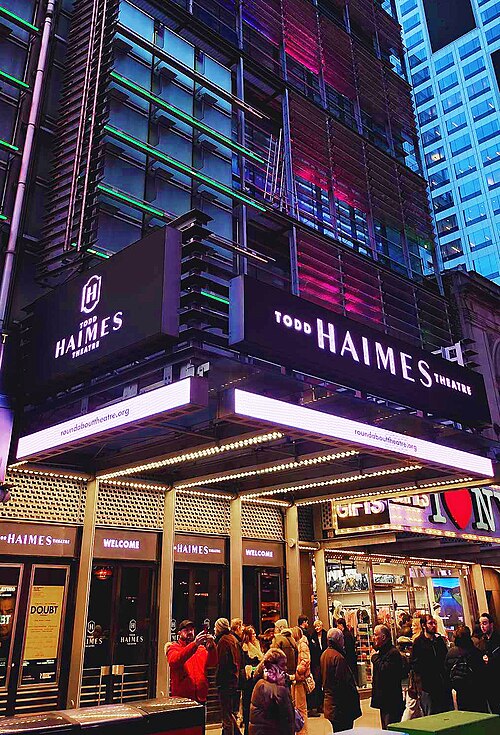
The Todd Haimes Theatre is Roundabout Theatre Company’s flagship Broadway house — a 740-seat Italian Renaissance theater at 227 West 42nd Street that opened in 1918 as the Selwyn. Restored for Roundabout in 2000, it received another comprehensive renovation in 2025–2026 that added new seating, expanded accessible locations, modernized elevators, renovated restrooms, restored the historic interior and upgraded assistive-listening technology.
The seating decision here is not about surviving a difficult room. It is about choosing the right kind of experience: close actor detail from Center Orchestra, or the full elevated stage picture from Mezzanine Row A center. Because the house has only 740 seats, even budget positions stay meaningfully connected to the stage.
Visitors searching for an American Airlines Theatre seating chart are looking for this same auditorium. It carried that name from 2000 until Roundabout renamed it for Todd Haimes in 2024; current seat maps and ticket listings use the Todd Haimes name.
The six-month renovation delivered new seating, expanded accessible locations, modernized elevators, renovated restrooms and dressing rooms, a new lobby, restored historic interiors, upgraded assistive-listening technology and the third-floor Mustang Hub for rehearsals and education. Public support totaled $13.9 million from New York City and New York State. Older reviews that complain about worn seats or tired restrooms describe the theater before this work.
The Todd Haimes Seating Principle
At the Todd Haimes, the room is small enough that you are rarely fighting distance. The smarter question is whether you want faces, blocking, value or access.
Center Orchestra rows C through H deliver the classic Todd Haimes experience — actor proximity, dialogue clarity and the intimacy that makes this theater so well suited to plays, revivals and Roundabout’s programming. Mezzanine Row A center delivers something different: the full stage picture, the logic of the blocking and the scenic design as a complete composition. Both are legitimate first choices, and in a house this size there are very few truly bad seats.
Orchestra Seats — Actor Detail, Comedy Timing and Play-First Intimacy
The Todd Haimes Orchestra has roughly 471 seats across rows A through P in Left, Center and Right sections, with step-free entry. The seating was replaced in the 2026 renovation, so older complaints about comfort or condition no longer describe the room.
Center Orchestra Rows C–H — The Primary Target
This is the house’s prime zone and the most consistent recommendation for any production. The center seats roughly 105 through 109 in these rows are the sweet spot. Within the range, rows D through G are the best starting point for most visitors — close enough for facial detail, far enough for the whole stage picture to compose itself.
For plays and comedies, where expression, dialogue rhythm and comic timing carry the evening, these rows are where the Todd Haimes is at its strongest.
Front Orchestra Rows A–B — Close and Immersive, But Check the Staging
Rows A and B sit very close to the stage. For some productions — especially those playing high on a raised stage — the very front can mean looking up at the action and losing part of the stage floor. Row D center onward gives a more balanced close view for most shows.
The underside of the Mezzanine begins to cover the Orchestra at row H, and from about row N back it can cut off the top of the stage. For most plays and comedies — which tend to play at stage level with contained scenery — this is a modest concern. For a production with tall sets, upper-level staging or projections, choose Center Orchestra rows C–G or Mezzanine Row A center instead.
Center Orchestra Rows I–N — Value Zone
In a 740-seat theater, rows I through N are meaningfully closer to the stage than the equivalent rows in a larger house. The overhang matters for shows with vertical staging, but for dialogue-driven plays these centered rows remain solid value.
Seats beside the exit doors on the right side of the Orchestra can pick up 42nd Street noise — a real distraction during a quiet play. If right-side seats are your only affordable option, check exactly where the exits sit on the current seat map before buying. Center and left-side seats avoid the issue.
Mezzanine Seats — The Elevated Stage Picture and Row A’s Special Status
The Todd Haimes Mezzanine — listed as the Balcony on some Roundabout maps — has about 269 seats across seven rows (A through G) in a single curving section. Its defining quirk is that there is no center aisle: this is continental seating, so you enter from the side aisles and move along the row. In the back two rows (F and G) the seating breaks at the middle, but rows A through E are side-access only.
The steep rake works in your favor. People in front rarely block the view, and even the back row sees the entire set clearly, if from farther away.
Mezzanine Row A Center — Sought After for a Reason
Row A center, along with row B center, is one of the best seats in the house. From here you see the full stage from above — the blocking, the scenic design and how the director has organized the space — in a way the Orchestra can’t show you. For productions where staging is part of the experience, it can be the best seat in the theater.
Mezzanine Rows B–C Center — Strong Premium, Slightly More Affordable
Rows B and C keep the same elevated-center advantage with a little more distance and usually a lower price. For most productions, the view difference between Row A and Row C center is smaller than the price difference.
Mezzanine Rows D–G Center — Budget Zone With Good Sightlines
Thanks to the rake, rows D through G still see well from the back. They are the budget tier — farther away, but still connected to the room in a way that equivalent seats at larger houses are not.
The Continental Seating Note
With no center aisle, arriving late to a center Mezzanine seat means squeezing past a full row. If you tend to run late or want easy restroom access, choose an aisle seat. The elevator lets you out next to row G, and you walk forward to your row from there.
Does the Todd Haimes Theatre Have a Balcony?
The Todd Haimes has a single upper level, called the Mezzanine or the Balcony depending on the listing. There is no second balcony and no third tier. The upper level spans two floors of the building but works as one seating section.
For visitors nervous about heights or long stair climbs, that makes the Todd Haimes far more comfortable than most classic Broadway houses. The Mezzanine is compact, well raked and reachable by elevator.
Choosing Seats for the Current Production
Every recommendation on this page is based on the room itself, and the room doesn’t change between shows. What does change is the staging: a production with a tall set or upper-level action makes the Mezzanine overhang matter more, while a stage-level comedy or drama makes the Orchestra rows even stronger. Before you buy, check whether any seat is marked partial or obstructed view on the live map for your performance.
Best Seats by Production Type
Dialogue, expression and emotional nuance reward proximity. The Todd Haimes is built for this kind of production, and these rows deliver it most fully.
Comic timing and physical business land harder when you can read faces. The primary range for any comedy here.
When a specific performance is the draw, proximity is the argument. These rows put you at the best distance for detailed acting.
When the scenery, staging or blocking is central to the experience, the elevated full-stage view shows what the Orchestra cannot.
Orchestra for the energy of singers in an intimate room; Mezzanine for the full picture if the staging spreads across the stage.
The cleanest first Todd Haimes experience: close enough to feel the performance, far enough to take in the stage.
Best Seats by Visitor Type
The single cleanest recommendation — intimate, centered and suited to the actor-forward work Roundabout programs here.
Orchestra for the actors, Mezzanine Row A for the director’s vision. The Todd Haimes rewards both kinds of deliberate viewing.
A restored historic room with a fifth-floor Penthouse Lobby for a pre-show drink. Orchestra for intimacy, Mezzanine for a thoughtful elevated view.
Both are real options in a 740-seat house. The steep Mezzanine rake keeps sightlines clear, and rear Orchestra rows are closer than they would be elsewhere.
Elevators serve all levels. There are 11 wheelchair spaces and 8 transfer seats across both levels. Contact Roundabout before booking.
The venue lists about 53 assistive-listening devices. Confirm availability and pickup requirements with Roundabout before the show.
New seats, modernized elevators and renovated restrooms. The Orchestra avoids row navigation in the Mezzanine entirely.
The steep Mezzanine rake solves the tall-person-in-front problem. Skip Row A if the safety bar is a concern; booster seats are available in the Orchestra.
Accessibility at the Todd Haimes Theatre
The 2026 renovation expanded accessible locations and modernized the elevators, so wheelchair users can sit on either level. Designated locations are limited, so confirm the live map before buying.
Seats to Avoid — or Approach With Clear Expectations
- Right-side Orchestra seats beside the exit doors, unless you’ve checked the map — 42nd Street noise can intrude during quiet scenes.
- Center Mezzanine seats if you expect to arrive late — with no center aisle, you’ll be crossing a full row.
- Mezzanine Row A for shorter visitors — the safety bar can clip the view; rows B–C center are cleaner.
- Orchestra rows A–B if you want the full stage picture — they can be too close for many productions.
- Orchestra row H and back for productions with tall sets or upper-level staging — the Mezzanine overhang starts cutting off the top of the stage.
- Far outer side seats in either section when centered seats are available at a similar price.
- Any seat marked partial or obstructed view, until you’ve confirmed what the current production’s staging blocks.
Todd Haimes vs Other Roundabout Broadway Houses
740 seats · Renovated 2026 · Historic Italian Renaissance house · Elevator to all levels · 11 wheelchair spaces · One compact upper level
Best for: intimate plays, revivals, actor-forward work, date nights and accessibility-conscious visitors.
1,055 seats · Rebuilt interior (2009) · Orchestra and Mezzanine only · Elevator to all levels · Strong accessibility
Best for: contemporary musicals, bigger audience energy and a modern, comfortable room at larger scale.
About 1,000 seats · Former nightclub · Excellent front Mezzanine · No elevator to the Mezzanine · Distinctive room
Best for: edgier plays and productions that benefit from the room’s personality.
Nearby Broadway Houses
Planning Your Todd Haimes Theatre Night
The theater sits at 227 West 42nd Street between 7th and 8th Avenues, one of Broadway’s best-connected addresses. Times Square–42nd Street is steps away, 42nd Street–Port Authority (A/C/E) is half a block west and 42nd Street–Bryant Park (B/D/F/M) is a short walk east. The entrance is on the north side of 42nd Street. See how to get to a Broadway show for full transit options.
The 42nd Street sidewalk is among the busiest in Manhattan, so build in 15–20 extra minutes. For dinner, Restaurant Row on West 46th Street and Hell’s Kitchen along 9th Avenue are both walkable; see restaurants near Times Square. The fifth-floor Penthouse Lobby, reachable by elevator, is a good place for a pre-show drink — confirm it’s open for your performance.
FAQ — Todd Haimes Theatre Seating
Center Orchestra rows C through H are the best overall, with rows D through G the safest pick for first-time visitors. Mezzanine Row A center is the best elevated view in the house. All seating was replaced in the 2026 renovation.
Choose the Orchestra for actor proximity, comic timing and facial expression. Choose Mezzanine Row A center for the full elevated stage picture — blocking, scenery and staging. Orchestra rows C through H are the safest all-around choice for dialogue-driven plays; for visually designed productions, Mezzanine Row A can be the better seat.
Yes. Row A center, along with row B center, is one of the best seats in the house for its sweeping full-stage view. The one caveat is a safety bar along Row A that can clip the view for shorter visitors; if that’s a concern, row B or C center may give a cleaner sightline.
It has one upper level, called the Mezzanine or the Balcony depending on the listing. There is no second or third tier, so there’s no steep nosebleed climb. For visitors nervous about heights or stairs, it is much more comfortable than most classic three-level Broadway houses.
Center Orchestra rows I through N are still good value in a 740-seat house, and you never feel far from the stage. The Mezzanine overhang begins at row H and matters more beyond row N for productions with tall staging, but for dialogue-driven plays these centered rows work well.
Right-side Orchestra seats beside the exit doors (street noise during quiet scenes), Orchestra rows A–B if you want the full stage picture, center Mezzanine seats if you tend to arrive late (no center aisle), Mezzanine Row A for shorter visitors because of the safety bar, and far outer side seats when centered seats are available.
Yes. Elevators serve all levels. Roundabout lists 11 wheelchair spaces — 6 in Orchestra row P (P101–P106) and 5 in Mezzanine/Balcony row F — plus 6 Orchestra transfer seats in rows B, G and K and 2 upper-level transfer seats in row F. Accessible restrooms are on the lobby and Penthouse Lobby levels. Contact Roundabout Audience Services at 212.719.1300 before booking.
Yes. The elevators were modernized in the 2026 renovation and reach the front and rear Mezzanine and the Penthouse Lobby. That sets the Todd Haimes apart from older Broadway houses like the Shubert, St. James and Majestic, where upper levels are reached by stairs.
Yes. The venue lists about 53 Sound Associates assistive-listening devices, and the technology was upgraded in the 2026 renovation. Contact Roundabout before attending to confirm availability and pickup requirements.
No. Elevators serve the Mezzanine and let you out next to row G; from there you walk forward to your row, with 1–2 steps down to each row and handrails. The row F wheelchair spaces are step-free from the elevator.
Yes. The 740-seat scale, renovated seats and restrooms, elevator access and Penthouse Lobby make it comfortable and easy to navigate. Book Center Orchestra rows D through G for the most reliable first experience.
Yes. The 2026 renovation added new seating, modernized elevators to all levels, renovated restrooms and expanded accessible locations. Orchestra seats avoid Mezzanine row steps entirely. Contact Roundabout in advance if you need specific mobility assistance.
It’s a fifth-floor lounge reachable by elevator, with bright windows, a deck over 43rd Street, drinks and light bites. Confirm it’s open for your performance before planning around it.
Plan on 20–30 minutes before curtain, and longer if you want time in the Penthouse Lobby or have accessibility arrangements. The 42nd Street sidewalk is very busy at curtain time.
One of Broadway’s Best Houses — Now Renovated to Match
Center Orchestra for the actors. Mezzanine Row A for the production. The Todd Haimes rewards a deliberate choice in a restored 740-seat room with a fifth-floor lounge and an elevator to every level.
Choose the Best Seat — Then Build the Whole 42nd Street Night
The Todd Haimes Theatre is one of Broadway’s most useful seating decisions because the room is intimate, newly renovated, and unusually strong on accessibility. Center Orchestra brings the actor detail. Mezzanine Row A center gives the elevated picture. The renovation changes the comfort and access story. Use these related guides to connect the seat choice with The Imaginary Invalid, Roundabout context, dinner, hotels, subway routes, parking, and nearby Broadway houses.
Todd Haimes Theatre Broadway Guide
Go deeper on the 42nd Street location, Roundabout history, Selwyn/American Airlines legacy, 2026 renovation, access upgrades, and full-night planning.
Open Theater Guide Current / Upcoming ShowThe Imaginary Invalid at Todd Haimes
Use the show guide to connect Bill Irwin’s physical comedy, Molière’s farce, the 90-minute no-intermission runtime, seat choice, ticket timing, and the full Broadway night plan.
Open Show GuideMore Seating, Ticket & Broadway Strategy
Seats · Timing · ValueBroadway Seating Guide
Compare Orchestra, Mezzanine, Balcony, boxes, sightlines, value zones, access issues, and when elevated center beats closer side seats.
All Broadway Theater Guides
Compare every Broadway house by size, access, neighborhood, seating levels, room personality, and night-out fit.
What’s Playing on Broadway
Browse current Broadway shows and connect each production to the right theater, seat choice, and full-night plan.
First-Time Broadway Guide
For visitors choosing their first show: seats, arrival, timing, dress, intermission, crowds, and Theater District basics.
When to Buy Broadway Tickets
Know when buying early matters, when waiting can work, and how timing changes for premium seats and limited runs.
Broadway Rush and Lottery Tickets
How discount systems work, what seat tradeoffs to expect, and when a bargain seat is worth the compromise.
Plan the Todd Haimes Theatre Night
Dinner · Hotels · TransitRestaurants Near Broadway
Use the broader Broadway dining guide when you want a reliable pre-show meal before walking into the 42nd Street theater zone.
Restaurants Near Times Square
Useful when your group wants to stay close to Todd Haimes, Times Square transit, Port Authority, and Broadway crowds.
Best Pre-Theater Restaurants
Pick a restaurant that fits the curtain time, walking route, crowd level, and kind of Broadway night you are planning.
Hotels Near Broadway
Compare Theater District, Times Square, Bryant Park, Midtown South, and Hell’s Kitchen hotel zones for a Broadway-centered trip.
Hotels Near Times Square
Best for visitors who want short walks, easy subway access, and simple post-show return logistics after a Todd Haimes show.
How to Get to a Broadway Show
Subway, walking, rideshare, and arrival timing for Theater District shows, including Todd Haimes on West 42nd Street.
Subway to Broadway
Pick the right subway approach for 42nd Street, Times Square, Port Authority, Bryant Park, and post-show exits.
Parking Near Broadway
When driving makes sense, when it does not, and how to avoid turning a Todd Haimes night into a Midtown garage problem.
Best Way Home After a Show
Subway, taxi, rideshare, walking, and hotel return strategy after a crowded 42nd Street performance.
Nearby Neighborhood & Theater Guides
42nd Street · Roundabout · Accessible HousesTimes Square
Useful for hotels, transit, crowd planning, visitor logistics, and the classic Broadway arrival flow.
Theater District
The practical guide to Broadway’s center: theaters, crowds, hotels, restaurants, walking routes, and first-time visitor logistics.
Bryant Park / Midtown South
A useful calmer base for visitors who want a 42nd Street show without staying directly in the Times Square crush.
Stephen Sondheim Theatre Guide
Compare another strong accessibility house with a larger, more modern-feeling Broadway room.
Studio 54 Guide
Compare Todd Haimes with Roundabout’s edgier former-nightclub Broadway house on West 54th Street.
Hayes Theatre Guide
Compare another intimate Broadway house where actor detail, sightlines, and room scale matter more than spectacle size.