

Hudson Theatre NYC: Tickets, Access & Guide
Hudson Theatre New York, at 141 West 44th Street: tickets, box office, access and what opens next on Broadway.
The Hudson Theater NYC at a glance
Hudson Theatre New York: What It Is and Who It Suits
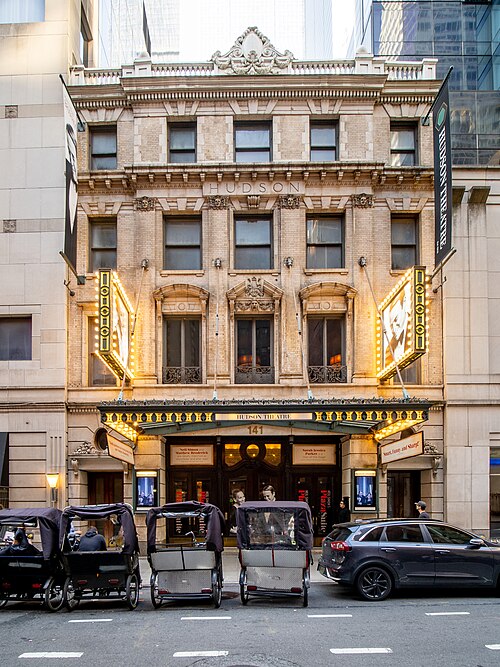
The Hudson Theatre NYC is a Broadway house at 141 West 44th Street, between Broadway and Sixth Avenue, with about 970 seats on three levels: Orchestra, Dress Circle and Balcony. It opened in 1903, spent decades in other uses, and came back as a Broadway theatre in 2017 after a full restoration. The house bills itself as Broadway’s oldest and newest.
What plays here changes by production. Every Brilliant Thing, a solo play, closed on August 9, 2026, and Other Desert Cities, a five-person family drama, begins previews on September 29. ATG Entertainment runs the Hudson, and what is on stage is decided one production at a time.
There is a line worth knowing about the Hudson: it is simultaneously Broadway’s oldest and newest theater. Built in 1903, it spent most of the twentieth century as a radio studio, a television stage, a nightclub, and eventually a hotel conference room before undergoing a full restoration and reopening as a Broadway house in 2017. What came back was something unusual — a theater with genuine historic bones, Beaux-Arts lobbies, and NYC landmark status, but also a clean, modern, fully rebuilt interior that feels nothing like a museum.
That combination — old pedigree, new polish — shapes the kind of shows that land well here and the kind of visitor who tends to love it. The Hudson at about 970 seats is not a small theater, but it feels more intimate than that number suggests. Focused, actor-forward work is exactly what the house is built for: Every Brilliant Thing, the solo play that just closed, relied entirely on proximity and presence.
Is the Hudson right for you?
It suits most visitors, with a few things worth weighing before you book.
Play lovers and anyone booking an actor-led production.
First-time Broadway visitors who want a landmarked, restored room in the middle of the Theater District.
Anyone who needs elevator access to every level. The Balcony is stairs only, and the Dress Circle has steps inside the seating area.
Late arrivals. ATG asks guests to arrive about 50 minutes early for security checks, and late seating is at management’s discretion.
Date nights where the venue itself is part of the experience — the lobbies here are genuinely striking.
Visitors who want intimacy at a moderate scale — not a tiny house, not a barn.
Visitors who want a big-cast Broadway spectacle — the Hudson programs intimate, actor-driven work.
A short history
The Hudson was built by the producer Henry B. Harris and opened on October 19, 1903, with Cousin Kate starring Ethel Barrymore. Its 100-foot lobby was the largest on Broadway at the time. In 1956 the first nationwide broadcast of The Tonight Show with Steve Allen came from its stage. The interior and exterior were landmarked in 1987, and after a renovation the theatre reopened in 2017 as the 41st Broadway house, with Sunday in the Park with George starring Jake Gyllenhaal and Annaleigh Ashford.
The Hudson was built for theatrical producer Henry B. Harris, who managed it until his death aboard the Titanic in 1912. His widow Renee Harris continued running the theater through the Depression years. It then passed through several lives — CBS Radio broadcasts in the 1930s, an NBC television studio from the late 1940s through the 1960s, an adult film house in the 1970s, and then the Savoy, a rock club. The building received New York City landmark status in 1987, which saved it from demolition and eventually led to its incorporation into what became the Millennium Times Square hotel, which used it as a conference and event space for decades. Ambassador Theatre Group acquired the venue in 2015, completed a full renovation, and reopened it as a Broadway house in 2017. The exterior and interior are both protected landmarks — which means the carved plasterwork, the original lobby proportions, and the Beaux-Arts detailing are all still there.
Hudson Theatre Tickets: What to Know Before You Buy
Prices, cancellation terms and availability are set production by production, so start with which show you are booking. The Broadway shows guide covers everything else that is running.
Where tickets come from
ATG runs the Hudson’s official box office, and its site lists what is on sale for each production. Partner and resale listings, including the ones behind the buttons on this page, can differ in price and terms, so use the production’s official ticket page as your baseline.
Hudson Theatre rush tickets and discounts
Rush and lottery programs are set by each production. The recent run of Every Brilliant Thing offered a $45 morning-of rush on TodayTix and a digital lottery on LuckySeat. Check the current show’s official ticket page before you count on either.
Picking a level
The straightforward choice for most visitors
Step-free from the entrance, and the level with ADA seating.
Step-free accessElevator to the level, steps inside
An elevator reaches the level, but there are steps inside the seating area, and no wheelchair seating.
Some interior stepsThree flights of stairs
No elevator, and no wheelchair or transfer seating.
Stairs onlyFor row-by-row advice, see the Hudson seating guide.
Hudson Theatre box office and will call
Will call tickets are held at the Hudson’s box office and can be picked up on the day of the performance or ahead of time, during regular box office hours. Everyone who enters needs a ticket, and lap seats for young children are not offered. ATG posts current box office hours and performance schedules on its official Hudson Theatre page; for schedule questions, call the information line at (646) 975-4620.
ATG encourages guests to arrive about 50 minutes before the performance for security checks. All guests go through a bag search, and large bags have to be checked at coat check.
Hudson Theater Tickets NYC: Prices, Discounts and How to Buy
Hudson Theater tickets in NYC are sold production by production, so the price you see depends on which show you book and when. This section covers what moves the number, where discounts come from, and what to check before you pay.
Hudson Theatre ticket prices: what changes the number
Hudson Theatre ticket prices are not fixed for the house. They shift with the production, the date and time of the performance, and the level and section you choose: Orchestra, Dress Circle or Balcony. Seller fees and resale markups change the total, so compare the all-in price at checkout, not the headline number.
Hudson Theatre discount tickets
Any Hudson Theatre discount is set by the production, not by the theatre. The recent run of Every Brilliant Thing offered a $45 morning-of rush on TodayTix and a digital lottery on LuckySeat. Other productions may run their own rush, lottery or discount offers, so check the current show’s official ticket page before you count on one. For how these programs work in general, see the rush and lottery guide.
Before you buy Hudson Theater tickets
Confirm the date, the level and the seller’s exchange and refund terms. Everyone who enters needs a ticket, and lap seats for young children are not offered, so count every person in your group. Will call tickets can be picked up at the box office on the day of the performance or ahead of time, during box office hours.
What’s Next at the Hudson Theatre
Other Desert Cities
Jon Robin Baitz’s Pulitzer Prize finalist play gets its first Broadway revival here, directed by John Benjamin Hickey. The cast is Julia Louis-Dreyfus, in her Broadway debut, with Ed Harris, Allison Janney, Joe Keery and Lily Rabe. Previews begin September 29, 2026, opening night is October 18, and the limited engagement runs through January 17, 2027, though dates can change before opening. For who it suits and how to plan around it, see the Other Desert Cities guide.
Just closed
Every Brilliant Thing, the solo play that starred Daniel Radcliffe, Mariska Hargitay and Tracee Ellis Ross across its run, played its final performance on August 9, 2026. You can still read about it on its show page.
Not sure which show to pick? Start with the guide for first-time Broadway visitors or the one on last-minute Broadway tickets.
Hudson Theatre Accessibility
The three levels have different access, and the Balcony in particular is not reachable by elevator. Read this before choosing seats if stairs matter for anyone in your group.
The Hudson’s 2017 renovation included meaningful accessibility upgrades for a building that is over a century old.
What you need to know
For a personal walkthrough of seating needs, call (646) 975-4620 and press 3. Leave a voicemail and a Hudson Theatre representative will call you back.
The Hudson’s box office and ATG’s access team are generally well-equipped to help with specific seating needs. If accessibility is a significant factor for your visit, a quick call before you book will save you guesswork on the day.
Getting to the Hudson Theatre and Planning the Night
Hudson Theatre, West 44th Street, New York, NY 10036
The Hudson is at 141 West 44th Street, between Broadway and Sixth Avenue, in the middle of the Theater District. The theatre entrance is on 44th Street. You are a short walk from Times Square, Bryant Park, and much of the neighborhood’s best pre-show dining.
Hudson Theatre Location and Address
The Hudson Theatre location is 141 West 44th Street, New York, NY 10036, on 44th Street between Broadway and Sixth Avenue. That is the Hudson Theatre address to use in maps and rideshare apps, and the theatre entrance is on 44th Street.
By subway
Times Square–42nd Street is the closest big hub, and the B, D, F and M stop at 42nd Street–Bryant Park. Either is a short walk to the theatre.
By subway — Times Square cluster
The 1, 2, 3, 7, N, Q, R, and W trains all stop at Times Square–42nd Street, about a four-minute walk along 44th Street to the theater. This is the most convenient cluster for anyone coming from Midtown, Uptown, or the outer boroughs.
By subway — Bryant Park cluster
The B, D, F, and M trains stop at 42nd Street–Bryant Park, a similarly short walk to the west. If you’re coming from downtown or Brooklyn, this cluster often involves fewer transfers.
By rideshare or taxi
Drop-off on 44th Street is easy. Pickup right after curtain is the slow part, so walk a block toward Sixth Avenue before you order a car.
Build in the extra time
With a bag search on the way in and about 50 minutes recommended, dinner should end earlier than you think.
After the show: pickup timing
Drop-off on 44th Street is straightforward, but post-show pickup is a different story — the Theater District generates real congestion between 10:30 pm and 11:15 pm. Request your car a few minutes before curtain call or walk a block toward Sixth Avenue before requesting to get cleaner pickup conditions.
Arrive earlier than you think
The Hudson recommends giving yourself extra time for entry, especially for large or sold-out performances. The main lobby of this theater is genuinely beautiful — one of the widest lobbies in New York when it opened in 1903 — but it can feel congested at curtain time. More is better if you have access needs.
Finding the entrance
The theater sits within the Millennium Times Square hotel building, which is worth knowing for navigation: look for the theater entrance on 44th Street, not the hotel entrance on 45th.
How to time dinner before a Broadway show, and what works in the Theater District.
Named picks for pre-theater and post-show dining.
What is on the streets around the Hudson and how the area works at night.
Where to stay if the Hudson is your anchor.
Subway lines, rideshare strategy and arriving in the Theater District.
Garages, rates and timing if you are driving in.
More Broadway planning: all Broadway theaters, what’s playing on Broadway, and Broadway vs. Off-Broadway.
Hudson Theatre NYC FAQ
Where is the Hudson Theatre NYC located?
The Hudson Theatre NYC is at 141 West 44th Street, New York, NY 10036, on 44th Street between Broadway and Sixth Avenue in the Theater District.
What is the Hudson Theatre address?
The address is Hudson Theatre, 141 W 44th St, New York, NY 10036, in the Theater District between Broadway and Sixth Avenue.
Which Hudson Theatre is this?
This guide covers the Broadway house on West 44th Street in Manhattan, which people also search for as the Hudson Theater Manhattan or the Hudson Theatre New York. It is not the Hudson Theatres complex in Los Angeles.
Where can I buy Hudson Theatre tickets?
Tickets are sold production by production. ATG runs the official Hudson box office and lists what is on sale on its site, and partner and resale listings, including the button on this page, can differ in price and terms. Everyone who enters needs a ticket, and lap seats for young children are not offered.
How much are Hudson Theater ticket prices?
Prices depend on the production, the date, and the level and section you choose, so there is no single price for the theatre. Check the current production’s official ticket page for a baseline before comparing other listings.
Are there Hudson Theatre rush tickets or discounts?
That is decided per production, not by the theatre. The recent run of Every Brilliant Thing offered a $45 morning-of rush on TodayTix and a digital lottery on LuckySeat. Check the current production’s official ticket page for its own policy.
What are the Hudson Theater box office hours?
The Hudson Theatre box office hours follow the performance schedule, and ATG posts them on its official Hudson Theatre page. For schedule questions, call the information line at (646) 975-4620.
Is the Hudson Theatre wheelchair accessible?
Yes, with limits. Wheelchair access is at the 44th Street entrance, and the Orchestra is step-free with ADA seating. An elevator reaches the Dress Circle level, but there are steps within the seating area. The Balcony is stairs only, with no elevator.
Is the Hudson Theatre Broadway or Off-Broadway?
It is a Broadway house. The Hudson reopened in 2017 as the 41st Broadway theatre after a restoration, and it hosts Broadway productions.
What is playing at the Hudson Theatre next?
Other Desert Cities, the first Broadway revival of Jon Robin Baitz’s play, begins previews September 29, 2026, and opens October 18. The limited engagement is scheduled through January 17, 2027, and dates can change.
Where can I buy Hudson Theater tickets in NYC?
Start with the official ATG box office listing for the production you want, then compare partner and resale listings, including the button on this page. Hudson Theater tickets in NYC are sold production by production, and prices and terms can differ by seller.
What affects Hudson Theatre ticket prices?
The production, the date and time, and the level and section you choose. Seller fees and resale markups also change the total, so compare the all-in price at checkout.
Is there a Hudson Theatre discount?
Any discount is set by the production, not the theatre. The recent run of Every Brilliant Thing offered a $45 morning-of rush on TodayTix and a digital lottery on LuckySeat. Check the current show’s official ticket page for its own rush, lottery or discount policy.
What is the Hudson Theatre location in NYC?
The Hudson Theatre location is 141 West 44th Street, New York, NY 10036, between Broadway and Sixth Avenue in the Theater District. The theatre entrance is on 44th Street.
How do I get to the Hudson Theater NYC from Times Square?
The Hudson Theater NYC is a short walk from Times Square–42nd Street, and the B, D, F and M stop at 42nd Street–Bryant Park. The theatre entrance is on 44th Street. Pickup right after curtain is slow, so walk a block toward Sixth Avenue before ordering a car.
The Hudson in short
The Hudson Theatre NYC is a landmarked 1903 Broadway house, restored in 2017, where the night depends on the production and the level you book. Orchestra is the straightforward choice. The Dress Circle level has elevator access but interior steps, and the Balcony is stairs only.
Check the production’s official ticket page first, then use the button below for dates and availability.
Hudson Theatre NYC: Tickets, Access & Guide
Hudson Theatre New York, at 141 West 44th Street: tickets, box office, access and what opens next on Broadway.
The Hudson Theater NYC at a glance
Hudson Theatre New York: What It Is and Who It Suits
The Hudson Theatre NYC is a Broadway house at 141 West 44th Street, between Broadway and Sixth Avenue, with about 970 seats on three levels: Orchestra, Dress Circle and Balcony. It opened in 1903, spent decades in other uses, and came back as a Broadway theatre in 2017 after a full restoration. The house bills itself as Broadway’s oldest and newest.
What plays here changes by production. Every Brilliant Thing, a solo play, closed on August 9, 2026, and Other Desert Cities, a five-person family drama, begins previews on September 29. ATG Entertainment runs the Hudson, and what is on stage is decided one production at a time.
There is a line worth knowing about the Hudson: it is simultaneously Broadway’s oldest and newest theater. Built in 1903, it spent most of the twentieth century as a radio studio, a television stage, a nightclub, and eventually a hotel conference room before undergoing a full restoration and reopening as a Broadway house in 2017. What came back was something unusual — a theater with genuine historic bones, Beaux-Arts lobbies, and NYC landmark status, but also a clean, modern, fully rebuilt interior that feels nothing like a museum.
That combination — old pedigree, new polish — shapes the kind of shows that land well here and the kind of visitor who tends to love it. The Hudson at about 970 seats is not a small theater, but it feels more intimate than that number suggests. Focused, actor-forward work is exactly what the house is built for: Every Brilliant Thing, the solo play that just closed, relied entirely on proximity and presence.
Is the Hudson right for you?
It suits most visitors, with a few things worth weighing before you book.
Play lovers and anyone booking an actor-led production.
First-time Broadway visitors who want a landmarked, restored room in the middle of the Theater District.
Anyone who needs elevator access to every level. The Balcony is stairs only, and the Dress Circle has steps inside the seating area.
Late arrivals. ATG asks guests to arrive about 50 minutes early for security checks, and late seating is at management’s discretion.
Date nights where the venue itself is part of the experience — the lobbies here are genuinely striking.
Visitors who want intimacy at a moderate scale — not a tiny house, not a barn.
Visitors who want a big-cast Broadway spectacle — the Hudson programs intimate, actor-driven work.
A short history
The Hudson was built by the producer Henry B. Harris and opened on October 19, 1903, with Cousin Kate starring Ethel Barrymore. Its 100-foot lobby was the largest on Broadway at the time. In 1956 the first nationwide broadcast of The Tonight Show with Steve Allen came from its stage. The interior and exterior were landmarked in 1987, and after a renovation the theatre reopened in 2017 as the 41st Broadway house, with Sunday in the Park with George starring Jake Gyllenhaal and Annaleigh Ashford.
The Hudson was built for theatrical producer Henry B. Harris, who managed it until his death aboard the Titanic in 1912. His widow Renee Harris continued running the theater through the Depression years. It then passed through several lives — CBS Radio broadcasts in the 1930s, an NBC television studio from the late 1940s through the 1960s, an adult film house in the 1970s, and then the Savoy, a rock club. The building received New York City landmark status in 1987, which saved it from demolition and eventually led to its incorporation into what became the Millennium Times Square hotel, which used it as a conference and event space for decades. Ambassador Theatre Group acquired the venue in 2015, completed a full renovation, and reopened it as a Broadway house in 2017. The exterior and interior are both protected landmarks — which means the carved plasterwork, the original lobby proportions, and the Beaux-Arts detailing are all still there.
Hudson Theatre Tickets: What to Know Before You Buy
Prices, cancellation terms and availability are set production by production, so start with which show you are booking. The Broadway shows guide covers everything else that is running.
Where tickets come from
ATG runs the Hudson’s official box office, and its site lists what is on sale for each production. Partner and resale listings, including the ones behind the buttons on this page, can differ in price and terms, so use the production’s official ticket page as your baseline.
Hudson Theatre rush tickets and discounts
Rush and lottery programs are set by each production. The recent run of Every Brilliant Thing offered a $45 morning-of rush on TodayTix and a digital lottery on LuckySeat. Check the current show’s official ticket page before you count on either.
Picking a level
The straightforward choice for most visitors
Step-free from the entrance, and the level with ADA seating.
Step-free accessElevator to the level, steps inside
An elevator reaches the level, but there are steps inside the seating area, and no wheelchair seating.
Some interior stepsThree flights of stairs
No elevator, and no wheelchair or transfer seating.
Stairs onlyFor row-by-row advice, see the Hudson seating guide.
Hudson Theatre box office and will call
Will call tickets are held at the Hudson’s box office and can be picked up on the day of the performance or ahead of time, during regular box office hours. Everyone who enters needs a ticket, and lap seats for young children are not offered. ATG posts current box office hours and performance schedules on its official Hudson Theatre page; for schedule questions, call the information line at (646) 975-4620.
ATG encourages guests to arrive about 50 minutes before the performance for security checks. All guests go through a bag search, and large bags have to be checked at coat check.
Hudson Theater Tickets NYC: Prices, Discounts and How to Buy
Hudson Theater tickets in NYC are sold production by production, so the price you see depends on which show you book and when. This section covers what moves the number, where discounts come from, and what to check before you pay.
Hudson Theatre ticket prices: what changes the number
Hudson Theatre ticket prices are not fixed for the house. They shift with the production, the date and time of the performance, and the level and section you choose: Orchestra, Dress Circle or Balcony. Seller fees and resale markups change the total, so compare the all-in price at checkout, not the headline number.
Hudson Theatre discount tickets
Any Hudson Theatre discount is set by the production, not by the theatre. The recent run of Every Brilliant Thing offered a $45 morning-of rush on TodayTix and a digital lottery on LuckySeat. Other productions may run their own rush, lottery or discount offers, so check the current show’s official ticket page before you count on one. For how these programs work in general, see the rush and lottery guide.
Before you buy Hudson Theater tickets
Confirm the date, the level and the seller’s exchange and refund terms. Everyone who enters needs a ticket, and lap seats for young children are not offered, so count every person in your group. Will call tickets can be picked up at the box office on the day of the performance or ahead of time, during box office hours.
What’s Next at the Hudson Theatre
Other Desert Cities
Jon Robin Baitz’s Pulitzer Prize finalist play gets its first Broadway revival here, directed by John Benjamin Hickey. The cast is Julia Louis-Dreyfus, in her Broadway debut, with Ed Harris, Allison Janney, Joe Keery and Lily Rabe. Previews begin September 29, 2026, opening night is October 18, and the limited engagement runs through January 17, 2027, though dates can change before opening. For who it suits and how to plan around it, see the Other Desert Cities guide.
Just closed
Every Brilliant Thing, the solo play that starred Daniel Radcliffe, Mariska Hargitay and Tracee Ellis Ross across its run, played its final performance on August 9, 2026. You can still read about it on its show page.
Not sure which show to pick? Start with the guide for first-time Broadway visitors or the one on last-minute Broadway tickets.
Hudson Theatre Accessibility
The three levels have different access, and the Balcony in particular is not reachable by elevator. Read this before choosing seats if stairs matter for anyone in your group.
The Hudson’s 2017 renovation included meaningful accessibility upgrades for a building that is over a century old.
What you need to know
For a personal walkthrough of seating needs, call (646) 975-4620 and press 3. Leave a voicemail and a Hudson Theatre representative will call you back.
The Hudson’s box office and ATG’s access team are generally well-equipped to help with specific seating needs. If accessibility is a significant factor for your visit, a quick call before you book will save you guesswork on the day.
Getting to the Hudson Theatre and Planning the Night
Hudson Theatre, West 44th Street, New York, NY 10036
The Hudson is at 141 West 44th Street, between Broadway and Sixth Avenue, in the middle of the Theater District. The theatre entrance is on 44th Street. You are a short walk from Times Square, Bryant Park, and much of the neighborhood’s best pre-show dining.
Hudson Theatre Location and Address
The Hudson Theatre location is 141 West 44th Street, New York, NY 10036, on 44th Street between Broadway and Sixth Avenue. That is the Hudson Theatre address to use in maps and rideshare apps, and the theatre entrance is on 44th Street.
By subway
Times Square–42nd Street is the closest big hub, and the B, D, F and M stop at 42nd Street–Bryant Park. Either is a short walk to the theatre.
By subway — Times Square cluster
The 1, 2, 3, 7, N, Q, R, and W trains all stop at Times Square–42nd Street, about a four-minute walk along 44th Street to the theater. This is the most convenient cluster for anyone coming from Midtown, Uptown, or the outer boroughs.
By subway — Bryant Park cluster
The B, D, F, and M trains stop at 42nd Street–Bryant Park, a similarly short walk to the west. If you’re coming from downtown or Brooklyn, this cluster often involves fewer transfers.
By rideshare or taxi
Drop-off on 44th Street is easy. Pickup right after curtain is the slow part, so walk a block toward Sixth Avenue before you order a car.
Build in the extra time
With a bag search on the way in and about 50 minutes recommended, dinner should end earlier than you think.
After the show: pickup timing
Drop-off on 44th Street is straightforward, but post-show pickup is a different story — the Theater District generates real congestion between 10:30 pm and 11:15 pm. Request your car a few minutes before curtain call or walk a block toward Sixth Avenue before requesting to get cleaner pickup conditions.
Arrive earlier than you think
The Hudson recommends giving yourself extra time for entry, especially for large or sold-out performances. The main lobby of this theater is genuinely beautiful — one of the widest lobbies in New York when it opened in 1903 — but it can feel congested at curtain time. More is better if you have access needs.
Finding the entrance
The theater sits within the Millennium Times Square hotel building, which is worth knowing for navigation: look for the theater entrance on 44th Street, not the hotel entrance on 45th.
How to time dinner before a Broadway show, and what works in the Theater District.
Named picks for pre-theater and post-show dining.
What is on the streets around the Hudson and how the area works at night.
Where to stay if the Hudson is your anchor.
Subway lines, rideshare strategy and arriving in the Theater District.
Garages, rates and timing if you are driving in.
More Broadway planning: all Broadway theaters, what’s playing on Broadway, and Broadway vs. Off-Broadway.
Hudson Theatre NYC FAQ
Where is the Hudson Theatre NYC located?
The Hudson Theatre NYC is at 141 West 44th Street, New York, NY 10036, on 44th Street between Broadway and Sixth Avenue in the Theater District.
What is the Hudson Theatre address?
The address is Hudson Theatre, 141 W 44th St, New York, NY 10036, in the Theater District between Broadway and Sixth Avenue.
Which Hudson Theatre is this?
This guide covers the Broadway house on West 44th Street in Manhattan, which people also search for as the Hudson Theater Manhattan or the Hudson Theatre New York. It is not the Hudson Theatres complex in Los Angeles.
Where can I buy Hudson Theatre tickets?
Tickets are sold production by production. ATG runs the official Hudson box office and lists what is on sale on its site, and partner and resale listings, including the button on this page, can differ in price and terms. Everyone who enters needs a ticket, and lap seats for young children are not offered.
How much are Hudson Theater ticket prices?
Prices depend on the production, the date, and the level and section you choose, so there is no single price for the theatre. Check the current production’s official ticket page for a baseline before comparing other listings.
Are there Hudson Theatre rush tickets or discounts?
That is decided per production, not by the theatre. The recent run of Every Brilliant Thing offered a $45 morning-of rush on TodayTix and a digital lottery on LuckySeat. Check the current production’s official ticket page for its own policy.
What are the Hudson Theater box office hours?
The Hudson Theatre box office hours follow the performance schedule, and ATG posts them on its official Hudson Theatre page. For schedule questions, call the information line at (646) 975-4620.
Is the Hudson Theatre wheelchair accessible?
Yes, with limits. Wheelchair access is at the 44th Street entrance, and the Orchestra is step-free with ADA seating. An elevator reaches the Dress Circle level, but there are steps within the seating area. The Balcony is stairs only, with no elevator.
Is the Hudson Theatre Broadway or Off-Broadway?
It is a Broadway house. The Hudson reopened in 2017 as the 41st Broadway theatre after a restoration, and it hosts Broadway productions.
What is playing at the Hudson Theatre next?
Other Desert Cities, the first Broadway revival of Jon Robin Baitz’s play, begins previews September 29, 2026, and opens October 18. The limited engagement is scheduled through January 17, 2027, and dates can change.
Where can I buy Hudson Theater tickets in NYC?
Start with the official ATG box office listing for the production you want, then compare partner and resale listings, including the button on this page. Hudson Theater tickets in NYC are sold production by production, and prices and terms can differ by seller.
What affects Hudson Theatre ticket prices?
The production, the date and time, and the level and section you choose. Seller fees and resale markups also change the total, so compare the all-in price at checkout.
Is there a Hudson Theatre discount?
Any discount is set by the production, not the theatre. The recent run of Every Brilliant Thing offered a $45 morning-of rush on TodayTix and a digital lottery on LuckySeat. Check the current show’s official ticket page for its own rush, lottery or discount policy.
What is the Hudson Theatre location in NYC?
The Hudson Theatre location is 141 West 44th Street, New York, NY 10036, between Broadway and Sixth Avenue in the Theater District. The theatre entrance is on 44th Street.
How do I get to the Hudson Theater NYC from Times Square?
The Hudson Theater NYC is a short walk from Times Square–42nd Street, and the B, D, F and M stop at 42nd Street–Bryant Park. The theatre entrance is on 44th Street. Pickup right after curtain is slow, so walk a block toward Sixth Avenue before ordering a car.
The Hudson in short
The Hudson Theatre NYC is a landmarked 1903 Broadway house, restored in 2017, where the night depends on the production and the level you book. Orchestra is the straightforward choice. The Dress Circle level has elevator access but interior steps, and the Balcony is stairs only.
Check the production’s official ticket page first, then use the button below for dates and availability.