

Belasco Theatre Tickets: Broadway Shows & NYC Guide
Belasco Theatre tickets, current Broadway shows, official ticketing guidance, 111 West 44th Street location, accessibility, history, and practical NYC planning for this distinctive Broadway house.
Belasco Theatre tickets currently center on Maybe Happy Ending, which is now playing at the theater. The Belasco is at 111 West 44th Street in New York, and the official Shubert venue page identifies Telecharge as the online ticket seller for the current production. Ticket inventory, prices and performance availability can change by date, so confirm the live performance calendar before purchasing.
The Belasco Theatre opened in 1907 as the Stuyvesant Theatre, designed by architect George Keister for producer and director David Belasco — one of the most influential and eccentric figures in the history of the American stage. It was renamed the Belasco in 1910, and the theater has carried his identity ever since in ways that go deeper than a name on a marquee. Belasco built the theater to embody a specific philosophy about the relationship between audience and actors, and that philosophy is still legible in the room today. The theater is currently home to Maybe Happy Ending.
This guide covers Belasco Theatre Broadway ticket and show planning, what makes the Belasco different from most Broadway houses, how to think about seating in a theater designed around intimacy rather than scale, what the accessibility situation looks like in practice, where the theater sits in the district, and how to plan a full evening around a visit to West 44th Street.
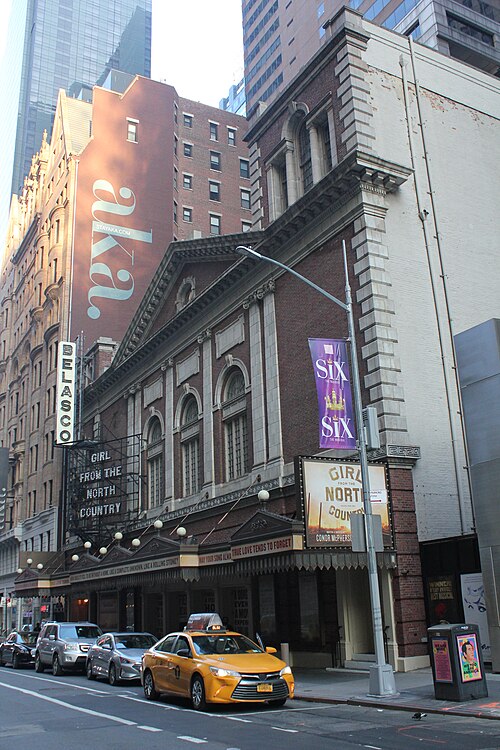
Belasco Theatre Tickets, Broadway Shows & Official Ticketing
Belasco Theatre tickets are sold production by production. As of September 23, 2026, Maybe Happy Ending is the current Broadway show at the Belasco Theatre. Shubert lists the production as now playing and identifies Telecharge as the official online ticket seller for this engagement. Stage & Street does not replace the live seller calendar here, so confirm the performance date, ticket inventory and final checkout price before purchasing.
Buying Belasco Theatre Broadway tickets
Before buying, confirm the exact performance date and time, whether the listing is primary inventory or resale, the section and level, and the all-in price at checkout. If seat location is the main decision, move to the Belasco Theatre seating guide rather than using this venue page as a seating chart. The seating guide owns detailed seat views, best-seat comparisons, section and row strategy, and view-from-my-seat intent.
Belasco Theatre box office and ticket questions
The Belasco box office is at the theater at 111 West 44th Street. Because box office operating hours can change with the performance schedule, verify current hours with the venue before making a special trip. The official venue listing is also the right source for current ticket policies, accessibility accommodations and showtime changes.
Belasco Theatre Broadway shows
The current production is Maybe Happy Ending. For the show itself — including cast, runtime, age guidance and production-specific planning — use the Stage & Street show guide. This page stays focused on the Belasco Theatre as the venue: tickets, Broadway show occupancy, location, accessibility, history and planning the visit.
What Kind of Broadway House This Is
The Belasco is a mid-sized Broadway house with 1,059 seats in Shubert’s current theatre specifications — not small, but not one of the district’s large blockbuster venues either. What distinguishes it from other theaters at a similar seat count is not the number but the shape: the auditorium is notably shallow in depth, which means the back of the orchestra is closer to the stage than it would be in a theater with a comparable seat count but a deeper configuration. The result is a room that feels more intimate than the numbers suggest.
This was deliberate. David Belasco designed his theater around a specific idea: that the distance between actor and audience was the enemy of theatrical truth, and that the closer people were to the performance, the more honest and affecting the theatrical experience would be. He called it a “living room” approach — the theater as a room in which real emotional transactions could happen, rather than a spectacle space in which audiences watched events happening at a distance. That concept is visible in the room’s proportions today, more than a century after Belasco built it.
The Belasco is at its best with productions that benefit from proximity — plays and musicals where the work lives in the detail of the performance rather than in the scale of the production. It is not the natural home for a giant spectacle musical with elaborate flying scenery and a 40-person ensemble. It is the natural home for exactly the kind of production that rewards an audience being genuinely close to the people onstage. Maybe Happy Ending, the current production, is exactly that kind of show in exactly the right kind of room.
The interior of the Belasco is also one of Broadway’s most visually distinctive — the original décor, including Belasco’s famous Tiffany-glass and detailed ornamentation, survived through the theater’s various ownership changes and remains part of what makes arriving at this particular theater feel different from arriving at a more standard Broadway house. Arriving early is worthwhile at the Belasco in a way it is not at every theater.
David Belasco — The Man Who Built This Theater
David Belasco is the most interesting figure in Broadway history that most visitors have never heard of, and the theater that carries his name is incomprehensible without some understanding of who he was. This is not a detour into theater history for its own sake — Belasco’s biography explains the room you are sitting in, why it feels the way it does, and why the building still generates stories that have nothing to do with any specific show.
Belasco was simultaneously one of the most commercially successful producers and directors in early twentieth-century American theater and one of its most genuinely innovative artists. He pioneered modern stage lighting — developing techniques for creating realistic atmospheric light effects that had not previously been possible on a theatrical stage — and insisted on a level of production realism that was considered extreme by his contemporaries. He was also a showman of the highest order, acutely aware that the theater he was building needed an audience to survive, and skilled at manufacturing the attention that filled houses.
The Priest’s Collar
Belasco’s most famous personal affectation was his signature costume: a Roman Catholic priest’s collar, which he wore as his standard public dress despite not being a priest and, by most accounts, not being particularly religious. The collar was theatrical costuming applied to real life — a way of being recognized, a statement of gravity, and an ongoing piece of performance that extended the theatrical into the everyday. It worked. Belasco was one of the most recognizable figures in New York for decades.
The Apartment Above the Theater
When Belasco built the Stuyvesant Theatre in 1907, he built an apartment for himself above the house — a six-room residence that he called his “monk’s cell” despite its elaborate furnishings and Tiffany-glass appointments. He lived there for years, working and receiving visitors in a space that was simultaneously his home and an extension of his theatrical world. The apartment remained part of the theater’s structure after his death in 1931 and has been used in various capacities since. It is one of the architectural details that makes the Belasco different from any other Broadway building: the man who built it also lived there, and the building still carries that history in its bones.
David Belasco died in 1931, but accounts of his presence in the theater he built have persisted for decades in the documented folklore of Broadway’s theater community. Stage managers, actors, and crew members have reported a figure in a priest’s collar in the upper levels of the house — most consistently described as appearing near the seats Belasco favored during his lifetime when observing performances from the back of the house. These reports are documented across Broadway oral history rather than being a single sensationalized story, and the Belasco’s reputation as Broadway’s most persistently haunted theater is part of its identity in the theatrical community. Whether you believe in theatrical ghosts or not, the fact that the building generates these stories — consistently, across decades, from people whose working lives are spent in it — is itself a form of evidence about how strongly Belasco’s presence is embedded in what he built.
Belasco’s technical innovations in stage lighting are perhaps his most lasting contribution to the craft. He developed a system of color filters and dimmer controls that allowed for atmospheric lighting effects — sunsets, moonrises, changing weather — that had not previously been achievable on stage, and that created new possibilities for theatrical realism that influenced how productions were designed for generations after him. The equipment he used is largely obsolete; the techniques he developed became standard practice. That is what genuine innovation looks like in the theater.
Seating Guide — How to Think About Best Seats
Seat choice at the Belasco is shaped by the theater’s core design principle: it is shallower than most Broadway houses of comparable capacity, which means the distance between the back of the orchestra and the stage is less than it would be elsewhere. At the Belasco, the standard hierarchy of “closer is better” applies — but the penalty for being further back is smaller than at a larger or deeper house.
The strongest seats in the house for most productions. Close to the stage, direct sightlines, maximum immersion. The shallow auditorium means even center orchestra rows M–N are not far from the action. Center rows D–K are the prime target for most visitors.
Because the Belasco’s auditorium is notably shallow, rear orchestra seats are closer to the stage than they would be at a deeper house with the same seat count. Visitors who assume rear orchestra means “far away” may be pleasantly surprised by what they find here.
Angle matters more than distance at the Belasco. Far side orchestra seats in the front rows can have somewhat oblique views of the full stage, particularly if the production uses the full width. Center-adjacent side seats are a better choice than extreme side positions.
Front mezzanine center gives you an elevated view of the complete stage picture. In a theater this intimate, the mezzanine elevation does not create the same distance penalty as at a larger house. Rows A–C center mezzanine are a solid choice, often at better value than equivalent orchestra positions.
The most affordable seats in the house. The shallow auditorium limits how far back you can get before the stage feels genuinely distant, so rear mezzanine seats at the Belasco are more viable than at many Broadway theaters. Works well for productions with strong visual presence.
At an intimate house like the Belasco, center orchestra rows F–L offer the best combination of proximity, direct sightlines, and price. You are inside the production rather than looking at it from a distance — which is exactly what Belasco designed the room for.
The Belasco’s intimacy is its most important seating characteristic. At most Broadway houses, the priority is avoiding specific problem seats — extreme side positions, obstructed views, the back of a deep balcony. At the Belasco, the priority is simply staying center and being aware that the room was built to make most seats work better than visitors expect. Verify current seating configuration on the official venue page before booking, as production-specific staging can affect which sections perform best.
Need the seating chart, best seats or view-from-my-seat detail? Use the dedicated Belasco Theatre seating guide. This main theater page keeps the seating overview concise so the two pages do not compete for the same seat-selection searches.
Accessibility — What to Know Before You Go
The Belasco Theatre has specific accessibility considerations that are worth understanding in advance, particularly if stair-free entry is a priority for your visit.
Accessibility details, device availability, and seating provisions can change between productions. Always verify current information directly with the Belasco box office or the official Shubert Organization accessibility page before finalizing plans where accessibility is a primary consideration.
Where the Belasco Theatre Is
The Belasco Theatre sits on West 44th Street between Sixth and Seventh Avenues — in the heart of the Theater District, close to Times Square and surrounded by the full range of pre- and post-show options that make a Broadway evening easy to build around. This is one of the most centrally located Broadway houses in the district.
The Belasco’s 44th Street address puts it in the densest part of the Broadway district — surrounded by other major houses and within easy walking distance of both the Times Square subway hub and Restaurant Row on West 46th Street. It is one of the easier Broadway houses to navigate, both for arriving from anywhere in the city and for building a full evening around. See the guide to getting to a Broadway show for full routing details and the parking near Broadway guide for garage options near West 44th Street.
Theater History — A Timeline
Current Broadway Show at the Belasco — Maybe Happy Ending
The Belasco Theatre is currently home to Maybe Happy Ending, a Broadway musical that has generated significant critical and audience attention since opening. Many visitors arrive at this theater page because they are attending the current production and want to understand the room before they go. The seating guide above — particularly the section on the theater’s unusual shallow depth and its effect on seat distances — is the most directly useful content for those visitors.
The Belasco’s intimate configuration is particularly well-suited to the kind of emotionally close storytelling that Maybe Happy Ending requires. The “living room” quality that Belasco designed into this room is one of the reasons the show works as well as it does in this specific space. For full Stage & Street information about the show itself — cast, runtime, age guidance, and planning the evening — use the Maybe Happy Ending Broadway guide and verify time-sensitive performance details against the current production calendar.
Verify the current show and performance schedule on the official Belasco Theatre or Shubert Organization site before booking.
Plan the Night Around the Belasco Theatre
The Belasco’s central Theater District location makes it one of the easiest Broadway houses to build a full evening around. West 44th Street puts you within a short walk of Times Square’s transit hub, Restaurant Row on 46th Street, and Hell’s Kitchen’s restaurant cluster to the west.
Getting there
Times Square connects to the 1, 2, 3, N, Q, R, W, A, C, E, and S trains — a two-block walk north from the theater. Bryant Park (B, D, F, M) is a short walk east. If you are driving in, Theater District garages are available on surrounding blocks — book in advance for weekend performances. See the guide to getting to a Broadway show for full routing details.
Dinner before the show
Restaurant Row on West 46th Street is two blocks north — one of the highest concentrations of pre-theater dining in the city, all used to theater-crowd timing and 6:30pm reservations. Hell’s Kitchen, a short walk west, adds further options at every price point. For a 7pm curtain, a 5:30 or 6pm reservation gives you comfortable timing. The restaurants near Broadway guide covers specific picks and the pre-show dining guide covers timing strategy.
Hotels and overnight stays
The Belasco’s central location puts it within walking distance of the largest concentration of Broadway-adjacent hotels in the city. The hotels near Broadway guide covers the best-positioned options. The Theater District neighborhood guide provides a full orientation to the surrounding area.
Frequently Asked Questions
Belasco Theatre tickets are sold for the production currently occupying the house. As of September 23, 2026, Maybe Happy Ending is playing at the Belasco, and the Shubert Organization identifies Telecharge as the official online ticket seller for the engagement. Confirm the live performance calendar, inventory and final price before purchasing.
Maybe Happy Ending is currently playing at the Belasco Theatre. For show-specific cast, runtime and planning information, use the Maybe Happy Ending Broadway guide.
The Belasco Theatre is at 111 West 44th Street in Manhattan, between Sixth and Seventh Avenues in the heart of the Theater District. Times Square is a two-block walk north and connects to virtually every subway line in the system. It is one of Broadway’s most centrally located houses.
The Belasco Theatre is currently home to Maybe Happy Ending. Verify the current show and performance schedule on the official Shubert Organization or Belasco Theatre site before booking, as programming can change.
The Belasco’s unusually shallow auditorium means seats are closer to the stage than they appear on a standard seating chart. Center orchestra rows D–K are the premium zone. Front mezzanine center rows A–C are a reliable value alternative. Avoid extreme side orchestra seats where angle matters. The rear orchestra is better than expected because the shallow design limits how far back you can actually get. See the full seating guide section above for a detailed breakdown.
The main entrance has 2 steps from the sidewalk to the lobby. The side entrance is step-free. The orchestra level is accessible from the side entrance with no steps. Wheelchair locations are on the Orchestra level, while Shubert also lists transfer locations in both the Orchestra and Mezzanine. There are no elevators or escalators to the mezzanine or upper levels. Assistive listening devices are available. Contact the box office before booking to confirm current provisions and arrangements. Verify accessibility details on the official Shubert venue page before attending.
The theater was built by and named for David Belasco, one of the most influential producers and directors in early twentieth-century American theater. Belasco opened the building in 1907 as the Stuyvesant Theatre and renamed it the Belasco in 1910. He was a pioneering innovator in stage lighting, a major commercial force in early Broadway, and a theatrical personality of considerable eccentricity — known for wearing a priest’s collar as his signature costume and for living in an apartment above the theater he built. He died in 1931, and his name and, according to theatrical folklore, his presence have remained in the building ever since. The section on David Belasco in this guide covers his biography and the theater’s identity in more detail.
The Belasco has Broadway’s most consistent reputation for reported supernatural activity, centered on accounts of a figure in a priest’s collar in the upper house — the collar being David Belasco’s signature costume in life. These accounts are part of the documented oral history of Broadway’s theater community rather than a single story, and have been reported across decades by stage managers, actors, and crew members who worked in the building. Whether you take them literally or as a form of institutional memory of an exceptionally powerful personality, the Belasco’s reputation in this regard is real and long-standing.
The Shubert Organization currently lists the Belasco Theatre at 1,059 seats total: 527 Orchestra, 283 Mezzanine, 200 Balcony, 24 Boxes and 25 Standing Room positions. Production configurations can still affect what is placed on sale for a specific engagement.
Yes — particularly for first-timers who are seeing an intimate dramatic production rather than a large-scale spectacle musical. The Belasco’s shallow auditorium and intimate proportions mean that most seats feel genuinely close to the stage, and the room’s visual character — the preserved original interior, the sense of accumulated theatrical history — adds to the experience of what a Broadway house can feel like at its most atmospheric. For first-timers who want a sense of Broadway’s deeper history alongside a good current production, the Belasco is one of the most interesting rooms in the district.
The Belasco Theatre in Brief
The Belasco Theatre is Broadway’s most atmospheric house — a room built by its most eccentric genius around a specific idea about what theater should feel like, and still delivering on that idea more than a century later. David Belasco’s “living room” philosophy is legible in the shallow auditorium, the intimate proportions, and the sense that most seats in the house are genuinely close to the stage in a way that a standard Broadway theater of similar capacity would not achieve. The original interior, the apartment above the theater, the priest’s collar, the ghost — all of it is part of the same story, and the story is inseparable from the room you are sitting in.
For Belasco Theatre tickets and the current Broadway show, verify the live performance calendar and ticket availability before purchasing. For current show information, verify the program on the official Shubert Organization venue site. For broader Broadway planning, the Broadway hub, Broadway theaters guide, and Theater District neighborhood guide are the right starting points.
One of Broadway’s Most Atmospheric Houses — Now Build the Night
The Belasco’s central West 44th Street location puts Restaurant Row, Hell’s Kitchen, Times Square, Bryant Park, and major subway lines within easy reach. Use these guides to connect the seating decision to the show, dinner, hotels, transit, and the full Broadway evening.
Belasco Theatre Seating Chart
Compare orchestra, mezzanine, balcony, center vs side, accessibility, value picks, and the best seats for Maybe Happy Ending before you book.
Open Seating Guide Current ShowMaybe Happy Ending Broadway Guide
Plan the show itself: what to expect, who it is best for, why the Belasco works for it, and how to build the night around curtain time.
Open Show GuideBroadway Seating & Ticket Planning
Seats · Timing · DealsBroadway Seating Guide
How orchestra, mezzanine, upper levels, side seats, premium zones, and obstructed-view listings compare across Broadway.
When to Buy Broadway Tickets
Know when buying early matters, when waiting can work, and how timing changes for intimate hits, weekends, and holidays.
Last-Minute Broadway Tickets
TKTS, same-day listings, rush, lottery, and practical ways to compare late options without choosing awkward seats blindly.
Broadway Rush and Lottery Tickets
How discount ticket systems work, what tradeoffs to expect, and why cheap seats can be great — or awkward — depending on location.
Best Broadway Shows for First-Time Visitors
Choosing the right show matters as much as choosing the right seat. Use this guide to match the production to the visitor.
Browse Broadway Shows
Compare current Broadway productions, then use the theater and seating guides to decide what kind of night each show creates.
Plan the Belasco Night Out
Dinner · Hotels · TransitRestaurants Near Broadway
West 44th Street puts Restaurant Row, Times Square, Bryant Park, and Hell’s Kitchen all within easy pre-show reach.
Pre-Show Dining Guide
Plan the reservation time, walking buffer, and post-show move so dinner and theater feel smooth instead of rushed.
Best Pre-Theater Restaurants NYC
Use this when you want restaurant-forward picks instead of only general timing advice before the show.
Date Night Restaurants NYC
The Belasco’s intimate atmosphere makes it a natural date-night theater — pair it with a restaurant that fits the tone.
How to Get to a Broadway Show
Subway, walking, rideshare, and arrival timing for Theater District shows, including the central West 44th Street houses.
Parking Near Broadway
When driving makes sense, when it does not, and how to avoid turning a Broadway night into a Midtown garage problem.
Nearby Neighborhood Guides
44th Street · Times Square · Bryant ParkTheater District
The practical guide to Broadway’s center: theaters, crowds, hotels, restaurants, walking routes, and first-time visitor logistics.
Times Square
Best when convenience, subway access, and being right in the center matter most — especially for short Broadway trips.
Bryant Park / Midtown South
A polished central compromise for Broadway, Bryant Park, Midtown hotels, library-area calm, and flexible subway access.
Hell’s Kitchen
A strong nearby option when dinner matters — more restaurant depth, calmer blocks, and an easy walk west after the show.
Hotels Near Broadway
Compare Theater District, Times Square, Bryant Park, Midtown South, and Hell’s Kitchen hotel zones for a Broadway-centered trip.
Where to Stay for Broadway Weekends
Match hotel zone, walking distance, subway access, and post-show energy to the kind of Broadway weekend you want.
More Broadway Theater Planning
Hubs · Compare · ChooseBroadway Theater Guides
Compare Broadway houses by room size, location, seating feel, history, accessibility, and what each theater is best for.
Broadway in NYC
The full Broadway planning hub for shows, theaters, resources, first-time visitors, seating, timing, and night-out logistics.
Broadway Planning Resources
Seat strategy, ticket timing, rush and lottery, date nights, families, first-timers, and smarter Broadway decision guides.