

Studio 54 Tickets, Box Office & Theater Guide
Find Studio 54 Broadway tickets, current Rocky Horror dates, box-office hours, accessibility details and everything needed to plan the night.
Studio 54 is the only Broadway theater where the name alone carries a charge that has nothing to do with Broadway.
At 254 West 54th Street, the building has been a Gilded Age opera house, a Depression-era nightclub, a CBS broadcast studio, the most mythologized discotheque in American history, and — since 1998 — one of Roundabout Theatre Company’s permanent Broadway homes. That sequence is not incidental context. It is what the building is, and it is why sitting inside it feels different from sitting inside a 1913 theater built for the singular purpose of staging plays.
As a Broadway theater, Studio 54 is a mid-size house of around 1,006 seats spread across three levels — orchestra, front mezzanine, and rear mezzanine. Roundabout uses it for productions that fit the room’s specific character: contemporary plays, provocative revivals, shows that benefit from a theater with some edge to it rather than the ceremonial grandeur of a classic ornate house. The fit is not accidental. This guide is for visitors who want to understand what they are walking into — what the room is like in practice, where to sit, what the stair and accessibility realities mean, and how to plan a night that does the theater justice.
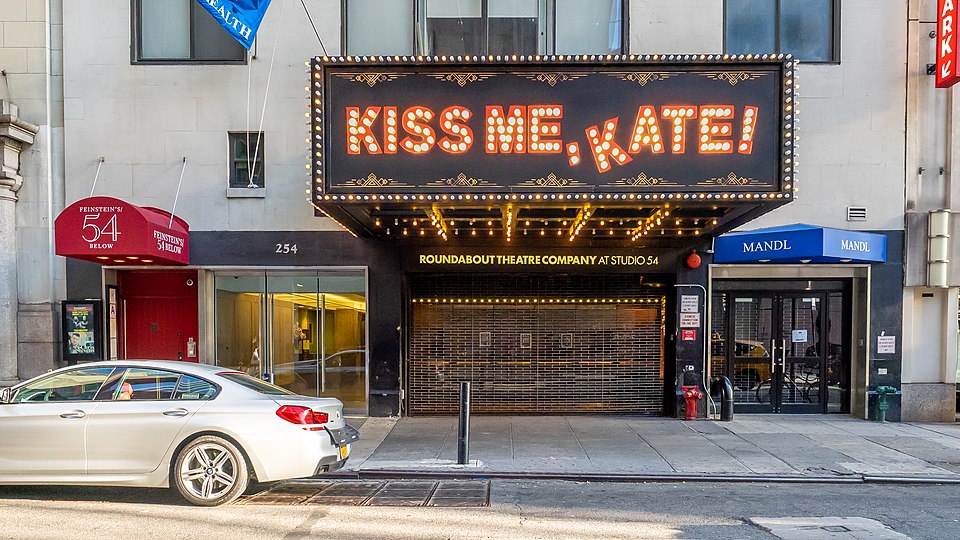
Studio 54 on West 54th Street — one of Broadway’s most distinctive houses, with a layered history and a sharper personality than many neighboring theaters.
Studio 54 Broadway Tickets and Box Office Information
Studio 54 Broadway tickets are currently available for The Rocky Horror Show, playing at 254 West 54th Street through February 28, 2027. Ticket inventory, performance dates and prices belong to the production, so use the approved show page below to review the current schedule before choosing seats.
The Studio 54 box office is open Monday from 12 PM to 6 PM; Tuesday through Saturday from 10 AM to 8 PM, or until showtime for a later performance; and Sunday from 12 PM to 6 PM, or until showtime for an evening performance. Criterion Ticketing is the production’s official online seller. Buying in person may avoid online or phone service fees, while groups of 10 or more should use Broadway Inbound.
Studio 54 at a Glance
What Kind of Broadway Theater Studio 54 Is
Most Broadway houses wear their character openly: the Shubert is a classic 1913 musical house with history in its bones; the St. James has two balconies and the memory of Oklahoma!; the Stephen Sondheim was rebuilt in 2009 with elevator access and engineered acoustics. Studio 54 is harder to categorize cleanly, and that difficulty is precisely what makes the room interesting.
The physical space was built in 1927 as an opera house, repurposed as a television studio, and then transformed into the nightclub that defined — and arguably invented — a certain idea of New York in the late 1970s. When Roundabout moved its production of Cabaret here in 1998, they were not simply occupying another available Broadway house. They were choosing a space whose physical character — the expanse of the room, the industrial quality of the bones, the cultural residue that most Manhattan buildings accumulate gradually but that Studio 54 absorbed at extraordinary speed — suited the production specifically. Sam Mendes, who was producing that Cabaret, considered the club’s dilapidated condition an ideal setting.
That instinct has guided the programming ever since. Roundabout uses Studio 54 for shows that benefit from a room with an edge: Assassins, Pacific Overtures, A Streetcar Named Desire, Lynn Nottage’s Pulitzer Prize-winning Sweat. The house feels more contemporary, more urban, more downtown-adjacent than the ornate 44th Street theaters nearby — even though it is just as much a part of the Broadway ecosystem. Visitors who want maximum traditional theatrical grandeur should probably be at the Majestic or the St. James. Visitors who want a room with a genuinely different energy — and the theatrical credibility to match — are in the right place.
There is one practical note worth registering here: some of the nightclub-era modifications to the space were never fully reversed when Roundabout converted it to a theater. Per architectural records of the renovation, this has required a temporary stage to be installed for every production rather than a fixed stage. That is more of a behind-the-scenes reality than something most visitors notice in practice, but it does mean sightlines vary more by show configuration than at a purpose-built theater — another reason to verify your specific seats for each production.
The Rocky Horror Show at Studio 54
Richard O’Brien’s The Rocky Horror Show is the current Studio 54 Broadway production, with performances scheduled through February 28, 2027. The revival runs about 1 hour 50 minutes, including a 15-minute intermission. Visitors searching for The Rocky Horror Show Broadway tickets should confirm the exact performance date and ticket availability on the dedicated show page.
The Three Levels — What Each One Is
The largest section. Three subsections (center, left side, right side). Rows A through approximately P. Center rows A–E are the premium orchestra; rows F–H are the acknowledged value zone. The rear orchestra has an overhang from the front mezzanine that starts to affect some sight and feel around rows I–P depending on the production’s staging height. Step-free entry; all wheelchair seating here.
The smallest but most praised section for sightlines. Four rows (AA through DD), divided into center, left, and right. Rows AA and BB center are among the best seats in the house — elevated enough for a complete picture, close enough to the stage to feel the production. Consistently outperforms its price relative to center orchestra. Requires stairs to access.
The most budget-friendly tier and the most honestly compromised one. Two sections (left and right — no center section). Very cramped per consistent audience reports. Front rows of the rear mezzanine offer elevated views at low prices; outer rear rows involve significant distance and angle. Know what you’re buying before choosing rear mezzanine side positions.
Studio 54 Seating — Section by Section
The three-level configuration at Studio 54 creates a wider range of seat experiences than a two-level house. The front mezzanine is the sleeper hit of the building — consistently better than its price suggests — while the rear mezzanine requires more care in what you buy. Here is the honest breakdown. For the full row-by-row analysis, seat-map terminology and view guidance, use the dedicated Studio 54 seating guide.
The premium orchestra zone. Rows A through E in the center section are close to the stage and centered for the full picture. Row A positions are the most intimate — excellent for certain kinds of productions, but front-row proximity involves some neck-angle trade-off for elevated staging. Rows C–E are usually the strongest center orchestra positions for balanced proximity and full-stage viewing.
The most consistently praised seats in the house. The front mezzanine at Studio 54 has a strong rake and the four rows (AA–DD) are compact enough that AA and BB center deliver both an elevated stage picture and genuine proximity. For productions with visual staging, choreography, or design that benefits from an overhead view, front-center mezzanine rows AA–BB frequently outperform center orchestra at comparable or lower prices. The upstairs commute requires stairs.
The consistently cited “value zone” of the orchestra. Far enough from the stage to see the full picture clearly, close enough to feel the production rather than just watch it from a distance. Crucially, rows F–H avoid the most significant effect of the mezzanine overhang that begins to feel present in rows I and beyond. Strong seats at a lower price point than rows A–E.
The back rows of the front mezzanine are still meaningfully better than much of the rear mezzanine, and the view remains elevated and complete. Good for budget-conscious visitors who want the mezzanine picture without paying for the prime AA–BB rows. Still requires the same stair climb as the front rows.
The front rows of the rear mezzanine offer elevated views at the lowest ticket prices in the house. For budget-prioritized seats that still deliver a reasonable overhead stage picture, front-center rear mezzanine rows are the right call. The section is small (left and right only — no dedicated center block), so verify which row and which side you are buying. Worth it for the right visitor at the right price.
The rear orchestra section sits under the front mezzanine overhang, which becomes increasingly noticeable from row I onward — some staging height and any scenic elements at the top of the set may be cut off. Side orchestra sections involve increasing lateral angle to the stage. These are the positions where the nightclub-era structural legacy is most felt. Worth avoiding unless they represent a significant price reduction over the center alternatives.
Consistently described as “very cramped.” The rear mezzanine has no center section — it splits into left and right blocks — and the outer positions involve significant angle to the stage, limited legroom, and the furthest distance in the house from the performance. Budget option for the right show; not the choice for a night when the experience matters as much as the production.
Front Mezzanine Consistently Outperforms Its Price Here
At most Broadway houses, “front mezzanine” is a reasonable consolation prize for visitors who couldn’t afford center orchestra. At Studio 54, front mezzanine rows AA and BB center frequently rank as the best seats in the house for shows with strong visual staging. The section is small — only four rows — and the compact mezzanine’s steep rake brings you close to the stage vertically while still providing the full elevated picture. Visitors who discover this on their first visit tend to book it on every subsequent one.
The practical implication: do not default to orchestra simply because it is the level closest to the stage. Check both center orchestra rows C–E and front mezzanine rows AA–BB against each other before buying. At comparable price points, front mezzanine often wins.
Best Seats Based on Who You Are and What You Want
For a first Broadway visit, both positions deliver a strong experience. Center orchestra C–E puts you close and centered; front mezzanine AA–BB gives you the full-stage picture from a considered elevation. If the show has significant visual staging, mezzanine. If you want the physical proximity and energy of being close to the performers, orchestra.
Studio 54 has a distinctive atmosphere that suits a date night well — the house’s layered history and Roundabout’s programming choices mean the productions that end up here tend to be more thought-provoking and personality-driven than a standard commercial Broadway offering. Front mezzanine center delivers a slightly elevated, cinematic quality that works particularly well for the occasion.
If you know Broadway well and want something that does not feel like going back to a familiar room, Studio 54’s programming and physical character reliably deliver that. Front mezzanine is the insider’s choice here — the position that experienced theatergoers book when they know the show benefits from an overhead perspective.
Orchestra rows F–H center are the acknowledged value zone — good sightlines, good proximity, below premium pricing. Front rows of the rear mezzanine are the lowest-price option that still delivers a usable view. Both work; the orchestra F–H rows are consistently the stronger experience.
Wheelchair seating is in the orchestra only: six accessible locations (rows A and B) plus two transfer seats (A 1/2). There is no elevator to the mezzanine levels. Accessible bathrooms are on the orchestra level. Contact Roundabout Audience Services at 212-719-1300 in advance. Do not attempt to reach the mezzanine without confirming access — the building has no elevator to those levels.
For any production where production design, set architecture, or spatial staging is part of the work — which at Studio 54 is often the case — the front mezzanine elevated view is the correct answer. You see everything the designer intended. This is the seat that makes the conversation after the show more interesting.
Accessibility at Studio 54 — What You Need to Know Before You Buy
Studio 54’s accessibility profile is more limited than the newer Broadway houses, and significantly more limited than the Stephen Sondheim Theatre nearby. Know this before choosing your seats.
Street-level entrance from 54th Street
The entrance from West 54th Street is step-free. No steps required to access the orchestra level from the street.
Accessible restrooms
Two accessible restrooms are available on the orchestra level — one on each side. There is a lift to the Golden Lounge below the orchestra level.
Wheelchair accessible locations
Six wheelchair-accessible locations in the orchestra: rows A (seats 7/8) and B (seats 9/10/11/12). Two transfer seats in orchestra (A 1/2). Mezzanine levels require stairs and do not have accessible seating.
Mezzanine access is stairs only
There is no elevator or escalator to the front or rear mezzanine. Any guest who cannot manage stairs must book orchestra seats. Contact Roundabout Audience Services at 212-719-1300 in advance to discuss specific arrangements.
For visitors traveling with anyone who has mobility needs, the guidance is clear: orchestra seats only, and contact Roundabout directly before purchasing to confirm the specific accessible seating options available for your performance date. Studio 54 is wheelchair accessible at the orchestra level, but the mezzanine is simply not reachable without stairs. This is a real limitation of the 1927 building and one that is worth planning around rather than discovering on the night.
How Studio 54 Got to Be What It Is
No other Broadway theater has lived as many lives in the same building.
The nightclub era is worth lingering on for a moment, not because the Bianca Jagger-on-a-white-horse mythology is relevant to your theater visit, but because it explains something about why the room feels the way it does. Steve Rubell and Ian Schrager opened Studio 54 in April 1977, and for a few years in the late 1970s it was the center of a specific kind of New York glamour — louche, inventive, deliberately transgressive — that most venues from that era have long since been sanitized out of. The building carries some of that charge even now, not as nostalgia but as residue. Architectural Digest described Studio 54 as “the nightclub where the velvet rope was born.” GQ called it the natural reference point for “a particular brand of louche elegance on a night-time scene.” Neither sentence applies directly to a Tuesday evening performance of a Roundabout drama. But both sentences explain why walking into the building still feels like entering something with a history that most Broadway houses simply do not have.
When Roundabout arrived in 1998, it was not by plan but by emergency. A construction accident at 4 Times Square blocked access to the Henry Miller’s Theatre (now the Stephen Sondheim Theatre), where Cabaret was running. Roundabout needed a venue fast. Studio 54 was the only option. The building was not air-conditioned and was in poor condition. Sam Mendes considered this an asset — the dilapidated space suited the production’s setting of Weimar-era Berlin. The gamble worked in ways that redefined both the show and the venue. Cabaret ran at Studio 54 from 1998 to 2004, the longest run in the show’s history. Roundabout kept the building.
As of 2025–2026, Roundabout is seeking city and state funding for a $100 million renovation — having raised $45 million toward that goal. The renovation aims to address the structural legacy of the nightclub era, including the sightline complications that require a temporary stage for every production. The building is still a working theater while that process proceeds, and the productions Roundabout mounts there continue to reflect the sense that this is a room built for work with some weight to it.
How Studio 54 Compares to Other Broadway Houses
1913–1927 vintage, purpose-built for Broadway with grand theatrical interiors. More ceremonial, more ornate, more immediately “Broadway” in the traditional sense. Better suited to large-scale musicals expecting classic grandeur. Less personality, less edge. Studio 54 is for visitors who want the theatrical credibility without the traditional package.
More personality than any other house in the district. Contemporary programming sensibility. A room that benefits from its own history rather than performing around it. The choice when you want a Broadway night that feels sharp, culturally aware, and less predictable than a standard Theater District evening.
Rebuilt 2009 with elevator access, LEED certification, and designed acoustics. More comfortable, more accessible, more contemporary-functional. Less personality, less history. The right choice for visitors who prioritize modern comfort and full accessibility over cultural texture and edge. The wrong choice if the room’s character is part of what you are paying for.
How to Plan a Full Night Around Studio 54
West 54th Street between Broadway and 8th is genuinely different from the main Theater District cluster on 44th–47th. One block north of the core does not sound like much, but it is enough to make the pre-show experience noticeably less compressed. The immediate 54th Street block around the theater is calmer, more navigable, and less Times Square–adjacent than the heart of the Theater District.
Where to eat before the show
The 54th Street location gives you good options in several directions. The stretch of 9th Avenue in Hell’s Kitchen — about 10 minutes on foot west of the theater — has the strongest concentration of real neighborhood restaurants in the broader area. Carnegie Hall is two blocks east on 57th, and the restaurant zone around 7th Avenue in the mid-50s has solid pre-show options at a range of price points. Heading south toward the 44th–47th Street restaurant corridor (Restaurant Row on 46th) adds a few minutes of walk time but opens up the full Theater District dining cluster. For strategy and timing, the pre-show dining guide covers the framework. For specific restaurant picks in the Broadway area, see restaurants near Broadway.
Transportation
The 50th Street station (C/E) on 8th Avenue and the 49th Street station (N/W) on 7th Avenue are both within a few blocks. Times Square–42nd Street (1/2/3/7/N/Q/R/W/S) is a walkable 12-minute distance for most visitors. The full transit approach is in the guide to getting to a Broadway show. Parking near 54th Street has the same Midtown premium as anywhere in this zone — see parking near Broadway for the best options.
Hotels
The mid-50s location puts Studio 54 slightly north of the densest Theater District hotel cluster, but the Times Square and Midtown West hotel zones are both within easy walking distance. Carnegie Hall-adjacent hotels on 57th Street are particularly well-positioned for a Studio 54 night. The hotels near Broadway guide covers the full picture. The Theater District neighborhood guide adds context on how the neighborhood around 54th Street compares to the 44th–47th block.
After the show
One of Studio 54’s practical advantages over the most congested Broadway blocks is that the post-show exit is calmer. The 54th Street block does not have the volume of simultaneous exiting audiences that 44th–46th Street produces when the houses let out. Walking north toward 57th Street or west toward 9th Avenue post-show is straightforward. For a post-show drink, the Hell’s Kitchen bar and restaurant corridor on 9th Avenue stays open late and handles post-theater crowds well.
What to Avoid When Planning a Studio 54 Night
Assuming Studio 54 is just another classic Broadway house
It is not. The room, the programming, and the vibe are distinct from the ornate Shubert-era houses two blocks south. Visitors who arrive expecting a standard grand Broadway experience will not find it — and that is not a disappointment, it is a different and often better kind of night. Know what you are going to before you go.
Defaulting to orchestra without checking front mezzanine pricing
At Studio 54, front mezzanine rows AA and BB center are the insider’s choice for most productions. Many visitors who buy orchestra seats first and front mezzanine seats on a return visit wish they had known to reverse that order. Check both before purchasing — at comparable price points, the front mezzanine frequently wins.
Buying rear orchestra without knowing about the mezzanine overhang
The front mezzanine overhangs the rear orchestra. From rows I–P in the orchestra, the overhang can cut off views of tall scenic elements at the top of the stage. This is a function of the building’s structure, not the production’s design. For any show with significant vertical staging, rear orchestra seats are a real compromise. Verify what you are buying.
Not planning accessibility in advance
There is no elevator to the mezzanine levels. Wheelchair seating is in the orchestra only. If any member of your group has mobility needs, this must be factored in before you choose a level. The accessible seats in the orchestra are specific positions — contact Roundabout Audience Services at 212-719-1300 to confirm what is available for your date before purchasing.
Over-romanticizing the nightclub history
The Studio 54 mythology is real and the building’s history is genuinely interesting. But the current theater is a serious Broadway venue operated by one of New York’s most respected nonprofit theater companies, not a time capsule of 1977. The nightclub history gives the room its edge; Roundabout’s programming gives it its credibility. The combination is what makes the night worthwhile.
Plan the Full Studio 54 Night
Here is the rest of the planning cluster to build the evening properly.
Frequently Asked Questions
Use the dedicated The Rocky Horror Show page to review current Studio 54 Broadway tickets, dates and performance details. Criterion Ticketing is the production’s official online seller. You can also buy at the Studio 54 box office, where in-person purchases may avoid online or phone service fees. Groups of 10 or more should use Broadway Inbound.
The Studio 54 ticket office is open Monday from 12 PM to 6 PM; Tuesday through Saturday from 10 AM to 8 PM, or until showtime when a performance begins later; and Sunday from 12 PM to 6 PM, or until showtime for an evening performance. Hours can change around holidays or schedule changes, so verify before making a special trip.
The Rocky Horror Show is currently playing at Studio 54, with performances scheduled through February 28, 2027. The production runs about 1 hour 50 minutes, including a 15-minute intermission.
Studio 54 is at 254 West 54th Street in Manhattan, between Broadway and 8th Avenue, in the Midtown Theater District. The entrance is on 54th Street and is step-free from street level. The nearest subway stations are 50th Street (C/E) on 8th Avenue and 49th Street (N/W) on 7th Avenue, both a few blocks away.
Studio 54 is a ~1,006-seat Broadway house operated by Roundabout Theatre Company, with three seating levels: orchestra, front mezzanine, and rear mezzanine. It has a distinct personality — more contemporary, more edge, more culturally layered than the classic ornate Broadway houses nearby. Roundabout programs it with plays and revivals that benefit from the room’s particular atmosphere: serious, bold work that would feel mismatched at a more ceremonial house. The front mezzanine is particularly well-regarded for sightlines.
Center orchestra rows A–E and front mezzanine rows AA–BB center are the two best positions in the house, and they compete with each other. For productions with significant visual staging, choreography, or production design, front mezzanine rows AA–BB center consistently outperform their price — experienced theatergoers consider this the insider’s choice. Center orchestra rows F–H are the acknowledged value zone: strong sightlines at a below-premium price. The rear mezzanine front-center rows work as a budget option; outer side rear mezzanine positions are cramped and angled.
Partially. Entry from 54th Street is step-free. Six wheelchair-accessible locations are in the orchestra (rows A and B), along with two transfer seats in the orchestra. There is a lift to the Golden Lounge below the orchestra level. Accessible restrooms are on the orchestra level. However, there is no elevator to the mezzanine levels — both front and rear mezzanine require stairs. Wheelchair seating is orchestra only. Contact Roundabout Audience Services at 212-719-1300 in advance to arrange specific accessible seating.
No elevator to the mezzanine. There is a lift to the Golden Lounge below the orchestra level, but both the front mezzanine and rear mezzanine require stairs to reach. This is a fixed limitation of the 1927 building. Any guest who needs elevator access must book orchestra seats — contact Roundabout in advance to confirm which orchestra positions are step-free and accessible.
Studio 54 is operated by Roundabout Theatre Company, one of New York’s major nonprofit theater organizations. Roundabout purchased the building after bringing its production of Cabaret there in 1998 and has operated it as a Broadway theater ever since. It is one of Roundabout’s three Broadway venues, alongside the Todd Haimes Theatre and the Stephen Sondheim Theatre.
The Studio 54 era at Roundabout has included some of the most notable productions of the past 25 years: the landmark revival of Cabaret (1998–2004), Stephen Sondheim and John Weidman’s Assassins (2004), Tennessee Williams’s A Streetcar Named Desire (2005), Lynn Nottage’s Pulitzer Prize-winning Sweat (2017), and more recently Days of Wine and Roses (2024), A Wonderful World (2024), and Jean Smart’s Call Me Izzy (2025). The current production is The Rocky Horror Show, scheduled through February 28, 2027.
The 54th Street location makes 9th Avenue in Hell’s Kitchen (about 10 minutes west on foot) a strong pre-show dinner option — real neighborhood restaurants without Times Square tourist-facing pricing. The Carnegie Hall area on 57th Street also has solid options within a short walk east. Budget extra walk time for arriving from Times Square transit — the 12-minute walk from Times Square–42nd Street is accurate but assumes no delays. Full pre-show logistics are in the pre-show dining guide.
Studio 54 — Broadway With Something Else Behind It
Studio 54 is the Broadway theater that rewards visitors who want more than a standardized night out at a classic house. The Roundabout programming is serious, the room has genuine character, and the building’s history gives every visit a layer of context that purpose-built theatrical venues simply cannot replicate. No other Broadway theater has been an opera house, a nightclub, a CBS studio, and the locus of one of the most famous cultural moments of the 20th century.
Book front mezzanine rows AA–BB center when the show has visual ambition. Book center orchestra rows C–F when you want the energy of proximity. Know that the rear orchestra overhang matters, and that the rear mezzanine outer sections are a genuine trade-off. Plan dinner in Hell’s Kitchen or the mid-50s zone rather than in the thick of Times Square. And walk into a building that has earned its atmosphere the hard way — by living it, rather than designing it.
Studio 54 Is Broadway With a Pulse — Now Plan the Room
Studio 54 is not just another Broadway house. It is a former opera house, CBS studio, nightclub, and Roundabout venue with a room personality that changes how you choose seats, plan dinner, and move through the night. Start with the dedicated seating guide, then connect the theater to Rocky Horror, West 54th Street, Hell’s Kitchen dining, Midtown hotels, transit, parking, and nearby Broadway houses.
Studio 54 Seating Chart & Best Seats
Compare Front Mezzanine, Center Orchestra, Rear Mezzanine warnings, Rocky Horror sightlines, accessibility, overhang issues, and seats to avoid.
Open Seating Guide Current ShowThe Rocky Horror Show
Browse the Broadway shows hub and connect Rocky Horror’s cult-show energy with seat choice, timing, and full Theater District planning.
Browse ShowsBroadway Seating, Theater & Ticket Strategy
Seats · Shows · ValueBroadway Seating Guide
Compare Orchestra, Mezzanine, Balcony, boxes, side seats, premium zones, and view tradeoffs across Broadway houses.
All Broadway Theater Guides
Browse every Broadway house guide and compare room scale, location, access notes, seating strategy, and night-out fit.
What’s Playing on Broadway
Compare current and upcoming Broadway productions, then connect each show to the right theater, seat choice, and night plan.
First-Time Broadway Guide
For visitors choosing their first show: seats, arrival, timing, dress, intermission, crowds, and Theater District basics.
When to Buy Broadway Tickets
Know when buying early matters, when waiting can work, and how timing changes for premium seats and hot limited runs.
Last-Minute Broadway Tickets
Compare same-day options without accidentally grabbing tight upper-level seats or rough side angles when better value exists.
Plan the Studio 54 Night
Dinner · Hotels · TransitRestaurants Near Broadway
Use the broader Broadway dining guide when you want a reliable pre-show meal before heading to West 54th Street.
Restaurants Near Times Square
Useful when your group wants a simple Broadway dinner zone before walking north toward Studio 54.
Pre-Show Dining Guide
Plan reservation timing, walking buffer, late-seating risk, and post-show movement around a high-energy Studio 54 night.
Hotels Near Broadway
Compare Theater District, Times Square, Midtown West, and Hell’s Kitchen hotel zones for a Broadway-centered trip.
Hotels Near Times Square
Best for visitors who want easy subway access, Broadway density, and a simple walk or ride to West 54th Street.
How to Get to a Broadway Show
Subway, walking, rideshare, and arrival timing for Broadway theaters, including Studio 54 on West 54th Street.
Subway to Broadway
Pick the right subway approach for Midtown, Times Square, 50th Street, and the north Theater District.
Parking Near Broadway
When driving makes sense, when it does not, and how to avoid turning a Studio 54 night into a Midtown garage problem.
Best Way Home After a Show
Subway, taxi, rideshare, walking, and hotel return strategy after a late, crowded, high-energy Broadway night.
Nearby Neighborhood & Theater Guides
54th Street · Hell’s Kitchen · RoundaboutHell’s Kitchen
A strong pre- and post-show dining base west of Studio 54, especially if you want less Times Square chaos.
Midtown West
Useful for 54th Street hotels, restaurants, subway access, and less obvious north-Theater-District planning.
Theater District
The practical guide to Broadway’s center: theaters, crowds, hotels, restaurants, walking routes, and visitor logistics.
Todd Haimes Theatre Guide
Compare Studio 54 with Roundabout’s newly renovated Broadway flagship on 42nd Street.
Stephen Sondheim Theatre Guide
Compare Studio 54’s Orchestra-only access with one of Broadway’s strongest modern accessibility houses.
Hudson Theatre Guide
Compare another distinctive Broadway room with a different scale, seating feel, and Midtown night-out pattern.