

Todd Haimes Theatre Tickets Broadway Seats, Box Office & Guide
Find Todd Haimes Theatre Broadway tickets, upcoming show dates, box-office hours, accessibility details and everything needed to plan the night.
The Todd Haimes Theatre is Broadway’s most recently renovated historic house — and the one that most rewards visitors who care about the complete theatergoing experience, not just the show title.
At 227 West 42nd Street, the Todd Haimes is Roundabout Theatre Company’s flagship Broadway home: 740 seats across two levels, an Italian Renaissance interior restored to its 1918 proportions, and — as of spring 2026 — the full benefit of a major renovation that included new seats, renovated restrooms, modernized elevators, expanded accessible seating and upgraded assistive-listening technology. The building that opened as the Selwyn Theatre more than a century ago now functions as one of the most carefully maintained and thoughtfully operated Broadway houses in the district.
This is not where you go for spectacle or scale. The Todd Haimes seats 740 people — significantly smaller than the St. James or the Majestic, closer in scale to an intimate Broadway house than a major musical venue. Roundabout programs it accordingly: plays, quality revivals, actor-driven work that benefits from a room where you can see every expression without binoculars. This guide is for visitors who want to understand what they are walking into — what the room is like now, where the best seats are, and how to build the kind of night this theater is built for.
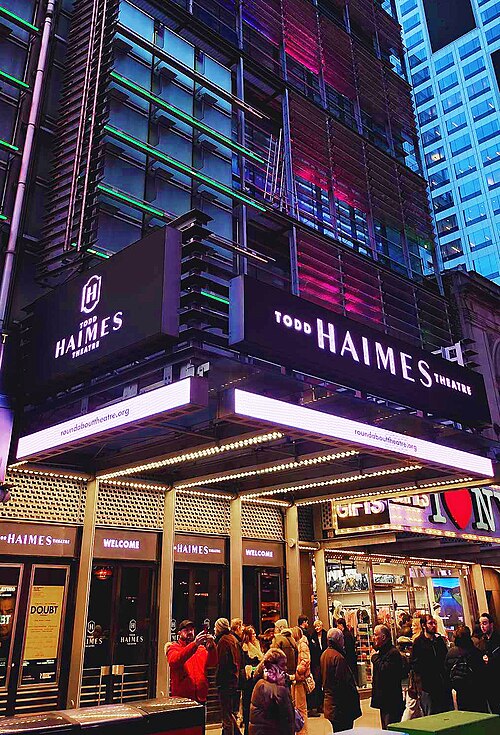
Todd Haimes Theatre at night on West 42nd Street — a strong current exterior image for the theater page, with the updated marquee and a clear Broadway streetscape feel.
Todd Haimes Theatre Broadway Tickets and Box Office Information
Todd Haimes Theatre Broadway tickets are available for The Imaginary Invalid, scheduled at Roundabout’s 227 West 42nd Street venue from September 25 through November 22, 2026. Bill Irwin stars in his new adaptation of Molière’s comedy, directed by Brandon J. Dirden, with Rachel Bloom in her Broadway debut. It runs about 90 minutes with no intermission. For cast, story, ticket tips and planning, see our full Imaginary Invalid show guide. Next up at the Todd Haimes is Mix and Master, Dominique Morisseau’s new play with Kara Young and Ruben Santiago-Hudson, from January 5 through February 28, 2027.
The Todd Haimes Theatre box office is open Monday through Saturday from 10 AM to 6 PM and closed Sunday. Criterion Ticketing is the official online ticket seller linked by Roundabout. Box-office hours and performance inventory can change, so verify the current schedule before making a special trip.
The Todd Haimes Theatre at a Glance
What Kind of Broadway Theater the Todd Haimes Is
The Todd Haimes occupies a specific and deliberately chosen position in Broadway’s ecosystem. It is not where the biggest commercial musicals play — those need the St. James or the Gershwin, houses designed for scale and spectacle. It is not an off-Broadway intimate space where 199 seats surround a thrust stage. The Todd Haimes is a 740-seat Broadway house in a restored Italian Renaissance building, operated by the most artistically focused major nonprofit on the Broadway circuit, running plays and quality revivals that belong in a room where clarity and proportion matter more than sheer size.
The physical experience reflects those priorities. At 740 seats — compared to the St. James’s 1,709 or the Majestic’s 1,800-plus — you are in a room where no seat feels far from the stage. The orchestra is steeply raked, which means even rows toward the back maintain strong sightlines rather than fighting to see over heads in front. The single mezzanine (no second balcony, no rear mezzanine) is compact enough that its continental seating — no center aisle, seven rows of forty seats each — reads more as an elevated extension of the orchestra than a separate tier. The original design, which a contemporary account described as aiming for a “cozy” feeling rather than the grandeur of two-balcony houses, still reads clearly in the room today.
The major renovation completed in spring 2026 addressed what decades of use had weathered. The Neo-Renaissance interior — murals, ornamental plasterwork and yellow-marble balustrade staircases — was restored. The seats were replaced, the restrooms were renovated, the elevators were modernized, and assistive-listening technology was upgraded. A new third-floor flexible-use space, the Mustang Hub, was also created for rehearsals, education and community programming. The result is a historic room in genuine working order rather than one maintained to minimum operational standards.
Roundabout’s programming has consistently matched the room. Since 2000, the Todd Haimes has hosted plays by David Auburn, Wendy Wasserstein, Edward Albee, Tom Stoppard, and others; notable revivals; and world-premiere productions that Roundabout incubates through its commitment to new American theater. The most recent seasons brought Sanaz Toossi’s Pulitzer Prize-winning English and a jazz-reimagined Pirates of Penzance. The programming philosophy is quality-first rather than commercial-first — which is why the productions that end up here often feel more considered, more carefully mounted, and more interesting to discuss after the fact than a standard commercial Broadway offering at a similar price point.
Where the Todd Haimes Sits — and Why the Address Changes Everything
227 West 42nd Street is the most transit-saturated address in the Theater District, and possibly in all of Manhattan. The 42nd Street–Times Square station, which serves the 1/2/3, 7, N/Q/R/W, and S trains, is directly below the block. The 42nd Street–Port Authority station (A/C/E) is half a block west. The 42nd Street–Bryant Park station (B/D/F/M and 7) is a short walk east. If you are arriving by subway from anywhere in the five boroughs, getting to the Todd Haimes is essentially frictionless.
The 42nd Street location also means you are at the geographic center of the Theater District rather than at its northern or southern edges. Everything within the district is accessible from 42nd Street on foot: the 44th–47th Street cluster of older houses, Hell’s Kitchen restaurants to the west, Times Square to the east, Hotel Row to the north. You are not in a transit desert or a neighborhood that requires logistical planning to reach. You are at the intersection.
One honest note on the immediate block: West 42nd Street between 7th and 8th is one of the most commercially and pedestrian-busy blocks in Manhattan. On a busy show night, arriving at 7:57 for an 8pm curtain involves navigating real foot traffic. The building’s entrance is on the north side of 42nd Street, which adds some orientation time for first-time visitors. Give yourself more than the minimum transit time, and note the 42nd Street entrance specifically when planning your approach. The Theater District neighborhood guide covers the full planning context for this part of Midtown.
One additional note that rewards knowing: the building that houses the Todd Haimes also contains The Duke on 42nd Street — a 199-seat off-Broadway theater on the second floor — and the New 42nd Street Studios, a rehearsal complex used by nonprofits throughout the city. The building is a genuine hub of working theater rather than a commercial venue surrounded by souvenir shops. That changes the feel of arriving.
Todd Haimes Theatre Seating — Section by Section
With 740 seats across two levels, the Todd Haimes has a narrower range of seat quality than larger houses — there are no genuinely bad positions here in the way that rear side balcony at the St. James or the back-of-floor at Barclays can be. But the specific positions that outperform their price are worth knowing. For the full row-by-row analysis, seat-map terminology and view guidance, use the dedicated Todd Haimes Theatre seating guide.
The orchestra is divided into three sections (left, center, right) by two side aisles. The mezzanine has a continental seating configuration — no center aisle, seven rows of forty seats each — which means you navigate to your seat along the row itself rather than from a center aisle. This is worth knowing before the show, especially if you need to get out during the performance.
The prime position at the Todd Haimes. Far enough from the stage to take in the full picture without neck-craning, close enough that facial expression and physical performance are fully legible without effort. The steeply raked orchestra means sightlines stay clean even in rows G and H, where you would be fighting for visibility at a flat-floored venue. These rows represent the heart of what this theater was built to deliver.
The front two rows of the center mezzanine consistently rank among the most sought-after seats in the house. Row A center is especially praised for its combination of elevated overview and genuine proximity — you see the full stage picture without feeling separated from the performance. A strong choice for plays where staging and spatial relationships between characters matter as much as individual performances.
The mid-to-rear center orchestra. The steep rake keeps sightlines workable further back than at many comparable houses — rows I through N are not the premium zone but they are still inside the main performance experience rather than outside it. Good value positions for visitors who want center without the front-row price premium. Note: the seats at the back of the orchestra (row P) are sometimes configured as a rear section with additional legroom.
Mid-mezzanine center stays in good sightline territory thanks to the mezzanine’s compact seven-row configuration. You are never more than seven rows back in the mezzanine. Rows C through E offer the elevated perspective at a meaningfully lower price than rows A–B. Worth choosing over rear orchestra for visitors who prefer the cleaner overhead view of a stage.
The side orchestra sections involve increasing lateral angle the further from center you go. Front-side rows close to the center section are workable and often priced below center orchestra. Outer side sections involve real angle. Booster seats are available at the theater, which helps shorter visitors in the center orchestra — less relevant in side positions where angle is the main variable.
A specific and documented issue at the Todd Haimes: seats near the exit doors on the right side of the orchestra can be affected by street noise from 42nd Street. The sound insulation under the back rows helps with general rumble, but the exits are a different matter. If you are particularly sensitive to ambient noise during quiet dramatic moments, verify your specific seat positions relative to those exits before purchasing.
The mezzanine uses continental seating: no intermediate aisles, forty seats per row. To reach your seat, you enter from the side aisle and navigate along the row itself. This is elegant in design and slightly awkward in practice if you need to arrive after others in your row are seated, or if you need to leave during the show. Arrive before the house is fully seated if you can. Not a reason to avoid the mezzanine — just worth knowing.
740 Seats Means No Position Is Genuinely Isolated From the Stage
At the Majestic or the St. James, the rear balcony puts you at a distance from the performance that is genuinely compromising — steep stairs, significant distance, real sightline trade-offs. At the Todd Haimes, the scale is small enough that the worst seat in the house is still in the same room as the production in a meaningful way. Center orchestra rows C–H are the prime zone. Mezzanine rows A–B center are the elevated equivalent. But even mid-mezzanine and rear orchestra center are inside the performance rather than watching it from a remove.
The practical implication: at this theater, the decision is less about avoiding bad seats and more about choosing the right kind of experience — proximity-forward (center orchestra C–F), overview-forward (mezzanine A–B center), or value-forward (mid-orchestra or mid-mezzanine center). All three work.
Best Seats Based on Who You Are and What You Want
For a first Broadway visit, the Todd Haimes at its intimate scale delivers something larger houses cannot: a room where you feel the performance happening close enough to matter. Center orchestra rows D–G is the ideal first Broadway position — close enough for the production to feel present, scaled correctly for a meaningful first experience.
For a play — especially a work that depends on performance detail, physical expression, and the subtler moments of theatrical acting — center orchestra rows C–F gives you the proximity to read everything. Mezzanine row A center is the right call if you want to see spatial relationships and blocking clearly alongside individual performance detail.
The Todd Haimes is one of Broadway’s better date-night theaters: a composed, well-maintained room with the Penthouse Lobby above for a pre-show drink, good transit access for arrival, and Roundabout’s programming which tends toward plays and works that generate real conversation afterward. Both center orchestra and front mezzanine center work well for the occasion.
At a 740-seat house, mid-mezzanine center rows C–E are not the compromise position they would be at a larger theater. The compact mezzanine means even rows C–E remain in genuine viewing range. A solid option for visitors who want a complete experience at a lower price point.
The Todd Haimes has 11 wheelchair spaces across the orchestra and balcony, elevator access to all levels, 6 orchestra transfer seats and 2 balcony transfer seats, accessible restrooms on the lobby and penthouse levels, and upgraded assistive-listening technology. Contact Roundabout at 212.719.9393 in advance to confirm specific seat arrangements. This is the right house for accessibility-conscious planning.
The 42nd Street entrance and the modernized elevators make the Todd Haimes particularly navigable for guests who need to avoid stairs or need more time to move through a venue. The orchestra level is accessible from the lobby without steps. The elevator to the mezzanine is newly modernized. Contact Roundabout in advance to discuss the specific path to your seats.
Accessibility at the Todd Haimes — Substantially Upgraded in 2026
The major renovation completed in spring 2026 substantially improved accessibility at the Todd Haimes Theatre. Elevators were modernized, wheelchair locations were expanded and assistive-listening technology was upgraded.
What Changed — and What Was Already Here
The combination of elevator access to all levels, wheelchair seating in both the orchestra and balcony, accessible restrooms on two levels and upgraded assistive-listening equipment makes the Todd Haimes unusually navigable for a historic Broadway house. Confirm the exact accessible seat configuration and device availability with Roundabout before booking.
The Todd Haimes Theatre — What the Building Has Been and Who It’s Named For
The building at 227 West 42nd Street has had more names than most Broadway theaters, and each name reflects a different relationship between the institution and its moment. It opened in 1918 as the Selwyn Theatre, designed by George Keister in the Italian Renaissance style for brothers Edgar and Archibald Selwyn. The Selwyn was built for plays and musicals at a moment when 42nd Street was Broadway’s commercial center rather than its tourist-facing margin. The original house seated 1,180 — nearly 60 percent more than it holds now.
Like many 42nd Street theaters, the Selwyn’s trajectory through the mid-20th century was a gradual one toward disrepair: movie house by the 1930s, eventual closure, the long dormancy of the 42nd Street corridor. Roundabout began working with the space in the late 1990s, and the theater was rebuilt as part of the 42nd Street Development Project — a city-backed effort to restore the street’s theatrical character. The renovation preserved the Italian Renaissance interior: the murals, the ornamental plasterwork, the yellow marble balustrades connecting orchestra and balcony. American Airlines bought the naming rights in 2000 for $8.5 million, and the theater operated as the American Airlines Theatre for more than two decades.
The renaming in January 2024 was different in kind. Todd Haimes joined Roundabout in 1983 and led the organization as artistic director until his death from cancer in April 2023. Under his tenure, Roundabout grew from a 500-member subscription organization to one of the largest nonprofit theaters in the United States — and did it while maintaining a serious commitment to the work rather than simply scaling for commercial growth. Naming the flagship house for him was an institutional act of gratitude and memory, not a commercial transaction. The theater is now named for the person most responsible for what Roundabout is.
The 2025–2026 renovation, which reopened the house in spring 2026 after six months of construction, was the most substantial investment in the building since the original 2000 restoration. Public support totaled $13.9 million from New York City and New York State. The work restored the historic interior, replaced the seating, modernized the elevators, renovated restrooms and dressing rooms, upgraded assistive-listening and core building systems, and created the third-floor Mustang Hub. The building is now in the best condition of its modern life.
The Imaginary Invalid on Broadway
The Imaginary Invalid plays the Todd Haimes Theatre from September 25 through November 22, 2026, with opening night on October 22. Tony Award winner Bill Irwin stars as Argan in his new adaptation of Molière’s comedy, with Rachel Bloom as Toinette and Brandon J. Dirden directing. At about 90 minutes with no intermission, it’s a good fit for this 740-seat room: a comedy that depends on faces, timing and physical detail.
Our Imaginary Invalid show guide covers the story, full cast, who it suits, previews versus opening, Roundabout’s $30 Hiptix option and how to plan the night. Note that Roundabout has announced Madeline Seidman will play Toinette on November 3 and 10.
Mix and Master on Broadway
Mix and Master follows at the Todd Haimes Theatre, with previews from January 5, 2027, opening night on January 27, and a limited run through February 28. Dominique Morisseau’s new play is set in the last record shop in the Bronx, where a rising DJ fights to keep the music alive and hip-hop and jazz collide across generations. Tony winners Kara Young and Ruben Santiago-Hudson star, Kamilah Forbes directs, and the production includes live DJ sets.
Our Mix and Master show guide covers tickets, cast, dates, Roundabout’s $30 Hiptix and how to plan the night. For a play that lives on faces and dialogue, the same center-orchestra and front-mezzanine logic in the seating section above applies.
How the Todd Haimes Compares to Other Broadway Houses
1,700–1,900 seats. Built for scale and spectacle — large musicals with production design that fills the room. Impressive at full capacity for the right show. No elevator, limited accessibility at several. The wrong choice for the kind of actor-driven, text-first work the Todd Haimes programs. The right choice when the production needs the scale.
Intimate enough for plays to land with full weight. Accessible to all levels by elevator. Just renovated. Programming that reflects quality over commercial scale. The right choice when the night is about the work, the room, and the full experience — and when you want a theater that functions as well as it looks.
600–900 seats. Even closer to the stage, even more chamber-like. Strong for small-cast plays and productions where extreme physical proximity changes the meaning. The Todd Haimes is slightly larger, slightly more formal, and more amenity-forward — it feels more like a proper Broadway night and less like an intimate workshop. Different tonal register.
How to Plan a Full Night Around the Todd Haimes Theatre
The 42nd Street location is the most logistically convenient Broadway address for most visitors. Here is how to use it well rather than just efficiently.
The Penthouse Lobby — the pre-show asset most visitors don’t know to use
The fifth-floor Penthouse Lobby is one of the theater’s most distinctive audience amenities, with bright windows, access to a deck overlooking 43rd Street, drinks and light bites. Arriving early enough to enjoy the space can turn pre-show waiting time into part of the night. Confirm availability for your specific performance with Roundabout.
Where to eat before the show
The 42nd Street location puts you equidistant from multiple dining zones. Hell’s Kitchen on 9th Avenue (10 minutes on foot west) has the best concentration of real neighborhood restaurants in the broader Theater District. Restaurant Row on West 46th Street between 8th and 9th is the nearest concentrated pre-theater dining cluster. Bryant Park on 6th Avenue is a short walk east with strong mid-range options. The full timing strategy is in the pre-show dining guide; for specific picks, see restaurants near Broadway.
Transportation
There is no better-served Broadway address by transit than 42nd Street. Times Square–42nd Street (1/2/3/7/N/Q/R/W/S) is steps away. 42nd Street–Port Authority (A/C/E) is half a block west. 42nd Street–Bryant Park (B/D/F/M) is a short walk east. If you are coming by subway from anywhere in the city, this is the easiest arrival in the district. Full logistics are in the guide to getting to a Broadway show. Parking on or near 42nd Street has the standard Midtown premium — see parking near Broadway for the best garage options in the area.
Hotels
The Times Square and midtown west hotel clusters are all within easy walking range. The hotels near Broadway guide covers the best options. For the Todd Haimes specifically, any hotel between 40th and 50th Streets west of 6th Avenue is a practical base with minimal arrival logistics.
What to Avoid When Planning a Todd Haimes Night
Confusing intimate scale with limited experience
740 seats is small by Broadway commercial standards, not by theatrical standards. What the scale delivers — every seat meaningfully close to the stage, acoustic clarity throughout, the sense of being inside the work rather than in front of it — is exactly what the house was designed for. Visitors who expect a large-scale musical experience will be choosing the wrong house; visitors who want a play or a quality revival to land with full weight will find the scale an asset.
Arriving without knowing about the 42nd Street entrance
The entrance is on the north side of 42nd Street, between 7th and 8th. First-time visitors sometimes look for the theater in the wrong direction or miss the entrance in the 42nd Street pedestrian flow. The block is busy. The address is 227 West 42nd — look for it on the north side and give yourself adequate approach time.
Buying right-side exit-adjacent seats without checking for street noise
Documented by multiple audience members: seats adjacent to the right-side exit doors can be affected by street noise from 42nd Street, particularly during quiet dramatic moments. The 2025 renovation improved general sound insulation but the exit-door adjacency is a specific issue. Verify your specific seat positions relative to those exits before purchasing, especially for a quieter dramatic play.
Not using the Penthouse Lobby as a pre-show space
Most visitors walk in, find their seats and skip the upstairs lounge. The Penthouse Lobby on the fifth floor is a genuine pre-show amenity — arrive early, take the elevator upstairs and treat the pre-show drink as part of the evening rather than logistics. It changes the texture of the night.
Overlooking the mezzanine’s continental seating configuration
The mezzanine has no center aisle — forty seats per row, enter from the side. If you are in the middle of the row and arrive after the row has filled, you will need to excuse yourself past multiple seated guests. Not a reason to avoid the mezzanine, but worth arriving before the house is full if your seats are in the center section of a middle row.
Plan the Full Todd Haimes Theatre Night
The theater is the anchor. Here is everything else for the planning cluster.
Frequently Asked Questions
Use Roundabout Theatre Company’s official production page to review Todd Haimes Theatre tickets, dates and live availability. Criterion Ticketing is the official online seller linked by Roundabout. You can also buy in person at the Todd Haimes Theatre box office at 227 West 42nd Street; Broadway Inbound handles group tickets.
The Todd Haimes Theatre box office is open Monday through Saturday from 10 AM to 6 PM and closed Sunday. Hours can change around holidays or production schedules, so check with Roundabout before making a special trip.
The Imaginary Invalid, starring Bill Irwin in his new adaptation of Molière’s comedy, is scheduled at the Todd Haimes Theatre from September 25 through November 22, 2026. Next is Mix and Master, Dominique Morisseau’s new play starring Kara Young and Ruben Santiago-Hudson, from January 5 through February 28, 2027. Confirm the exact performance calendar and ticket availability on Roundabout’s official production page.
The Todd Haimes Theatre is at 227 West 42nd Street in Manhattan, between 7th Avenue and 8th Avenue. The entrance is on the north side of 42nd Street. The nearest subway stations are Times Square–42nd Street (1/2/3/7/N/Q/R/W/S), steps from the theater, and 42nd Street–Port Authority (A/C/E), half a block west. It is one of Broadway’s best-served addresses by transit.
The Todd Haimes is a 740-seat Broadway house operated by Roundabout Theatre Company, with two levels (orchestra and single balcony) in an Italian Renaissance interior that was originally built in 1918 and most recently renovated in 2025–2026. It is one of Broadway’s more intimate commercial houses — well-maintained, thoughtfully operated and specifically suited to plays and quality revivals rather than large-scale musicals. The latest renovation added new seats, renovated restrooms, modernized elevators, expanded accessible locations and upgraded assistive-listening technology.
Yes. All levels are accessible by elevators modernized in 2026. The venue lists 11 wheelchair spaces: 6 in the orchestra and 5 in the balcony. Transfer seats are in the orchestra (rows B, G and K) and balcony (row F). Accessible restrooms are on the lobby level and in the Penthouse Lobby on Level 5, and assistive-listening devices are available. Contact Roundabout at 212.719.9393 in advance to arrange specific accessible seating.
Yes. The elevators at the Todd Haimes Theatre reach all levels, including the front and rear mezzanine. The elevators were modernized as part of the 2025–2026 renovation. This distinguishes the Todd Haimes from many older Broadway houses — such as the Shubert, St. James, or Majestic — where upper levels require stairs only.
Center orchestra rows C through H are the prime positions — far enough for the full stage picture, close enough for physical performance detail. Mezzanine row A center is the most sought-after elevated position, offering a sweeping overhead view with genuine proximity. Mid-orchestra center (rows I–N) and mid-mezzanine center (rows C–E) are solid value alternatives. Note: seats near the right-side exit doors in the orchestra can be affected by 42nd Street street noise during quiet moments — worth checking your specific seat location before purchasing.
Yes — strongly recommended. The 740-seat scale means no seat feels remote from the stage, the recently renovated facilities are in excellent condition, and the transit access is the best of any Broadway house. Roundabout’s programming is quality-first, which means productions here tend to reward first-time visitors with something more substantive than a standard commercial Broadway offering. Center orchestra rows D–G is the ideal first-Broadway seat at this theater.
The Todd Haimes Theatre is operated by Roundabout Theatre Company, one of New York’s major nonprofit theater organizations. The building is owned by the city and state of New York and leased to New 42nd Street. The theater was renamed in 2024 in memory of Todd Haimes, who served as Roundabout’s artistic director from 1983 until his death in 2023.
Arrive early enough to use the fifth-floor Penthouse Lobby — one of Broadway’s more distinctive pre-show amenities, available by elevator and worth treating as part of the evening. For dinner, Hell’s Kitchen on 9th Avenue (10 minutes west on foot) or Restaurant Row on 46th Street are the strongest pre-theater options. The full pre-show logistics are in the pre-show dining guide. Give yourself more than minimum arrival time because the 42nd Street block is busy and the entrance is on the north side.
The Todd Haimes Theatre — Broadway as a Complete Experience
The Todd Haimes Theatre is the right house for visitors who care about the whole experience, not just the ticket. Roundabout’s programming is quality-first. The room is intimate enough for the work to land fully. The 2026 renovation added new seats, renovated restrooms, modernized elevators, expanded accessible locations and upgraded assistive-listening technology, while restoring the historic Italian Renaissance interior.
Get center orchestra rows C–H for the proximity-forward experience, or balcony row A center for the elevated overview. Have a drink in the Penthouse Lobby before the show. Take the transit connection that puts you at 42nd Street faster than almost anywhere else in the district. And walk into a room built in 1918, restored for Roundabout in 2000 and comprehensively renewed in 2026.
Todd Haimes Is Broadway’s Renovated Playhouse — Now Plan the Right Night
The Todd Haimes Theatre gives you intimate Broadway scale, Roundabout polish, a major 2026 renovation, and one of the strongest accessibility profiles in the Theater District. Start with the seating guide, then connect the theater to The Imaginary Invalid, dinner, hotels, transit, parking, Times Square, Bryant Park, and nearby Broadway houses.
Todd Haimes Seating Chart & Best Seats
Compare Center Orchestra, Mezzanine Row A, renovated access, induction loop, sightlines for The Imaginary Invalid, value rows, and seats to avoid.
The Imaginary Invalid at Todd Haimes
Bill Irwin adapts and stars in Molière’s comedy with Rachel Bloom in her Broadway debut — cast, story, 90-minute runtime, Hiptix discount, ticket timing, and full night planning.
Broadway Seating, Theater & Ticket Strategy
Seats · Shows · ValueMix and Master at Todd Haimes
Dominique Morisseau’s new play with Kara Young, Ruben Santiago-Hudson and live DJ sets. Limited run through Feb 28.
Broadway Seating Guide
Compare Orchestra, Mezzanine, Balcony, boxes, side seats, premium zones, accessibility, and view tradeoffs across Broadway houses.
All Broadway Theater Guides
Browse every Broadway house guide and compare room scale, location, access notes, seating strategy, and night-out fit.
What’s Playing on Broadway
Compare current and upcoming Broadway productions, then connect each show to the right theater, seat choice, and night plan.
First-Time Broadway Guide
For visitors choosing their first show: seats, arrival, timing, dress, intermission, crowds, and Theater District basics.
When to Buy Broadway Tickets
Know when buying early matters, when waiting can work, and how timing changes for premium seats and limited runs.
Plan the Todd Haimes Theatre Night
Dinner · Hotels · TransitRestaurants Near Broadway
A reliable pre-show meal before walking into the 42nd Street theater zone.
Restaurants Near Times Square
Stay close to Todd Haimes, Times Square transit, Port Authority, and the Broadway crowds.
Best Pre-Theater Restaurants
Pick a restaurant that fits the curtain time, walking route, and kind of night you’re planning.
Hotels Near Broadway
Compare Theater District, Times Square, Bryant Park, and Hell’s Kitchen hotel zones for a Broadway trip.
Hotels Near Times Square
Short walks, easy subway access, and simple post-show return logistics after Todd Haimes.
How to Get to a Broadway Show
Subway, walking, rideshare, and arrival timing, including Todd Haimes on West 42nd Street.
Subway to Broadway
The right subway approach for 42nd Street, Times Square, Port Authority, and Bryant Park.
Parking Near Broadway
When driving makes sense, when it doesn’t, and how to avoid a Midtown garage headache.
Best Way Home After a Show
Subway, taxi, rideshare, and walking strategy after a crowded 42nd Street performance.
Nearby Neighborhood & Theater Guides
42nd Street · Roundabout · Accessible HousesTimes Square
Hotels, transit, crowd planning, and the classic Broadway arrival flow.
Theater District
Broadway’s center: theaters, crowds, hotels, restaurants, and walking routes.
Bryant Park / Midtown South
A calmer base for a 42nd Street show without staying in the Times Square crush.
Stephen Sondheim Theatre
Another strong accessibility house, in a larger, more modern-feeling Broadway room.
Studio 54
Roundabout’s edgier former-nightclub Broadway house on West 54th Street.
Hayes Theatre
Another intimate house where actor detail and sightlines matter more than spectacle.