

The St. James Theatre — A Complete Broadway Guide
What this house is actually like, where to sit for a musical, the full accessibility picture, and how to build the kind of Theater District night that does the occasion justice.
The St. James Theatre has the deepest musical-theater pedigree of any Broadway house still operating. That is not hyperbole — it is what the record shows.
At 246 West 44th Street, the St. James is a large, traditionally proportioned Broadway house with around 1,709 seats across orchestra, mezzanine, balcony, and boxes. It opened in 1927, was designed by Warren and Wetmore — the same firm behind Grand Central Terminal — and has the quality that only comes from nearly a century of serious theatrical use: a room that feels like it knows what it is for. The St. James is for big Broadway musicals. Everything about the way the room is built reflects that.
This guide is for people who want to know what sitting in the St. James is actually like — which seats to target and which to avoid, what the stair situation really means in a building of this age, and how to plan the kind of night this theater is built for.
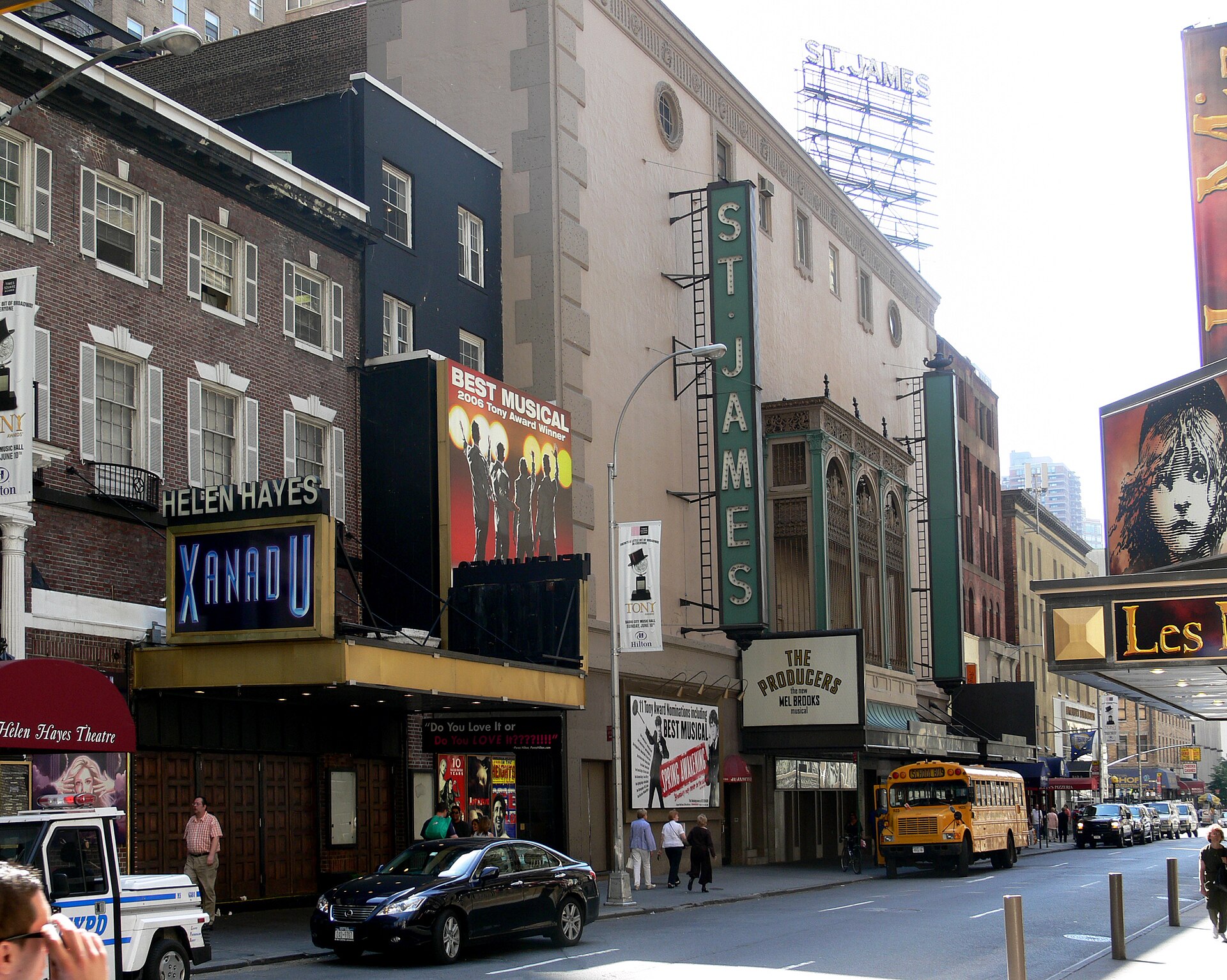
The St. James Theatre at a Glance
What Kind of Broadway Theater the St. James Is
The St. James is a large, serious Broadway musical house — and it was built to be exactly that from the start. When A. L. Erlanger commissioned Warren and Wetmore to design the theater in 1927, the explicit purpose was a house sized and shaped for musical theater at scale. It originally opened with 1,600 seats — comparatively large even for Broadway in that era — and the two-balcony design was a deliberate departure from the single-balcony format most contemporary houses used. The room was built to hold a lot of people without feeling like it was making compromises to do so.
The interior character is worth noting: a contemporary description called the auditorium “residential rather than theatrical” — meaning it prioritizes warmth and proportion over ornamental flash. There is plasterwork, there are murals, but the St. James does not try to overwhelm you with its own decoration. It is elegant without being showy, which turns out to be the correct register for a house that has spent nearly a century letting the productions do the talking.
What this means in practice: when you sit in the St. James for a major Broadway musical, the room supports the show rather than competing with it. The scale is right for big choreography, full orchestral sound, and production design that needs room to breathe. It is not an intimate playhouse where you feel the performers’ breath. It is a house where you feel the full weight of what Broadway at its most ambitious looks like when the room is correctly sized for it.
That list is not trivia. It is a description of what this building is built for and what it is best at. Every one of those shows needed a house with real scale and the right acoustics for full-cast musical theater. The St. James delivered. That is the honest answer to what kind of Broadway theater this is.
Where the St. James Sits — and Why the Location Matters
246 West 44th Street puts the St. James at the geographic center of the Broadway world in a way that is practically useful, not just symbolically correct. Shubert Alley — the passage between the Shubert and Booth Theatres — opens onto 44th Street less than a block east. The Majestic, the Broadhurst, and the Music Box are all within a two-block radius. Times Square is a short walk in one direction; Hell’s Kitchen and 9th Avenue are a short walk in the other.
The 44th Street block between 7th and 8th is one of the most transit-accessible theater corridors in New York. Multiple subway lines converge at 42nd Street–Times Square to the east (N/Q/R/W/1/2/3/7) and at 42nd Street–Port Authority to the west (A/C/E). The block itself reads as genuinely theatrical — this is the kind of street where arriving on foot before a Broadway show feels like arriving somewhere, rather than just navigating Midtown.
The practical night-out implication: this location gives you strong options in every direction. For pre-show dining, 9th Avenue in Hell’s Kitchen delivers real neighborhood restaurants rather than tourist-facing chains, about ten minutes on foot. Restaurant Row on West 46th Street between 8th and 9th has concentrated pre-theater options within two blocks. The Theater District neighborhood guide covers all of this in detail. The short version: the St. James’s location means your night-out planning is easier, not harder — you are not in a transit desert or a neighborhood with nothing around it.
One honest note: 44th Street between 7th and 8th can be genuinely congested on major show nights. Times Square foot traffic is adjacent, and when two or three large Broadway houses are all doing matinees or evening performances simultaneously, the sidewalks fill. Leave time. Arriving 15–20 minutes before the 40-minute-early door opening is the correct margin, not a luxury.
St. James Theatre Seating — Section by Section
With roughly 735 orchestra seats, 674 mezzanine seats, and 326 balcony seats, the St. James has real variation across its levels. The size of the house means the distance from the back rows of the mezzanine or the rear balcony to the stage is significant — and the stair count to get there is equally significant. Here is what each zone actually delivers.
The prime zone at the St. James. Far enough from the stage to take in the full picture, close enough to feel the performance rather than just watch it. At a house of this size and musical-theater heritage, center orchestra rows D–L is where the show is designed to land. Worth paying for when it matters. Note: rows Q, R, S, and T in Center and Right Orchestra have 1–2 steps up.
The front-center mezzanine at the St. James is one of Broadway’s better elevated vantage points for a large-scale musical. You get the full stage picture — choreography, set design, the whole production — at a price that is substantially lower than center orchestra. The 29-step climb is the honest tradeoff. If stairs are manageable, this is the strongest value play in the house.
Rows B–C put you very close to the stage — immersive and energetic, with some trade-off in seeing the full overhead staging. Rows M–P are further back but still connected. Good alternatives when the D–L center range is sold out or priced above budget. Verify any step requirements for rows Q–T before purchasing.
Lateral angle on the production, but proximity to the stage compensates. Works well for most musicals, especially ones where being close to the action matters more than seeing the full-width staging picture. Verify exact seat positions — “side orchestra” covers a wide range of actual angles at a house of this width.
A step back from front-mezzanine rows but still a complete stage view. The 674-seat mezzanine at the St. James is deep — mid-rows are noticeably further from the stage than front rows. Still a usable position for a budget-conscious visitor who wants the elevated perspective. The additional 20 steps to access the rear mezzanine (beyond row E entrance) are worth knowing about.
The balcony at the St. James is steep and requires 76 steps to reach — a meaningful physical commitment in a 1927 building. Front-center balcony rows retain decent sightlines and deliver the widest production overview in the house. The right choice only for visitors who are comfortable with the altitude and the stairs, and who want the full panoramic picture of a large-scale production.
The furthest and most angled positions in the house — steep, high, and with genuinely limited sightlines from extreme side angles. The price difference honestly reflects the experience difference. Not the right call for a night you’ve invested in. Know what you’re getting before the 76-step climb.
The boxes at the St. James are elegant architectural features of the room, not its best sightlines. Box seating offers a partial, angled view of the stage. They can be the right choice for a small group seeking a distinct experience, but they are not the practical pick for seeing the full production clearly.
This Is a Big House — And That Matters More Than at Smaller Theaters
At roughly 1,709 seats, the distance from the rear mezzanine or upper balcony to the stage at the St. James is significant in a way it is not at a 900-seat playhouse. Center orchestra rows D–L and front-center mezzanine are the positions where the house genuinely delivers its best. Mid-mezzanine and front balcony center are workable value picks. The rear mezzanine and side balcony involve real compromises. The St. James rewards buying the best seats you can actually afford in the center zones rather than buying a larger quantity of compromised ones.
Best Seats Based on Who You Are and What You Want
The St. James is one of the Broadway houses where being in the center orchestra rows E–K makes the experience feel like what Broadway is supposed to feel like. Spend for this. The combination of the room’s scale and its musical-theater DNA makes a good center orchestra seat here genuinely memorable.
If the production has ambitious choreography, detailed set design, or large-scale staging — which most shows at the St. James do — the front-center mezzanine gives you the most complete visual picture in the house. The 29-step climb is worth it for the right show.
Close enough to feel the energy of the production, centered enough for the full picture. The St. James at full capacity for a major musical is one of Broadway’s better date-night settings — the room has the right mix of scale and warmth for the occasion.
The strongest budget position in the house. A significantly lower price point than center orchestra, and still a complete view of the stage. The 29-step climb to get there is the practical cost of the savings. Worth it for most productions at this theater.
All accessible seating is on the orchestra level. There is no elevator. Mezzanine requires 29 steps minimum; balcony requires 76. For any guest with mobility concerns, orchestra is the only practical choice — and note that rows Q, R, S, and T in Center and Right Orchestra have 1–2 steps. Confirm your specific seats before purchasing.
The St. James handles groups well in the center orchestra zones. For larger groups, front mezzanine center can be easier to seat together. The house is well-suited to milestone celebrations — it has the kind of ceremony that makes a birthday or anniversary night feel appropriately significant.
Accessibility at the St. James — What You Actually Need to Know
The St. James is a 1927 building. The accessibility situation is honest and specific, and knowing it before you buy tickets can significantly affect your planning.
Orchestra access from street
No steps from sidewalk to orchestra level. Wheelchair-accessible seating is available in the orchestra. Contact the theater in advance to confirm specific accessible seat locations for your performance.
Rows Q–T, Center & Right Orchestra
There are 1–2 steps up to access rows Q, R, S, and T in the Center and Right Orchestra sections. If these rows are relevant to your seats, verify before purchasing. This is a specific detail that standard accessibility guidance sometimes omits.
Upper levels require stairs
There is no elevator and no escalator in the St. James Theatre. Mezzanine access requires a minimum of 29 steps. Balcony access requires 76 steps. For any guest who cannot manage these stair counts comfortably, orchestra is the only viable level.
Accessible restroom
A single-stall, all-gender accessible restroom is located on the orchestra level inside the theater. Unlike the Shubert Theatre (where accessible restrooms are across the street), the St. James has accessible facilities on-site at the orchestra level.
The bottom line on accessibility: if you or anyone in your group has mobility concerns, buy orchestra seats and verify that your specific rows are in the step-free zone. The orchestra level accessible infrastructure is solid. The upper levels are not accessible by any means other than stairs.
The St. James Theatre and the American Musical
The case for the St. James having the deepest musical-theater legacy on Broadway rests on what happened inside it, not just how long it has been open. Oklahoma! opened here in 1943 and ran for 2,212 performances — at the time, the longest run in Broadway history. That production changed what Broadway musicals were allowed to be. The King and I followed in 1951. Hello, Dolly! in 1964. The Producers in 2001, breaking the Tony Award record for a single production. These are not merely popular shows; they are the productions around which the history of the American musical is organized.
What that history means for a visitor in 2026 is not nostalgia. It is context. Sitting in the St. James orchestra for a major Broadway musical means sitting in the same room where those things happened — a room that was built for exactly what you are about to watch, and that has been used for exactly that purpose without interruption for nearly a century. That is a different feeling from attending a production at a more recently built venue, and it is a feeling the St. James delivers whether or not you know the history going in.
The architects who designed the St. James also designed Grand Central Terminal. The connection is not incidental. Both buildings were designed with the conviction that arrival should feel like something — that the physical experience of entering a space should signal that what happens inside it matters. The St. James has retained that quality. Audiences feel it, whether or not they can articulate why.
How the St. James Compares to Other Broadway Houses
Under 1,000 seats. Physically much closer to the stage from nearly every seat. The right choice when the production is built for proximity — quieter plays, chamber musicals, work where the audience’s physical nearness to the performers changes the meaning. The St. James operates at a different scale with different strengths.
Purpose-built for large-scale musical theater and continuously operating at that purpose for nearly 100 years. Large enough to support full orchestral productions with space for choreography, production design, and theatrical ambition. Historic enough that the room itself carries weight. The strongest large-house choice for a classic Broadway musical night.
1,700–1,900+ seats, built or extensively renovated for modern production requirements. Better technical infrastructure, newer accessibility systems, more modern feel. Less historical texture. The right choice when the production specifically needs maximum capacity or modern staging technology. The St. James offers comparable scale with a room character that no modern renovation can replicate.
How to Plan a Full Night Around the St. James Theatre
The St. James’s location on West 44th Street is a planning asset. Here is how to use it.
Where to eat before the show
The pre-show dining decision around 44th and 8th is primarily directional. The best nearby options are a short walk away, not immediately adjacent. 9th Avenue in Hell’s Kitchen — a 10-minute walk west — has a corridor of actual neighborhood restaurants that are genuinely good: more local character, less tourist-facing pricing, better food than the blocks immediately around Times Square. Restaurant Row on West 46th Street between 8th and 9th is concentrated and practical — multiple pre-theater-friendly restaurants on one block, well-priced fixed-price menus before 7pm. For full strategy on timing, reservations, and what kind of dinner works before a Broadway show, the pre-show dining guide covers it. For specific restaurant picks in the Broadway radius, see restaurants near Broadway.
Transportation
The St. James is one of the most transit-accessible Broadway theaters on 44th Street. Times Square–42nd Street (N/Q/R/W/1/2/3/7) is a short walk east; 42nd Street–Port Authority (A/C/E) is a short walk west. Any midtown hotel is within range. Transit is the strong recommendation on show nights — the 44th Street parking situation during Broadway performances is as difficult as Midtown parking ever is. The full logistics are in the guide to getting to a Broadway show. If driving is unavoidable, parking near Broadway covers the closest garage options.
Hotels
The Theater District has a strong hotel cluster, and the St. James’s central location means most midtown Broadway-area hotels are equally practical. The hotels near Broadway guide covers the best-positioned options across price ranges — the key variable here is whether you want walkability to the theater or proximity to other neighborhood amenities.
The arrival ritual
Doors open approximately 40 minutes before showtime. Use that window. The 44th Street corridor at 30 minutes before an 8pm curtain is busy; at 40 minutes before, it is navigable and the lobby still has room to move. Get a drink, look at the room, read the program. The St. James has the kind of interior — the murals, the proportion, the age — that rewards arriving before it fills rather than sliding in at the last minute.
What to Avoid When Planning a St. James Theatre Night
Buying upper-level tickets without accounting for the stair count
Twenty-nine steps to the mezzanine and seventy-six to the balcony sounds abstract until you are in a 1927 building with no escalator, in dress clothes, with a ten-minute intermission. Know your group’s mobility reality before you buy. The orchestra is the only level accessible without significant stair climbing.
Assuming rows Q–T in the orchestra are step-free
Most of the orchestra at the St. James is step-free from the street. But rows Q, R, S, and T in the Center and Right Orchestra have 1–2 steps up. If any member of your group has mobility concerns, verify that your specific seats are in the fully step-free zone before purchasing. This specific detail is not always surfaced by generic accessibility guides.
Treating the mezzanine as interchangeable at its full depth
The St. James mezzanine has 674 seats — it is a large level. Front-center mezzanine rows A–E are meaningfully different from mid-to-rear mezzanine. The entrance to the mezzanine is behind row E or F (depending on the source), meaning you are already past the best rows when you enter. Know your row number before you sit down and work your way forward, not back.
Not leaving enough time for the 44th Street arrival zone
The blocks between 7th and 8th on 44th Street are genuinely busy when multiple Broadway houses are running simultaneously. Give yourself 15–20 minutes beyond your minimum travel time, especially on weekend evenings and when the show has been getting attention. The St. James does not hold curtain for late arrivals.
Eating on the tourist-facing blocks closest to the theater
The stretch of 44th and 45th Streets adjacent to Times Square has options that work in a pinch, but the better pre-show dinner is a 10-minute walk away on 9th Avenue or Restaurant Row. If you plan dinner as part of the night rather than as logistics to get through, the quality difference is significant and the price-per-meal difference is even more so.
Plan the Full St. James Theatre Night
The theater is the anchor. Here is the rest of the planning cluster.
Frequently Asked Questions
The St. James Theatre is at 246 West 44th Street in Manhattan, between 7th Avenue and 8th Avenue in the Theater District. The main entrance and box office are on 44th Street. The nearest subway stations are Times Square–42nd Street (N/Q/R/W/1/2/3/7) a short walk east, and 42nd Street–Port Authority (A/C/E) a short walk west.
The St. James is a large, traditional Broadway musical house — approximately 1,709 seats across orchestra, mezzanine, balcony, and boxes, designed by Warren and Wetmore in 1927. The interior is elegant without being ornate, with murals and plasterwork that give the room warmth and proportion. It is the kind of theater that was built specifically for large-scale musical theater and has spent nearly a century delivering exactly that. First-time Broadway visitors and experienced theatergoers alike tend to find it one of the most satisfying houses in the Theater District.
Yes — one of the larger classic Broadway houses. At approximately 1,709 seats it is significantly bigger than intimate playhouses like the Booth (783 seats) or the Lyceum, and comparable in scale to other large musical houses like the Majestic or the Gershwin. It was designed from the start for major musical productions, and the room is sized accordingly.
Center orchestra rows D through L are the strongest positions in the house — close enough to be inside the production, centered enough for the full picture. Front-center mezzanine rows A through E are the best value alternative, offering a complete elevated stage view at a significantly lower price than center orchestra, with 29 steps up as the practical trade-off. For the widest-angle overview of a large production, front balcony center works — but requires 76 steps and carries meaningful sightline compromises in side and rear sections.
Front-center balcony seats can work for visitors who want the complete panoramic view of a large-scale production, are physically comfortable with 76 steps, and understand they are trading physical connection to the show for visual overview. Rear and side balcony at the St. James is a genuine compromise — steep, distant, and angled. The price difference between balcony and mid-mezzanine is often not large enough to justify the experience trade-off, especially given the stair count. Front-center mezzanine is usually the better budget decision.
Partially. The orchestra level is accessible from the street without steps, and wheelchair-accessible seating is available there. There is a single-stall, all-gender accessible restroom on the orchestra level — an improvement over some older Broadway houses. However, there is no elevator and no escalator. Mezzanine requires a minimum of 29 steps; balcony requires 76. Rows Q, R, S, and T in the Center and Right Orchestra also have 1–2 steps up. For guests with any mobility concerns, orchestra seats in the step-free sections are the practical requirement.
No. The St. James Theatre has no elevator and no escalator. Access to the mezzanine and balcony is by stairs only. This is a fixed limitation of the 1927 building. Any guest who needs elevator access should book orchestra seats and contact the theater in advance to confirm their specific seating requirements.
Doors open about 40 minutes before showtime — plan to arrive in that window rather than at the last minute. For dinner, 9th Avenue in Hell’s Kitchen (about 10 minutes on foot west of the theater) has the best range of real neighborhood restaurants in the pre-theater zone. Restaurant Row on West 46th Street is closer and practical for a pre-theater fixed-price menu. The pre-show dining guide covers the full timing and strategy. Budget 15–20 minutes of walk time on busy show nights — the 44th Street corridor fills when multiple Broadway houses are running simultaneously.
The list defines American musical theater: Oklahoma! (1943, 2,212 performances — then the longest-running show in Broadway history), The King and I (1951), Hello, Dolly! (1964), The Pajama Game, Barnum, My One and Only, The Who’s Tommy, and The Producers (2001, which set the record for Tony Awards won by a single production). No Broadway house has a comparable record of originating defining American musicals. Current production: Titanique, which began performances in March 2026 for a limited engagement.
The St. James Theatre — What You’re Really Booking
When you buy tickets to the St. James Theatre, you are not just buying a seat at a show. You are booking one of the rooms where the American Broadway musical was invented and repeatedly reinvented — a house that was built specifically for large-scale musical theater in 1927 and has been delivering that purpose without interruption ever since.
Get center orchestra rows D–L or front-center mezzanine. Make a dinner reservation on 9th Avenue or Restaurant Row rather than eating adjacent to Times Square. Know the stair count before you buy your level. Arrive when the doors open, not when the lobby is full. Walk into a room that has earned everything it is — and let the production justify the occasion.
The St. James Is Big Broadway Energy — Now Plan the Right Night
The St. James Theatre is one of Broadway’s great large musical houses: classic, bold, crowded, and built for full-room productions. Start with the dedicated seating guide, then connect the theater to Titaníque, dinner, hotels, subway routes, parking, accessibility, and nearby 44th Street houses.
St. James Seating Chart & Best Seats
Compare Center Orchestra, Front Mezzanine, Balcony stairs, Row A warnings, overhang notes, accessibility, Titaníque sightlines, and seats to avoid.
Open Seating Guide Current ShowTitaníque at the St. James
Connect Titaníque’s comedy-musical energy with the right seat zone, ticket timing, show-night logistics, and full Broadway plan.
Open Show GuideBroadway Seating, Theater & Ticket Strategy
Seats · Shows · ValueBroadway Seating Guide
Compare Orchestra, Mezzanine, Balcony, boxes, side seats, premium zones, and view tradeoffs across Broadway houses.
All Broadway Theater Guides
Browse every Broadway house guide and compare room scale, location, access notes, and seating strategy across the Theater District.
What’s Playing on Broadway
Compare current and upcoming Broadway productions, then connect each show to the right theater, seat choice, and night plan.
First-Time Broadway Guide
For visitors choosing their first show: seats, arrival, timing, dress, intermission, crowds, and Theater District basics.
When to Buy Broadway Tickets
Know when buying early matters, when waiting can work, and how timing changes for premium seats and popular musicals.
Last-Minute Broadway Tickets
Compare same-day options without accidentally grabbing extreme sides, rough Balcony angles, or stair-heavy seats.
Plan the St. James Theatre Night
Dinner · Hotels · TransitRestaurants Near Broadway
Use the broader Broadway dining guide when you want a reliable pre-show meal before walking into the 44th Street theater zone.
Restaurants Near Times Square
Useful when your group wants to stay close to the St. James, Broadway, Times Square, and post-show transit.
Pre-Show Dining Guide
Plan reservation timing, walking buffer, arrival, late-seating risk, and post-show movement around a Theater District show.
Hotels Near Broadway
Compare Theater District, Times Square, Midtown West, and Hell’s Kitchen hotel zones for a Broadway-centered trip.
Hotels Near Times Square
Best for visitors who want short walks, easy subway access, and simple post-show return logistics after a St. James show.
How to Get to a Broadway Show
Subway, walking, rideshare, and arrival timing for Theater District shows, including the St. James on West 44th Street.
Subway to Broadway
Pick the right subway approach for West 44th Street, Times Square, Shubert Alley, and post-show exits.
Parking Near Broadway
When driving makes sense, when it does not, and how to avoid turning a St. James night into a Midtown garage problem.
Best Way Home After a Show
Subway, taxi, rideshare, walking, and hotel return strategy after a crowded 44th Street performance.
Nearby Neighborhood & Theater Guides
44th Street · Shubert Alley · Nearby HousesTheater District
The practical guide to Broadway’s center: theaters, crowds, hotels, restaurants, walking routes, and first-time visitor logistics.
Times Square
Useful for hotels, transit, crowd planning, visitor logistics, and the classic Broadway arrival flow.
Hell’s Kitchen
A strong pre- and post-show dining base west of the St. James, especially if you want less Times Square noise.
Shubert Theatre Guide
Compare another major 44th Street Broadway house with a classic musical-theater feel and important access limitations.
Majestic Theatre Guide
A nearby classic Broadway house useful for comparing musical-house scale, balcony tradeoffs, and 44th Street planning.
Booth Theatre Guide
Compare the St. James’s big musical-house energy with a smaller, play-friendly Broadway house near Shubert Alley.