

Shubert Theatre Tickets & Box Office — Broadway NYC Guide
Compare Shubert Theatre ticket options, confirm the official seller and box office details, then plan seating, accessibility, arrival and a complete Theater District night.
There are Broadway theaters and there is the Shubert Theatre — a house that sits at the center of what the American musical actually is, rather than adjacent to it.
The Shubert Theatre NYC is at 225 West 44th Street in the Theater District, and this guide starts with what most visitors need first: Shubert Theatre tickets, the box office and its phone number, the address and how to get there. Seating, accessibility and how to plan the night follow. Galileo begins previews on November 10, 2026, and its official ticket page lists tickets on sale through Telecharge.
Built in 1913 at 225 West 44th Street, the Shubert is the kind of theater that makes visitors feel like they’ve arrived somewhere specific. Not the largest Broadway house, not the most modern, not the most intimate — but one of the most unmistakably Broadway, in the way that term carries genuine weight. The Shubert has the physical substance of a serious theater: 1,502 seats across orchestra, mezzanine, balcony, boxes, and standing room; an elegantly proportioned room with enough scale to fill on a big musical night without feeling like an arena; and a history so deeply connected to the American musical tradition that sitting in the orchestra can feel, even now, like sitting inside a living institution.
This guide is built for people who want to know what the Shubert is actually like — not just the specs, but the character of the house, the tradeoffs in different parts of the room, and how to plan the kind of night that does justice to the occasion.
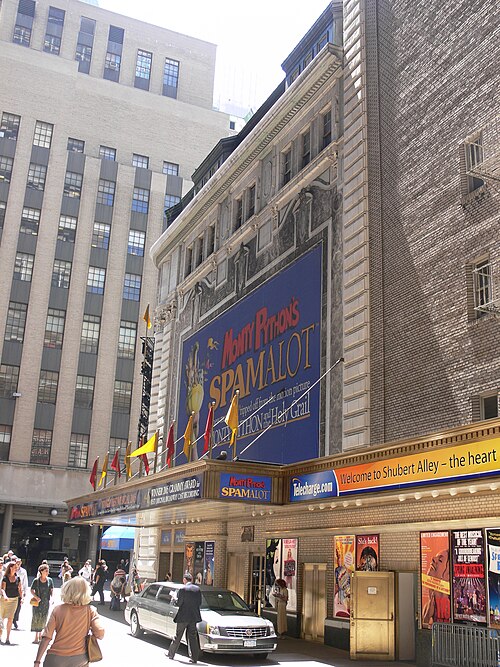
The Shubert Theatre from Shubert Alley — one of Broadway’s classic houses and one of the most central theater addresses in the district.
The Shubert Theatre at a Glance
What Kind of Broadway Theater the Shubert Is
The Shubert sits in a specific and important category: it is a classic Broadway musical house with genuine scale. That distinction matters more than it might sound.
Broadway has intimate playhouses — the Booth, the Lyceum, the Roundabout’s American Airlines Theatre — where the room holds 900 seats or fewer and the audience feels physically close to the stage in a way that changes the entire experience. And it has modern mega-houses — the Gershwin, the Minskoff, the Marquis — built for blockbuster productions at industrial scale, where size is part of the proposition. The Shubert is neither. At 1,502 seats, it is large enough to feel like a proper major Broadway house, to fill with a big musical night the way a big musical night should feel, without ever crossing into the territory where the room works against the production.
The room itself is elegantly proportioned. The orchestra is wide, with a good center section. The mezzanine is the kind of level that actually works at a Broadway house of this vintage — elevated enough to see clearly, close enough to feel connected. The balcony is higher and steeper, which is honest about what it is. The proscenium and the general character of the space feel formal in the best sense: this is a theater that takes itself seriously, and in doing so makes the audience feel like the occasion is serious too.
It was designed by Henry B. Herts, completed in 1913 as a companion to the Booth Theatre next door, and the two houses share a facade on 44th Street and an alley between them — Shubert Alley — that has become one of the most recognizable passages in American theater geography. The architecture has the quiet authority of a theater that was built to last, and has.
A House That Feels Like Broadway in the Classic Sense
If a first-time Broadway visitor asked what they should expect the experience to feel like, the Shubert Theatre is close to a correct answer. Not the most intimate house on the block, not the most technically modern, but one of the rooms where the act of attending a Broadway musical feels like it carries the weight it should. The age of the building and the depth of what has happened inside it are both present when you sit in the orchestra — not as nostalgia, but as the genuine texture of a working theatrical institution.
Shubert Theatre Tickets and Box Office
Shubert Theatre tickets are sold production by production. Galileo, the new musical starring Raúl Esparza, begins previews on November 10, 2026 and opens on December 6, 2026. The official production site lists Broadway tickets on sale now through Telecharge, by phone at 212-239-6200 and through the Shubert box office. Group sales for 10 or more are handled through Broadway Inbound or 866-302-0995. Performance inventory and dates can change, so confirm the selected date before purchasing. For the cast, running time, weekly schedule and when to buy, see our Galileo Broadway tickets and show guide.
Shubert Theatre box office hours and phone
The Shubert box office and official ticket phone number for Galileo is 212-239-6200. Box office hours can change with the production and performance calendar, so call ahead or check the current official listing before making a special trip. Official online inventory is sold through Telecharge, and tickets may also be purchased at the theater box office at 225 West 44th Street.
Shubert Theater Tickets NYC: what to check before you buy
Confirm the date and time, the level and section (Orchestra, Mezzanine, Balcony or boxes) and the seller’s exchange and refund terms, and compare the all-in price at checkout, since fees and resale markups change the total. Any rush, lottery or discount offer is set by the production, and the rush and lottery guide explains how those programs generally work. Because the Mezzanine and Balcony are stairs-only, confirm access needs before you choose a level. For row-by-row advice see the Shubert seating guide, and for timing see the when to buy Broadway tickets guide.
Where the Shubert Sits in the Theater District
225 West 44th Street is about as central a Broadway address as exists. The Shubert sits between Broadway Avenue and 8th Avenue on a block that contains the Booth Theatre to its east and opens onto Shubert Alley — the pedestrian passage that connects 44th and 45th Streets and has long served as the informal main street of the Broadway community. The Majestic Theatre is on the same block of 44th. The St. James and the Broadhurst are nearby. This part of 44th Street is dense with Broadway history in a way that feels less like tourism and more like the thing itself.
The practical implications of this location are straightforwardly good. Times Square and the main Theater District transit options are steps away. The pre-show restaurant zone extends in every direction — north on 9th Avenue toward Hell’s Kitchen, east toward 8th Avenue, south toward the 40s, west toward the restaurant corridors off 46th Street (Restaurant Row). The Theater District neighborhood guide covers the full picture, but the short version is that this location gives you more planning flexibility than most Broadway theaters: you can eat nearby, arrive on foot from most midtown hotels, and have genuine pre-show options that don’t require a cab or a sprint.
One realistic note on arrival: the 44th Street corridor on a two-show Wednesday matinee or a Friday evening is genuinely busy. Leave time. This is not a block where you want to arrive two minutes before curtain. The guide to getting to a Broadway show covers the best transit approaches to this part of the Theater District.
Shubert Theatre NYC Address and Directions
The Shubert Theatre address is 225 West 44th Street, New York, NY 10036, between Broadway and 8th Avenue in the Theater District. The Shubert Theater in New York City is the Broadway house named for Sam S. Shubert, and it is not the same as the Shubert theaters in other cities such as Boston, New Haven or Philadelphia.
Shubert Theatre, West 44th Street, New York, NY
Shubert Theatre, 225 W 44th St, New York, NY 10036 is the address to use in maps, ticket confirmations and rideshare apps. Searches for the New York Shubert Theatre, the NYC Shubert Theater or the Shubert Theater Manhattan all point to this same building.
Getting to the Shubert Theatre Broadway address
The Shubert is a short walk from Times Square–42nd Street (1, 2, 3, 7, N, Q, R, W, S) and 42nd Street–Bryant Park (B, D, F, M), and the A/C/E at 42nd Street–Port Authority is also close. The guide to getting to a Broadway show covers transit, rideshare and timing, and parking near Broadway covers garages for drivers.
Shubert Alley New York: What It Is
Shubert Alley in New York is a private pedestrian passage that connects West 44th and West 45th Streets, running between the Shubert Theatre and the Booth Theatre. According to the Shubert Organization, the passage was created so that each of the two theaters could occupy a corner lot, and it runs behind the building that was formerly the Astor Hotel and is now the Minskoff.
Shubert Alley NYC is a natural pre-show stop, and the Shubert Theatre’s ticket-lobby entrance opens onto the Alley. See the History section below for how the Alley fits into the Shubert’s story.
Shubert Theatre Seating — What Each Section Actually Means
The Shubert’s seating divides into four main levels: orchestra, mezzanine, balcony, and boxes. Here is an honest breakdown of what each level delivers in practice — not just where it is, but what sitting there is actually like.
The premium seating experience at the Shubert. Center rows in the C–M range put you close enough to read expressions and close enough to feel the room, while elevated enough from the front rows to avoid any sightline issues from orchestra pit or production design. This is where the Shubert feels most like the theater it is.
The Shubert mezzanine is one of the stronger mezzanine tiers on Broadway — elevated enough for a full stage picture, close enough to the action that you do not feel removed. Front-center mezzanine rows are a genuine alternative to center orchestra for visitors who want a slightly elevated perspective on a big production. Good for musicals where the full stage design matters.
Good proximity to the stage, with some lateral angle on the production. Works well for most musicals; may involve slight compromise on extreme stage-left or stage-right sight lines. Worth checking specific seats — the Shubert orchestra is wide enough that side-center can still be excellent. Verify any obstructed view designations before buying.
Very close to the stage — an immersive experience for the right kind of show. At a large-production musical with a broad proscenium, front rows can involve some neck-craning and may miss overhead staging. Best for visitors who want proximity above all else; not the pick for seeing the full picture of a complex production design.
A step back from the front mezzanine rows but still a complete view. At the Shubert’s scale, mid-mezzanine retains a strong sightline at a noticeably lower price point. A reliable option for visitors on a budget who want a full-stage view without paying orchestra prices.
The balcony at the Shubert is steep and genuinely high. Front-center balcony rows retain decent sightlines and the full stage picture, but the vertical distance from the action is significant. Works best for visitors who prioritize a wide overview of a large-scale production and are comfortable with the height. Not ideal for quieter dramatic plays where physical proximity changes the experience.
The furthest, most angled positions in the house. Sightlines are compromised in the side rear balcony, and the distance from the stage is substantial at this level. Legitimate budget option for the right visitor and the right show, but worth being clear-eyed about what you’re buying.
The Shubert’s stage boxes are architectural assets — part of what the room looks like — rather than its best vantage points. Box seats provide partial views and unconventional angles. They carry historical resonance. If you want the most complete view of the production, they are not the practical pick.
The Center Orchestra and Front Mezzanine Are Where This Room Lives
At 1,502 seats, the Shubert is a house where the gap between the best and least ideal seats is real and worth understanding before you buy. The center orchestra rows C through M and the front mezzanine center are the positions that deliver the full version of what this theater offers. If your budget pushes you to the mid-mezzanine, that is still a complete experience. The rear and side balcony are genuinely compromised, and the price difference is worth knowing about. Always check for any obstructed-view designations before purchasing — the Shubert is a historic building, and older theaters have column considerations that modern arenas do not.
Best Seats Based on Who You Are and What You Want
You want to feel it. The center orchestra at the Shubert is the right answer for a visitor who has never sat inside a working Broadway institution. Being in the room matters as much as what is on stage. Spend a little more for this.
For a big Broadway musical where production design, choreography, and the full stage picture matter, the front-center mezzanine gives you the most complete view in the house. The slight elevation is an advantage, not a compromise.
Both work well. The orchestra has the slight edge for the physical immediacy of being close to the performance. The front mezzanine feels slightly more elevated and cinematic. Either is a good night. Book early and get center.
A significant step down in price from the orchestra, a modest step down in proximity. Still a complete view of the stage, still a full experience of the production. The right call when price is a genuine constraint.
The orchestra is accessible without steps. The mezzanine and balcony require stairs — significant stairs in a historic building with no elevator. For any guest with mobility concerns, orchestra is not a preference but a practical requirement. See the full accessibility section below.
If you know the production and know what you want to see, any well-positioned seat works. The Shubert’s orchestra center is still the most complete experience in the room. But a serious theatergoer who has done this before may find front mezzanine the better analytical seat for a complex production.
Accessibility at the Shubert Theatre — The Honest Picture
The Shubert Theatre is a 1913 building, and the accessibility situation reflects that history honestly. If you or anyone in your group has mobility needs, read this section before purchasing tickets — the details matter.
Orchestra access
The orchestra level is accessible without steps. Wheelchair-accessible seats are available on the orchestra level. This is where guests with mobility needs should plan to sit.
Upper levels require stairs
There is no elevator and no escalator in the Shubert Theatre. The mezzanine and balcony require significant stair climbing. This is not a small consideration in a building of this age and height.
Accessible restroom on the Shubert Alley side
The current official production visit page lists wheelchair-accessible restrooms at floor level under the marquee on the Shubert Alley side of the theater. Use the exterior door to the right of the main entrance and ask a staff member for assistance.
Shubert Organization accommodation
The Shubert Organization manages the theater and can assist with specific accessibility arrangements. Contact the box office in advance of your visit to discuss specific needs — do not assume standard accommodations are sufficient without confirming.
The accessibility limitations at the Shubert are not a flaw in planning — they are the straightforward reality of a historic theater that predates modern building codes by decades. The Orchestra and the current floor-level accessible restroom can work for wheelchair users, but the Mezzanine and Balcony require stairs because the theater has no elevator or escalator. Confirm the current access route with theater staff before purchasing.
The Shubert Theatre and the American Musical
The Shubert Theatre was built by Lee and J.J. Shubert in 1913 as a tribute to their brother Sam S. Shubert, who died in a train accident in 1905 at 29 years old. That origin — a major Broadway theater built as an act of grief and legacy — gives the Shubert an emotional weight that most venues simply do not carry. Designed by Henry B. Herts, who also designed the Brooklyn Academy of Music, the building was conceived with permanence in mind. It has outlasted most of its peers.
The Shubert’s history is especially tied to the American musical in its most important phase. The theater has housed some of the most significant long runs in Broadway history, including A Chorus Line, which ran at the Shubert from 1975 to 1990 — 6,137 performances — and was, for a time, the longest-running production in Broadway history. That run is not merely a record; it represents a period in which the Shubert was the address of the most discussed, most culturally consequential Broadway show running anywhere in the world. The theater absorbed that history and it lives in the room.
What matters for a visitor in 2026 is not just the record but what it means in practice: the Shubert is a Broadway theater with enough weight behind it that sitting in the orchestra feels like more than attending an event. It feels like participating in a tradition. That is either important to you or it is not. If it is, the Shubert is the right house. If you need the most modern infrastructure or the most technically advanced staging setup, there are better-equipped buildings down the block.
The relationship to Shubert Alley — the passage between the Shubert and the Booth Theatre connecting 44th and 45th Streets — is worth noting for anyone planning a pre-show walk. The Alley has served as a gathering point for the Broadway community for over a century: actors posting their headshots, casting calls, stage-door culture. Walking through it before a show at the Shubert is not exactly a tourist activity. It is the appropriate way to arrive.
How the Shubert Compares to Other Broadway Houses
The Shubert sits in a specific part of the Broadway theater landscape. Understanding where it fits helps clarify whether it is the right house for your particular night.
Under 1,000 seats. Physically closer to the stage for every seat in the house. The right choice when proximity is the entire point — dramatic plays, chamber musicals, productions where you want to feel the performers’ breath. The Shubert is more powerful at full Broadway scale.
The correct size for a major Broadway musical with full production design, choreography, and the proper theatrical weight that scale enables. Old enough to carry history. Large enough to fill with a big show. The center category on Broadway’s size spectrum — and often its strongest.
1,800–2,000+ seats, built for modern blockbuster productions with industrial production requirements. Better accessibility infrastructure, larger technical capabilities. Less historical texture. The right choice when the production genuinely needs the scale — and sometimes feels oversized when it doesn’t.
The practical upshot: the Shubert is the right house for a major Broadway musical at what feels like the proper proportions for that kind of show. It is neither too intimate for a big production nor so large that the room works against the performers. For visitors who want a classic Broadway musical experience in a room that was built for that specific purpose and has been delivering it for over a century, the Shubert is the answer.
How to Plan a Full Night Around the Shubert Theatre
The Shubert’s location on West 44th Street makes night-out planning more flexible than most Broadway theaters allow. Here is how to use that location well.
Where to eat before the show
The pre-show dining strategy around 44th Street is primarily a question of direction. For a proper sit-down dinner, the 9th Avenue corridor in Hell’s Kitchen — ten minutes on foot from the Shubert — offers the best range of actual neighborhood restaurants in the Theater District. Restaurant Row (West 46th Street between 8th and 9th) has concentrated options within two blocks of the theater. For a quicker pre-show meal or a drink before curtain, the blocks immediately around 44th and 8th have serviceable options but lean more commercial in character. The pre-show dining guide covers the timing and strategy in full. For specific restaurant picks, see restaurants near Broadway.
Transportation
The N/Q/R/W/1/2/3/7 trains at Times Square–42nd Street and the A/C/E at 42nd Street–Port Authority are both short walks from the Shubert. The B/D/F/M trains stop at 42nd Street–Bryant Park. Any midtown Manhattan hotel is within a reasonable walk or a short cab ride. The full logistics are in the how to get to a Broadway show guide.
Hotels
Because the Shubert sits at the center of the Theater District, midtown hotels within a five-to-ten block radius are all practical bases. The hotels near Broadway guide covers the best options by distance, price, and overall fit for a Broadway night.
Parking
Driving to the Shubert is not the recommended approach — this is Midtown Manhattan, parking near 44th Street and 8th Avenue is expensive and logistics-heavy, and transit is genuinely superior. If driving is unavoidable, the parking near Broadway guide has the garage options closest to this block.
Before and after
Shubert Alley is worth a pre-show walk. The Booth Theatre and the broader 44th Street block carry more Broadway history per square foot than almost any street in New York. After the show, the Theater District has late-night options in every direction — the 9th Avenue bars and restaurants stay open late, and Times Square itself, for all its chaos, is an effective post-show gathering point for a drink or a bite if the group wants to extend the night.
What to Avoid When Planning a Shubert Theatre Night
Treating all classic Broadway houses as interchangeable
The Shubert and the Gershwin are both “Broadway theaters” the way a pub and a hotel bar are both places that serve drinks. The scale, atmosphere, seating layout, and character of these rooms are genuinely different. If you care about the experience of the house — and at the Shubert you should — spend ten minutes understanding what you are walking into.
Choosing seats by price without understanding balcony tradeoffs
The Shubert’s balcony is steep and high. Rear balcony tickets are substantially cheaper than orchestra for a reason, and that reason is that the experience is substantially different. If budget requires balcony, front-center balcony is the sensible compromise. Rear side balcony is a real compromise that the ticket price honestly reflects.
Overlooking the stair reality for mobility-limited guests
There is no elevator in the Shubert Theatre, so the Mezzanine and Balcony require stairs. The current production’s official visit page lists a floor-level accessible restroom under the marquee on the Shubert Alley side. If anyone in your group has mobility limitations — even moderate ones that would make multiple flights of stairs difficult — Orchestra tickets are the practical choice. Plan this before you buy.
Not leaving enough arrival time for the 44th Street corridor
This part of Midtown is genuinely busy on Broadway nights. Walking from Times Square or from a nearby restaurant takes longer when the sidewalks are full. Leave 15–20 minutes for arrival rather than 5–10. The Shubert does not hold curtain. Late arrivals are typically seated between acts.
Eating too close to the theater without planning ahead
The blocks immediately adjacent to the Shubert on 44th Street are more tourist-facing than the nearby Hell’s Kitchen and 9th Avenue options. The better pre-show dinner is a 10-minute walk away, not a 2-minute walk. Give yourself time to get there and eat without rushing back.
Plan the Full Shubert Theatre Night
The theater is the centerpiece. Here is everything else you need to build the night properly.
Frequently Asked Questions
The Shubert Theatre is at 225 West 44th Street in Manhattan, between Broadway Avenue and 8th Avenue. It sits beside Shubert Alley, directly adjacent to the Booth Theatre, in the heart of the Theater District. The nearest subway stations are Times Square–42nd Street (N/Q/R/W/1/2/3/7) and 42nd Street–Port Authority (A/C/E), both a short walk away.
The Shubert is a classic Broadway house — 1,502 seats across orchestra, mezzanine, balcony, boxes, and standing room, with the scale and atmosphere of a major musical theater rather than an intimate playhouse or a modern mega-house. It was built in 1913, is operated by the Shubert Organization, and has a room that feels appropriately formal and historically weighted without being stiff or cold. Visitors who want Broadway to feel like Broadway tend to love it.
Mid-to-large for Broadway. At 1,502 seats it is noticeably larger than the intimate houses like the Booth (783 seats) or the Lyceum (922 seats), but smaller than the biggest modern Broadway arenas like the Gershwin (1,933 seats) or the Minskoff (1,710 seats). For a major Broadway musical, the Shubert’s scale tends to feel right: large enough to fill, proportioned correctly for big theatrical productions.
Center orchestra rows C through M are the strongest positions in the house — close enough to feel the production, centered enough for the complete picture. Front-center mezzanine is the best alternative for a slightly elevated, full-stage view and is especially good for musicals with ambitious choreography or production design. If budget requires it, mid-mezzanine center is a complete experience at a lower price. The rear and side balcony involve genuine compromises that the lower pricing honestly reflects.
Front-center balcony can work for visitors who want the widest possible view of a large-scale production and are comfortable with the height. Rear and side balcony seats are genuinely compromised — steep, high, and with limited or angled sightlines. If price is the deciding factor, mid-mezzanine center is a better value than rear balcony in most cases. Be honest with yourself about what you are buying before choosing balcony seats at the Shubert.
Partially. The Orchestra level is accessible without steps, and wheelchair-accessible seating is available there. There is no elevator or escalator, so the Mezzanine and Balcony require stairs. The current official production visit page lists a wheelchair-accessible restroom at floor level under the marquee on the Shubert Alley side, reached through the exterior door to the right of the main entrance. Contact theater staff in advance to confirm the current access route.
No. The Shubert Theatre has no elevator and no escalator. The mezzanine and balcony require stairs. This is a consistent limitation of the building’s 1913 construction. Guests who need elevator access should book orchestra seats and contact the theater in advance.
Walk through Shubert Alley — the passage between the Shubert and the Booth on 44th Street — before the show. Have dinner on 9th Avenue in Hell’s Kitchen (10 minutes on foot) or on Restaurant Row (46th Street between 8th and 9th) if you want proper pre-theater dining rather than something rushed near Times Square. Leave 15–20 minutes for the walk from dinner to the theater on busy show nights. The full pre-show logistics are covered in the pre-show dining guide.
It is one of the best Broadway houses for a major musical. The scale is correct for the genre — large enough to fill with a big production, proportioned correctly to let choreography and staging breathe, and acoustically suited to the full-orchestra musical. Its history is essentially the history of the American Broadway musical at its peak. Sitting in the Shubert for a significant musical production is the most accurate approximation of what the genre is supposed to feel like at full weight.
Shubert Theatre tickets for Galileo are on sale through the production’s official Telecharge inventory, by phone at 212-239-6200 and through the box office at 225 West 44th Street. Broadway previews begin November 10, 2026. Confirm the performance date and all-in price before purchasing.
The Shubert box office and official Galileo ticket phone number is 212-239-6200. Box office hours can change with the production and performance calendar, so call ahead or check the current official listing before making a special trip.
The Shubert Theatre address is 225 West 44th Street, New York, NY 10036, between Broadway and 8th Avenue in the Theater District, beside Shubert Alley.
Galileo, a new musical starring Raúl Esparza, begins previews at the Shubert Theatre on November 10, 2026 and opens on December 6, 2026. The official production site recommends it for ages 10 and up. Dates can change, so confirm before you buy.
Shubert Alley is a private pedestrian passage connecting West 44th and West 45th Streets, between the Shubert Theatre and the Booth Theatre. It was created so that each of the two theaters could occupy a corner lot.
The Shubert Theater in New York City is at 225 West 44th Street in Manhattan’s Theater District, between Broadway and 8th Avenue. It is a short walk from Times Square–42nd Street and 42nd Street–Bryant Park.
The Shubert Theatre — A House Worth Knowing
The Shubert Theatre has been at the center of American Broadway for over a century because it is genuinely well suited to what Broadway at its best is supposed to be. A classic house with proper scale, a room that earns its formality, a location so central it simplifies rather than complicates the planning — and a history specific enough that sitting in it still carries some weight.
Plan the center orchestra or the front mezzanine. Book dinner in Hell’s Kitchen or on 9th Avenue and walk back. Walk through Shubert Alley before curtain. Know the accessibility situation if it applies to your group. And let the room do the work it has been doing since 1913 — which is to make a Broadway musical feel like the occasion it is.
The Shubert Is Classic Broadway — Now Plan the Right Night
The Shubert Theatre is one of Broadway’s defining houses: historic, central, dramatic, and deeply tied to Shubert Alley. Start with the dedicated seating guide, then connect the theater to current shows, dinner, hotels, subway routes, parking, accessibility, and nearby 44th Street houses.
Shubert Seating Chart & Best Seats
Compare Center Orchestra, Front Mezzanine, Balcony, boxes, accessibility, no-elevator warnings, and the best views in this classic Broadway house.
Open Seating Guide Now at the Shubert · Previews Nov 10Galileo on Broadway
Raúl Esparza stars in the new rock musical, opening December 6. Get the cast, running time, weekly schedule and when to buy before you pick your seats.
Open Galileo GuideBroadway Seating, Theater & Ticket Strategy
Seats · Shows · ValueBroadway Seating Guide
Compare Orchestra, Mezzanine, Balcony, boxes, side seats, premium zones, and view tradeoffs across Broadway houses.
All Broadway Theater Guides
Browse every Broadway house guide and compare room scale, location, access notes, and seating strategy across the Theater District.
What’s Playing on Broadway
Compare current and upcoming Broadway productions, then connect each show to the right theater, seat choice, and night plan.
First-Time Broadway Guide
For visitors choosing their first show: seats, arrival, timing, dress, intermission, crowds, and Theater District basics.
When to Buy Broadway Tickets
Know when buying early matters, when waiting can work, and how timing changes for premium seats and limited runs.
Last-Minute Broadway Tickets
Compare same-day options without accidentally grabbing extreme sides, rough Balcony angles, or stair-heavy seats.
Plan the Shubert Theatre Night
Dinner · Hotels · TransitRestaurants Near Broadway
Use the broader Broadway dining guide when you want a reliable pre-show meal before walking into the 44th Street theater zone.
Restaurants Near Times Square
Useful when your group wants to stay close to the Shubert, Broadway, Times Square, and post-show transit.
Pre-Show Dining Guide
Plan reservation timing, walking buffer, arrival, late-seating risk, and post-show movement around a Theater District show.
Hotels Near Broadway
Compare Theater District, Times Square, Midtown West, and Hell’s Kitchen hotel zones for a Broadway-centered trip.
Hotels Near Times Square
Best for visitors who want short walks, easy subway access, and simple post-show return logistics after a Shubert show.
How to Get to a Broadway Show
Subway, walking, rideshare, and arrival timing for Theater District shows, including the Shubert on West 44th Street.
Subway to Broadway
Pick the right subway approach for West 44th Street, Times Square, Shubert Alley, and post-show exits.
Parking Near Broadway
When driving makes sense, when it does not, and how to avoid turning a Shubert night into a Midtown garage problem.
Best Way Home After a Show
Subway, taxi, rideshare, walking, and hotel return strategy after a crowded 44th Street performance.
Nearby Neighborhood & Theater Guides
44th Street · Shubert Alley · Nearby HousesTheater District
The practical guide to Broadway’s center: theaters, crowds, hotels, restaurants, walking routes, and first-time visitor logistics.
Times Square
Useful for hotels, transit, crowd planning, visitor logistics, and the classic Broadway arrival flow.
Hell’s Kitchen
A strong pre- and post-show dining base west of the Shubert, especially if you want less Times Square noise.
Booth Theatre Guide
Compare the Shubert’s intimate next-door neighbor and understand why these two connected houses feel so different.
Majestic Theatre Guide
A nearby classic Broadway house useful for comparing musical-house scale, balcony tradeoffs, and 44th Street planning.
St. James Theatre Guide
Compare another major Broadway musical house with a bigger room, different seating feel, and nearby 44th Street logistics.