

The Lyceum Theatre — Broadway Guide
Seating, history, accessibility, location, and how to plan the full night at Broadway’s oldest continuously operating house.
The Lyceum Theatre is Broadway’s oldest continuously operating legitimate theater — a 922-seat Beaux-Arts house at 149 West 45th Street that has been running without interruption since 1903. It is smaller than most of the Broadway houses visitors encounter in the Theater District, which makes it meaningfully different: more intimate, more immediate, and better suited to the kind of production that benefits from proximity between performer and audience. It is currently home to Oh, Mary!, running through January 3, 2027.
This guide covers what kind of room the Lyceum actually is, how to think about seating in a house this size, what to know about accessibility and getting there, and how to build a complete night around a visit. Whether you are choosing seats before you book or orienting yourself before you arrive, this is the practical information that makes the evening work.
What Kind of Broadway House This Is
The Lyceum is a smaller Broadway house — at around 922 seats, it holds roughly 300 fewer people than a mid-size house like the Al Hirschfeld and several hundred fewer than the district’s largest venues. That difference is not just a number. It changes the feel of the room in ways that matter before you book: there is less physical distance between the back of the orchestra and the stage, the mezzanine feels closer to the action than in a larger house, and the audience as a whole feels like a single coherent group rather than a distributed crowd spread across a cavernous space.
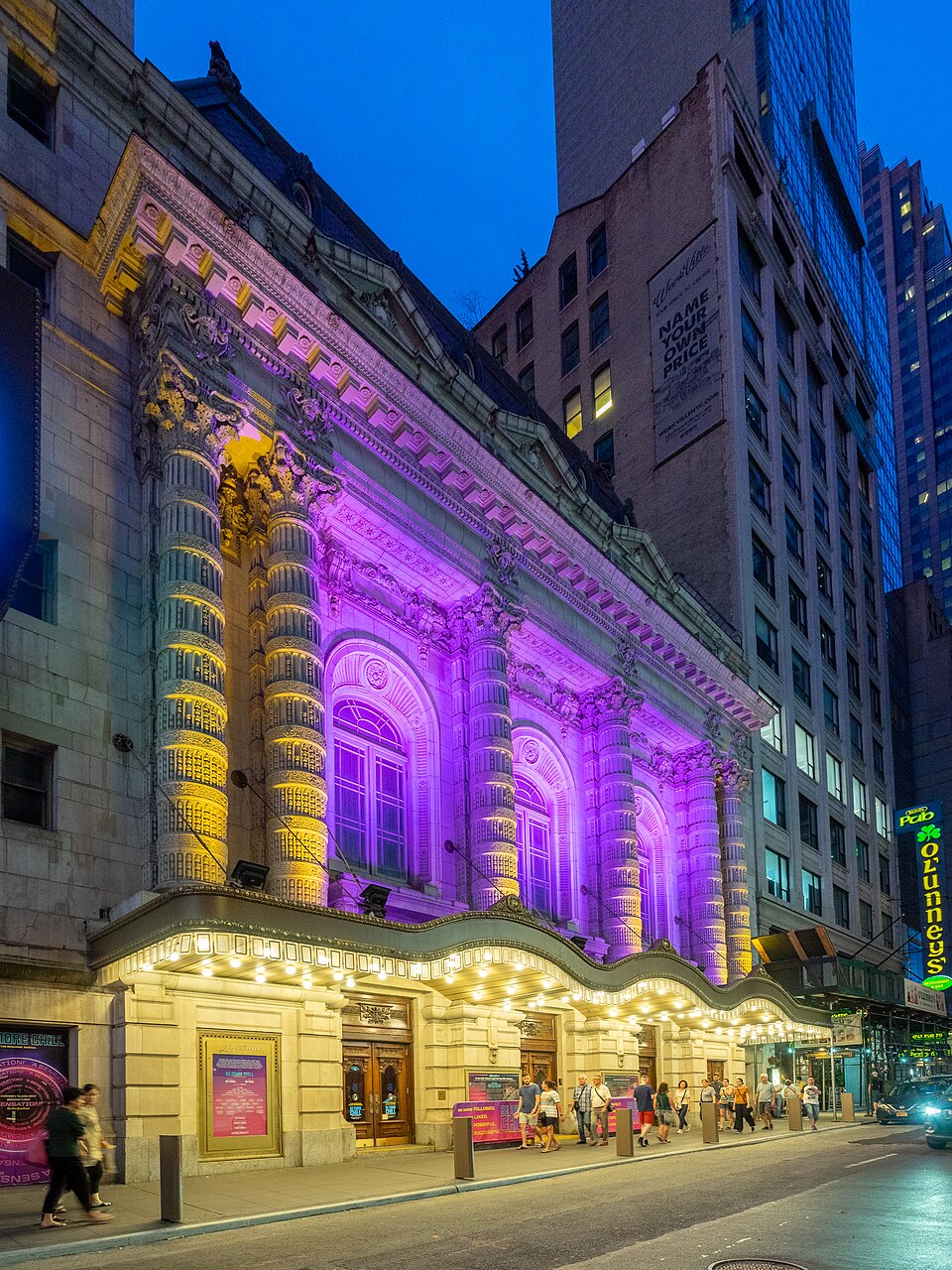
The theater was designed by Herts & Tallant in the Beaux-Arts style — the same architects behind several other notable Broadway-era buildings — and the result is a house with genuine architectural presence: a limestone Corinthian-columned facade, a lobby with twin grand staircases finished in marble, and a mauve and rose interior with what the Shubert Organization describes as candlelit-style lighting throughout. It is a room that was built to feel like an occasion before the show even begins.
The Lyceum has historically been a home for plays more than for large-scale musicals, and the room reflects that. The smaller scale means productions land differently here — there is less physical separation between the audience and the performance, which rewards shows where the writing, the acting, and the specificity of the performances carry the evening. Visitors who find larger Broadway houses overwhelming, or who want to feel close to what is happening on stage, will find the Lyceum a natural fit.
The theater was the first on Broadway to receive full landmark status — both interior and exterior — designated by the New York City Landmarks Preservation Commission in 1974. That designation has preserved the building’s original architectural character. What you see when you walk in is largely what audiences in 1903 saw, with updates for modern theater operations but without the gut renovations that have altered or erased the character of less-protected houses.
What the Theater Experience Feels Like
Being inside the Lyceum before a show is part of the experience in a way that not every Broadway theater can claim. The twin staircases in the lobby, the marble detailing, the warm low lighting throughout the house — these are not just historical curiosities. They make the act of arriving feel considered. Arriving twenty minutes before curtain gives you time to take the room in properly, which is worth doing at the Lyceum in a way it is not at every Broadway house.
Above the stage, Daniel Frohman — the theater’s original builder and operator — had a private apartment constructed when the building was new. It includes a small door that opens to a bird’s-eye view of the stage, allowing him to watch performances unseen from above. The Shubert Organization, which has operated the Lyceum since 1950, now uses the space to house the Shubert Archive. The peephole is still there. It is a small detail, but the kind that gives a building character rather than just age.
For first-time Broadway visitors, the Lyceum is one of the more approachable houses in the district. Its size means nothing feels too far away, the acoustics in a room this compact tend to be strong throughout, and the intimacy of the space makes the performance feel like something you are genuinely attending rather than observing from a distance. For visitors who have seen Broadway in larger houses and found it less personal than expected, this is a different experience.
The Lyceum rewards visitors who want to be close to the performance — where the distance between the audience and the stage feels personal rather than vast. It is a natural fit for plays and smaller-scale productions, and for anyone who finds the grandeur of a 1,500-seat house more intimidating than appealing. If your instinct is that you want to feel like you are in the room with the performers rather than watching from across an arena, the Lyceum will suit you well.
Seating Guide — How to Think About the Lyceum
Seat choice at the Lyceum is less complicated than at many larger Broadway houses, largely because the theater is compact enough that the extremes are not very extreme. The orchestra and mezzanine are the two main levels. There is no separate balcony. At around 922 seats total, even the rear sections are not dramatically far from the stage by Broadway standards.
The orchestra is fully accessible from the street without steps. Strong sightlines throughout at this house size. Center seats give you the direct view; side seats can have angled sightlines but the stage width is not extreme. At 922 seats, rear orchestra is still meaningfully close to the stage relative to a larger house.
The mezzanine requires two flights of stairs from the orchestra, with approximately two steps per row within the level. No elevator access. The elevated position gives a clear view of the full stage picture — useful for productions with complex staging or set design you want to take in as a whole. Front mezzanine is the strongest value position for most visitors who can manage stairs.
The Lyceum is not an unusually wide house, so side seats are less of a concern here than at the wider proscenium houses nearby. Still, center and center-adjacent seats give you the most direct relationship with the stage on both levels.
For most visitors who can use stairs, front mezzanine center rows offer a strong combination of full stage view, reasonable proximity, and lower price than center orchestra. At a house this size, the distance penalty of the mezzanine is smaller than it would be in a 1,400-seat theater.
At a house this intimate, the main decision is simpler than at larger theaters: orchestra puts you at stage level and inside the action; mezzanine gives you a slightly elevated perspective on the full stage picture. Neither involves a significant distance penalty by Broadway standards. If accessibility is a consideration, the orchestra is the only step-free option — the mezzanine has no elevator access. See the accessibility section below for full details.
Where the Lyceum Is — and Why Location Matters
The Lyceum Theatre sits at 149 West 45th Street, between Sixth and Seventh Avenues — a central Theater District position that puts it closer to the heart of the district than many Broadway houses. Times Square is a short walk to the west; Bryant Park is a short walk to the east. The surrounding blocks are dense with pre-theater dining, and the subway access from this location is among the strongest of any Broadway theater.
The Lyceum’s central position is one of its practical advantages. Unlike theaters on the far western edge of the district, the Lyceum gives you dining options in multiple directions — Hell’s Kitchen to the west, the blocks around Sixth Avenue and Bryant Park to the east, and the 45th and 46th Street corridors immediately around the theater itself. Getting there by subway is straightforward from most parts of the city. See our guide to getting to a Broadway show for full subway routing and timing details. If you are driving, our parking near Broadway guide covers the best garage options in the Theater District.
Accessibility at the Lyceum Theatre
Orchestra — step-free from the sidewalk
There are no steps into the Lyceum from the sidewalk, and the orchestra level is fully accessible without stairs. Designated wheelchair seating is located within the orchestra. The accessible restroom is also available. Contact the Shubert Organization box office or check the official venue accessibility page to confirm current accessible seating availability and booking procedures before your visit.
Mezzanine — stairs required, no elevator
The mezzanine is located two flights of stairs above the orchestra, and there is no elevator access to the upper level. Within the mezzanine, there are approximately two steps per row. Visitors who cannot manage stairs should book orchestra-level seats and verify current accessibility provisions with the box office in advance.
Hearing access and assistive services
The Lyceum provides infrared assistive listening devices at every performance. Audio description devices, hand-held captioning devices, and downloadable audio description and captioning for personal mobile devices are available beginning four weeks after a production’s official opening. Loop technology is also available at this theater. Contact Shubert Audience Services at 212-944-3700 or check the official venue page for current details and to arrange devices in advance.
Accessibility provisions, seating availability, and services can vary by production and change over time. Always confirm current details directly with the box office or the official Shubert/venue page before finalizing your visit, particularly if accessibility is a primary consideration.
A Century of Broadway — The Lyceum’s History
The Lyceum Theatre opened on November 2, 1903, and has been in continuous legitimate theatrical operation ever since — making it the oldest such theater in New York City without interruption. That distinction is worth understanding: Broadway has lost many of its original houses over the decades, whether to demolition, conversion, or long dormancy. The Lyceum never went dark in any meaningful sense, and the building that stands today is recognizably the same building that opened in 1903.
The Lyceum’s survival is partly architectural luck, partly the intervention of people who valued it, and partly the result of its landmark designation coming early enough to protect it before the pressures that have threatened other houses could take hold. It is one of the few places in the district where you can sit in essentially the same room that Broadway audiences occupied in 1903.
Current Production — Oh, Mary!
Oh, Mary! opened at the Lyceum on July 11, 2024, and is currently scheduled to run through January 3, 2027. Written by Cole Escola, directed by Sam Pinkleton, and running 80 minutes with no intermission, it is a dark comedy built around a wildly fictionalized portrait of Mary Todd Lincoln in the weeks before Lincoln’s assassination. The production transferred from a sold-out Off-Broadway run and has extended repeatedly, cycling through a series of high-profile performers in the lead role.
If you are landing on this page because you have tickets to Oh, Mary! and want to understand the room before you arrive, the seating guide and accessibility sections above are the most directly useful. For full show details — current cast, content advisories, age guidance, and planning the evening specifically around this production — see the Oh, Mary! Broadway guide once it is available, or verify current programming on the official Lyceum/Shubert venue page.
Build the Night Around the Lyceum Theatre
The Lyceum’s central Theater District position is one of its practical strengths as a planning anchor. Unlike theaters on the far western edge of 45th Street, the Lyceum gives you real options in multiple directions for dinner before the show — and getting there from most of Manhattan is straightforward by subway.
Getting there
The Times Square–42nd Street station (1, 2, 3, 7, N, Q, R, W, S trains) is a short walk from the theater. The 47–50 Streets–Rockefeller Center station (B, D, F, M trains) is also walkable from the Lyceum for those coming from midtown or uptown on the east side of Sixth Avenue. If you are driving in from outside the city, consult our parking near Broadway guide for the best garage options near this part of the Theater District. Full subway routing by neighborhood is covered in the how to get to a Broadway show guide.
Dinner before the show
The Lyceum’s position gives you strong pre-show dining options in multiple directions — toward Times Square and Hell’s Kitchen to the west, and toward the blocks around Bryant Park and Sixth Avenue to the east. The Theater District dining corridor along 45th and 46th Streets is immediately around you. The restaurants near Broadway guide covers specific picks by type and area. If you want to think through timing and logistics for dinner before an 80-minute no-intermission show like Oh, Mary!, the pre-show dining guide covers that specifically.
Hotels and overnight stays
The Theater District and Times Square area have Broadway-adjacent hotels at every price point, the majority of them within easy walking distance of the Lyceum. The hotels near Broadway guide covers the best-positioned options. For a fuller orientation to the neighborhood — what is around the theater, what the blocks feel like, and how the area fits into a longer visit — the Theater District neighborhood guide is the right starting point.
Frequently Asked Questions
The Lyceum Theatre is at 149 West 45th Street in Manhattan, between Sixth and Seventh Avenues in the Theater District. The nearest subway is the Times Square–42nd Street station, served by the 1, 2, 3, 7, N, Q, R, W, and S trains, a short walk from the theater. The 47–50 Streets–Rockefeller Center station (B, D, F, M) is also walkable.
The Lyceum is currently home to Oh, Mary!, running through January 3, 2027. Verify the current show and performance schedule on the official Shubert/venue page before booking, as programming details change and cast rotations are ongoing for this production.
At roughly 922 seats, the Lyceum is compact enough that there are no truly remote seats. Center orchestra puts you closest to the stage at eye level. Front mezzanine center gives you an elevated full-stage view and often represents the strongest value in the house. Avoid extreme side seats on either level for the most direct sightlines. If accessibility is a consideration, the orchestra is the only step-free option — there is no elevator to the mezzanine.
The Lyceum Theatre has approximately 922 seats across the orchestra and mezzanine levels. It is one of the smaller Broadway houses in the district, which contributes to its more intimate character compared with larger neighboring theaters.
The orchestra level is accessible from the sidewalk without steps, and wheelchair seating is available at the orchestra level. The mezzanine requires two flights of stairs and has no elevator access. An accessible restroom is available. Infrared assistive listening devices are provided at every performance; audio description and captioning devices are also available. Contact Shubert Audience Services at 212-944-3700 or check the official venue accessibility page to confirm current details and arrange services in advance.
The Lyceum opened in 1903 and has been in continuous legitimate theatrical operation without interruption since — making it the oldest surviving Broadway theater in that specific sense. Many of Broadway’s original early-twentieth-century houses were demolished, converted to other uses, or went dark for extended periods. The Lyceum never did. It was also the first Broadway theater to receive full landmark designation, both interior and exterior, from the New York City Landmarks Preservation Commission in 1974.
Yes — the Lyceum is an excellent choice for first-timers, particularly those seeing a play rather than a large-scale musical. The smaller scale makes the experience feel immediate rather than overwhelming. The building has genuine architectural presence that makes arriving feel like an occasion. And the fact that no seat is very far from the stage means the performance lands with more directness than in a much larger house. If you want your first Broadway experience to feel personal rather than like a stadium event, the Lyceum is one of the better places to start.
The Lyceum Theatre in Brief
The Lyceum is Broadway’s oldest continuously operating theater — a 1903 Beaux-Arts house that has been a working part of the district for over 120 years without interruption. At around 922 seats, it is one of the smaller Broadway houses in the neighborhood, which makes it more intimate, more immediate, and better suited to plays and close-performance work than to large-scale musical spectacle. Its central Theater District position gives you strong pre-show dining and transit options in multiple directions, and its landmark-protected interior is worth arriving early to take in.
For current show information, verify programming directly on the official Shubert/Lyceum venue page. For broader Broadway planning, the Broadway hub and the Theater District neighborhood guide are the right starting points.
The Landmark Is Set — Now Choose the Right Seat
The Lyceum is a compact Broadway landmark where seat choice is about comedy detail, center alignment, and stair realities. Start with the new seating guide, then build the rest of the night around Oh, Mary!, dinner, hotels, subway access, parking, and nearby Theater District planning.
Lyceum Seating Chart & Best Seats
Compare Orchestra, Mezzanine, Balcony, Boxes, comedy sightlines, stair warnings, accessibility, and the best seats for Oh, Mary! before buying.
Open Seating Guide Current ShowOh, Mary! Broadway Guide
Plan the show around comedy timing, facial expression, adult humor, 80-minute pacing, no intermission, and the best Lyceum seat perspective.
Open Show GuideBroadway Seating & Ticket Strategy
Seats · Timing · ValueBroadway Seating Guide
Compare orchestra, mezzanine, balcony, boxes, side seats, premium zones, and obstructed-view listings across Broadway houses.
All Broadway Theater Guides
Browse every Broadway house guide and compare room scale, location, access notes, and seating strategy across the Theater District.
What’s Playing on Broadway
Compare current and upcoming Broadway productions, then connect each show to the right theater, seat choice, and full-night plan.
When to Buy Broadway Tickets
Know when buying early matters, when waiting can work, and how timing changes for limited runs, weekends, and strong seat inventory.
Last-Minute Broadway Tickets
TKTS, same-day listings, rush, lottery, and practical ways to compare late options without choosing awkward seats blindly.
Broadway Rush and Lottery Tickets
How discount systems work, what tradeoffs to expect, and why cheap seats can be great — or risky — depending on the view.
Plan the Lyceum Theatre Night
Dinner · Hotels · TransitRestaurants Near Broadway
The Lyceum sits on West 45th Street, close to Times Square, Bryant Park, and the central Theater District dining corridor.
Restaurants Near Times Square
Useful for visitors staying near Times Square or coming in from the central subway-heavy Theater District zone.
Pre-Show Dining Guide
Plan reservation timing, walking buffer, arrival, and post-show movement so dinner and theater work together.
Hotels Near Broadway
Compare Theater District, Times Square, Midtown West, and Bryant Park hotel zones for a Broadway-centered trip.
How to Get to a Broadway Show
Subway, walking, rideshare, and arrival timing for Theater District shows, including the central West 45th Street houses.
Parking Near Broadway
When driving makes sense, when it does not, and how to avoid turning a Broadway night into a Midtown garage problem.
Nearby Neighborhood & Theater Guides
45th Street · Theater District · Nearby HousesTheater District
The practical guide to Broadway’s center: theaters, crowds, hotels, restaurants, walking routes, and first-time visitor logistics.
Times Square
Best when convenience, subway access, and being right in the center matter most — especially for short Broadway trips.
Bryant Park / Midtown South
A calmer pre-show dining and hotel zone east of Times Square, useful for visitors who want Broadway access without full Times Square chaos.
Hudson Theatre Guide
A nearby Broadway house useful for comparing landmark-theater scale, central location, and seating decisions.
Belasco Theatre Guide
A neighboring historic house useful for comparing intimate-room feel, playhouse energy, and Theater District logistics.
Stephen Sondheim Theatre Guide
A nearby West 43rd/44th Street option useful for comparing modernized Broadway comfort, location, and planning routes.