

The Stephen Sondheim Theatre — A Complete Broadway Guide
What makes this house different from every other Broadway theater, where to sit for a musical, why it leads the district on accessibility, and how to plan the full night around it.
The Stephen Sondheim Theatre is the Broadway house most visitors do not know to ask for — until they have been inside it once.
At 124 West 43rd Street, it is not the largest house in the Theater District, not the most famous address, not the one with the biggest marquee legacy. What it is: Broadway’s most thoughtfully rebuilt theater, a room that combines the landmarked façade of a 1918 venue with an interior rebuilt from the ground up in 2009 to modern standards. The result is something rare in the Broadway world — a house that feels genuinely current without being generic, that has real acoustic design rather than a century of acoustic improvisation, and that treats accessibility as a feature rather than an afterthought. It is the first LEED-certified Broadway theater. It has an elevator to every level. It has bars on both floors and restrooms that are not an embarrassment.
This guide is for visitors who want to know what sitting in the Sondheim is actually like — where the best seats are and why, what the rebuilt interior means for your experience, and why this theater might suit you better than the more famous houses a block away.
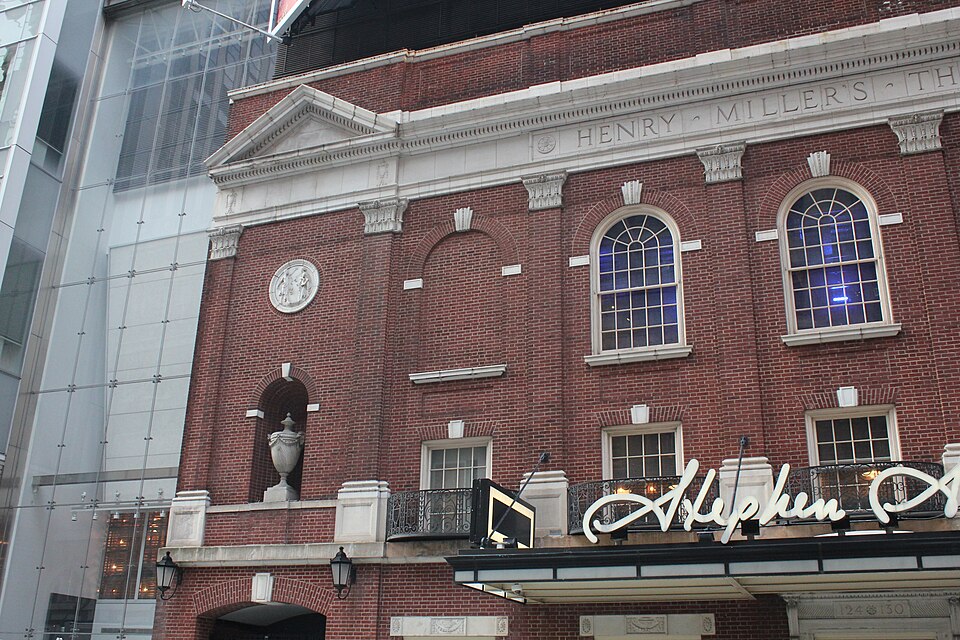
The Stephen Sondheim Theatre on West 43rd Street — a sleek Broadway house with historic roots and a more modern-feeling theater experience than many neighboring venues.
The Stephen Sondheim Theatre at a Glance
What Kind of Broadway Theater the Stephen Sondheim Is — and Why It Feels Different
Most Broadway theaters are time capsules that have been modified, patched, renovated in pieces, and kept operating despite infrastructure that was never designed for the 21st century. The Shubert was built in 1913. The St. James in 1927. The Majestic in 1927. These are great rooms, and the age is part of their character — but it also means cramped restrooms, limited accessibility, acoustic compromises accumulated over decades, and physical discomforts that have become so normalized in Broadway culture that most visitors do not realize they are specific to old buildings.
The Stephen Sondheim is different in a way that matters practically. When the theater closed in 2004 to allow construction of the Bank of America Tower above it, the interior was rebuilt entirely from the foundation up. The original 1918 façade — a landmarked piece of West 43rd Street — was preserved and restored. But the room inside is a product of 2009 construction standards, not 1918 ones. That means designed acoustics rather than historical accident. Better sightlines because the seating rake was engineered from scratch. An elevator. Accessible restrooms on multiple levels. A bar on each floor. Leg room that reflects contemporary expectations rather than early-20th-century ones.
The result is a theater that sits in an unusual category: it has genuine Broadway history — the original Henry Miller’s Theatre hosted works by Shaw and O’Neill and served as the venue for an early run of Cabaret before that production moved to the more famous Studio 54 staging — but it delivers that history through a room that feels nothing like a museum. It is the Broadway theater that rewards visitors who have found older houses uncomfortable or frustrating, while still being recognizably part of the district and its tradition.
At 1,055 seats across only two levels — orchestra and mezzanine — the scale is also right. There is no balcony, no third tier, no nose-bleed zone. Every seat in the house is in one of two levels, and the mezzanine’s steep pitch means even the rear rows maintain real sightlines. This is not a house where you feel like you lost the seat lottery.
Where the Stephen Sondheim Sits — and Why the Approach Feels Different
124 West 43rd Street sits one block south of the main Theater District corridor — the 44th Street cluster of houses that includes the Shubert, the Booth, the Majestic, and the St. James. That single block of distance makes a real perceptible difference in how the approach to the theater feels. The 43rd Street block between Sixth Avenue and Broadway is quieter, more navigable, and less saturated with Times Square foot traffic than the blocks above it. Arriving at the Sondheim on a busy Friday evening is a noticeably calmer experience than arriving at a theater in the thick of 44th and 45th Streets.
Transit is excellent. The 42nd Street–Bryant Park station (B/D/F/M and 7) is steps from the theater on Sixth Avenue. Times Square–42nd Street (1/2/3/7/N/Q/R/W/S) is a short walk east. The theater is equidistant from two of Manhattan’s busiest transit intersections, which means very few arrival scenarios involve meaningful inconvenience.
The planning implications extend to dinner. The 43rd Street position puts the Sondheim slightly south of the main pre-theater restaurant cluster on Restaurant Row (46th Street) but equally close to the strong 9th Avenue dining corridor in Hell’s Kitchen, the options around Bryant Park and 6th Avenue, and the Midtown west-of-Times-Square zone. The Theater District neighborhood guide covers all of it. The useful summary: the Sondheim’s location gives you more dining flexibility than houses sitting in the middle of the most congested Times Square blocks.
Stephen Sondheim Theatre Seating — Section by Section
The Sondheim has two levels and no balcony. That simplification matters: you are choosing between orchestra and mezzanine, not navigating three or four tiers with wildly different experiences. Both levels work. The rebuilt sightlines mean the range from best to worst seat here is narrower than at most Broadway houses of comparable size.
Orchestra section numbering runs roughly 21–1 (odd, left side), 101–119 (center), and 2–22 (even, right side). Rows run A through approximately U. The mezzanine has center, left, and right blocks, with press boxes at the far front left and right of the mezzanine level. Mezzanine rows are labeled AA, BB, CC and so on — making row identification clear and the front-row premium easy to find.
The prime position at the Sondheim. Far enough from the stage to see the full picture, close enough that the performance feels like it is happening to you rather than in front of you. Rows C–G in the center section are the target for a premium night. Row D center — seats 109 and 110 specifically — is frequently cited as the sweet spot for a complete end-to-end stage view.
The Sondheim mezzanine has a steep, well-engineered rake that makes rows AA and BB the most coveted elevated positions in the house for a musical. You get the full overhead view of choreography and staging — the complete picture of what the production designed. These rows are prized enough that front-center mezzanine tickets here compete with orchestra pricing on strong productions. Worth every penny for a show where staging and design matter.
The value zone of the orchestra. Rows H–L in the center section offer a complete, unobstructed view of the stage at a noticeably lower price point than the C–G premium rows. The rebuilt sightlines mean these rows do not have the degradation you get in mid-orchestra at older houses. Strong value for visitors who want center position without the premium pricing.
Mid-mezzanine center delivers a complete stage picture with good elevation — less intimate than rows AA–BB but still a solid elevated position for a musical. The steep rake keeps sightlines clean even as you move back. Works especially well for productions with ambitious aerial or overhead staging.
The back half of the center orchestra. The house’s rebuilt acoustics mean sound quality holds well across these rows — you will not feel like you are far from the performance in the way you might in the mid-to-rear orchestra of a larger, older house. A strong budget choice for center position. Some stepped seating toward the rear aids visibility over heads in front.
The side sections number toward odd (left) and even (right). Front-of-side rows close to the center section can be excellent value — proximity without full center pricing. Further into the sides, views become more lateral and eventually partially obstructed depending on stage design. Verify your specific seat position before buying anything in the outer side sections.
Side mezzanine sections at the Sondheim involve increasing angle to the stage the further you move from center. Partial views are more likely in outer side mezzanine positions. The press boxes at the far front left and right of the mezzanine level are not general seating — specific box seats at the mezzanine edges should be verified for sightlines before purchasing.
The very front rows offer maximum proximity and a specific kind of intensity — useful for the right show and the right visitor. The tradeoff is neck angle for overhead staging and the loss of the full-stage picture. Note that Row A, seats 106–109, may have the conductor’s box adjacent — verify before purchasing these specific seats.
Two Levels Only — and Both Actually Work
The absence of a balcony at the Sondheim is one of its underappreciated advantages. At the Shubert, the St. James, or the Majestic, the third tier puts some seats 76+ steps up with genuinely compromised sightlines. The Sondheim’s mezzanine is the furthest tier — and the rebuilt rake means front-center mezzanine rows AA and BB consistently rank among the most praised seats in the house. There is no “nosebleed section” at the Sondheim. The price-to-experience ratio is more honest here than at houses with three levels.
Best Seats Based on Who You Are and What You Want
For a first Broadway visit, the combination of proximity, center position, and the Sondheim’s clear sightlines makes rows D–H the most reliable “this is what Broadway is supposed to feel like” experience in the house. The room’s clarity rewards people experiencing it for the first time.
If you want to see the full production — every movement, every set element, every moment of choreography in spatial context — front-center mezzanine is the answer. The Sondheim mezzanine’s steep rake makes these rows genuinely superior to mid-orchestra for anyone who wants the complete overhead picture of a musical.
Both work beautifully. The Sondheim is one of the more comfortable and polished Broadway rooms for an occasion evening — the built-in bar on both levels, the cleaner sightlines, and the less-cramped feel compared to older houses all contribute. Front mezzanine rows AA–BB have a slightly cinematic quality that suits a date night well.
The value zone at the Sondheim is better than at most comparable houses because the rebuilt acoustics and sightlines hold further back. Center orchestra H–L is a complete experience at a meaningful price reduction from the C–G premium rows. Mid-mezzanine center works similarly for elevated-view tickets.
The Sondheim is the right choice for any visitor with mobility needs. No steps into the theater. Elevator to all levels except the House Left Box. Wheelchair seating on both orchestra and mezzanine. Transfer seats in Row C (11/12), Row H (1/2), and Row T (15/16). Accessible restrooms on orchestra and lounge levels. This is Broadway’s strongest accessibility profile by a significant margin.
If you have attended Broadway shows at older houses and found the cramped seats, poor accessibility, or inadequate restrooms discouraging, the Sondheim was specifically built to solve those problems. The rebuilt interior was designed with contemporary comfort standards in mind. Start here and re-evaluate your relationship with Broadway.
Accessibility at the Stephen Sondheim — Broadway’s Best
The Stephen Sondheim Theatre’s accessibility profile is not comparable to other Broadway houses — it is in a different category. The 2009 rebuild was an opportunity to design accessibility in rather than retrofit it, and the result is a theater where the limitations that make older Broadway houses difficult for mobility-impaired visitors either do not exist or have been genuinely solved.
What No Other Major Broadway House Can Match
For any Broadway visitor with mobility needs — or anyone traveling with someone who has them — the Sondheim should be the default recommendation in the Theater District. There is no other major Broadway house that provides elevator access to the mezzanine, accessible seating on multiple levels, and accessible restrooms inside the building at all. The comparison to houses like the Shubert (accessible restrooms across the street) or the St. James (76-step balcony, no elevator) is significant.
Contact the Roundabout Theatre Company box office at 212.719.9393 in advance to discuss specific accessibility requirements and confirm seating arrangements. Describe any specific needs, including transfer requirements, when booking — the theater is well-equipped to assist, but advance notice is always worth the call.
The Stephen Sondheim Theatre — History, Rebuild, and What the Name Means
The building at 124 West 43rd Street opened on April 1, 1918, as Henry Miller’s Theatre — named for the prominent actor-director-producer who built it. It was a 1918 Broadway house in the classical mode, and it operated continuously as a theatrical venue for the better part of the 20th century, hosting productions by Shaw, O’Neill, and dozens of other playwrights. In 1969 it became a cinema, then a nightclub, then reverted to theatrical use before closing in 2004 when the construction of One Bryant Park — the Bank of America Tower — began directly above it.
The rebuild was complex. The original façade was a New York City landmark and had to be preserved intact. The interior, however, was stripped entirely and rebuilt from the ground up to 2009 standards — engineered acoustics, designed sightlines, modern accessibility infrastructure, LEED certification. When it reopened in September 2009, it was a genuinely new room wearing a 91-year-old exterior. A year later, at a ceremony on September 15, 2010, it was renamed for Stephen Sondheim on the occasion of his 80th birthday. Sondheim was the dominant figure in American musical theater of the late 20th century — the composer and lyricist behind Company, Sweeney Todd, Into the Woods, Sunday in the Park with George, and A Little Night Music, among others. The naming was an act of recognition from the Broadway community, not a commercial arrangement.
What the combination of preserved façade and rebuilt interior produces, in practice, is a theater that carries the weight of history without its physical liabilities. You walk past a 1918 façade and into a 2009 room. The cognitive dissonance is slight and the practical benefit is substantial. For visitors who care about what kind of room they are in — who want to feel that the Broadway tradition has some bearing on what they are attending — the Sondheim provides that. For visitors who want modern comfort and do not want to fight a century-old building to get it, the Sondheim provides that too.
How the Stephen Sondheim Compares to Other Broadway Houses
1913–1927 vintage. Deep musical-theater legacy, powerful room character, genuinely historic atmosphere. Also: no elevators, limited accessibility, older restrooms, acoustic compromises built up over decades. The right choice when the weight of theatrical history is part of what you want. A harder choice for accessibility-conscious visitors.
Historic façade, modern interior. The Broadway house that solves the comfort and accessibility problems of older venues without sacrificing the sense of occasion. LEED-certified, fully elevator-accessible, two clean levels with engineered sightlines. The right choice when you want Broadway without its most persistent 20th-century frustrations.
600–900 seats. A fundamentally different experience — physically close to every seat, chamber-scale atmosphere, suited to plays and chamber works where proximity is the point. The Sondheim is larger and better suited to musicals with full orchestration and staging scope. These smaller houses are not competitors so much as a different category.
The honest comparison to make: if you are choosing between the Sondheim and a similarly-sized older house for the same production, and accessibility or physical comfort is relevant to your group, the Sondheim wins by a large margin. If the production itself is specifically associated with one of the older landmark houses and the room character is part of what you want to experience, that consideration is legitimate. For most contemporary musicals at either venue, the Sondheim’s rebuilt interior gives it a practical edge in comfort that most visitors notice and appreciate.
How to Plan a Full Night Around the Stephen Sondheim Theatre
The Sondheim’s location on West 43rd Street changes the pre-show planning calculus slightly compared to the 44th–45th Street core, mostly in positive ways.
Where to eat before the show
The 43rd Street block between Sixth and Broadway puts you within easy walking distance of the Bryant Park zone (restaurants along 42nd–44th on the Sixth Avenue corridor), the west-of-Times-Square options on 8th and 9th Avenues, and the concentrated Restaurant Row on West 46th Street — all without navigating the most congested Times Square blocks to get there. For strategy on timing and approach, the pre-show dining guide covers the Theater District framework. For specific picks, see restaurants near Broadway.
The bar inside the theater
One of the Sondheim’s practical advantages over older houses is worth noting: there are bars on both the orchestra and mezzanine levels, plus a lounge level below. The bar opens approximately one hour before showtime. For a show night where arriving early and having a drink in a comfortable lobby is part of the experience rather than a logistics task, the Sondheim handles this better than most Broadway houses. You can have a drink on the level where you are seated rather than navigating to a single overcrowded lobby bar.
Transportation
42nd Street–Bryant Park (B/D/F/M and 7 train) is steps from the theater on Sixth Avenue — one of the most direct Broadway transit approaches anywhere in the district. Times Square–42nd Street (1/2/3/7/N/Q/R/W/S) is a short walk east. The full logistics are in the guide to getting to a Broadway show. If you are driving, the Icon Parking garage at 1133 Sixth Avenue (between 43rd and 44th) and Edison ParkFast at 50 West 44th Street are the closest options — see parking near Broadway for the full picture.
Hotels
The 43rd Street location puts the Sondheim close to the Bryant Park hotel cluster on 6th Avenue as well as the broader Times Square hotel zone. The hotels near Broadway guide covers the best-positioned options — for the Sondheim specifically, Bryant Park-area hotels are particularly convenient given the direct transit connection.
What to Avoid When Planning a Stephen Sondheim Theatre Night
Defaulting to a more famous address when the Sondheim fits better
The Shubert and the St. James have more famous names. They also have no elevators, older accessibility infrastructure, and physical limitations the Sondheim was specifically rebuilt to avoid. If any of those factors are relevant to your group — or if you have found older Broadway houses less comfortable than you hoped — the Sondheim is the better choice for the night and deserves to be evaluated on its own terms, not ranked by marquee recognition.
Overlooking front-center mezzanine rows AA and BB
Many first-time Broadway visitors assume orchestra is always better than mezzanine. At the Sondheim’s steep-raked mezzanine, rows AA and BB center are among the most praised seats in the house. For a musical with ambitious staging and choreography, this position gives you a more complete view of what the production designed than anything but the very best orchestra center rows. Do not dismiss mezzanine by default.
Eating at the tourist-facing options right at Times Square
The Sondheim’s proximity to Bryant Park and the Sixth Avenue corridor opens up the Bryant Park area for pre-show dining — better options and less congestion than the immediate Times Square blocks. Walk a few minutes and eat well rather than eating expediently at the nearest available table.
Not using the theater’s accessibility infrastructure if you need it
The elevator, the accessible seating on both levels, and the accessible restrooms exist precisely for visitors who need them. Contact Roundabout Theatre Company in advance at 212.719.9393 to arrange appropriate seating. Do not assume the Sondheim has the same limitations as other Broadway houses — it was built specifically to not have them.
Buying side orchestra or side mezzanine without checking the angle
Center sections at the Sondheim are where the sightlines were engineered to perform best. Outer side sections — particularly side mezzanine further from center — involve increasing lateral angle that can result in partial views for some stage positions. The center seats are the priority; if you must go to the sides, verify your specific seat before buying.
Plan the Full Stephen Sondheim Theatre Night
The theater is the anchor. Here is the rest of the planning cluster.
Frequently Asked Questions
The Stephen Sondheim Theatre is at 124 West 43rd Street in Manhattan, between Sixth Avenue and Broadway in the Theater District. The main entrance and box office are on 43rd Street. The nearest subway station is 42nd Street–Bryant Park (B/D/F/M and 7 trains) on Sixth Avenue, steps from the theater. Times Square–42nd Street (1/2/3/7/N/Q/R/W/S) is a short walk east.
The Stephen Sondheim Theatre is a 1,055-seat Broadway house operated by Roundabout Theatre Company. Its original 1918 façade is preserved as a New York City landmark, but the interior was entirely rebuilt in 2009 — making it one of the most modern and comfortable rooms in the Theater District. It has two levels (orchestra and mezzanine, no balcony), engineered acoustics and sightlines, an elevator to all levels, bars on both floors, and the strongest accessibility profile of any major Broadway house. It is the first LEED-certified Broadway theater.
Yes — the interior is. The original 1918 facade is preserved, but the entire interior was rebuilt from the ground up in 2009. The result is a contemporary room with designed acoustics, modern seating comfort, full elevator access, and an accessibility infrastructure that no other major Broadway house can match. The exterior looks like a classic Theater District building; the inside functions like a venue built in the 21st century. That combination is what makes the Sondheim unusual in the Broadway context.
Center orchestra rows C through G are the prime orchestra positions — close enough to feel the performance, centered for the full picture. Row D center (seats 109/110 in particular) is frequently identified as the sweet spot for a complete stage view. For an elevated perspective on a musical, front-center mezzanine rows AA and BB are prized for their steep-rake overhead view of staging and choreography. Mid-orchestra center (rows H–L) is the best value position — complete sightlines at a lower price point. Side sections on both levels involve increasing angle the further from center you go.
Yes — it is Broadway’s most accessible major theater. There are no steps into the building from the street. An elevator serves all levels except the House Left Box. Wheelchair seating is available on both the orchestra and mezzanine levels. Transfer seats are available at Row C (seats 11/12), Row H (seats 1/2), and Row T (seats 15/16). Accessible restrooms are on the orchestra level and lounge level inside the building. Assistive listening, handheld captions, and audio description devices are available free of charge on all levels. Contact Roundabout Theatre Company at 212.719.9393 in advance to arrange specific accessible seating.
Yes. The Stephen Sondheim Theatre has an elevator that reaches all levels except the House Left Box. This is a significant distinction from most classic Broadway houses — the Shubert, the St. James, the Majestic, and others have no elevator, making their upper levels inaccessible to anyone who cannot climb significant numbers of stairs. The Sondheim’s elevator was built into the 2009 rebuild as part of its modern accessibility infrastructure.
The Stephen Sondheim Theatre is operated by Roundabout Theatre Company, one of New York’s major nonprofit theater organizations. Roundabout typically mounts its own productions at the Sondheim as part of its programming, and also hosts commercial transfers and limited runs. The theater was renamed from Henry Miller’s Theatre to the Stephen Sondheim Theatre in 2010 in honor of the composer’s 80th birthday.
As of spring 2026, the Stephen Sondheim Theatre is home to & Juliet, the pop musical powered by Max Martin songs and based on a reimagining of Romeo & Juliet. The production has been running through mid-2026. For current and upcoming programming, check the Roundabout Theatre Company website or Broadway.com for the most up-to-date listings.
The theater bar opens approximately one hour before showtime — arriving then gives you the comfortable lobby experience the Sondheim is built for. For dinner, the Bryant Park corridor on Sixth Avenue and the 9th Avenue Hell’s Kitchen stretch are both strong pre-show options within walking distance. The full pre-show strategy is in the pre-show dining guide. Transit from the Bryant Park station on Sixth Avenue is the most direct approach; walk east from the station and the theater is on your right.
The Stephen Sondheim Theatre — Broadway the Way It Should Work
The Stephen Sondheim Theatre was named for the most significant figure in American musical theater of the past 60 years. It is also the most practically modern Broadway house in the district — an elevator-equipped, LEED-certified, accessibility-first room with engineered acoustics and a two-level simplicity that removes most of the frustrations that older houses have normalized.
Get front-center mezzanine rows AA–BB if you want the most complete musical overhead view, or center orchestra rows C–G if you want the performance to feel like it is happening directly to you. Eat in Hell’s Kitchen or near Bryant Park rather than at the closest Times Square option. Arrive early enough to use the bar on your level. And recognize that this building’s combination of 1918 exterior and 2009 interior is the result of a specific architectural and institutional decision — one that produced the Broadway theater experience most visitors would design if they were starting from scratch.
The Sondheim Is Built for Easy Broadway Nights — Now Pick the Right View
The Stephen Sondheim Theatre is one of Broadway’s most visitor-friendly houses: modern rebuilt interior, no Balcony, two main levels, strong accessibility, and a central 43rd Street location. Start with the dedicated seating guide, then connect the theater to & Juliet, dinner, hotels, transit, parking, and nearby Theater District planning.
Stephen Sondheim Seating Chart & Best Seats
Compare Center Orchestra, Front Mezzanine, no-Balcony sightlines, accessibility, & Juliet views, legroom, transfer seats, and rows to avoid.
Open Seating Guide Current & Upcoming ShowsBrowse Broadway Show Guides
& Juliet currently anchors the Sondheim, but the show hub keeps the page useful as Broadway lineups change.
Browse ShowsBroadway Seating, Theater & Ticket Strategy
Seats · Shows · ValueBroadway Seating Guide
Compare Orchestra, Mezzanine, Balcony, boxes, side seats, premium zones, accessibility, and view tradeoffs across Broadway houses.
All Broadway Theater Guides
Browse every Broadway house guide and compare room scale, location, access notes, and seating strategy across the Theater District.
What’s Playing on Broadway
Compare current and upcoming Broadway productions, then connect each show to the right theater, seat choice, and night plan.
First-Time Broadway Guide
For visitors choosing their first show: seats, arrival, timing, dress, intermission, crowds, and Theater District basics.
When to Buy Broadway Tickets
Know when buying early matters, when waiting can work, and how timing changes for premium seats and popular musicals.
Last-Minute Broadway Tickets
Compare same-day options without accidentally grabbing extreme side seats when better centered value may still be available.
Plan the Stephen Sondheim Theatre Night
Dinner · Hotels · TransitRestaurants Near Broadway
Use the broader Broadway dining guide when you want a reliable pre-show meal before walking into the 43rd Street theater zone.
Restaurants Near Times Square
Useful when your group wants to stay close to the Sondheim, Broadway, Times Square, Bryant Park, and post-show transit.
Pre-Show Dining Guide
Plan reservation timing, walking buffer, arrival, intermission expectations, and post-show movement around a Broadway musical.
Hotels Near Broadway
Compare Theater District, Times Square, Midtown West, and Bryant Park hotel zones for a Broadway-centered trip.
Hotels Near Times Square
Best for visitors who want short walks, easy subway access, and simple post-show return logistics after a Sondheim night.
How to Get to a Broadway Show
Subway, walking, rideshare, and arrival timing for Theater District shows, including the Sondheim on West 43rd Street.
Subway to Broadway
Pick the right subway approach for West 43rd Street, Times Square, Bryant Park, and post-show exits.
Parking Near Broadway
When driving makes sense, when it does not, and how to avoid turning a Sondheim night into a Midtown garage problem.
Best Way Home After a Show
Subway, taxi, rideshare, walking, and hotel return strategy after a crowded 43rd Street performance.
Nearby Neighborhood & Theater Guides
43rd Street · Bryant Park · Nearby HousesTheater District
The practical guide to Broadway’s center: theaters, crowds, hotels, restaurants, walking routes, and first-time visitor logistics.
Times Square
Useful for hotels, transit, crowd planning, visitor logistics, and the classic Broadway arrival flow.
Bryant Park / Midtown South
A smart nearby planning zone for subway access, quieter hotel bases, dinner timing, and Midtown arrivals.
Hudson Theatre Guide
Compare another 43rd Street house with a different scale, access setup, and intimate Broadway feel.
Lyceum Theatre Guide
Compare an older historic Broadway house with more traditional layout quirks and a very different accessibility feel.
Shubert Theatre Guide
Compare the Sondheim’s modern comfort with one of Broadway’s defining classic musical houses on nearby 44th Street.