

Samuel J. Friedman Theatre — Guide & Seating
Manhattan Theatre Club’s Broadway home is not trying to be the biggest room on 47th Street. It is trying to be the best one — for the right kind of play and the right kind of audience.
The Samuel J. Friedman Theatre sits at 261 West 47th Street, squarely in the Broadway Theater District, and on the surface it looks like another Broadway house in a neighborhood dense with them. What distinguishes it is what was done with those 650 seats. When Manhattan Theatre Club renovated the building and reopened it in 2003, they reduced the original capacity by nearly 40 percent — not an accident. The result is a house that feels contained, focused, and attentive in a way that distinguishes it from the larger commercial houses around it.
This is Manhattan Theatre Club’s Broadway home. MTC is not a tourist-machine producer — it is one of the country’s most respected non-profit theater organizations, founded in 1970, with a subscriber base of 20,000, a deep commitment to new American plays, and a history of developing work that ends up defining a generation’s sense of what serious theater looks like. The Friedman reflects that identity. The productions here tend to be actor-forward, text-driven, and designed to be experienced rather than watched. That is the distinction that matters when choosing this theater over others.
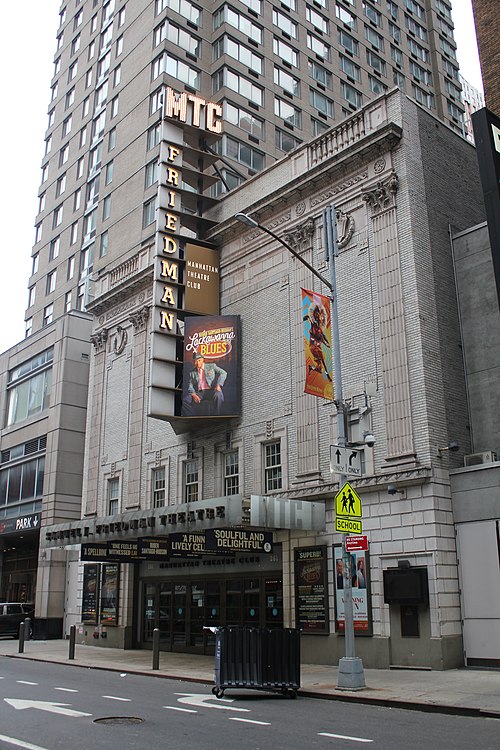
Samuel J. Friedman Theatre on West 47th Street — Manhattan Theatre Club’s intimate Broadway house in the heart of the Theater District.
What Kind of Broadway Theater the Friedman Is
650 seats sounds like a mid-size Broadway house, and technically it is — but the renovation choices MTC made change what that number feels like in the room. The original Biltmore Theatre held approximately 1,000 seats; in the 2003 renovation, MTC reduced capacity by roughly 35 percent. The effect is a wider, more comfortable per-seat experience in which the back row of the mezzanine feels considerably closer to the stage than equivalent rear seats at larger houses.
The auditorium interior is a New York City landmark — the neo-Renaissance design by Herbert J. Krapp, the same architect who designed many of the most beloved Broadway houses, has been restored and preserved rather than modernized into visual anonymity. You walk into a room with genuine architectural character: plasterwork, proportional detail, and the sense of a space that was designed to frame performance rather than just contain an audience.
The typical MTC season at the Friedman runs plays and occasionally musicals with a specific artistic ambition — often world premieres, often first-rate casts, often work by significant American writers. The subscription model means a proportion of the audience knows MTC’s identity and attends with particular intentionality. The aggregate effect is a room that tends to have a more focused, more appreciative, and somewhat quieter audience energy than the tourist-heavy houses nearby.
This Is a Theater Operated by One of Broadway’s Most Respected Non-Profits
Manhattan Theatre Club has been developing and producing American plays and musicals since 1970. The organization’s commitment to new work — commissions, dramaturgy, artist development — means that productions at the Friedman are often the result of years of intentional creative process rather than commercial programming decisions. Seeing a show at the Friedman is not the same as seeing a commercial Broadway transfer, even when the result looks similar from the outside. The institutional identity of MTC shapes the experience of the house.
Samuel J. Friedman Theatre Seating — What to Know Before You Choose
The seating at the Friedman works differently than at larger houses, and the difference matters when making a seat-buying decision. Because the renovation reduced capacity significantly, even seats that would feel “far back” at a 1,500-seat Broadway house feel manageable here. The trade-offs are not about distance so much as about angle, immersion, and the particular quality of the view from each section.
Center orchestra at the Friedman provides the full-stage picture with genuine proximity to the actors — a combination that rewards the kind of intimate, performance-driven work MTC typically produces. Front center can occasionally feel close enough to affect perspective on larger staging elements; mid-center orchestra is the most consistently useful position for most productions.
The front mezzanine at the Friedman has a strong reputation among theatergoers and is specifically noted for its sightlines. The elevation gives a clear view of the full stage without the distance penalty you would pay in the mezzanine of a larger house. For productions with significant staging complexity or visual design, front-center mezzanine can be the clearest single perspective in the room.
Side orchestra positions are workable but worth watching — particularly for plays with tight, central staging where an angled view may feel limiting. In the Friedman’s reduced-capacity configuration, side orchestra is less of a compromise than at larger houses, but verifying the production’s staging notes before choosing far-side seats is still good practice.
The Premier Circle level sits between the Orchestra and Mezzanine and functions somewhat like a front balcony in traditional terminology. In the Friedman’s configuration, it tends to provide a raised, clear view of the full stage with good proximity — often a more comfortable experience than equivalent pricing tiers at larger houses. MTC currently also lists a Premier Circle lounge exclusively for members of the Patron Program.
The least predictable positions at the Friedman — far side seats may have angle limitations depending on the production’s staging, and rear orchestra positions, while acceptable, are a lesser value than the front mezzanine at similar or lower prices. Checking specific production reviews for seat preferences before buying extreme-side positions is worth the few minutes it takes.
Wheelchair accessible seating is available by phone, in person, and online. MTC currently lists wheelchair locations in the Orchestra and one in the Mezzanine, plus removable-armrest seats and limited front Orchestra seating for guests who are blind or have low vision. Contact MTC before purchasing if seat path, lift use, or removable-armrest access matters.
The Friedman’s most consistent quality is that nearly every seat is a workable seat — the renovation’s capacity reduction means there is no zone of the house where you would routinely feel parked far from the action. Even so, the front mezzanine center and the mid-center orchestra are the positions that most consistently earn the strongest reviews across productions.
Where the Samuel J. Friedman Theatre Sits — and What That Means for the Night
The Friedman’s address — 261 West 47th Street between Broadway and 8th Avenue — places it squarely in the Theater District without putting it on the most tourist-trafficked stretch of the neighborhood. It shares the block with the Ethel Barrymore Theatre and Longacre Theatre; the Eugene O’Neill and Walter Kerr Theatres are a block north. The immediate block feels decidedly Broadway without the overwhelming density of Times Square one block east.
For pre-show dining, the location is genuinely useful. Restaurant Row — the stretch of West 46th Street between 8th and 9th Avenues — is a one-block walk from the Friedman’s entrance. This is the best-known concentration of pre-theater restaurants in the area, ranging from casual to more formal, and most are comfortable with the curtain-time rhythms of Broadway audiences. The restaurants near Broadway guide covers the current options and how to choose based on timing and type of night.
Subway access is straightforward. The closest station is 50th Street on the C and E lines; the A/C/E/1/2/3/7/N/R/W/S cluster at 42nd Street–Times Square is a short walk south. For most visitors arriving from anywhere in Manhattan or the outer boroughs with a Times Square subway connection, the Friedman is as easy to reach as any Broadway house. See the transportation guide for the full picture of how to get to the Theater District.
Who Tends to Love the Samuel J. Friedman — and Why
Play lovers and actor-forward theatergoers
The Friedman is almost entirely a play theater. MTC’s Broadway programming centers on new American plays — often world or Broadway premieres, often featuring significant casts, often the product of careful development processes. If the production in question is a play rather than a large-scale musical, the Friedman’s 650-seat configuration creates the conditions for a specifically intimate and attentive experience that larger houses cannot replicate. The work tends to reward the room, and the room rewards the work.
Date night and grown-up Broadway evenings
There is something specifically right about the Friedman for a Broadway date night. The house has genuine architectural beauty, the audience tends toward the more engaged and less tourist-heavy end of the Broadway spectrum, and the kind of play MTC typically produces is the kind that gives couples something real to talk about afterward. A pre-show dinner at Restaurant Row, an MTC production at the Friedman, and a post-show drink in the neighborhood constitutes one of the better theater-night structures available in the Broadway area.
Repeat Broadway visitors
Visitors who have seen the major commercial musicals and are looking for something different — more challenging, more intimate, more actor-driven — will often find the Friedman a welcome contrast to the Majestic, the Gershwin, or the St. James. The scale change from a 1,800-seat house to 650 seats is significant, and the MTC programming identity tends to produce evenings that feel more specifically theatrical and less spectacle-driven.
First-time Broadway visitors — with caveats
The Friedman can be an excellent first-time Broadway theater depending on the production. A first-timer who wants an actor-forward drama in an intimate room may have a more memorable first experience here than in a cavernous house watching a large musical from the back. The caveat: if someone’s image of Broadway is fundamentally about large-scale staging, elaborate choreography, and theatrical spectacle, the Friedman may feel underwhelming purely because of scale — and a different house would be the right recommendation.
Accessibility at the Samuel J. Friedman
The Friedman is accessible in ways that are worth understanding specifically rather than generically. MTC currently lists the street-level entrance at 261 West 47th Street and an elevator at the right of the box office lobby that provides access to all levels of the theater, plus the Susan and Peter J. Solomon Family Lounge and Mezzanine lounge/restroom area. The theater also has a motorized lift for access to select front Orchestra seats on house left.
Wheelchair accessible seating can be purchased by phone, in person, or online. MTC currently lists six wheelchair seating locations in the Orchestra (A117, O125, O126, P101, P102, P120) and one in the Mezzanine (E2), with adjacent companion seating available for purchase. MTC also lists removable-armrest seats in the Orchestra (B101, F123, L130, N127, O101, O102) and Mezzanine (F101, F121).
For guests who have difficulty with stairs but do not need a removable armrest, MTC identifies Row P in the Orchestra, Row AA in the Premier Circle, and Row F in the Mezzanine as better limited-mobility options. Because the theater still has stairs in the aisles, guests should alert the box office or Telecharge ticketing agent about seating needs before purchasing.
The Friedman Theatre has a built-in induction loop for compatible hearing devices. Assistive listening devices and hearing-aid compatible devices are available free of charge on a first-come, first-served basis. MTC’s current accessibility page lists these devices through staff/equipment handling at the Solomon Lounge; the Plan Your Visit page also notes the podium in the corridor outside the Orchestra entrance. Ask house staff when you arrive so you are routed to the correct current pickup point.
MTC offers Braille and large-print Playbills, live audio description at select performances, on-demand audio description beginning three weeks after a show’s opening night, and limited front Orchestra seating for audience members who are blind or have low vision. Seating for guests who are blind or have low vision can be purchased at the Box Office or through Telecharge.
Accessible restrooms are currently listed on the lower-level Susan and Peter J. Solomon Family Lounge and on the upper Mezzanine level. Members of MTC’s Patron Program have access to restrooms in the Patrons’ Lounge on the Premier Circle level. Service animals are welcome.
MTC encourages visitors with specific accessibility needs to contact their administrative offices at (212) 399-3000 (Monday through Friday, 10am–6pm, excluding holidays) or email accessibility@mtc-nyc.org for assistance planning the visit. For comprehensive Broadway accessibility resources, TheatreAccess.NYC aggregates accessibility details for Broadway venues including the Friedman.
The Susan and Peter J. Solomon Family Lounge opens 45 minutes before curtain at the Orchestra/lower-lounge level; the Mezzanine lounge opens 45 minutes before performances as well. The Premier Circle lounge is available exclusively for members of MTC’s Patron Program. Late seating and re-entry are allowed only at the discretion of house management — this is standard Broadway practice and is worth noting for anyone planning a dinner that might run close to curtain.
How to Build a Night Around the Samuel J. Friedman Theatre
The Friedman’s location makes the evening genuinely easy to structure. The best approach for most visitors follows a simple sequence: an early dinner in the area, the performance itself, and a post-show drink or light bite somewhere nearby.
Restaurant Row on 46th Street between 8th and 9th Avenues is a one-block walk from the theater — it is the most specifically theater-oriented dining strip in the Broadway area, with most restaurants experienced at managing curtain-time service. The best pre-theater restaurants guide covers how to think about timing and what to look for in a pre-theater restaurant. For a fuller list of options by type and occasion, the restaurants near Broadway guide has the current landscape.
The immediate 47th Street vicinity has a few restaurants noted directly across the street from the theater — including Trattoria Trecolori, Glass House Tavern, and Friedman’s. These serve the theater crowd and understand the pre-show window. For visitors who prefer more casual or varied options, 8th Avenue and 46th Street offer additional choices.
MTC’s current box office hours depend on whether the Friedman is in performance. When in performance, the box office is listed as Monday 12–6pm; Tuesday through Saturday from 12pm until 30 minutes after the evening curtain; and Sunday 12–6pm, or until 30 minutes after an evening curtain when scheduled. On matinee days, the box office opens at 10am. When not in performance, MTC lists Monday–Saturday 12–6pm and closed Sunday. Check MTC’s current Plan Your Visit page before making a special trip, since holiday and season-transition hours can differ.
For visitors staying nearby, the hotels near Broadway guide covers the range of options in walking distance of the Theater District. For the full neighborhood context of the Theater District — what the surrounding blocks feel like, when to arrive, and how the area changes through the evening — see the Theater District neighborhood guide.
How the Friedman Compares to Larger Broadway Houses
The comparison that clarifies the Friedman’s identity fastest: put it next to a house like the Gershwin or the Majestic, which run at 1,800–1,900 seats, and the differences become immediately concrete. Those rooms have space enough for elaborate set machinery, large casts, and theatrical effects that require distance and scale to read correctly. The Friedman’s 650 seats sit in a room where none of that is expected — and where the alternative, a focused room in which every detail of a performance is visible and audible, is genuinely compelling on its own terms.
This is not a hierarchy. The Majestic is the right house for a certain kind of Broadway evening, and the Friedman is the right house for a different kind. The practical implication for theatergoers: choosing the Friedman means choosing an experience defined by proximity, clarity, and the specific quality of intimate theatrical attention rather than the specific quality of large-scale theatrical spectacle. Both are legitimate Broadway experiences; they are not interchangeable ones.
Among the cluster of mid-size Broadway houses — where the Lyceum, Booth, John Golden, and Todd Haimes Theatre also sit — the Friedman is notable for its combination of architectural distinction, MTC’s artistic reputation, and the specific feel of a renovated house that was made smaller rather than larger. Those choices create a room with a particular personality that is worth understanding before you buy your ticket.
Common Mistakes at the Friedman
Assuming all Broadway houses feel basically the same
The experience of seeing a play in 650 seats at the Friedman is genuinely different from seeing a musical in 1,900 seats at the Gershwin. Room scale shapes the experience of a theatrical performance in ways that are not always obvious from a ticket price comparison. If this distinction matters to you — and it should — the Friedman is worth choosing deliberately, not stumbling into.
Buying seats based on price alone without considering room geometry
In a smaller house, the calculus shifts. The cheapest seats in the Friedman are often better relative to the best seats in a larger house than the pricing suggests. Conversely, some buyers overpay for front orchestra when mid-center mezzanine would have given a cleaner overall picture of the stage. At 650 seats, the tier differences matter less; the specific seat within each tier matters more.
Arriving without time to use the lounge
The public lounges open 45 minutes before curtain. This is not incidental — the Susan and Peter J. Solomon Family Lounge and the Mezzanine lounge are part of the house experience, with restrooms, concessions, and coat lockers. Arriving at 7:55 for an 8:00 performance bypasses the part of the Friedman experience that makes the evening feel like something more than the show itself.
Not noting that late seating is at house management’s discretion
Standard Broadway policy, but worth restating for the Friedman specifically. The house is serious about the work and about the audience experience; a late arrival disrupting a focused room matters more here than at houses where audiences come and go more loosely. Plan dinner so the bill is settled 30 minutes before curtain, not 5.
Frequently Asked Questions
261 West 47th Street, between 8th Avenue and Broadway, in the Theater District of Midtown Manhattan. It is on the north side of 47th Street, sharing the block with the Ethel Barrymore and Longacre Theatres. Restaurant Row on 46th Street is one block south. The closest subway station is 50th Street on the C and E lines; 42nd Street–Times Square on the A/C/E/1/2/3/7/N/R/W/S lines is a short walk south.
A 650-seat Broadway house with a genuinely intimate feel — significantly smaller than most commercial Broadway houses and designed specifically for plays and actor-driven productions. The auditorium interior is a New York City landmark with neo-Renaissance design by Herbert J. Krapp, restored by Manhattan Theatre Club in a $35 million renovation that reopened in 2003. The room has architectural character, strong sightlines from most positions, and an audience that tends toward the more intentional and less tourist-heavy end of the Broadway spectrum.
Yes — the front Mezzanine center is specifically noted for excellent sightlines and is often one of the best positions in the house. Because the theater was renovated to reduce capacity significantly, the Mezzanine at the Friedman does not have the cavernous distance problem that afflicts equivalent levels in larger Broadway houses. Front-center Mezzanine is a consistently strong choice, especially for productions with complex staging or significant visual design where an elevated perspective clarifies the full stage picture.
Relative to the largest Broadway houses, yes. 650 seats is smaller than houses like the Gershwin or the Majestic, though it is comparable in size to other mid-range Broadway houses like the Lyceum, Booth, or Todd Haimes Theatre. The specific feel of the Friedman is shaped less by the raw seat count and more by the renovation choices that widened the spacing and reduced the original 1,000-seat configuration — the room feels more spacious per person and more intimate relative to the stage than the numbers alone suggest.
Manhattan Theatre Club (MTC), one of the country’s leading non-profit theater organizations. Founded in 1970, MTC is known for its commitment to new American plays, artist development, and subscriber-driven programming. The organization took over the then-abandoned Biltmore Theatre in 2001, completed a $35 million renovation, reopened the venue in 2003, and renamed it in 2008 to honor Broadway publicist Samuel J. Friedman (1912–1974).
Yes. MTC currently lists a street-level entrance, an elevator at the right of the box office lobby with access to all levels, accessible restrooms on the lower-level Susan and Peter J. Solomon Family Lounge and upper Mezzanine level, wheelchair accessible seating, removable-armrest seats, an induction loop, assistive listening devices, Braille and large-print Playbills, and limited front Orchestra seating for guests who are blind or have low vision. For specific assistance planning an accessible visit, contact MTC at (212) 399-3000 or accessibility@mtc-nyc.org.
It can be — especially for visitors whose interest in Broadway is driven by plays, literary quality, or actor-forward work rather than large-scale musicals. The intimate room rewards the kind of close attention that makes theater feel genuinely alive, and the MTC programming tends to be stronger on those qualities than typical tourist-oriented productions. The honest caveat: visitors whose primary image of Broadway is large-scale spectacle may find 650 seats with a straight play underwhelming relative to that expectation, and a different house and production choice might be the better first experience for them.
The Friedman Is One of Broadway’s Best Houses for the Right Evening
The Samuel J. Friedman Theatre is one of the Broadway houses that tends to appeal most to visitors who want the room itself to feel like part of the art. The 650-seat configuration, the architectural character, the MTC identity, and the kind of actor-forward, play-driven work that fills the space together create an experience that is genuinely different from seeing a large commercial musical in a 2,000-seat house. Neither is better in the abstract; they are designed for different kinds of evenings.
What makes the Friedman worth choosing deliberately is knowing what you are choosing. If the evening is about a strong play, intimate theatrical attention, and the pleasure of being in a beautiful, properly sized room for the work — this is one of the best places on Broadway to have that experience.
For row-by-row seats, use the Samuel J. Friedman Theatre seating guide. For broader planning, start with the Broadway hub, the Broadway theaters guide, and the Theater District neighborhood guide.
The Friedman Is Intimate — Now Choose the Right Seat
The Samuel J. Friedman Theatre is MTC’s Broadway home: a smaller, actor-forward playhouse where sightlines, dialogue clarity, center angles, and access matter. Start with the dedicated seating guide, then build the rest of the night around Broadway dining, hotels, subway routes, parking, and nearby Theater District houses.
Samuel J. Friedman Seating Chart & Best Seats
Compare Orchestra, Premier Circle, Mezzanine, accessibility, actor-forward sightlines, center angles, and value seats in MTC’s intimate Broadway room.
Open Seating Guide Current & Upcoming ShowsBrowse Broadway Show Guides
The Friedman rotates MTC productions, so the best seat can shift by show. Start with the current Broadway show hub before locking in the night.
Browse ShowsBroadway Seating, Theater & Ticket Strategy
Seats · Plays · ValueBroadway Seating Guide
Compare Orchestra, Mezzanine, Balcony, boxes, sightlines, value zones, accessibility, and when elevated center beats closer side seats.
All Broadway Theater Guides
Compare every Broadway house by size, access, neighborhood, seating levels, room personality, and night-out fit.
What’s Playing on Broadway
Browse current Broadway shows and connect each production to the right theater, seat choice, and full-night plan.
First-Time Broadway Guide
For visitors choosing their first show: seats, arrival, timing, dress, intermission, crowds, and Theater District basics.
When to Buy Broadway Tickets
Know when buying early matters, when waiting can work, and how timing changes for plays, limited runs, and premium center seats.
Broadway Rush and Lottery Tickets
How discount systems work, what seat tradeoffs to expect, and why cheap seats can be great — or risky — depending on the room.
Plan the Samuel J. Friedman Theatre Night
Dinner · Hotels · TransitRestaurants Near Broadway
Use the broader Broadway dining guide when you want a reliable pre-show meal before walking into the 47th Street theater zone.
Restaurants Near Times Square
Useful when your group wants to stay close to the Friedman, Broadway, Times Square, and post-show transit.
Pre-Show Dining Guide
Plan reservation timing, walking buffer, arrival, late-seating risk, and post-show movement around a Theater District play.
Hotels Near Broadway
Compare Theater District, Times Square, Midtown West, and Hell’s Kitchen hotel zones for a Broadway-centered trip.
Hotels Near Times Square
Best for visitors who want short walks, easy subway access, and simple post-show return logistics after an MTC night.
How to Get to a Broadway Show
Subway, walking, rideshare, and arrival timing for Theater District shows, including the Friedman on West 47th Street.
Subway to Broadway
Pick the right subway approach for West 47th Street, Times Square, Restaurant Row, and post-show exits.
Parking Near Broadway
When driving makes sense, when it does not, and how to avoid turning a Friedman night into a Midtown garage problem.
Best Way Home After a Show
Subway, taxi, rideshare, walking, and hotel return strategy after a crowded Theater District performance.
Nearby Neighborhood & Theater Guides
47th Street · Restaurant Row · Nearby HousesTheater District
The practical guide to Broadway’s center: theaters, crowds, hotels, restaurants, walking routes, and first-time visitor logistics.
Hell’s Kitchen
A strong pre- and post-show dining base west of the Friedman, especially if you want less Times Square noise.
Times Square
Useful for hotels, transit, crowd planning, visitor logistics, and the classic Broadway arrival flow.
Booth Theatre Guide
Compare another intimate Broadway house where plays, actor detail, and center sightlines matter more than spectacle scale.
John Golden Theatre Guide
A nearby play-first Broadway house useful for comparing intimate room feel, sightlines, and theatergoer-focused nights.
Lyceum Theatre Guide
A historic Broadway house with a different layout, useful for comparing classic room character, scale, and seat strategy.