

Eugene O’Neill Theatre Tickets: Box Office & Broadway Guide
Eugene O’Neill Theatre tickets, box office hours, The Book of Mormon Broadway information, official ticketing guidance, location, accessibility, seating links and night-out planning.
Eugene O’Neill Theatre tickets currently center on The Book of Mormon, which remains the Broadway production at 230 West 49th Street. ATG currently lists Broadway performances through May 30, 2027. For primary online inventory, the official production directs buyers to ATG Tickets; the Eugene O’Neill box office also sells tickets in person.
Most visitors arrive at the Eugene O’Neill Theatre for one reason: The Book of Mormon, which has been running here since March 2011. At this point the show and the theater are so identified with each other that planning a night here means thinking about both simultaneously. But the Eugene O’Neill is also a working Broadway house with real history, a distinct character, and access specifics that are worth understanding before you book.
This main venue guide covers Eugene O’Neill Theatre ticket and box-office planning, the current show, location, accessibility, history and the rest of the evening. For detailed seat-selection intent, use the Eugene O’Neill Theatre seating guide.
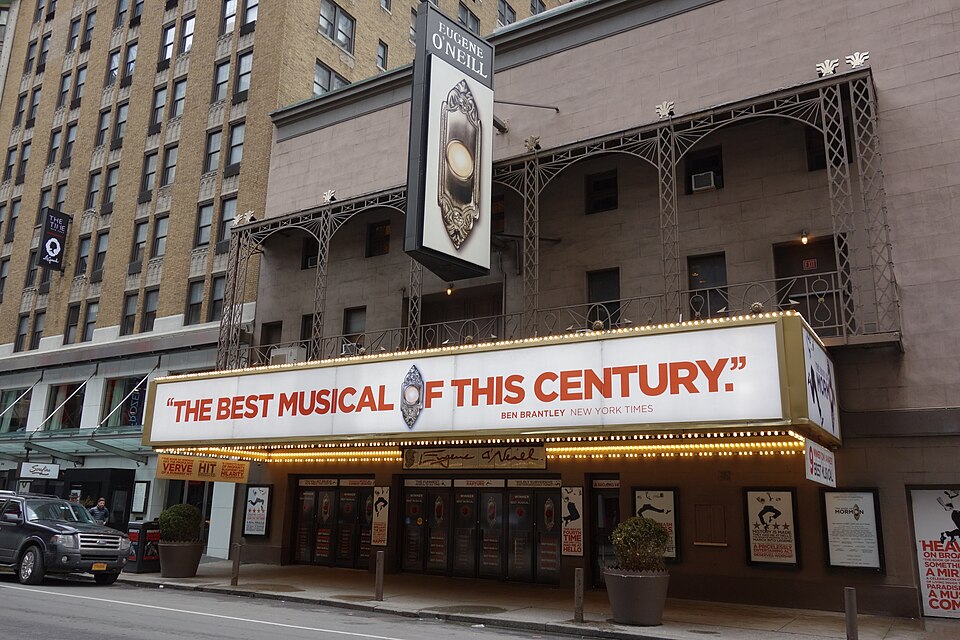
Eugene O’Neill Theatre Tickets & Box Office
The primary commercial intent on this page is Eugene O’Neill Theatre tickets. The current Broadway production is The Book of Mormon, and the official Broadway production currently directs online buyers to ATG Tickets. ATG lists performances at the Eugene O’Neill through May 30, 2027.
Buying Eugene O’Neill Theatre tickets
Before purchasing, confirm the performance date and time, exact seat, whether the listing is primary inventory or resale, and the final all-in price. The official Book of Mormon site directs Broadway buyers to ATG Tickets, while in-person purchases can be made at the Eugene O’Neill Theatre box office.
Eugene O’Neill Theatre box office
The Eugene O’Neill Theatre box office is at 230 West 49th Street, between Broadway and Eighth Avenue. Current posted hours are Monday 10am–6pm, Tuesday through Saturday 10am–8pm, and Sunday 12pm–7pm. The box office remains open through curtain for ticket pickup and day-of sales; advance sales pause before curtain. Hours can change, so verify before making a special trip.
The Book of Mormon at the Eugene O’Neill Theatre
Book of Mormon Eugene O’Neill Theatre searches belong naturally on this venue page because the musical has occupied the house since 2011. The production currently runs approximately 2 hours and 30 minutes including one intermission, and ATG lists performances through May 30, 2027. For show-specific cast, content, runtime and production information, use the Stage & Street Book of Mormon guide.
Quick Answers
About the Eugene O’Neill Theatre
The theater at 230 West 49th Street opened on November 24, 1925, as the Forrest Theatre — designed by Herbert J. Krapp as part of a combined theater-hotel complex and named after 19th-century tragedian Edwin Forrest. Krapp was also the architect behind the Ethel Barrymore, the Lyceum, and the Shubert, giving these Theater District houses a family resemblance in their proportions and craft. At the time, the Forrest was a construction novelty: it used a steel frame structure, previously reserved for skyscrapers, to give the theater both its height and its unusual long-term durability.
The theater changed hands and names twice before finding its current identity. It became the Coronet in 1945 following a renovation, then was renamed the Eugene O’Neill in 1959 by new owner Lester Osterman — making it the first Broadway theater named after a playwright. O’Neill’s widow initially objected, but Osterman prevailed. The name stuck, and the etched glass portrait of O’Neill that Osterman commissioned is still in the lobby.
Neil Simon purchased the theater in 1967 and used it as the home for some of his best-known plays through the 1970s — The Odd Couple, Last of the Red Hot Lovers, The Good Doctor, California Suite, and others. It is an unusual piece of theater history: a house named for America’s greatest dramatic playwright, acquired and programmed by America’s most commercially successful comic playwright, who used it as his personal creative home for fifteen years. Jujamcyn (now ATG Entertainment) has operated the theater since 1982.
The Eugene O’Neill’s auditorium interior is a New York City designated landmark — its plasterwork and proportions are protected. The house seats approximately 1,100 patrons across orchestra and mezzanine, a mid-size Broadway configuration that accommodates both comedies and dramas without the removed feeling of the largest houses or the cramped intimacy of the smallest ones.
Eugene O’Neill Theatre Seating Overview
The Eugene O’Neill has a conventional two-level Broadway layout: a sloped orchestra with center and side sections, a front mezzanine that overhangs it, and a rear mezzanine behind that. The house is wider than it is deep, which means the center sections have genuinely good sightlines throughout, and side positions are the places to think carefully about.
For the full seating chart, seating views, best seats, sections and row-by-row seat-selection guidance, use the dedicated Eugene O’Neill Theatre seating guide. This main venue page keeps the overview because it is useful for planning, but detailed seating intent belongs to the separate guide.
For The Book of Mormon specifically — a show built on physical comedy, ensemble timing, and a stage picture that frequently uses the full width — the ability to read the whole stage at once matters more than being extremely close. This is not an intimate two-person play where proximity to individual faces is the priority. The comedy rewards being able to see everything happening simultaneously, which slightly favors centered mid-distance positions over very front orchestra seats.
The most reliable range in the house. Far enough back from the stage to take in the full width of the action, close enough to follow individual performances clearly. Rows D through K center hit the right balance for a comedy musical where ensemble staging is the point. These are the highest-demand seats, priced accordingly.
The front rows of center orchestra are premium-priced and genuinely close to the performers. For a show with physical comedy and wide-stage ensemble numbers, the very front can narrow your field of view in ways that work against the material. Rows B and C center are better than row A for this production. Enthusiasts may love the proximity; first-timers usually get more from a slightly more pulled-back position.
A consistently strong position for The Book of Mormon. The elevated angle gives the widest stage picture in the house, which suits the show’s large-cast staging well. Rows A and B center in the front mezzanine are often cited as the best value seats in the theater when priced at a meaningful discount to premium orchestra. The rake is good — heads in front rarely obstruct.
The front mezzanine side sections angle outward, giving increasingly diagonal views of the stage. Inside seats — closest to the center aisle — are significantly better than outer positions. If booking in this range, prioritize seats as close to center as possible. Far outer positions in front mezzanine sides are the least useful seats at this level.
The rear mezzanine offers the cheapest seats in the house and unobstructed center sightlines, but it is a genuine distance from the stage. For a comedy where facial expressions and physical timing are part of the joke, the rear mezzanine loses some of what makes the show work up close. Worth it for budget-constrained visitors who still want a full-stage overview; less ideal if you have flexibility.
The inner side orchestra seats — closest to the center sections — offer views comparable to center orchestra a few rows further back, often at lower prices. The outer side orchestra, particularly in the front rows, can involve meaningful stage angles where one side of the action is harder to follow. Worth comparing seat numbers before booking discounted side positions.
Orchestra row T requires one step up from the main orchestra level. These are still within the orchestra and do not require the full mezzanine stair climb, but visitors who need to avoid any steps should be aware of this when selecting specific rows. Confirm exact accessible positions through the box office when booking.
Best Seats by Visitor Type
The most reliable introduction to what the Eugene O’Neill feels like. Centered, mid-distance, and close enough to the action without being so close that the full stage picture narrows.
The orchestra is step-free from the sidewalk. If avoiding stairs is a priority, book orchestra seats — the mezzanine is not an option without climbing. Wheelchair seating is in the orchestra only.
For seeing the full width of ensemble staging — especially relevant for The Book of Mormon — front mezzanine center rows A and B are the widest perspective in the house, and frequently represent the best value when priced below premium orchestra.
Rear mezzanine center offers unobstructed but distant views. Inner side orchestra seats give better sightlines than rear mezzanine at potentially similar prices, and stay on the orchestra level for anyone who prefers fewer stairs.
This is a show where the stage picture matters — large cast, physical comedy, wide-stage choreography. Being able to take it all in simultaneously matters more than extreme proximity to individual performers. Center orchestra rows D–K or front mezzanine center rows A–C both deliver this well.
Groups with mixed mobility needs should book within the same level to avoid splitting. Orchestra center keeps everyone step-free. If the whole group can manage stairs, front mezzanine center rows keep everyone together with strong sightlines.
Accessibility and Mobility Notes
The Eugene O’Neill’s accessibility picture is worth knowing before you book — particularly because the mezzanine involves a substantial stair climb and the accessible restroom situation is unusual.
The mezzanine is reached by climbing 25 steps from the orchestra level. The front mezzanine entrance is behind row D; reaching the remainder of the mezzanine requires an additional 15 steps beyond that. Once in the mezzanine, each row involves approximately two steps down. There are no elevators or escalators anywhere in the theater. If stairs are a concern for anyone in your group, book orchestra seats before checking out is complete.
Orchestra access
The orchestra level is step-free from the sidewalk — no steps between the street entrance and the orchestra seating. This is the section to book for anyone who cannot climb stairs. Note that row T requires one step up from the main orchestra floor. When booking accessible seats, confirm exact row positions through the box office.
Wheelchair seating
Wheelchair positions are available in the orchestra only. Companion seating and aisle transfer seats are also available. To book accessible seating or confirm specific positions, contact the Eugene O’Neill box office directly or use the accessible ticketing option through the official ticket source. Do not assume that wheelchair positions are automatically available for peak performances — book early.
Accessible restroom — an important note
The accessible restroom for the Eugene O’Neill Theatre is located in the adjacent Time Hotel at 224 West 49th Street, not within the theater building itself. Staff can direct you and assist in reaching it. Plan for this in advance if an accessible restroom is a necessity — it requires leaving the theater and entering the hotel, which takes more time than a standard in-house restroom visit before or during intermission.
Assistive listening and captioning
The Eugene O’Neill currently offers D-Scriptive devices, I-Caption devices, infrared headsets, audio-induction neck loops, and Showtrans translation devices. Aisle transfer, companion, wheelchair and vision/hearing accessible seating options are also available. Confirm the specific device or seating accommodation you need for your performance date before booking.
The Eugene O’Neill’s Character and Production History
A theater’s history tends to reflect its character, and the Eugene O’Neill’s history is more varied — and more interesting — than its current identity as “the Book of Mormon house” might suggest. What the record shows is a theater that has consistently attracted major commercial productions across a wide range of material, from the longest-running drama in Broadway history through a decade of Neil Simon comedies to one of the longest-running musicals of the modern era.
What the history makes clear is that the Eugene O’Neill is a house that gravitates toward long runs and American material — it tends to find shows that connect with audiences broadly and sustain them. Tobacco Road, Annie, Big River, The Book of Mormon: each dominated its era at this address. The theater is not a place that chases prestige for its own sake; it is a working Broadway house that knows how to support a show that an audience wants to keep coming back to.
Planning a Night Around the Eugene O’Neill
Location and getting there
The Eugene O’Neill is at 230 West 49th Street, between Broadway and 8th Avenue — deep in the Theater District and an easy walk from Times Square. The closest subway is the C or E train to 50th Street at 8th Avenue, which puts you a short block from the theater. The 1 train to 50th Street on Broadway is also close. N/R/W trains to 49th Street on 7th Avenue are a slightly longer walk but still convenient. The getting to a Broadway show guide covers transit in more detail. Parking garages exist in the area but compete with Theater District traffic on performance nights — transit is usually the faster option. The parking near Broadway guide covers nearby options for drivers.
Arrive with time to spare
The Eugene O’Neill’s doors currently open approximately 45 minutes before showtime, while the theater bars open about 40 minutes before the performance. The lobby can feel busy on performance nights, so arriving early gives you time for security screening, ticket issues, finding your section, and settling in without pressure. If you are in the mezzanine, navigating the 25-step climb and finding your row takes additional time — plan accordingly.
Pre-show dinner
49th Street is surrounded by Theater District restaurant options at every price point, but the closest blocks tend toward the tourist-oriented end of the spectrum. Moving a few blocks west toward 9th Avenue or Hell’s Kitchen — roughly a 5–8 minute walk — improves the dining quality considerably for the same logistics. Plan to be seated for dinner no later than 90 minutes before curtain; The Book of Mormon has a 2-hour-30-minute runtime with one intermission, so a rushed dinner lands in an awkward spot. The pre-show dining guide covers timing strategy, and the restaurants near Broadway guide has specific options for this part of the Theater District.
Hotels and the neighborhood
The Time Hotel sits directly adjacent to the theater at 224 West 49th Street — convenient for visitors who want to minimize the distance between hotel and curtain. Broader Theater District hotel options along 7th and 8th Avenue are covered in the hotels near Broadway guide. The Theater District neighborhood guide is useful for visitors planning more of the evening or more than one night in this part of Midtown.
The Book of Mormon: content advisory
The show contains explicit language throughout and is not suitable for young children. Children under 5 are not admitted. The official advisory says the content includes strong themes, language, and sexual content. The age guidance is adults and teens; the show is generally recommended for audiences 13 and older, with the understanding that parental discretion applies. This is one of the few Broadway shows where the content advisory genuinely matters for group planning — worth confirming before bringing anyone who might find explicit satirical comedy genuinely uncomfortable.
Frequently Asked Questions
For the current Broadway production, The Book of Mormon, the official show directs primary online ticket buyers to ATG Tickets. Tickets can also be purchased in person at the Eugene O’Neill Theatre box office at 230 West 49th Street. Verify the performance date, seat and final price before checkout.
Current posted hours are Monday 10am–6pm, Tuesday through Saturday 10am–8pm, and Sunday 12pm–7pm. The box office remains open through curtain for ticket pickup and day-of sales, while advance sales pause before curtain. Hours are subject to change.
230 West 49th Street in Manhattan, between Broadway and 8th Avenue in the Theater District. The closest subway is the C or E train to 50th Street at 8th Avenue. The 1 train to 50th Street on Broadway is also a short walk.
The Book of Mormon remains the current Broadway production. ATG currently lists performances at the Eugene O’Neill Theatre through May 30, 2027. Check the live calendar before purchasing because schedules and booking horizons can change.
Approximately 1,100 seats. Published capacity figures vary slightly by source — ATG’s current venue materials list about 1,102, while other databases list between 1,047 and 1,108. Use roughly 1,100 as the working figure.
Partially. The orchestra level is step-free from the sidewalk, and wheelchair seating is available in the orchestra. The mezzanine requires 25 steps from the orchestra level, with an additional 15 steps to reach the rear section — no elevators or escalators are available. The accessible restroom is in the adjacent Time Hotel, not within the theater itself. For accessible seating arrangements, contact the box office directly or use the accessible ticketing option.
For most productions, center orchestra rows D through K offer the strongest combination of proximity and full-stage sightlines. Front mezzanine center rows A and B are frequently the best value in the house when priced at a discount to premium orchestra — a wider stage picture at a lower cost. For The Book of Mormon specifically, where large-cast staging and ensemble comedy matter, slightly pulled-back center positions (orchestra rows E–K or front mezzanine rows A–C) generally outperform very front-row positions.
Children under 5 are not admitted. The show contains explicit language, strong themes, and sexual content throughout — it is not a family musical in any conventional sense. Generally recommended for audiences 13 and older, with the understanding that parental discretion applies depending on the specific child. This is one of Broadway’s more explicitly adult-oriented comedies, and the content advisory is worth taking seriously for mixed-age groups.
The theater was renamed for American playwright Eugene O’Neill in 1959 by owner Lester Osterman — making it the first Broadway theater named after a playwright. O’Neill was chosen because Osterman admired his work; O’Neill’s widow initially objected but ultimately agreed. The etched glass portrait of O’Neill commissioned for the renaming is still in the lobby. The theater had previously been called the Forrest Theatre (1925) and the Coronet (1945).
Since March 24, 2011 — now in its 15th year on Broadway. It is one of the longest-running shows in Broadway history and continues to play on an open run with no announced closing date.
The Eugene O’Neill in Brief
The Eugene O’Neill Theatre is a mid-size Broadway house with real character — a theater that has been home to some of the longest-running and most commercially significant productions in Broadway history, and that currently hosts one of them. Its proportions make it more manageable than the largest houses without sacrificing the sense of occasion that makes a Broadway night feel like a Broadway night.
For Eugene O’Neill Theatre tickets, verify the live Book of Mormon performance calendar, official primary ticket source, seat and final checkout price before purchasing.
The key decisions for visitors are section (center over side, always), stair load (orchestra if mobility matters, mezzanine if stairs are not a concern), and for The Book of Mormon specifically, embracing a slightly pulled-back center position over very front-row seats that narrow the stage picture. The Broadway theaters guide covers the full district if you are comparing houses, and the Book of Mormon Broadway guide covers the current production in more detail.
The Joke Needs the Full Stage — Then the Night Falls Into Place
The Eugene O’Neill is a mid-size Broadway house where centered seats, comedy timing, mezzanine stairs, and the West 49th Street plan all matter. Use these guides to connect the theater, seating chart, The Book of Mormon, dinner, transit, parking, hotels, and the surrounding Theater District night.
Eugene O’Neill Theatre Seating Chart
Compare center orchestra, front mezzanine, rear mezzanine, side views, stairs, accessibility, value picks, and the best seats for The Book of Mormon before you book.
Open Seating Guide Current ShowThe Book of Mormon Guide
Plan around the adult satire, musical comedy timing, runtime, visitor fit, content advisory, and the kind of centered view that lets the whole joke land.
Open Show GuideBroadway Seating & Ticket Planning
Seats · Timing · DealsBroadway Seating Guide
Compare orchestra, mezzanine, boxes, side seats, premium zones, and obstructed-view listings across Broadway houses.
When to Buy Broadway Tickets
Know when buying early matters, when waiting can work, and how timing changes for long-running hits, weekends, and high-demand performances.
Last-Minute Broadway Tickets
TKTS, same-day listings, rush, lottery, and practical ways to compare late options without blindly choosing poor distance or angle.
Broadway Rush and Lottery Tickets
How discount systems work, what tradeoffs to expect, and why a cheap seat can be smart — or risky — depending on the view.
First-Time Broadway Guide
For visitors choosing their first show or first theater: seats, arrival, timing, intermission, dress, and Theater District basics.
Best Broadway Shows for Date Night
Compare show tone, dinner pairing, mood, pacing, and whether the production fits the kind of night you are planning.
Plan the Eugene O’Neill Theatre Night
Dinner · Transit · ParkingRestaurants Near Broadway
West 49th Street puts you deep in the Theater District core, with Hell’s Kitchen dining a short walk west.
Pre-Show Dining Guide
Plan reservation timing, walking buffer, arrival, and post-show movement so dinner and theater work together.
Best Pre-Theater Restaurants NYC
Use this when you want stronger restaurant choices around Broadway instead of only timing and logistics advice.
Best Post-Show Restaurants NYC
Where to go after the curtain when you want a drink, dessert, late dinner, or a calmer landing after the show.
How to Get to a Broadway Show
The 1/C/E at 50th Street is close, with Times Square and 49th Street subway options also useful depending on where you start.
Parking Near Broadway
Driving can work, but garage choice and timing matter. Use this before choosing a Midtown parking plan.
Nearby Neighborhood & Hotel Guides
49th Street · Times Square · Hell’s KitchenTheater District
Where to eat, what to skip, and how to use the blocks around the Eugene O’Neill before and after the show.
Times Square
Best when convenience, subway access, and being right in the center matter most for a short Broadway trip.
Hell’s Kitchen
A strong nearby option when dinner matters — more restaurant depth, calmer blocks, and an easy walk west after the show.
Midtown West
A broader west-side planning base for hotels, transit, restaurants, and nights that stretch beyond the immediate Theater District.
Hotels Near Broadway
Compare Theater District, Times Square, Midtown West, and Hell’s Kitchen hotel zones when Broadway is the center of the trip.
Where to Stay for Broadway Weekends
Match hotel zone, walking distance, subway access, and post-show energy to the kind of Broadway weekend you want.
More Broadway Theater Planning
Hubs · Shows · CompareBroadway Theater Guides
Compare Broadway houses by room size, location, seating feel, history, accessibility, and what each theater is best for.
All Broadway Shows
Compare current productions before committing, with planning links to match the show to your group, budget, and night-out style.
Broadway in NYC
The full Broadway planning hub for shows, theaters, ticket timing, seating, visitor strategy, and night-out logistics.