

The Book of Mormon Musical Tickets, Cast & Broadway Guide
Find The Book of Mormon musical tickets, current lottery and rush options, Broadway cast, best Eugene O’Neill Theatre seats, runtime, plot and planning tips before you book.
230 W 49th St
15 years on Broadway
15-min intermission
Best for teens & adults
The Book of Mormon musical tickets remain in strong demand fifteen years into the show’s Broadway run at the Eugene O’Neill Theatre. Created by Trey Parker, Matt Stone, and Robert Lopez, the nine-time Tony-winning musical follows two mismatched missionaries sent to Uganda and turns their collision with faith, culture, poverty, and their own certainty into a deliberately outrageous Broadway satire.
The show remains what it was on opening night: sharp, profane, unapologetically adult, and technically polished. None of that makes it the automatic best Broadway choice for every visitor. This page is still a decision guide — it helps you work out whether The Book of Mormon is the right show for your specific group and expectations, while also covering current official tickets, lottery and rush options, cast, seat strategy, runtime, and planning details.
ATG is currently advertising a Broadway Fall Sale for The Book of Mormon: save up to 30% on select performances through October 4 using code FALLSALE. Availability is limited to select performances, so compare the final sale price with standard inventory before booking.
The Book of Mormon Musical Tickets: Lottery, Rush & Where to Buy
The Book of Mormon musical tickets are sold officially through ATG Tickets and directly at the Eugene O’Neill Theatre box office at 230 West 49th Street. The box office offers fee-free ticketing, and the Broadway production is currently on sale through May 30, 2027. Treat that date as the present ticket-sale window, not an announced closing date.
The production’s official 15th-anniversary lottery is currently active for eligible performances. Winners may purchase up to two tickets at $15 each, including the listed $3 service fee. Seat location, blackout dates, and available performances vary.
The Broadway League currently lists a limited number of $45 digital lottery tickets through Lucky Seat. This is separate from the special $15 anniversary lottery, so flexible visitors should check both official options.
TodayTix currently offers $49 same-day digital rush for the Broadway production. Rush inventory is app-based, first-come first-served, and seats may be partial view.
TKTS and Cheap Book of Mormon Tickets
TKTS is worth checking for same-day or next-day availability if your date and exact seat location are flexible. Inventory changes by performance, so treat TKTS as a live option rather than a guaranteed discount.
Where to Buy Book of Mormon Broadway Tickets
ATG Tickets: the official Broadway production site routes standard online ticket buyers to ATG Tickets.
Eugene O’Neill Theatre box office: official tickets are sold at 230 West 49th Street. Current posted hours are Monday 10 AM–6 PM, Tuesday–Saturday 10 AM–8 PM, and Sunday noon–7 PM. Buying at the box office is the official fee-free option.
Group tickets: official group sales are available for groups of 10 or more through Broadway Inbound.
Discount strategy: compare the $15 anniversary lottery, $45 Lucky Seat lottery, $49 TodayTix rush, TKTS, and the current ATG Fall Sale before using third-party resale inventory.
What Is The Book of Mormon Musical About?
Two Mormon missionaries — Elder Price, earnest and ambitious, and Elder Cunningham, hapless and well-meaning — are sent to a remote village in Uganda to convert the locals. What follows is two and a half hours of jokes that arrive at machine-gun pace, songs that alternate between catchy and shocking, and a story that manages to be genuinely warm about its characters while relentlessly mocking everything around them. The creative team is Trey Parker and Matt Stone — the South Park creators — working with Robert Lopez, the Tony- and EGOT-winning composer behind Avenue Q and Frozen. The combination produces something that no other Broadway musical sounds or feels like.
The humor operates on multiple registers simultaneously. The show satirizes organized religion, American naivety, missionary culture, and what happens when cheerful certainty meets conditions it has no framework for — and it does this while also writing songs catchy enough to be stuck in your head for weeks. “Hello,” the opening number, is a full-throated Broadway showstopper that introduces the missionaries’ door-knocking optimism. “Hasa Diga Eebowai” is its exact tonal opposite. “Spooky Mormon Hell Dream” is one of the most inventive production numbers on Broadway. The show earns its reputation for every minute of its two and a half hours.
The energy is relentless and the laughs are genuine — not the polite Broadway laughter of an audience being appreciative, but the involuntary kind that catches people off guard. Audience members who saw it in 2011 still describe it as one of the funniest things they’ve ever seen in a theater. Fifteen years later, that reputation holds. The show hasn’t softened or become comfortable with itself the way long-running productions sometimes do — it’s still playing at the same voltage.
The advisory is not decorative. The Book of Mormon contains sustained and deliberate crude language, sexual references, and humor about religion, race, and global poverty that is designed to be shocking before it becomes funny. This is central to what the show is, not incidental to it. Parker, Stone, and Lopez are not making a family musical with a few naughty words — they are making a show whose entire method involves pushing past what audiences expect to be acceptable and finding the comedy on the other side.
Back and running normally: A May 2026 electrical fire in the Eugene O’Neill Theatre’s spotlight room caused significant damage and a temporary closure. Repairs and safety inspections were completed and the show resumed performances on May 27, 2026. It has been running normally since — worth knowing if you’d heard about the closure and were unsure of the current status.
Current Book of Mormon Broadway Cast
The current Broadway company is led by Kevin Clay as Elder Price and Diego Enrico as Elder Cunningham, with Sydney Quildon as Nabulungi, Charlie Franklin as Elder McKinley, Jacques C. Smith as Mafala Hatimbi, and Derrick Williams as the General.
Current Broadway lead as the ambitious missionary who expects his mission to be the beginning of something extraordinary.
Current Broadway lead as Price’s socially awkward, improvisational mission companion.
Current principal cast member as Nabulungi.
Current principal cast member as Elder McKinley.
Original Broadway stars Nikki M. James and Rory O’Malley return from October 27, 2026 through January 17, 2027 as Nabulungi and Elder McKinley. If seeing either performer is part of the reason for your visit, book inside that specific engagement and verify the official cast calendar before purchasing.
Because this is a long-running production, principal roles can change. The show itself is stable, but travelers searching for the original cast — including Josh Gad and Andrew Rannells — should not assume those performers are part of the regular current company.
Best Seats for The Book of Mormon at the Eugene O’Neill Theatre
The Eugene O’Neill is a compact Broadway house, which works well for The Book of Mormon: the show depends on facial reactions, physical comedy, and full-company musical numbers more than giant scenic effects. Centered seats usually matter more than being as close as possible.
A strong balance of facial detail and full-stage perspective for the comedy, choreography, and ensemble numbers.
Excellent for taking in the complete stage picture while staying close enough for the character comedy to register.
The theater is compact enough that centered seats farther back can still give a satisfying view at a lower price than premium mid-Orchestra inventory.
Some discount, lottery, and rush inventory may have restricted angles. Check the exact seat location if an unobstructed view matters to you.
For the full seating layout, sightline advice, accessibility details, and section-by-section planning, see the Eugene O’Neill Theatre guide.
Who The Book of Mormon is best for
The clearest fit for The Book of Mormon is an adult audience that already knows it will like this kind of humor — people who watch South Park, who enjoy irreverent comedy, or who have a baseline comfort with satire that doesn’t pull its punches. The show rewards audiences who come prepared for it far more than audiences who come hoping it will be funny in a gentler way than advertised.
For the specific goal of laughing as hard as possible for two and a half hours at a Broadway show, The Book of Mormon remains the benchmark. No other current Broadway production is in the same category for sheer sustained comedy output.
If you know Parker and Stone’s sensibility from South Park, The Book of Mormon is that sensibility applied to the Broadway musical form with full production resources. Same targets, same irreverence, better songs.
The Book of Mormon is one of Broadway’s best group experiences — a show where the shared shock and laughter of a full house becomes part of the event. It’s an ideal choice for a friend-group Broadway night where everyone knows what they’re signing up for.
For regular theatergoers who have done the big spectacle musicals and want a different kind of Broadway energy — faster, funnier, more contemporary — The Book of Mormon is the most consistently rewarding option in this lane.
The show is also one of Broadway’s best date-night options for couples who share that sense of humor — the combination of genuinely funny songs, a story that has real warmth underneath the shock, and the specific energy of a packed Broadway house all laughing together makes it a memorable evening. The Broadway date night guide covers it in the context of the current season.
Is The Book of Mormon a good first Broadway show?
This is the question the show’s fame makes more complicated than it appears. The Book of Mormon is so well-known, and so enthusiastically recommended by people who loved it, that it often becomes the default suggestion for someone’s first Broadway experience. That recommendation is sometimes exactly right and sometimes significantly wrong.
The case for it as a first show: it is undeniably one of the most technically accomplished Broadway musicals of this century. The songwriting is superb, the choreography is inventive, the performances are consistently excellent, and the whole production has the kind of precision that fifteen years of nightly performances produces. If you leave The Book of Mormon having enjoyed it, you will understand immediately why people love Broadway.
The case against it as a default first show: a first Broadway experience is often described by the people who had it for decades afterward, and the nature of that description is shaped by what the show was. “My first Broadway show was The Book of Mormon” is a specific story — one that works well if the show’s humor matched your sensibility and one that works less well if you spent two and a half hours more uncomfortable than amused. For first-time visitors who want to be safely delighted rather than deliberately provoked, The Lion King, Wicked, or Aladdin deliver that experience with less risk of the content not landing the way the reputation suggested it would.
The right question for a first-time visitor is not “is The Book of Mormon famous enough to be worth seeing?” but “is this specifically the kind of comedy I know I’ll enjoy?” If the answer is yes, it’s a very good first Broadway show. If you’re uncertain, the first-time Broadway visitors guide helps work through the full current season with that question in mind.
Is The Book of Mormon Appropriate for Kids or Teenagers?
The production contains sustained explicit language, sexual references, crude humor, religious satire, and material involving race, poverty, and violence. The official production site asks each family to decide what is suitable rather than giving a simple age recommendation.
Current official sources are not perfectly aligned on the minimum admission age: the production’s own ticket FAQ still says children under 4 are not admitted, while ATG and the Broadway League currently state that all guests must be at least 5. For planning purposes, treat age 5 as the safest minimum and verify the current policy before buying for a young child.
For teenagers, the more useful question is whether they already enjoy this register of comedy. A mature teen who is comfortable with South Park-style satire may be completely fine. A younger or more sensitive viewer may find the content uncomfortable rather than funny. For families with younger children looking for a different Broadway fit, the Broadway shows for kids guide covers the current season.
The content advisory is real: explicit language is sustained throughout the show, along with sexual references and satire involving religion, race, poverty, and violence. Do not book it for a family group assuming the material is only mildly edgy.
What the Eugene O’Neill Theatre adds to the experience
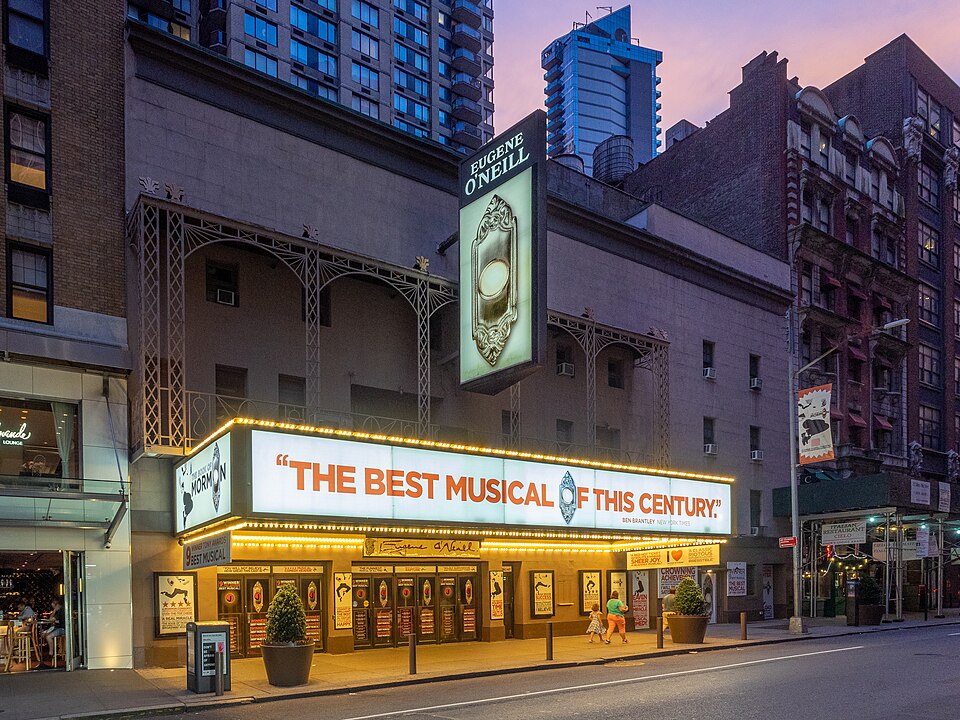
The Eugene O’Neill Theatre at 230 West 49th Street opened in 1925 and has been The Book of Mormon’s home since the show opened here on March 24, 2011. It is now the longest-running show in the O’Neill’s hundred-year history — the show has broken the house gross record more than fifty times and has simply become what this theater is associated with for an entire generation of Broadway theatergoers. Note: The Book of Mormon plays the Eugene O’Neill Theatre, not the Shubert Theatre — the two are sometimes confused since both are historic Broadway houses in the same general Theater District area.
The theater holds approximately 1,066 seats across orchestra and mezzanine. It is a mid-sized Broadway house — not as intimate as the Hayes, not as large as the Majestic — which means the energy of a full Saturday night audience fills the room in a way that makes the comedy land harder. The Book of Mormon is a show that benefits significantly from a packed house: the collective shock-and-laughter dynamic between the audience and the stage is part of what makes the experience what it is. A half-empty Tuesday matinee is a meaningfully different experience from a sold-out Saturday evening.
For seat selection: the orchestra center delivers the most immediate engagement with the show’s physical comedy and ensemble numbers. The mezzanine provides a complete stage picture with good sightlines for the full-company numbers. Side seats at the orchestra edges can miss some staging. The Eugene O’Neill Theatre guide covers the O’Neill layout, accessibility, and seat planning in more detail.
When The Book of Mormon may not be the right Broadway choice
If explicit language and crude humor are a dealbreaker. The advisory exists for a reason and the show does not become gentler as it progresses. This is the most straightforward reason to choose a different show — the content is fundamental to what The Book of Mormon is, not a surface layer that can be looked past.
If you want Broadway’s biggest visual spectacle. The Book of Mormon is a production-strong show, but it is not a visual-effects-first experience in the way that Wicked, The Lion King, or Aladdin are. The spectacle is in the songwriting, the choreography, and the performances rather than in set transformations or theatrical flying. For visitors whose primary goal is Broadway as a technical visual event, other current season options deliver that more directly.
If you want an emotionally warm or moving Broadway night. The show has genuine warmth for its characters — there is real affection underneath the satire — but the emotional register is primarily comedic rather than moving. For Broadway visitors whose ideal evening is one that leaves them feeling emotionally stirred in the way Hadestown or Wicked or Beaches can, The Book of Mormon offers something different and not necessarily less valuable, but categorically distinct.
If you are traveling with a mixed group that includes children or religiously observant members. The religious satire at the show’s core is not mild or easily overlooked. It is targeted, sustained, and central to the comedy. For a group where any member is likely to be genuinely offended rather than amused by that content, the evening becomes uncomfortable for everyone rather than funny for most.
If you’re looking for the touring production instead. The Book of Mormon also runs as a national touring production that plays regional theaters across the country separately from the Broadway run — if you searched for tour dates or a specific city’s engagement, this page covers the Broadway production at the Eugene O’Neill Theatre specifically, not the tour.
What to Know Before Booking The Book of Mormon
Runtime: The Book of Mormon runs approximately 2 hours and 30 minutes, including one 15-minute intermission. Performance schedules can shift around holidays and special events, so check the official ticket calendar for the curtain time on your exact date.
Age and content: The production contains explicit language and strobe lighting. ATG and the Broadway League currently require guests to be at least 5, while the production’s own FAQ still says children under 4 are not admitted. Because those official sources conflict, verify the current minimum-age policy if bringing a young child.
Run status: The Broadway production has no announced closing date. ATG currently has primary ticket inventory on sale through May 30, 2027; that is the present ticket-sale window, not a closing announcement.
$15 anniversary lottery: the official production is currently offering a 15th-anniversary digital lottery for eligible performances, with winners able to buy up to two tickets at $15 each including the listed $3 service fee.
$45 Lucky Seat lottery: the Broadway League currently lists a limited number of $45 digital lottery tickets through Lucky Seat.
$49 TodayTix rush: TodayTix currently lists a $49 same-day digital rush. Rush seats may be partial view.
Current ATG Fall Sale: through October 4, 2026, ATG is advertising savings of up to 30% on select performances with code FALLSALE.
The Broadway rush and lottery guide explains how the major day-of programs work across Broadway.
Popularity and availability: The Book of Mormon remains a major long-running Broadway title. Flexible visitors have several legitimate discount routes, while travelers with fixed dates and preferred seating should still book earlier. The when to buy Broadway tickets guide covers the broader timing strategy.
How Long Is The Book of Mormon?
The Book of Mormon runtime is approximately 2 hours and 30 minutes, including one 15-minute intermission. That makes it a full Broadway evening rather than a short comedy, so allow enough time for dinner, security, and theater entry before the performance.
The Eugene O’Neill Theatre opens its doors approximately one hour before the scheduled performance. Check the exact curtain time on your ticket because schedules can shift around holidays and special events.
Runtime: about 2 hours 30 minutes, including one intermission.
Theater: Eugene O’Neill Theatre, 230 West 49th Street.
Current on-sale window: through May 30, 2027; this is not an announced closing date.
Content: explicit language and strobe effects; verify the current minimum-age policy if bringing a young child.
Planning a Book of Mormon Broadway Evening
The Eugene O’Neill Theatre at 230 West 49th Street sits directly in the Theater District, two blocks north of the main cluster of Broadway houses. The surrounding blocks are dense with dining options — Restaurant Row on West 46th, the full range of Hell’s Kitchen restaurants extending west toward Ninth Avenue, and the Theater District standbys on 44th and 45th Streets are all within a comfortable walk.
The Book of Mormon’s energy — high, fast, irreverent — suits a pre-show dinner that matches that register rather than a slow, ceremonial meal. The show begins at a sprint and doesn’t let up, so arriving at the theater fed, comfortable, and with a drink in hand is better preparation than a rushed pre-show meal eaten with one eye on the curtain time. The restaurants near Broadway guide covers the full pre-show dining picture in the Theater District.
For visitors making a full evening of it, the Theater District neighborhood guide covers the surrounding area. Transportation options including subway routes, rideshare, and walking from Midtown hotels are covered in the Broadway transportation guide.
Frequently asked questions
For the right audience, it is one of the most rewarding Broadway experiences currently available — a show that has been running for fifteen years and still plays at full voltage, with some of the best original songwriting in the Broadway canon and a production that has been refined to a level of precision that only years of nightly performance produces. Whether it is worth it for your specific group depends on whether the content — explicit language, religious satire, deliberately crude humor — is something you’ll find funny rather than off-putting. The New York Times called it “the best musical of this century.” Entertainment Weekly called it “the funniest musical of all time.” Both assessments are accurate for the right audience. Neither is accurate for the wrong one.
The Book of Mormon runs approximately 2 hours and 30 minutes, including a 15-minute intermission. Plan for a full evening — the show typically starts at 7:00 or 8:00 PM and ends between 9:30 and 10:30 PM depending on the performance. Factor in pre-show dinner timing accordingly; the area around the Eugene O’Neill Theatre on West 49th Street has good dining options within easy walking distance.
The show contains sustained explicit language, sexual references, crude humor, and religious satire. Official sources currently conflict on the minimum admission age: ATG and the Broadway League say guests must be at least 5, while the production’s own ticket FAQ still says children under 4 are not admitted. Verify the current house policy before bringing a young child.
It can be — but only if you are confident the humor will land for you. The Book of Mormon is one of the most technically accomplished Broadway musicals of this century, and audiences who love it tend to love it intensely. But its content is specific and deliberately provocative, and a first Broadway experience shaped by a show that wasn’t quite the right fit is a different story than one that was exactly right. If you have any uncertainty about whether explicit language and sharp religious satire are your kind of comedy, starting with Wicked, Aladdin, or The Lion King is lower risk. If you know this is your sensibility, The Book of Mormon is excellent.
The Book of Mormon plays at the Eugene O’Neill Theatre, 230 West 49th Street, between Broadway and 8th Avenue in Midtown Manhattan — not the Shubert Theatre, which is sometimes confused with it. It has been playing at this theater since it opened on March 24, 2011 — making it the longest-running show in the O’Neill’s hundred-year history and the 10th longest-running Broadway musical of all time. The show has no announced closing date, and current ATG ticket inventory is on sale through May 30, 2027.
No. The Broadway production at the Eugene O’Neill Theatre in New York is separate from The Book of Mormon’s national touring production, which plays regional theaters in other cities. If you’re looking for tour dates in your city, this guide covers the Broadway run specifically.
Yes — a May 2026 electrical fire in the Eugene O’Neill Theatre’s spotlight room caused significant damage and a temporary closure. The theater was fully repaired and inspected, and performances resumed on May 27, 2026. The show has been running normally since.
Yes. The production currently has an official $15 anniversary digital lottery for eligible performances, the Broadway League lists a limited $45 Lucky Seat digital lottery, and TodayTix currently offers $49 same-day digital rush. Availability, blackout dates, and seat locations can vary.
The official Broadway site routes standard online ticket sales through ATG Tickets. Official tickets are also sold at the Eugene O’Neill Theatre box office at 230 West 49th Street, where the production advertises fee-free in-person ticketing.
The current Broadway company is led by Kevin Clay as Elder Price and Diego Enrico as Elder Cunningham, with Sydney Quildon as Nabulungi, Charlie Franklin as Elder McKinley, Jacques C. Smith as Mafala Hatimbi, and Derrick Williams as the General. Nikki M. James and Rory O’Malley return October 27, 2026 through January 17, 2027 as Nabulungi and Elder McKinley.
Center Orchestra in the middle rows is a strong all-around choice, while front Mezzanine center gives an excellent elevated view of the full stage. Because the Eugene O’Neill is relatively compact, centered seats farther back can also be good value. Check partial-view and extreme-side locations carefully.
Fifteen years on Broadway is not an accident. The Book of Mormon has stayed because it is genuinely extraordinary at what it does — a musical that makes audiences laugh harder than they expected and remember the experience longer than most shows manage. The Tony Awards, the critical superlatives, the word-of-mouth that has kept it selling for a decade and a half: all of it reflects a real achievement in Broadway musical writing.
What it also reflects is a very specific achievement — a show built for adults who want their Broadway comedy sharp, fast, explicit, and completely unwilling to be polite about it. For that audience, it remains one of the best choices in the current Broadway season. For everyone else, the season has other strong options. Knowing which category you’re in before booking is the most useful thing this page can help with.