

Yankee Stadium Seating Chart: Seat Map, Views & Best Seats
Where to sit for Yankees games, concerts, NYCFC soccer, and every major event — the full seat-decision framework, level by level, priority by priority.
The most common mistake people make when buying seats at Yankee Stadium is treating it as a single, fixed problem: find the closest seat at the best price. But Yankee Stadium is not one room — it is a flexible venue that reconfigures for baseball, concerts, soccer, football, and major international events. The field changes orientation. The stage moves. Upper levels open and close. A seat that gives you one of the best views of a Yankees home game can put you at the back corner of a concert. A floor-level ticket to a sold-out show can be twenty feet from the stage or seventy, depending entirely on which end the stage is facing.
This is the master seating guide for Yankee Stadium — the core seat-decision page for the venue across every event type. It covers the permanent architecture, the sightline logic by level, and how event type shifts the calculus. Whether you are buying for a Yankees playoff push, a summer stadium concert, an NYCFC derby, or the Pinstripe Bowl, the goal is the same: leave here knowing exactly what you are buying and why.
Yankee Stadium Seating Chart & Seat Map — How to Read the Layout
Yankee Stadium seating chart, Yankee Stadium seat map, Yankee Stadium seat layout, Yankee Stadium ticket map, and Yankee Stadium seating guide all describe the same core problem: understanding where a section sits in a large multi-level stadium before deciding whether it fits the event you are attending. This page uses the permanent seating bowl as the framework, then shows how baseball, concerts, soccer, football and other field events change the value of those same sections.
The permanent structure is straightforward: Field Level (100s), Main Level (200s), Terrace Level (300s), Grandstand Level (400s), plus the outfield bleachers and premium club products. What changes is the focal point. Home plate drives baseball seating. A concert stage can reverse the room. Soccer and football rotate the action again. That is why a static seating diagram is useful for orientation but not sufficient by itself for a non-baseball event.
Use this master Yankee Stadium seating chart to understand levels, section relationships, elevation and known value zones. For any concert or other converted-field event, use the live event-specific map from the ticket platform as the final authority on stage position, temporary floor sections, production holds and side-view inventory.
Yankee Stadium Seat View & “A View From My Seat” — What to Compare
Searches for Yankee Stadium seating view, Yankee Stadium seat view, Yankee Stadium a view from my seat, and view from my seats Yankee Stadium are especially useful because this building changes dramatically by level and event type. A seat photo can tell you how high the section feels, how steep the rake is, whether an overhang affects the view, and how much of the permanent bowl is visible.
For baseball, a seat-view photo from the same section and similar row is usually a strong representation of the geometry you will get. For concerts, it is only half the answer: match the section and row, then confirm that the photo came from a show with a comparable stage orientation. A different stage end, runway, B-stage or floor layout can make the same permanent seat feel completely different.
1. Match the section. 2. Match the row or at least the same part of the section. 3. For concerts, match the stage orientation. A photo is excellent evidence for elevation and angle; it is not a guarantee that a different production will occupy the same part of the field.
Yankee Stadium Interactive Seating Chart & Virtual Venue
The Yankees maintain official seating-map resources and a Yankee Stadium Virtual Venue, while ticketing platforms provide interactive maps that let buyers drill into available sections and rows. Those tools are especially valuable for comparing a flat diagram with an actual visual perspective before you commit.
Use an interactive Yankee Stadium seating chart or virtual view to answer permanent-building questions: how elevated is the section, how far does it wrap around the bowl, and what does the general angle look like? For concerts, do not let a baseball-oriented virtual view override the event-specific ticket map. Temporary floor seating, GA pits, runways and production kills are not permanent parts of the building and can change by tour.
Yankee Stadium seating chart with seat numbers
A Yankee Stadium seating chart with seat numbers becomes most useful after you have already chosen the correct section and row range. Exact seat numbers help determine where you fall within a section — closer to an aisle, closer to the center-facing edge, or farther toward a side angle. The buying order that prevents mistakes is: event configuration first, section second, row third, exact seat number last.
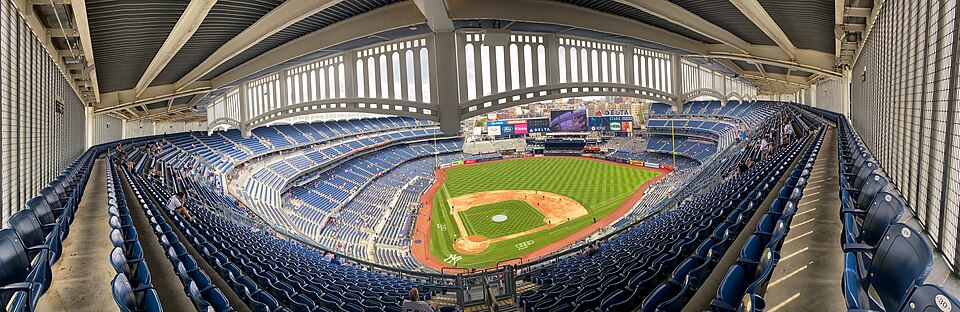
Panoramic interior view of Yankee Stadium showing the seating bowl and overall venue layout.
How Yankee Stadium Is Actually Built
Yankee Stadium opened in 2009 as a purpose-built baseball facility on a 24-acre site in the Bronx, directly across from where the original stadium stood. The design is baseball-first: a bowl oriented around home plate, seating wrapping the field across four levels of varying elevation and distance.
The stadium seats roughly 46,537 for Yankees games — this is the Yankee Stadium capacity and Yankee Stadium seating capacity most commonly cited, sometimes searched as new Yankee Stadium capacity, new york Yankee Stadium capacity, or ny Yankees stadium capacity to distinguish it from the demolished original ballpark across the street. For NYCFC soccer matches, upper levels are typically closed, bringing capacity to around 28,000. For large concerts and football events, Yankee Stadium concert capacity — also searched as Yankee Stadium capacity concert or Yankee Stadium capacity for concerts — can expand toward 50,000 depending on stage configuration and how much of the field is converted to Yankee Stadium concert seating. That range is exactly why seating logic shifts so significantly by event type.
The four gates give you your primary orientation. Gate 4 sits behind home plate (East 161st Street and Macombs Dam Bridge). Gate 6 is near right field (River Avenue and East 161st Street). Gate 2 is near left field (East 164th Street and Jerome Avenue). Gate 8 is near center field (East 164th Street and River Avenue). Your section determines your gate — wrong gate means a significant walk inside a large stadium on a busy event night.
One structural feature that changes how the stadium feels more than anything else: the Main Level (200s) hangs directly over the Field Level (100s) with a substantial overhang. The back rows of most Field Level infield sections sit completely under this canopy — shaded, weather-protected, and closer-feeling than they appear on any chart. The same relationship applies between the Terrace Level (300s) and the Main Level below it. These overhangs are part of why Yankee Stadium regularly surprises visitors with how close the “wrong” level feels once they are seated.
The Great Hall is the stadium’s internal spine — a seven-story concourse running between Gates 4 and 6, housing retail, food, and the 16-elevator vertical transport system that serves all levels. On high-capacity nights, the Great Hall is where crowd flow concentrates. Build in time to navigate it, especially if you are in an upper level or arriving after gates open.
The Seat Decision Variables at Yankee Stadium
Before looking at specific sections, the more useful step is understanding what the variables actually are. At 46,000 seats, the difference between a great experience and a frustrating one is rarely just about how much you spent.
Being close to the field is not the same as having a good angle to the action. For baseball, the best angle is roughly off the infield — not dead-center, not far down the line. For concerts, the best angle is directly facing the stage. Close but sideways often loses to slightly further but centered.
Elevated seats give you a wider, strategic view — useful for baseball, revealing for production-heavy concerts. Floor-level seats give you proximity and physical energy. Neither is objectively better; they deliver different experiences. Knowing which one you are actually buying is the first decision to make.
46,000 seats means that sections close on a chart can feel further in person than a smaller arena’s upper level. The overhang effect works the other way — the Main Level often feels closer to the field than its elevation suggests. Always check actual seat-view photos before committing.
The best sections for a Yankees game are not the best sections for a concert. The logic for soccer is different again. The permanent bowl structure is the constant; which sections within it are optimal shifts with the event. This guide explains both.
The most expensive seats are the closest seats — not always the best relative experience. Several Main Level sections deliver views comparable to Field Level sections at significantly lower cost. Knowing where that gap exists is some of the most actionable intelligence this guide offers.
Yankee Stadium is open-air. Sun exposure is a real planning factor for daytime events. The Main Level overhang shades back rows of Field Level sections. The Terrace Level overhang shades back rows of the Main Level. Several outfield sections — 205, 206, 207 on the Main Level — receive full afternoon sun. If shade matters, target overhang-protected rows explicitly.
The Seating Levels — What Each One Actually Delivers
Field Level
The Field Level is the bottom ring — sections immediately adjacent to the playing field, from foul line to foul line and into the outfield corners. For baseball, this is where the game is most physical: dugout conversations are audible, pitch grips are visible, and crowd noise lands differently than from any elevated position. The premium sections directly behind home plate (Legends Suites, 011–029; Champions Suites, 011–013 and 027–029) are the most expensive seats in the stadium.
Important: protective netting covers Field Level from Section 011 through Section 029 for all Yankees games — behind home plate extending along both baselines. This netting has been in place since 2018. For concerts and other non-baseball events, netting configurations vary; confirm with the event. Very front rows of Field Level baseline sections can involve a compromised angle — close, but looking sharply sideways for most infield action. Back rows of most Field Level infield sections sit under the Main Level overhang, providing shade and weather protection that front rows lack.
Main Level at Yankee Stadium
The Main Level is where Yankee Stadium’s value story lives. These sections hang directly over the Field Level — an overhanging design that places them significantly closer to the field than their elevation suggests. In low-numbered rows near the infield, you cannot see the Field Level seats below you, creating the impression of immediate proximity to the action. The angle to the diamond from infield Main Level sections is, for many purposes, better than equivalent-dollar Field Level seats directly below: you see pitch location from catcher’s perspective, track defensive alignment across the full infield, and sit at the elevation that makes baseball most readable as a strategic game.
Sections 213, 214, 223, and 224 are the most consistently cited value standouts — strong infield views at pricing often half or less than comparable Field Level sections. Back rows of Main Level infield sections receive shade from the Terrace Level overhang. At the top of sections 218–222 directly behind home plate, the Delta Sky360 Suite combines what many experienced Yankee Stadium visitors consider the best overall centered view in the building with a private climate-controlled club lounge and complimentary amenities.
The outfield corners of the Main Level — sections 205, 206, 210, 211, 228, 229, 233, 234 — carry real sightline tradeoffs. The Think Twice section covers specifics on each.
Terrace Level at Yankee Stadium
The Terrace Level is the lower tier of the upper bowl. For baseball, infield sections — particularly 312 and 328 — deliver clean full-field views at meaningfully lower prices than Main Level equivalents. Sections 305 and 306 include All-You-Care-to-Enjoy food and soft drinks through the fifth inning, making them useful for families or groups where concession spending adds up. Behind home plate at this level, the Jim Beam Premium Seats (sections 317–323) offer a private entrance, exclusive food and restrooms, padded seating, and an elevated centered view of the diamond — the most reliably-delivered premium experience at the stadium for a midrange price.
Grandstand Level
The Grandstand is the highest and most affordable general seating at Yankee Stadium. Less steeply raked than older venues, it provides a panoramic view that can be a genuine asset for strategic baseball watching — you see the full field at once, follow defensive shifts, and track baserunners across the diamond in a way that close, low seats cannot replicate. Alcohol-free sections 407A and 433 offer a quieter environment for fans who prefer it. For concerts, the Grandstand is the back of the room. But at its price point — often running significantly below all other levels — it remains the legitimate answer for budget-first event attendance.
Yankee Stadium Bleachers
The bleachers at Yankee Stadium are their own event within the event. Section 203 is home to the Bleacher Creatures — the Yankees’ most vocal, ritualistic, and committed fan section, known for their roll call at the start of each game where outfielders individually acknowledge the section by name. This tradition has been part of Yankees baseball for decades and cannot be replicated from anywhere else in the stadium. If you want to feel what it is like to be in the most invested part of the Bronx on a big game night, section 203 is the only answer.
The practical reality: metal bench seating without padding, full sun exposure except for rows above 13 where the 300-level overhang provides partial shade, and a level of crowd noise and participation that is enthusiastically, intentionally loud. For families with young children or first-time visitors expecting a quieter experience, these sections need an honest heads-up. For everyone who wants to be at the center of the noise: this is the section. A bonus: the FreshDirect Terrace and Toyota Terrace in center field are open to all ticket holders, including bleacher ticket holders — bar service, food options, and outdoor rails for standing room between innings.
Yankee Stadium Section Map — Popular Sections Buyers Search
Individual section searches are common at Yankee Stadium because a section number often carries a strong reputation of its own. The most useful way to read those searches is still event-specific: the same section can be an excellent baseball value, a poor concert angle, or a completely different proposition for soccer.
Section 203 is the cultural standout for Yankees games because it is home to the Bleacher Creatures. Sections 213 and 214 on one infield side and 223 and 224 on the other are among the Main Level baseball value zones already explained in this guide. Sections 205 and 206, along with 233 and 234 on the opposite side, carry the baseball sightline tradeoffs covered later in the Think Twice section.
For concert buyers, do not inherit a baseball section verdict automatically. Pull up the event-specific concert map first, locate the stage and floor, then use the permanent section information on this page to judge elevation, distance and side angle. That is the safest way to use a Yankee Stadium section map without mixing incompatible event layouts.
Best Seats for Yankees Games
Baseball seating at Yankee Stadium has a clear hierarchy but also clear value pockets that pricing structure tends to obscure. The Main Level’s overhanging architecture is the single most important thing many buyers do not know — it makes sections that look like a step down on the chart feel like the right call once you are in them.
This page covers seating across every event Yankee Stadium hosts. If a Yankees game is the only thing you’re planning around, the dedicated Yankees seating guide goes deeper on baseball-only detail — day-game vs. night-game shade patterns, a closer breakdown of the Legends and Champions Suites, and bleacher-specific advice by section.
Best overall view: Main Level infield
Sections 213, 214, 223, and 224 are the most consistently praised value positions at Yankee Stadium for baseball. The overhang design places these sections closer to the field than their level number implies. From the lower rows, you see the full diamond at an angle that Field Level seats below cannot replicate — the elevation gives you pitch-location clarity, defensive positioning, and the full geometry of the game. These sections typically price at a meaningful discount to Field Level equivalents with comparable or better sightlines. Experienced repeat visitors who started at Field Level often end up here after a few games.
Best atmosphere: The Bleacher Creatures at Yankee Stadium (Section 203)
Section 203 is where Yankees culture lives loudest. The Bleacher Creatures’ roll call — where outfielders turn and acknowledge the section by name at the start of each game — is a Yankee Stadium ritual unlike anything else in baseball. For a meaningful game, a pennant race, a rivalry series, or simply wanting to feel the full weight of Bronx fandom, the bleachers deliver something the lower bowl cannot manufacture. Come prepared: sun, metal benches, full participation required.
Best value: Terrace Level infield sections 312 and 328
For fans who want a real view at the lowest justifiable price for a non-budget game, sections 312 and 328 are the specific answer. Clean sightlines to the full diamond, comfortable Terrace Level positioning, pricing well below comparable Main Level infield sections. These are the seats that Yankee Stadium regulars recommend when asked where to sit on a budget without sacrificing the ability to actually watch the game.
When Field Level earns its premium
Field Level makes the most sense for games where proximity itself is part of the experience — postseason games, a special matchup, a milestone night. The physical energy of being at field level for a packed Yankees game is real and different from anything above it. For a Tuesday night regular-season game in May, the Field Level premium is harder to justify against what a good Main Level section delivers. For a September pennant race game or October playoff night, that calculus shifts considerably.
The protective netting behind home plate and along the baselines (sections 011–029) has been in place since 2018. It is fine-mesh and designed to minimize visual impact, but it is visible from the closest Field Level seats directly behind home plate. For baseball viewers who prioritize an unobstructed sightline from behind the plate, Main Level sections 218–222 (Delta Sky360) provide a comparable centered view at greater elevation without netting between you and the field.
Yankee Stadium Concert Seating Chart & Best Seats for Concerts
The single most important thing to understand about concerts at Yankee Stadium: the stage is typically placed at center field, facing toward home plate. This inverts the stadium’s baseball logic entirely. Sections behind home plate — the premium baseball positions — become the back of the room. The outfield bleacher sections, the cheap seats for baseball, become closest to the stage. The field itself is converted into seating or standing areas depending on the show.
This is not a subtle difference. Buying tickets for a Yankee Stadium concert using baseball seat logic — pay more for sections closer to home plate — is exactly backwards. A Legends Suite ticket for a center-field-stage concert puts you at the farthest fixed seating position in the venue from the performance. A field-level section near center field can put you in the first rows of the house.
Floor and field sections: close but not automatically best
Reserved field sections offer genuine proximity to the stage when they sit near the stage end. The experience depends entirely on which field sections are positioned closest to the stage for your specific show — sections directly in front of the stage are immersive; sections at the opposite end or at sharp side angles can be comparable in raw distance to Main Level elevated seats but with a worse viewing angle and no elevation advantage. GA pit areas near the stage are the most immersive option for standing-room shows but require early arrival to claim position near the front. For seated field tickets, the event-specific map is essential before buying.
Main Level center sections: the best elevated concert view
For most concerts at Yankee Stadium, Main Level sections roughly 218 through 226 — facing out toward center field — provide an excellent elevated perspective on the full stage production. At this elevation you see the complete stage design, the lighting rig, the full scope of the performance. For artists with elaborate visual shows, large video displays, and production-heavy sets, these sections frequently deliver a more complete experience than being on the field at a comparable distance but at ground level looking up. For audio-first experiences, being slightly elevated also distributes sound better than the stage speakers projecting directly over your head.
Side sections: angle matters more than closeness
Any section significantly off-center — far down the baselines, in the deep outfield corners — views the stage at an angle that can put part of the production off-axis and require watching primarily through video screens. For artists and shows where audio experience is primary, this matters less. For visually complex productions, it matters considerably. Center sections at the back of the room often serve better than side sections at the same tier.
The non-negotiable concert rule
Every major concert at Yankee Stadium has an event-specific seating configuration. Stage end, floor section layout, GA versus reserved field placement, runway and B-stage positioning all change by show and artist. There is no standard concert configuration. Before buying any concert ticket here — especially any field-level ticket — find and review the event-specific seating map for your exact show from the official ticket platform. Do not use the baseball chart as a proxy. This one step prevents the most common and expensive Yankee Stadium concert seat mistake.
Soccer, Football, and Other Field Events
Yankee Stadium hosts NYCFC MLS matches as a regular tenant, the annual Pinstripe Bowl college football game, and occasional international matches and special events. Each changes the optimal seat differently.
NYCFC Soccer Seating at Yankee Stadium
For NYCFC matches, the pitch runs along the stadium’s long axis — left-field to right-field. Sideline sections along the baselines at Field and Main Level provide the classic soccer viewing angle: full pitch width visible, both ends in sight, play tracking naturally. The upper levels are typically closed for NYCFC matches, concentrating the crowd in the lower bowl at around 28,000 capacity. The supporters section — sections 236 and 237 — houses The Third Rail, NYCFC’s most passionate fan group, at the left-field end.
The Delta Sky360 sections (218–222) behind home plate are less ideal for soccer; the pitch orientation puts fans somewhat off-axis to the field of play. Main Level sections in the 227–231 range offer better angles for soccer specifically. Legends Suite and Champions Suite sections near the baselines have strong proximity to pitch-side action. For NYCFC, think sideline angle first, intensity second.
Pinstripe Bowl and football
For the Pinstripe Bowl, a football field is oriented along the stadium’s long axis — typically left-field to right-field. Sideline sections at the Main Level gain significant value for football; end-zone views come from the outfield sections. Football at Yankee Stadium requires checking the event-specific configuration to identify which sections become sideline and which become end zone, since the orientation relative to permanent seating changes entirely.
The universal rule for non-baseball events
The permanent bowl structure tells you elevation, distance, and angle relative to the center of the field. The event-specific configuration tells you where the center of attention actually is. You need both to make an informed seat decision. For any event that is not a Yankees home game, the event-specific chart is mandatory before purchasing.
This seating guide is organized around the permanent room — levels, distances, angles, sightline logic — rather than around any single event type. That structure stays constant regardless of what is happening on the field. Use this guide to understand the room; use the event-specific chart to identify where your priority zone sits within that room for your specific event.
Best Seats at Yankee Stadium — By What You Actually Want
If there is one section recommendation to build a Yankees seat search around, it is this range: Main Level infield sections 213–214 on the first-base side, or 223–224 on the third-base side. Both sit within the overhang zone, both offer near-perfect angles to the full diamond, and both price at a consistent discount to the Field Level sections directly below them that are sold as the premium option. Multiple independent sources including Stadium Insiders, TickPick’s editorial team, and MLB Ballpark Guides specifically cite this range as the best regular-attendee choice in the building.
Sections to Think Twice About
Yankee Stadium does not have the dramatically bad seats of older multi-purpose venues. But several sections carry real sightline or experience tradeoffs that pricing does not always reflect, and being specific about them is useful.
Main Level sections 205, 206, 233, 234 — confirmed sightline issues
These four outfield corner sections on the Main Level carry obstructed or compromised sightlines. Sections 205 and 206 face into the right-field corner; the angle to home plate is poor for following infield action and deep right-field balls require body rotation to track. Sections 233 and 234 are the left-field mirror. Multiple verified sources — RateYourSeats, TickPick editorial, Stadium Insiders, and TicketIQ — specifically flag these sections. If they are available at an unusual discount for baseball, the price is reflecting the view limitation.
Main Level sections 210, 211, 228, 229 — poor infield angle
These baseline sections are not officially obstructed, but their position far down the baseline creates poor angles to home plate — watching most at-bats requires significant body rotation. For baseball viewers here primarily to watch the game, these sections are a weak choice relative to the same money spent on an infield section at a higher level. Fans whose primary interest is outfield proximity may find them workable.
Delta Sky360 on secondary market without verified club access
The Delta Sky360 sections (218–222) are excellent seats. But club access for these sections on the secondary market has been documented as inconsistently honored — particularly for Field MVP ticket designations from certain platforms. Stadium Insiders and other reliable sources have noted this specifically as of 2024–2025. If club access matters to your purchase, only buy tickets that explicitly list it and screenshot the benefit description at time of purchase. If club access is not confirmed, you are buying excellent Main Level seats — which they are — not a premium club experience.
Very front rows of Field Level baseline sections
The front two or three rows of Field Level sections significantly down either baseline place you extremely close to the field but at an angle that means looking sharply sideways for most pitches and infield plays. They work well for outfield events and for the atmosphere of proximity. For sustained, comfortable baseball viewing, mid-rows of the same sections are meaningfully better — and the price differential between front and mid-rows within the same section is sometimes significant enough to notice.
Concert floor tickets without checking the event-specific map
This is the most consequential trap in Yankee Stadium ticket buying. Not all floor sections at a concert face the stage equally or sit at the same proximity to it. A field section at the home-plate end of the stadium for a center-field stage show can be among the furthest-from-stage seating in the venue — at floor-level prices that imply proximity. The baseball chart is not a proxy for concert layout. For any concert floor purchase, the event-specific seating map is not optional research — it is the only information that tells you where your section actually sits relative to the performance.
How to Use the Seating Chart Intelligently
The seating chart is a map, not a verdict. A few principles that meaningfully change how useful it is.
Within any section, your row changes the experience substantially. At Field Level infield, front rows are physically closest but involve the steepest scoreboard angle and the sharpest sideways view from baseline sections; mid-rows (roughly 10–20) are the consistent sweet spot. At Main Level, back rows gain overhang shade while front rows deliver the close-to-field impression. At Terrace and Grandstand, front rows of sections are closer to the concourse railing than to the field — you are higher than lower-row seats in the same section. Know your row, not just your section.
The Yankees official virtual venue tool at yankees.io-media.com provides 3D seat views from specific sections. Third-party platforms including RateYourSeats and SeatGeek offer fan photos from actual seat locations. For any section you have not sat in before, five minutes with these tools prevents surprises. The difference between row 3 and row 15 in the same section is visible — and occasionally that difference is significant enough to change whether you want the ticket at all.
For every concert at Yankee Stadium, obtain and review the event-specific seating configuration before purchasing any ticket. This is the difference between a floor ticket that puts you twenty feet from the stage and one that puts you behind the catcher’s mound facing away from it. The baseball chart does not reflect concert layouts. Find the official Ticketmaster or Yankees event page for your specific show, locate the event seat map, and verify your section’s position relative to the stage before completing any purchase.
At 46,000 seats, Yankee Stadium rewards specificity in buying decisions. General impressions — “Field Level is better than Main Level” or “closer is always better” — do not hold consistently across the full range of sections, events, and goals. The framework in this guide is designed to help you make a specific, informed choice for your specific situation rather than a general guess based on price tier alone.
Best overall baseball view, best value: Main Level infield sections 213, 214, 223, 224. Best premium view: Delta Sky360 Suite (218–222) with verified club access. Best atmosphere: Bleachers, section 203. Best budget real view: Terrace infield 312 and 328. Best accessible premium: Jim Beam Suite 317–323.
Concerts: Find the event-specific map first — every time. Main Level center sections 218–226 for elevated full-production view. Field sections near the stage end for immersion, only after confirming placement on the event map. NYCFC soccer: Main Level sideline sections 227–231 for pitch angle; sections 236–237 for supporters culture. Any other event: Permanent structure as framework, event-specific layout to identify your priority zone.
How Your Seat Connects to the Full Night
Where you sit shapes the entire evening’s logistics — not just the hours inside the gates. Premium Field Level sections reward early arrival for batting practice access, club amenity time, and in-seat service from first pitch. Grandstand and bleacher sections reward arriving closer to game time and getting out efficiently at the final out to beat the exit rush. Main Level infield sits comfortably between the two: arrive with enough time for a pre-game stop, find your seat during warm-ups, exit at a human pace when it ends.
Where you eat before the game depends partly on your seat timing. A Legends Suite arrival has dining built in. A Bleacher Creatures night benefits from a pre-game stop at Yankee Tavern or Court Deli on East 161st Street first. The restaurants near Yankee Stadium guide covers what is worth stopping at — from the classic River Avenue pregame to the Arthur Avenue Italian neighborhood a short rideshare east.
Transportation affects your post-game experience as much as your pre-game plan. The 4 train platform at 161st Street fills hard immediately after the final out. Staying in your section for 15–20 minutes, or posting up at a nearby bar while the crowd clears, consistently outperforms racing to the subway. The transit and transportation guide covers subway lines, Metro-North Yankee Clipper service, and how to think about the post-game exit. For drivers, the parking guide is the companion piece — including whether driving makes sense for your specific event. For overnight visits, the hotels guide covers the Bronx options and the case for staying local versus commuting from a Manhattan base.
Frequently Asked Questions
This page is the Stage & Street master Yankee Stadium seating chart and seat-decision guide, organized by permanent level, section relationships and event type. For a live visual map, the Yankees and major ticketing platforms provide interactive seating resources. For concerts and other converted-field events, use the event-specific ticket map as the final authority because temporary floor sections and stage placement change by event.
Use a seat-view photo to judge elevation, rake, distance, overhang coverage and the general angle of the permanent bowl. For baseball, match the section and row as closely as possible. For concerts, also compare the stage orientation because a photo from a different tour may show a different stage, runway or floor layout.
Yes. The Yankees maintain official seating-map resources and a Yankee Stadium Virtual Venue, and ticketing platforms provide interactive event maps. Use those tools to understand the permanent view and exact inventory, but for a concert always prioritize the event-specific map because the temporary floor and stage configuration can change by tour.
The answer is event-specific, not universal — good seats at Yankee Stadium depend entirely on what you’re attending. For the best overall baseball view at strong value: Main Level infield sections 213, 214, 223, 224. For maximum atmosphere: Bleachers section 203. For the best premium centered view: Delta Sky360 Suite (218–222) with confirmed club access. For the best accessible premium: Jim Beam Seats (317–323). For the best value view at any level: Terrace infield sections 312 and 328. For concerts: center Main Level sections facing the stage, or field sections near the stage end after verifying the event-specific layout. No single section is the best seat for every event at this venue.
For the best combination of view quality and price: Main Level infield sections 213, 214, 223, 224. The overhanging design makes these feel closer to the field than their level number suggests, and they price well below the Field Level sections with comparable sightlines. For the premium experience: Delta Sky360 Suite (218–222) for the best elevated view in the stadium. For atmosphere above everything: Bleachers, section 203. For budget with a real view: Terrace Level infield 312 and 328.
For concerts with a center-field stage: Main Level center sections facing the stage (roughly 218–226) for the elevated full-production view. Floor or field sections close to the stage end for immersion and proximity. The critical step is finding the event-specific seating map for your show before buying — floor section quality varies enormously depending on which end of the field the stage occupies for each specific event. The baseball chart is not a reliable guide to concert floor sections.
Potentially yes — if your section is close to and facing the stage. Floor tickets range from twenty feet from the performance to well over a hundred feet away depending on section location and stage placement. A floor ticket near the stage end is genuinely one of the best seats in the venue. A floor ticket at the home-plate end of the field for a center-field stage concert can be among the most poorly-positioned seats in the building at premium pricing. The event-specific map is the only way to know which situation your ticket represents.
Not categorically. The Terrace Level infield sections — particularly 312 and 328 — deliver genuinely good baseball views despite their elevation. The Grandstand (400s) is the highest and furthest, and the distance is real at this level, especially for outfield sections; but infield Grandstand seats provide a panoramic perspective that some baseball fans actively prefer. The Main Level is the biggest surprise: the overhanging design makes it feel significantly closer to the field than its level number suggests, and it is widely considered the best view in the building for baseball by experienced regular attendees.
Significantly. The premium baseball positions behind home plate (Legends, Delta Sky360) become the back of the room for center-field stage concerts. NYCFC soccer makes sideline sections the priority and renders behind-the-plate premium sections off-axis from the play. Football changes which sections are sideline versus end zone. The permanent structure stays constant; which sections within it are optimal shifts with each event configuration. Using the bowl structure as the framework and the event-specific layout to identify priority sections is the right approach for any non-baseball event at this venue.
For baseball: Main Level sections 205, 206, 233, and 234 carry confirmed obstructed sightlines at the outfield corners. Sections 210, 211, 228, and 229 require significant body rotation to follow infield action. For concerts: any floor section purchased without checking the event-specific map risks being far from or poorly angled to the stage. The Delta Sky360 Suite (218–222) should not be bought on the secondary market unless club access is explicitly confirmed in the listing.
Main Level infield sections 213, 214, 223, 224 for baseball — the best price-to-view ratio in the stadium. Terrace Level sections 312 and 328 for the next price tier down with still-solid views. Jim Beam Seats (317–323) for premium-adjacent experience with clearly delivered amenities at a midrange spend. For concerts, a well-positioned center Main Level section facing the stage often delivers better value than a floor section that turns out to be poorly angled — but verify your floor position on the event-specific map before concluding it is the wrong choice.
Yankee Stadium Rewards Getting the Seat Right
At 46,000 seats across four levels, multiple premium tiers, event-specific configurations, and sightline variables that shift by section, row, and what is happening on the field — Yankee Stadium is a venue where a few minutes of advance research pays off in ways that most smaller venues do not require. The framework in this guide — the level structure, the event-type shifts, the specific value sections, the traps worth avoiding — is designed to help you reach a confident, specific decision rather than an expensive guess.
The right seat at Yankee Stadium is not the most expensive available or the closest to the action. It is the one that matches the event you are attending, delivers the experience you came for, and makes the night worth what you paid for it. That answer is different for a Yankees playoff game, a sold-out summer concert, an NYCFC derby, a first visit with someone who just discovered baseball, and a work event in a premium club. Now you have the framework to find it for each one.