

Webster Hall Tickets & Upcoming Events: NYC Concerts, Schedule & Venue Guide
New York City’s most historically significant concert venue in the East Village — three rooms, a wraparound balcony that changes the viewing equation, and a concert night that connects as naturally to dinner as any venue in Manhattan. Here is how to plan it properly.
Webster Hall is at 125 East 11th Street in the East Village, between Third and Fourth Avenues, in a building that has been hosting events since 1886. It is one of the city’s most historically layered performance venues — a building that served as RCA’s East Coast recording studio through the 1950s and 1960s, became a rock showcase under the name The Ritz in the 1980s, and reopened in 2019 after a $10 million renovation that preserved the original stage while adding the building’s first elevator, expanded restrooms, and updated acoustics. The New York City Landmarks Preservation Commission designated Webster Hall and its Annex a New York City landmark in 2008.
For practical concert planning purposes, the most important thing to know is that the Grand Ballroom is Webster Hall’s 1,500-capacity primary concert room. AXS still references the Marlin Room (600) and The Studio (up to 400) in its venue FAQ, while Webster Hall’s current rentals page now calls the former Marlin Room the Ritz Lounge. Most headline concerts are simply listed as Webster Hall, so check the specific event page rather than assuming a room from older naming. The Grand Ballroom has a GA standing main floor and a wraparound balcony — two genuinely different experiences from the same ticket. Tickets are sold through AXS. Bags over 14″×14″ are not permitted, confirmed from the official venue prohibited items list.
The East Village location is one of Webster Hall’s strongest practical assets. The surrounding neighborhood has the densest concentration of pre-show and post-show dining, bars, and nightlife of any mid-size concert venue in Manhattan — the concert fits naturally into a longer evening rather than requiring a purpose-built logistics plan. The L train at 3rd Avenue puts you a short walk from the entrance. Union Square (4/5/6/N/Q/R/W) is several blocks away but accessible from virtually every part of the city.
Whether you’re searching webster hall tickets or webster hall nyc tickets, both point to the same East 11th Street address — checking the webster hall calendar or webster hall lineup directly on AXS is the most reliable way to confirm which room a specific show is in before you buy.
Webster Hall Tickets, Upcoming Events & Concert Schedule
Webster Hall tickets are sold through AXS, and the official Webster Hall event calendar should be your first stop for Webster Hall upcoming events, Webster Hall concerts, the Webster Hall schedule, calendar, and lineup. The venue hosts concerts across genres along with DJ nights, late-night events, and special programming, so the event page matters as much as the artist name: check the date, door time, age restriction, and any VIP or premium-viewing option before you buy.
Upcoming Webster Hall Events — Current 2026 Calendar
Looking for Webster Hall tonight? Check AXS or the official Webster Hall calendar immediately before leaving. The venue calendar changes frequently, late-night events can share dates with earlier programming, and cancellations or venue changes can occur after an editorial guide is updated.
Official Webster Hall Tickets — AXS vs. Resale
Webster Hall’s own ticket page directs buyers to AXS for show tickets. Start there for primary inventory. If a show is sold out and you compare resale listings, verify the exact event date, delivery method, age restriction, and final checkout total before purchasing. A third-party listing should not be treated as the venue’s official box office simply because it ranks for a Webster Hall ticket search.
Webster Hall Box Office & In-Person Tickets
Bowery Presents currently says that, when a show has not sold out in advance, tickets can be sold at the door on the night of the show. It also says tickets to future Webster Hall shows can be purchased in person at Webster Hall and several other Bowery Presents venue box offices once those box offices open on show nights. There is no dependable all-day Webster Hall box-office schedule published on the venue’s current ticket page, so do not make a special trip expecting daytime hours without checking first.
Webster Hall NYC — New York / Manhattan Location
Webster Hall is at 125 East 11th Street, New York, NY 10003, in Manhattan’s East Village between Third and Fourth Avenues. Searches for Webster Hall NYC, Webster Hall New York, and Webster Hall Manhattan all refer to this same East 11th Street venue.
The L train at Third Avenue is the most direct subway approach. Union Square, served by the 4/5/6/N/Q/R/W, is also within walking distance and gives the venue unusually strong Manhattan and Brooklyn transit access for a 1,500-capacity concert room.
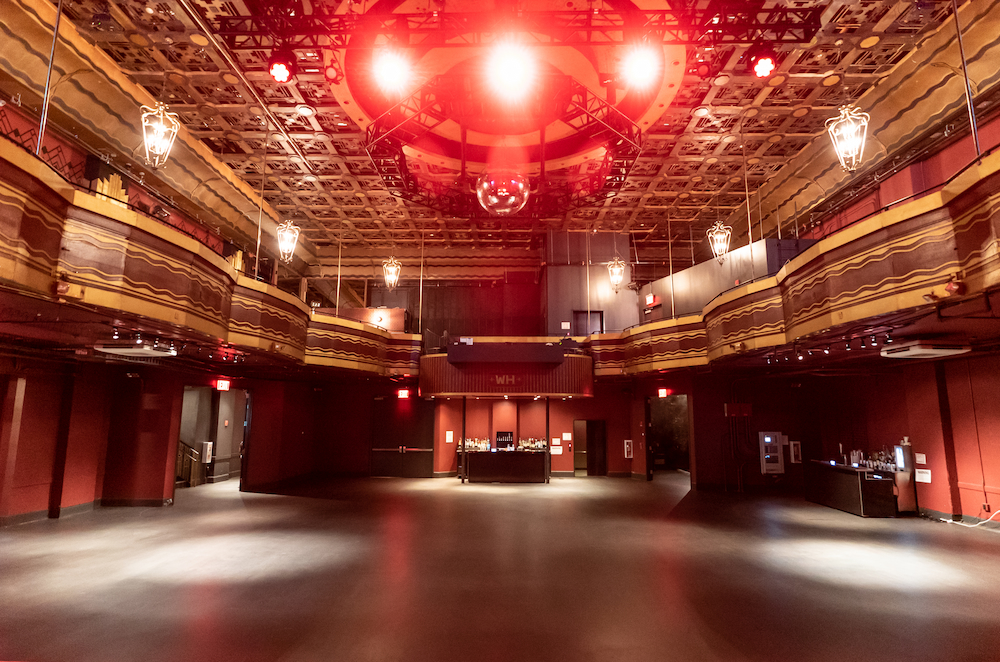
Webster Hall in Manhattan, a historic concert venue known for its energetic mid-size shows, downtown location, and classic New York live-music atmosphere.
What Webster Hall Is Like for Concerts
Webster Hall Capacity — 1,500 in the Main Concert Room
Webster Hall capacity, Webster Hall seating capacity, and Webster Hall NYC capacity searches generally refer to the main concert venue. AXS currently lists Webster Hall at 1,500 total capacity, primarily general-admission standing room with limited balcony seating. That scale is central to the venue’s appeal: substantially more intimate than an arena, but large enough to host nationally touring acts and high-demand club-scale shows.
Webster Hall works on a different register from a converted industrial space or a purpose-built modern arena. The Grand Ballroom has the feel of a room that has been a performance space for over a century — Gothic chandeliers, ornate architectural details, a stage that has not been replaced across multiple incarnations of the building’s identity. The 2019 renovation added acoustic improvements and modern infrastructure without eliminating the character. The result is a room that feels genuinely alive rather than merely functional, with a weight of history that newer venues cannot manufacture.
At 1,500 capacity for concerts in the Grand Ballroom, the scale is right for the kind of show that benefits from being close to the audience. Artists who play Webster Hall are typically past the 500-person club circuit but not yet selling arenas — or major artists doing intentional intimate runs. Either way, the Grand Ballroom at capacity creates a density that feels energized without feeling overwhelming. The wraparound balcony changes the sightline equation: from the balcony rail, the full stage is visible without the crowd competition of the standing floor below.
The venue has multiple bars throughout — including a large bar at the back of the main room — and the overall atmosphere skews younger and more nightlife-oriented than a traditional seated theater. Webster Hall’s weekly club nights (Thursday through Saturday) mean the venue is also experienced as a nightclub by a significant portion of its regular visitors. For concert nights, the energy is concert-focused rather than club-focused, but the nightlife DNA of the building is part of its character in a way that shapes the overall feel.
Webster Hall Rooms — Grand Ballroom, Ritz Lounge / Marlin Room & The Studio
Webster Hall has three distinct performance spaces in a 40,000 square foot building. Most visitors searching for concert information are attending an event in the Grand Ballroom — but not all events are in the Grand Ballroom, and arriving with the wrong expectation about the room you are in is an easily avoidable problem.
There is a current naming mismatch across official sources. Webster Hall’s rentals page now calls the former Marlin Room the Ritz Lounge, while AXS’s current Webster Hall venue FAQ still lists a Marlin Room with a 600-person capacity and The Studio at up to 400. For a ticketed event, trust the room or access details shown on your specific AXS event listing rather than assuming an older room name still describes the public setup.
The main concert room on the second floor of the building. GA standing main floor, wraparound balcony, Gothic chandeliers, original stage preserved from the building’s recording studio and showcase years. ADA viewing area house left. This is where major touring acts and most headline concerts take place. When most people think “a concert at Webster Hall,” this is the room.
AXS’s current venue FAQ still describes the Marlin Room as a 600-person space, but Webster Hall’s current rentals page says the former Marlin Room has been revamped as the Ritz Lounge, a bar and meeting spot. Because the naming is inconsistent across current official sources, do not assume a public concert is in a separate Marlin Room unless your specific event listing says so.
A smaller venue-within-a-venue with 300–400 capacity. Used for emerging artists, private events, and shows that belong in an intimate room. When opened in 2008 it hosted primarily Brooklyn indie acts. Now hosts a range of smaller-scale performances. For a show in The Studio, the capacity and atmosphere are closer to an intimate club than to the main ballroom experience.
Your ticket and the event page on AXS will specify which room the show is in. The Grand Ballroom, Marlin Room, and The Studio are three genuinely different experiences in the same building. Arriving for a Grand Ballroom show with Grand Ballroom expectations when your ticket is for the Marlin Room — or vice versa — produces the wrong mental model for the evening. Verify before you go.
Webster Hall Seating — Grand Ballroom Floor vs Balcony
For concerts in the Grand Ballroom, the primary viewing decision is floor versus balcony. Both are part of the same room. The floor is GA standing directly in front of and around the stage. The balcony wraps around the main floor, providing an elevated view. Understanding which serves your preferred experience is the most useful thing this guide can offer for anyone buying webster hall concert tickets for a Grand Ballroom show — and it’s the same decision whether you found the listing searching concerts at webster hall or came straight from an artist’s tour page.
The Grand Ballroom’s wraparound balcony is lower and closer to the stage than most balconies in comparable rooms — multiple first-person accounts describe the balcony as providing strong sightlines to the full stage without feeling remote. From front balcony rail positions, you have a clean elevated view of the complete performance space. From the GA floor, you have physical proximity and crowd immersion — the closest positions are genuinely close in a 1,500-person room.
The decision maps to the same logic as Hammerstein Ballroom and Brooklyn Paramount: at a packed sold-out show, the balcony rail beats mid-to-rear floor for visual clarity. On the floor at a show where the crowd is at full density, your position depends entirely on how early you arrived. Decide before you walk in.
GA standing floor — the immersive option
The main floor of the Grand Ballroom is GA standing. For shows where being in the crowd and close to the performer is the primary value — where the collective energy of the floor is inseparable from the experience — the floor is the right call. Arrive at or shortly after doors to establish a front-center position. The building has a large back-area bar that draws some crowd away from the stage area, which can help front-floor density at mid-demand shows.
At sold-out 1,500-person capacity, the floor fills throughout. Mid-to-rear floor at maximum density produces the same crowd-competition-for-sightlines situation as any packed GA room. The floor at Webster Hall is excellent when you can get toward the front; less satisfying from the back half of a crowd that has been building since doors opened.
Balcony — the consistent sightline upgrade
The wraparound balcony runs around the perimeter of the Grand Ballroom and provides an elevated view of the full stage and floor. Reviewers consistently describe strong sightlines from the balcony with good sound. VIP balcony sections and premium viewing areas are available for select shows — check the specific event on AXS for VIP ticket options. For standard GA shows, the balcony is first-come-first-served and arrival timing determines which positions are available.
Front balcony rail positions — center-facing the stage — are the most sought-after positions in the building for a clean full-stage view. These fill early. If the balcony is your plan, arrive within the first 30 minutes after doors open.
Elevated clear view of the full stage without floor crowd competition. The consistent strong viewing position. Wraparound structure allows angle adjustments. Arrive within 30 minutes of doors for front rail positions. Some events offer VIP balcony — check event-specific page.
Maximum physical proximity and crowd immersion. At 1,500 capacity, the front floor is genuinely close to the stage. Best at mid-demand shows or when you arrive at doors. Large back bar draws some crowd away from front area. At sold-out shows: arrive at doors or accept mid-floor density.
Elevated viewing with premium access for select events. Check the specific event on AXS for VIP ticket availability. Not available for all shows. When available, provides designated balcony area with cleaner access than general GA balcony.
Designated ADA viewing area in the Grand Ballroom house left. Elevator access from primary entry. Contact venue via AXS or box office for specific accessibility arrangements in advance. Accessible stalls on Ritz and Balcony levels.
At full 1,500-person capacity, mid-to-rear floor has the same crowd-sightline competition as any packed GA room. The balcony rail consistently outperforms this position at sold-out shows unless you arrived at doors and established a front position.
For shows in the Marlin Room (600) or The Studio (300–400), the room is smaller and the sightline dynamics are different from the Grand Ballroom. Verify which room your event is in. These rooms have their own floor configurations — check your specific event.
What to Know Before You Go
Webster Hall Bag Policy — 14″×14″ Maximum
The official Webster Hall prohibited-items list confirms that large bags over 14″×14″ are not allowed. This is the maximum permitted size — a smaller limit than many comparable venues. A standard daypack or large tote may exceed it. Measure your bag before leaving home. The current official policy page does not promise storage for an oversized bag, so do not arrive with a bag over the limit expecting to check it. A small crossbody or clutch within the 14″×14″ limit is the cleanest approach. See the what to wear guide for venue-specific packing advice.
Tickets through AXS — verify event details carefully
All Webster Hall tickets are sold through AXS. When purchasing, check three specific things on the event page: which room the show is in (Grand Ballroom, Marlin Room, or The Studio), the age restriction for your specific event (concert nights vary; regular club nights are 19+), and whether VIP balcony options are available if elevated access is a priority. Age restrictions at Webster Hall are event-dependent and enforced at the door.
Arrival timing — the balcony fills before the floor does
Doors typically open approximately one hour before the show starts. The Grand Ballroom balcony fills at front rail positions faster than the main floor fills at the front — the balcony has less square footage than the floor and the best positions are at the front rail. If the balcony is your plan, arriving within 30 minutes of doors opening is the consistent recommendation. For floor front-center positions, arriving at doors is the standard guidance.
No re-entry
Once you are inside Webster Hall, re-entry is not permitted. This affects the plan if you are thinking about stepping out mid-show. Have everything you need before you enter.
Age restrictions vary by event
Concert nights at Webster Hall have event-specific age restrictions. Regular club nights (Thursday through Saturday) are 19+. Concert nights can vary — some are all ages, some are 18+, some are 21+. Always check the specific event page on AXS before purchasing. Age restrictions are enforced at entry without exception.
Accessibility at Webster Hall
The 2019 renovation brought Webster Hall to full ADA compliance for the first time in the building’s history — the original building had no elevator and limited accessibility. The following information is confirmed from the official Webster Hall ADA page.
The main entry is accessible. An elevator is located near the primary building entrance and provides access to all levels including the Grand Ballroom on the second floor. The ADA viewing area in the Grand Ballroom is positioned house left — a dedicated position with clear sightlines to the stage. Accessible restroom stalls are available on the Ritz and Balcony levels. Parking near the venue should be treated as a planning challenge in the East Village — the transit options are generally more reliable for visitors with mobility considerations, and the L train at 3rd Avenue has elevator access.
For event-specific accessibility needs — reserved viewing positions, interpreter requests, specific accommodations, or advance arrangements — Webster Hall’s current ADA page directs guests to info@bowerypresents.com. The venue asks for interpreter requests at least two weeks in advance when possible.
The East Village, Dinner, and the Full Concert Night
Webster Hall’s neighborhood is one of its strongest assets
The blocks around 11th Street and Third Avenue in the East Village are among the most naturally concert-compatible in Manhattan. There is no equivalent of the Penn Station dead zone around Hammerstein or the sparse western blocks around Terminal 5. The East Village has restaurants, bars, and neighborhood energy before and after the show without any special planning effort. The concert integrates into an evening rather than requiring the evening to be built around it.
Pre-show dinner in the East Village
The stretches of St. Mark’s Place, Second Avenue, and Third Avenue immediately surrounding Webster Hall have a range of dining options at every price point — from quick ramen and casual spots to sit-down restaurants that can anchor a proper pre-show dinner. The neighborhood is not primarily a tourist zone; it has real neighborhood restaurant character that rewards casual exploration as well as advance planning. For weekend shows at popular artists where you want a guaranteed table, book in advance. For weeknight shows, the neighborhood generally has capacity for walk-in dinner. See the restaurants near NYC concert venues guide for broader context on building a concert dinner night.
Date night at Webster Hall
The combination of the Grand Ballroom’s historic character, the East Village neighborhood’s restaurant density, and the venue’s scale — large enough to feel like an event, small enough to feel personal — makes Webster Hall one of the stronger date-night concert options in Manhattan. The building itself contributes to the evening’s atmosphere in a way that a plain industrial venue does not. For a downtown Manhattan date night that includes dinner and a show, Webster Hall’s location and room character make it one of the most naturally complete options at this scale. See the concert date night guide for the full framework.
Hotels for out-of-town visitors
The East Village and Lower East Side have a cluster of hotels that put you within short walking distance of Webster Hall — the neighborhood has developed significantly as a destination for visitors over the past decade. For visitors primarily here for the show, staying in the East Village or NoHo puts the post-show neighborhood at your doorstep. For visitors who want more Manhattan hotel infrastructure, Midtown hotels with Union Square subway access (4/5/6/N/Q/R/W) put you 10–15 minutes from Webster Hall by train. See the hotels near NYC concert venues guide for options.
Webster Hall Parking
Webster Hall parking is a secondary option, not the easiest arrival plan. The venue does not advertise a dedicated parking facility, and East Village street parking is limited. If you are driving, reserve a nearby commercial garage before the show rather than circling East 11th Street at doors. For most visitors, the L at Third Avenue or Union Square subway complex is the cleaner plan.
Getting there
The L train at 3rd Avenue is the most direct subway to Webster Hall — exit the station and walk one block south to 11th Street. The L runs frequently and connects from 14th Street–Union Square (transfer from 4/5/6/N/Q/R/W), 6th Avenue, 8th Avenue, and across from Brooklyn via Williamsburg. The 4/5/6/N/Q/R/W at 14th Street–Union Square is several blocks north but connects from virtually every part of the city. The M14A and M14D buses on 14th Street run east-west and drop you close to the venue. For visitors from New Jersey, the L train at 14th Street and 8th Avenue is accessible from the PATH. Parking in the East Village is limited and not recommended as a primary plan. See the transit guide for full routing and the parking guide if driving is necessary.
Webster Hall vs Other NYC Concert Venues
Webster Hall for downtown atmosphere and neighborhood integration; Terminal 5 for larger scale. Terminal 5 at 3,000 is twice Webster Hall’s Grand Ballroom capacity at 1,500. They serve the same general tier of touring artist at different scales. Webster Hall wins on room character (historic vs industrial-conversion), neighborhood (East Village dinner scene vs sparse 56th Street and 11th Ave blocks), and transit convenience (L train at 3rd Ave steps from the entrance vs 12-minute walk from Columbus Circle). Terminal 5 wins on capacity for shows that have grown past 1,500. For comparable shows at both venues, Webster Hall typically produces a more atmospheric and more completely evening-integrated experience.
Manhattan vs Brooklyn; comparable atmosphere scale. Both are approximately 2,700 (Brooklyn Paramount) and 1,500 (Webster Hall Grand Ballroom) — Brooklyn Paramount is larger. Both have restored historic character. Brooklyn Paramount wins on room grandeur (restored 1928 French Baroque) and the wraparound balcony’s visual sweep. Webster Hall wins on Manhattan location and East Village neighborhood for a dinner-and-show night. Transit to both is strong (L train to Webster Hall; B/Q/R at DeKalb to Brooklyn Paramount). For comparable shows, the choice is primarily about scale — Brooklyn Paramount for the larger room, Webster Hall for the more intimate Manhattan experience.
Webster Hall for downtown/East Village atmosphere; Hammerstein for Midtown Penn Station convenience and larger scale. Hammerstein at 2,000–2,500 is larger than Webster Hall’s 1,500. Hammerstein wins on transit for Penn Station arrivals (one block) and on scale. Webster Hall wins on downtown location, neighborhood character, and the building’s history as a performance space. For comparable shows at both, the choice is largely about which evening you want: a downtown date-night concert in the East Village, or a Midtown Penn Station–adjacent show.
Webster Hall for floor energy and standing-room crowd; Beacon for seated elegance and four-level architecture. The Beacon at 2,894 is larger and fully seated across four levels. For shows that play both in the same market, the Beacon show is typically the more polished seated event; the Webster Hall show is the more energized standing-room experience. They serve different kinds of concert nights for different preferences. Transit to the Beacon (1/2/3 to 72nd Street) is from the Upper West Side; Webster Hall (L to 3rd Ave) is from the East Village. Geographically on opposite sides of Manhattan.
Webster Hall for more scale; Irving Plaza for more intimacy. Irving Plaza at approximately 1,000 capacity is smaller than Webster Hall’s 1,500-person Grand Ballroom. Both are in the same East Village / Union Square geographic zone and serve similar artist tiers at different scales. Irving Plaza feels more intimate and physically connected; Webster Hall has more room character and a larger floor with balcony viewing. For artists playing both venues in the same market, the Irving Plaza show is typically more personal and the Webster Hall show more event-like. Both are worth attending — the right choice depends on the scale of connection you want with the performance.
Frequently Asked Questions
Webster Hall’s official ticket page directs buyers to AXS. Start with the official Webster Hall calendar or AXS venue page for primary inventory, current door times, age restrictions, and any VIP or premium-viewing options.
As of September 22, 2026, upcoming AXS listings include The Milk Carton Kids, Pattie Gonia, Karina Rykman with Guerilla Toss, Kybba, Nitzer Ebb, and Public Image Ltd. Because the calendar changes frequently, check the official AXS listing immediately before traveling.
AXS currently lists Webster Hall at 1,500 total capacity, primarily as a standing-room general-admission venue with limited balcony seating. That figure generally refers to the main concert space.
Bowery Presents says unsold tickets may be available at the door on show nights, and future Webster Hall tickets can be purchased at participating Bowery Presents venue box offices once those box offices open on show nights. Do not assume daytime Webster Hall box-office hours without checking first.
Yes — particularly for mid-size shows in the 1,000–1,500 range where the Grand Ballroom’s historic character, strong acoustics, and wraparound balcony combine to produce an experience that plain-walled clubs of comparable capacity cannot replicate. The East Village location integrates naturally into a full evening. The tradeoffs are the standing-room format (the balcony has limited seating options but the main floor is GA standing) and the 14″×14″ bag limit that is smaller than most comparable venues. For the right show and the right visitor, Webster Hall is one of Manhattan’s strongest mid-size concert rooms.
Balcony rail front-center in the Grand Ballroom — the consistently strongest viewing position for most shows. Elevated, clear sightline to the full stage, no floor crowd competition. Arrive within 30 minutes of doors for the best rail positions. GA floor front-center for shows where proximity and crowd immersion are the priority — arrive at doors. VIP balcony for select events with that option on AXS. The ADA viewing area is house left in the Grand Ballroom. Always verify which room your event is in — Grand Ballroom (1,500), Marlin Room (600), or The Studio (300–400).
No bags over 14″×14″ are permitted — confirmed from the official venue prohibited items list. This is a smaller limit than most comparable venues and is worth checking before you leave home. Do not rely on the venue to store an oversized bag; the current official policy page does not promise bag storage. Clear bags are not required — standard soft-sided bags within the 14″×14″ limit are permitted.
Yes, for Grand Ballroom concerts. The main floor is GA standing. The balcony has limited seating available depending on the event configuration, and VIP balcony sections with seating may be available for select shows. The building also has the Marlin Room (600) and The Studio (300–400) for smaller events. If you want assigned seated comfort, Webster Hall is not primarily that kind of venue — the Beacon Theatre or Radio City would better serve that preference.
For Grand Ballroom balcony rail positions: within 30 minutes of doors opening. The front rail is the most sought-after position and fills faster than the floor front. For floor front-center positions: at doors (approximately one hour before showtime). For mid-demand shows where competition is lower, 30–45 minutes after doors is generally sufficient for a workable position on any level. Check the specific event on AXS for exact door times.
L train to 3rd Avenue — the station is directly adjacent to the venue’s block at East 14th Street and 3rd Avenue, then one block south to 11th Street. The L runs frequently from 14th Street–Union Square (which connects to 4/5/6/N/Q/R/W trains), from 8th Avenue, and from Brooklyn via Williamsburg. The 4/5/6/N/Q/R/W at 14th Street–Union Square is several blocks north of the venue but connects from virtually anywhere in the city. M14A and M14D buses run east-west on 14th Street. See the transit guide for full routing details.
Yes — particularly for first-timers who want a genuine Manhattan concert night that feels downtown and alive rather than arena-scale or tourist-facing. The East Village neighborhood is one of the best pre-show environments for a first-time visitor who wants to feel the city rather than just get to a venue. The Grand Ballroom’s character makes the room itself part of the experience. The balcony gives less-experienced GA-floor visitors a strong viewing option without requiring front-of-crowd commitment. The age restriction varies by event — check the specific show before purchasing. See the first-timers concert guide for the broader framework.
Webster Hall, Done Right
Webster Hall is one of Manhattan’s most complete mid-size concert experiences because the room, the neighborhood, and the scale all align in a way that few comparable venues achieve simultaneously. The Grand Ballroom has genuine character from a building that has been a performance space since the 1880s. The East Village puts dinner and post-show drinks within the same neighborhood footprint without any special logistics. The 1,500-person capacity is right for the kind of show that benefits from being close to the audience rather than being swallowed by arena distance.
The planning checklist: verify which room your event is in (Grand Ballroom, Marlin Room, or The Studio) on your ticket and the AXS event page. Bags over 14″×14″ are not permitted — measure before you leave. Check the age restriction on your specific event. L train to 3rd Avenue for the most direct transit. Arrive within 30 minutes of doors for balcony rail positions; at doors for floor front-center. VIP balcony available for select events — check AXS. No re-entry. Eat on the East Village blocks before or after — the neighborhood supports it without any special planning.
Done right, a Webster Hall concert is one of the most naturally complete mid-size concert nights available in Manhattan.
The Right Webster Hall Night Depends on Grand Ballroom vs Smaller Rooms, Balcony Rail Timing, East Village Dinner, Hotels, Transit, Parking & Post-Show Momentum
Webster Hall is not just a room decision. The full night works when the seating strategy, door timing, East Village dinner plan, hotel base, subway route, parking decision, and post-show options all support the same night. Start with the Webster Hall-specific Night Out cluster first, then branch into neighborhood context, seating, concert resources, and venue comparisons.
Start with the page itself and the dedicated seating guide before pushing readers into broader NYC concert resources.
These are the links that replace the generic NYC concert restaurants/transit/parking/hotel cards.
Use approved area links nearby instead of inventing an East Village page that is not confirmed.
Venue comparisons come after the Webster Hall Night Out cluster, not before it.
These support authority flow without replacing Webster Hall-specific planning.