

Barclays Center Concert Tickets: Concerts, Box Office & Venue Guide
A concert-first guide to Barclays Center tickets, upcoming concerts, the concert schedule, box office, seating overview, transit and the full Brooklyn night.
Barclays Center is at 620 Atlantic Avenue in Prospect Heights, Brooklyn, at the corner of Atlantic and Flatbush Avenues — sitting directly above one of the largest transit hubs in New York. Nine subway lines and the Long Island Rail Road’s Atlantic Terminal converge at the station beneath the arena, making Barclays one of the most accessible major concert venues in the country. The building was designed by SHoP Architects with a weathering Cor-Ten steel exterior that looks like it has been standing longer than it has, and a compact bowl interior that makes the upper deck feel closer to the action than the geometry suggests.
For concerts, Barclays runs up to approximately 19,000 seats depending on stage configuration. That puts it in the same general category as MSG — a full major-touring-artist arena, capable of hosting the largest shows on the road. But the experience of being there is distinct from MSG in ways that matter: the building is in Brooklyn rather than Midtown, the transit connections draw from a different geography, the post-show neighborhood has different options, and the bowl design creates a slightly more connected relationship between the upper sections and the floor than a wider arena would allow.
The thing most first-time Barclays buyers do not know before arriving: the venue’s general bag policy limits bags to 10″×6″×2″, and individual events can impose stricter event-specific rules. The second thing many buyers underestimate is how much the concert setup changes the value of a section. This guide is built around the decisions people actually make when searching for Barclays Center tickets, Barclays Center events, Barclays Center concerts, the current schedule, the box office, and same-day availability — while the dedicated seating guide handles the section-by-section seat decision.
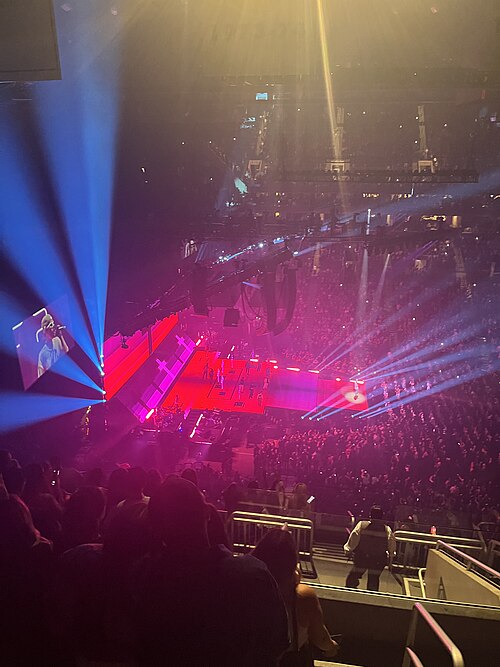
A live concert inside Barclays Center, capturing the large-arena scale, production energy, and crowd atmosphere that define one of New York’s biggest concert venues.
Barclays Center Concerts, Upcoming Shows & Concert Schedule
This is a Barclays Center concert venue guide, so the focus here is concerts and concert-ticket buying. The strongest searches around the music side of the arena include Barclays Center concerts, Barclays Center upcoming concerts, and the Barclays Center concert schedule. The official arena calendar also lists sports and other events, but those are outside this page’s core intent.
Barclays Center Concert Schedule & Calendar
Use the official Barclays Center calendar to confirm the live concert schedule, show date and start time. New concerts can be announced, added, moved or placed on sale throughout the year, so a live calendar is more reliable than a static roundup. Once you know the concert, this page covers the ticket-buying, box-office, transit and venue-planning questions that remain.
This venue page owns Barclays Center tickets, events, concerts, schedule, box office and tonight/today searches. For the Barclays Center seating chart, best seats, seat views and section-by-section advice, use the dedicated seating guide.
What Barclays Center Is Actually Like for Concerts
The Barclays Center bowl was specifically designed with concerts in mind alongside basketball, and that dual intent shows in the upper deck angle. The 200-level sections are steeply pitched, which means they hang over the lower bowl at a more aggressive angle than you find in older arenas. The effect: even a row 15 upper deck seat looks down into the arena at an angle that keeps you involved rather than a seat that stares across a flat expanse of distance. The bowl compresses the distance between audience and stage in a way that makes Barclays feel more connected than its capacity suggests.
The arena opened in September 2012, which makes it one of the newer major arenas in the New York market. The concourses are wider than older buildings, the sight lines are cleaner, and the production infrastructure — rigging, power, loading — is built for contemporary large-scale touring. For artists running current major tours with complex production, Barclays handles it cleanly.
The crowd character at Barclays concerts reflects the borough in a specific way. The audience draw is broader than just Brooklyn residents — the transit connections from Long Island, Queens, and Manhattan are too strong for that — but the feel of a Barclays show tends to have a different energy from MSG. It is neither better nor worse; it is different. For visitors who want a major NYC concert that is not definitionally tied to Midtown Manhattan, Barclays delivers a version of that experience with its own context and texture.
Barclays Center’s general venue policy does not allow bags larger than 10″×6″×2″, and hard-sided bags are prohibited. The arena generally does not offer bag check, so guests are encouraged to travel light; those without bags can use Express Lanes for faster entry. Individual events can impose stricter rules — including special clear-bag requirements — so check the event page before leaving home.
When Barclays Is the Right Arena — and When It Isn’t
Barclays is the right choice when
You want a full major-arena show and are indifferent between Brooklyn and Manhattan. Barclays hosts the same scale of touring artist as MSG — the production capacity, the ticket volume, and the show types are comparable. For fans whose priority is seeing the artist at arena scale rather than the specific Manhattan feel of MSG, Barclays delivers the same fundamental experience with different surrounding context. Neither is objectively superior; they are different venues with different neighborhoods.
You are coming from Brooklyn, Queens, or Long Island. Barclays’s transit advantage is most pronounced for audiences who do not need to start their journey in Manhattan. From Jamaica Station on Long Island, the LIRR reaches Atlantic Terminal in approximately 20 minutes. From Queens neighborhoods served by the N, Q, or R lines, Barclays is often more direct than MSG. From Brooklyn itself, no major Manhattan arena competes on transit convenience. The Atlantic Avenue hub — the third-largest subway hub in New York — genuinely changes the venue equation for a large portion of the region’s population.
You want a Brooklyn night as part of the evening. The neighborhoods around Barclays — Fort Greene, Boerum Hill, Cobble Hill, and the Flatbush Avenue corridor — have dining and bars that support a pre-show evening in a way that the Penn Station block around MSG does not. For visitors who want the concert to be part of a broader Brooklyn experience, the venue’s neighborhood delivers on that without needing to be romanticized. See the neighborhood section below for the practical version of this.
Barclays may not be the right choice when
Manhattan is where your evening starts and ends. The geographic reality of Barclays in Brooklyn means the transit journey from most Manhattan neighborhoods takes 15–25 minutes — straightforward, but present. For visitors staying in Midtown who want to walk from the hotel to the arena, MSG is the answer. For anyone whose dinner plan, hotel, or post-show destination is in Midtown or the Upper West Side, adding a Brooklyn round trip to the evening changes the logistics in ways that are worth accounting for.
You want a polished seated-theater experience. Barclays is an arena, and it performs like one: loud, large, crowd-energy-focused. For someone who specifically wants a beautiful room, strong acoustics, and a more attentive audience culture, Radio City, the Beacon, or Carnegie Hall will serve them better. The choice to go to Barclays should be a deliberate arena choice, not a default.
The artist’s show is built for stadium scale. Barclays at ~19,000 seats is an arena. MetLife Stadium at ~82,500 seats is a stadium. Some artists — touring stadium shows — play Barclays as a secondary market or add-on date; those shows typically look and feel slightly compressed in the smaller space. For stadium-scale productions, MetLife is the venue that matches the production intent.
Where to Sit at Barclays Center — Seating Overview
Barclays seating for concerts divides into three broad tiers: floor, lower bowl (sections 1–31), and upper bowl (200-level). Stage configuration — end-stage, in-the-round, catwalk, or GA floor — changes which sections are strong for a given show, so the right section depends on what’s actually on sale for your specific date, not a fixed rule.
Floor puts you closest to the stage, typically standing for major tours, with your position depending on how early you arrive for GA setups or which floor sub-section you’re assigned for reserved floor. Lower bowl is the most consistent seated option — close enough for real detail, with side-center sections generally offering the strongest value relative to price. Upper bowl is where Barclays’s bowl design earns its reputation: a steep pitch keeps upper sections more connected to the floor than a typical arena, and corner sections that look awkward on a flat chart tend to be more usable in practice than the diagram suggests.
Specific section numbers, the floor sub-sections (F1–F9), the Honda Center Lounge, and which seats to avoid for a particular stage configuration are all covered in the dedicated Barclays Center Seating Guide. Use it before you buy — the best section changes by show, and that page walks through it show-type by show-type.
Barclays Center Tickets & Box Office
For Barclays Center tickets, start with the venue’s official event page for the show or event you want. Barclays Center event listings provide the live date, on-sale status and official purchase path, while Ticketmaster is the venue’s established ticketing platform for primary tickets and supported resale inventory. Ticket availability and pricing are event-specific, so compare the exact date and section rather than assuming one standard Barclays Center ticket price.
Barclays Center box office and ticket office
The Barclays Center Box Office is located inside the Main Atrium at 620 Atlantic Avenue. Current standard non-event hours are Monday through Friday from 12:00 PM to 6:00 PM, Saturday from 12:00 PM to 4:00 PM, and Sunday closed. On non-Nets/Liberty event days, the box office opens at 12:00 PM and remains open until one hour after the ticketed start time. The venue also notes that the box office does not sell tickets on the first day of public sale for future events.
Barclays Center ticket prices, presales and resale
Ticket prices vary by event, demand, section and sale phase. Presales can create earlier access to inventory without guaranteeing the lowest price, while resale pricing can move above or below face value depending on demand. If a concert is sold out, compare the official ticketing marketplace with reputable resale listings, but verify the exact section, row and any view restriction before buying.
The box office is useful for in-person service and event-day purchasing when inventory exists, but it should not be treated as a secret discount channel. For a newly announced event, use the official event page first — especially because the box office does not sell future-event tickets on the first day of public sale.
Barclays Center Concert Tonight: Same-Day & Last-Minute Tickets
If you’re searching for a Barclays Center concert tonight or checking Barclays Center tonight before heading to Brooklyn, start with the live arena calendar to confirm whether tonight’s listing is a concert. Then open the specific show page for start time, doors, ticket status and any production-specific entry rules.
For a concert tonight, same-day ticket inventory can change as an event approaches. Primary inventory, production holds or verified resale tickets may appear even after earlier searches looked limited. If you’re making a last-minute decision, check the live event page and ticketing inventory again rather than relying on an earlier screenshot or cached search result.
Confirm the event first, then the ticket. “What’s at Barclays Center tonight?” is an event-calendar question; “Can I still get Barclays Center tickets tonight?” is an inventory question. Treating them separately gets you a faster, more accurate answer.
What First-Timers Should Know Before a Concert at Barclays
Two questions come up constantly from first-timers: how long are concerts at barclays center, and what can you bring into barclays center. On timing, most touring concerts run roughly two to three hours including an opener, though this varies significantly by artist and tour. On what you can bring, the short answer is very little beyond a small bag meeting the size limit below — see the full breakdown next.
The bag size limit changes your packing plan entirely
This is the most important practical thing to know before your first Barclays concert. Under the general venue policy, bags larger than 10″×6″×2″ and hard-sided bags are not permitted, and the arena encourages guests to travel light. Guests without bags can use Express Lanes for faster entry. Barclays generally does not offer bag check, but individual productions can set stricter event-specific rules, so check your event page before leaving home. See the what to wear guide for full venue-specific packing advice.
Atlantic Terminal changes the LIRR equation
Visitors coming from Long Island by LIRR reach Atlantic Terminal — located across the street from Barclays on Flatbush Avenue — in approximately 20 minutes from Jamaica Station. Atlantic Terminal is LIRR Zone 1, trains run every 8 minutes at peak hours, and late-night service continues up to 2 AM on weeknights and weekends. For Long Island visitors, Barclays is often significantly more convenient than MSG, which requires a train to Penn Station and then a subway or walk. The LIRR-to-Barclays connection is the venue’s most underappreciated logistical advantage for the region.
The subway is genuinely faster than any car option
Barclays Center was designed around transit, not parking. The arena has no parking lot of its own. Nine subway lines at the Atlantic Ave–Barclays Center station — the 2, 3, 4, 5, B, D, N, Q, R — put the venue 18 minutes from Penn Station by the 2/3 express and 20 minutes from Times Square. From Manhattan’s East Side, the N or Q direct to Atlantic Avenue is straightforward. Rideshare and car options compete with these times under the best conditions and lose badly under event-night conditions when Atlantic Avenue and Flatbush Avenue are congested. Transit is not a recommendation at Barclays — it is the clear first choice for any visitor who is not specifically coming from a location with no subway access. See the transit guide for full subway directions.
Arrival timing matters more than people expect
For major sold-out Barclays concerts, the entry queue at the Atlantic Avenue entrance builds significantly in the 30–45 minutes before showtime. The combination of multiple subway lines all arriving simultaneously, the security bag-size check, and the arena’s entry flow creates a compression point that rewards arriving 45–60 minutes before the listed show time. Not because the arena is inefficient — it is not — but because the transit convergence on the station and plaza at event time is real and measurable.
Post-show — the exit is manageable but requires a plan
The Atlantic Avenue subway hub handles the post-Barclays crowd efficiently compared with MSG’s Penn Station situation, because the nine subway lines at the station disperse outgoing crowds across multiple routes rather than funneling everyone onto one or two platforms. Still: the first 15–20 minutes after a sold-out show ends is busy. Staying for an encore or allowing a few minutes for the initial surge to pass before joining the exit flow consistently produces a cleaner transit experience than rushing out immediately at the end of the set.
The Full Night — Brooklyn, Dinner, and Getting There
Fort Greene and Boerum Hill — the pre-show dinner zone
The neighborhoods immediately surrounding Barclays Center — Fort Greene to the north, Boerum Hill to the west, the edges of Cobble Hill and Carroll Gardens a short walk further — have a genuine restaurant density that makes a pre-show dinner in the neighborhood a real option rather than a logistics compromise. These are established Brooklyn neighborhoods with restaurants that serve the local community daily, not just event-night tourists. Booking a restaurant on DeKalb, Smith Street, or the surrounding blocks when you purchase your tickets is the move that turns a concert night at Barclays into a complete evening rather than an isolated transit-to-arena-and-back experience.
The Flatbush Avenue corridor between Atlantic and Fulton also has options at various price points — more casual, more immediate to the arena entrance, and accessible for anyone who is arriving directly at showtime without a pre-planned dinner. For the full picture on restaurants near Barclays and other NYC concert venues, see the restaurants near Barclays Center guide.
Is Barclays a “full night out” venue?
For visitors coming from Manhattan or Long Island who are making a specific trip, Barclays works best as a full evening destination — dinner in the neighborhood, show, post-show drink or walk — rather than a quick in-and-out venue. The transit is efficient enough that the Brooklyn geography is not a burden, but the round trip from Manhattan is not so short that doing it without building an evening around it feels worth it. For Brooklyn-based concertgoers, the calculation is simpler: the arena is already in the neighborhood, and the evening integrates naturally.
Hotels near Barclays for overnight visitors
For visitors building a trip around a Barclays show, staying in Downtown Brooklyn or Prospect Heights removes the post-show transit variable. Downtown Brooklyn hotels within walking distance of the arena include several mid-size options on or near Fulton Street. For visitors who prefer to stay in Manhattan and take the subway over, any hotel on the N/Q/R line or the 2/3/4/5 lines offers a direct ride to Atlantic Avenue. See the hotels near Barclays Center guide for area-specific options.
Parking — the honest version
Barclays has no arena-owned parking. Nearby garages on Dean Street and Pacific Street are the primary options, at $30–60 on event nights. The venue’s official guidance is to use public transit, and this is genuine advice rather than boilerplate — the streets around Atlantic and Flatbush on a major show night are congested in a way that makes post-show car retrieval a 45-minute exercise under reasonable conditions. If driving is necessary, pre-book through SpotHero at least a day in advance. See the parking near Barclays Center guide for strategy.
Barclays Center vs Other NYC Concert Venues
Barclays for a Brooklyn night and transit from Long Island or Queens; MSG for Manhattan and the “world’s most famous arena” factor. Both are major arenas at comparable capacity — MSG at ~20,000, Barclays at ~19,000. Both host the same scale of touring artist. MSG wins on Manhattan location, historical reputation, and Penn Station’s rail connections from New Jersey and the full Northeast Corridor. Barclays wins for visitors from Long Island (LIRR directly to Atlantic Terminal), Brooklyn residents, and anyone who prefers a Brooklyn night to a Midtown one. The neighborhood dinner options around Barclays are meaningfully stronger than the Penn Station block around MSG. Neither is objectively better for concerts — they serve different geographies and different preference profiles.
Different categories. Radio City at 5,960 seats is a theater; Barclays at up to 19,000 is an arena. Artists who play both in New York are offering genuinely different experiences. The Radio City show will feel more intimate and acoustically polished; the Barclays show will feel like a major arena concert. Choose based on which kind of experience fits the artist and the evening you want.
Entirely different scales and vibes. The Beacon at 2,894 seats is a historic mid-size theater on the Upper West Side. Barclays is a 19,000-seat arena in Brooklyn. These are not interchangeable options for any artist — the production and show type self-select which venue is appropriate. The Beacon for intimate, room-character concerts; Barclays for major touring productions at arena scale.
Barclays for arena-scale concerts; MetLife for stadium-scale productions. MetLife Stadium in East Rutherford, New Jersey seats approximately 82,500. Stadium shows are a different logistical and experiential category from arena shows — longer transit (NJ Transit from Penn Station, ~35–40 minutes), larger crowds, more walking inside the venue, and productions specifically designed for that scale. When an artist plays both Barclays and MetLife on the same tour, the Barclays show is typically the more connected, intimate experience. MetLife is for productions specifically designed to require that scale.
Barclays for Brooklyn-based transit access; UBS for Long Island / Nassau County residents. UBS Arena in Elmont, Long Island (~17,500 capacity) is roughly similar in scale to Barclays and hosts comparable touring artists. Transit from Manhattan to UBS requires LIRR from Penn Station (~30–35 minutes), which is slightly longer than Barclays. From Nassau County or eastern Queens, UBS is closer. From Brooklyn, Queens, or Manhattan, Barclays is generally the more convenient arena option. The choice is primarily geographic.
Different categories, different reasons. Williamsburg clubs, Brooklyn Steel, and similar mid-size venues (300–2,500 capacity) deliver standing-room proximity and scene energy that Barclays cannot approximate. Barclays delivers arena scale, production capacity, and the collective energy of a large crowd. These are different kinds of nights for different artists and different preferences. Neither substitutes for the other.
Common Barclays Concert Mistakes
Arriving with an oversized bag
Barclays Center does not allow any bag larger than 10″×6″×2″ — a size restriction stricter than most NYC arenas, including MSG. A standard purse, tote bag, or backpack will not pass entry regardless of whether it’s clear or opaque. There is no onsite bag storage. The result of arriving with an oversized bag is being turned away with no recourse at the venue. Pack accordingly before you leave home, not when you are standing in the entry queue.
Assuming any section will work regardless of the show’s stage setup
Barclays uses multiple concert configurations — end-stage, in-the-round, catwalk, pit setups — and which sections are strong changes significantly between them, including upper bowl corner sections that look worse on paper than they actually perform. Buying based on a generic seating chart rather than the event-specific one for your show is the most common way to end up in a worse seat than you paid for. The Barclays Center Seating Guide covers section-by-section detail by configuration.
Driving when transit is the clear answer
Barclays has no arena-owned parking. Nine subway lines converge at the station below the venue. The arena was designed specifically for transit access. Choosing to drive to a Barclays concert means competing for $40–60 garage spots, sitting in Atlantic Avenue event-night traffic, and then waiting for the post-show garage exit — an exercise that costs two to three times the subway fare and takes significantly longer for most visitors from Manhattan, Brooklyn, or Queens. The transit option is not just acceptable here; it is the consistently superior choice for most of the concert-going population.
Treating Barclays as the default when MSG was actually the goal
Some visitors choose Barclays for a show not because it is the right venue for their evening but because tickets were available when MSG sold out. This is a legitimate reason to go to Barclays, but it is worth being conscious of: if what you actually wanted was the Madison Square Garden experience — the Midtown Manhattan location, the building’s history, the Penn Station rail connections — the Barclays show will be a good concert but not the specific thing you were hoping for. Know what you are choosing and why, and the evening will match your expectations.
Underestimating the arrival queue for major shows
The convergence of nine subway lines at Atlantic Avenue on a sold-out concert night creates a significant crowd density at the arena’s entry points in the 30 minutes before showtime. The venue is not inefficient — the security and entry process is well-organized — but the volume of people arriving simultaneously from multiple transit lines at roughly the same time produces queues that reward arriving 45–60 minutes early rather than at the last minute. A missed opener or a first-song-standing-in-line experience is consistently the result of tight arrival timing at a Barclays sold-out show.
Frequently Asked Questions
Start with the official Barclays Center site or Ticketmaster for face-value pricing and the most reliable inventory. If a show is sold out or you want a specific section not currently listed, verified resale platforms are the next step — just confirm the seat location and any view restrictions before buying, since resale listings don’t always match the venue’s official seating chart labels exactly.
Yes — for major touring productions at arena scale, Barclays is one of the stronger large venues in the New York area. The bowl design keeps the upper sections more connected to the floor than a shallower arena would, the transit access is genuinely excellent, and the production infrastructure handles large-scale tours cleanly. The tradeoff is the Brooklyn location (which is an advantage for some visitors and a neutral or slight disadvantage for others) and the bag size limit, which is stricter than most NYC venues. For a major concert that fits the arena format, Barclays delivers a solid experience across most seating sections.
It depends on the show’s stage configuration, but broadly: side-center lower bowl offers the strongest price-to-quality ratio, upper bowl center sections benefit from the arena’s steep-pitch design that keeps them more connected to the floor than a typical arena, and floor works best if you want proximity and don’t mind standing. Upper bowl corner sections look worse on the chart than they perform in person. For section numbers, floor sub-sections, and configuration-specific detail, see the Barclays Center Seating Guide.
Neither is universally better — they serve different audiences and different geographies. MSG wins for visitors from New Jersey, the Northeast Corridor, Midtown hotel guests, and anyone who specifically wants the Manhattan arena experience. Barclays wins for Long Island visitors (LIRR to Atlantic Terminal is faster than to Penn Station for many routes), Brooklyn-based concertgoers, Queens residents on the N/Q/R lines, and anyone who wants to build the evening around a Brooklyn neighborhood dinner. The shows are comparable in scale; the difference is location, surrounding neighborhood, and which transit connections serve you best.
45–60 minutes before the listed show time for major sold-out concerts. The convergence of nine subway lines at Atlantic Avenue creates significant crowd density at the arena entry points in the final 30 minutes before showtime, and the bag-size security check adds time to the entry process. For smaller-capacity shows or nights without sell-out pressure, 30 minutes is generally sufficient. When in doubt, earlier is consistently better at Barclays.
Subway — unambiguously. The 2, 3, 4, 5, B, D, N, Q, and R trains all stop at Atlantic Ave–Barclays Center station directly below the arena. From Manhattan: the 2/3 express from anywhere on the West Side IRT line, or the D/N/Q from Midtown on the BMT Brighton/4th Ave lines. From Times Square: 20 minutes. From Penn Station: 18 minutes. From Long Island: LIRR to Atlantic Terminal, directly across the street from the arena, approximately 20 minutes from Jamaica Station. Late-night LIRR service continues to 2 AM. Transit beats driving by a wide margin for nearly every visitor demographic. See the Barclays Center transit guide for full directions.
Yes, with preparation. The transit is genuinely accessible, the bowl is designed to feel connected across all sections, and the concert quality for major touring acts is strong. The preparation items: know the bag size limit before you pack (10″×6″×2″ max, stricter than most NYC venues), check the event-specific seating configuration before buying, and arrive 45–60 minutes early for sold-out shows. For a first-time visitor who wants a big-arena concert experience with strong transit access, Barclays is a fully viable choice — and for visitors coming from Long Island or Brooklyn, potentially the most practical choice in the region. See the first-timers concert guide for the broader venue-choice framework.
The Barclays Center Seating Guide covers section-by-section detail — floor sub-sections, lower bowl, upper bowl, and how the best section changes by stage configuration. For a purely visual seating chart, Ticketmaster’s event-specific chart for your exact show is the most reliable source, since the layout genuinely shifts between end-stage, in-the-round, and other configurations.
Use the current Barclays Center calendar to see upcoming concerts and open the specific concert page for date, start time and ticket status. The arena also hosts sports and other events, but this Stage & Street page is specifically focused on Barclays Center as a concert venue.
Standard non-event hours are Monday through Friday from 12:00 PM to 6:00 PM, Saturday from 12:00 PM to 4:00 PM, and Sunday closed. On non-Nets/Liberty event days, the box office opens at 12:00 PM and remains open until one hour after the ticketed start time. Event-day rules can differ for Nets and Liberty games.
Yes, often. Ticketmaster is the fastest way to check genuine same-day availability, since held inventory is sometimes released the day of a show. The box office is also an option for same-day in-person purchases when it’s open ahead of an event. Checking the official venue calendar or Ticketmaster directly gives a more accurate same-day picture than a general search, and last-minute availability tends to be more limited in section and price range than booking further ahead.
Most touring concerts run roughly two to three hours including an opening act, though this varies by artist. Under the venue’s general policy, bags larger than 10″×6″×2″ and hard-sided bags are prohibited, outside food and beverages are not permitted, and professional camera or recording equipment is restricted. Individual productions can impose stricter rules, so check the specific event page before you go.
Barclays, Understood
Barclays Center is the best argument for seeing a major concert in Brooklyn — not because of any abstract borough identity, but because of transit, bowl design, and neighborhood. Nine subway lines below the building, LIRR across the street, a steep-pitch upper deck that keeps you connected, and Fort Greene and Boerum Hill a short walk away for dinner. For the right visitor, Barclays is the cleaner choice over MSG even without the historical weight.
The practical checklist: bag under 10″×6″×2″ or leave it home (plan this before you leave home). Check the event-specific seating configuration, not the generic venue chart. Consider upper bowl center rows 1–8 before assuming you need floor. Use the transit. Arrive 45–60 minutes early for sold-out shows. Book dinner in the neighborhood when you book the tickets.
Done correctly, a Barclays concert night is a full Brooklyn evening — not just an arena visit with a long ride home.
Get Your Barclays Center Tickets