

Vivian Beaumont Theater Seating Chart: Best Seats, Views & Seat Map
Use this Vivian Beaumont Theater seating chart and seat map to compare Orchestra and Loge views, understand view-from-my-seat reports, find the best seats for your priorities, and avoid the side-angle and stair-access mistakes that matter most in this unusual Lincoln Center house.
The Vivian Beaumont Theater is not a standard Broadway seating decision. It is the only Tony Award-eligible theater outside the Theater District — an Eero Saarinen building on the Lincoln Center campus at 150 West 65th Street, designed in 1965 with a theater consultant’s precise brief: make sure no seat is more than 65 feet from the stage.
That engineering decision changes everything about how you buy tickets here. At most Broadway houses, the central worry is being too far away — the nosebleed Balcony, the distant rear Orchestra, the steep climb that puts you eighty feet from the action. At the Beaumont, that problem is architecturally solved. The concern is different: where you sit on the horizontal arc matters more than whether you are front or back. Side angle is the real risk. The thrust-stage configuration can affect front rows. And the Loge is not a distant balcony — it may be the best seat in the house for a large-scale musical.
The Beaumont Seating Principle
At the Vivian Beaumont, you are not simply buying closeness. Eero Saarinen solved the distance problem — no seat is more than 65 feet from the stage, in any section, at any row. The buyer’s real decision is about experience type: Center Orchestra for faces and performer connection; Loge center for the full geometry of the stage, its turntable, its ensemble formations; Row O for accessibility; outer side seats for angle risk; and front rows for immersion only after you have verified the staging configuration.
The Beaumont is one of the rare Broadway houses where “the back of the room” is not an insult. Broadway Scorecard notes Row P center as the house’s “Smartest Value” — a seat with good sightlines, best-in-house legroom, and a slight one-step elevation advantage. The Loge front two center rows are “some of the best in the house” per SeatPlan — not a consolation prize but a deliberate choice. At the Beaumont, the question is whether you want faces, architecture, accessibility, or the full map of the stage.
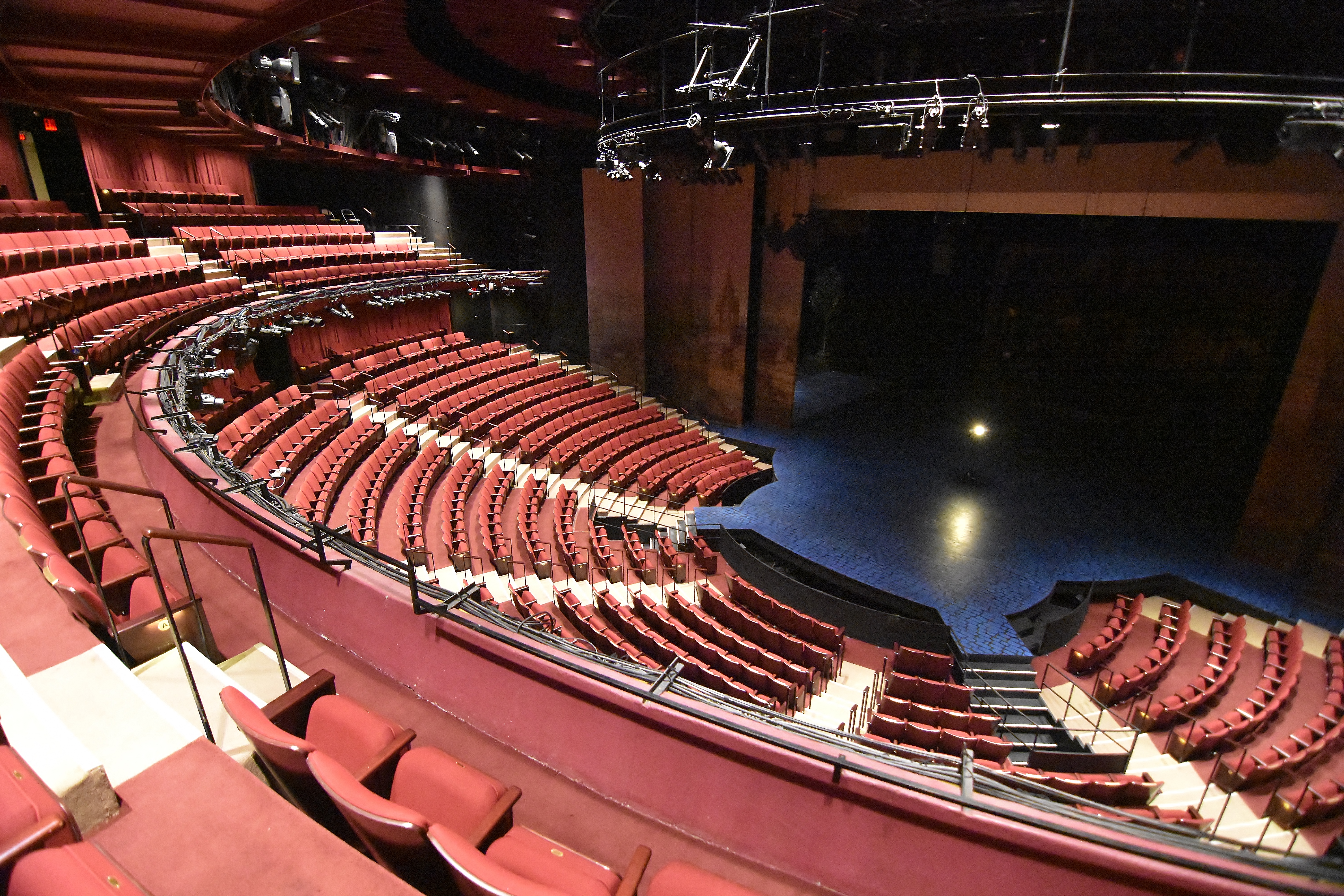
Vivian Beaumont Theater View From My Seat — How to Read Seat Reports
Searches for Vivian Beaumont Theater view from my seat are especially useful at this house because a photo alone can be misleading. The Beaumont uses a curved, three-quarter-thrust relationship between audience and stage, so two seats at a similar distance can feel very different depending on horizontal angle. A center seat a few rows farther back may give a cleaner overall picture than a closer seat pushed toward the far side.
When comparing seat-view photos or audience reports, check four things before treating one photo as definitive: the exact section and row, whether the seat is near the outer edge of the curved Orchestra or Loge, whether the production uses scenic elements close to one side of the thrust, and whether the first rows have been reconfigured for that production. The physical theater stays the same; the usable view can change with staging.
Orchestra Seats — Performance Connection, Stadium Sightlines, and the Row O Question
The Beaumont Orchestra curves around the thrust stage in a horseshoe/semicircle, giving most seats a three-sided relationship to the action. Stadium-style seating means people in front generally do not block the view. The center section gives the most balanced perspective on the thrust stage’s three-sided blocking, and this house rewards being centered significantly more than it rewards being extremely close.
Center Orchestra Rows D–K — The Consensus Prime Zone
Every major source — SeatPlan, TickPick, Headout, and Broadway Scorecard — identifies Center Orchestra rows D through K as the house’s best overall zone. SeatPlan’s exact summary: “rows D to K of the central Orchestra sit far enough back for an overview but close enough to feel immersed.” TickPick confirms this range as “the best combination of sight and comfort.” From here you get the performer detail of Orchestra proximity while remaining far enough to see the thrust stage’s full three-sided staging as a composed picture. For actor-driven plays, rows D through H give the most emotionally immediate experience. For large-scale musicals where the full stage width and turntable action matter, rows H through L balance detail with stage picture.
Front Orchestra Rows A–C — Immersive, But Verify the Thrust Configuration
The very front rows at the Beaumont are exciting — the proximity to the thrust stage puts you inside the performance in a way that is unique on Broadway. But there are two considerations. First, the Beaumont is a 3/4 thrust stage, which means performers frequently play toward side sections, and front-center seats may have moments when actors’ backs are partially to them. Second, the first seven Orchestra rows can mechanically lower to extend the thrust stage for certain productions. For any production, verify the current stage configuration before assuming front rows A through C give the best view. Some AVFMS reviewers note brief sightline issues from very close positions, including one noting a piano obstruction from a near-stage left seat.
The Beaumont’s Orchestra entrance is behind Row O. Row O is the only step-free row in the Orchestra. All rows A through N require 1–2 steps down per row to reach from the Row O entry level. Row P requires 1 step up from Row O. This means that “accessible Orchestra seating” means Row O specifically — not general Orchestra level. If you or your party need step-free access, Row O is the row. If Row O is sold out, verify accessibility of any alternative with LCT / Telecharge Access Services before purchasing. Do not assume that any other Orchestra row is step-free based on the general “Orchestra accessible” language in listings.
Center Orchestra Rows L–P — The Beaumont’s Smartest Value
Broadway Scorecard specifically identifies Center Orchestra rows L through P as the “Smartest Value” zone, with Row P as particularly strong: “Row P has a dedicated step-up elevation advantage — you are the one step above Row O, which actually gives a slightly better sightline.” Headout endorses Row P for “great sight lines and plenty of leg room” and recommends it specifically for tall visitors — it has the best legroom in the house. In a theater where no seat is more than 65 feet from the stage, the Center Orchestra back rows are not a compromise. They are a legitimate primary choice for budget-conscious visitors who want to stay on the central axis of the thrust.
Side Orchestra — Immersive But Angle-Aware
The Left Center, Right Center, Left, and Right Orchestra sections curve around the thrust stage. Inner positions within these sections are generally workable — the thrust creates genuine three-sided performer engagement and some AVFMS reviewers have found side-adjacent positions exciting. The far extremes — the cheapest seats coded “above 500 and below 100” per SeatPlan — do risk a side-on relationship to the staging. For productions where important action consistently plays to the full thrust, far outer side seats can miss portions of the picture. If choosing between inner side and Center Orchestra a few rows back, choose center.
Loge Seats — Not a Normal Balcony
The Beaumont Loge is not the punishing nosebleed section that most Broadway Balcony pages warn against. Because Saarinen’s 65-foot maximum covers the entire house, Loge rows A and B center are still within that distance. The Loge’s elevated, centered position reveals something the Orchestra cannot: the full geometry of the thrust stage, turntable movements in their spatial context, ensemble formations as composed patterns, and the complete visual architecture of a large production. SeatPlan’s verdict: “the Loge is excellent for clear views of the set, especially at big musicals.” The front two center rows are “considered some of the best in the house.” For a sweeping, ensemble-driven musical on the Beaumont’s unusually large stage, Front Loge center can be one of the strongest single seat choices in the building.
Loge Rows A–B Center — Elevated Premium
Rows A and B of the Loge Center section give a full elevated view of the Beaumont’s stage — one of the largest on Broadway. From here you see the production as its director designed it: staging across the full width and depth, turntable movement as spatial choreography, and the scale of a large-ensemble show fully revealed. For first-time visitors to the Beaumont with a large musical, this may be the single most complete view available anywhere in the theater.
Loge Rows D–E Center Left and Right — Confirmed Value
TickPick specifically calls out rows D and E of Center Left and Center Right Loge as “amazing views at a lower cost.” A JK’s TheatreScene reviewer quoted by Broadway Scorecard paid $99 for these seats and reported: “budget-friendly and worth every penny… view not appreciably different than the first few rows.” The slight side angle of Left Center and Right Center Loge rows is manageable and the elevated position keeps sightlines clear. Only five rows exist in the Loge, so row D is still “front Loge” in any meaningful sense.
Loge: The 30-Stair Reality
The Loge requires two flights of stairs — 30 steps — from the Orchestra level. There is no elevator. Once in the section, there are 1–2 steps down per row. LCT is direct: “the Loge level of the Beaumont is not accessible to anyone that cannot use stairs.” SeatPlan adds that legroom is restricted across the Loge — aisle seats are strongly recommended for taller visitors. Sound quality can thin at the rear sides. For anyone with any mobility concern, doubt about stairs, or preference for accessibility, the Loge is not the right section.
Far Side Loge — Approach With Awareness
The outer Left and Right Loge sections sit at the extremes of the curved seating arc. From here the angle to the stage becomes more pronounced. For productions where the full-stage horizontal picture matters — as with most large musicals at the Beaumont — the far side Loge is not the best choice. Center Loge and Center Left/Right Loge are meaningfully better aligned to the thrust’s three-sided staging.
Does the Vivian Beaumont Theater Have a Balcony?
The Vivian Beaumont Theater has a Loge — an upper level that wraps above and behind the Orchestra. It is the closest functional equivalent to a Mezzanine or Balcony, and TDF officially notes: “Mezzanine is called Loge at this theater.” There is no separate third tier or additional Balcony above the Loge. The Loge is the highest general seating level.
The key distinction from a traditional Broadway Balcony: because Saarinen’s design keeps every seat within 65 feet of the stage, the Loge is not the punishing distant section that the word “balcony” implies in most Broadway contexts. The front center Loge rows are genuinely competitive with premium Orchestra seats for many productions — especially large-scale musicals. The meaningful warning is the 30-stair climb and the absence of elevator access, not the view.
Best Seats for A Few Good Men at the Vivian Beaumont Theater
A Few Good Men begins previews October 8, 2026 and opens October 29 at the Vivian Beaumont. Because previews have not started yet, there are no reliable production-specific view-from-my-seat reports for this staging. The recommendations below are therefore based on the Beaumont’s established room geometry and on the needs of an actor-driven courtroom play, not on unverified claims about this production’s final scenic configuration.
The production is scheduled through January 10, 2027. The Broadway League lists the Vivian Beaumont as the venue and confirms the October 8 first preview and October 29 opening. Stage & Street will treat any later seat-specific claims as production-specific only after real preview reports exist.
Best Seats by Production Type
The Beaumont was built for this. Front Loge center reveals the full stage geography. Center Orchestra H–L gives emotional connection without losing the stage picture. Either is a legitimate first choice.
Performer detail, facial expression, and the three-sided thrust relationship are strongest from Center Orchestra rows D through H. The Beaumont can be intimate in a way surprising for its capacity.
Ensemble formations, large-company movement, and spatial staging all read as designed from the front Loge center. For any production where the full stage picture is part of the artistic argument, this is the seat.
The Beaumont’s 10,000-square-foot stage with turntable and thrust creates visual compositions that the elevated, centered Loge position reveals most completely. For design-forward work, Loge center is the right elevation.
The 3/4 thrust stage surrounds the central Orchestra on three sides. For a true thrust production, Center Orchestra rows D–L put you in the three-sided staging relationship the theater was designed to create. Verify front-row configuration.
If you have experienced the Beaumont from Orchestra, the Loge reveals the theater’s spatial architecture as a whole. The turntable, the thrust, the ensemble formations — all read differently from above.
Best Seats by Visitor Type
The cleanest first Beaumont experience. Close enough for the three-sided thrust to feel immediate, far enough for the full stage picture to read, and centered enough to see the production as designed.
The deliberate choice of an experienced Beaumont visitor. The elevated center position reveals the spatial logic of the thrust, the turntable, and the staging architecture in a way Orchestra seats cannot. Worth doing at least once.
Center Orchestra for immersive engagement. Front Loge for the architectural perspective and slightly more elevated atmosphere. Lincoln Center arrival — fountain plaza, campus energy — is part of the date-night experience here.
Row P center is Broadway Scorecard’s “Smartest Value” with legroom, sightlines, and the 65-foot maximum still working in your favor. Loge D–E Center Left/Right is the independently confirmed value pick for Loge buyers.
Row O is the only step-free Orchestra row. 6 wheelchair spaces. 4 transfer seats. Do not book Loge under any circumstances — 30 stairs, no elevator, LCT official: “not accessible to anyone that cannot use stairs.” Contact Telecharge Access Services at (212) 239-6222 before purchasing.
Row P has the best legroom in the Orchestra per Headout. Loge aisle seats are best for legroom in the upper section (SeatPlan confirms Loge legroom is otherwise restricted). Aisle positions throughout give the most physical comfort.
The Loge requires 30 stairs and has a real elevated feel. The Beaumont’s Orchestra is stadium-raked without the steep Loge climb. For visitors who dislike height or stair climbing, Orchestra center is the right section.
The Vivian Beaumont has an induction hearing loop funded by Shari and Ken Eberts. LCT official: “If your hearing aid has a T-coil, please toggle to that setting to receive audio signal directly without any headphones.” Confirm T-coil compatibility with Telecharge Access Services before arriving.
Accessibility at the Vivian Beaumont Theater
The Beaumont is accessible at the Orchestra level via the specific path described below. It is not accessible in the Loge under any circumstances. The difference between “the Orchestra is accessible” and “all Orchestra rows are step-free” is critical at this theater, because they are not the same thing.
Seats to Avoid — or Approach With Clear Expectations
- Do not book any Loge seat for a visitor who cannot comfortably climb 30 stairs (2 flights) with no elevator alternative — LCT’s language is explicit: “not accessible to anyone that cannot use stairs.”
- Do not book any Orchestra row below Row O expecting step-free access — rows A through N each require 1–2 steps down per row from the Row O entry level. This is the Beaumont’s most commonly misunderstood accessibility fact.
- Do not buy front Orchestra rows A–C for a large musical without verifying the current production’s thrust-stage configuration — the first seven rows can mechanically lower and the very front position may not give the best stage picture for sweeping ensemble productions.
- Do not book far outer side Orchestra (especially the cheapest side-coded seats) for productions where full horizontal staging matters — sightlines from the far extremes are confirmed angled by SeatPlan and AVFMS reviewers.
- Do not book far outer side Loge for large musicals where the full stage width is part of the production — the angle from extreme Loge sides is more pronounced than from center and Center Left/Right sections.
- Do not assume Loge rear rows are equivalent to front Loge — sound quality may thin toward the rear sides of the Loge per SeatPlan, and the distance is meaningful even within the Beaumont’s 65-foot maximum design.
- Do not book any seat without considering the current production’s specific stage setup — the Beaumont’s flexible thrust configuration means front-row sightlines can vary significantly between productions.
- Do not bring children under 5 — Lincoln Center Theater’s policy applies at the Beaumont.
The Vivian Beaumont vs Other Broadway Houses
The Beaumont occupies a distinctive position: larger than intimate playhouses like the Hayes or Hudson, comparable in capacity to classic mid-size houses like the Shubert or St. James, but architecturally and experientially unlike any of them. The Stephen Sondheim Theatre and Todd Haimes Theatre are stronger accessibility comparisons — both have elevators throughout. The Beaumont has the thrust stage, the Saarinen sightline engineering, and the Lincoln Center campus, none of which any other Broadway theater can match.
Planning a Vivian Beaumont Theater Night
The Beaumont is at 150 West 65th Street on the Lincoln Center campus. The cleanest transit is the 1 train to 66th Street–Lincoln Center — a walk across the plaza to the theater entrance. The M104 bus runs along Broadway. The Lincoln Center campus arrival is part of the experience: the reflecting pool, the Geffen Hall facade, the evening plaza light. Plan 30–45 minutes before curtain for arrival and the plaza. Do not eat in the Theater District and rush uptown — plan dinner on the Upper West Side near Lincoln Center. The pre-show dining and hotel context here is Lincoln Center, not Times Square.
For accessible parking, the Lincoln Center Parking Garage (Yellow Section) can be booked in advance. The Box Office is at the 65th Street entrance. The accessible entrance uses a wheelchair lift to the left of the main entrance on 65th Street. Four unisex restrooms are on the lobby levels. Assistive listening devices are at the concessions bar in the theater’s lobby. Children under 5 are not admitted.
FAQ — Vivian Beaumont Theater Seating
Center Orchestra rows D through K is the consensus prime zone — confirmed by SeatPlan, TickPick, Headout, and Broadway Scorecard. Loge rows A and B center are “some of the best in the house” per SeatPlan, especially for large musicals. For actor-driven plays, rows D through H center; for large musicals, rows H through L center balance performer connection with stage picture. Row P center is specifically endorsed for legroom and sightlines as the “Smartest Value” by Broadway Scorecard.
Both are strong for different experiences. Center Orchestra gives performer proximity and the three-sided thrust engagement the room was designed for — best for actor-driven plays and immersive musical connection. Front Loge center gives the full stage picture — turntable movement, ensemble formations, and the visual architecture of a large production — and is often the better choice for sweeping, visually broad musicals. The Beaumont’s 65-foot maximum means neither section is truly far from the stage.
Yes — Loge Row A center is among the best seats in the house for large-scale productions. SeatPlan specifically calls the “front two rows in the center” as “some of the best in the house, offering elevated views of the stage.” The main considerations: you must be comfortable with 30 stairs, because there is no elevator, and the Beaumont’s legroom is tight throughout the Loge — aisle seats are worth requesting if available.
The Beaumont has a Loge, which functions as the upper level. TDF officially notes: “Mezzanine is called Loge at this theater.” There is no separate third-tier Balcony. The Loge wraps above the Orchestra and — because of Saarinen’s 65-foot maximum design — is not the punishing distant section that “balcony” implies at most Broadway houses. The meaningful warning is the 30-stair climb without elevator access, not the view.
30 steps — two flights of stairs — from the Orchestra level, confirmed by LCT official, TDF, SeatPlan, and Headout. The Loge entrance is behind row E. Once inside the section, there are approximately 1–2 steps down to each row. There is no elevator. The Loge is not accessible for wheelchair users or anyone who cannot climb stairs.
No. LCT’s official accessibility page states: “Due to structural limitations, the Loge level of the Beaumont is not accessible to anyone that cannot use stairs.” This is confirmed by TickPick, SeatPlan, TDF, and all major sources. There is no elevator. Do not book Loge for any visitor with mobility concerns, limited stair capacity, or a need for step-free access.
All accessible seating is in the Orchestra at Row O — the only step-free row. Up to 6 wheelchair spaces and 4 transfer seats with folding armrests per SeatPlan, with 2–3 companion seats available per accessible position. Orchestra entrance is behind Row O. Accessible seating may be booked through Telecharge Access Services: (212) 239-6222, on Telecharge.com, or at the box office. Book in advance for popular performances.
Yes — Row O is the only step-free row in the entire Orchestra. The Orchestra entrance is behind Row O. All rows A through N require 1–2 steps down per row from the Row O entry level. Row P requires 1 step up from Row O. “Orchestra accessible” in listings means Row O specifically — not all Orchestra rows. If you need step-free access, verify that your specific seat is in Row O, not simply labeled as “Orchestra accessible.”
Front Orchestra center rows A through E are exciting — Headout calls them among the best seats in the house. The three-sided thrust stage creates a physically immersive experience from close positions. Two considerations: the first seven rows can mechanically lower for some productions, so verify the current staging configuration, and the thrust means performers sometimes play away from the center for a front-center seat. For large musicals, rows D through H may give a more balanced full-stage view than rows A through C.
The view depends more on horizontal angle than on extreme distance because the Beaumont keeps every seat relatively close to the stage. Center Orchestra and center Loge are the safest baselines. For outer side seats and the very front rows, compare the exact section, row and seat number with current-production reports because thrust configuration and scenic placement can change what an older seat photo shows.
Approach carefully: all Loge seating for anyone with mobility concerns, because there are 30 stairs and no elevator; far outer side Orchestra, which has confirmed angled sightlines; far outer side Loge, where the angle is more pronounced and sound may thin toward the rear; front rows A–C without verifying current staging configuration; and rows A–N if step-free access is needed, because only Row O is step-free. Any seat marked partial view or obstructed view should be checked against the current production’s staging.
Before previews begin, Center Orchestra rows D through H are the safest baseline for an actor-driven courtroom play because they prioritize facial detail, dialogue and centered sightlines. Center Orchestra H through L adds more stage perspective, while Loge A–B center is the strongest elevated alternative. Recheck production-specific seat reports after October 8, because the final staging and any localized sightline issues cannot be verified before previews.
Exceptionally well. The 10,000-square-foot stage, 46-foot turntable, 3/4 thrust, and Saarinen’s sightline engineering combine to make the Beaumont one of Broadway’s best houses for sweeping ensemble musicals. SeatPlan specifically notes that the Loge is excellent for clear views of the set, especially at big musicals. The combination of stage scale and audience proximity is essentially unique on Broadway.
Yes — with the right seat. Center Orchestra rows E through J give the cleanest first-Beaumont experience: the three-sided thrust, the Lincoln Center room, and strong performer connection from a well-centered position. The theater’s unique architecture and Lincoln Center setting make it one of the most memorable first Broadway nights available. Plan it as a Lincoln Center night, not a Times Square night.
Four things: it is Broadway’s only Tony-eligible theater outside the Theater District; its Eero Saarinen design ensures no seat is more than 65 feet from the stage; it has a three-sided thrust stage with roughly 10,000 square feet and a 46-foot turntable; and it is on the Lincoln Center campus, making the full night a different kind of New York experience than Times Square. The seat decision is not about avoiding bad seats — it is about choosing the experience type: performer detail, full-stage architecture, or accessibility.
Yes. The Vivian Beaumont Theater is part of the Lincoln Center for the Performing Arts complex at 150 West 65th Street on the Upper West Side of Manhattan. It shares the campus with David Geffen Hall, the Metropolitan Opera House, David H. Koch Theater, Alice Tully Hall, and the Mitzi E. Newhouse Theater. The theater was named for philanthropist Vivian Beaumont Allen, who donated $3 million toward its construction. It has been operated by Lincoln Center Theater since 1985.
Plan 30–45 minutes before curtain. The Lincoln Center campus arrival — fountain plaza, campus architecture, evening light — is worth experiencing. The 65th Street entrance and box office can have queue time before popular shows. If using accessible seating, arrive 30 minutes early and find front-of-house staff. The lobby and concessions bar, where assistive listening devices are available, are worth time before curtain. Children under 5 are not admitted.
The 1 train to 66th Street–Lincoln Center is the cleanest single option — a walk directly across the campus to the theater entrance. From the east side, the M104 bus runs along Broadway. Times Square–42nd Street is walkable in approximately 20 minutes but the subway is faster. Do not assume Times Square-area trains are the closest — the 66th Street 1 stop is specifically designed for Lincoln Center visitors.
65 Feet Maximum. The Rest Is Your Choice.
Center Orchestra for the actor. Front Loge for the stage. Row O for access. The Beaumont solved the distance problem — your only job is choosing the kind of experience you want.
The Beaumont Solves Distance — Now Choose the Right Angle
The Vivian Beaumont is the rare Broadway house where distance is not the biggest problem. Saarinen’s room keeps every seat close, but the right decision still matters: Center Orchestra for emotional connection, Loge center for full-stage architecture, Row O for access, and Lincoln Center planning for the full night around it.
Vivian Beaumont Theater Guide
Go deeper on Broadway’s only Lincoln Center house, Saarinen’s design, the 10,000-square-foot stage, accessibility details, and the Upper West Side night around it.
Open Theater Guide Current ShowRagtime at the Vivian Beaumont
Use the show guide to connect this sweeping musical’s ensemble scale, vocals, stage picture, ticket timing, and Lincoln Center planning. Final extension, closing August 16.
Open Show Guide Up Next · Oct 8A Few Good Men at the Vivian Beaumont
Once Ragtime closes, Aaron Sorkin’s courtroom drama takes the stage — a dialogue-driven play where seat choice for facial detail and sound matters more than usual.
Open Show GuideMore Seating, Ticket & Broadway Strategy
Seats · Timing · ValueBroadway Seating Guide
Compare Orchestra, Mezzanine, Balcony, boxes, sightlines, value zones, access issues, and when elevated center beats closer side seats.
All Broadway Theater Guides
Compare every Broadway house by size, access, neighborhood, seating levels, room personality, and night-out fit.
What’s Playing on Broadway
Browse current Broadway shows and connect each production to the right theater, seat choice, and full-night plan.
First-Time Broadway Guide
Seats, arrival, timing, dress, intermission, crowds, and how a Lincoln Center Broadway night differs from Times Square.
When to Buy Broadway Tickets
Know when buying early matters, when waiting can work, and how timing changes for premium center seats and limited runs.
Broadway Rush and Lottery Tickets
How discount systems work, what seat tradeoffs to expect, and when a bargain seat is worth the compromise.
Plan the Full Lincoln Center Night
Dinner · Hotels · Transit · CampusRestaurants Near Lincoln Center
Plan dinner around the Upper West Side and Lincoln Center instead of forcing a Theater District meal into the wrong neighborhood.
Hotels Near Lincoln Center
Best for visitors who want an Upper West Side base, an easier Beaumont arrival, and less Times Square pressure.
How to Get to Lincoln Center
Subway, cab, bus, rideshare, and arrival strategy for the Beaumont, the plaza, and the broader Lincoln Center campus.
Parking Near Lincoln Center
Garage strategy, arrival timing, accessible parking planning, and when driving to Lincoln Center makes sense.
Upper West Side Guide
Use the neighborhood guide for pre-show restaurants, calmer post-show options, hotels, walking routes, and a better Lincoln Center night.
Lincoln Center Venue Guide
Understand the wider campus: David Geffen Hall, Alice Tully Hall, the plaza, the reflecting pool, and the cultural-night rhythm.
Pre-Show Dining Guide
Use this for reservation timing, walking buffer, curtain planning, and building a calmer dinner-to-show rhythm.
Subway to Broadway
Useful for visitors comparing Times Square Broadway routes with the 1 train approach to 66th Street–Lincoln Center.
How to Get to a Broadway Show
Compare general Broadway arrival logic with the Beaumont’s special Lincoln Center / Upper West Side route.
Compare Other Broadway Houses
Architecture · Access · ScaleStephen Sondheim Theatre Guide
Compare Beaumont’s Row O / Loge-stair limitation with one of Broadway’s strongest modern accessibility houses.
Todd Haimes Theatre Guide
Compare another nonprofit Broadway house with a major renovation story, strong access profile, and intimate play-friendly scale.
Studio 54 Guide
Compare Beaumont’s Lincoln Center calm with Studio 54’s former-nightclub energy and very different upper-level access issues.
Hudson Theatre Guide
Compare a renovated classic Theater District house with Beaumont’s campus setting and modernist room geometry.
St. James Theatre Guide
Compare Beaumont’s engineered closeness with a larger classic Broadway musical house where balcony distance and stairs matter more.
Shubert Theatre Guide
Compare the Theater District’s classic Broadway energy with Beaumont’s Lincoln Center setting and stage engineering.