

The Nederlander Theatre — Broadway Guide
What the room feels like, honest seating advice, accessibility details, the 41st Street location, and how to plan the full evening at Broadway’s southernmost house.
The Nederlander Theatre opened in 1921 at 208 West 41st Street — one block south of where most Broadway activity concentrates, making it the southernmost Broadway house in the Theater District. That position shapes the experience in practical ways: the street is quieter, the arrival is calmer, and the planning logic for dinner and transit is slightly different from theaters clustered around 44th and 45th Streets. It is an older house with around 1,235 seats across orchestra, mezzanine, and box levels, operated by the Nederlander Organization, and it has spent a century hosting everything from Shakespeare revivals to the original run of Rent.
This guide covers what the Nederlander is as a room and as an experience, how to think about seating in a house with real stair and access considerations, what accessibility actually looks like here, and how to build a full evening around a theater that sits at the southern edge of the district. Whether you have tickets or are still deciding, this is the planning information that makes the evening work.
For the full show guide — who it’s for, best seats, and how to plan the evening — see the Schmigadoon! Broadway show guide.
What Kind of Broadway House This Is
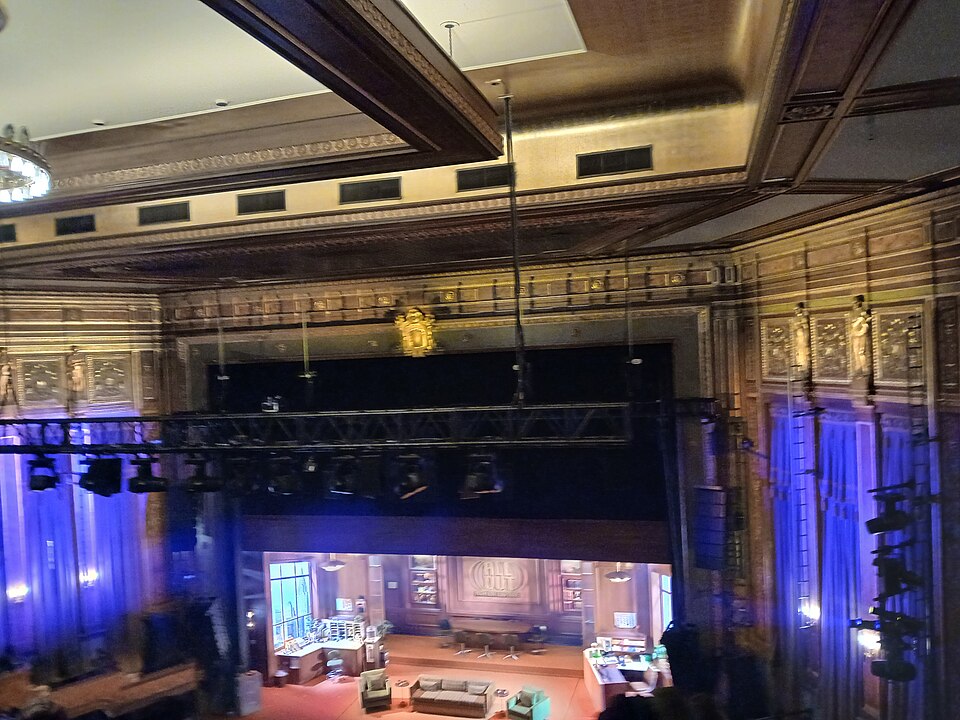
The Nederlander sits in a category of its own within the current Broadway lineup — older than most of its neighbors, smaller than the large commercial houses on 45th and 46th Streets, and located a full block south of where the district’s foot traffic concentrates. The brick facade is relatively plain, the building was not originally constructed as a theater, and the interior has been modified repeatedly over a century of changing ownership and programming. None of that is a drawback. It makes the Nederlander feel genuinely different from theaters designed and built to project theatrical prestige from the outside in.
Inside, the auditorium sits at a medium Broadway scale — approximately 1,235 seats across orchestra, mezzanine, and box sections, with a narrower, more traditional layout than the wider modern houses further north. That narrowness is part of the character. Sightlines throughout most of the house are generally good, and the room does not feel large in the alienating way that some of the district’s biggest houses can. Productions that have worked best here — Rent, Newsies, shows that benefit from energy moving between stage and audience — have worked partly because the room’s proportions allow that kind of connection.
The Nederlander is not a showcase theater. It does not announce itself from the street with architectural grandeur or a hotel-lobby arrival sequence. What it offers is a more direct Broadway experience: a real theater on a relatively quiet block, with a room that has hosted a century of productions and shows its history in the right way. Visitors who find larger, more modern houses impersonal sometimes prefer the Nederlander’s scale and character. That is not an accident — it is what the room is.
The theater’s full official name is the David T. Nederlander Theatre, named in 1980 for David Tobias Nederlander, the founder of the Nederlander Organization — one of Broadway’s two major theater-owning families alongside the Shuberts. The organization operates nine Broadway theaters, but the Nederlander on 41st Street is the one that carries the family name directly.
Seating Guide — How to Think About Where to Sit
The Nederlander has three seating areas: orchestra on the ground floor, mezzanine above it, and boxes on either side of the auditorium. The critical practical fact — covered in detail in the accessibility section — is that only orchestra seating is accessible without stairs. The mezzanine requires stair access, there are no elevators or escalators in the building, and the restroom facilities for upper-level patrons involve additional stairs. This matters not just for wheelchair users but for anyone with mobility considerations, and it is worth knowing before you book.
The strongest seating in the house for most productions. The orchestra is step-free from the entrance, and the center section gives you good sightlines throughout. Six wheelchair spaces are available between rows K and Q in the rear orchestra. Mid-center orchestra is the reliable choice for visitors who want proximity and clear sightlines without committing to the front rows.
One floor above the orchestra, accessible by stairs only — no elevator access. Once in the mezzanine, there may be one or two steps per row with handrails available. The elevated angle gives you a wider view of the full stage picture. A genuine option for visitors comfortable with stairs who want value or a different vantage point. Not accessible for wheelchair users or those who cannot climb stairs.
The Nederlander has box seating on either side of the auditorium. Boxes offer a distinctive vantage point but trade stage width for it — extreme angle positions mean you see some but not all of the stage. Worth knowing what you are getting before booking. Three aisle transfer seats are available in the mezzanine for patrons with limited mobility who can manage stairs.
Six wheelchair spaces with up to three companion seats each are available in the rear orchestra, between rows K and Q. These positions are entirely step-free and accessible from the main entrance. Wheelchair-accessible seating must be booked through the box office. No equivalent accessible seating exists at the mezzanine level, which requires stairs to reach.
As in most proscenium houses, the furthest side orchestra seats can have partial sightlines to the opposite stage edge. Center and center-adjacent positions throughout the orchestra are noticeably stronger. Worth being deliberate about when a production uses the full stage width — which musicals at this house typically do.
For productions where seeing the full stage picture matters — ensemble musicals, shows with elaborate staging — front mezzanine center offers strong sightlines at a lower price point than orchestra premium. The trade is stairs and some additional distance. For visitors comfortable with stairs, it is often the best value in the house.
The Nederlander has no elevator and no escalator. The only seating accessible without stairs is the orchestra. If you or anyone in your group has mobility limitations, requires step-free access, or cannot climb stairs comfortably, orchestra seating is the only viable option — and wheelchair-accessible spaces should be booked directly through the box office. The mezzanine’s stair requirement is not a warning that can be dismissed as a minor inconvenience. It is a real planning factor for a meaningful portion of theatergoers.
Accessibility at the Nederlander Theatre
Step-free entrance and orchestra access
The Nederlander Theatre is accessible step-free from the main entrance at 208 West 41st Street. Wheelchair users and patrons with limited mobility can get from the lobby to designated accessible seating in the orchestra without stairs. Six wheelchair spaces with up to three companion seats are located in the rear orchestra between rows K and Q — entirely step-free. Contact the box office to book accessible seating directly, as these positions are available through the box office only.
No elevator or escalator — mezzanine by stairs only
The theater does not have an elevator or escalator. The mezzanine is one floor above the orchestra and is accessible by stairs only. Once inside the mezzanine, there may be one or two steps per row, with handrails available for assistance. There are also three aisle transfer seats in the mezzanine for patrons who can manage stairs but need easier aisle access. Patrons who cannot climb stairs should book orchestra-level seating and not plan to access the mezzanine.
Accessible restroom — orchestra level only
A wheelchair-accessible unisex restroom is available on the orchestra level. Mezzanine-level restrooms are not wheelchair-accessible. Patrons who require step-free restroom access should plan around the orchestra-level facility, which is accessible via the same step-free path as the accessible seating.
Assistive listening and hearing support
Headsets for sound augmentation are available at the theater free of charge — ID is required as a deposit. Personal induction loop devices are also available with ID. Closed captioning and audio description services may be available for specific performances — verify current availability for the production you are attending with the box office or official venue page in advance.
Accessibility details and venue policies can change between productions. Always confirm current provisions directly with the Nederlander Theatre box office before finalizing plans, particularly if step-free access, wheelchair seating, or accessible restroom use is a primary consideration for your group.
A Century of Names and Productions
The building at 208 West 41st Street was constructed in 1920 — originally as a carpenter’s shop, of all things. It was converted into a theater the following year, opening as the National Theatre on September 1, 1921. That origin as a non-theatrical building is part of why the structure looks and feels different from purpose-built Broadway houses designed in the same era. What it lacks in theatrical grandeur from the outside, it has made up for in programming over a century.
Location — 41st Street and Getting There
The Nederlander sits on the south side of West 41st Street between Seventh and Eighth Avenues — one block south of the main Theater District cluster around 42nd through 45th Streets. That single block makes a real difference in how the arrival feels. The street is quieter than 44th and 45th. There is no Shubert Alley, no concentrated marquee strip, no tourist-density foot traffic at the level of blocks further north. For visitors who find Times Square overwhelming, the Nederlander’s block can feel like a reasonable exhale before the show.
Transit from Times Square–42nd Street is a short walk south on Seventh Avenue and right onto 41st Street. From Port Authority on Eighth Avenue, walk south to 41st and turn left. Either route takes under five minutes on foot from the station exits. For full transit options and timing, the guide to getting to a Broadway show covers the district comprehensively. For parking near this part of the Theater District, the parking near Broadway guide covers your closest garage options.
Build the Night Around the Nederlander
The Nederlander’s 41st Street position changes the pre-show planning calculus slightly compared with theaters further north. The block itself is quiet, but you are one block from 42nd Street’s density and two blocks from the Theater District’s main dining concentration around 44th and 45th. For most visitors, that is close enough to make the standard pre-theater dinner options completely accessible without rethinking the approach.
Dinner before the show
Restaurant Row on West 46th Street is a five-minute walk north — the most concentrated pre-theater dining strip near this part of the district, accustomed to early seatings and theater-crowd turnover. Hell’s Kitchen, continuing west from 46th Street, adds depth with stronger neighborhood options less oriented to Times Square traffic. The 42nd Street corridor between Seventh and Eighth Avenues — one block north of the theater — has a range of quicker casual options if you are arriving tight on time. The restaurants near Broadway guide covers specific picks by area and occasion. For timing strategy, the pre-show dining guide covers how to plan dinner without rushing the evening.
Hotels for out-of-town visitors
The Times Square area has the widest selection of Broadway-adjacent hotels in the city at every price point, and the Nederlander’s location puts most of them within a comfortable walking distance. The hotels near Broadway guide covers the best-positioned options. For a fuller orientation to the surrounding blocks — what the Theater District looks like, what is worth knowing about the neighborhood before you arrive — the Theater District neighborhood guide is the right starting point.
First-time Broadway visitors
The Nederlander is a workable theater for first-time visitors, particularly those seeing an accessible, energy-driven musical — which has been the house’s programming sweet spot for the past three decades. The building is easy to find, the room is comfortable and human-scaled, and the productions it tends to host are designed to work for audiences at all levels of Broadway experience. For visitors who are also considering other shows alongside whatever is playing at the Nederlander, the best Broadway shows for first-time visitors guide covers the current season.
Current Production — Schmigadoon!
Schmigadoon! began performances at the Nederlander on April 4, 2026, with an official opening on April 20 and a scheduled closing date of September 6, 2026. It is a new stage musical based on the Apple TV+ series of the same name — itself a loving parody of Golden Age Broadway musicals from the 1940s and 1950s. The show is produced by Lorne Michaels (Saturday Night Live), written and scored by Cinco Paul, and directed and choreographed by Tony Award winner Christopher Gattelli, who previously choreographed Newsies at this same theater. The cast is led by Alex Brightman and Sara Chase, with Ana Gasteyer, Ann Harada, Brad Oscar, and Isabelle McCalla in supporting roles.
The premise follows two New York doctors who stumble into Schmigadoon — a magical town trapped inside a 1940s musical — and must find true love to escape. The show is a Golden Age parody built around new original songs alongside material from the TV series, with the visual and choreographic scale you would expect from a Broadway production aiming to affectionately satirize the genre it is celebrating. It is the kind of show the Nederlander suits well: a high-energy musical with strong ensemble staging and an audience that will skew toward fans of the source material and Broadway comedy in general.
For last-minute tickets generally — TKTS, rush, lottery, and other options across the district — the how to get last-minute Broadway tickets guide covers all current approaches.
See Current Ticket OptionsFrequently Asked Questions
The Nederlander Theatre is at 208 West 41st Street in Manhattan, between Seventh and Eighth Avenues — one block south of 42nd Street on the south side of 41st Street. It is the southernmost Broadway theater in the Theater District. The nearest subway is Times Square–42nd Street (1, 2, 3, 7, N, Q, R, W trains) — walk south on Seventh Avenue to 41st Street and turn right. From Port Authority (A, C, E trains on Eighth Avenue), walk south to 41st and turn left.
Schmigadoon!, the new Broadway musical based on the Apple TV+ series, is currently playing at the Nederlander Theatre. Previews began April 4, 2026; the show officially opened April 20 and is scheduled to run through September 6, 2026. Verify current performance schedule and availability on the official show site before booking.
For most productions, center orchestra is the reliable choice — step-free access, strong sightlines throughout, and good proximity to the stage. Front mezzanine center is the best value alternative for visitors comfortable with stairs, offering an elevated view of the full stage picture at a lower price point. Avoid extreme side positions in both sections, where sightlines to the opposite stage edge can be partial. The key practical note: the mezzanine is accessible by stairs only — no elevator or escalator — so it is not an option for visitors who cannot climb stairs.
Partially. The entrance and full orchestra level are step-free, and six wheelchair spaces with companion seating are available in the rear orchestra between rows K and Q. A wheelchair-accessible restroom is on the orchestra level. However, the theater has no elevator or escalator — the mezzanine is accessible by stairs only, and there is no step-free path to upper-level seating. Wheelchair-accessible tickets must be booked directly through the box office. Verify current arrangements before attending.
The theater was renamed in 1980 for David Tobias Nederlander, the founder of the Nederlander Organization — one of Broadway’s primary theater-owning families, operating nine Broadway houses. The theater had previously been known as the National Theatre (from its 1921 opening), the Billy Rose Theatre (from 1959), and briefly the Trafalgar Theatre (1979). Its full official name is the David T. Nederlander Theatre, though it is commonly referred to simply as the Nederlander.
The Nederlander is best known as the home of Rent, which transferred from Off-Broadway and ran at the theater from 1996 to 2008 — one of the longest runs in Broadway history. Other notable productions include Newsies (2012–2014), early Broadway works by Edward Albee, Harold Pinter, and Tom Stoppard during the Billy Rose era, and Lena Horne: The Lady and Her Music, for which Lena Horne won a Tony Award in 1981.
Yes, particularly for a high-energy musical, which has been the Nederlander’s programming sweet spot for the past three decades. The room is comfortable and human-scaled, the building is easy to find and navigate, and the kind of shows the house tends to attract are designed for broad audiences including theatergoers at every experience level. For visitors also considering other Broadway options, the best Broadway shows for first-time visitors guide covers what is currently worth seeing across the district.
Yes. In-person rush tickets are available at the Nederlander Theatre box office from 10am the day of the performance — $40 each, limit two per person. A digital lottery is also available: it opens at 10am and closes at 2pm the day before each performance, with winners notified by email and given one hour to purchase up to two tickets at $45 each. Both are subject to availability. Verify current details at the official Schmigadoon! site before planning around either option.
The Nederlander in Brief
The Nederlander Theatre is Broadway’s southernmost house — a 1921 theater at 208 West 41st Street that has spent a century hosting productions ranging from early Albee and Pinter to the twelve-year run of Rent. It is a mid-size older house with genuine character, a quieter block than most of its district neighbors, and a straightforward arrival experience that suits visitors who find Times Square’s density tiring. The seating requires advance thought — no elevator, no escalator, orchestra only for step-free access — but for visitors without mobility constraints, it is a reliable and often underrated Broadway venue.
Schmigadoon! runs through September 6, 2026. For current ticket information, visit the official Schmigadoon! Broadway site. For broader Broadway planning, the Broadway hub and the Theater District neighborhood guide are the right next steps.
The Nederlander Is Set — Now Choose the Right Seat
The Nederlander is one of Broadway’s most useful mid-size musical houses, but the seat choice matters. Use the dedicated seating guide for Orchestra-vs-Mezzanine strategy, then build the night around Times Square, Bryant Park, pre-show dining, hotels, transit, parking, and nearby theaters.
Nederlander Seating Chart & Best Seats
Compare Orchestra, Mezzanine, step-free access, center-vs-side views, box seats, and the best seat zones for musical-comedy staging.
Open Seating Guide Current ShowSchmigadoon! at the Nederlander
Plan the musical-comedy night around the room: big Broadway charm, ensemble movement, comedy detail, arrival timing, and a full 41st Street theater plan.
Open Show GuideBroadway Seating & Ticket Strategy
Seats · Timing · ValueBroadway Seating Guide
Compare Orchestra, Mezzanine, Balcony, boxes, side seats, premium zones, and view tradeoffs across Broadway houses.
All Broadway Theater Guides
Browse every Broadway house guide and compare room scale, location, access notes, and seating strategy across the Theater District.
What’s Playing on Broadway
Compare current and upcoming Broadway productions, then connect each show to the right theater, seat choice, and full-night plan.
When to Buy Broadway Tickets
Know when buying early matters, when waiting can work, and how timing changes for limited runs, musicals, and center seats.
Last-Minute Broadway Tickets
Compare same-day options without accidentally grabbing awkward far-side seats, stair-heavy sections, or compromised sightlines.
Broadway Rush and Lottery Tickets
How discount systems work, what seat tradeoffs to expect, and why cheap seats can be great — or risky — depending on view.
Plan the Nederlander Theatre Night
Dinner · Hotels · TransitRestaurants Near Broadway
The Nederlander sits near Times Square and Bryant Park, so dinner location affects the approach, crowd level, and arrival buffer.
Restaurants Near Times Square
Useful for visitors staying nearby, arriving by subway, or building a classic central Broadway night.
Pre-Show Dining Guide
Plan reservation timing, walking buffer, arrival, intermission expectations, and post-show movement.
Hotels Near Broadway
Compare Theater District, Times Square, Midtown West, and Bryant Park zones for a Broadway-centered trip.
Hotels Near Times Square
Best for visitors who want short walks, easy subway access, and simple post-show return logistics.
How to Get to a Broadway Show
Subway, walking, rideshare, and arrival timing for Theater District shows, including the 41st/42nd Street edge.
How to Get to Times Square
Use subway, walking, Port Authority, or Midtown arrival routes without getting swallowed by the busiest blocks.
Subway to Broadway
Pick the right stop for the Nederlander, Times Square, Port Authority, Bryant Park, and the southern Theater District.
Parking Near Broadway
When driving makes sense, when it does not, and how to avoid turning a Broadway night into a Midtown garage problem.
Nearby Neighborhood & Theater Guides
41st Street · Times Square · Nearby HousesTheater District
The practical guide to Broadway’s center: theaters, crowds, hotels, restaurants, walking routes, and first-time visitor logistics.
Times Square
Best when convenience, subway access, hotels, and a classic Broadway visitor base matter most.
Bryant Park / Midtown South
A calmer Midtown base east of Times Square with hotels, transit, dining, and easy Broadway walking routes.
New Amsterdam Theatre Guide
A nearby 42nd Street Disney house useful for comparing family trips, Times Square access, and large-house seating.
Lyric Theatre Guide
A nearby 42nd Street theater that helps visitors compare large-room spectacle seating and Times Square arrival planning.
Marquis Theatre Guide
A nearby Times Square theater useful for comparing large modern Broadway rooms, hotel-theater arrival, and night-out planning.