

John Golden Theatre Seating Chart: Best Seats, Front Mezzanine, Orchestra & Accessibility Tips
A practical guide to choosing seats at the John Golden Theatre — Orchestra vs Front Mezzanine vs Rear Mezzanine, stair warnings, value picks, accessibility, and where to sit for Operation Mincemeat.
The John Golden Theatre is one of Broadway’s most intimate houses — approximately 800 seats in a room with Mission Revival architecture, rough plaster walls, and a jewel-box quality that has made it home to serious drama, sharp comedy, and landmark productions for nearly a century. At this scale, many seats are better than they would be in a larger house. But the best seat still depends on what you want from the show, and the mezzanine stair requirement changes the calculus significantly for anyone with mobility concerns.
The current show, Operation Mincemeat, is a different kind of production for a theater historically associated with serious drama. It’s fast, comic, musical, and ensemble-driven — a five-actor show where quick character changes, physical comedy, and crisp timing are central to how the production works. The Golden’s compact scale makes it a surprisingly good fit: the show’s energy fills the room, and even seats in the rear mezzanine feel less remote than they would in a larger house.
This guide breaks down all three seating levels, explains what “no elevator” really means in practice, and connects every choice to Operation Mincemeat’s specific demands before you buy.
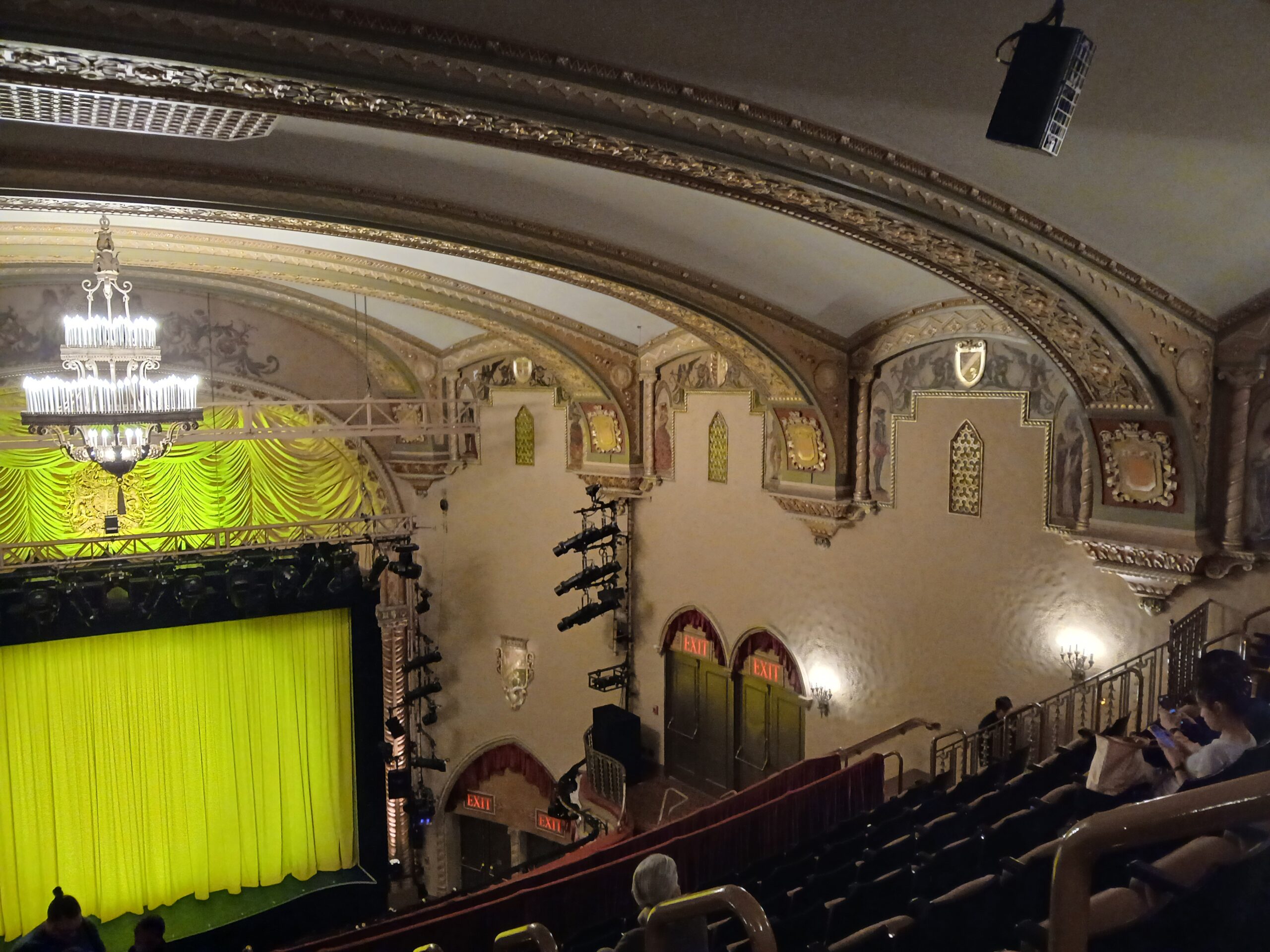
Seating Chart Overview — One of Broadway’s Smallest Rooms
The John Golden Theatre was built in 1927 as the Theatre Masque by the Chanin Brothers — the most intimate of a three-theater complex that also included the mid-size Royale (now the Bernard B. Jacobs) and the large Majestic. Designed by Herbert J. Krapp with Spanish Mission Revival styling — rough plaster walls, coiled columns, wrought iron fixtures — it’s one of Broadway’s most architecturally distinctive rooms and one of its most intimate. Waiting for Godot had its Broadway premiere here in 1956. Glengarry Glen Ross opened here in 1984. It’s a house with serious history.
The theater has approximately 800 seats across two levels: Orchestra (the main floor) and a divided Mezzanine with Front and Rear sections. The Front Mezzanine is notably compact — just four rows (A through D). The Rear Mezzanine has eight rows (A through H). There are no boxes and no balcony above the rear mezzanine.
At approximately 800 seats, the Golden is small enough that no section feels genuinely remote — even the rear mezzanine is closer than rear mezzanine in most Broadway houses. The tradeoff for the mezzanine’s sightlines is 28 steps up with no elevator and no escalator. That fact is the most important practical variable in the whole seat-buying decision at this theater. If the stairs are fine: front mezzanine center may be the best view in the house. If they’re not: orchestra is your answer, and you’re still in an excellent theater.
Reliable, comfortable, step-free, and the strongest all-around position for most visitors. Rows E–P is the broader premium sweet spot.
Full-stage elevated view — some of the best sightlines in the house. Often priced below center orchestra premium. 28 stairs required.
More workable than rear mezzanine at larger houses because the Golden is compact. Center rows A–D are the target. Stairs required.
Orchestra Seats — The Main Floor
The orchestra is the most reliable, most flexible section at the John Golden — step-free from the sidewalk, housing all the wheelchair seating, and the cleanest access option for visitors who need to avoid stairs. In a theater this intimate, orchestra mid-rows don’t feel like a compromise. They’re simply the safest seat in one of Broadway’s best small rooms.
Center Orchestra, Rows F–M — The Sweet Spot
This range is the most consistent recommendation across seat-view sources, ticketing platforms, and theatergoer reviews. Far enough from the stage to see the full picture without uncomfortable angles, close enough to read faces and feel the energy of the production. At the Golden’s compact scale, even the back of this range — rows K through M — doesn’t feel distant.
For Operation Mincemeat, this section gives you exactly what the show’s fast comic staging needs: a centered view where all five actors are visible at once, the quick character switches read cleanly, and the physical comedy lands with full impact. Rows G through J are the heart of the sweet spot; rows F and M anchor either end. The broader premium zone — rows E through P — includes strong options at a range of prices.
Front Orchestra, Rows A–E — Close, Production-Dependent
The very front rows bring you as close as the Golden gets to its stage. For Operation Mincemeat, rows A and B may put you close enough that the show’s ensemble staging — which moves fast and spans the full width of the modest stage — becomes slightly harder to take in as a whole picture. Rows C through D are better than A and B for most visitors seeing this production: still very close, but at a distance where the comic machine begins to work as a complete composition.
That said, the very front rows can be electric for visitors who want proximity and don’t mind missing some of the wider staging picture. For a first-time visitor to Operation Mincemeat, rows E or F and back will serve the show better than the absolute front.
Side Orchestra — Inner Works, Far Side Has Caution
The Golden isn’t an unusually wide theater, which helps side seats more than they might at a larger house. Inner side orchestra — seats close to the center section — can be reasonable value. The angle is manageable in this compact room, and the ensemble staging still reads clearly from inner positions.
Far outer side orchestra is more of a caution zone, particularly in forward rows. For a show where five actors are constantly trading off playing multiple characters simultaneously, a sharp side angle means you may be better positioned to see some characters’ faces than others’. Center placement is worth prioritizing for this specific show’s format.
Rear Orchestra — Step-Free and Close Enough
Rear orchestra — rows N through S — is step-free, houses the theater’s wheelchair seating (4 ADA viewing locations with companion seats), and in a room this compact, is actually closer to the stage than rear orchestra in most Broadway houses. If pricing is right and step-free access matters, rear orchestra center is a perfectly strong choice. Center rear orchestra can be a better decision for mobility-sensitive groups than any mezzanine seat, regardless of the mezzanine’s sightline advantages.
Center orchestra rows F through M is the safest, most reliable all-around choice — step-free access, clean centered sightline, and the right distance for Operation Mincemeat’s quick comic ensemble staging.
Front Mezzanine Seats — Four Rows and One of the Best Views in the House
Both the Front Mezzanine and Rear Mezzanine are reached by three flights of stairs — approximately 28 steps from the main lobby level. There is no elevator and no escalator at the John Golden Theatre. Once inside the mezzanine, there are approximately 2 additional steps down per row, with handrails at the end of every stepped row. The entrance to the mezzanine is located behind orchestra Row D. If anyone in your group has difficulty with stairs, book orchestra only.
With that clearly stated: the Front Mezzanine Center at the John Golden is genuinely one of the best views in this theater. The section has only four rows (A through D), all of them compact and offering an elevated full-stage view that works particularly well in a small room like the Golden. Because the house is compact, even row D — the rear of the front mezzanine — feels much closer than “front mezzanine” would suggest in a larger Broadway house.
Front Mezzanine Center, Rows A–D — The Full-Stage Target
Rows A and B of the center front mezzanine are consistently cited as some of the best seats in the Golden. The elevation gives you the full stage picture — for Operation Mincemeat, this means you can see all five actors at once even when the staging spreads across the width of the stage, and you can track the quick character changes and the show’s physical comedy as a complete composition rather than from a close-up angle that may miss parts of the picture.
Row D — the last row of the front mezzanine — is noted by multiple sources as a strong value pick: clean view, clearly in the front mezzanine price range, and often meaningfully cheaper than rows A and B. At this theater’s scale, row D front mezzanine center is an excellent budget-within-the-section choice.
Front mezzanine is typically priced below center orchestra premium at the Golden. When the gap is significant — $30 or more per ticket — front mezzanine center is one of the stronger value arguments on Broadway for a show like Operation Mincemeat.
Side Front Mezzanine — Inner Can Work, Outer Less So
Inner side front mezzanine seats can be reasonable given the small size of the room. Outer side front mezzanine develops more angle, and in a show where the staging uses the full stage width, a sharp side angle can make parts of the picture harder to follow. Center remains strongly preferred within the front mezzanine at any price point.
Rear Mezzanine Seats — The Honest Budget Option
The Rear Mezzanine at the John Golden is one of the theater’s most interesting propositions — more viable than rear mezzanine at most Broadway houses because the room is so compact. Rows A through H, with center rows A through D being the primary target for budget-conscious visitors.
Rear Mezzanine Center, Rows A–D — Budget That Actually Works Here
At a typical Broadway house, rear mezzanine is the section where visitors most often regret their decision. At the Golden’s ~800-seat scale, it’s different. The room is small enough that rear mezzanine center rows A through D give you a clear view of the full stage at a distance that, in a larger house, would feel like rear orchestra. The show communicates clearly from here — Operation Mincemeat’s energy, its humor, its musical numbers, and its comic timing all land at this range.
What you trade is close performer detail. In a show like Operation Mincemeat, which depends significantly on physical comedy, facial reactions, and the actors’ expression of multiple characters, some of that fine-grain detail will be harder to read from the rear mezzanine than from center orchestra mid-rows. For a first-time visitor seeing the show, center orchestra is worth the additional investment. For a return visitor or anyone for whom budget is the primary constraint, rear mezzanine center rows A through D is a legitimate option at this particular theater.
Rear Mezzanine Front Rows — Check the Current Map
Some rear mezzanine front rows may be affected by the front mezzanine overhang or ceiling depending on the specific staging height. This varies by production. Before booking rear mezzanine front rows specifically, check the current Telecharge seating map for any limited-view or partial-view notes on those positions. Do not book based on a generic description alone if a specific production’s staging is particularly tall or high.
Rear Mezzanine Side — The Caution Zone
Rear mezzanine side is the most challenging position in the house — the combination of distance and horizontal angle is compounding. If budget forces a rear mezzanine booking, insist on center placement. Side rear mezzanine should only be considered if the price is significantly lower than center rear mezzanine and the current seat map shows no partial-view warnings.
Operation Mincemeat — Seating Strategy for This Show
Operation Mincemeat is playing at the John Golden Theatre in an extended run currently booking through September 13, 2026 (the show’s 7th extension on Broadway). Book, music, and lyrics by David Cumming, Felix Hagan, Natasha Hodgson, and Zoë Roberts (SpitLip). Directed by Robert Hastie; choreographed by Jenny Arnold. An all-American cast has been leading the production since February 23, 2026; the original SpitLip cast departed February 22, 2026. Olivier Award winner for Best New Musical (2024); Tony Award winner for Best Featured Actor in a Musical (Jak Malone, original cast). Runtime: approximately 2 hours 30 minutes with one intermission. Ages 5+; children under 4 not admitted.
Content warnings: loud sound effects, strobe/flashing lights, moments of darkness. Named the #1 Broadway Show of 2025 by Entertainment Weekly and the highest-rated West End show of all time with over 130 five-star reviews. Currently playing simultaneously on Broadway and in the West End, with a world tour underway.
Operation Mincemeat is a fast comic musical — five actors playing dozens of characters across a tight, meticulously staged production that moves at relentless speed. The staging uses the full width of the Golden’s modest stage, the character switching is physical and immediate, and the comedy depends on the audience being able to see the whole picture at once rather than focusing on a single performer.
That makes the seat-buying logic here slightly different from a drama or an actor-focused solo show. The best seat for Operation Mincemeat is not simply the closest seat — it’s the seat that lets you see the full ensemble at once, track the quick transitions, and follow the comedy as a whole composition. Center placement is the priority.
Center Orchestra, Rows F–M — The Recommended Position
This range gives you everything Operation Mincemeat needs: close enough to feel the energy of five actors at full-throttle comedy, centered enough to see all of them simultaneously, and at a distance where the staging’s quick physical comedy reads as a complete picture rather than a close-up sequence. This is where the show’s machine is most legible and most entertaining.
Front Mezzanine Center, Rows A–D — The Best Full-Stage View
For visitors who want to see the whole show as a staged composition — how the five actors fill the space, how the quick transitions work spatially, how director Robert Hastie has organized the visual chaos — front mezzanine center is arguably the best position in the house for Operation Mincemeat. The elevated view lets you track all five actors at once even in the most frenetic sequences. This is also typically priced below center orchestra premium, making it the strongest value pick for this show specifically.
For budget tickets: digital lottery via rush.telecharge.com — $39 per ticket (opens midnight day before, closes 3pm, winners drawn 10am and 3pm, up to 2 tickets per winner). In-person rush $49 at the box office (10am M–Sa, noon Sunday), limit 2 per person. The production also periodically offers $79 ticket draws for mailing list subscribers — sign up at operationbroadway.com. See the rush and lottery guide for current details.
Best Seats by Visitor Type
Step-free, centered, and the most reliable position for any visitor who wants to see Operation Mincemeat at its most complete without second-guessing the decision.
Center orchestra for the energy and proximity. Front mezzanine center for the full-stage composition. Both serve the show well; stairs are the tiebreaker for the mezzanine.
The most complete elevated view of Operation Mincemeat’s ensemble staging. See the full comic machine. Typically priced below center orchestra premium. 28 stairs required.
Row D is the rear of the front mezzanine — noted by multiple sources as a clean view at a lower price than rows A–C. At this theater’s scale, the difference is modest.
No elevator, no escalator. Mezzanine requires 28 stairs. 4 ADA viewing locations with companion seats in orchestra. Accessible restrooms are in the adjacent Schoenfeld Theatre. Contact Shubert Audience Services (212-944-3700) to confirm arrangements.
Center orchestra for the premium immersive pick. Front mezzanine center for an elegant elevated view at potential savings. Both make a strong evening at this historic house.
More viable at the Golden’s compact scale than at larger houses. Operation Mincemeat communicates the energy and comedy at this distance. Consider lottery ($39) as a better alternative.
For Operation Mincemeat’s ensemble format, a centered seat in row J beats a side seat in row D almost every time. Five actors, fast transitions, wide staging — center is the priority.
Accessibility — Know Before You Book
The John Golden Theatre is accessible at the orchestra level with step-free entrance from 45th Street. The mezzanine is stairs-only — 28 steps up, with no elevator and no escalator available anywhere in the building. This is a firm, current limitation of this historic house. There is also an important restroom note: the Golden’s own restrooms are not wheelchair accessible, and the nearest wheelchair-accessible restrooms are in the adjacent Gerald Schoenfeld Theatre, on the same block.
- Step-free entrance from West 45th Street — automatic doors from sidewalk to ticket lobby, then attended doors to orchestra (small incline between sets of doors)
- Orchestra is accessible to all parts without steps — step-free throughout
- Wheelchair seating in Orchestra only — 4 ADA compliant viewing locations with companion seating
- Mezzanine: 3 flights of stairs, 28 steps total — no elevator, no escalator
- Inside the mezzanine: approximately 2 steps down per row; handrails at end of every stepped row
- Mezzanine entrance is behind orchestra Row D
- Lower lounge (restrooms): down 19 steps from orchestra level with continuous handrails
- Restrooms at the Golden are NOT wheelchair accessible — wheelchair-accessible restrooms are located in the adjacent Gerald Schoenfeld Theatre, on the same block
- Infrared assisted listening devices: 10+ available per performance; no advance reservation needed; driver’s license or ID with printed address required as deposit; call 212-582-7678 to reserve in advance
- GalaPro app for audio description and captioning on personal devices — available beginning 4 weeks after official opening night
- Handheld audio description and captioning devices also available beginning 4 weeks after opening; contact Shubert Audience Services at audienceservices@shubertorg.com for earlier access
- Shubert Audience Services: 212-944-3700 or audienceservices@shubertorg.com
What to Avoid at the John Golden Theatre
- Do not book mezzanine if anyone in your group struggles with stairs or requires step-free access. 28 stairs, no elevator, no escalator — this is a firm limitation of the building, not a temporary condition.
- Do not assume front mezzanine is accessible. It is one of the best views in the house, but only if the stairs are manageable. “Great view” and “accessible” are separate questions at this theater.
- Do not overpay for far side orchestra if centered rows farther back are available at similar or lower prices. For Operation Mincemeat’s wide ensemble staging, a centered row L beats a side row D consistently.
- Do not choose rear mezzanine side if center rear mezzanine is available. Outer side rear mezzanine is the most challenging viewing position in the theater — distance and angle compound each other.
- Do not sit in the very front rows (A–B) if your primary goal is seeing Operation Mincemeat’s full-stage comic staging — rows C and D forward already give excellent proximity while allowing a more complete view of the ensemble.
- Do not book rear mezzanine front rows without checking the current Telecharge seat map for limited-view notes — some specific positions may be affected by the front mezzanine overhang depending on the production’s staging height.
- Plan for the accessible restroom situation if relevant — the Golden’s own restrooms are not wheelchair accessible. The nearest accessible restroom is in the Schoenfeld Theatre on the same block.
How to Choose Between Two Similar Prices
The Seat-Picking Formula
- Best overallCenter Orchestra rows F–M — reliable, centered, step-free, right distance for this show
- Full-stage viewFront Mezzanine Center rows A–D — elevated, full ensemble visible, often strong value; stairs required
- Best valueFront Mezzanine Center when priced below center orchestra; Row D front mezzanine for best value within the section
- Operation MincemeatCenter Orchestra F–M for energy; Front Mezzanine Center A–D for full-stage comic composition
- AccessibilityOrchestra only — no elevator anywhere; accessible restrooms in adjacent Schoenfeld Theatre
- BudgetRear Mezzanine Center rows A–D — more viable here than in larger houses; $39 lottery often worth trying first
- No stairs at allAny orchestra section — step-free throughout; rear orchestra center beats mezzanine if stairs are a concern
- Avoid all riskStay center, verify rear mezzanine front rows on current map, skip mezzanine if stairs are any concern
FAQ — John Golden Theatre Seating
For most visitors, center orchestra rows F through M is the safest all-around choice — step-free, centered, and the right distance for Operation Mincemeat’s fast ensemble staging. Front mezzanine center rows A through D is an excellent alternative and potentially the best view in the house — elevated enough to take in the full stage picture, compact enough that the distance feels intimate. Front mezzanine is typically priced below center orchestra premium, making it the strongest value argument for this show when the gap is meaningful. Both sections require knowing the mezzanine’s stair situation before booking.
Both are legitimate, and the right answer depends on two things: can you handle 28 stairs with no elevator alternative, and do you want proximity or full-stage perspective? Orchestra is safer, step-free, and the most reliable choice for most visitors. Front mezzanine center is genuinely excellent — consistently rated as one of the best sightlines in the house at typically lower prices than premium orchestra. For Operation Mincemeat specifically, the full-stage elevated view from front mezzanine center may be the single best place to see the show.
Yes — front mezzanine center is consistently cited as one of the best sections in the house, with rows A and B offering a premium elevated sightline and row D noted as a strong value pick. Because the Golden is compact, front mezzanine doesn’t feel as remote as it might in a larger theater — it feels close, elevated, and well-positioned to take in the full stage at once. The only caveat is the stair requirement: 28 steps up from the main lobby, no elevator, plus approximately 2 steps per row inside. If the stairs are manageable, front mezzanine center is one of the smartest picks at this theater.
Less so than it would be at most Broadway houses. The Golden is compact enough that rear mezzanine center rows A through D don’t feel as remote as equivalent positions in a larger house. For Operation Mincemeat — a production with strong musical energy and a big theatrical personality — the show communicates at this distance. The tradeoffs are real: performer detail is reduced, facial expression is harder to read, and some of the finer comic business will be less sharp. But as a budget option at this theater’s scale, rear mezzanine center rows A–D is viable in a way it wouldn’t be at the Imperial or the Gershwin.
Not exactly — there’s no traditional third level. The theater has an Orchestra on the main floor and two mezzanine sections above: Front Mezzanine (rows A–D, 4 rows) and Rear Mezzanine (rows A–H, 8 rows). These are sometimes collectively called “the balcony” in casual usage, but they’re a single elevated level divided into front and rear sections. There are no boxes and no separate upper balcony above the rear mezzanine.
No. There is no elevator and no escalator at the John Golden Theatre. The mezzanine requires climbing three flights of stairs — approximately 28 steps from the main lobby level — with no accessible alternative. Inside the mezzanine, there are additional steps between rows (approximately 2 per row) with handrails at each row end. If elevator access or step-free movement is required for any member of your group, book orchestra seating only.
Partially. The 45th Street entrance is step-free, and the orchestra is accessible without steps throughout. Wheelchair seating consists of 4 ADA compliant viewing locations with companion seats in the orchestra. The mezzanine requires 28 stairs with no elevator or escalator — it is not wheelchair accessible. There is also an important restroom note: the Golden’s own restrooms are not wheelchair accessible. The nearest wheelchair-accessible restrooms are in the adjacent Gerald Schoenfeld Theatre, on the same block. Contact Shubert Audience Services at 212-944-3700 before your visit to confirm accessible seating and to understand the restroom logistics.
Center orchestra rows F through M is the most reliable recommendation for most visitors — close enough for the show’s energy, centered for the full ensemble staging, and step-free. Front mezzanine center rows A through D is the alternative: a better full-stage view, typically lower priced than center orchestra, and particularly well-suited to a show where five actors playing multiple characters simultaneously benefit from being seen as a complete picture. For either section, center placement is the priority — side seats lose the legibility of the quick staging transitions that make Operation Mincemeat work.
Approach with caution: mezzanine of any kind if stairs are a concern (no elevator, 28 steps), far outer side orchestra (angle matters for wide ensemble staging), front orchestra rows A–B if you want to see Operation Mincemeat’s full-stage composition rather than a close-up angle on the staging, rear mezzanine side (distance plus angle compounds), and any rear mezzanine front rows without checking the current seat map for limited-view notes.
Inner side orchestra seats can work at this compact theater — the room isn’t very wide, which limits the angle problem. But for Operation Mincemeat’s wide ensemble staging, a side angle shifts your perspective toward one side of the stage and away from the other. Center placement is worth more for this show than closeness via a side seat. Center rear orchestra is typically better for this production than closer inner side orchestra at similar or comparable pricing.
It’s an excellent choice — intimate, beautiful, and hosting one of Broadway’s most acclaimed productions in Operation Mincemeat. Center orchestra mid-rows is the safe recommendation for a first visit. The Golden’s compact scale means even value seats feel closer than equivalent positions at a larger house. The one logistical note for first-timers: if you’re considering mezzanine, be clear-eyed about the 28 stairs and plan accordingly. For a first Broadway visit, orchestra is the reliably satisfying choice.
The theater opened in 1927 as the Theatre Masque, built by the Chanin Brothers as part of a three-theater complex on 45th Street. In 1930, the Chanins transferred ownership of all three theaters to the Shubert Organization. In 1937, producer John Golden assumed management and renamed it the John Golden Theatre — the third Broadway house to bear his name. The Shuberts regained full control in 1946 and have operated it continuously since. Some venues and sources refer to it simply as “the Golden Theatre” — both names refer to the same house.
Plan the Night Around the Show
The John Golden is one of Broadway’s most rewarding small rooms — a theater where even the budget seats feel closer than they have any right to, and where a show like Operation Mincemeat can fill every corner of the house with comic energy. Center orchestra F through M for the safest, most complete experience. Front mezzanine center when the value is there and the stairs aren’t a problem. The Golden rarely disappoints — just know what you’re getting into before you climb those 28 steps.
Pick the Center — Then Plan the Night
The John Golden is compact enough that many seats work, but the best choices still depend on what you need: Orchestra for access and intimacy, Front Mezzanine for a polished full-stage view, and Rear Mezzanine Center for budget value if stairs are fine. Use these guides to connect the seat decision to Operation Mincemeat, dinner, hotels, transit, and the full 45th Street night.
John Golden Theatre Guide
Go deeper on the Golden itself: 45th Street location, Spanish-style landmark interior, Pulitzer history, accessibility, and how this intimate house works.
Open Theater Guide Current ShowOperation Mincemeat Guide
Plan the show around the room: fast comic staging, ensemble timing, full-stage visibility, dinner timing, and what to expect before curtain.
Open Show GuideMore Seating & Ticket Strategy
Seats · Timing · ValueBroadway Seating Guide
Compare orchestra, mezzanine, balcony, boxes, side seats, premium zones, and obstructed-view listings across Broadway houses.
When to Buy Broadway Tickets
Know when buying early matters, when waiting can work, and how timing changes for hit shows, weekends, holidays, and strong seat inventory.
Last-Minute Broadway Tickets
TKTS, same-day listings, rush, lottery, and practical ways to compare late options without choosing awkward seats blindly.
Broadway Rush and Lottery Tickets
How discount systems work, what tradeoffs to expect, and why cheap seats can be great — or risky — depending on the view.
First-Time Broadway Guide
For visitors choosing their first show or first theater: seats, arrival, timing, intermission, dress, and Theater District basics.
Best Broadway Shows for Date Night
Compare Broadway nights by tone, dinner pairing, room feel, pacing, and how the whole evening works beyond the ticket.
Plan the John Golden Theatre Night
Dinner · Hotels · TransitRestaurants Near Broadway
The Golden sits in the heart of the Theater District, with Restaurant Row, Times Square, and Hell’s Kitchen dining all close by.
Pre-Show Dining Guide
Plan reservation timing, walking buffer, check arrival, and post-show movement so dinner and theater work together.
Best Pre-Theater Restaurants NYC
Use this when you want stronger restaurant choices around Broadway rather than only timing and logistics advice.
Hotels Near Broadway
Compare Theater District, Times Square, Midtown West, and Hell’s Kitchen hotel zones for a Broadway-centered trip.
How to Get to a Broadway Show
Subway, walking, rideshare, and arrival timing for Theater District shows, including the West 45th Street houses.
Parking Near Broadway
When driving makes sense, when it does not, and how to avoid turning a Broadway night into a Midtown garage problem.
Nearby Neighborhood & Theater Guides
45th Street · Theater District · Nearby HousesTheater District
The practical guide to Broadway’s center: theaters, crowds, hotels, restaurants, walking routes, and first-time visitor logistics.
Times Square
Best when convenience, subway access, and being right in the center matter most — especially for short Broadway trips.
Hell’s Kitchen
A strong nearby option when dinner matters — more restaurant depth, calmer blocks, and an easy walk west after the show.
Bernard B. Jacobs Theatre Guide
A neighboring Chanin/Krapp house that helps compare 45th Street theater scale, seating, and arrival logistics.
Gerald Schoenfeld Theatre Guide
A nearby 45th Street Broadway house with a different room shape, sightline profile, and show-night rhythm.
Imperial Theatre Guide
A larger nearby musical house that gives helpful contrast against the Golden’s smaller, more intimate proportions.