

Westside Theatre Seating Guide: Best Seats, Upstairs vs Downstairs & What to Know
A practical guide to choosing seats at Westside Theatre — how the Upstairs proscenium and Downstairs thrust stage differ, best seats for Little Shop of Horrors, the accessibility realities of the Upstairs Theatre, and Hell’s Kitchen planning.
Westside Theatre seating depends first on one question: which room is your show in? The venue at 407 West 43rd Street in Hell’s Kitchen has two separate auditoriums — Upstairs and Downstairs — and the seat-buying logic is different in each. Getting this wrong means choosing seats with the wrong frame of reference entirely.
The Westside Upstairs is a 270-seat proscenium room on the second floor, currently associated with Little Shop of Horrors. The audience faces the stage directly in the conventional frontal arrangement, which makes center seating the reliable default. The Westside Downstairs is a 249-seat thrust-stage room, where the stage extends toward the audience and seat choice becomes more about angle and relationship to the performance than about distance.
Both rooms are small enough that rear seats feel genuinely close compared with any Broadway house. But there is a third factor that matters as much as layout for the Upstairs Theatre: access. Reaching the Upstairs requires 21 steps from street level. There is no elevator or escalator. The Upstairs Theatre is not wheelchair accessible. This is not a minor footnote — it is a decision that should be made before any seat is chosen.
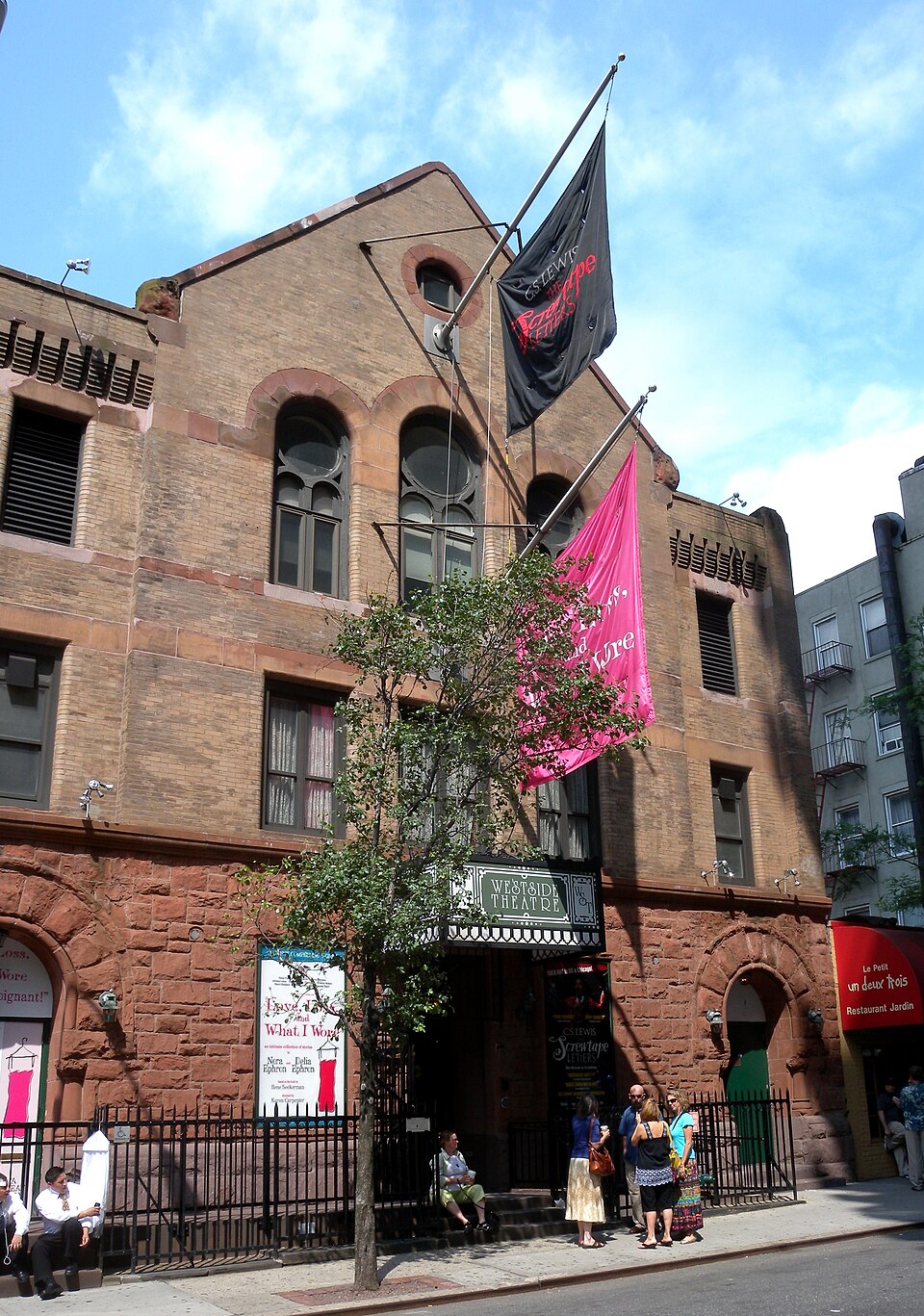
The Two Rooms: Upstairs vs Downstairs
Westside Theatre is two genuinely different theatrical experiences sharing a building. The decision about which room you are in determines more about your seat choice than almost any other single factor.
A traditional proscenium room where the audience faces the stage through a conventional frame. The best seat logic is familiar: center is safest, middle rows balance proximity and full-stage view, rear seats are less remote than they would be in a large house.
Currently associated with Little Shop of Horrors, a production where seeing the full staging, puppet mechanics, and set composition matters alongside performer detail.
A thrust-stage room where the performance area extends toward the audience. Seat choice is more about angle and relationship to the performers than about distance. Side seats can be immersive; centered angles are safest for first-timers.
The exact configuration can vary more than a fixed proscenium room. Always verify the current Downstairs production and official seating map before purchasing.
Westside Upstairs and Downstairs are not interchangeable. A center seat in the Upstairs proscenium is a different decision than a center seat in the Downstairs thrust room. Confirm your room before doing anything else, and factor in access needs before you even look at the seating chart.
Westside Upstairs Seating Strategy
The Upstairs Theatre is a traditional proscenium room — the audience faces a clearly framed stage, and seat quality follows the familiar logic of a conventional frontal arrangement. Center is safest. Distance is less punishing than in a large Broadway house because the room holds only 270 seats. The main wrinkle for the Upstairs is not sightlines or row numbers; it is access.
For most Upstairs productions, the middle rows of the center section offer the best overall balance: close enough for performer detail, far enough to take in the full stage composition. Very front seats can be exciting and immediately immersive, but for a production like Little Shop of Horrors where set design, puppet mechanics, and staging movement are part of the experience, a middle-center seat may reward more of what the production has to offer than an extreme front position.
Westside Downstairs Seating Strategy
The Downstairs Theatre is a thrust-stage room, which means the stage extends toward the audience and the experience of different seats varies more than in a fixed proscenium. Seat choice here is primarily about angle and your relationship to the performance, not about how far back you are sitting.
Centered positions along the main axis of the thrust give you the most balanced view. Side seats can feel more immediate and surrounding — which can be exciting for the right production and more disorienting for first-timers who want a conventional front-facing theater experience. Very close seats near the thrust can make the performance feel unusually immediate; slightly pulled back can give a better full-room picture.
Do not apply proscenium rules to the Downstairs thrust room. The most important variable is angle, not row number. A seat that feels excellent from the main staging axis may feel very different from the far side of the house. Trust the current production’s official map more than any generic row-number intuition.
Little Shop of Horrors Seating Notes
Little Shop of Horrors plays in the Westside Upstairs Theatre — a 270-seat proscenium room. The proscenium format suits the show well: the production uses a conventional frontal stage picture, and seeing the full set, Audrey II’s staging and growth across the production, and the ensemble composition all benefit from a centered, mid-range view.
This is a production where being too close may actually reduce what you get to see. The show’s puppet and staging mechanics, its scenic transitions, and the broader comedic compositions are designed to be read from a mid-house position. Very front rows put you very close to performers, which can be exciting and immersive, but may compress the staging picture that the director has built for a slightly fuller view.
Best Seats at Westside Theatre
Think Twice Before Booking These Seats
- Any Upstairs ticket without confirming that the 21 steps, additional aisle steps, and no-elevator situation are manageable for everyone in your party. This is the most important pre-purchase check for any Westside Upstairs booking.
- Very front Upstairs seats for Little Shop of Horrors if seeing the full staging, Audrey II staging, and scene compositions matters. Very close seats can compress the full picture in a production with significant staging mechanics.
- Extreme side proscenium seats in the Upstairs at full center pricing. Side seats lose angle on a full stage picture. They are better value at a meaningful discount, not at mid-center price.
- Downstairs thrust-stage side seats without checking the current production’s configuration. In a thrust room, side seats can be excellent or disorienting depending on the specific staging.
- Any seat labeled partial view, limited view, obstructed, accessible, companion, transfer, or production hold. Follow the ticketing label, not general category advice.
- Seats chosen based on a previous Westside production’s reviews or photos. Each production may use the space differently. Always verify the current official seat map.
Accessibility & Stairs at Westside Theatre
This section deserves direct, plain language. The Upstairs Theatre at Westside is not accessible to wheelchair users and cannot accommodate visitors who cannot manage stairs. This is a fixed constraint of the building, not something that varies by performance or can be accommodated with advance notice for the Upstairs room.
What to Know Before Booking Upstairs
- The Upstairs Theatre is on the second floor and requires 21 steps from street level to reach. There are handrails on the main stairway.
- There is no elevator or escalator in the building. This is not a temporary situation — it is a physical constraint of the venue.
- The Upstairs Theatre is not wheelchair accessible.
- Once inside the Upstairs seating area, additional steps exist throughout the house: nine steps to reach rows F and G, and two steps in the aisle at every row throughout the house.
- A wheelchair-accessible unisex restroom is available at the lobby/ground-floor level. Upper restrooms require stairs.
- Concessions, bar access, and restrooms on the Upstairs level are on the same floor as the theater, which is reached after the 21-step stairway.
- If stairs are a concern for you or anyone in your party, do not purchase Upstairs tickets without speaking with the venue first.
- If your production is in the Downstairs Theatre, verify the current access situation directly with the box office before purchasing. Downstairs accessibility details may differ.
Best Seats by Visitor Type
Westside is a genuine neighborhood Off-Broadway theater with a long track record. Center seats in either room are the reliable entry point. Confirm your room and check the access situation before booking Upstairs.
The sweet spot for Little Shop. Close enough for performer detail, far enough to see the full staging, puppet mechanics, and scene compositions. Middle rows center are the standard recommendation.
Center mid-house seats for a shared sightline and a full experience. Hell’s Kitchen restaurants on 9th Avenue make an excellent pre-show dinner pairing with Westside Theatre.
Confirm that the current production is appropriate for younger audience members before booking. For the Upstairs, also confirm that all family members can manage the 21-step stairway. Aisle seats add flexibility if children may need to move during the show.
At 270 and 249 seats, value seats at Westside are much more competitive than in larger venues. Rear center is a strong value pick in both rooms. Avoid extreme side seats at full pricing.
If seeing the complete staging matters more than performer proximity, mid-center is usually the answer in either room. For Little Shop specifically, middle-center may give you more of the production than the absolute front.
In both a 270-seat proscenium and a 249-seat thrust room, front seats are genuinely close. For the Upstairs, verify that the production’s staging rewards closeness over a fuller picture.
The Upstairs Theatre is not wheelchair accessible, requires 21 steps, and has no elevator. Do not purchase Upstairs tickets without verifying access directly. For the Downstairs Theatre, confirm current access details with the box office before booking.
The Upstairs proscenium room is the most conventional introduction to Westside Theatre. Center mid-house gives you a familiar seat format in a much more intimate setting than a Broadway house.
The Upstairs requires 21 steps plus additional aisle steps at every row inside the theater. If stairs or tight row navigation are a concern, the Downstairs may be a more comfortable option — but confirm current Downstairs access before purchasing.
Westside Theatre vs Larger Broadway Houses
- Distance penaltyMuch lower. At 270 and 249 seats, even rear rows feel close compared with a large Broadway house. The value gap between rear and premium seats is narrower.
- Main decision factorNot “how close can I get?” but “which room, which layout, and how much access comfort do I need?” Configuration and access matter more than row number.
- Actor-forward feelBoth Westside rooms feel more intimate and actor-forward than most Broadway houses. The performer/audience relationship is closer throughout the house.
- Practical limitationsWestside has no elevator and the Upstairs is not wheelchair accessible. Broadway houses generally have accessibility infrastructure that Westside Upstairs cannot match.
- Value seat qualityHigher relative value than in a large house. Rear and slightly side seats at Westside are significantly more workable than the equivalent positions in a Broadway theater.
- Premium rationaleThe main reason to pay for center seats at Westside is alignment and angle, not just distance. Center is better because of how both rooms are configured, not simply because it is closer.
Plan the Night — Hell’s Kitchen & Westside Theatre
Westside Theatre is at 407 West 43rd Street on Theater Row — the strip of Off-Broadway theaters on West 43rd between Ninth and Tenth Avenues. The most practical subway is the A, C, or E to 42nd Street–Port Authority Bus Terminal, a short westward walk along 42nd or 43rd Street. Times Square trains are also walkable.
For dinner, Ninth Avenue in Hell’s Kitchen is the strongest pre-show option — a dense stretch of neighborhood restaurants within easy walking distance of the theater. Hell’s Kitchen sits away from the Times Square tourist concentration, which makes it a genuinely good pre-show neighborhood for visitors who want a less hectic evening.
If you are attending the Upstairs Theatre, arrive with extra buffer. The 21-step stairway, lobby movement, concessions, and bathroom logistics all take slightly more time than a ground-floor theater. Give yourself a few extra minutes before curtain. The concessions, bar, and restrooms on the Upstairs level are accessible after the stairway, on the same floor as the theater.
More Westside Theatre & Hell’s Kitchen Planning
Venue guide, Little Shop of Horrors, restaurants, transportation, and hotels for your Westside night.
FAQ — Westside Theatre Seating
Center-middle in whichever room your show is in. For the Upstairs proscenium, mid-center gives you the full stage picture with strong performer detail. For the Downstairs thrust, a central-axis position gives the most balanced view of the staging. Confirm your room before making any seat decision.
270 seats in a traditional proscenium / end-stage layout on the second floor.
249 seats in a thrust-stage layout at ground level.
The Upstairs is a 270-seat traditional proscenium room on the second floor — audience faces the stage directly in a conventional arrangement. The Downstairs is a 249-seat thrust-stage room at ground level — the stage extends toward the audience and seat choice is more about angle than distance. They also have very different access situations: the Upstairs requires 21 steps and has no elevator; the Downstairs access situation should be verified directly for the current performance.
Center-middle in the Westside Upstairs. For a production where the full staging, set design, and puppet mechanics matter alongside performer detail, mid-center gives you the best complete picture. Front-center is also strong for performer proximity. Verify the current official seating map and production configuration before purchasing.
The Upstairs Theatre is not wheelchair accessible. It requires 21 steps and has no elevator or escalator. A wheelchair-accessible unisex restroom is available at the lobby/ground-floor level. The Downstairs Theatre is at ground level, but current accessibility details should still be verified directly with the venue before purchasing.
No. There is no elevator or escalator in the building. The Upstairs Theatre requires 21 steps from street level and is not wheelchair accessible.
21 steps from street level to the Upstairs Theatre. Inside the seating area, there are additional steps: nine steps to reach rows F and G, and two steps in the aisle at every row throughout the house. Handrails are present on the main stairway.
No. At 270 seats Upstairs and 249 seats Downstairs, rear seats are genuinely close compared with any Broadway house. The rooms are small enough that even the back rows feel intimate. Rear center is a strong value pick. Rear side seats are less ideal because center alignment still matters for a complete view.
Off-Broadway. Westside Theatre is a two-auditorium Off-Broadway venue at 407 West 43rd Street in Hell’s Kitchen. Both rooms are under the Off-Broadway seat-count threshold for Broadway classification.
The A, C, or E train to 42nd Street–Port Authority Bus Terminal is the most practical option. Times Square subway lines are also walkable with a short westward walk along 42nd or 43rd Street.