

The Public Theater:
Off-Broadway at Astor Place
Five theater spaces. Joe’s Pub. The former Astor Library. A sixty-year mission to make theater for all New Yorkers — and a track record that includes Hair, A Chorus Line, and Hamilton. Not just a venue. An institution.
Why The Public Theater Matters
The Public Theater is not just another Off-Broadway venue. It is the downtown institution where new American theater, civic programming, playwright-driven productions, and Broadway-bound work all overlap — housed in one of the most extraordinary buildings in New York City.
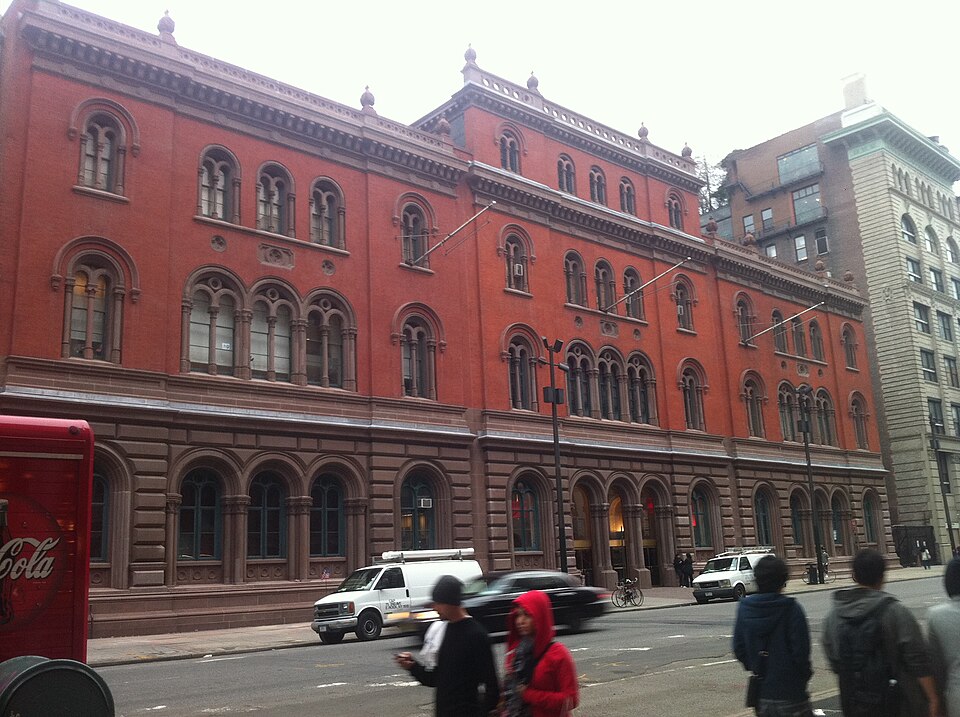
Joseph Papp founded the organization in 1954 as the Shakespeare Workshop, driven by a conviction that theater should belong to all New Yorkers, not just those who could afford it. The company moved into 425 Lafayette Street — the former Astor Library, a landmarked Romanesque Revival building from 1853 — in 1967. Its inaugural production there was the world premiere of Hair. The Public has been producing work of consequence ever since.
Its legacy is specific and verifiable: A Chorus Line, Hamilton, Fun Home, Bring in ‘da Noise, Bring in ‘da Funk, and dozens of other productions developed here before reaching wider audiences. The Public is also behind Free Shakespeare in the Park at the Delacorte Theater in Central Park — a separate venue that runs every summer and represents a different Public Theater experience entirely.
The Public Theater at 425 Lafayette Street and Shakespeare in the Park at the Delacorte Theater in Central Park are both Public Theater productions — but they are very different venues, different seasons, and different planning logistics. This guide covers the Lafayette Street complex only.
The current building has five distinct performance spaces, Joe’s Pub, The Library restaurant and bar, and the Taub Box Office serving all venues. A night at The Public feels different from a Midtown Off-Broadway night. The building is on Astor Place — in a neighborhood with its own restaurants, bars, and energy. It draws a theater-literate crowd. The programming tends toward the adventurous. It is a place where the audience often leaves with something to talk about.
Quick Facts
The Spaces Inside The Public
The Public Theater contains five distinct performance spaces, each with its own character. Knowing which room your show is in matters — the experience can vary significantly between a Newman production and a Shiva production, both in scale and in staging approach.
Always check which space your specific show occupies before purchasing tickets. Seating configurations can be flexible in several rooms, meaning the sightline and feel of a production may differ from what a standard seat count implies.
The largest and highest-profile space in the building. When The Public lands a major production — a new play by a significant playwright, a high-profile transfer candidate, or work with broad cultural attention — it often lands in the Newman.
A flexible space often used for more ambitious staging — productions that want more room to maneuver than conventional theater seating allows. Strong for serious new work and productions with non-traditional staging approaches.
A mid-size theater space that sits between the larger rooms and the smallest intimate spaces. Often used for productions that benefit from a more focused audience-performer relationship while still maintaining some production scale.
A smaller, intimate space that suits chamber-scale productions — text-heavy plays where proximity to the performers is part of the experience, or works that would feel lost in a larger room.
The smallest and most flexible space in the building. Productions here can be staged in almost any configuration — in the round, traverse, proscenium, or some hybrid the director invents for the specific work.
Joe’s Pub: Its Own Category
Joe’s Pub is inside the Public Theater complex at 425 Lafayette Street, but a Joe’s Pub night is not the same as seeing a play in one of The Public’s theater spaces. It is worth understanding the distinction before you plan around it.
Joe’s Pub
Joe’s Pub is a cabaret-style performance venue for music, spoken word, comedy, solo artists, and late-night downtown performance — not a traditional theater experience. It has table seating, food and drinks service during performances, and a programming calendar that runs nightly and operates independently from the main theater season.
The seating at Joe’s Pub involves tables and a bar, not rows of fixed theater seats facing a proscenium. Sightlines depend on where you are seated at your table, and the food and drink element is part of the experience in a way it is not in the theater spaces upstairs.
Booking a show “at The Public” and booking a Joe’s Pub event involve different ticketing, different spaces, different atmospheres, and different evening logistics. Check which type of experience you are booking before assuming they work the same way.
Seating at The Public
There is no single seating chart for The Public Theater. Each of the five spaces has its own layout, and several can be reconfigured for specific productions. What this means practically is that seating strategy varies not just by venue preference but by room and production.
- For text-heavy plays in the Newman or Barbaralee, center seats closer to the stage tend to be the premium experience.
- For flexible or in-the-round configurations, there may not be a clearly “better” side.
- For Joe’s Pub, table placement and proximity to the stage matter more than they do in a conventional theater.
- For LuEsther Hall or the Shiva, proximity is generally good; the rooms are small enough that distance is rarely a problem the way it is in a large Broadway house.
Check which specific room your show is in. Look at the seating map for that production specifically — not a generic Public Theater layout. If the show uses a non-standard configuration, The Public’s website will usually note it.
Accessibility
The Public Theater building at 425 Lafayette Street was built in the nineteenth century and later renovated as a theater. Access varies by space and production. The summary below reflects publicly available information — verify with The Public directly before attending if accessibility is central to your visit.
- Building access includes two ramps and six stairs at the main entrance. Verify specific entrance logistics based on your mobility needs before arriving.
- Accessible restrooms are on the lobby level only. Other floors have restrooms that are not accessible.
- Elevator access to upper floors is available. Verify current elevator routing for the specific space your show occupies.
- Assistive listening systems are available. Check with the box office for specific devices and how to arrange them.
- Joe’s Pub is on the first floor, accessed via three stairs or a ramp.
- Accessibility varies by room. Review the official venue-specific accessibility information for your exact space.
Do not assume all rooms have identical accessibility. If stairs, elevator access, restroom location, or hearing assistance matter for your visit, contact The Public Theater directly before purchasing tickets.
Getting There
The Public Theater is at 425 Lafayette Street at Astor Place — one of the best-connected locations in lower Manhattan. Transit is straightforward from almost anywhere in the city.
The B/D/F/M trains at Broadway-Lafayette are also accessible, though they involve a slightly longer walk. For most visitors coming from Midtown, the 6 train is the cleanest option.
Plan the Night Around It
A Public Theater night is not a Times Square night. The building sits at Astor Place, on the edge of NoHo, the East Village, and Greenwich Village — a part of the city with its own restaurant culture, bar scene, and neighborhood feel that differs sharply from the Theater District corridor. That distinction is part of the appeal.
The blocks immediately around The Public — Lafayette Street, East 4th Street, Astor Place, and the adjacent NoHo corridor — have a density of restaurants worth planning around. The Greenwich Village and East Village neighborhoods are walkable in either direction and expand the options substantially.
Plan dinner before the show on the same block or the surrounding NoHo and East Village streets. Post-show drinks are easy in any direction. The Library, The Public’s own restaurant and bar, is in the building; verify current hours before planning around it.
The Public is well-positioned for visitors staying anywhere in lower Manhattan, the East Village, Greenwich Village, or Brooklyn. For visitors staying in Midtown, the 6 train makes it a straightforward ride that feels less distant than the geography suggests.
Who The Public Is Best For
- Theater fans who want new work by living playwrights
- Visitors who want a downtown theater night instead of Times Square
- Audiences interested in politics, culture, and formally ambitious theater
- Joe’s Pub fans — music, cabaret, spoken word, and late-night downtown performance
- Broadway regulars who want something deeper and less predictable
- Date nights that want a genuine conversation-starter after
- Families wanting a guaranteed kid-friendly show without checking content first
- Visitors wanting large-scale spectacle or musical theater grandeur
- People who want one fixed long-running production with a familiar seating chart
- Groups looking for safe tourist entertainment
- Anyone booking without reading what the specific production is about
How The Public Compares
The Public is the clearest choice for downtown Off-Broadway with institutional depth and adventurous programming. But the right Off-Broadway venue depends on what you want from the night.
What to Check Before Booking
- Which of the five spaces is the show in?
- Is it a play, musical, concert, cabaret, or Joe’s Pub event?
- What is the runtime and is there an intermission?
- What is the content advisory?
- What is the seating configuration?
- If accessibility matters, verify per-room access directly with the theater.
- Check for lottery, rush, student, or other access programs.
- If planning to use The Library restaurant, verify current hours.
Frequently Asked Questions
425 Lafayette Street at Astor Place, New York, NY 10003. The building is the former Astor Library on the south side of Astor Place, between East 4th Street and Lafayette.
Off-Broadway. Despite its national reputation and the number of productions it has sent to Broadway, every show at the 425 Lafayette Street complex is an Off-Broadway production.
The 6 train to Astor Place is the most direct. The R/W trains to 8th Street–NYU are also close.
Yes. Joe’s Pub is inside the 425 Lafayette Street complex, on the first floor. It is a cabaret/music/performance room experience — different from the five theater spaces upstairs.
New American plays, world premieres, formally adventurous productions, musicals in development, plays with civic and political themes, playwright-driven work, and Joe’s Pub programming.
Partially, with variation by room. Accessibility details vary by specific room, so contact The Public directly if stairs, elevator access, restroom location, or hearing assistance matter for your visit.
No. Shakespeare in the Park is a separate annual summer series produced by The Public Theater at the Delacorte Theater in Central Park. This guide covers only the 425 Lafayette Street building.
Either works well. The NoHo and East Village blocks around Astor Place have enough restaurant and bar options that pre-show dinner or post-show drinks both make sense.
The Practical Summary
The Public Theater is the right choice for visitors who want new work, a downtown night, and a theater experience with real cultural weight. It is not the easiest Off-Broadway venue to generalize — the programming changes, the rooms vary, and the content can be challenging — but that is largely the point.
Check which room your show is in. Know what you are booking. Plan dinner in the neighborhood rather than rushing to a curtain from Midtown. And if you are seeing a show in the Shiva or the Barbaralee for the first time, expect the room to be part of the work.