

The Lucille Lortel Theatre — Off-Broadway Venue Guide
A 295-seat West Village playhouse with roots in 1926 and a production history that helped define what Off-Broadway is — now a nonprofit theater presenting sharp, serious work a long way from Times Square.
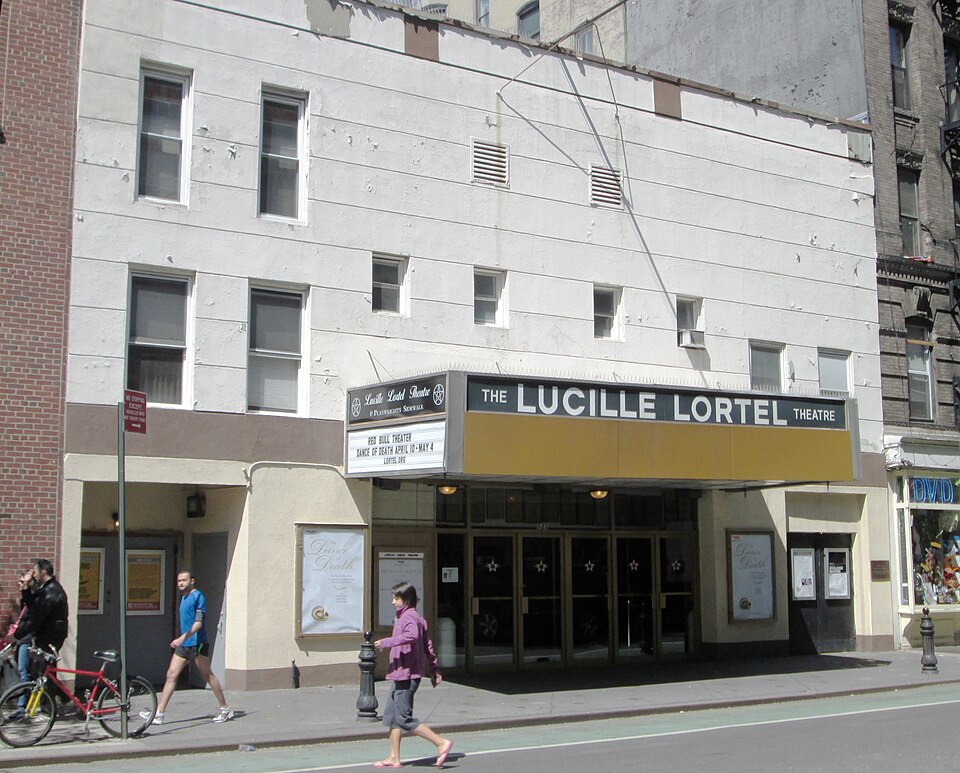
The Lucille Lortel Theatre is not easy to categorize alongside the city’s other Off-Broadway venues, because it has been here longer than most of them — and because its history is less a venue-rental story than the story of a specific person’s conviction that serious theater deserved a permanent home downtown. The building at 121 Christopher Street has been in continuous theatrical use since 1953. The Threepenny Opera, which ran there for nearly seven years and won the Tony Award for Best Off-Broadway Show, helped establish the legitimacy of Off-Broadway as a form. The venue was named for Lucille Lortel — actress, producer, champion of experimental and international work — in 1981, and it has been operated as a nonprofit by the Lucille Lortel Theatre Foundation since her death in 1999.
All of that history produces a specific kind of venue identity: a 295-seat West Village playhouse with a seventy-year track record of choosing productions over commerce, new work over safe bets, and seriously made theater over crowd-pleasing formulas. The Lortel Awards — the Off-Broadway world’s equivalent of the Tonys — were established here in 1986. Productions that have played the Lortel have gone to Broadway. Plays that needed a serious Off-Broadway home have found it here. None of that is a guarantee about any given production, but it describes the institutional gravity that shapes what the venue is.
What Makes the Lucille Lortel Different
The most important thing to understand about the Lortel is that it is not a commercial rental venue. It is a nonprofit theater with a foundation, a production history, an annual awards program, and a sustained commitment to the kind of Off-Broadway work that is too serious for the commercial entertainment market and too small for Broadway. That institutional character is what makes it different from a generic Off-Broadway address.
The Lortel has hosted work by David Mamet, Sam Shepard, William Inge, Kurt Vonnegut, Samuel Beckett, Jocelyn Bioh, and dozens more — from the 1950s to the 2020s. Its productions have included world premieres, American premieres, and transfers that eventually reached Broadway. The common thread is not a genre or a style but an orientation: work that is trying to do something rather than work that is trying to please everyone. That is the Lortel’s curatorial identity, and it has held across seven decades of ownership and management.
The venue also administers the Lucille Lortel Awards — established in 1986, now produced in partnership with the League of Off-Broadway Theatres and Producers — which recognize excellence in Off-Broadway productions across plays, musicals, and design. Having the Off-Broadway field’s most significant awards named for and administered by this theater is not incidental. It is a statement about what the venue represents to the broader Off-Broadway ecosystem. The Lortel is not just a place where Off-Broadway happens; it is one of the places that Off-Broadway was built around.
What Kind of Theater Night the Lortel Offers
At 295 seats, the Lortel is intimate in a way that matters to how productions work there. You are close to the performers throughout — whether you are sitting in the front rows or in the back of a house that is, at most, a moderate distance from the stage. The theater’s interior, largely unchanged from its original design, has a warmth and specificity that purpose-built commercial theaters often lack. It does not feel like a neutral black box or a commercial facility. It feels like a theater.
Productions at the Lortel tend to be actor-driven and writing-intensive rather than production-scale and spectacle-intensive. The venue’s history of hosting solo performances, intense three-handers, new American plays, and works by emerging or underrecognized writers is not an accident of programming — it reflects what the space does well. A production built around large visual spectacle, elaborate scenery, or the scale of a 1,200-seat house will not find its natural home here. A production built around language, performance, and the specific electricity of a small room where the work cannot hide behind production design very often does.
The Lucille Lortel Theatre works best for theatergoers who want writing and performance as the main event rather than visual scale. It suits people who want to be genuinely close to what is happening rather than watching it across a distance. It is a strong fit for repeat New York visitors who have done the Broadway circuit and want something sharper, more specific, or more adventurous. It is a strong fit for first-time visitors who are drawn to a particular production and want to experience what a serious small Off-Broadway theater feels like. It is less the right fit for visitors who want the feeling of a big theatrical event — the sense of occasion that comes from entering one of the Theater District’s grand houses — or for audiences who need broad accessibility and crowd-pleasing programming to feel comfortable.
The West Village setting reinforces the identity. This is not a Midtown venue where you arrive through Times Square energy and leave through a taxi line on a wide avenue. It is a neighborhood theater in the most literal sense — on a small street, in a living neighborhood, surrounded by the character of one of Manhattan’s most distinct communities. The evening has a flavor that starts before you sit down and continues after you leave.
What’s Playing at the Lucille Lortel Now
The current production at the Lortel is 2:22 A Ghost Story, the West End supernatural thriller making its New York debut. Previews began October 20, opening night is November 5, and the limited run is scheduled through January 17, 2027. Jasmine Cephas Jones, Finn Jones, Anna Camp and Martin Marquez lead the four-person cast, directed by Matthew Dunster and Gabriel Vega Weissman. The setup is simple: a new mother is convinced something walks through her house at exactly 2:22 a.m., and a dinner party turns into a wait to find out. It runs about two hours with an intermission and is recommended for ages 12 and up.
It is a different kind of Lortel booking from the venue’s usual new-play programming — a crowd-pleasing thriller rather than a writer’s showcase — but the room suits it almost perfectly. A ghost story with four actors, one kitchen and a lot of held breath plays very differently when you are a few rows from the stage and the whole house goes quiet at the same moment. Go in knowing as little as possible. The full 2:22 A Ghost Story guide covers tickets, cast, runtime and how the New York production relates to the London original, without spoilers.
The Lortel’s previous main-stage production, KENREX, closed June 27, 2026.
Verify the current production schedule and any additional listings at the official site (lortel.org) before booking. The Lortel’s season programming can include multiple productions and developmental events beyond the main stage show.
121 Christopher Street — The West Village Location
Christopher Street in the West Village is one of the most specific addresses in Manhattan. It sits between Hudson Street and Bleecker Street, in a neighborhood that has been an arts, LGBTQ+, and community hub for decades. The Stonewall Inn is nearby. The blocks around the Lortel are residential, restaurant-dense, and genuinely alive in the evenings in a way that feels nothing like Midtown. Going to a show at the Lortel means arriving into that neighborhood rather than into a tourist-service zone.
From Midtown, the 1 train from 50th Street or 42nd Street runs directly to Christopher Street–Sheridan Square in approximately 15 minutes. The A, C, or E to West 4th Street is a slightly longer walk to the theater. From Brooklyn or the outer boroughs, connections vary; the getting to a show in Manhattan guide covers routing from different parts of the city.
The West Village is one of Manhattan’s best neighborhoods for a pre-show dinner that feels like a real neighborhood meal rather than a theater-district service transaction. Christopher Street, Hudson Street, Bleecker Street, and the surrounding blocks have strong restaurants at every price point, none of them specifically organized around theater tourism. For dinner before a 7:30 or 8:00 PM curtain, a reservation at 6:00 or 6:30 is comfortable timing. The pre-show dining guide covers timing strategy, and the restaurants guide covers options across the city for broader planning.
After the show, the neighborhood is active well into the evening — bars, cafes, and late-night options in every direction. If you are visiting from a Midtown hotel, the hotels guide covers options with strong subway access to the Village. The 1 train back to Midtown runs regularly and puts you back in the Times Square area in about 15–20 minutes.
The Building’s History — Why It Matters
The building at 121 Christopher Street is older than the theater. It traces back to two row houses and rear stables built in 1868, converted to a small movie house around 1913, then formally opened as the New Hudson Theatre in 1926 — a 590-seat neighborhood cinema. That original cinema had nearly twice the seating capacity of the current theater; the conversion to an intimate Off-Broadway house reshaped the space while largely preserving the interior design.
How the Lortel Compares to Other Off-Broadway Venues
New World Stages is a Midtown commercial multi-theater complex running broad-audience entertainment simultaneously. The Lortel is a single nonprofit playhouse in the West Village with a specific artistic identity. Different purposes, different programming, different neighborhoods.
Minetta Lane is a Greenwich Village single-stage venue currently operated as Audible Theater’s New York home — curated but commercially anchored. The Lortel is a nonprofit foundation-operated theater with a broader institutional history. Both are intimate and writing-first; the Lortel has deeper roots.
Irish Rep is a mission-driven company theater devoted exclusively to Irish and Irish-American work. The Lortel is a nonprofit with a broader mandate — no single cultural focus, but a consistent orientation toward ambitious and artistically serious Off-Broadway work from any tradition.
The Lortel is a nonprofit, foundation-run playhouse; the Daryl Roth is a commercial Off-Broadway house in a converted bank building at Union Square, with more flexible staging. The Lortel has been in continuous operation since 1953; the Daryl Roth opened in 1998.
For the broader Off-Broadway landscape and more context on how these venues compare to each other and to Broadway, see the Off-Broadway guide and the Broadway vs. Off-Broadway guide.
What to Know Before You Go
Box office opens three hours before curtain on show days
The official visit page states that the box office at 121 Christopher Street is open three hours prior to curtain time on show days. Verify specific hours for your performance date at lortel.org before planning your arrival, as hours may vary.
Accessibility — contact the box office directly
The official Lortel FAQ directs accessibility questions to the box office by email or phone. If accessibility is a primary consideration for your visit — seating, mobility, hearing assistance, or other specific needs — contact the box office before your visit rather than assuming availability on the day.
The venue is on Christopher Street, not a main avenue
121 Christopher Street sits on the street itself, between Hudson and Bleecker. The Christopher Street–Sheridan Square station on the 1 train puts you directly on Christopher Street, a short walk from the theater. Coming by subway is the most straightforward approach; the neighborhood is also walkable from the West 4th Street station on the A, C, E, B, D, F, and M lines.
Frequently Asked Questions
At 121 Christopher Street in the West Village, between Hudson Street and Bleecker Street in lower Manhattan. The nearest subway is the 1 train at Christopher Street–Sheridan Square. The A, C, E, B, D, F, and M trains at West 4th Street are also accessible by a short walk. From Midtown, the 1 train southbound reaches Christopher Street in approximately 15 minutes.
Off-Broadway. At approximately 295 seats, the Lortel falls well below the 500-seat threshold that defines Broadway classification. It is one of the older and more historically significant Off-Broadway venues in the city, having been in continuous theatrical use since 1953 — predating most of the venues now operating under the Off-Broadway label.
The current production is 2:22 A Ghost Story, the West End supernatural thriller starring Jasmine Cephas Jones, Finn Jones, Anna Camp and Martin Marquez. Previews began October 20, 2026, opening night is November 5, and the run is scheduled through January 17, 2027. Verify the current schedule at lortel.org before booking.
Approximately 295 seats. The theater was originally a 590-seat cinema; the conversion to an intimate Off-Broadway playhouse significantly reduced the capacity and reshaped the audience relationship to the stage. The interior design is largely unchanged from the original, which gives the theater a distinctive warmth and specificity compared to purpose-built Off-Broadway facilities.
The Lucille Lortel Theatre Foundation, a nonprofit organization. The theater was named for actress and producer Lucille Lortel on her 81st birthday in 1981, and when she died in 1999, she left the building to the Foundation. The venue has operated as a nonprofit since then. The Foundation also administers the Lucille Lortel Awards — the Off-Broadway field’s most significant annual recognition — established in 1986.
The Lortel has a long history of hosting new American plays, American premieres of international works, solo performances, and productions that are too ambitious or too specific for the commercial Off-Broadway market. Its programming has ranged from Samuel Beckett world premieres (1983) to Sam Shepard to Jocelyn Bioh to Jacqueline Novak — what they share is artistic seriousness rather than commercial accessibility. The previous production, KENREX, was a representative example: formally inventive, content-intense, and not a broad crowd-pleaser. The current one, 2:22 A Ghost Story, is a more mainstream thriller that uses the small room for maximum tension.
For the right first-timer, yes — specifically for someone drawn to a particular production there. This season it is an easier recommendation than usual: 2:22 A Ghost Story is a genuinely accessible thriller, and the Lortel’s size makes it more intense than it would be in a big house. In seasons when the programming is more demanding, a more entertainment-forward venue may be the better starting point. See the Off-Broadway guide for the full landscape and the Broadway vs. Off-Broadway guide for broader context.
Is Lucille Lortel Theatre Right for Your Night?
The Lortel is one of the most historically grounded and artistically serious Off-Broadway venues in New York — a place where the building’s age, the institutional identity of the Foundation that runs it, and the West Village neighborhood it has occupied since 1953 all work together to create an experience that is genuinely different from any other Off-Broadway option in the city. It is not the most accessible or broadly appealing venue. It is one of the most consistently rewarding for the audiences it is built for.
If you want a downtown theater night in a real neighborhood, in a room with genuine history, watching work that was selected for artistic ambition rather than commercial safety — the Lucille Lortel Theatre is one of the best answers to that want in New York. If you want a big-event feeling, a crowd-pleasing production, or the scale of Broadway in an Off-Broadway package, this is not the venue for that night.
For the current production, see the 2:22 A Ghost Story guide. For the broader Off-Broadway landscape, the Off-Broadway guide covers what is currently running across the city.