

Playwrights Horizons:
Off-Broadway on West 42nd Street
A writer’s theater — not a venue, exactly, but an institution organized around the playwright’s voice. Two intimate rooms on West 42nd Street where contemporary American theater is made in real time, often before anyone else has seen it.
Why Playwrights Horizons Matters
If Broadway is often where shows arrive fully commercialized, Playwrights Horizons is one of the places where contemporary American theater is still being made in real time — where a playwright’s name on the wall means something, and where the writing is treated as the center of the evening rather than the vehicle for it.
Founded in 1971 by Robert Moss at the Clark Center Y, Playwrights Horizons moved to West 42nd Street in 1977 — becoming one of the original institutions that transformed Theater Row from an adult entertainment corridor into an Off-Broadway destination. The current building sits at 416 West 42nd Street, between Ninth and Tenth Avenues. Under Artistic Director Adam Greenfield and Managing Director Casey York, the theater continues its founding mission: centering and advancing the voice of the playwright, composer, and lyricist.
The track record is specific and verifiable: seven Pulitzer Prize winners developed or premiered here, including Sunday in the Park with George, Driving Miss Daisy, The Dining Room, and A Strange Loop. These are not productions that arrived at Playwrights Horizons fully formed — they were made here, in the rooms that still exist today.
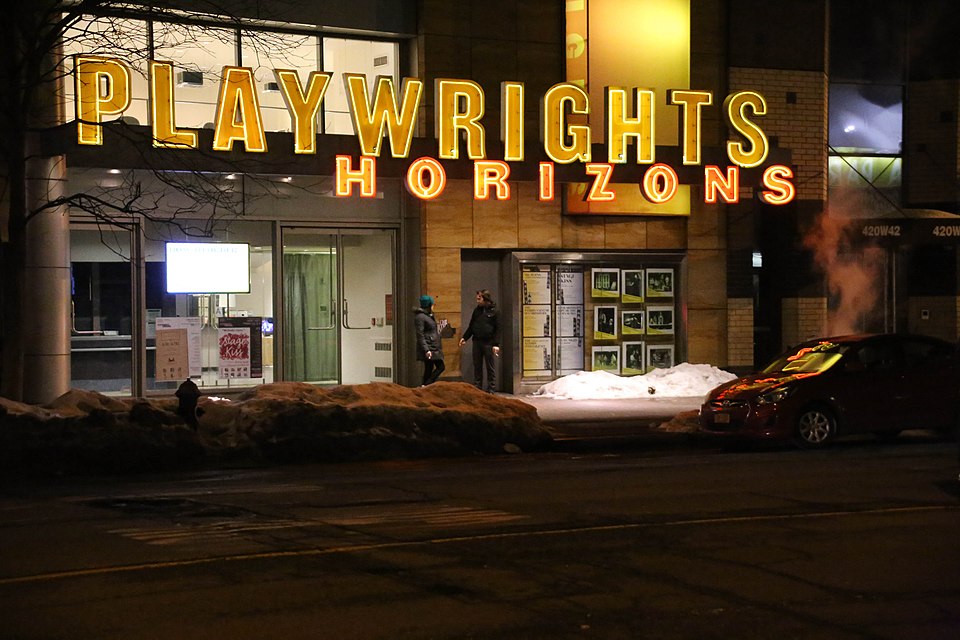
Playwrights Horizons is not a venue for touring productions, long-running commercial shows, or familiar titles. Every production is a new play or musical produced with the playwright’s involvement. The names on the marquee change every few months. You are seeing theater being made — not theater that has already been everywhere.
The 2025–26 season included works by Jacob Perkins, Milo Cramer, Shayok Misha Chowdhury, and John J. Caswell Jr., across both the Judith O. Rubin Theater and Peter Jay Sharp Theater. The season closed with Jerome, directed by Dustin Wills, in May and June 2026. Check the official site for current productions and the 2026–27 season as it is announced.
Quick Facts
What Kind of Theater Plays Here
Playwrights Horizons is best understood through what it is committed to, rather than what it has produced — though the production history is remarkable. The theater supports playwrights, composers, and lyricists through every stage of development: script evaluations, commissions, readings, workshop productions, and full Mainstage and Studio productions.
In practice, a Playwrights Horizons season tends to include:
- New plays by emerging and established American writers
- World premieres — often the first fully staged production of a new script
- New American musicals, including early-stage musicals that may later transfer
- Formally adventurous work that does not fit neatly into commercial categories
- Productions through specific programs: “Unplugged” and “Redux”
- The annual Foreign Exchange Festival with London’s Soho Theatre
Not every Playwrights Horizons production is difficult or experimental. The range within a season is wide — the same year can include a sharp musical comedy, a politically charged drama, a formally adventurous devised work, and an intimate two-hander. What they have in common is the writer’s fingerprint on the work. This is not a venue for polished, pre-packaged entertainment.
The show matters as much as the venue. Read the production page, not just the theater name. Two Playwrights Horizons shows in the same season can feel like completely different theatrical experiences. Know what you are booking.
How Playwrights Horizons Compares
Choosing the right Off-Broadway venue means matching the institution to what you want from the night.
The Spaces Inside Playwrights Horizons
Two theaters. Two distinct scales. Because Playwrights Horizons produces new work in both rooms across the season, always confirm which theater your show is in before purchasing — the experience differs significantly between a Judy production and a Peter Jay Sharp production.
The main theater and the larger of the two spaces. This is the room where Playwrights Horizons stages its higher-profile productions — the ones more likely to draw critical attention, transfer candidates, and productions with larger casts or production designs.
A 128-seat studio theater on Level 4 — the more intimate of the two spaces and the one more likely to host formally experimental or stripped-down productions. At this scale, distance from the stage is rarely the issue; staging configuration matters more.
The production listing on the Playwrights Horizons website will specify which theater your show is in. This matters for seating strategy, access planning, and expectations about scale and intimacy.
Seating & Sightlines
There is no single best seat at Playwrights Horizons because the setup can change by production and by room. What holds across both spaces is that Playwrights Horizons is generally intimate enough that distance is less of a problem than it is in a 1,500-seat Broadway house.
- For text-driven plays, closer center seats usually give the best access to facial expression and small physical details.
- For unconventional configurations, the official seating map for that specific production is the right reference point.
- Avoid assuming “front row is best.” Some productions stage close, physically, and front-row seats can feel too exposed.
- In the Peter Jay Sharp Theater, almost any seat is close enough; the main consideration is configuration and centering.
Playwrights Horizons provides specific seating dimensions on its official accessibility page: The Judy seats measure 22.5 inches armrest to armrest; Peter Jay Sharp seats measure 23 inches armrest to armrest. Verify before booking if seat width, aisle access, or mobility matters.
Accessibility
Playwrights Horizons provides detailed accessibility information by room. The summary below reflects public information, but verify with the theater for your specific production, room, and date before attending.
- All entrances to the building and both theaters are accessible.
- Elevator provides access to The Judy on Level 1M and the Peter Jay Sharp Theater on Level 4.
- Accessible seating in The Judy: Row E, Seats 1–7.
- Accessible seating in the Peter Jay Sharp Theater: Row F, Seats 1–2 and 15–16.
- Accessible restrooms on Level LL and Level 3M.
- Captioning, audio description, ASL, relaxed performances, and touch tours are available for select productions.
- Access Passport program offers discounted tickets to accessible performances.
- Contact accessibility@phnyc.org or the box office at (212) 279-4200 for specific needs.
Late seating is at the discretion of management for each performance. Do not assume you will be seated after curtain.
Getting There
Playwrights Horizons is on West 42nd Street between Ninth and Tenth Avenues — the western stretch of 42nd Street known as Theater Row. It is farther west than the Times Square core, so visitors should give themselves a few extra minutes beyond the subway exit.
Playwrights Horizons is easier to reach than many downtown Off-Broadway venues for visitors staying in Midtown. The main thing to account for is that the venue is farther west than it might look on a map centered on Times Square.
Plan the Night Around West 42nd Street
A Playwrights Horizons night fits well into the Hell’s Kitchen and Theater Row dining corridor — more neighborhood-feeling than Times Square, better for pre-show dinner, and active enough for post-show drinks.
The immediate stretch of Ninth Avenue in Hell’s Kitchen has a density of restaurants at a range of price points. This is the natural pre-show dining direction from Playwrights Horizons.
Ninth Avenue in Hell’s Kitchen is the right pre-show direction. Plan reservations in the 5:30–6:30 range for a 7:30 or 8:00 PM curtain. Post-show drinks are easy because Hell’s Kitchen stays active on weeknights.
For visitors staying in Midtown West or near Times Square, Playwrights Horizons is one of the most logistically convenient Off-Broadway options — no subway required from many hotels, and in a neighborhood that rewards lingering before or after.
Flexible Passes, Free Memberships & Access Tickets
- Flex Pass: Choose a 4-, 6-, 8-, or 12-ticket package with early booking access.
- Free membership for under-35 and full-time students: Early access to tickets and season benefits.
- Access Passport: Free to join. Discounted accessible performance tickets.
- Discounted seats: Look for red seats on the seating map for discounted pricing.
- Rush and student ticket availability should be verified per production.
Who Playwrights Horizons Is Best For
- People who want new plays by living writers
- Theater fans who follow playwrights, directors, and the theater conversation
- Off-Broadway enthusiasts who want something with more friction
- Date nights that want a conversation-starter afterward
- Visitors who have already seen the big Broadway staples
- Theater students, aspiring writers, and anyone interested in how new work gets made
- Families needing a guaranteed kid-appropriate show
- Visitors who want spectacle or musical theater grandeur
- People who want one familiar long-running title
- Groups that only respond to famous show names or celebrity marketing
- Anyone booking without reading what the specific production is about
What to Check Before Booking
- Which theater is the show in — The Judy or the Peter Jay Sharp?
- Is this a full production, a reading, a festival event, or a special format?
- Runtime and whether there is an intermission.
- Content advisory.
- Seating configuration for the specific production.
- Accessibility needs by room and performance date.
- Discounted seats, membership options, Flex Pass, Access Passport, rush, or student offers.
- Whether the show is likely to sell out due to reviews or buzz.
Frequently Asked Questions
416 West 42nd Street, between Ninth and Tenth Avenues, New York, NY 10036. This is the western section of 42nd Street known as Theater Row.
Off-Broadway. All productions at 416 West 42nd Street are Off-Broadway.
The A, C, E, and 7 trains to 42nd Street–Eighth Avenue are the closest and most direct.
Two: the Judith O. Rubin Theater, also called The Judy, and the Peter Jay Sharp Theater.
The Judy is the informal name for the Judith O. Rubin Theater, the main larger performance space at Playwrights Horizons.
The Peter Jay Sharp Theater is the smaller, 128-seat studio performance space at Playwrights Horizons.
Yes, but details should be verified by production and room. The building has elevator access, accessible seating, accessible restrooms, and select accessible performances.
New American plays, world premieres, new musicals in development, and productions centered on playwrights and composers.
Hell’s Kitchen — especially the Ninth Avenue corridor — is the natural pre-show dining zone for this part of West 42nd Street.
New World Stages is a commercial Off-Broadway complex with longer-running productions. Playwrights Horizons is a nonprofit playwright-centered theater producing new work.
Often yes, especially for the 128-seat Peter Jay Sharp Theater or any production with strong reviews, limited dates, or awards buzz.
The Practical Summary
Playwrights Horizons is the right choice when you want new work by living writers, made with the playwright’s voice at the center of the room. It is not a venue for familiar titles or long-running commercial shows. What it offers instead is the chance to see contemporary American theater being made before anyone else has decided what it means.
Check the specific show before booking. Know which room it is in. Read the production page, not just the venue name. Plan dinner in Hell’s Kitchen rather than Times Square. Buy tickets earlier than you think you need to, especially for the Peter Jay Sharp.
For current shows, the full season calendar, and accessible performance schedules, go directly to playwrightshorizons.org. For everything around the evening itself, the Stage & Street planning guides cover the rest.