

John Golden Theatre Tickets — Box Office, Location & Visitor’s Handbook
One of Broadway’s most intimate and acclaimed houses — 800 seats, a landmarked Spanish-style interior, and a track record for serious drama that no other theater on the street can match.
The John Golden Theatre is not a famous name in the way that the Shubert or the Majestic is. It does not have a blockbuster musical that has run there for a decade. What it has — and what makes it unlike almost any other house on Broadway — is a concentration of serious, acclaimed dramatic work that is essentially unmatched on the street. More Pulitzer Prize-winning plays have opened at the Golden than at any other Broadway theater. That is not marketing copy. It is a meaningful statement about what this room is for and what it attracts.
At 800 seats, the Golden is among Broadway’s smallest houses. The intimacy is the point. The Spanish-style interior — rough plaster walls, spiral columns, a vaulted rib-arched ceiling — is a New York City landmark. The room rewards work that needs to be felt rather than spectacle that needs to fill a cavern. If you are going to the Golden for the first time, you are going to one of the most distinctive and historically significant small houses in American theater.
This guide covers the room, the seating, accessibility, and how to plan the evening — so that everything about the visit is handled before you arrive.
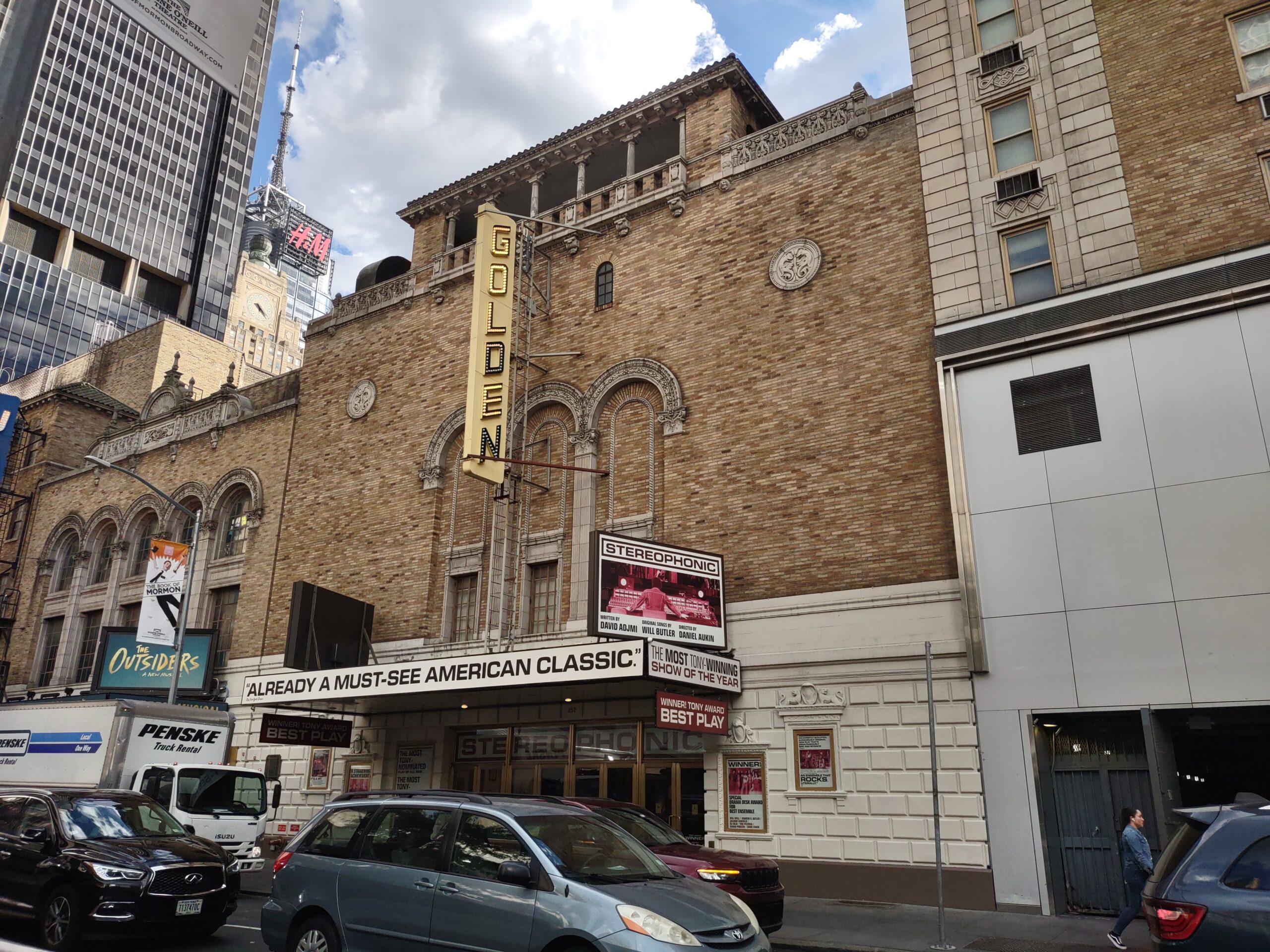
What the John Golden Theatre Actually Is
The Golden sits at 252 West 45th Street on George Abbott Way, in the heart of the Theater District. The building was constructed in 1927 as the Theatre Masque — the smallest of a three-theater complex developed by the Chanin Brothers, with the explicit purpose of housing intimate plays. The other two Chanin theaters — the Royale (now the Bernard B. Jacobs) and the Majestic — were built for musicals and spectacle. The Masque was built for plays that needed the audience close.
Producer John Golden took over the theater’s management in 1937 and renamed it after himself — the third Broadway house to carry his name. The Shubert Organization has operated it since the mid-1940s, with a 2013 renovation that stripped away decades of modifications and restored the original Spanish-style interior using historical photographs and architectural references.
The room itself
The auditorium is wider than it is deep — a proportional characteristic that places the audience relatively close to the stage across a wide arc rather than funneled into a long narrow hall. This is what makes the Golden’s sightlines genuinely strong from most positions: the furthest seat is not nearly as far as in a conventional deeper house. The ribbed ceiling, the rough plaster walls, and the wrought iron fixtures give the room a warmth and texture that newer houses simply do not have. The acoustics support clarity of speech across all sections — a deliberate feature in a house designed for dialogue-driven drama.
The Golden has no boxes — an architectural choice, not an oversight. The house was designed for an audience that was focused on the stage, not arranged in a social hierarchy around it. Every seat faces the performance. The orchestra level is raked, and the single balcony is divided into front and rear mezzanine sections by the entry point.
At 800 seats, the John Golden is not a small theater by off-Broadway standards — but on Broadway, it is intimate. The houses on either side of it hold 1,000 to 1,900 seats. That difference is not just numerical. It changes the relationship between performer and audience in a way that can be felt from the moment the lights go down. Productions that play the Golden are chosen for this room. Directors stage for these distances. Actors pitch their performances differently. The intimacy is structural, not incidental.
John Golden Theatre Seating Guide
The Golden has two levels: an orchestra of approximately 465 seats and a balcony divided into front mezzanine (110 seats) and rear mezzanine (227 seats). Unlike Broadway’s larger houses, the gradient between the best and worst seats here is relatively narrow — the room’s compact proportions mean that even the rear mezzanine is closer to the stage than the equivalent section would be at a 1,400-seat house. That said, there are real distinctions worth knowing before you book.
The orchestra floor is raked for sightlines. The balcony entry is at the front of the rear mezzanine section — so the “front mezzanine” rows are actually the portion of the balcony closer to the stage, beyond the entry point. Understanding this labeling matters: front mezzanine seats at the Golden are genuinely excellent, and the rear mezzanine, while further back, is not a remote or compromised experience in the way upper tiers can be at larger theaters.
The mid-center orchestra is the most consistently cited premium zone. Far enough back to take in the full stage picture, close enough for facial detail and performance intimacy. At a house this size, these rows put you in exactly the relationship with the stage that the theater was designed to create. Strong demand; book early for the best center positions.
The front mezzanine at the Golden is one of the best-value positions in the house. The elevated angle gives you the full stage picture — top to bottom — and because the room is not particularly deep, the distance from the front mezzanine to the stage is much shorter than at larger houses. Frequently cited by visitors as their favorite position once they have tried it. Often priced below premium orchestra for comparable or better sightlines.
The front rows are very close to the stage — genuinely close, in the way that feels immersive for some productions and slightly overwhelming for others. For plays with naturalistic staging, this can be an extraordinary experience. For anything with upward staging elements, the front orchestra rows may require more upward neck angle than is comfortable over a full evening. Row C–D center is typically better than row A–B for comfort across most productions.
The Golden’s curved eastern wall (due to the Bernard B. Jacobs Theatre next door) gives the room a slightly asymmetric shape, and the far outer orchestra seats are at more of an angle to the stage than center positions. Because the room is intimate, even side seats are closer than they would be at larger houses. Still: center and center-adjacent positions are noticeably better. Side orchestra at a good price is a reasonable trade; far outer side at full premium is not.
The rear mezzanine is the furthest and highest seating section. At this house, the word “surprisingly good” appears frequently in visitor accounts — and that is a function of the room’s intimacy rather than any magic of the seats themselves. At a larger theater, the rear mezzanine might be genuinely remote; here, the Golden’s proportions keep even these seats in a reasonable relationship with the stage. Handrails are available at each row end. Budget-conscious visitors often find rear mezzanine center a fair trade.
The front rows of the rear mezzanine sit under the overhang of the balcony structure — which means the top portion of the stage (any high backdrops, projection elements, or staging above a certain height) may be partially cut from view. Visitors note this varies by production and by exact row. If vertical stage elements matter for the show you are seeing, front-of-rear-mezzanine center rather than extreme front is the safer choice.
At the John Golden, the question is not really “which section is good?” Most of them are. The question is what kind of experience you want: the close, immersive energy of front orchestra; the full-picture perspective of the mezzanine; or the mid-distance balance of center orchestra. All three work in a house this size. The choice reflects preference more than a meaningful quality gap.
Best Seats by Visitor Type
The reliable, centered introduction to this room. Strong sightlines, full stage picture, performance detail at a comfortable distance. This is how the Golden is supposed to be experienced.
The elevated angle gives the widest, most complete view of the stage in the house — top to bottom, edge to edge. Often better value than premium orchestra. Consistently praised in visitor accounts for this room.
Close enough to feel the energy of the performance in an intimate drama house. Best for productions where physical proximity to the actors is the point — which is frequently what plays at the Golden are about.
The Golden’s intimacy and the quality of its typical programming make it an excellent date night choice for theatergoers who want something substantial rather than just crowd-pleasing. Front mezzanine center pairs well with a pre-show dinner on 45th or 46th Street.
At a house this size, rear mezzanine center is a more honest option than the equivalent section at larger theaters. The room’s proportions keep even these seats in meaningful contact with the stage. Check rush and lottery availability for the current production before booking at full price.
The orchestra is accessible without steps. Wheelchair seating is in the orchestra only — four ADA-compliant positions with companion seating, plus nine row-end seats with folding armrests. The mezzanine requires 28 steps and has no elevator. Confirm specific arrangements directly with the box office before your visit.
Accessibility and Mobility Notes
The John Golden Theatre has meaningful accessibility limitations that are worth understanding clearly before you book. This is not a fully wheelchair-accessible building in the way that a purpose-built modern venue would be. It is a 1927 structure with a landmark interior, and the physical constraints of that history are real.
Orchestra level — accessible without steps
The orchestra level is accessible from the street entrance without steps. Double doors at the entry are automatic, with a slight incline between the first and second sets. The entire orchestra section can be reached without stairs. This is where wheelchair seating is located: four ADA-compliant viewing positions with companion seating are available, plus nine row-end seats with folding armrests that provide transfer options. For accessible booking, contact the box office directly or call Sound Associates for assistive device arrangements.
Mezzanine — stairs only
The mezzanine is on the second level, reached by three flights of stairs — approximately 28 steps total. Once at the mezzanine level, individual rows require approximately two steps each. There are no elevators or escalators in the building. This is a hard constraint: if stair-free access is required, the orchestra is the only option. The mezzanine, including the front mezzanine, is not accessible for visitors who cannot manage stairs.
The John Golden Theatre does not have elevators. Wheelchair-accessible seating is exclusively in the orchestra. The Shubert Organization’s accessibility agreement includes this theater, and accessible restrooms are available — though the restrooms in the Golden’s own building are not wheelchair-accessible. Accessible restrooms are located in the Bernard B. Jacobs Theatre, on the same block. Confirm all accessibility needs with the box office before booking.
Assistive listening devices
Infrared assistive listening devices are available for every performance at the John Golden Theatre. No advance reservation is required, though contact can be made through Sound Associates at 212-582-7678. Beginning four weeks after a production’s official opening night, hand-held audio description and captioning devices are also available, as is downloadable audio description and captioning for personal mobile devices — free of charge for each performance. Hand-held device availability is limited; if a specific device is essential, 24 hours advance notice is recommended.
What Kind of Theater This Is — and Why the History Matters
The John Golden has more Pulitzer Prize-winning productions in its history than any other Broadway theater. This is the single most useful thing to know about the room’s character — not as a piece of trivia, but as a description of what consistently chooses to play here and why. The Pulitzers came because serious writers, serious directors, and serious producers have recognized for nearly a century that this room is the right size and the right shape for intimate, language-driven American drama.
Four Pulitzer Prize-winning productions in seven years is a record for any Broadway theater. No other house comes close. But the Golden’s distinction goes beyond a single decade. Samuel Beckett’s American premiere of Waiting for Godot was staged here in 1956, with Bert Lahr. Beyond the Fringe played here in 1962. The original Broadway run of Avenue Q — which transferred from off-Broadway and earned back its full production cost within a year — ran 2,534 performances, the Golden’s longest run. More recently, Slave Play, Stereophonic (the 2024 Pulitzer winner), Three Tall Women with Glenda Jackson, and Eclipsed with Lupita Nyong’o have all played this room.
The pattern is consistent. The Golden attracts work that is testing what theater can do with language and with the truth of close-up human experience. It is not a prestige address for lavish productions. It is a working theater that has earned its reputation by consistently housing the most significant new plays of the last century.
The architecture reinforces the identity
The Spanish-influenced interior — rough plaster walls with stucco blocks, wrought iron lighting sconces, spiral colonettes, and the ribbed vaulted ceiling — is not decorative background. It creates a specific atmosphere: warm, slightly cave-like, focused. The lighting in the house tends to feel intimate even before the show begins. The room does not announce itself the way a gilded grand opera house does; it settles you in and lets the work on stage take over. Both the interior and the facade are New York City landmarks, designated in 1987. The 2013 restoration returned the room to something close to its 1927 character after decades of modification.
The stage and what it suits
The proscenium opening is 30 feet 6 inches wide and 24 feet high — proportionate to the room’s scale, not the scale of a Broadway barn. The stage depth is modest. This is a house that works best when the production is not asking for forty feet of wing space or elaborate flying rigs. What the Golden stage does exceptionally well is provide a tight, focused frame for performance: two people in a room, a family in crisis, a monologue that needs the audience near enough to see the face clearly. Productions that have thrived here have consistently been those that turned constraint into precision.
Planning a Night Around the John Golden Theatre
Getting there
The Golden is at 252 West 45th Street, between Seventh and Eighth Avenues. The nearest subways are the N, Q, R, or W train to 49th Street, or the 1 train to 50th Street — both a short walk. The A, C, E trains to 42nd Street–Port Authority put you about three blocks south, still manageable. The 2, 3 to Times Square is equally close. The theater sits on one of the most transit-connected blocks in the Theater District; there is no single correct approach. The how to get to a Broadway show guide covers transit options in full detail, including timing from different boroughs and hubs.
Arriving and entering
The entrance is directly off 45th Street — no arcade, no escalators, no building-within-a-building navigation. Doors open 45 minutes before curtain. The bar is one level below the orchestra, in the lower lounge. The theater does not provide coat check. Because it is a smaller house, the entrance flow is manageable even close to curtain — but arriving 20 minutes early is still the comfortable choice rather than 10 minutes. Note that the theater is cashless: concessions and merchandise accept credit or debit cards and mobile payments only.
Pre-show dinner on 45th Street and nearby
The Golden sits in the dense dining corridor of the Theater District. 45th Street itself and the surrounding blocks — 44th to 46th, Seventh to Ninth Avenue — have consistent pre-show restaurant options across price points. The concentration of serious theatergoers in the area means most restaurants on these blocks are practiced at timing a meal for a curtain. Allow 90 minutes between the check and the walk to the theater as a comfortable baseline; two hours is better for a leisurely dinner. The pre-show dining guide covers timing strategy, and the restaurants near Broadway guide has specific options in this part of the district.
Parking near the John Golden
Paid parking garages are within a few blocks of the theater on both 45th Street and the surrounding blocks. The Theater District is reasonably well-served by midblock garages, though performance-night demand makes rates higher and availability tighter. The parking near Broadway guide covers specific garage options and pricing strategy. Transit is generally faster and easier on performance nights in this part of Midtown.
Hotels for visitors staying overnight
The Golden’s 45th Street location puts it within walking distance of the Theater District hotel cluster along Seventh and Eighth Avenues, as well as the broader Midtown hotel options north and south. For visitors building a trip around a visit to the Golden, the hotels near Broadway guide covers options across price points and neighborhoods. The Theater District neighborhood guide gives a fuller picture of the area for visitors spending multiple nights in the district.
Frequently Asked Questions
The John Golden Theatre address is 252 West 45th Street (George Abbott Way), Manhattan, in the Theater District between Seventh and Eighth Avenues. The entrance is directly off the street — no arcade or building lobby. The nearest subways are the N, Q, R, W to 49th Street or the 1 to 50th Street; the A, C, E and 2, 3 trains at 42nd Street are also a short walk.
John Golden Theatre tickets are sold through official Broadway ticketing channels for the current production, or in person at the theater’s own box office at 252 West 45th Street. The John Golden theater box office hours generally follow the Shubert Organization’s standard schedule — open on performance days ahead of the show, with hours shifting around matinees and dark days — so confirm the exact John Golden theatre box office hours for your visit through the Shubert Organization or the current production’s official site before you go.
Approximately 800 seats across two levels. The specific count varies slightly depending on the source — the Shubert Organization cites 802, The Broadway League cites 805, and Playbill cites 787. In practice: approximately 465 seats in the orchestra, 110 in the front mezzanine, and 227 in the rear mezzanine. One of Broadway’s smaller houses by capacity.
Center orchestra rows E–M for the premium mid-distance experience; front mezzanine center for the most complete stage picture at often better value. The Golden’s compact size makes even “second-tier” positions at this house better than equivalent seats at larger Broadway theaters. The worst-performing zone is far-side orchestra at premium prices — the angle is not worth the cost when center options exist.
Partially. The orchestra level is accessible from the street without steps, and wheelchair seating (four ADA positions with companion seating) is in the orchestra. The mezzanine requires approximately 28 steps and there are no elevators or escalators in the building — the mezzanine is not accessible to wheelchair users. Wheelchair-accessible restrooms are in the adjacent Bernard B. Jacobs Theatre, not in the Golden itself. Contact the box office directly for accessible seating arrangements.
As of 2025–2026, Operation Mincemeat: A New Musical — the Olivier Award winner for Best New Musical and 2025 Tony winner for Best Featured Actor in a Musical — is running at the Golden. It began previews in February 2025. Verify the current schedule and any cast changes through the official Shubert Organization site or official show ticketing before booking.
The Golden holds a record no other Broadway theater matches: four Pulitzer Prize-winning plays in seven years during the 1980s — The Gin Game, Crimes of the Heart, ‘night, Mother, and Glengarry Glen Ross. More Pulitzer-winning plays have played at this theater than at any other house on Broadway. Its history also includes the American premiere of Waiting for Godot, the original run of Avenue Q, and productions featuring some of the most significant performers and playwrights of the last century. The interior and exterior are both New York City landmarks.
It opened in 1927 as the Theatre Masque, part of a three-theater complex built by the Chanin Brothers and designed by architect Herbert J. Krapp. It was intentionally built as the smallest of the three, for intimate plays rather than musicals. Producer John Golden leased and renamed it after himself in 1937 — the third Broadway house to carry his name. The Shubert Organization regained control in 1945 and has operated it since, except for a brief period as a cinema in the late 1940s.
More often yes than at larger houses. Because the Golden’s footprint is compact, even the rear mezzanine is not as remote as the equivalent section at a 1,400-seat theater. Visitors consistently report that the room’s proportions make the rear mezzanine a functional and sometimes excellent option, particularly for productions that play the full stage. Front rows of the rear mezzanine have a balcony overhang that may cut the top of the stage from view — center rows further back typically avoid this issue.
Yes — one bar in the lower lounge level below the orchestra. The theater is cashless; credit/debit cards and mobile payments only. There is no coat check.
The John Golden, Briefly
The John Golden Theatre is not the most famous name on Broadway — it is something rarer. It is the room that serious American drama has returned to for nearly a century, and the physical evidence of that is the most concentrated run of Pulitzer Prize-winning productions in Broadway history. At 800 seats, with a landmarked Spanish-style interior and proportions designed for intimacy, the Golden does what very few Broadway houses can: it makes the performance feel like it is happening specifically for you.
The seating decision is simple by Broadway standards. Center orchestra mid-rows or front mezzanine center — pick based on whether you want proximity or perspective. Everything else follows from there. Arrive 20 minutes early, allow time for pre-show dinner on 45th Street, and take the train. The show will do the rest.
See the Broadway theaters guide for the full range of houses in the district, and the Broadway shows hub for what is currently playing across Broadway.
The Room Is Intimate — Now Choose the Right Seat
The John Golden is one of Broadway’s great small-room experiences: close, theatrical, and built for performance detail. Start with the new seating chart to compare Orchestra, Front Mezzanine, Rear Mezzanine, value zones, and stair warnings, then build the rest of the night around Operation Mincemeat, dinner, hotels, transit, and the Theater District.
John Golden Seating Chart & Best Seats
Compare Orchestra, Front Mezzanine, Rear Mezzanine, center-vs-side sightlines, stair warnings, accessibility, and the best seats for Operation Mincemeat before buying.
Open Seating Guide Current ShowOperation Mincemeat Guide
Plan the show around the room: fast comic staging, ensemble timing, full-stage visibility, dinner timing, and what to expect before curtain.
Open Show GuideBroadway Seating & Ticket Strategy
Seats · Timing · ValueBroadway Seating Guide
Compare orchestra, mezzanine, balcony, boxes, side seats, premium zones, and obstructed-view listings across Broadway houses.
When to Buy Broadway Tickets
Know when buying early matters, when waiting can work, and how timing changes for hit shows, weekends, and strong seat inventory.
Last-Minute Broadway Tickets
TKTS, same-day listings, rush, lottery, and practical ways to compare late options without choosing awkward seats blindly.
Broadway Rush and Lottery Tickets
How discount systems work, what tradeoffs to expect, and why cheap seats can be great — or risky — depending on the view.
First-Time Broadway Guide
For visitors choosing their first show or first theater: seats, arrival, timing, intermission, dress, and Theater District basics.
Best Broadway Shows for Date Night
Compare Broadway nights by tone, dinner pairing, room feel, pacing, and how the full evening works beyond the ticket.
Plan the John Golden Theatre Night
Dinner · Hotels · TransitRestaurants Near Broadway
The Golden sits in the heart of the Theater District, with Restaurant Row, Times Square, and Hell’s Kitchen dining all close by.
Pre-Show Dining Guide
Plan reservation timing, walking buffer, check arrival, and post-show movement so dinner and theater work together.
Best Pre-Theater Restaurants NYC
Use this when you want stronger restaurant choices around Broadway rather than only timing and logistics advice.
Hotels Near Broadway
Compare Theater District, Times Square, Midtown West, and Hell’s Kitchen hotel zones for a Broadway-centered trip.
How to Get to a Broadway Show
Subway, walking, rideshare, and arrival timing for Theater District shows, including the West 45th Street houses.
Parking Near Broadway
When driving makes sense, when it does not, and how to avoid turning a Broadway night into a Midtown garage problem.
Nearby Neighborhood & Theater Guides
45th Street · Theater District · Nearby HousesTheater District
The practical guide to Broadway’s center: theaters, crowds, hotels, restaurants, walking routes, and first-time visitor logistics.
Times Square
Best when convenience, subway access, and being right in the center matter most — especially for short Broadway trips.
Hell’s Kitchen
A strong nearby option when dinner matters — more restaurant depth, calmer blocks, and an easy walk west after the show.
Bernard B. Jacobs Theatre Guide
A neighboring Chanin/Krapp house that helps compare 45th Street theater scale, seating, and arrival logistics.
Gerald Schoenfeld Theatre Guide
A nearby 45th Street Broadway house with a different room shape, sightline profile, and show-night rhythm.
Imperial Theatre Guide
A larger nearby musical house that gives helpful contrast against the Golden’s smaller, more intimate proportions.