

Chicago Broadway Tickets, Cast & Show Guide
Find Chicago Broadway tickets, $49 rush and $27 standing-room options, the current cast, best Ambassador Theatre seats, runtime, plot and planning tips before you book.
219 W 49th St
30th Broadway year
15-min intermission
Adult themes
Chicago Broadway tickets remain in steady demand for the long-running Kander and Ebb revival at the Ambassador Theatre. The production is now in its 30th Broadway year and still runs on the same stripped-down formula that made it famous: a visible orchestra, black costumes, razor-sharp choreography in the style of Bob Fosse, and a story about Roxie Hart and Velma Kelly turning murder trials into celebrity theater.
Chicago has been running on Broadway since November 14, 1996, making it Broadway’s longest-running American musical and one of the most durable institutions in the Theater District. All of which is interesting, and none of which tells you whether it’s the right Broadway show for your particular night — or which Chicago tickets you should actually be booking.
Chicago is cool, sleek, and deliberately withheld. It does not want you to feel uplifted — it wants you to feel like you’re in on the joke. That distinction matters enormously for the booking decision, and it’s the distinction this page is built around.
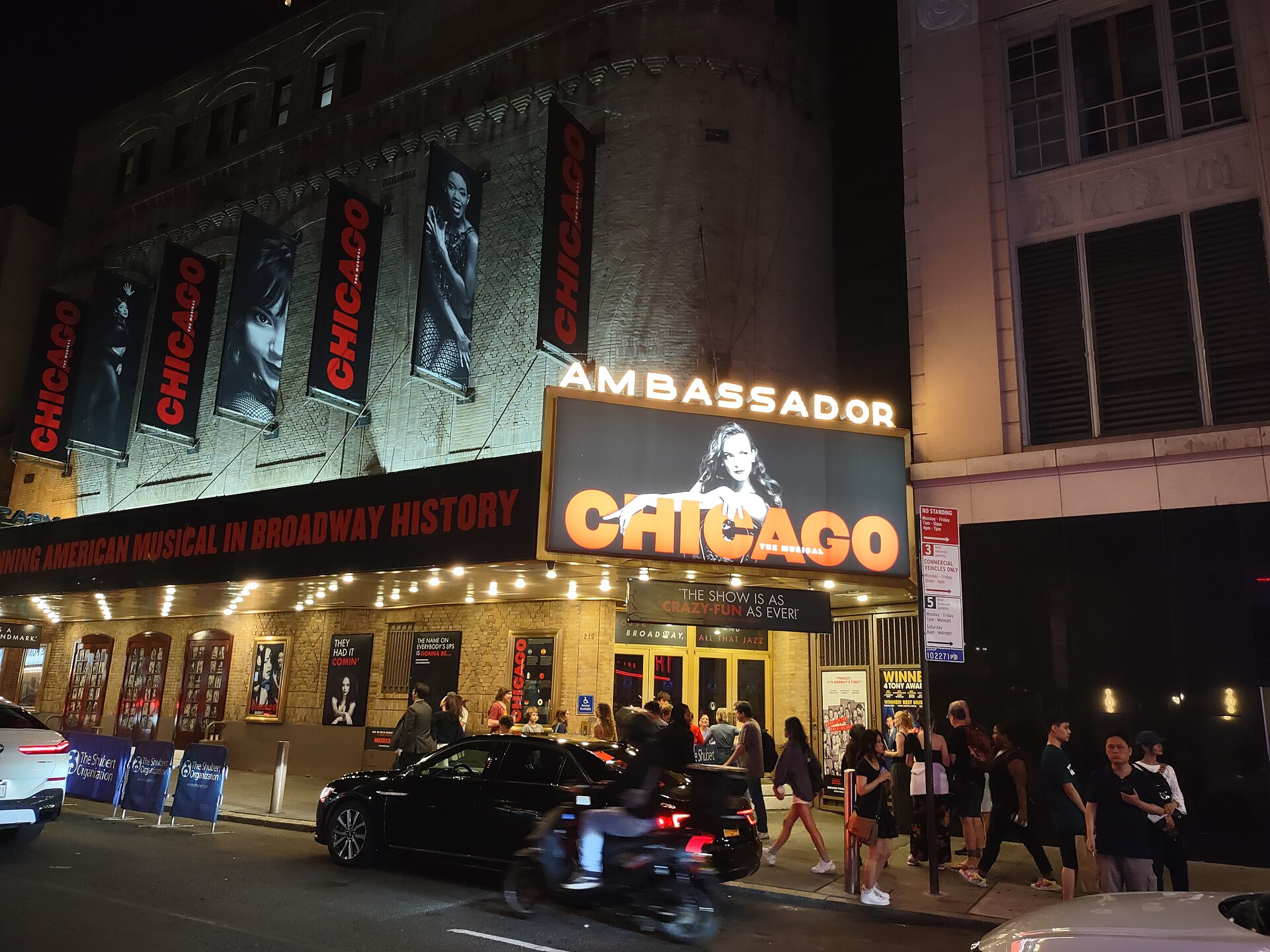
Chicago Broadway Tickets: Rush, Standing Room & Where to Buy
Chicago Broadway tickets are sold officially through Telecharge and directly at the Ambassador Theatre box office at 219 West 49th Street. The official production currently advertises weekend matinee tickets beginning at $49.50, while day-of discount options can go lower.
A limited number of $49 general-rush tickets are sold at the Ambassador Theatre box office when it opens on the day of the performance. Rush is first-come, first-served, limited to two tickets per person, and is not available for Saturday evening performances.
When a performance is sold out, a limited number of $27 standing-room tickets are sold at the Ambassador box office on the day of the performance, limited to two per person. Do not count on standing room for a specific date — it is only released when the house is sold out.
Does Chicago on Broadway Have a Ticket Lottery?
No current digital lottery is listed for the Broadway production at the Ambassador Theatre. Searches for “Chicago Broadway lottery” often surface Broadway In Chicago programs for touring productions in Chicago, Illinois, which are separate from the New York production. For the Broadway show, the current official day-of discounts are general rush and sold-out-performance standing room.
Where to Buy Chicago Broadway Tickets
Telecharge: The official Chicago site routes standard online ticket sales through Telecharge.
Ambassador Theatre box office: Official tickets are also sold in person at 219 West 49th Street. Current posted hours are Monday–Saturday 10 AM–8:30 PM and Sunday noon–7:30 PM.
TKTS: Chicago frequently appears as a same-day discount option, making it worth checking if your date and seat location are flexible.
Group tickets: Official group sales are available for groups of 10 or more through Broadway Inbound.
What Chicago on Broadway is actually like
The story is set in 1920s Chicago: two women in Cook County Jail — Velma Kelly, a fading vaudeville star who killed her cheating husband and sister, and Roxie Hart, a chorus girl who shot her lover — compete for the attention of the same slick defense attorney, Billy Flynn, who promises to turn their trials into media circuses. The show’s argument is that celebrity, scandal, and the law are all the same performance, and that the audience for justice and the audience for entertainment want the same thing. It made this argument in 1975 when it first opened. It has not become less relevant since.
What makes Chicago distinct as a Broadway experience is its aesthetic. The production is performed on a nearly bare stage — just a band visible at the back, black chairs, minimal props, and whatever the dancers are doing at any given moment. There are no spectacle effects, no elaborate set changes, no visual coups engineered by the design department. The show is built entirely on the Kander and Ebb score and the Bob Fosse choreography as interpreted by Ann Reinking — and those two elements, deployed by a cast of exceptional dancers and musicians, produce an experience that is complete and self-sufficient without requiring anything else.
The choreography is the reason to see Chicago. Bob Fosse’s movement language — the turned-in feet, the isolation of body parts, the deliberate sexuality made abstract by precision — is one of the defining aesthetics in American musical theater, and Chicago is where you see it in its most concentrated and purposeful form. The dancers in the current production are not performing in the style of Fosse; they are in a direct line of transmission from Fosse through Ann Reinking, who danced for him, won a Tony choreographing this revival in his style, and built the production around movement that comes from genuine understanding rather than imitation.
The score is a string of standards — “All That Jazz,” “Cell Block Tango,” “Roxie,” “Mr. Cellophane,” “Razzle Dazzle” — that most Broadway audiences already know. That familiarity is either a pleasure or a reason to choose something else, depending on whether you want your Broadway evening to include the specific experience of recognizing songs you love in a live performance, or whether you’d rather encounter something new.
Chicago has for years attracted celebrity casting in its principal roles, rotating actors from television, dance, and entertainment through limited engagements as Roxie Hart, Velma Kelly, and Billy Flynn — recent names have included Dancing With the Stars alumni, television and streaming stars, and returning Broadway veterans, each typically for a run of several weeks before the next casting change. Because these engagements rotate every few weeks, treat any specific name you see advertised as a snapshot rather than a guarantee — the production’s own site and box office are the only reliable source for who’s currently playing which role on your specific date.
The celebrity rotation is worth understanding as a planning variable rather than a reason to book or skip a date. The ensemble — the dancers and supporting cast who are in the show for the full run — are consistently strong, and Chicago does not live or die by the celebrity principal in the way some shows depend entirely on a single star. Seeing Chicago during a period between celebrity engagements, when the principal roles are being played by seasoned Broadway performers rather than guest stars, often produces a tighter, more cohesive production. The celebrity casting draws audiences, but the underlying show runs on its dancers. Both are legitimate reasons to book; they produce different experiences.
Current Chicago Broadway Cast
The Broadway production is built to handle frequent principal-cast changes, but the current lineup still matters — especially because searches for Roxie Hart and the current cast are a major part of Chicago’s demand. As of September 2026, Reece Weaver is playing Roxie Hart in a limited engagement through October 18.
The America’s Sweethearts: Dallas Cowboys Cheerleaders breakout is making her Broadway debut as Roxie through October 18, 2026.
Current principal cast member as Velma Kelly.
Tony-, Drama Desk-, and Grammy-nominated Broadway performer currently playing Billy Flynn.
Tony nominee and Grammy winner currently appearing as Matron “Mama” Morton.
The current principal company also includes Red Concepción as Amos Hart and J. Workman as Mary Sunshine. Chicago rotates guest stars and principal performers regularly, so if a specific performer is a reason for your visit, verify the official cast page before buying.
Roxie Hart is one of the show’s signature roles, and Chicago frequently uses limited celebrity or guest engagements in the part. Reece Weaver is the current Roxie through October 18, 2026; after that, casting can change again. The production itself is stable, but the principal lineup is deliberately fluid.
Best Seats for Chicago at the Ambassador Theatre
Chicago is unusually friendly to seats a little farther back because its choreography is built around full-stage patterns rather than large scenic effects. The best choice depends on whether you want facial detail or the cleanest view of the Fosse-style ensemble work.
A strong balance of proximity and full-stage perspective. You stay close to the performers without sitting so near that the choreography flattens out.
The elevated angle makes ensemble spacing, formations, and the visible orchestra especially easy to take in.
The minimalist production loses very little without elaborate scenic detail, so central seats farther back can still deliver a complete view.
Side angles can reduce your view of the full choreographic picture. If you’re buying mainly for dance, center is more valuable here than being a few rows closer on the side.
For the full venue layout, sightline notes, accessibility information, and seat-selection help, see the Ambassador Theatre guide.
Who Chicago is best for
Chicago’s clearest fit is an adult audience that wants to be impressed rather than moved — people who find the show’s cool precision and moral cynicism more satisfying than emotional uplift, and who come to Broadway to watch exceptional dancing rather than to follow a conventional story of obstacles and triumph.
If you know Bob Fosse’s work — from Cabaret, Pippin, or the 2002 film — and want to see his movement language performed live at its source, this production is as close as Broadway currently gets. The choreography is exceptional and the cast are first-rate dancers.
Chicago is uninterested in making you feel good about people. It is interested in showing you how people use each other — and in making that funny. For adult audiences who respond to that register, it is one of Broadway’s most satisfying experiences.
Chicago is one of Broadway’s better date-night choices for couples who want to be stylish rather than swept away — the show has genuine glamour without demanding that you feel anything in particular. The Broadway date night guide covers it in the current season context.
The Academy Award–winning film with Catherine Zeta-Jones, Renée Zellweger, and Richard Gere brought the show to an enormous audience. For visitors who loved the film, seeing it live at the source — a bare stage, a live band, dancers who don’t have the luxury of a film editor — is a specific and often revelatory experience.
Chicago is also a reliable choice for repeat Broadway visitors who want to take out-of-town guests to something they can confidently recommend regardless of those guests’ theater experience. It is almost universally well-received by adult audiences who are not expecting something it isn’t. The issues arise when people go expecting warmth or spectacle and find precision and irony instead.
Is Chicago a good first Broadway show?
The honest answer is nuanced — and the nuance is specific to what you want your first Broadway experience to establish as the frame for the art form.
Chicago is technically accomplished, musically strong, and will absolutely demonstrate that Broadway can do things no other medium replicates — seeing live dancers execute Fosse choreography in real time, with a live orchestra, in a packed theater, is genuinely transporting. As a first Broadway show, it can produce a lasting impression.
The complication: Chicago is a cool show, and cool can register differently on audiences depending on their expectations. First-time visitors who come in hoping to be emotionally swept away — who want the kind of Broadway night that leaves them in tears or stunned by something overwhelming — may find Chicago’s deliberate irony and refusal of sentiment to be a withholding experience rather than a satisfying one. The show does not want your tears. It wants your knowing smirk.
For first-time visitors who know they enjoy satire, sharp writing, and dance as a primary theatrical language, Chicago is an excellent first show. For first-time visitors who aren’t sure what they want from Broadway yet, starting with something that has a clearer emotional throughline — Wicked, Hadestown, The Lion King — and returning for Chicago later often produces a more complete introduction to what Broadway can do across its full range. The first-time Broadway visitors guide covers the full current season.
Is Chicago appropriate for teens or families?
Chicago carries an approximate 13+ recommendation, reflecting its adult content: the show deals in murder, adultery, sexuality, and moral corruption, presented with considerable wit but without any suggestion that these things are not exactly what they are. The tone is entirely adult — not in the sense of explicit language or graphic violence, but in the sense of a worldview that assumes an audience old enough to understand irony about celebrity, justice, and human selfishness.
For mature teens aged 14 and above who are already comfortable with adult themes in film and television, Chicago is often an excellent choice — the music is recognizable, the story is engaging, and the dancing is genuinely spectacular. The 2002 film, which many teenagers have seen, provides useful context for what the show is doing with its material.
For younger teenagers, or for families with children below 13, Chicago is not the right show. The subject matter is adult in a meaningful way, and the show’s refusal of anything warm or redemptive means there is no soft landing for an audience that is not ready to engage with what it’s actually doing. For families with younger children looking for a Broadway experience that works across age groups, the Broadway shows for kids guide covers the current season.
A note on the content for parents: Chicago’s adult content is thematic and tonal rather than explicit. There is no graphic language or violence in the conventional sense — but the show’s entire premise involves glamorizing murderers and satirizing the justice system, and it presents sexuality as entertainment in a way that is specifically designed to make the audience complicit. That’s the show’s method, and it’s worth understanding before bringing a teenager who might be more confused than engaged by it.
What the Ambassador Theatre adds to the experience
The Ambassador Theatre at 219 West 49th Street opened in 1921 and has been Chicago’s home since January 29, 2003. The revival opened at the Richard Rodgers Theatre on November 14, 1996, transferred to the Shubert Theatre in February 1997, and moved to the Ambassador after its final Shubert performance in January 2003. The Ambassador is a mid-sized house — approximately 1,125 seats across orchestra and mezzanine — and it is an intimate room for a show that plays on a nearly bare stage. The proximity to the performers matters here in a way it doesn’t for spectacle productions: you are close enough to see the dancers’ technique, the individual choices that distinguish one performance from another, and the live band that drives the whole production from its position at the rear of the stage.
For seat selection: Chicago is unusual among Broadway musicals in that the bare-stage production actually improves the further back in the orchestra you sit, because the full spatial composition of the choreographic sequences is more legible from a slight distance than from the front rows where the angle cuts off the stage picture. Center orchestra rows G through O tend to produce the most complete viewing experience. The mezzanine front rows offer an elevated perspective that is also excellent for watching the full ensemble work. The Ambassador Theatre guide covers the venue layout, accessibility, and seating details in more depth.
The Ambassador is also one of the few Broadway houses where the sight of the live band is built into the production design rather than hidden below stage. The musicians perform visibly at the rear of the stage, functioning as part of the visual world of the show — which reinforces the vaudeville-as-performance framing that is Chicago’s central metaphor.
One more thing worth confirming before you book: this page covers the Broadway production at the Ambassador Theatre in New York specifically. Chicago tours extremely frequently — domestically and internationally — and a listing for “Chicago” in another city is very likely a separate touring or licensed production, not this one. As of now, the most recent North American tour wrapped in May 2026, with current touring engagements running internationally. If you’re comparing a ticket in your home city against a trip to see it here, confirm which production you’re actually booking — the venue name on the ticket is the fastest way to check.
When Chicago may not be the best Broadway choice
If you want a family-friendly show or are bringing young children. Chicago is not a family musical. Its content — murder, adultery, media corruption, moral cynicism — is adult in a way that isn’t mitigated by the show’s wit. Children under 13 have no meaningful relationship with what the show is doing, and bringing younger kids to Chicago tends to be an uncomfortable experience for everyone.
If you want Broadway’s biggest visual spectacle. Chicago is the anti-spectacle Broadway musical — the show is built on removing everything except the dancers and the music and seeing what that leaves. For visitors whose primary expectation of Broadway is grand visual design, elaborate sets, or theatrical effects, Chicago will feel spare in a way that disappoints rather than impresses.
If you want to be emotionally moved or uplifted. Chicago does not do warmth. The show’s relationship with its characters is ironic throughout — we are meant to find them fascinating and funny, not to care about their redemption or root for their happiness. For audiences whose ideal Broadway night includes being genuinely moved, shows like Hadestown, Wicked, or Beaches offer that experience in a way Chicago is deliberately not trying to.
If you want a new Broadway experience. Chicago has been running since 1996. The production is settled, efficient, and as consistent as a show can be after nearly 30 years. That consistency is itself a virtue for many visitors — you are getting something proven rather than something experimental. But for theatergoers who specifically want to see something that is happening now, in this Broadway season, the current season has newer productions that reflect the moment in ways a nearly 30-year revival cannot.
Chicago Broadway Ticket Strategy: Timing, Rush & Discounts
Runtime: 2 hours and 30 minutes, including one 15-minute intermission. A full but not especially long Broadway evening — comfortable for pre-show dinner starting at 6:00 PM before a 7:00 or 8:00 PM curtain.
Age guidance: The current Broadway League advisory recommends the show for ages 13 and older. The adult themes are the primary reason for that guidance rather than graphic staging.
Run status: Chicago remains an open-ended Broadway run with no announced closing date. The practical question is what date, cast, and price work for your trip rather than racing a fixed closing date.
Tickets start at $49.50 for Saturday and Sunday matinees, among the more accessible entry prices for a major current Broadway production. Weeknight and weekend evening pricing runs higher and rises further during celebrity guest engagements and holiday weeks.
Day-of rush: The Ambassador Theatre box office releases a limited number of $49 rush tickets each performance day, first-come first-served, with a limit of two per person. The box office opens at 10 AM Monday through Saturday and noon on Sunday — arriving before opening is worth it, since rush allocation is limited and seat location is assigned at the box office’s discretion.
Standing room: The Broadway League currently lists a limited number of $27 standing-room tickets for sold-out performances, available at the Ambassador box office on the day of the show, limit two per person.
TKTS: Chicago is one of the more consistently available titles at the TKTS discount booths in Times Square, which makes it a realistic option for visitors with flexible dates who haven’t locked in a specific performance.
Looking for discount or cheap Chicago tickets generally? Day-of rush, standing room when sold out, and TKTS are the primary recurring discount paths. There is no current Broadway digital lottery listed for the Ambassador Theatre production.
For visitors with fixed dates and preferred seating, booking in advance is still the better approach — particularly for Saturday evenings and performances during celebrity guest engagements, which draw larger audiences and sell through rush and standing-room availability faster. The when to buy Broadway tickets guide covers timing strategy in full. The rush and lottery guide covers the day-of options across other shows. For booking close to your travel date specifically, the last-minute Broadway tickets guide covers the broader playbook.
On longevity and quality: A show does not run for 29 years on Broadway by accident. Chicago has maintained its production quality through a consistent directorial vision, a permanent creative team commitment to the Fosse methodology, and a casting process that prioritizes dancers who genuinely understand the movement language. The current production still looks remarkably close to the revival’s established visual language — which is either reassuring or irrelevant depending on what you’re looking for.
Planning a Chicago Broadway evening
The Ambassador Theatre at 219 West 49th Street is one block north of the main Theater District cluster, placing it in a slightly less congested part of Midtown than the 44th–46th Street theater concentration. The surrounding blocks have strong pre-show dining options: the full Hell’s Kitchen restaurant zone to the west, Restaurant Row on 46th Street within a comfortable walk, and the Theater District dining cluster on 44th and 45th Streets also accessible.
Chicago’s cool, adult tone suits a dinner that matches that register — something stylish rather than boisterous, a place where conversation carries the meal rather than the noise level. The show’s jazz-age sensibility makes it one of the more natural fits for a dinner that leans into the era’s aesthetic: a proper cocktail before dinner, a restaurant where the food is taken seriously, and the show as the centerpiece of the evening rather than a box-tick after a rushed meal. The restaurants near Broadway guide covers the pre-show dining picture in full.
For transportation, the Ambassador sits between the 1/2/3 at 50th Street and the C/E at 50th Street on Eighth Avenue — one of the better-served subway locations in the Theater District. The Broadway transportation guide covers all arrival options including subway, rideshare, and walking from Midtown hotels.
Frequently asked questions
For adult audiences who want a sharp, stylish, dance-driven Broadway classic, yes — very much so. Chicago is Broadway’s longest-running American musical for reasons that have nothing to do with marketing and everything to do with the quality of the Kander and Ebb score and the Fosse choreography as performed by an exceptional cast. For visitors who want warm uplift, grand visual spectacle, or a family-friendly night, it is a less natural fit — the show is cool, cynical, and deliberately withheld in ways that are satisfying for the right audience and puzzling for the wrong one.
The Ambassador Theatre box office sells a limited number of $49 general-rush tickets on the day of the performance, first-come first-served, limit two per person. Rush is not offered for Saturday evening performances. If a performance sells out, the Broadway League currently lists a limited number of $27 standing-room tickets, also limited to two per person.
Day-of rush ($49) and standing room ($27, sold-out performances only) at the Ambassador Theatre box office are the most reliable low-cost last-minute options. Chicago is also one of the more consistently available titles at the TKTS discount booths in Times Square, which is worth checking if your dates are flexible. Since Chicago runs open-ended with no closing date, there’s no artificial scarcity pushing prices up the way there is with a limited engagement — availability mainly tightens around Saturday nights, holidays, and celebrity guest engagement weeks.
No — they’re related but separate productions. This page covers the original Broadway production at the Ambassador Theatre in New York, which has run continuously since 1996. Chicago also tours nationally and internationally on a separate schedule with its own cast; the most recent North American tour concluded in May 2026, with current touring engagements running internationally. If you’re seeing “Chicago” advertised in your home city, check the venue name on your ticket — a local performing arts center or civic theater means you’re looking at the touring production, not this one.
No. Unlike some Broadway shows, Chicago at the Ambassador Theatre does not run a digital ticket lottery. The two day-of discount options are rush tickets ($49, in person at the box office) and standing room ($27, sold-out performances only). If you’ve seen a “Chicago lottery” mentioned elsewhere, it’s most likely referring to Broadway In Chicago’s separate lottery for touring shows playing in Chicago, Illinois — not this production.
Chicago runs 2 hours and 30 minutes, including one 15-minute intermission. A complete Broadway evening that fits comfortably with pre-show dinner starting at 6:00 PM before a 7:00 or 8:00 PM curtain. The show ends around 9:30 to 10:30 PM depending on curtain time, leaving the post-show evening open.
For mature teens aged 14 and above who are comfortable with adult themes and have some context for the show’s satirical approach — particularly those who have seen the 2002 film — Chicago works well. The music is recognizable, the dancing is spectacular, and the story is engaging at a teen level. For younger teenagers or families with children under 13, the show’s adult content (murder, adultery, moral cynicism) and its refusal of anything warm or redemptive make it a less appropriate choice than shows specifically designed for a younger audience range.
For first-time visitors who specifically want what Chicago offers — cool, dance-driven, cynically brilliant — it is excellent. For first-timers who aren’t yet sure what they want from Broadway, it carries a risk: the show’s emotional register is ironic rather than warm, and audiences expecting to be swept away may find its deliberate coolness to be withholding rather than sophisticated. Starting with a show that has a clearer emotional arc — Wicked, Hadestown, The Lion King — and returning for Chicago on a subsequent Broadway visit tends to produce the more complete introduction to what Broadway can do. The first-time Broadway visitors guide helps with the comparison.
Chicago plays at the Ambassador Theatre, 219 West 49th Street in the Theater District. The revival opened on Broadway at the Richard Rodgers Theatre on November 14, 1996, transferred to the Shubert Theatre in 1997, and moved to the Ambassador Theatre on January 29, 2003. It remains an open-ended run with no announced closing date.
The official Chicago site routes online sales through Telecharge, and tickets are also sold directly at the Ambassador Theatre box office at 219 West 49th Street. The box office handles the $49 general-rush and $27 sold-out standing-room programs. TKTS is also worth checking for flexible same-day plans.
The current principal cast includes Reece Weaver as Roxie Hart through October 18, 2026, Lissa deGuzman as Velma Kelly, Max von Essen as Billy Flynn, NaTasha Yvette Williams as Matron “Mama” Morton, Red Concepción as Amos Hart, and J. Workman as Mary Sunshine. Chicago changes principal performers regularly, so verify the official cast page if a specific performer matters to your booking.
Center Orchestra in the middle rows is a strong all-around choice, while front Mezzanine center gives an excellent elevated view of the full Fosse-style choreography. Because Chicago uses minimal scenery, centered seats a little farther back can still offer very good value.
Nearly 30 years in, Chicago is not trying to prove anything. It knows what it is, it has known for a long time, and it delivers that specific thing with the precision that comes from nearly three decades of nightly performances. For the audience it’s made for — adults who want to be stylishly entertained by something that takes their intelligence seriously and asks nothing of their sentimentality — it remains one of Broadway’s most satisfying evenings.
The question is whether that’s the kind of Broadway evening you want. If it is, Chicago will not disappoint. If you’re still working out what you’re looking for, the guides below help with the rest of the decision.