

Ambassador Theatre Tickets, Chicago & Broadway Guide
Ambassador Theatre tickets, Chicago Broadway information, box office hours, 219 West 49th Street location, accessibility, and what to know before your visit.
The Ambassador Theatre is a 1921 Broadway house at 219 West 49th Street — one of the Theater District’s more architecturally distinctive venues, best known today as the home of Chicago, the longest-running American musical in Broadway history. It seats 1,114 people across orchestra and mezzanine levels in an auditorium that sits on a diagonal lot, which gives the room a shape and character unlike most Broadway houses on the street.
This guide covers what the theater is actually like as a room — why the diagonal matters for seating and sightlines, how to think about the best seats, what accessibility looks like in practice, where the theater sits in the district, and how to plan the surrounding evening. Whether you are choosing tickets or orienting yourself before you arrive, this is the practical information that makes the visit work.
Ambassador Theatre Tickets, Chicago Broadway & Box Office
Ambassador Theatre tickets currently mean tickets for Chicago, the long-running Broadway revival playing at 219 West 49th Street. The official Chicago site directs online buyers to Telecharge, and Broadway.org also links buyers to the production’s official ticket source. Ticket prices and availability vary by performance, so compare the final all-in price for the date and section you want before purchasing.
Ambassador Theatre box office
The Ambassador Theatre box office is at 219 West 49th Street between Broadway and Eighth Avenue. The official Chicago site currently lists box office hours as Monday through Saturday 10 AM–8:30 PM and Sunday noon–7:30 PM. Hours and performance schedules can change, so check the official production or venue listing before making a special trip.
Chicago Broadway tickets at the Ambassador Theatre
Chicago at the Ambassador Theatre is the venue’s current commercial ticket driver. The revival opened on Broadway in 1996, but it did not move into the Ambassador until January 29, 2003. That distinction matters on a venue page: Chicago owns the show-specific intent, while this page owns the theater-ticket, box-office and venue-location intent around the Ambassador.
Ambassador Theatre group tickets
Google Keyword Planner shows unusually large volume for Ambassador Theatre group tickets. Treat that term as supporting rather than primary because the wording can carry broader or mixed intent. For Chicago, Broadway.org currently directs groups of 10 or more to the official group-sales channel. Confirm the current group minimum, dates and pricing before booking.
For seat-selection help, use the Ambassador Theatre seating guide. For broader timing and discount strategies, see the when to buy Broadway tickets guide, rush and lottery guide, and last-minute Broadway tickets guide.
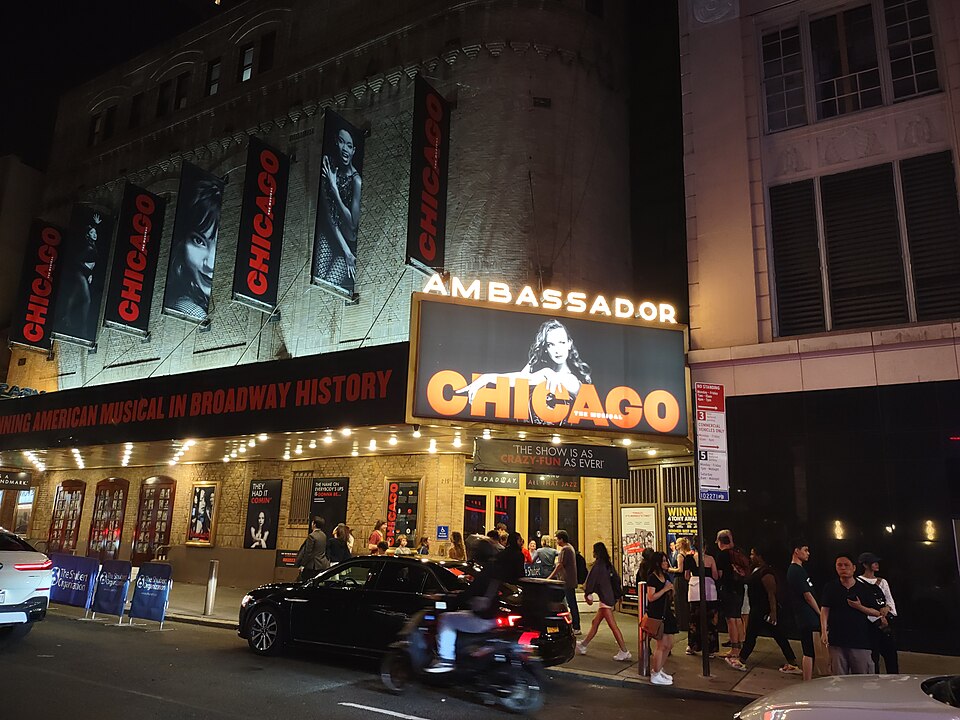
What Kind of Broadway House This Is
The Ambassador is a mid-sized Broadway house — compact enough that no seat feels truly remote, large enough to support a full-scale production with an ensemble cast. At 1,114 seats it is considerably smaller than the blockbuster houses like the Hirschfeld or the Minskoff, which means the room has an intimacy that the seat count alone does not fully communicate. Audiences in the rear orchestra and front mezzanine are genuinely close to the stage here in a way that would not be true at a 1,800-seat theater.
The house was designed by Herbert J. Krapp — the most prolific Broadway theater architect of the 1920s, responsible for more of the district’s surviving historic houses than any other single designer. His theaters tend to share certain qualities: well-considered proportions, strong sightlines from most sections, and a sense of theatrical occasion built into the architecture itself. The Ambassador has those qualities, plus the additional character of its unusual lot-driven shape.
The Ambassador is the kind of theater where first-time visitors are often surprised by how close they feel to the stage, and where the room itself contributes to the experience in ways that a more generic Broadway house would not. It is not a grand statement like the New Amsterdam or a visual spectacle like the Hirschfeld mid-Moulin Rouge. It is a working Broadway theater with genuine character, built at a time when theaters were designed to be interesting rooms rather than neutral containers.
The Diagonal — What Makes This Theater Different
The Ambassador Theatre was built on a lot that does not align with the street grid. Rather than force a standard rectangular auditorium onto a non-rectangular lot — which would have produced awkward geometry throughout — the designers oriented the auditorium on a diagonal. The result is an auditorium that sits at an angle relative to 49th Street, which you can feel when you enter the house: the room does not face you straight on the way most Broadway theaters do.
This is not a quirk or a flaw — it is a considered architectural response to a real constraint, and it produces a room with more personality than a standard rectangular house would have had on the same footprint. The diagonal orientation affects how the seats relate to the stage, how the sight lines work from the side sections, and how the room feels to move through before the show begins.
In a standard Broadway house, the geometry is predictable: center is best, sides are a compromise, front is close, back is far. In a diagonally oriented house like the Ambassador, those rules hold in general terms but the specific angles matter more. Seats that would be considered “side” in a rectangular house may have surprisingly direct sightlines to the stage here, because the stage itself is rotated relative to the room’s relationship to the street. Conversely, seats that look central on a standard chart may sit at a slightly oblique angle to the performance area. This is why looking at a standard seating diagram for the Ambassador is less reliable than at most Broadway theaters — the relationship between where you sit and what you see is shaped by geometry that a flat chart does not fully communicate.
For Chicago specifically, the production has been calibrated to this theater over more than two decades — the 1996 Broadway revival moved into the Ambassador on January 29, 2003. The staging is calibrated for the Ambassador’s specific geometry, which means the production plays well throughout the house in ways that a show designed for a different theater and adapted here might not. Trust the room: it was built for exactly this kind of use.
Seating Guide — How to Think About Best Seats
Seat choice at the Ambassador requires thinking about the diagonal rather than just the distance from the stage. The general principles hold — closer tends to be more immersive, higher tends to give you a fuller picture — but the specific geometry of this room rewards some advance thought.
The strongest seats in the house for most productions. Close to the stage, direct sightlines, full immersion in the performance. Rows D–M in center orchestra are the prime target. The theater’s compact size means even row M feels genuinely close.
Because of the diagonal orientation, far side orchestra seats can sit at a more oblique angle to the stage than a standard chart suggests. The further left or right you go in the front rows, the more the diagonal affects your relationship to the performance. Check specific seat reviews before booking extreme side positions.
The compact house means rear orchestra seats are closer to the stage than rear orchestra seats at a larger Broadway theater. Rows past R are further back but the room does not expand as dramatically as a bigger house would. Good value for the price differential.
Front mezzanine rows at the Ambassador give you a slightly elevated view of the full stage picture without the distance penalty that mezzanine seats carry at larger houses. Rows A–C center mezzanine are a reliable choice, often at a better price than equivalent orchestra center seats.
Further from the stage and higher up. Acceptable for a production like Chicago where the show reads well at distance — the choreography and production design are built to be seen from throughout the house. Not ideal for shows where intimate performance detail is the main event.
For most productions at the Ambassador, front mezzanine center rows A–B offer the best combination of sightlines, full stage view, and price. The diagonal geometry is less of a factor at mezzanine level, and the compact house means you are not as far from the stage as the elevation suggests.
One note specific to Chicago: the production uses the full stage width and the orchestra pit area actively. The choreography is designed to be seen from across the house, and the production has played this theater long enough that every section has been refined against the Ambassador’s specific geometry. The show works well throughout the house — including from rear orchestra and front mezzanine — in a way that is partly a function of how long the production has been calibrated for this specific room.
Accessibility — What to Know Before You Go
The Ambassador Theatre has specific accessibility considerations that are worth understanding before you plan your visit, particularly if wheelchair access or stair-free entry is a priority.
Accessibility details, seating availability, and services can change. Always verify current provisions directly with the box office or the official Shubert Organization venue page before finalizing plans where accessibility is a primary consideration.
Where the Ambassador Theatre Is
The Ambassador Theatre sits on West 49th Street between Broadway and Eighth Avenue — in the northern part of the Theater District, further from Times Square than many first-timers expect but easy to access from multiple subway lines and well-positioned for Hell’s Kitchen dining.
The 49th Street N/Q/R/W stop is one of the most convenient subway exits in the Theater District for this specific theater — you emerge essentially at the theater’s block. The 50th Street 1 train is also a short walk. If you are driving, midtown garages are available in the area; book in advance for weekend performances. See the full guide to getting to a Broadway show for routing details and the parking near Broadway guide for garage options near this part of 49th Street.
A Century on West 49th Street — Theater History
The Ambassador Theatre opened in 1921, designed by Herbert J. Krapp for the Shubert Organization — a relationship that continues to this day, as the Ambassador remains a Shubert theater. Krapp designed more Broadway houses than any other architect of his era, and the Ambassador represents one of the more distinctive examples of his work precisely because the lot’s irregular shape forced a creative solution rather than a standard layout.
Herbert J. Krapp is worth knowing as a name if you spend time in Broadway theaters. He designed a remarkable number of the district’s surviving historic houses — the Lyceum, the Ethel Barrymore, the Longacre, the Broadhurst, and others — and his work shares certain consistent qualities: practical attention to sightlines, strong proportional sense, and an understanding that a theater is a working room rather than a monument. The Ambassador represents his approach applied to an unusual site constraint, which makes it one of the more interesting examples of his output.
Current Show — Chicago
The Ambassador Theatre is currently home to Chicago, the Kander and Ebb revival that opened on Broadway in 1996 and moved to this address on January 29, 2003. The revival — directed by Walter Bobbie with choreography in the style of Bob Fosse — holds the record as Broadway’s longest-running American musical and one of the longest-running productions in Broadway history overall.
Many visitors search for the Ambassador Theatre specifically because they are attending Chicago. If that describes you, the seating guide and diagonal sections above are the most useful parts of this page. For full information about the show itself — cast, runtime, age guidance, and planning the evening — see the Chicago Broadway guide on this site.
Verify the current show and performance schedule on the official Ambassador Theatre or Shubert Organization site before booking, as programming can change.
Plan the Night Around the Ambassador Theatre
The Ambassador’s central Theater District location makes it one of the easier Broadway houses to build a full evening around. The 49th Street location puts you close to Hell’s Kitchen’s restaurant cluster to the west, Times Square’s transit hub to the south, and the full range of Theater District dining and hotel options in every direction.
Getting there
The 49th Street N/Q/R/W stop is one block from the theater — one of the most direct subway connections in the district for this specific venue. The 50th Street 1 train and the Times Square hub connecting to almost every line in the system are also close. If driving, midtown garages are available nearby; book in advance for weekend shows. See the guide to getting to a Broadway show for full routing details.
Dinner before the show
Hell’s Kitchen — one block west and north — is the natural choice for pre-show dining at the Ambassador. The neighborhood has the strongest concentration of reliable pre-theater restaurants near this part of 49th Street, at every price point, all used to theater-crowd timing and 6:30pm reservations. The restaurants near Broadway guide covers specific picks and the pre-show dining guide covers timing strategy for different show runtimes.
Hotels and overnight stays
The Theater District has strong hotel options within walking distance of the Ambassador at most price points. See the hotels near Broadway guide for the best-positioned options. The Theater District neighborhood guide provides a full orientation to the area.
Frequently Asked Questions
The Ambassador Theatre is at 219 West 49th Street in Manhattan, between Broadway and Eighth Avenue in the Theater District. The nearest subway is the 49th Street N/Q/R/W stop, one block from the theater. Times Square is a short walk south.
The Ambassador Theatre is currently home to Chicago. The official production site directs online buyers to Telecharge, and Broadway.org links to the official source. Tickets are also sold at the Ambassador box office at 219 West 49th Street.
The official Chicago site currently lists the Ambassador Theatre box office as open Monday through Saturday 10 AM–8:30 PM and Sunday noon–7:30 PM. Hours can change, so check the official listing before making a special trip.
Yes. For Chicago, Broadway.org currently lists official group sales for groups of 10 or more. Group minimums, pricing and availability can change by performance, so verify the current group-sales terms before booking.
The Ambassador Theatre is currently home to Chicago, the long-running Kander and Ebb revival that opened on Broadway in 1996 and moved to the Ambassador on January 29, 2003. Verify the current show and performance schedule on the official Shubert Organization site before booking.
For most productions, center orchestra rows D–M are the premium zone — close to the stage with direct sightlines. Front mezzanine center rows A–C are a strong value alternative that gives you a fuller view of the stage picture. Avoid extreme side orchestra seats, where the theater’s diagonal orientation can affect sightlines. The diagonal auditorium shape means that standard seating chart logic is less reliable here than at most Broadway theaters — the section above explains the geometry in more detail.
The main entrance has two steps. The side entrance provides step-free access. Wheelchair seating is at the orchestra level; there is no elevator to the mezzanine. Assistive listening devices are available. If accessibility is a primary consideration, contact the box office before booking to confirm current provisions and make arrangements. Verify current accessibility details on the official Shubert venue page before attending.
The theater was built on a lot that does not align with the street grid. Rather than force a standard rectangular auditorium onto the irregular footprint — which would have produced poor geometry throughout the house — the designers oriented the auditorium at a diagonal angle relative to 49th Street. The result is a room with unusual character and a seating geometry that is meaningfully different from a standard rectangular Broadway house. The diagonal section of this guide explains what that means in practice for seat choice.
The Ambassador Theatre seats 1,114 people across orchestra and mezzanine levels. Verify the current capacity on the official venue page, as production modifications can affect the seat count.
Yes — it is a strong theater for first-time visitors. The compact size means the room feels accessible rather than overwhelming, most seats are reasonably close to the stage, and the house has genuine architectural character that adds to the sense of occasion. For first-timers seeing Chicago specifically, the production has been running at this address long enough that it is calibrated to the room in a way that makes the show work well from throughout the house.
The Ambassador Theatre in Brief
The Ambassador Theatre is one of Broadway’s more architecturally distinctive mid-sized houses — a 1921 Shubert theater on a diagonal lot that gives the auditorium a character unlike most of its neighbors in the district. At 1,114 seats it is compact enough that no seat feels remote, the diagonal geometry rewards some advance thought about seat choice, and the house has been the home of Chicago since January 2003 — a relationship long enough that the production and the room have shaped each other.
For full information about the current show, see the Chicago Broadway guide. For broader Broadway planning, the Broadway hub and Theater District neighborhood guide are the right starting points. For other Broadway theaters, see the Broadway theaters guide.